
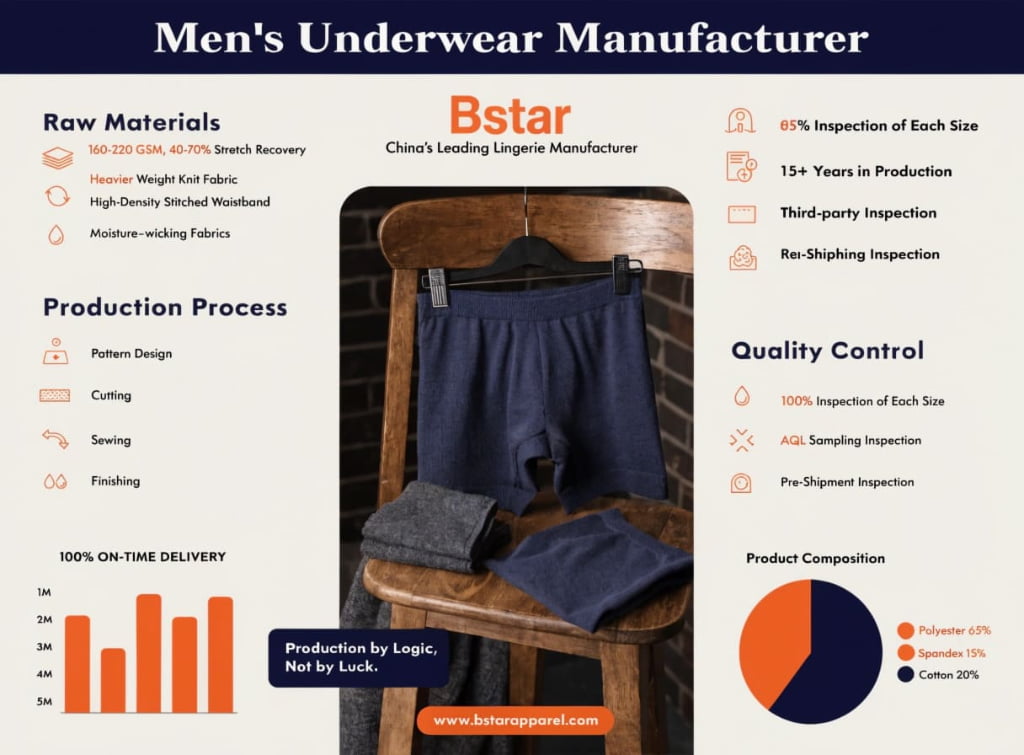
A cheap quote can look safe today. It can become a full batch of loose waistbands and returns tomorrow. I have seen that pain.
To find a reliable men’s underwear manufacturer in China, test the factory before you compare prices. Ask about fabric weight, stretch recovery, waistband sewing, bulk quality control, inspection steps, and past batch problems. A good factory should explain its process clearly, not only send certificates and low prices.
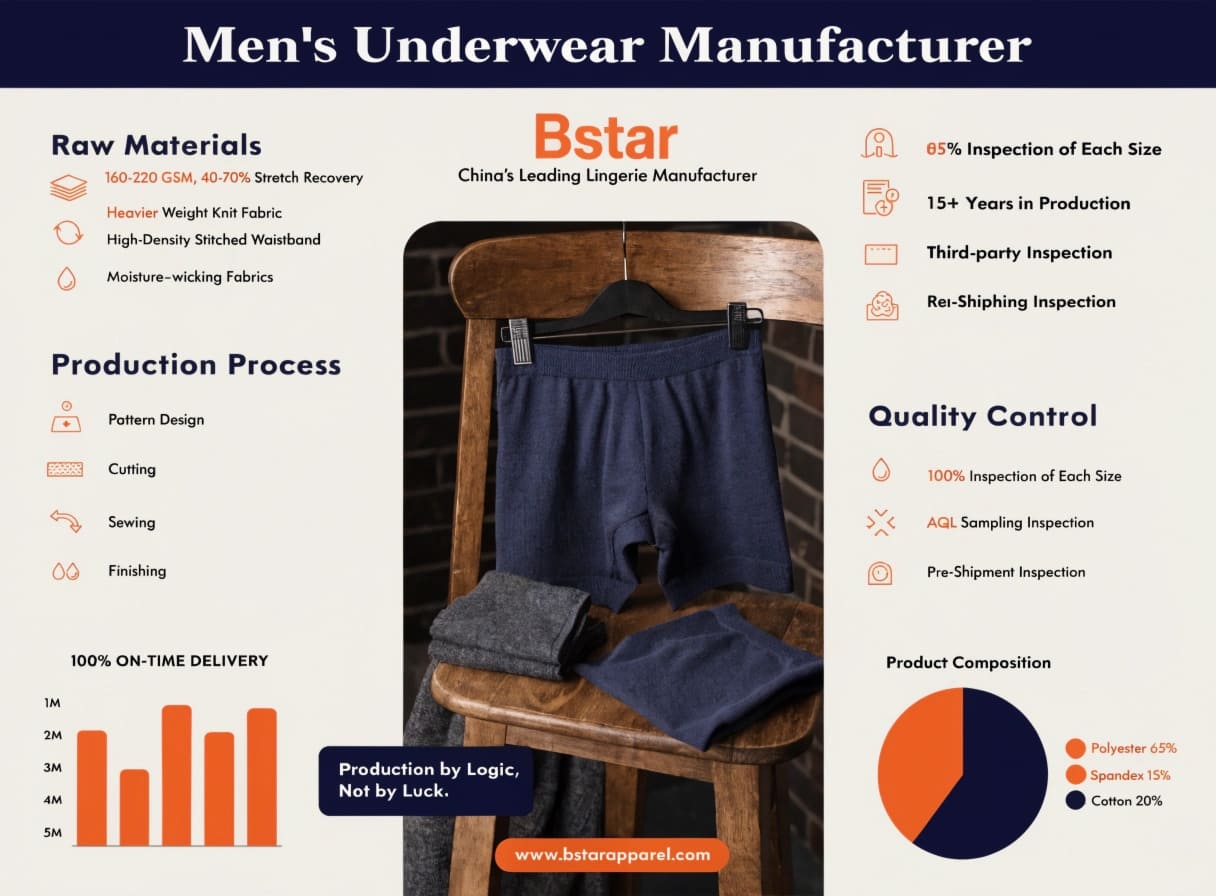
I write this as a factory person, not as a neutral consultant. My factory has worked in Zhongshan, Guangdong for 18 years. I talk with overseas buyers, check quotes, handle samples, and solve problems after orders go wrong. I have learned one thing again and again. Finding a good underwear factory is not a price game. It is a matching game. You need to know whether the factory fits your product, your stage, and your risk level.
What red flags should I watch out for when vetting Chinese underwear manufacturers?
A supplier can look polished online. The sample can also look fine. The real risk often hides inside fabric, elastic, and bulk control.
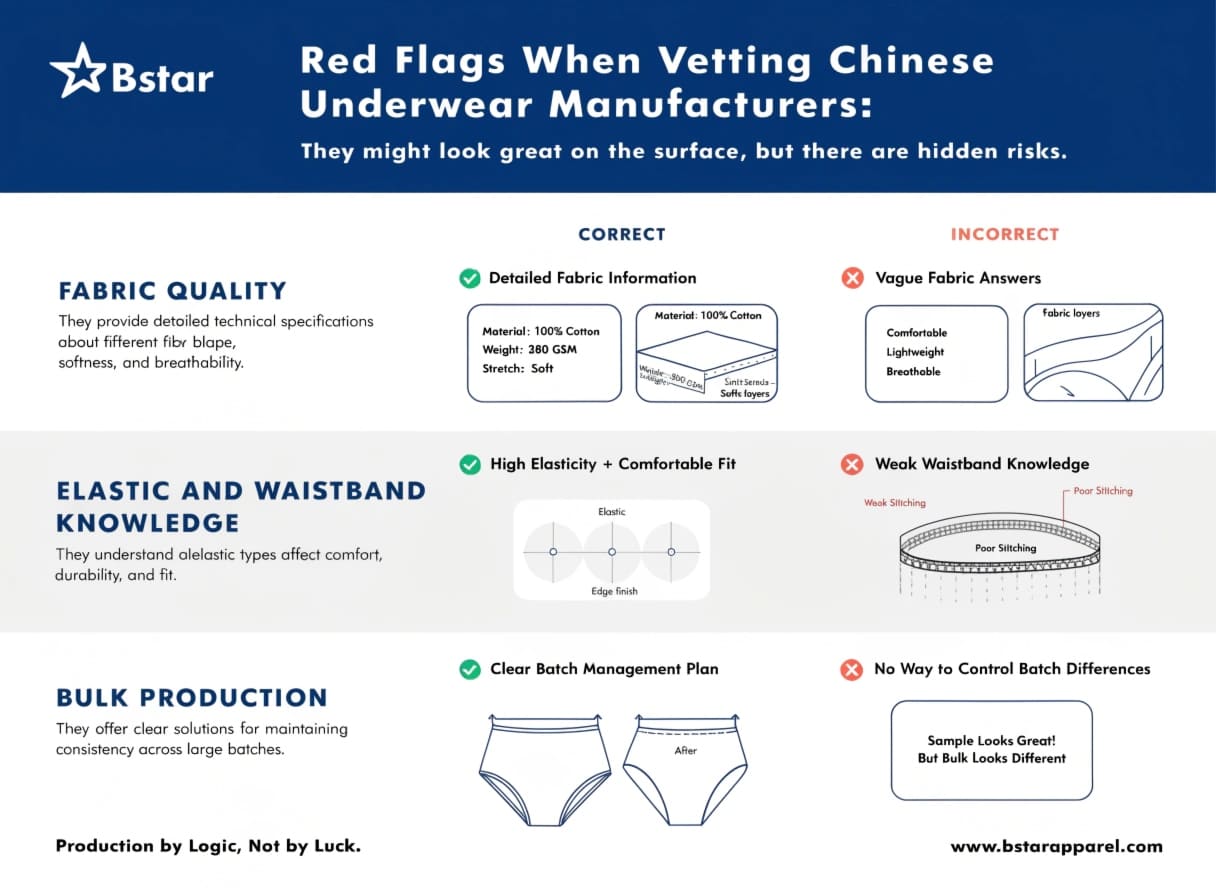
A red flag is not only a very low price. It can also be vague answers, no underwear experience, unclear fabric details, weak waistband knowledge, and no clear way to handle batch differences between samples and bulk goods.
I do not start with the quote
When a buyer asks me, “Why is your price higher?” I often ask back, “What fabric are you using as the reference?” This is not a trick. It is the real start of the discussion. A men’s boxer brief made with 180 gsm cotton spandex is not the same as one made with 160 gsm fabric. “GSM” means fabric weight per square meter.1 It affects hand feel, coverage, shrinkage, and cost.2
Underwear is not a T-shirt. A T-shirt can be a little loose and still sell. Underwear touches the skin all day. The fabric must recover after stretch.3 The waistband must stay flat.4 The crotch shape must not pull. These details decide whether customers reorder or complain.
| Red flag I notice | What it may mean | What I would ask next |
|---|---|---|
| The price is much lower than others | Fabric weight or elastic quality may be reduced | “What exact fabric weight and composition are included?” |
| The factory mainly makes T-shirts | It may not understand underwear fit and seams | “Can you show bulk underwear orders, not only samples?” |
| The supplier only talks about certificates | It may not control daily production well | “How did you handle your last bulk quality issue?” |
| The sample looks good, but details are not recorded | Bulk may not match the sample | “Can we seal one approved sample with all specs?” |
Certificates matter. BSCI, Oeko-Tex, and FSC can show a factory has passed certain checks.5 But certificates do not prove that bulk goods will match your approved sample.6 I always tell buyers to use certificates as the floor, not the final answer.
How can I use trade assurance and third-party inspections to secure my order?
Payment safety helps, but it cannot fix a weak product brief. Inspection helps, but it must check the right things for underwear.
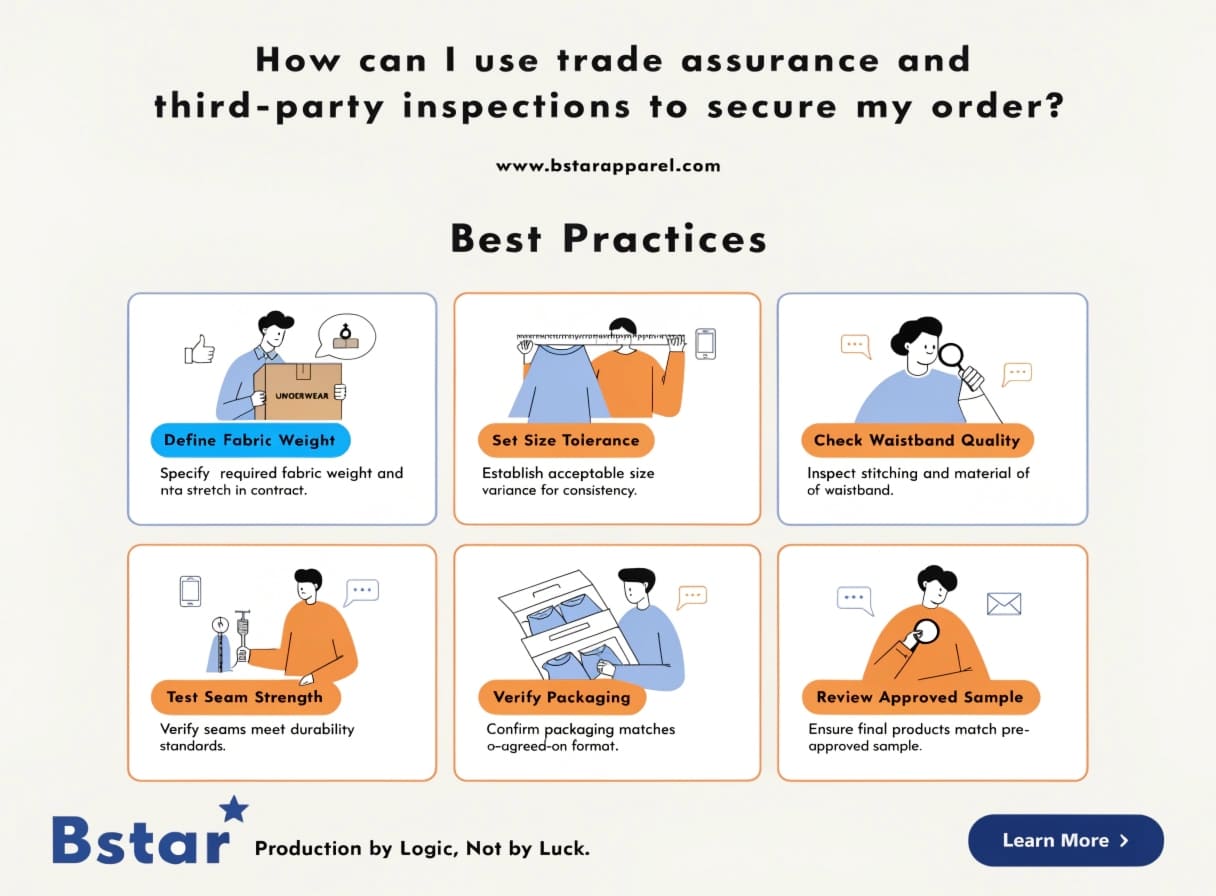
Trade assurance and third-party inspections can reduce order risk when they are linked to clear product specs. Buyers should define fabric weight, size tolerance, waistband quality, seam strength, packaging, and approved samples before production starts.
I treat protection tools as support, not magic
Trade assurance can help you set payment terms and dispute rules.7 A third-party inspection can help you check goods before shipment.8 But both tools need clear standards. If your purchase order only says “men’s boxer brief, cotton spandex, black,” the inspector has little ground to judge the goods.9
I have seen buyers feel safe because they paid through a platform. Then the goods arrived with loose elastic, wrong fabric hand feel, or poor size control. The problem was not only the factory. The buyer did not lock the important details before production.
| Tool | What it can protect | What it cannot protect alone |
|---|---|---|
| Trade assurance | Payment terms and basic order records | Product comfort and long-term wear |
| Third-party final inspection | Visible defects before shipment | Problems that need wash tests or wear tests |
| Approved sample | Look, feel, sewing, and packaging reference | Changes that are not written down |
| Detailed tech pack | Size, fabric, trims, and construction | A factory that cannot follow it |
For underwear, I suggest buyers write down more than size and color. You should define fabric composition, fabric weight, elastic width, waistband type, stitch method, label position, carton packing, and wash label content. You should also ask for size measurement points. For example, waistband relaxed width and stretched width are both useful.
A good inspection plan should include inline inspection and final inspection when order size allows it. Inline inspection means checking goods during production.10 It helps catch problems before all pieces are finished.11 Final inspection happens after packing. It helps confirm shipment quality. If your order is small, you may only do final inspection. But you still need one sealed sample and one clear written standard.
What should I check when visiting factories in China during an underwear production tour?
A factory visit should not be a photo tour. It should show whether the factory can repeat your sample in bulk.
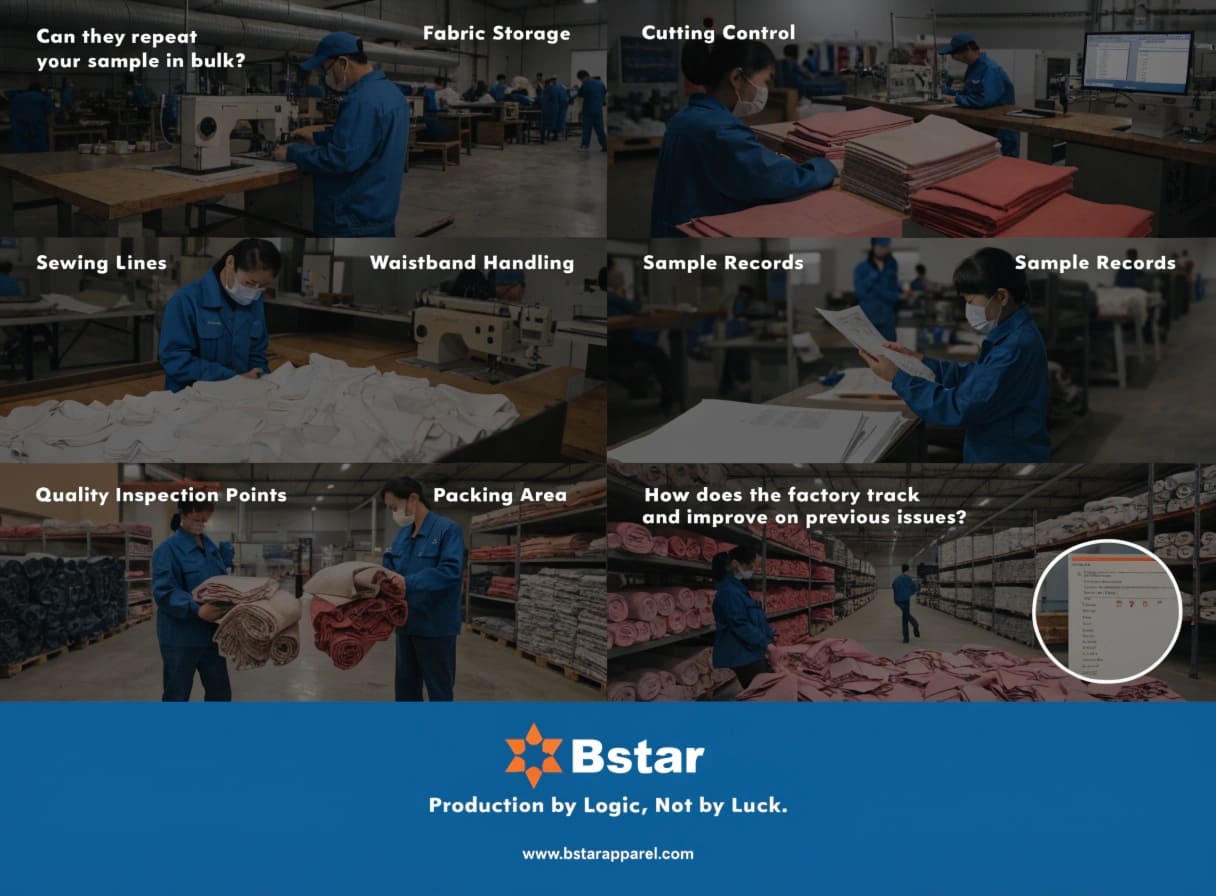
During a factory visit, buyers should check fabric storage, cutting control, sewing lines, waistband handling, sample records, quality inspection points, packing area, and how the factory tracks problems from one batch to the next.
I watch the small things first
When buyers visit our area in Zhongshan, some first look at the office. I understand that. A clean meeting room gives comfort. But I care more about the production floor. I want to see how fabric rolls are stored. I want to see whether the cutting team checks shrinkage. I want to see whether operators understand elastic tension. These small things decide bulk quality.
You do not need to act like an engineer during a visit. You only need to ask simple, direct questions and listen to whether the answers are clear. If the factory manager gives empty answers, that is a warning. If the line leader can explain the steps in plain words, that is a good sign.
| Area to check | What I would look for | Why it matters |
|---|---|---|
| Fabric warehouse | Labels, batch separation, clean storage | Mixed fabric lots can cause color and hand feel differences12 |
| Cutting room | Pattern control and fabric relaxation | Bad cutting can cause twisting and wrong size |
| Sewing line | Operators making similar underwear products | Underwear needs stable seam and elastic control |
| QC table | Records of defects and corrections | Quality must be checked during the process |
| Sample room | Approved samples and spec sheets | Bulk production needs a fixed reference |
| Packing area | Size sorting and barcode control | Wrong packing creates customer service problems |
I also suggest buyers ask one question during the tour: “Can you show me one quality issue from a past order and how you fixed it?” A real factory should have records. The answer may not sound perfect. That is fine. Real production always has problems. What matters is whether the factory can find the cause, stop the spread, and prevent the same issue next time.
Factory visits also need to match your stage. If you are a new DTC brand, you may care more about communication, sample support, and flexible MOQ. If you are a mature brand, you may care more about capacity, compliance, and repeat quality. If you are a retail buyer, you may care more about shipment timing, carton marks, and inspection pass rate.
How did a successful men’s underwear brand find a long-term Chinese partner?
One brand did not find success by choosing the cheapest factory. It found success after it changed the questions it asked.
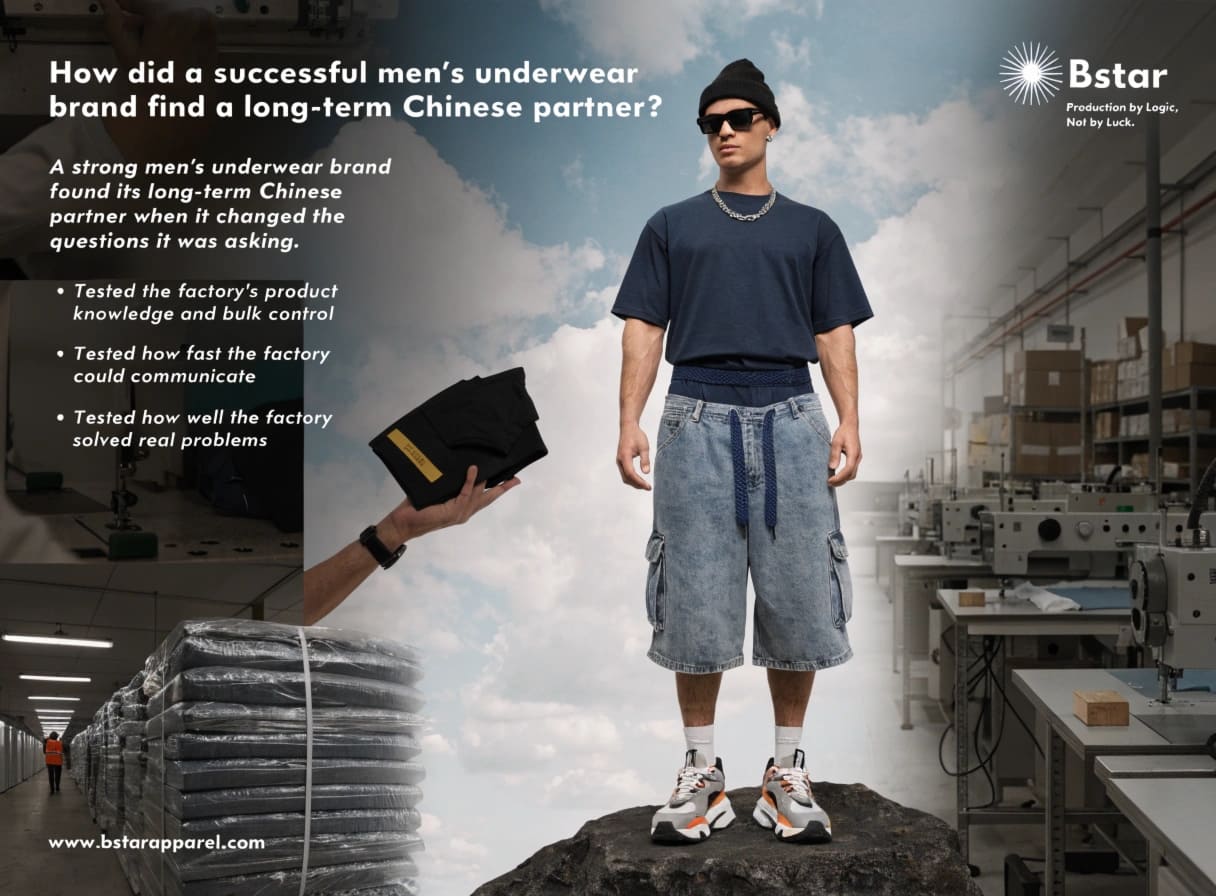
A strong men’s underwear brand found its long-term Chinese partner by moving from price comparison to supply chain matching. It tested the factory’s product knowledge, bulk control, communication speed, and ability to solve real production problems.
I remember one recovery case clearly
A DTC buyer once came to me after a difficult first order with another supplier. The buyer had chosen the lower quote. The sample looked acceptable. The factory also had certificates. But after shipment, customer complaints started. The waistband became loose after washing. Some pieces twisted at the side seam. The brand had to replace many orders. The lost customer trust cost more than the saved unit price.
I did not treat that case as proof that all low-price suppliers are bad. That would be unfair. The real lesson was more useful. The buyer had not asked the right questions before placing the order. They compared price sheets, but they did not compare fabric basis, elastic quality, construction method, and quality control habits.
| Brand stage | Common wrong question | Better question |
|---|---|---|
| New DTC brand | “Who can give me the lowest MOQ and price?” | “Who can help me build a stable first product?” |
| Growing DTC brand | “Who can copy my current sample cheaper?” | “Who can improve consistency while I scale?” |
| Retail brand | “Who can pass the audit?” | “Who can pass audit and keep bulk stable?” |
| Premium underwear brand | “Who has made knitwear before?” | “Who understands waistband, crotch, stretch, and comfort?” |
In that recovery case, we first rebuilt the product standard. We compared the original sample, the shipped goods, and the buyer’s target product. We checked fabric weight, elastic width, waistband sewing, size points, and packaging details. Then we made new samples with all details written down. The buyer used those samples as the real base for the next order.
The brand later grew because it stopped treating sourcing as a hunt for the cheapest factory. It started treating sourcing as product risk control. The owner also learned to ask better questions in calls. Instead of asking only, “Can you do this price?” they asked, “What will change if we reduce the price by 8%?” That one question often reveals the truth. A good factory will explain the trade-off. A weak factory may only say yes.
I believe this is the best way to find a long-term partner in China. You should not look for a perfect factory. You should look for a factory that fits your product and your stage, and that tells you the real cost of each decision.
Conclusion
A reliable underwear manufacturer is found through fit, detail, and proof. Test the factory’s product knowledge before you trust its price.
-
"Units of textile measurement – Wikipedia", https://en.wikipedia.org/wiki/Units_of_textile_measurement. A textile reference defines GSM as grams per square meter, a standard expression of fabric mass per unit area. Evidence role: definition; source type: education. Supports: GSM means fabric weight per square meter.. ↩
-
"Analysis of Woven Fabric Mechanical Properties in the Context of …", https://pmc.ncbi.nlm.nih.gov/articles/PMC12349057/. Textile engineering sources describe fabric mass per unit area as a factor associated with fabric handle, opacity or coverage, dimensional behavior, and material consumption, which helps explain its relationship to garment performance and cost. Evidence role: mechanism; source type: education. Supports: Fabric weight affects hand feel, coverage, shrinkage, and cost.. Scope note: The source may support these relationships generally for textiles rather than specifically for men’s underwear. ↩
-
"Impact of the Elastane Percentage on the Elastic Properties of … – PMC", https://pmc.ncbi.nlm.nih.gov/articles/PMC9570736/. Textile research on elastic and knitted fabrics identifies stretch recovery as a key performance property for garments that undergo repeated extension during wear. Evidence role: expert_consensus; source type: paper. Supports: Underwear fabric must have adequate stretch recovery.. Scope note: The evidence is likely to address stretch garments or knitted fabrics broadly, not every underwear style specifically. ↩
-
"[PDF] Innovative Automated Stretch Elastic Waistband Sewing Machine for …", https://arxiv.org/pdf/2503.18373. Apparel construction and textile quality sources discuss elastic waistband performance, including resistance to twisting, rolling, and distortion, as an important aspect of garment fit and durability. Evidence role: general_support; source type: education. Supports: A waistband in underwear should remain flat and resist distortion during wear and laundering.. Scope note: The source may support waistband quality principles generally rather than provide underwear-specific test data. ↩
-
"Oeko-Tex – Wikipedia", https://en.wikipedia.org/wiki/Oeko-Tex. Institutional descriptions of BSCI, OEKO-TEX, and FSC show that these schemes assess social compliance, textile chemical safety, or forest-product chain-of-custody criteria rather than serving as direct product-batch quality guarantees. Evidence role: definition; source type: institution. Supports: BSCI, Oeko-Tex, and FSC indicate that a factory or product has passed certain defined checks.. Scope note: Each scheme covers different criteria, so a combined citation should avoid implying that they certify the same type of factory performance. ↩
-
"Accreditation of Third-Party Certification Bodies to Conduct …", https://www.fda.gov/media/94479/download. Quality management literature distinguishes compliance certification from lot-specific conformity, supporting the point that audit certificates do not by themselves verify that a production batch matches an approved sample. Evidence role: expert_consensus; source type: institution. Supports: Factory certificates do not prove that bulk goods will match an approved sample.. Scope note: The support is conceptual and quality-management based, not a direct test of underwear factories. ↩
-
"Alibaba.com Transaction Dispute Rules", https://rule.alibaba.com/rule/detail/8882.htm. Platform documentation for Trade Assurance describes it as an order-protection mechanism that records payment terms, order requirements, and dispute procedures between buyer and supplier. Evidence role: definition; source type: other. Supports: Trade assurance can help set payment terms and dispute rules.. Scope note: Because Trade Assurance is a platform-specific service, the most direct documentation may come from the platform rather than a neutral third party. ↩
-
"Pre-shipment inspection – Wikipedia", https://en.wikipedia.org/wiki/Pre-shipment_inspection. Inspection standards and quality-control guidance describe pre-shipment inspection as a method for checking finished goods against specified requirements before release or shipment. Evidence role: definition; source type: institution. Supports: Third-party inspection can help check goods before shipment.. Scope note: Pre-shipment inspection reduces detection risk but does not guarantee that all defective units will be found. ↩
-
"6.2.1. What is Acceptance Sampling?", https://www.itl.nist.gov/div898/handbook/pmc/section2/pmc21.htm. Quality inspection guidance based on acceptance sampling requires defined specifications or acceptance criteria, supporting the claim that vague purchase descriptions limit an inspector’s ability to judge conformity. Evidence role: mechanism; source type: institution. Supports: Inspectors need clear product specifications to judge whether goods conform to requirements.. Scope note: The citation supports inspection logic generally, not this exact underwear example. ↩
-
"Why Inline Quality Inspection Is a Game-Changer for Modern …", https://orkaautomation.com/why-inline-quality-inspection-is-a-game-changer-for-modern-manufacturing/. Quality-control references define in-process or inline inspection as inspection conducted during production to identify defects before completion of the full lot. Evidence role: definition; source type: education. Supports: Inline inspection means checking goods during production.. ↩
-
"The Benefits of In-Process Quality Inspections in Manufacturing", https://stainlesssolutionscip.com/the-benefits-of-in-process-inspections/. Manufacturing quality-control literature explains that in-process inspection can identify nonconformities earlier in production, allowing corrective action before an entire batch is completed. Evidence role: mechanism; source type: education. Supports: Inline inspection helps catch problems before all pieces are finished.. Scope note: The source would support the general production-control mechanism, not guarantee defect prevention in every order. ↩
-
"Learn Dye Lot Variations in Fabrics – TWOPAGES Curtains", https://twopagescurtains.com/pages/dye-lot-variations?srsltid=AfmBOorYkby7FpviM-Pi67IvuEZsWoeP_ZUAAzFkVZdYl0KluwX2cXQR. Textile quality sources note that variations between fabric or dye lots can produce shade differences and related material inconsistencies, supporting the need for batch separation in storage and production. Evidence role: mechanism; source type: education. Supports: Mixed fabric lots can cause color and hand feel differences.. Scope note: The evidence may focus more strongly on color variation than on hand-feel variation. ↩
Discussion & questions 0 comments