I know the risk feels high. You need steady quality, fair pricing, and on-time delivery. You also need truth, not glossy brochures. Let me show you a simple path.
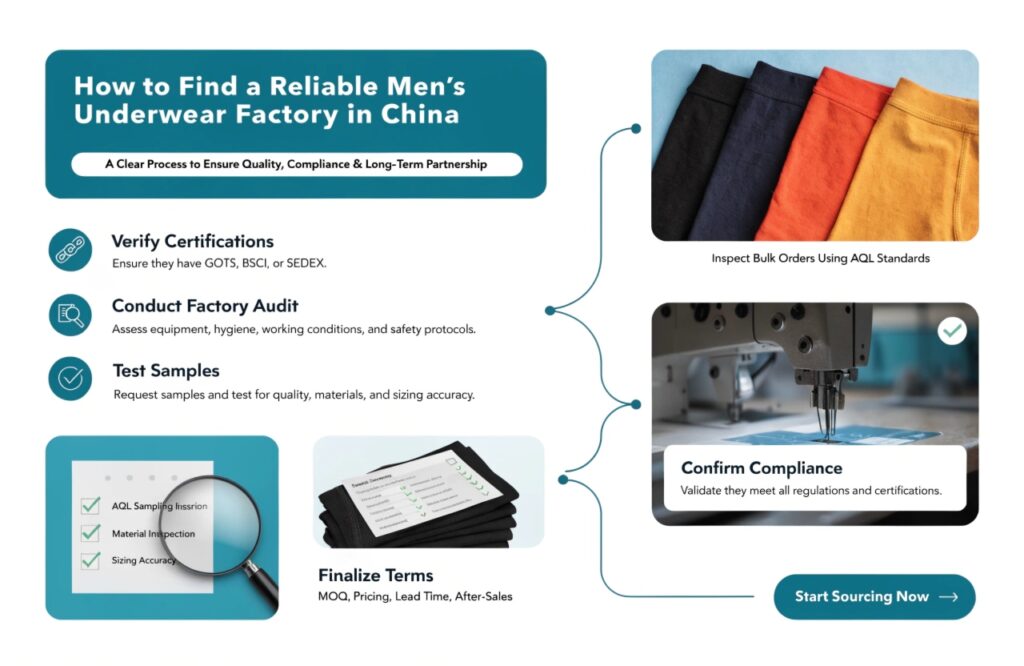
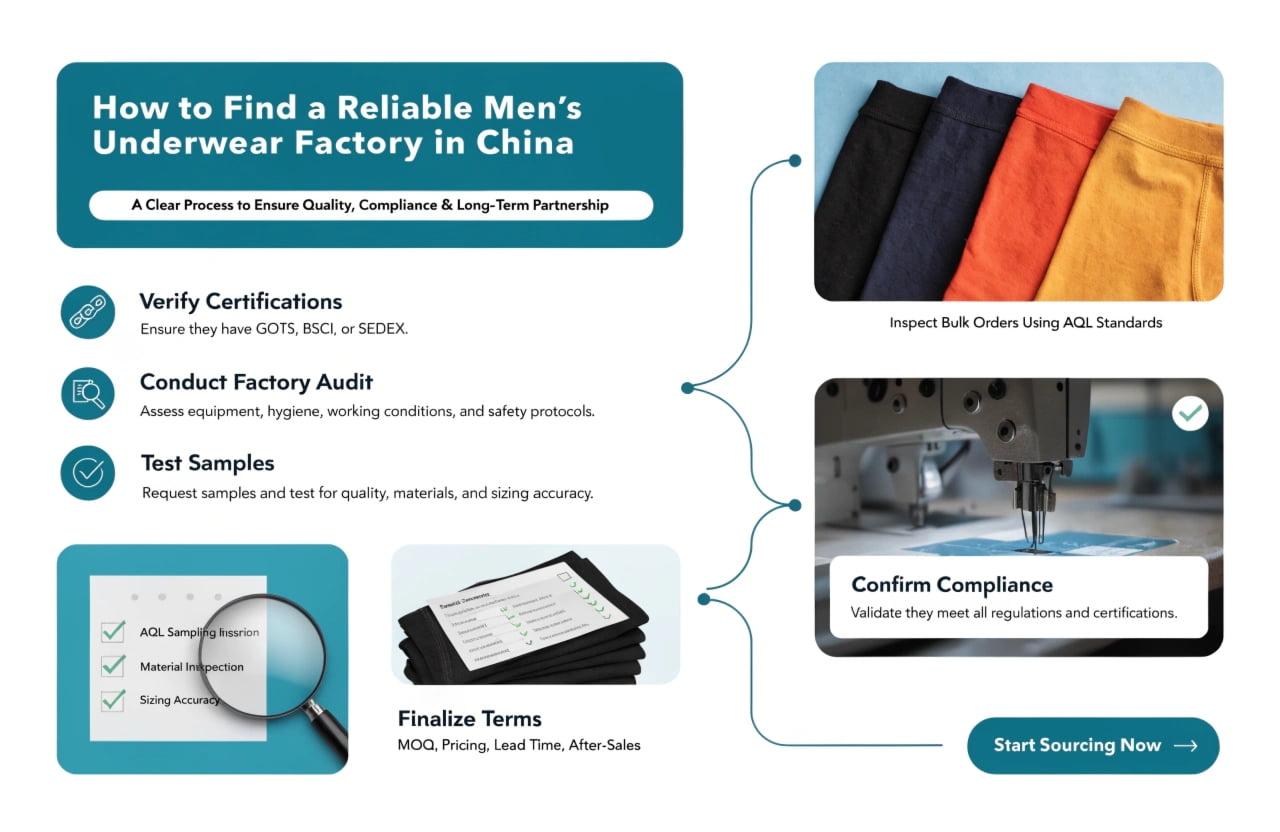
The fastest way to find a reliable men’s underwear manufacturer in China is to verify certifications, run a basic factory audit, and test samples with strict criteria. Then inspect bulk with AQL standards, confirm compliance, and lock clear terms on MOQ, pricing, lead time, and after-sales.
You want a method you can trust from the first click. You also want a partner who will grow with you. I keep the process tight. I test proof first. I move only when the proof is solid.
Key criteria to screen Chinese men’s underwear manufacturers: certifications, factory audit, and sample quality?
You may face nice slides and weak production. That gap burns budgets and time. I fix it early. I screen hard on paper, on site, and in-hand samples.
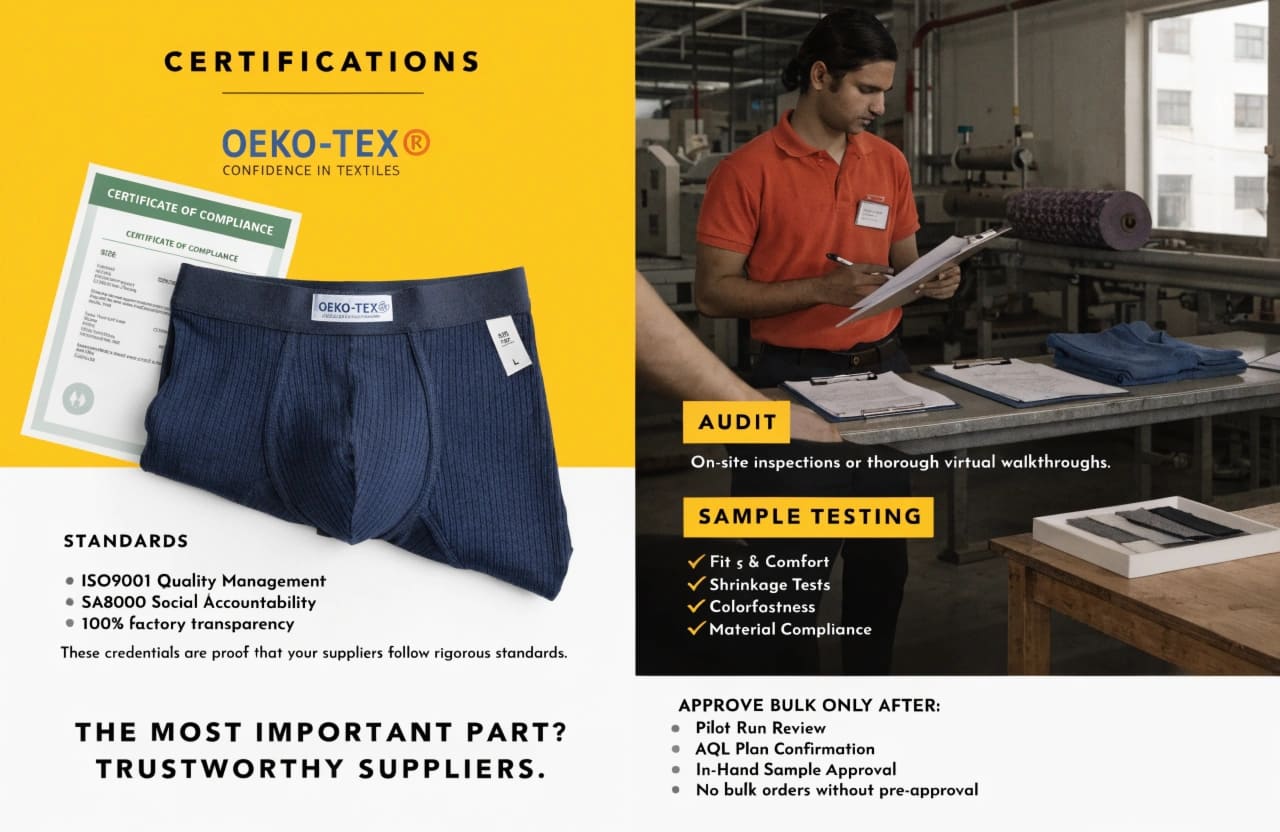
Start with proof of capability. Confirm legal status and compliance. Verify OEKO-TEX and other relevant certificates. Audit the factory or do a video walk-through. Test samples for fit, comfort, shrinkage, and colorfastness. Then approve bulk only after a pilot run and AQL plan.
Dive deeper: The step-by-step screening framework
I keep a clean checklist. I move in stages. I start with documents, then eyes-on, then hands-on, then a controlled trial. This flow reduces risk and saves cost.
- Stage 1: Paper check
- Stage 2: Factory check
- Stage 3: Sample check
- Stage 4: Trial production
- Stage 5: Bulk inspection
Stage 1: Paper check
- Verify Chinese business license in the factory’s name.1
- Confirm bank account matches business name.
- Check certifications on official databases:
- Ask for a client list and product focus (men’s underwear, not just “apparel”).
Stage 2: Factory check
- Do a live video tour. Ask to see cutting, sewing, printing, packing lines, and QA stations.
- Confirm ownership of equipment. Look for knitting or dyeing partners if vertical.
- Ask where they do digital or rotary printing. Ask for dye house details.
Stage 3: Sample check
- Test fit on your size chart. Check stretch and recovery.
- Wash test: 40°C for cotton blends, 30°C for modal or bamboo. Measure shrinkage.6
- Colorfastness to rubbing and sweat. Aim for grade 4 or above.7
- Hand feel after wash. Check pilling.
- Elastic durability: stretch cycles. Inspect seam strength.
- Needle detection for safety where needed.8
Stage 4: Trial production and AQL
- Run a small pilot, like 100–300 units.9
- Set AQL 2.5 for major defects.10
- Confirm shade control for each dye lot.
Stage 5: Bulk inspection
- Book a third-party pre-shipment inspection.
- Cross-check carton labels, sizes, barcodes, and packaging.
Here is a quick table I use to keep each stage clear:
| Stage | Goal | Proof to Collect | Red Flags |
|---|---|---|---|
| Paper | Legitimacy | License, bank match, verified certs | Certificates in another company’s name |
| Factory | Capacity | Live tour, equipment list | “No video allowed”, hidden floors |
| Sample | Product match | Wash tests, fit notes | Different fabric hand-feel after wash |
| Pilot | Process control | AQL report, dye lot notes | Shade variation, late corrections |
| Bulk | Shipment readiness | Inspection report, packing list | Refusal of third-party inspection |
I build trust with structure. I do not skip steps. I share these steps with my partners so we stay aligned.
How to avoid unreliable suppliers: common scams and risks when sourcing underwear from China?
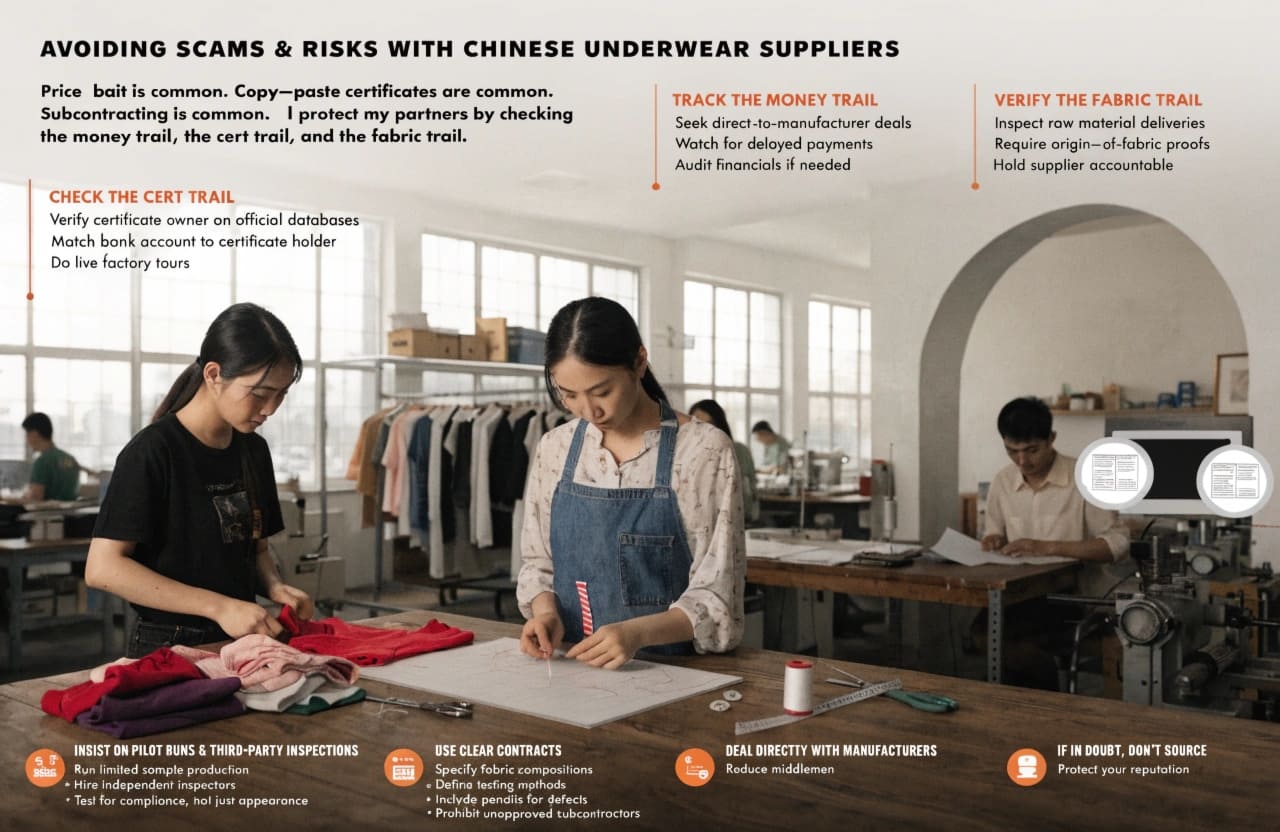
Price bait is common. Copy-paste certificates are common. Subcontracting is common. I protect my partners by checking the money trail, the cert trail, and the fabric trail.
Avoid unreliable suppliers by verifying certificate owners on official databases, matching bank accounts to company names, and doing live factory tours. Insist on pilot runs and third-party inspections. Use clear contracts with fabric specs, test methods, penalties, and no-unapproved-subcontractor clauses.
Dive deeper: The risk map and how I block each one
I see patterns. I watch for small details that point to big problems. I map the risks and set simple blocks. The goal is not fear. The goal is clean work.
Typical risks
- Trading companies posing as factories.
- Fake OEKO-TEX or GRS certificates.11
- Bait-and-switch materials after sample approval.
- Unapproved subcontracting to lower-grade workshops.12
- Sudden price hikes after deposit.
- Shipment delays tied to fabric shortages.
- IP misuse of prints and waistband designs.
- Refusal of third-party inspections.
Controls I use
- Certificate verification on the issuer’s website. I check the holder’s legal name, address, scope, and expiry.
- Business license and bank account match. I do a small TT to confirm receiving entity.
- Contract with detailed tech pack and test standards:
- Fabric composition tolerances.
- GSM range.
- Colorfastness target.
- Shrinkage limits per fabric type.
- Elastic recovery metrics.
- Needle policy and broken-needle control.
- No-subcontract clause without written approval.
- Pilot run with sealed samples kept by both sides.
- Price lock with fabric cost index or clear change triggers.
- Agreed lead time with buffer and staged deposits tied to milestones.
- IP clause and NDA for prints and artist work.
- Inspection rights with a named AQL and the right to rework or reject.
Here is how I summarize this in my tracker:
| Risk | Check | Contract Tool | Escalation |
|---|---|---|---|
| Fake factory | Live tour, license | Named site address, photos | Walk away if no access |
| Fake certs | Verify on official site | Attach cert copies with holder name | Report to issuer |
| Material switch | Sealed sample, lab tests | Spec sheet with tolerances | Chargebacks for fails |
| Subcontracting | Production plan, visit | No-subcontract clause | Stop work, approval needed |
| Price hike | Fabric index, quotes | Price lock window | Renegotiate or exit |
| Delay | Capacity check | Lead-time penalty | Air ship at supplier cost if extreme |
| IP misuse | NDA | Ownership and usage limits | Legal counsel if breach |
| No inspection | Pre-book inspection | AQL in contract | Hold payment |
This may feel strict. It is simple in practice. When I hold this line, I avoid most pain.
5 must-ask questions before partnering with a Chinese boxer factory: MOQ, pricing, lead time, certifications, and after-sales support?
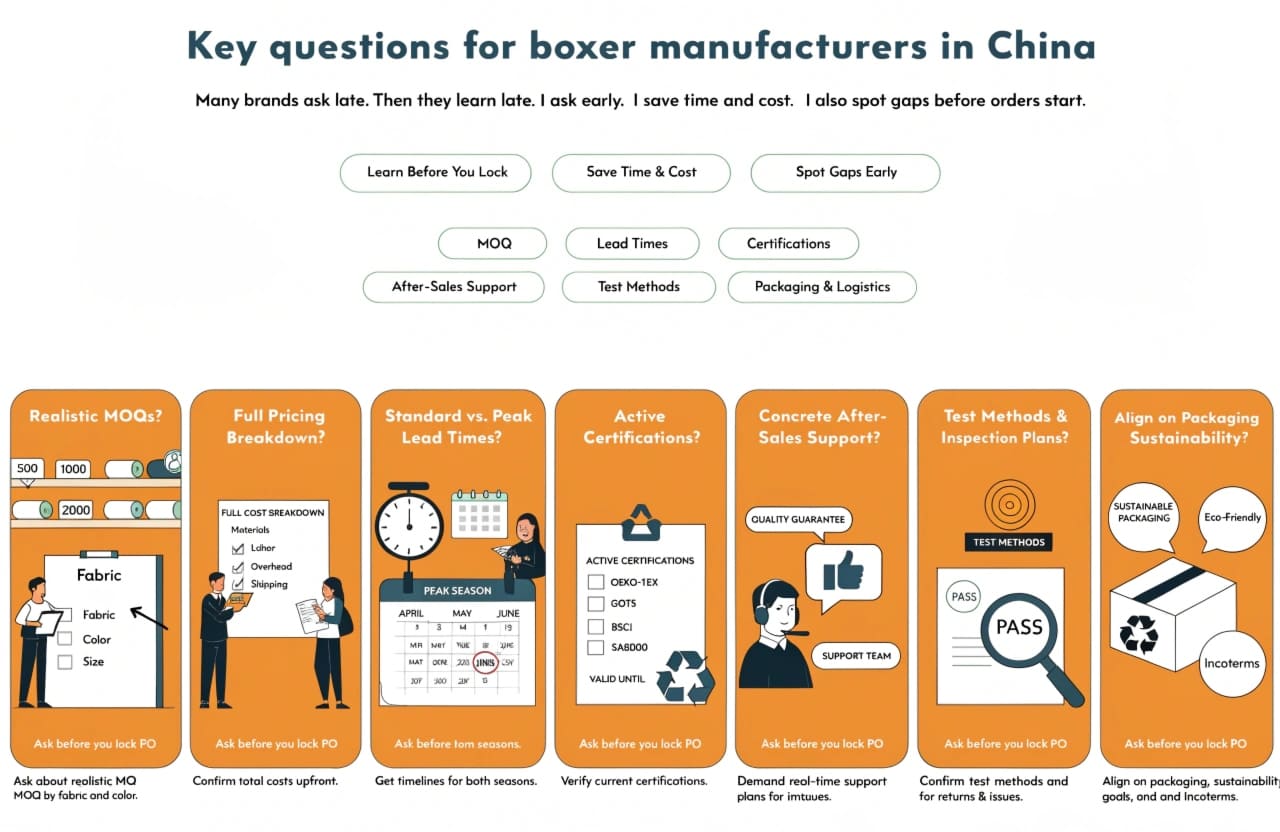
Many brands ask late. Then they learn late. I ask early. I save time and cost. I also spot gaps before orders start.
Ask about realistic MOQ by fabric and color, full pricing breakdown, standard and peak-season lead times, active certifications, and concrete after-sales support. Confirm test methods and inspection plans. Align on packaging, sustainability goals, and Incoterms before you lock a PO.
Dive deeper: The five questions I never skip (and what good answers look like)
I keep these five questions on a single page. I ask them on the first call. I listen for clear and consistent answers. I ask for proof at once.
1) MOQ
- Ask by style, fabric, and color. Modal-cotton blends and digital prints often need higher MOQs.
- Typical bands:
- 300–500 units per color for cotton blends.
- 500–800 units for modal or bamboo due to yarn and dye minimums.
- 800–1,200 units for sublimation polyester prints.
- Good answer: A matrix by fabric and color with options for mixed sizes and combined orders.
2) Pricing
- Ask for a cost breakdown:
- Fabric consumption (with marker report).
- Elastic and waistband cost.
- Printing or dyeing cost.
- Sewing and overhead.
- Packaging and labeling.
- Good answer: A quote with Incoterms (EXW/FOB/DDP), validity period, and clear assumptions.
3) Lead time
- Ask for sampling, lab dips, strike-offs, and bulk lead times.
- Typical:
- Proto sample: 7–10 days.
- Fit/PP sample: 10–15 days.
- Bulk: 35–60 days after PP approval.
- Good answer: A timeline with critical path and peak-season notes.
4) Certifications and tests
- Ask for current OEKO-TEX, GRS if recycled, BSCI/Sedex, and ISO.
- Ask for test methods used: colorfastness, pilling, shrinkage.
- Good answer: Current certificates in the factory name, and a test list with pass criteria.
5) After-sales support
- Ask what happens if bulk fails tests or sizes.
- Good answer: Rework or remake policy, response time, spare parts for waistbands, and a clear warranty window.
I usually capture the answers like this:
| Topic | What I Ask | What I Want to See | Warning Sign |
|---|---|---|---|
| MOQ | By fabric/color | Matrix with options | One MOQ for all things |
| Pricing | Breakdown + Incoterms | Fabric yield and trims detail | Round numbers with no basis |
| Lead time | Stage-by-stage | Critical path with buffers | “Depends” with no dates |
| Certs | Current, in-house | Valid, in factory name | Expired or third-party’s name |
| After-sales | Policy and steps | Written SOP with timeline | Vague “we will solve” |
I also add two bonus checks. I ask about sustainability claims and the data behind them. I ask to speak with a current client who makes men’s underwear, not just T-shirts.
Alibaba vs Manufacturer’s Official Website: Which channel is the most reliable for finding a China underwear manufacturer?
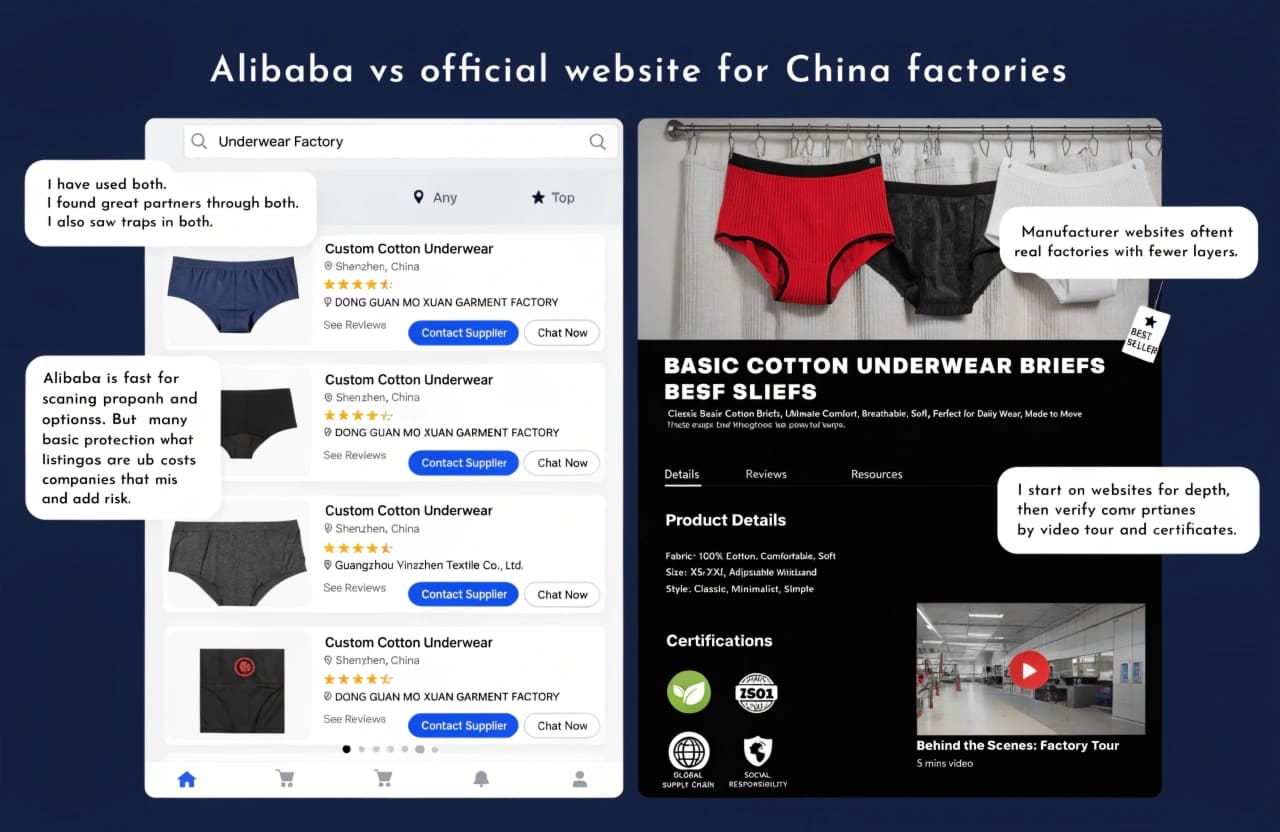
I have used both. I found great partners through both. I also saw traps in both. I now lean on direct factory sites when I want depth and control.
Alibaba is fast for scanning options and basic protection. But many listings are trading companies that mark up costs and add risk. Manufacturer websites often point to real factories with fewer layers. I start on websites for depth, then verify by video tour and certificates.
Dive deeper: How I choose the right channel and verify the real factory
My own view is simple. On Alibaba, you can move fast and use filters. But you often speak with trading teams. They can be good at communication. Yet they add a margin. They also have less control over floor production. On manufacturer sites, you often find companies that lack strong sales channels. They post clearer factory info to attract clients. I see real photos, real addresses, and consistent product focus.
Here is how I compare them:
| Channel | Strengths | Weaknesses | How I Use It |
|---|---|---|---|
| Alibaba | Large pool, chat, escrow tools | Many traders, mixed quality | Quick scan, shortlist, trade assurance for small trials |
| Manufacturer site | Higher chance of real factory, deeper info | Harder to find, fewer reviews | Primary source for mid/long-term partners |
How I verify on Alibaba:
- Check business type. Ask directly if they own sewing lines.
- Request a live video tour of sewing and cutting.
- Verify certificates on issuer sites. Confirm the holder matches the company.
- Check the bank account name matches the license.
- Start with a small, protected order. Use platform payment tools if you choose that route.
How I verify from a manufacturer’s website:
- Search the Chinese name of the company. Confirm address on Baidu Maps.
- Ask for a live video tour. Ask to meet the QA lead on the floor.
- Request production photos with date stamps.
- Ask for 2–3 client references in men’s underwear.
- Check domain age and web archives for factory history.
- Review product range for focus on trunks, boxers, and briefs, not “everything”.
My personal tip:
- Use both, but start with the manufacturer’s website for depth. Then double-check with a live tour and certification checks.
- Use Google searches like “site:.cn men’s underwear factory Shantou” or “modal boxer manufacturer Guangdong”.
- Look at hubs like Shantou (Gurao) for underwear and lingerie, and Guangzhou for trims and printing.
- Visit trade shows for face-to-face proof when you can.
I once found a “factory” on a marketplace with stunning images. A live tour showed an office only. I moved on. Weeks later I found a small factory website with modest photos. The owner walked me through sewing lines on video. He knew his shrinkage rates by fabric. That was the partner I chose. The orders shipped clean and on time.
Conclusion
I follow proof, not promises. I verify documents, I tour the floor, and I test samples. I lock clear terms and protect inspections. I use channels that lead me to real factories. With this path, you can build a stable underwear line with less risk and more control.
-
"What Is China’s National Enterprise Credit Information Publicity …", https://www.chinajusticeobserver.com/a/what-is-china-s-national-enterprise-credit-information-publicity-system. China’s National Enterprise Credit Information Publicity System is the official public registry for checking enterprise registration information, providing contextual support for verifying a supplier’s legal name and registration status before contracting. Evidence role: general_support; source type: government. Supports: Buyers should verify that a Chinese supplier’s business license is valid and in the factory’s own legal name.. Scope note: The registry supports legal-status verification, but it does not by itself prove manufacturing capability or product quality. ↩
-
"Oeko-Tex – Wikipedia", https://en.wikipedia.org/wiki/Oeko-Tex. OEKO-TEX Standard 100 classifies textile products by intended skin contact; Product Class II covers articles with direct skin contact, which is contextually relevant to underwear certification screening. Evidence role: definition; source type: institution. Supports: OEKO-TEX Standard 100 Product Class II is the relevant class to check for underwear or other direct-skin-contact textiles.. Scope note: The source defines the certification class and scope; it does not verify any individual factory certificate. ↩
-
"Recycled Claim Standard (RCS) + Global Recycled Standard (GRS)", https://textileexchange.org/recycled-claim-global-recycled-standard/. The Global Recycled Standard is a textile certification that verifies recycled content and related chain-of-custody requirements, supporting its use when a supplier claims recycled fibers. Evidence role: definition; source type: institution. Supports: GRS certification is relevant when a manufacturer claims recycled textile fibers.. Scope note: The standard supports verification of recycled-content claims but does not establish broader environmental superiority of a product. ↩
-
"amfori BSCI – Business Social Compliance Initiative", https://www.amfori.org/amfori-bsci/. amfori BSCI and Sedex are supply-chain due-diligence frameworks used to assess labor, health-and-safety, and ethical trade practices, supporting their role as social-compliance screening tools. Evidence role: definition; source type: institution. Supports: BSCI and Sedex are relevant tools for evaluating supplier social compliance.. Scope note: These frameworks help structure social-compliance assessment, but membership or an audit result is not conclusive proof of ongoing compliance. ↩
-
"ISO 9001:2015 – Quality management systems — Requirements", https://www.iso.org/standard/62085.html. ISO 9001 specifies requirements for a quality management system and is used to demonstrate an organization’s ability to consistently provide products and services that meet customer and regulatory requirements. Evidence role: definition; source type: institution. Supports: ISO 9001 is relevant evidence of a factory’s quality-management system.. Scope note: ISO 9001 certification indicates a documented quality-management system, not automatic conformity of any specific underwear shipment. ↩
-
"Domestic washing and drying procedures for textile testing", https://www.iso.org/obp/ui#iso:std:iso:6330:ed-4:v1:en. ISO 6330 describes domestic washing and drying procedures for textile testing, including controlled laundering conditions used to evaluate dimensional change after washing. Evidence role: mechanism; source type: institution. Supports: Controlled wash tests are used to measure textile shrinkage before bulk approval.. Scope note: The standard supports controlled wash testing and shrinkage measurement; the exact 30°C and 40°C choices may also depend on fiber blend, care label, and buyer specification. ↩
-
"[PDF] INTERNATIONAL STANDARD ISO 105-E04", https://cdn.standards.iteh.ai/samples/57973/9451145185ba403286034dfc887c5eaf/ISO-105-E04-2013.pdf. ISO colorfastness methods assess textile staining or color change using standardized grey-scale ratings, providing a technical basis for specifying rubbing and perspiration colorfastness targets such as grade 4. Evidence role: mechanism; source type: institution. Supports: Colorfastness to rubbing and perspiration can be evaluated using standardized tests and grading scales.. Scope note: The source supports the test methods and rating scale; the grade-4 threshold is a buyer specification rather than a universal legal requirement. ↩
-
"Product Safety Practice NEEDLE AND METAL CONTAMINATION …", https://www.academia.edu/22675370/Product_Safety_Practice_NEEDLE_AND_METAL_CONTAMINATION_CONTROL_STANDARD_OPERATING_PROCEDURES. Garment safety guidance and quality-control procedures commonly treat broken-needle control and metal detection as safeguards against metal fragments remaining in sewn products. Evidence role: mechanism; source type: government. Supports: Needle detection can be a relevant safety-control step in garment production.. Scope note: The relevance of needle detection varies by product category, buyer policy, and market regulations; it is not equally mandated for all adult underwear. ↩
-
"Measuring Agents in Production – arXiv", https://arxiv.org/html/2512.04123v1. Quality-management literature describes pilot production or pre-production runs as a way to validate processes, materials, and controls before full-scale manufacturing. Evidence role: expert_consensus; source type: paper. Supports: A small pilot run helps validate manufacturing processes before bulk production.. Scope note: The source can support the value of pilot production generally; the specific 100–300 unit quantity is an operational rule of thumb rather than a universal standard. ↩
-
"[PDF] ISO 2859-1 – UNT Chemistry", https://chemistry.unt.edu/~tgolden/courses/iso2859-1.pdf. ISO 2859-1 provides acceptance-sampling procedures indexed by acceptance quality limit, supporting the use of AQL-based inspection plans for lot-by-lot quality control. Evidence role: definition; source type: institution. Supports: AQL-based sampling plans are an established method for inspection of production lots.. Scope note: The standard explains AQL sampling; selecting 2.5 for major defects is a buyer risk tolerance and industry practice, not a single mandatory value. ↩
-
"Search the RN Database", https://www.ftc.gov/rn-database/search. Certification bodies maintain public certificate-validation tools that allow buyers to check certificate number, holder, scope, and validity, supporting the need to verify textile certificates rather than relying on copies alone. Evidence role: mechanism; source type: institution. Supports: Buyers should verify OEKO-TEX or GRS certificates through official validation channels.. Scope note: Certificate databases support verification of document validity; they do not measure the prevalence of counterfeit certificates in the market. ↩
-
"Responsible garment and footwear supply chains – OECD", https://www.oecd.org/en/topics/sub-issues/due-diligence-guidance-for-responsible-business-conduct/responsible-garment-and-footwear-supply-chains.html. OECD due-diligence guidance for the garment and footwear sector identifies subcontracting and limited visibility beyond direct suppliers as recognized supply-chain risks requiring risk-based due diligence. Evidence role: expert_consensus; source type: institution. Supports: Unauthorized or poorly controlled subcontracting is a recognized risk in garment supply chains.. Scope note: The guidance supports subcontracting as a sector risk generally; it does not prove that any named supplier uses unauthorized subcontractors. ↩
Discussion & questions 0 comments