
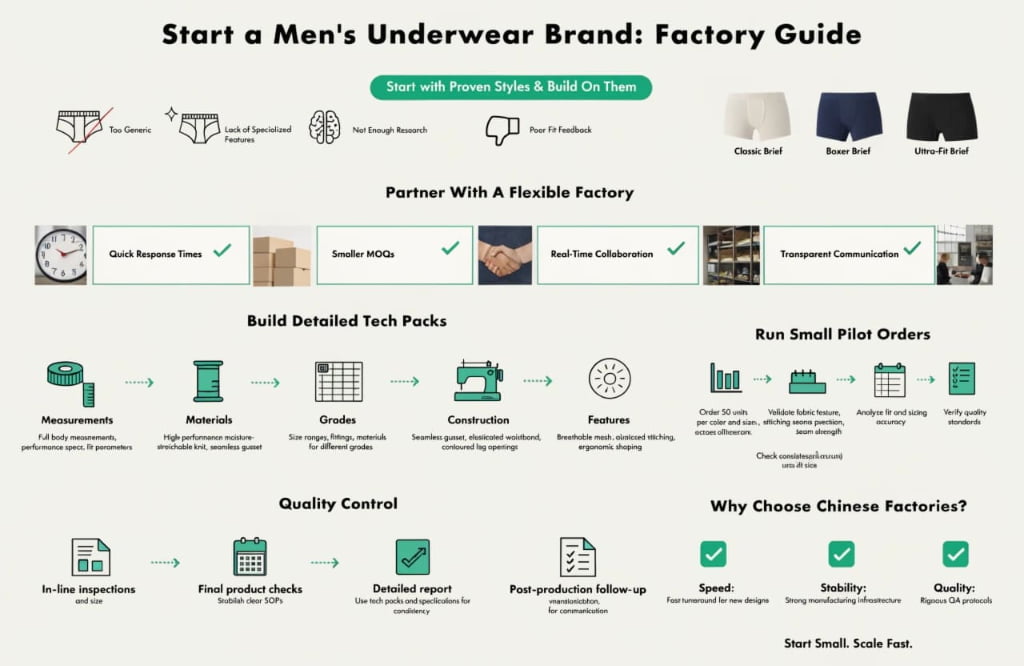
Starting a men’s underwear brand feels hard. Choices look endless. Factories feel risky. I cut through noise with a simple plan that solves real pain and locks quality early.
Start with proven styles, map unmet pain points, and partner with a flexible factory. Build tech packs, run small pilots, validate fit, and scale with systems. Use Chinese supply chains for speed and stability.
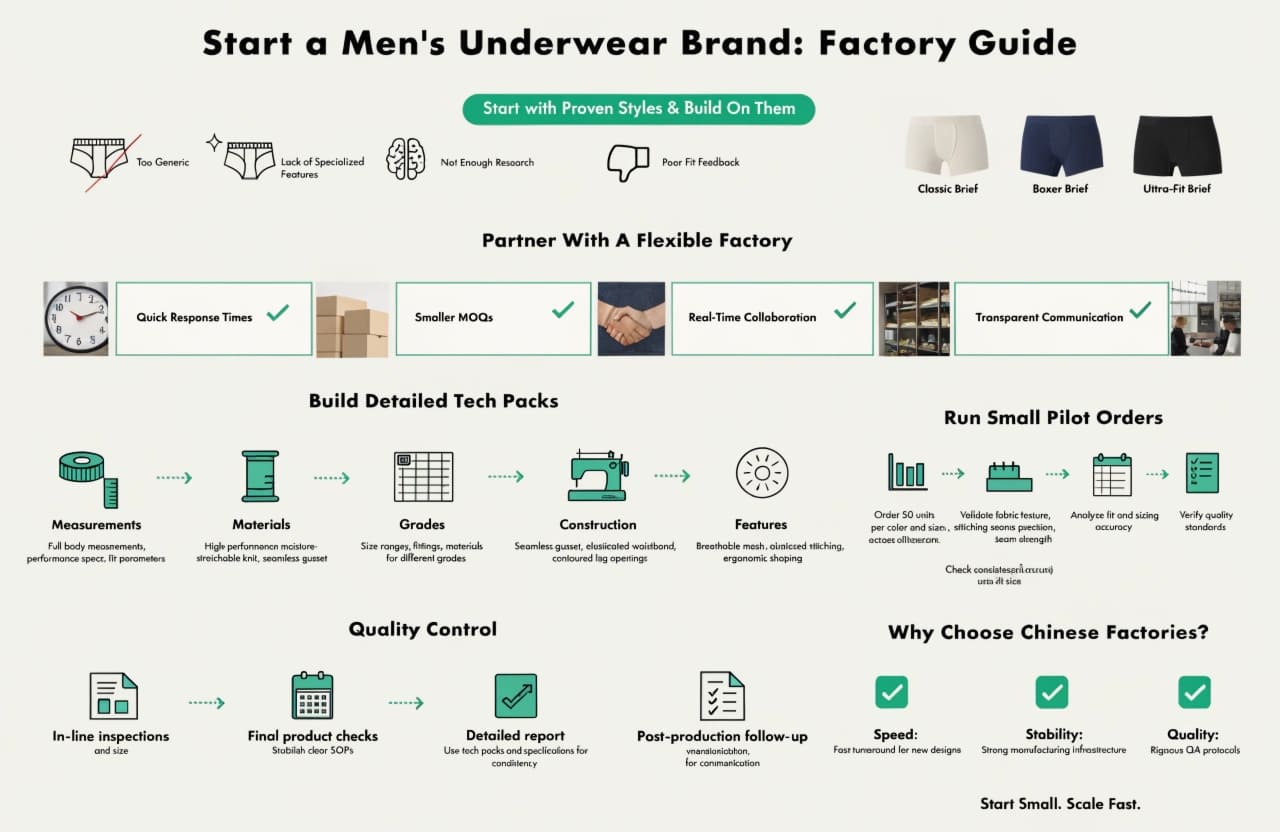
You want a clear start and safe moves. I will show my method. I will share steps that I use with clients and with my own builds.
Premium sounds fancy. The real work sits in details. Comfort, breathability, and durability must prove true. I start where demand is big and pain is sharp.
I begin with boxer briefs, since the market proves demand1. I study ride-up, waistband roll, heat, and odor pain points. I design fixes, then I find a partner factory that will grow with me.
My starting thesis
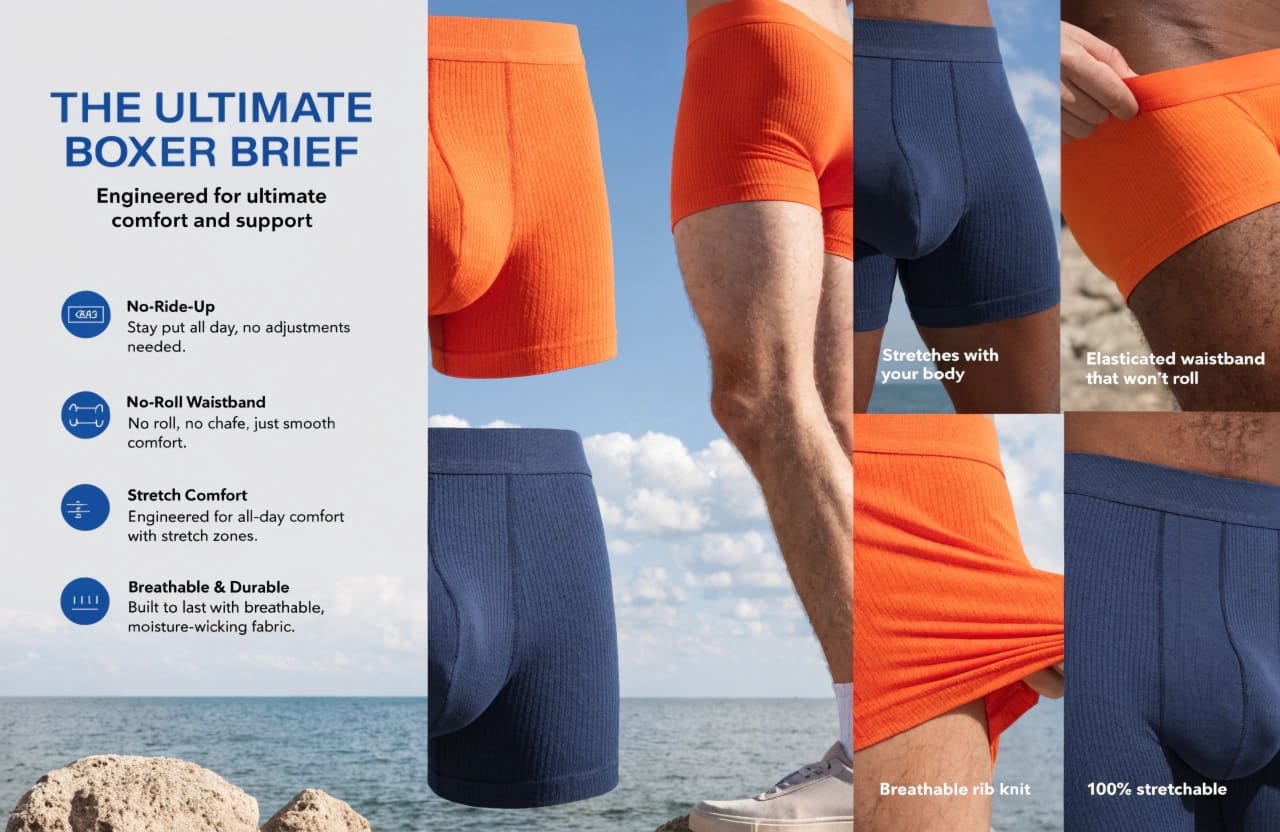
- I pick boxer briefs first. Market share is high. Risk is lower.
- I write the core promise. No roll. No ride-up. All‑day cool.
My design logic
- I use micro modal or combed cotton with elastane for soft stretch2.
- I spec a wider, brushed waistband with stable recovery3.
- I add no‑chafe seams and a supportive pouch that still breathes.
| Pain Point | Cause | My Fix | Test I Run |
|---|---|---|---|
| Ride-up | Poor leg opening tension | Measured leg elastic, silicone dots if needed | 5-hour wear test with movement |
| Waistband roll | Weak recovery | 3.5–4 cm jacquard waistband, 8–10% elastane | Stretch/recovery lab test |
| Heat and odor | Dense fabric, low airflow | Micro modal or mesh zones4 | Breathability and odor trial |
| Seams chafe | Bulky joins | Flatlock seams and soft thread5 | Rub test on treadmill |
My factory approach
- I brief with a clean tech pack. I include GSM, stretch, grade rules, and tests.
- I start small. I ask for 100–300 units per style. I learn. I adjust.
- I choose a Chinese factory with a full supply chain. I protect lead times against shocks. I value fast change over fancy slides.
How to Launch Your Own Underwear Line Successfully?
A launch can look loud. A weak fit can sink it. I keep launch risk low and learning fast. I plan and I test.
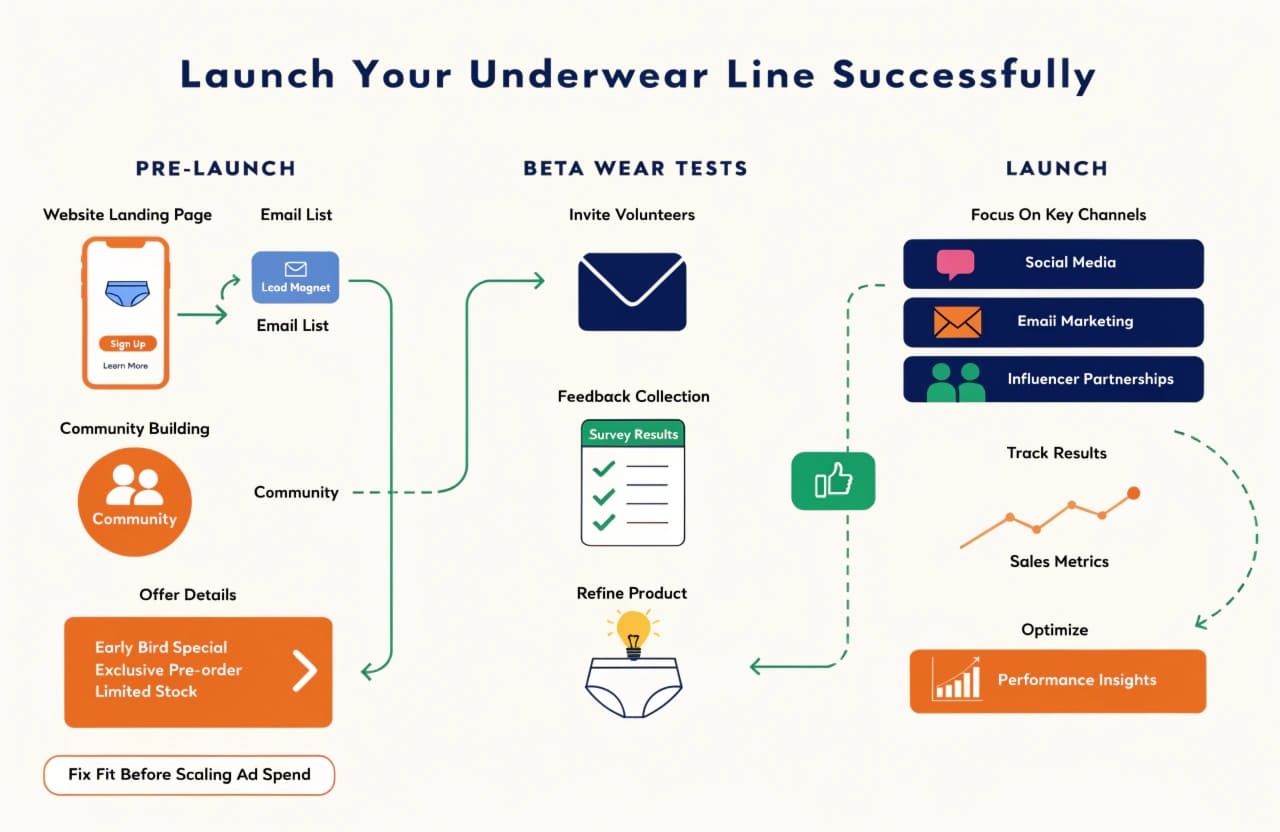
I use a three-phase path: pre-launch list building, beta wear tests, and a focused launch. I track returns and feedback. I fix fit before I scale spend.
Phase plan that works
- Weeks 1–4: Promise, waitlist, and size quiz.
- Weeks 5–8: Beta run, creator seeding, and fit fixes.
- Weeks 9–12: Launch with bundles and a comfort swap.
| Phase | Goal | Actions | Key Metric |
|---|---|---|---|
| Pre-launch | Demand map | Landing page, quiz, email flows | Email CVR > 20% |
| Beta | Fit proof | 100–300 units, try-ons, surveys | Returns < 10% |
| Launch | Sales | UGC ads, bundles, PR | CAC at target |
My validation stack
- 3D fit modeling for early size checks6.
- Micro creator wear tests for real feedback.
- Dynamic MOQs tied to demand signals.
My offer math
- I lead with a 3‑pack bundle at a fair discount.
- I add a 30‑day comfort swap. I make exchanges easy.
- I use one landing page per promise. I place size help near the CTA.
How do I start a men’s essentials business?
Underwear can be a door. Tees and socks build baskets and loyalty7. Essentials win with repeat use, tight costs, and a steady supply plan.
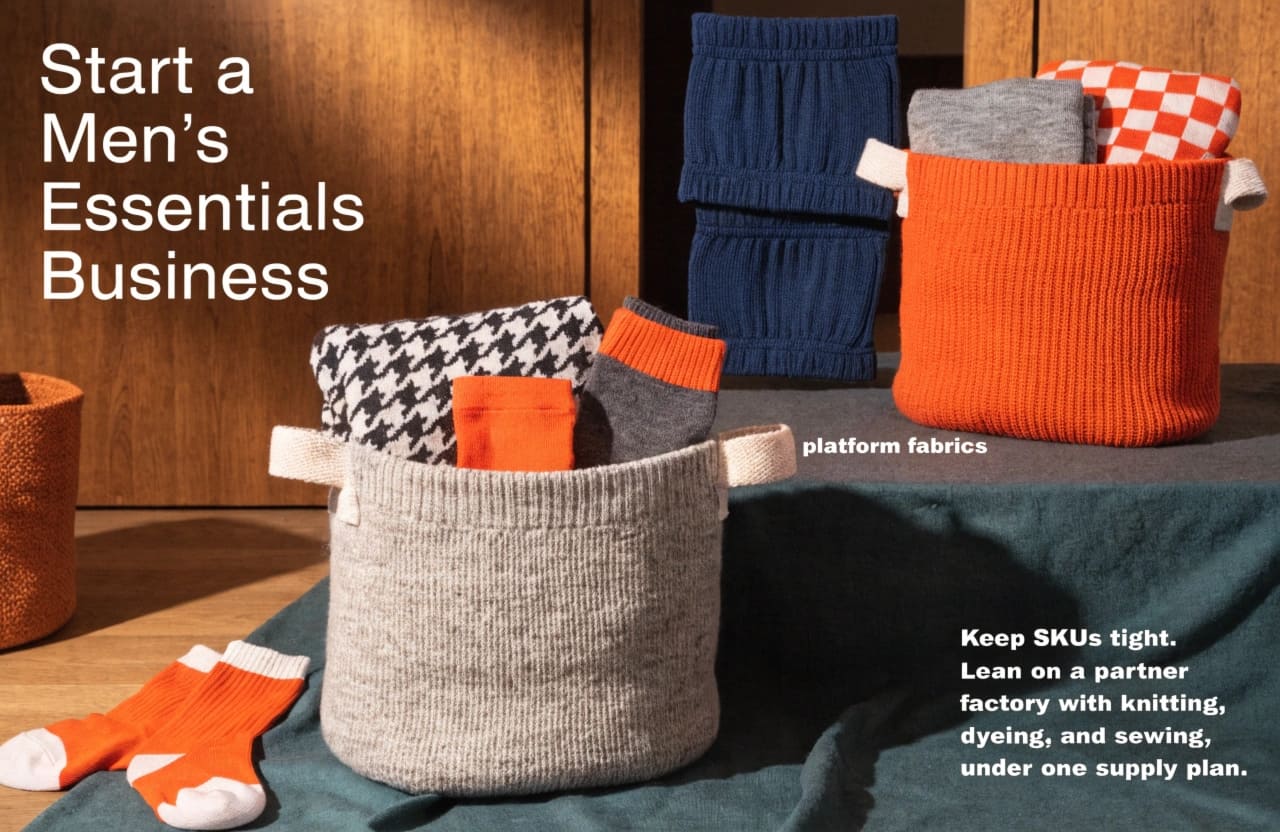
I build a fabric platform first, then I add adjacent items. I keep SKUs tight. I lean on a partner factory with knitting, dyeing, and sewing under one plan.
The platform approach
- I choose two base fabrics: micro modal blend and premium cotton blend.
- I lock colors across categories. I simplify dye lots and inventory.
Category rollout
- Phase 1: Boxer briefs and trunks.
- Phase 2: Crew tees and tanks using the same fabric.
- Phase 3: Socks or leggings that share colors and packaging.
| Element | Why It Matters | What I Do |
|---|---|---|
| Fabric platform | Fewer variables and lower MOQs | Same yarn, same dye house |
| Shared trims | Speed and cost | One waistband spec across styles |
| Size rules | Fewer returns | Unified grade rules by body type |
| Bundles | Higher AOV | 3‑packs and cross‑category sets |
| Replenishment | Cash flow | ABC stock plan with 30/60/90-day buys |
My supply setup
- I pick a Chinese partner that can knit, dye, and sew. I keep lines flexible. I switch volumes fast when a SKU wins.
- I plan steady reorders. I avoid big bets. I grow by repeat, not noise.
How do I start my own underwear brand?
The first steps can feel fuzzy. Legal rules, specs, and suppliers can blur together. I put them in order. I move one step at a time.
I define the promise, write a tech pack, validate a factory, and run a pilot. I lock labeling and tests. I set terms that protect timelines and quality.
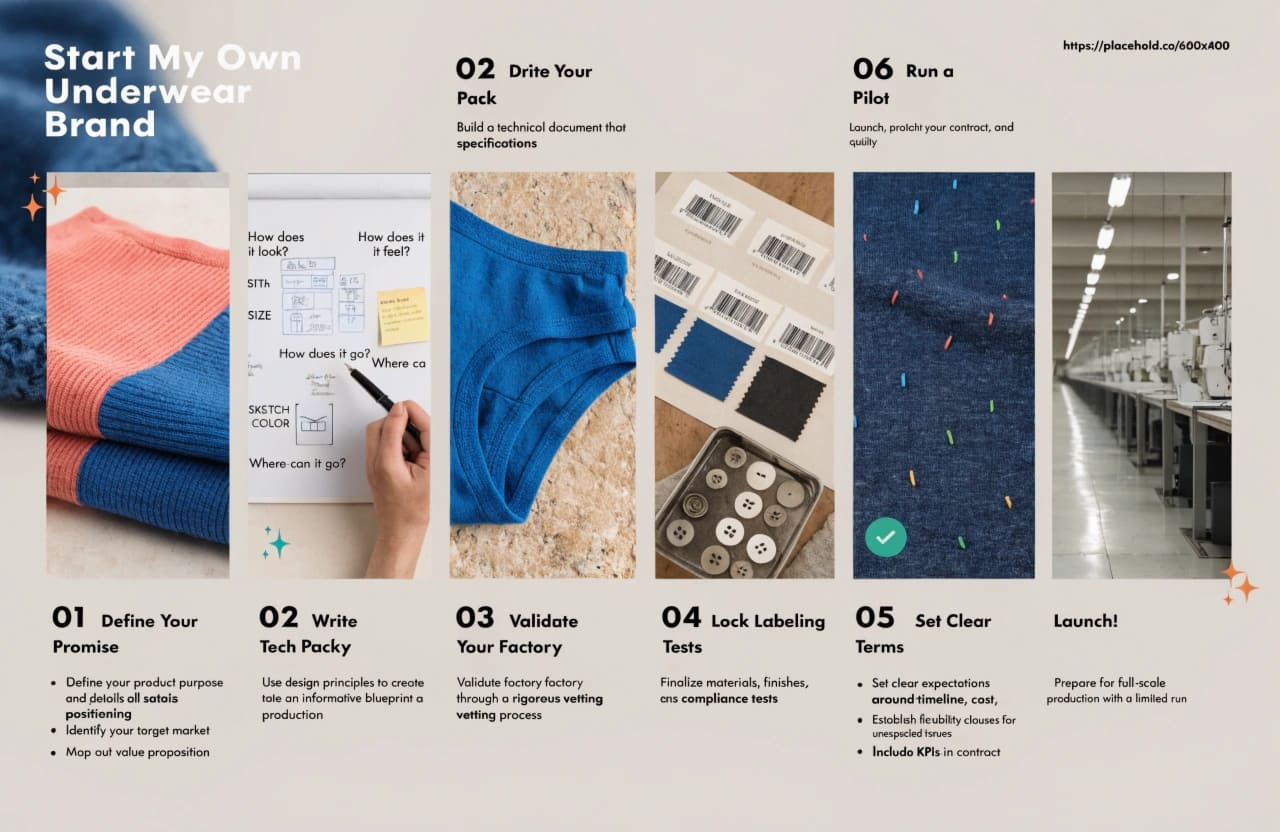
Step-by-step path
- I register the brand and secure IP8.
- I write the brand line and target buyer.
- I build tech packs with fabric, GSM, stretch, seams, labels, and tests.
| Step | Checkpoint | What I Confirm |
|---|---|---|
| Factory shortlist | Capability and focus | Similar styles, machines, team size |
| Certifications | Proof and scope | OEKO‑TEX, GOTS/GRS where needed9 |
| Quality plan | Control in place | In‑line checks, AQL, lab tests10 |
| Contract | Incentives aligned | MOQs, lead time, penalties, IP clauses |
| Logistics | Clear terms | Incoterms, HS codes, cartons, duties11 |
Why I choose China for partners
- The supply chain is deep and stable. Yarn, dyeing, and trims sit close12. Response is fast during shocks.
- Small orders are possible. I move from idea to sample in days. I protect launch dates.
Pilot to scale
- I run 100–300 units. I capture returns and fit notes. I fix grade rules fast.
- I scale only when proof is strong. I grow with logic, not luck.
Conclusion
Start with proven styles. Solve real pain. Choose a partner factory that adapts fast. Test early. Enforce systems. Then scale with focus. Steady wins.
-
"Men’s underwear index – Wikipedia", https://en.wikipedia.org/wiki/Men%27s_underwear_index. Industry market research reports, such as those published by Statista or Grand View Research, document boxer briefs as the leading segment within the men’s underwear category by consumer preference and sales volume. Evidence role: statistic; source type: institution. Supports: Boxer briefs represent the largest or fastest-growing segment of the men’s underwear market by volume or revenue share.. Scope note: Specific share figures vary by geography and year; the cited source should be checked for the relevant market and time period. ↩
-
"Combed Cotton Vs Carded Cotton: 9 Key Differences & Tests", https://fabric-supplier.com/combed-cotton-vs-carded-cotton-differences/. Textile science literature describes the combing process as removing short staple fibers and neps from cotton sliver, resulting in a more uniform, finer yarn with improved tensile strength and surface smoothness, properties that translate to greater softness and reduced pilling in finished fabrics used in next-to-skin applications. Evidence role: mechanism; source type: research. Supports: The combing process removes short fibers and impurities from cotton, producing a smoother, stronger, and softer yarn compared to carded cotton.. Scope note: Performance differences between combed and carded cotton in finished garments also depend on yarn count, knit structure, and finishing treatments. ↩
-
"Impact of the Elastane Percentage on the Elastic Properties of … – PMC", https://pmc.ncbi.nlm.nih.gov/articles/PMC9570736/. Textile engineering studies on elastic fabrics indicate that elastane content in the range of 8–10% significantly improves recovery force and dimensional stability in waistband constructions, reducing the tendency for roll under repeated stretch cycles. Evidence role: mechanism; source type: research. Supports: Elastane content and waistband width are key determinants of elastic recovery and dimensional stability in knitted waistbands.. Scope note: Optimal elastane percentage is also influenced by yarn count, knit structure, and finishing treatments, so the cited range should be understood as a general guideline rather than a universal specification. ↩
-
"Comparison of Mechanical and Thermal Comfort Properties of …", https://www.academia.edu/86373437/Comparison_of_Mechanical_and_Thermal_Comfort_Properties_of_Tencel_Blended_with_Regenerated_Fibers_and_Cotton_Woven_Fabrics. Textile science literature describes modal fibers, derived from beech wood pulp, as having a finer diameter and higher moisture absorption capacity than conventional cotton, properties associated with improved thermal comfort and reduced microbial odor buildup. Evidence role: mechanism; source type: research. Supports: Micro modal fibers exhibit superior moisture management and breathability relative to standard cotton, which reduces conditions conducive to odor development.. Scope note: Performance differences are fabric-construction dependent; fiber type alone does not guarantee superior breathability without appropriate knit structure and GSM. ↩
-
"The Future of Functional Clothing for an Improved Skin and Textile …", https://pmc.ncbi.nlm.nih.gov/articles/PMC8226598/. Research on athletic and performance apparel construction documents that flatlock stitching, which joins fabric edges in a flat plane rather than overlapping them, measurably reduces seam height and associated skin friction, a factor linked to chafing in high-movement garments. Evidence role: mechanism; source type: research. Supports: Flatlock seam construction reduces seam bulk and surface irregularity, lowering friction against skin compared to raised seam types.. Scope note: Most published studies focus on athletic or military contexts; direct evidence specific to underwear end-use is limited. ↩
-
"3D Garment Design Model Based on Convolution Neural Network …", https://pmc.ncbi.nlm.nih.gov/articles/PMC9252671/. Academic and industry research on virtual prototyping in apparel development, including studies using platforms such as CLO3D and Browzwear, demonstrates that 3D simulation can predict ease, stress distribution, and fit deviations with sufficient accuracy to reduce physical sample rounds in early development stages. Evidence role: mechanism; source type: research. Supports: 3D virtual fit simulation software can identify fit issues in garment prototypes before physical sampling, reducing development iterations.. Scope note: Accuracy of 3D fit simulation depends on the precision of the digital avatar and fabric simulation parameters; results may diverge from physical samples for highly elastic or complex constructions such as underwear. ↩
-
"Product (business)", https://en.wikipedia.org/wiki/Product_(business). E-commerce and retail strategy research documents that product line extensions into adjacent categories, particularly consumable or replenishment-driven items, are associated with higher average order values and increased purchase frequency, as customers consolidate purchases within a trusted brand. Evidence role: general_support; source type: research. Supports: Expanding into adjacent product categories increases average order value and customer lifetime value in direct-to-consumer apparel brands.. Scope note: The magnitude of AOV and retention effects depends on brand positioning, category fit, and execution quality; the general principle does not guarantee specific outcomes for any individual brand. ↩
-
"Apply online – USPTO", https://www.uspto.gov/trademarks/apply. According to the United States Patent and Trademark Office (USPTO), trademark registration grants the owner exclusive rights to use a mark in commerce in connection with specified goods or services, providing legal recourse against infringement and establishing priority of use. Evidence role: definition; source type: government. Supports: Trademark registration provides legal protection for brand names and logos in commerce, and is a foundational step in establishing enforceable intellectual property rights for an apparel brand.. Scope note: IP protection requirements and procedures vary by jurisdiction; international protection requires separate filings under frameworks such as the Madrid Protocol administered by WIPO. ↩
-
"OEKO-TEX® STANDARD 100", https://www.oeko-tex.com/en/our-standards/oeko-tex-standard-100/. OEKO-TEX Standard 100 is an independent testing and certification system for textile raw materials and finished products, verifying the absence of harmful substances; GOTS (Global Organic Textile Standard) certifies organic fiber processing chains; and GRS (Global Recycled Standard) verifies recycled content claims, all administered by recognized international bodies. Evidence role: definition; source type: institution. Supports: OEKO-TEX Standard 100, GOTS, and GRS are internationally recognized third-party certification systems that verify textile safety, organic fiber content, and recycled material claims respectively.. Scope note: Certification scope and requirements differ; OEKO-TEX addresses chemical safety while GOTS and GRS address supply chain and material origin claims, and they are not interchangeable. ↩
-
"[PDF] ISO 2859-1 – UNT Chemistry Department", https://chemistry.unt.edu/~tgolden/courses/iso2859-1.pdf. AQL (Acceptable Quality Level) is defined under ISO 2859-1 as the quality level that is the worst tolerable process average when a continuing series of lots is submitted for acceptance sampling; it is the prevailing standard for incoming quality inspection in apparel and textile manufacturing. Evidence role: definition; source type: institution. Supports: AQL refers to the Acceptable Quality Level, a statistical sampling methodology standardized under ISO 2859, widely used in garment and textile manufacturing to determine acceptable defect rates in production batches.. Scope note: AQL sampling provides probabilistic rather than absolute quality assurance; it does not guarantee zero defects in accepted lots. ↩
-
"Know Your Incoterms – International Trade Administration", https://www.trade.gov/know-your-incoterms. Incoterms (International Commercial Terms), published by the International Chamber of Commerce and most recently updated as Incoterms 2020, define the obligations of buyers and sellers regarding delivery, risk transfer, and cost allocation in international trade; HS codes, administered by the World Customs Organization, provide the standardized classification system used globally to determine applicable tariffs and import duties. Evidence role: definition; source type: institution. Supports: Incoterms are internationally standardized trade terms published by the International Chamber of Commerce that define the allocation of costs, risks, and responsibilities between buyers and sellers in international shipments; HS codes are the standardized numerical codes under the World Customs Organization’s Harmonized System used to classify traded goods for tariff and customs purposes.. Scope note: Applicable duties depend on the specific HS code classification, country of origin, and destination country trade agreements, and should be verified with a licensed customs broker. ↩
-
"[PDF] The Chinese Apparel Cluster in Guangdong", https://www.isc.hbs.edu/Documents/resources/courses/moc-course-at-harvard/pdf/student-projects/Chinese_Apparel_Cluster_2006.pdf. Reports from the World Trade Organization and academic studies on global apparel supply chains document China’s position as the world’s largest textile and apparel exporter, supported by geographically concentrated industrial clusters that integrate spinning, dyeing, and garment assembly within close proximity. Evidence role: general_support; source type: institution. Supports: China’s textile and apparel manufacturing sector is characterized by high vertical integration and geographic clustering of yarn, fabric, dyeing, and trim suppliers.. Scope note: Supply chain stability is subject to geopolitical, regulatory, and logistical disruptions; the characterization of stability reflects historical structure rather than a guarantee of future conditions. ↩
Discussion & questions 0 comments