
I have seen many men’s brief samples fail because one missing note forced the factory to guess. That guess cost time, money, and trust.
I create a men’s briefs tech pack by putting clear measurements, fabric and trim details, stitch methods, grading rules, labels, and packing notes into one file. That file helps me quote faster, sample more accurately, and reduce costly back-and-forth with the factory.
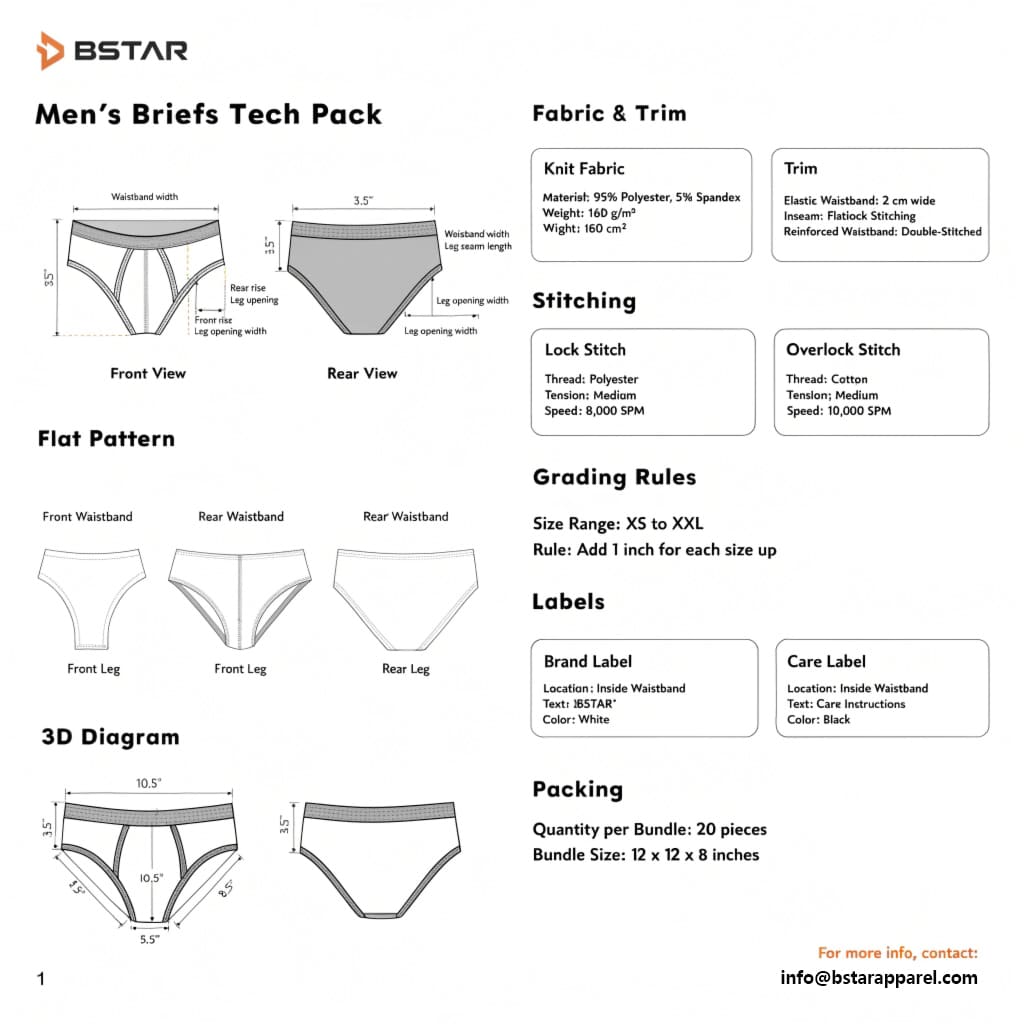
I have seen good brief designs break down at sampling because the idea stayed in my head and not on the page. A strong tech pack closes that gap. It gives the factory one clear standard. I will walk through the four parts I always build first.
What essential measurements, fabric specs, and trim details should I include in a tech pack for men’s briefs?
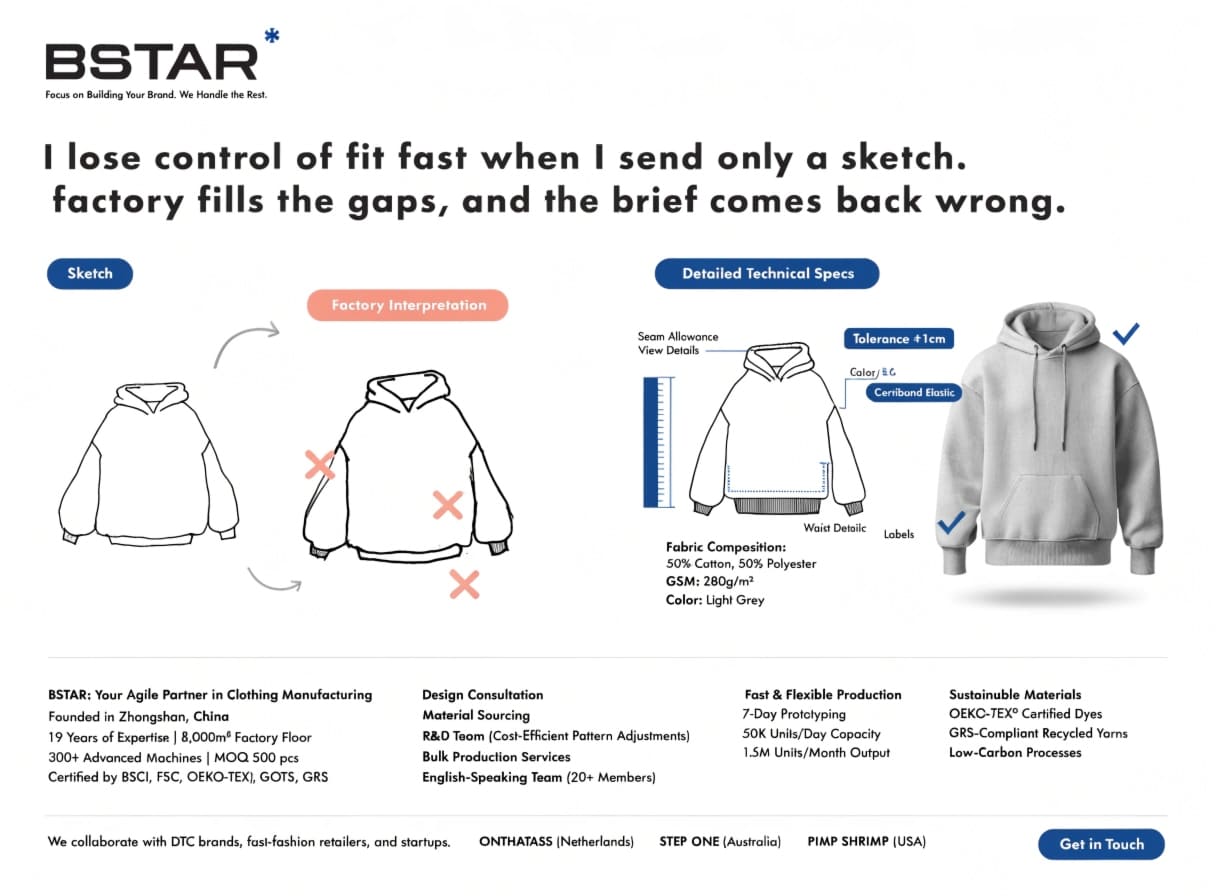
I lose control of fit fast when I send only a sketch. The factory fills the gaps, and the brief comes back wrong.
I include a flat sketch, point-of-measure chart, tolerance, fabric composition, GSM, color, waistband elastic, labels, and every trim note1. I also add seam allowance and view details, so the factory can read the style without guessing.
 "BSTAR Hoodie Tech Pack")
The measurement block
I start with a front and back flat sketch. I mark each point of measure with arrows and names. I usually list waistband width, waist relaxed, front rise, back rise, side seam, leg opening, pouch width, and crotch width2. I also state the base sample size. I keep tolerance realistic. I often use tighter tolerance on the waistband and leg opening3 because those two points change fit fast.
| Item | What I write |
|---|---|
| Base size | M |
| Main POMs | Waist, rise, side seam, leg opening, pouch width |
| Tolerance | Usually ±0.5 cm to ±1.0 cm by point |
| Seam allowance | 6 mm or as needed by construction |
The material block
I write fabric composition, knit type, GSM, color code, and finish4. I also write shrinkage target, wash test standard, and colorfastness need5. Then I list trims. I include waistband elastic width, logo method, care label, size label, and hangtag if needed.
| Material area | Spec |
|---|---|
| Fabric | 95% cotton 5% elastane, single jersey, 180 GSM |
| Waistband | 40 mm jacquard elastic, brushed back |
| Labels | Satin care label, heat transfer size mark |
I once saw a good-looking brief become too tight after wash6 because the tech pack had no shrinkage note. I do not leave that risk open now.
How do I write accurate stitching and elastic specifications in a men’s underwear tech pack?
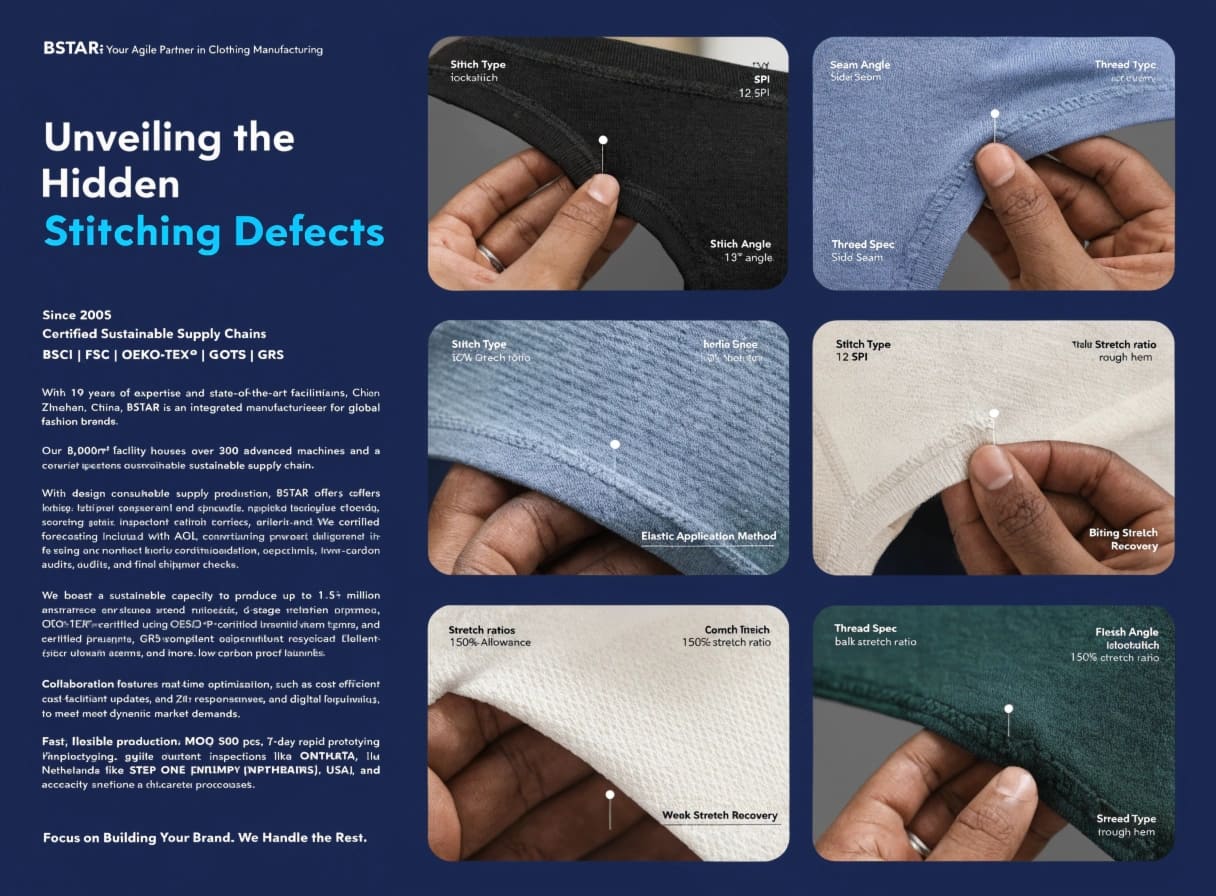
I see many samples look close at first. Then I touch the seams, and I find twisting, biting, or weak stretch recovery.
I write stitch type, seam location, SPI, seam allowance, thread spec, and elastic application method7. I also note stretch ratio, needle type, and finish quality, because underwear comfort depends on clean sewing and stable elastic control8.
The stitch map
I treat sewing notes like a route map. I mark every seam on the sketch. I name the operation. I list the machine. I list the stitch type. For men’s briefs, I often call out 4-thread overlock for body joins9, coverstitch or zigzag for waistband attachment, and topstitch details only where they matter for comfort or look.
| Area | Spec I write |
|---|---|
| Side and crotch seams | 4-thread overlock, 8 to 10 SPI10 |
| Waistband attach | Coverstitch or 3-step zigzag |
| Leg opening | Turn-back with elastic or clean binding |
| Thread | 100% polyester, color matched |
The elastic block
I never write only “attach elastic.” I write the elastic width, overlap method, join position, and finished exposure. I also note how much the elastic should stretch during sewing. If I skip that ratio, the waistband can bite, wave, or roll after wash. I often start with a note like “apply waistband elastic at 85% to 90% of opening11,” then I adjust after fit comments. I also state if the elastic must be pre-joined, logo-centered, or seam-aligned at the back.
What should a men’s briefs tech pack sample include for size grading, labeling, and packaging instructions?
I waste days in sampling when sizing, labels, and packing are missing. The sample may fit, but the production file still stays weak.
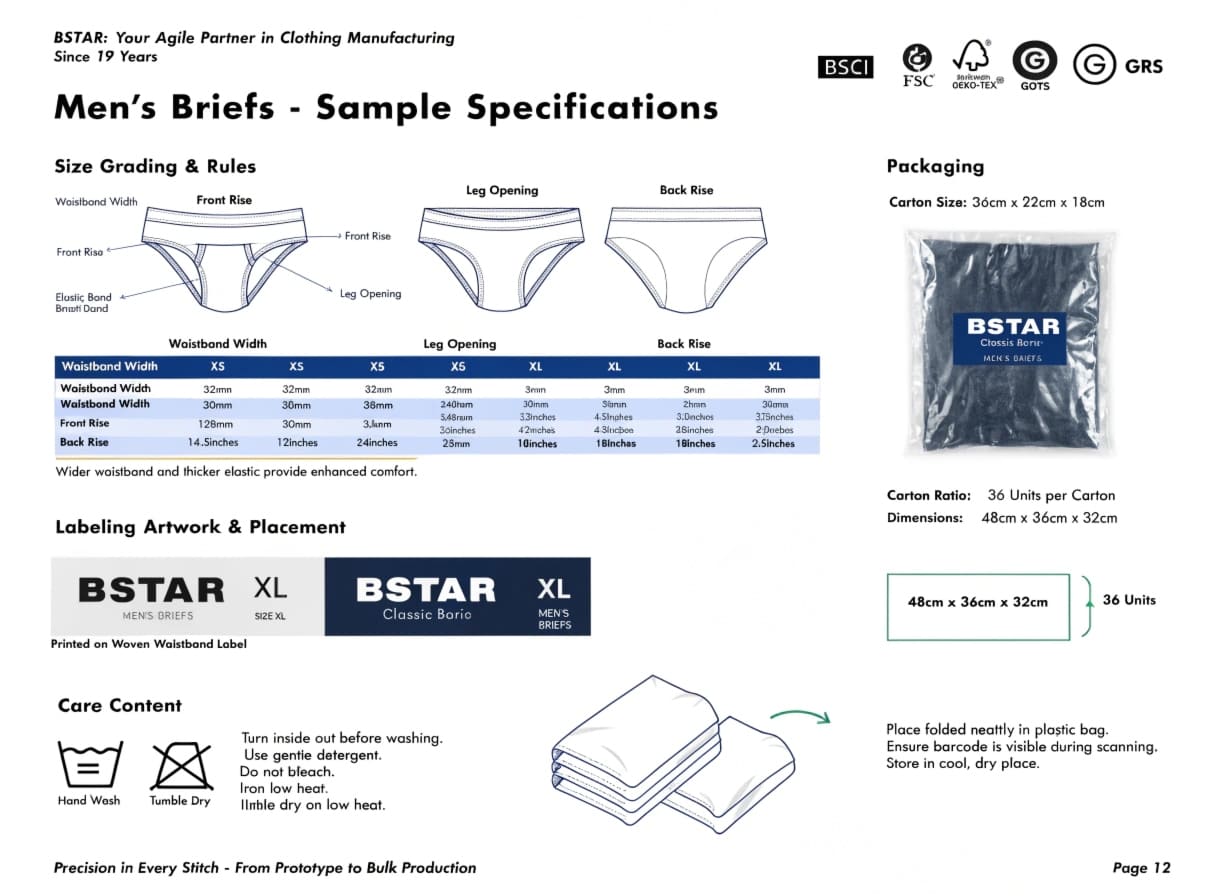
I add grade rules for each point, label artwork and placement, care content, folding method, polybag size, carton ratio, and barcode notes. I keep these pages simple, because a good sample file should also guide bulk production.
The grading page
I build grading from one base size. I state that size first, and I often use M. Then I add grade increments by point of measure. I do not grade every point the same way. Waist and leg opening may follow one rule. Rise may follow another. That keeps the brief balanced across the size range.
| POM | Base M | Grade to L | Grade to XL |
|---|---|---|---|
| Waist relaxed | 34 cm | +2 cm | +4 cm |
| Front rise | 24 cm | +1 cm | +2 cm |
| Leg opening | 24 cm | +1 cm | +2 cm |
The label and packing page
I also add label content and placement. I note the brand label, size mark, care label text, country of origin, and fiber content12. Then I write packing steps. I show fold direction, insert card if needed, polybag thickness, warning print, carton mark, and units per carton.
| Area | What I include |
|---|---|
| Labels | Artwork, size, care, origin, placement |
| Polybag | Size, thickness, warning text, barcode position |
| Carton | Carton size, quantity, assortment ratio |
I once saw a ready sample miss a retail launch because the barcode went on the wrong bag side. I now treat packaging as part of the tech pack, not an afterthought.
What common mistakes should I avoid when creating a tech pack for men’s briefs, and what checklist do I use?
I see many tech packs look complete, but one vague line still creates a bad sample. That small gap can become a big cost.
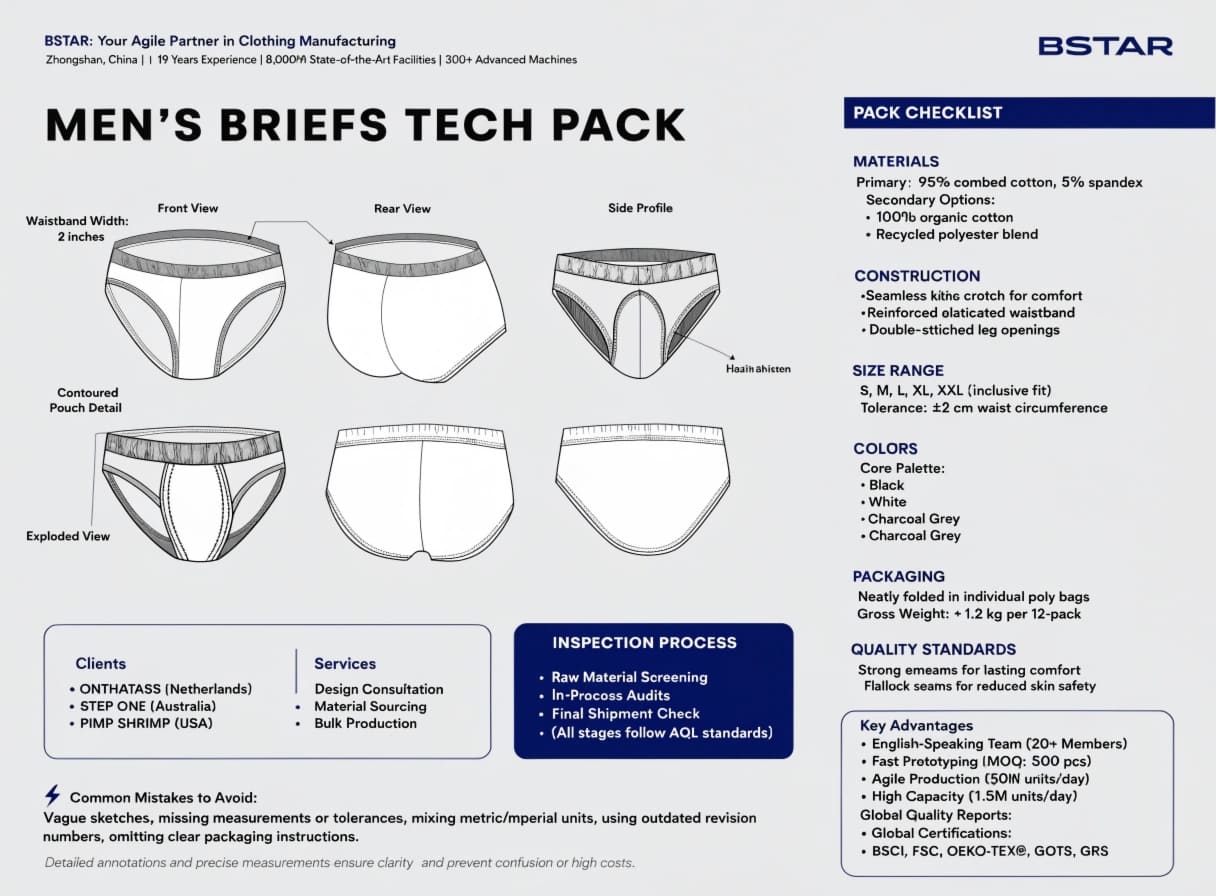
I avoid vague sketches, missing tolerances, mixed units, old revisions, and weak packaging notes. I use a short checklist before I send the file, so the factory can act fast and ask fewer questions.
The mistakes I check first
I do not rely on memory. I run through a short checklist before I release any men’s briefs file. I make sure one file version is active. I lock units in centimeters or inches, but not both unless I show both clearly. I check that every page matches the same style code and revision date. I also make sure the drawing, measurement chart, and sewing notes all describe the same style.
| Checkpoint | What I confirm |
|---|---|
| Sketch | Front, back, inside view, seam callouts |
| Measurements | POM names, base size, tolerance, grade rules |
| Materials | Fabric, GSM, composition, color, shrinkage |
| Sewing | Stitch type, SPI, seam allowance, elastic method |
| Labels | Artwork, placement, legal text |
| Packaging | Fold, bag, sticker, carton, assortment |
The words I remove
I also remove words like “normal,” “same as sample,” or “good quality.” Those words sound easy, but they mean different things to different factories. I replace them with numbers, sketches, and approval notes. If I update the file after a fit sample, I mark every change in a revision box. That one habit saves me from repeat mistakes, old-page confusion, and factory claims that they
Conclusion
I create a strong men’s briefs tech pack when I turn every design choice into a clear number, note, or drawing. That clarity protects fit, speed, and margin.
-
"How to Prepare a Tech Pack That Vietnamese Garment …", https://blogs.scu.edu/inspire/2026/02/13/how-to-prepare-a-tech-pack-that-vietnamese-garment-manufacturers-will-love-working-with/. A technical design or production specification typically documents the garment drawing, measurements, tolerances, materials, trims, and construction information needed to communicate production requirements. Evidence role: general_support; source type: education. Supports: A men’s briefs tech pack should include sketches, measurement charts, tolerances, fabric specifications, color, elastic, labels, and trim notes.. Scope note: The source would support the general role of these elements in apparel specification documents, not prove that every listed item is mandatory for all men’s briefs. ↩
-
"[PDF] A Phenomenological Exploration of the Apparel Sizing Practice of …", https://conservancy.umn.edu/bitstreams/11dfb1b1-341e-490e-977f-f34ff80c43fc/download. Garment measurement guidance commonly uses defined points of measure to control fit and dimensional consistency across samples and production. Evidence role: definition; source type: education. Supports: Men’s briefs tech packs should identify specific points of measure such as waist, rises, side seam, leg opening, pouch, and crotch dimensions.. Scope note: The source may describe apparel POM methodology broadly rather than prescribe this exact men’s-briefs measurement set. ↩
-
"Putting the Squeeze on Compression Garments: Current …", https://pmc.ncbi.nlm.nih.gov/articles/PMC9023423/. Fit and sizing literature treats garment openings and elasticized edges as dimensionally important areas because their circumference and recovery influence body contact, pressure, and perceived fit. Evidence role: mechanism; source type: paper. Supports: Waistband and leg-opening dimensions warrant tighter control because they strongly affect fit.. Scope note: The source would provide biomechanical or apparel-fit context; it may not specify exact tolerance values for men’s briefs. ↩
-
"(PDF) Variation in Fabric GSM Due To Change in Yarn Count, Stitch …", https://www.academia.edu/90004344/Variation_in_Fabric_GSM_Due_To_Change_in_Yarn_Count_Stitch_Length_and_Machine_Gauge. Textile specifications commonly identify fiber composition, fabric construction, mass per unit area, color designation, and finishing because these variables affect fabric performance, appearance, and manufacturing repeatability. Evidence role: general_support; source type: education. Supports: The material block should specify fabric composition, knit type, GSM, color code, and finish.. Scope note: This supports the importance of textile specification categories generally, not any one preferred fabric for men’s briefs. ↩
-
"AATCC Standard Test Methods and Procedures", https://www.aatcc.org/standards/. Textile test standards evaluate dimensional change after laundering and colorfastness to washing or rubbing, making shrinkage targets and colorfastness requirements relevant quality-control specifications. Evidence role: expert_consensus; source type: institution. Supports: Tech packs can specify shrinkage targets, wash-test standards, and colorfastness requirements to control textile performance.. Scope note: Standards define test methods and performance evaluation; they do not determine the buyer’s acceptable target unless a separate specification sets it. ↩
-
"Fabric Shrinkage in Fashion: Causes, Testing, and How to Prevent It …", https://deepwear.info/blog/fabric-shrinkage-in-fashion-causes-testing-and-how-to-prevent-it-in-2025/. Laundering can cause dimensional change in textiles, and shrinkage reduces garment dimensions after washing, which can affect post-wash fit. Evidence role: mechanism; source type: institution. Supports: A brief can become tighter after washing if shrinkage is not controlled or specified.. Scope note: The source would support the general mechanism of laundering shrinkage; it would not verify the author’s specific anecdotal sample failure. ↩
-
"Impact of Stitch Type and Stitch Density on Seam Properties", https://www.academia.edu/110624536/Impact_of_Stitch_Type_and_Stitch_Density_on_Seam_Properties. Apparel manufacturing specifications use stitch type, seam type or location, stitch density, seam allowance, thread, and operation details to define how garments are sewn and inspected. Evidence role: general_support; source type: education. Supports: Accurate underwear sewing specifications should include stitch type, seam location, SPI, seam allowance, thread, and elastic application method.. Scope note: The source would support these as common sewing specification fields, not establish a universal list for all underwear factories. ↩
-
"Pressure and Thermal Behavior of Elastic Polyurethane and … – PMC", https://pmc.ncbi.nlm.nih.gov/articles/PMC11990927/. Research on clothing comfort links seam construction, pressure, stretch, and material-skin interaction to tactile and physiological comfort, providing context for why underwear sewing and elastic stability affect wearability. Evidence role: mechanism; source type: paper. Supports: Clean sewing and stable elastic control are important to underwear comfort.. Scope note: The evidence may address clothing comfort broadly rather than men’s briefs specifically. ↩
-
"[PDF] How to Sew Facings and Enclosed Seams – Oregon State University", https://ir.library.oregonstate.edu/downloads/h702q650b. Overlock stitch formations are widely used to seam knitted fabrics because they enclose cut edges while allowing stretch, and multi-thread overlock constructions are common in knit apparel assembly. Evidence role: mechanism; source type: education. Supports: Four-thread overlock is a common specification for body joins in knitted underwear.. Scope note: The source can support suitability of overlock seams for knits generally, not prove that 4-thread overlock is always optimal for every brief design. ↩
-
"[PDF] Optimization of Sewing Parameters for Improving the Waterproof …", https://jtatm.textiles.ncsu.edu/index.php/JTATM/article/download/20809/9744/76358. Stitch density, often expressed as stitches per inch, is a standard sewing parameter that affects seam appearance, strength, elasticity, and production quality. Evidence role: mechanism; source type: education. Supports: SPI is a relevant specification for side and crotch seams in a men’s briefs tech pack.. Scope note: A source may support the importance of SPI generally but may not validate the specific 8-to-10 SPI range for every fabric and seam in men’s briefs. ↩
-
"The Effect of Waistbands on Intra-Abdominal Pressure … – PubMed", https://pubmed.ncbi.nlm.nih.gov/39178170/. Elastic application requires controlling the relationship between elastic length and fabric opening length; changing the extension ratio alters garment pressure, edge stability, and recovery. Evidence role: mechanism; source type: paper. Supports: Waistband elastic should be applied at a specified stretch ratio rather than left undefined.. Scope note: The source would support the need to specify an elastic-to-opening ratio, but the 85% to 90% figure may remain a style- and material-dependent production parameter. ↩
-
"The Textile Products Identification Act", https://www.ftc.gov/legal-library/browse/rules/textile-products-identification-act-text. Textile labeling regulations require consumer textile products to disclose fiber content, manufacturer or dealer identity, and country of origin, and care-labeling rules require care instructions for covered garments. Evidence role: definition; source type: government. Supports: A tech pack’s label page should include care text, country of origin, and fiber content.. Scope note: This source would support legal requirements in the cited jurisdiction, such as the United States; requirements vary by market.
followed the wrong version. ↩
Discussion & questions 0 comments