
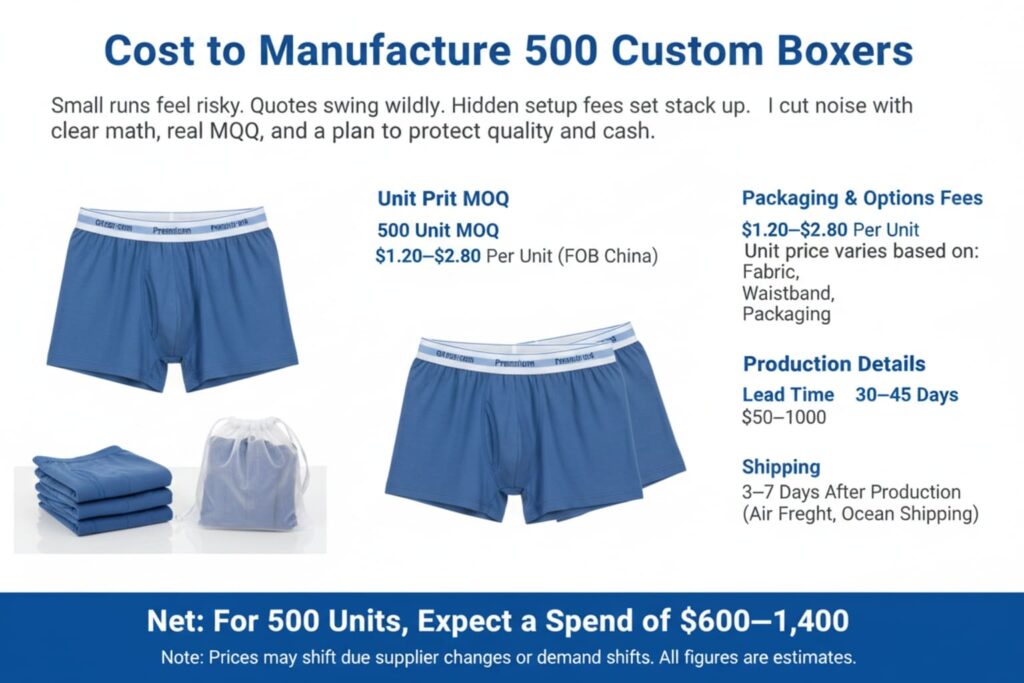
Small runs feel risky. Quotes swing wildly. Hidden setup fees stack up. I cut noise with clear math, real MOQs, and a plan to protect quality and cash.
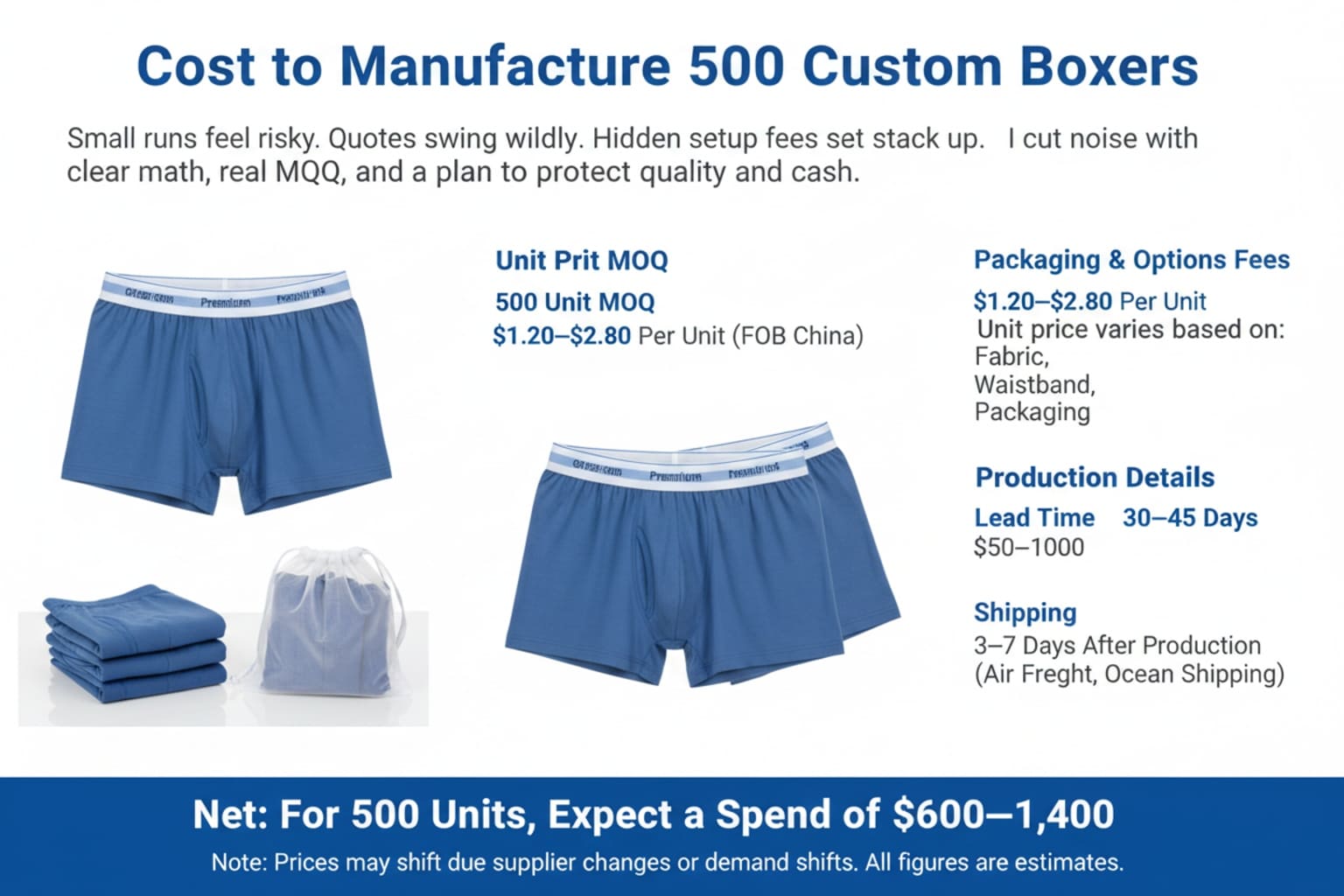
For 500 custom boxer briefs, expect $1.20–$2.80 per unit FOB China, depending on fabric, waistband, and packaging. Total spend sits around $600–$1,400 plus $50–$100 in sampling and setup, and 30–45 days lead time.
You want real numbers and safe steps. I will share both. I will show costs, MOQs, timelines, and ways to save without hurting quality.
Minimum order quantity (MOQ) for custom boxer shorts: What to expect from manufacturers?
Low MOQs sound great. Reality bites later. Elastic mills ask for meters. Dye houses ask for kilos. Small orders trigger surcharges and delays.
Most factories target 500–1,000 units per style1. Fabric dye lots often need 200–300 kg per color2. Jacquard waistbands need 1,000–3,000 meters3. Workarounds exist. I use stock colors, printed elastic, and hold-over trims to make 500-piece runs work.
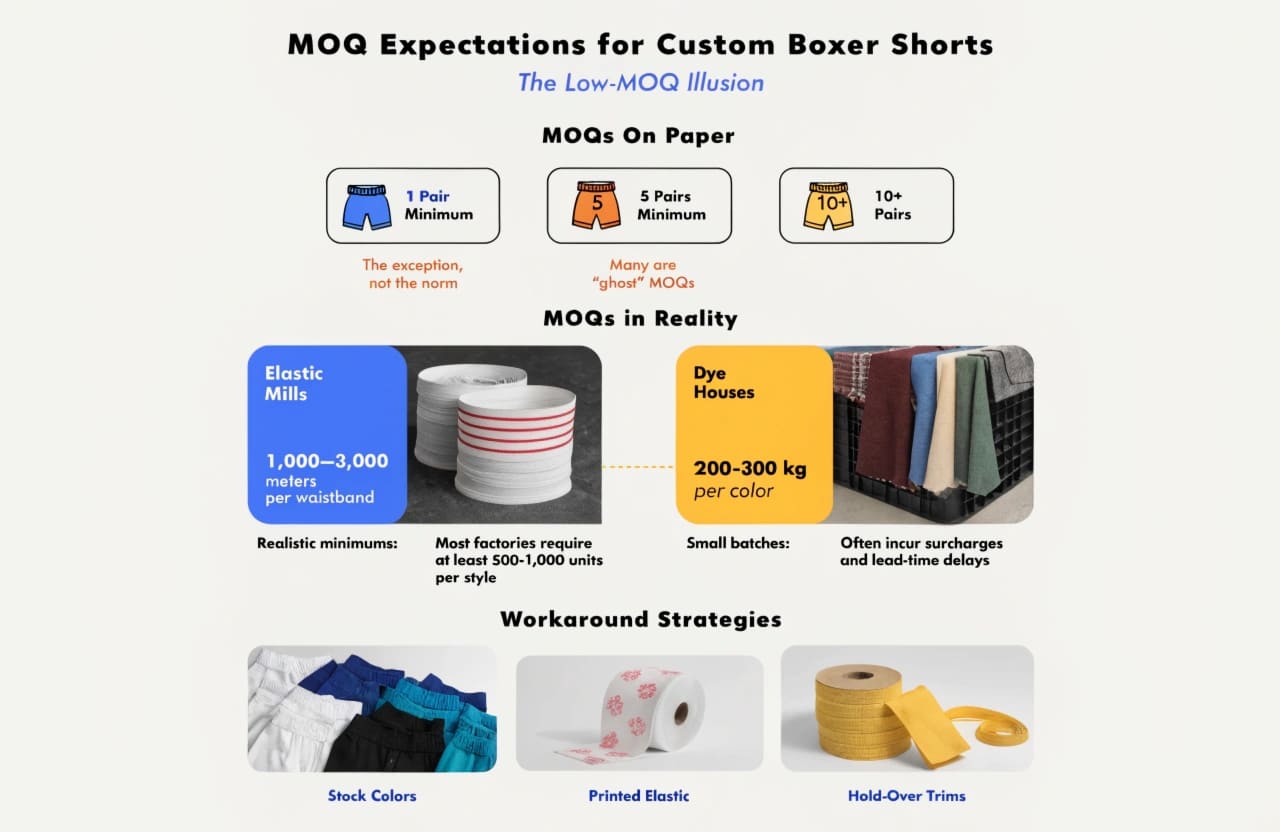
What MOQs really look like
- Fabric: Knit mills prefer 200–300 kg per color. At 500 pieces, one color may use 40–50 kg. I pick stock colors or split a lot with the factory.
- Waistband: Custom jacquard needs 1,000–3,000 meters. Each boxer uses ~0.8 m. For 500 pieces, I buy extra and store, or I use printed elastic.
- Prints: Screen print set-ups drive MOQs by color. For small runs, I choose digital or heat-transfer prints.
Where I bend, not break
- Fewer colors and sizes cut MOQs. I launch with two colors and S–XL first.
- I standardize one waistband design across styles to hit one larger MOQ.
| Component | Typical MOQ | What I do at 500 units | Notes |
|---|---|---|---|
| Body fabric | 200–300 kg/color | Use stock-dyed colors; consolidate colors | Greige + garment dye is another path4 |
| Jacquard waistband | 1,000–3,000 m | Buy 1,000 m and hold; or use printed elastic | Printed elastic MOQ: ~500–1,000 m |
| Heat-transfer label | 1,000–5,000 pcs | Order 1,000; use across sizes | Avoid woven label MOQs early |
| Packaging | 1,000–3,000 pcs | Plain polybag + insert | Boxes raise MOQs and unit cost |
I once launched 500 pairs for a DTC pilot. We used stock black and navy, one printed elastic, and a heat-transfer label. We met a 500 MOQ, protected cash, and shipped in 32 days.
Custom underwear manufacturer pricing: Factors that affect the cost per unit?
Unit price hides many parts. Fabric drives most. Elastic and sewing time matter. Small orders carry extra costs. I pull the stack apart and set clear targets.
Unit cost comes from fabric, waistband, cut-make-trim (CMT), packaging, prints, testing, and low-MOQ surcharges. For 500 boxer briefs, most quotes land between $1.20–$2.80 FOB China5, depending on choices and complexity.
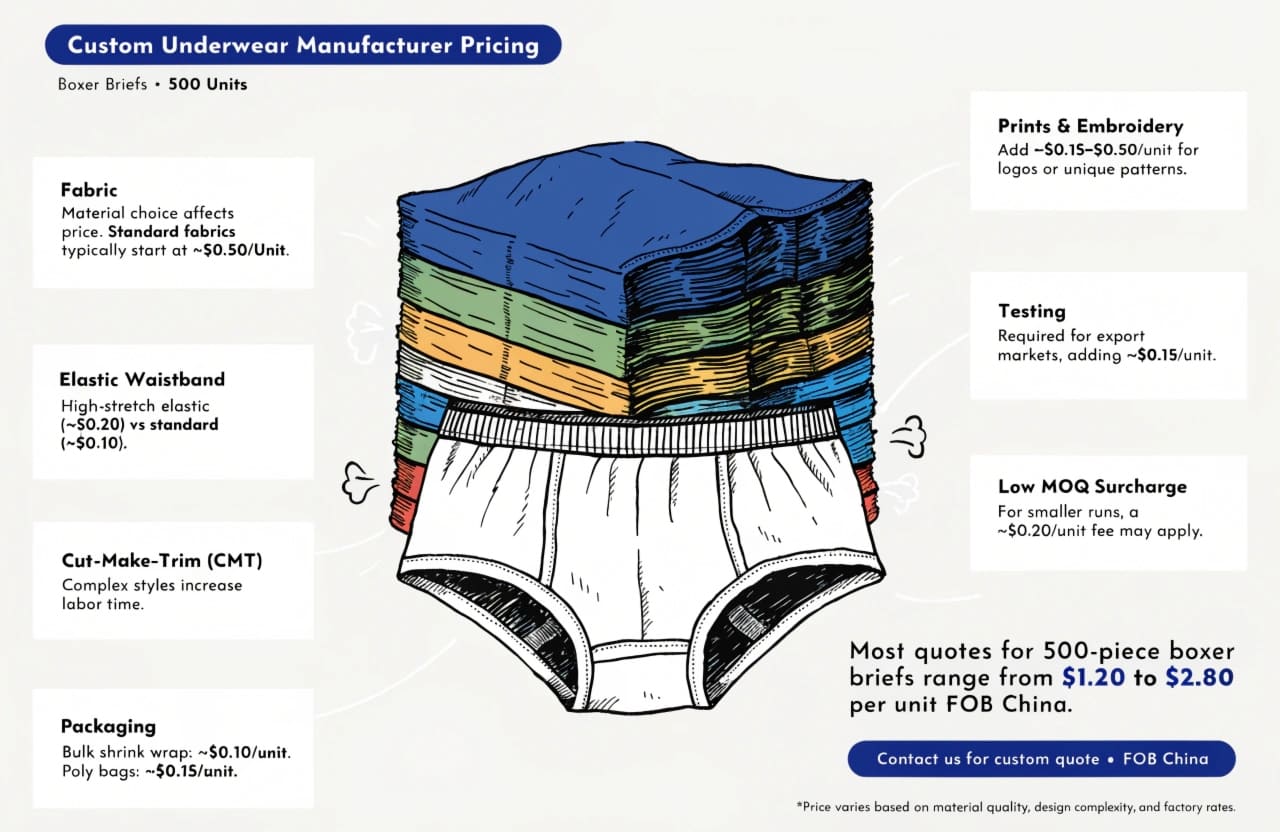
The main cost stack
- Fabric and dyeing: Biggest driver. Modal blends cost more than cotton6.
- Waistband: Jacquard is premium. Printed elastic is flexible.
- Sewing labor (CMT): Panel count, flatlock seams7, and pouch design raise time.
- Packaging: Boxes look nice but add cost and freight.
- Testing and QC: Small but essential. I never skip.
Typical ranges I see at 500 units (FOB China)
| Component | Basic Cotton/Elastane | Premium Modal/Elastane | Notes |
|---|---|---|---|
| Fabric + dyeing | $1.20–$1.80 | $1.80–$2.80 | 180–220 GSM, solid colors |
| Waistband | $0.20–$0.40 | $0.30–$0.50 | Printed elastic cheaper at low MOQs |
| CMT (sewing) | $0.30–$0.50 | $0.60–$0.80 | Flatlock seams add $0.05–$0.08 |
| Labels/prints | $0.10–$0.30 | $0.15–$0.40 | Heat-transfer vs woven |
| Packaging | $0.20–$0.40 | $0.30–$0.60 | Polybag + insert vs box |
| QC/testing | $0.05–$0.20 | $0.10–$0.25 | AQL checks8, basic tests |
| Low-MOQ adders | $0.10–$0.50 | $0.20–$0.70 | Small-lot surcharges |
One-time or per-project setup
- Pattern and grading: $120–$250 per style9.
- Jacquard waistband plate/card: $80–$250.
- Samples: $30–$80 each, 3–6 rounds typical.
- Lab tests (optional but wise): $100–$300 per style10.
These fees sit outside unit cost. I budget them upfront to avoid surprises.
How to lower the manufacturing cost of custom boxers without sacrificing quality?
Cutting cost often cuts comfort. I refuse that. I protect what buyers feel. I trim what they do not. I change process and choices, not the promise.
I standardize fabrics and trims, reduce panels, simplify packaging, and buy smarter. I keep fit, waistband recovery, and seam comfort intact. Savings come from design for manufacturing and tighter planning.
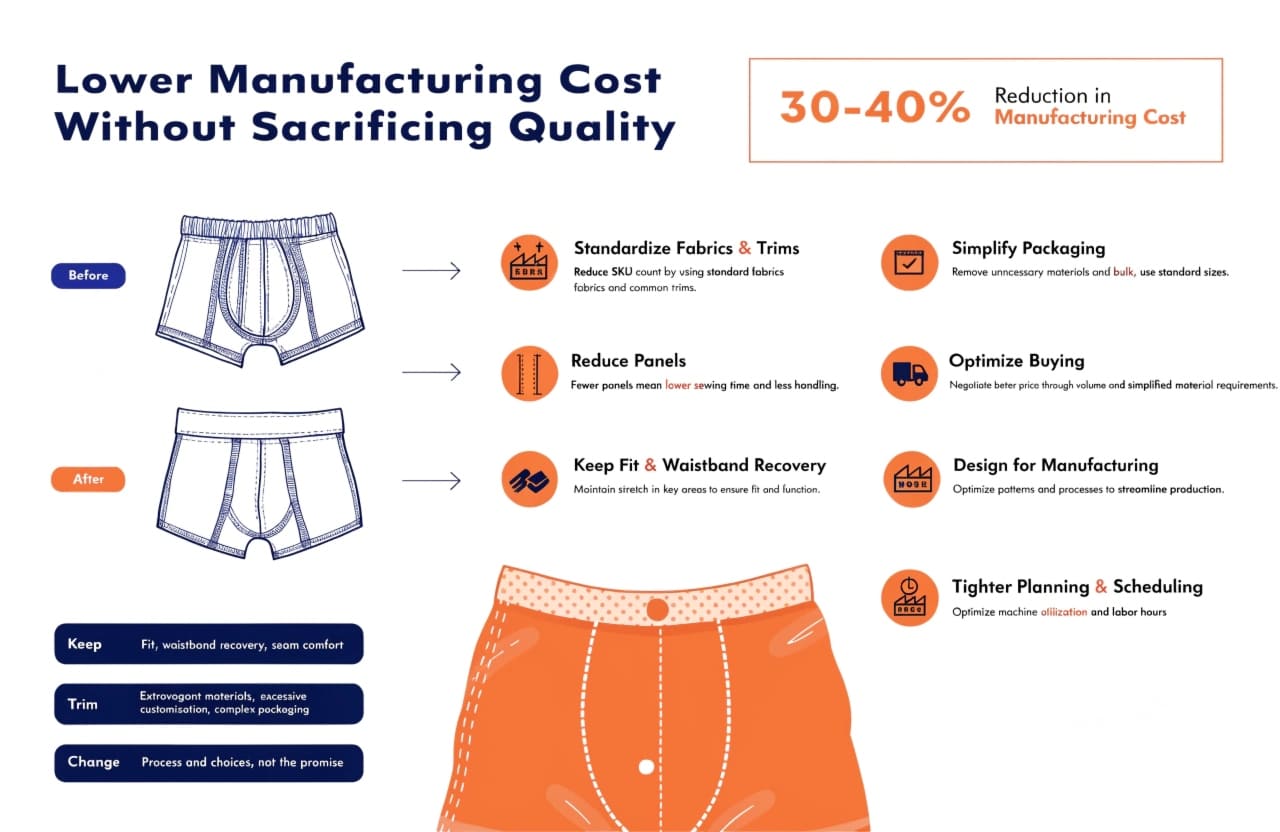
What I never cut
- Fabric hand feel and breathability.
- Waistband recovery and comfort.
- Fit and grade rules.
Where I safely save
- Use stock-dyed colors for small runs.
- Use printed elastic early, move to jacquard later.
- Reduce panels; keep flatlock only where skin rubs most.
- Switch from boxes to polybags with a strong insert.
- Consolidate colorways and sizes for the first buy.
| Tactic | Cost Impact | Quality Risk | My Note |
|---|---|---|---|
| Stock colors | −$0.20–$0.40 | Low | Faster and cheaper dyeing |
| Printed elastic | −$0.10–$0.30 | Low–Medium | Good for pilots; test recovery |
| Fewer panels | −$0.15–$0.35 | Low | Keep support in pouch |
| Targeted flatlock | −$0.20–$0.40 | Low | Use where chafe risk is high |
| Polybag + insert | −$0.30–$0.80 | None | Lighter freight too |
| Bundle orders | −3–8% | None | One PO, fewer changeovers |
| Marker optimization11 | −1–3% fabric | None | Tight cutting plans |
| Shared trims | −$0.05–$0.15 | None | One label spec across sizes |
I ran a 500-unit pilot with premium modal. We kept flatlock on the inner thigh only, moved to printed elastic, and used stock black. We saved $0.78 per unit with no comfort loss.
Lead time and sampling cost for 500 pairs of custom boxers: A B2B guide?
Small runs still need discipline. Delays hide in approvals. Timelines slip when I change designs late. I lock steps and keep decisions tight.
I plan 30–45 days from deposit to ex-factory for 500 pairs, if materials are standard. Sampling costs $150–$600 total. I keep approvals fast: lab dips, waistband, pre‑production, then bulk.
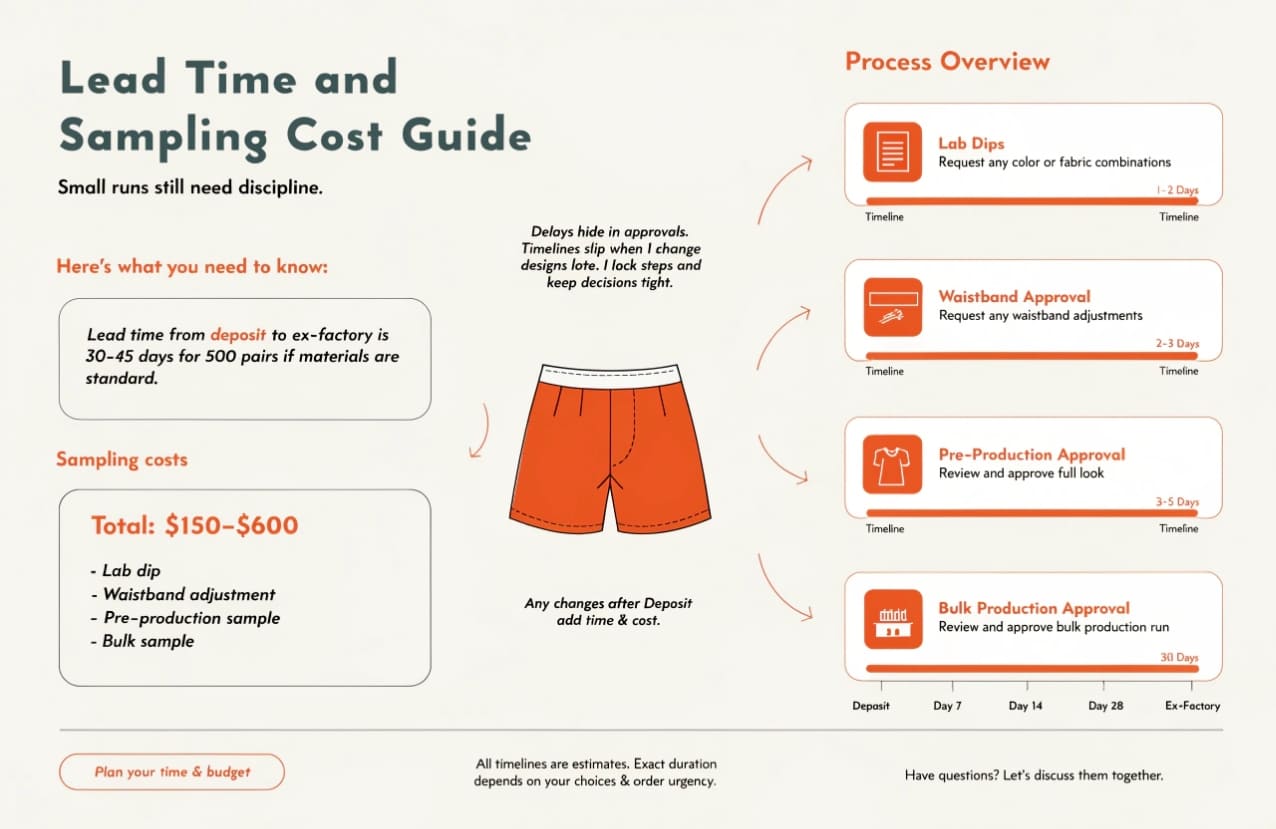
My standard timeline (FOB China)
- Development and tech pack: 2–4 days.
- Proto sample: 5–7 days with stock materials.
- Lab dips/elastic strike-offs: 5–10 days in parallel.
- Pre‑production (PP) sample: 3–5 days after approvals.
- Bulk production: 10–15 days for 500 units.
- Final inspection and pack: 2–3 days.
| Step | Duration | Typical Cost | Notes |
|---|---|---|---|
| Proto sample | 5–7 days | $30–$80 each | 1–2 rounds typical |
| Lab dips/strike-offs | 5–10 days | $0–$120 | Often credited at bulk |
| PP sample | 3–5 days | $40–$100 | Must match bulk |
| Bulk (500 pcs) | 10–15 days | In unit price | Faster with one color |
| Inspection | 1–2 days | $0–$150 | 3rd party optional |
| Freight | Air: 5–8 days; Sea LCL: 20–35 days12 | Varies | 60–90 kg est. weight |
How I keep time tight
- One color, two sizes less, and one waistband design at start.
- Approve lab dips and strike-offs within 24 hours.
- Use stock colors and printed elastic for the pilot batch.
- Book freight early. Avoid peak week surcharges.
I once shipped 500 pieces in 28 days by locking one color, printed elastic, and same-day approvals. We air-shipped the first 100 for launch photos and sent the rest by sea LCL.
Conclusion
Know your MOQs. Map your unit cost. Protect comfort. Save in smart places. Approve fast. Pilot with 500 pieces. Learn, then scale. Build by logic, not luck.
-
"Minimum Order Quantity: How Fashion MOQs Change Everything", https://tegmade.com/resources/minimum-order-quantity-how-fashion-moqs-change-everything/. Industry sourcing analyses and apparel trade reports document that contract garment factories in major manufacturing hubs typically set minimum order quantities in the range of 500–1,000 units per style, reflecting the economic thresholds of cut-and-sew operations. Evidence role: general_support; source type: research. Supports: That 500–1,000 units per style is a commonly observed MOQ threshold in apparel contract manufacturing. Scope note: Published MOQ benchmarks vary widely by product category, country of manufacture, and factory tier; a single cited figure may not capture the full distribution. ↩
-
"Exposures in the Textile Manufacturing Industry – NCBI", https://www.ncbi.nlm.nih.gov/books/NBK519215/. Textile industry technical literature and mill documentation indicate that jet and overflow dyeing machines used for knit fabrics are optimized for batch sizes that commonly start at 200 kg or above, as smaller loads reduce dye-to-liquor ratio consistency and increase per-unit cost. Evidence role: general_support; source type: institution. Supports: That commercial dye houses impose minimum batch weights, typically in the range of hundreds of kilograms, due to the economics of dyeing machinery and dye chemistry consistency. Scope note: Exact minimums depend on machine type, dye class, and individual mill policy; the 200–300 kg figure is a representative range rather than a universal standard. ↩
-
"(PDF) Design of Narrow Jacquard Fabrics with Elastomeric Threads", https://www.academia.edu/36819394/Design_of_Narrow_Jacquard_Fabrics_with_Elastomeric_Threads. Narrow fabric and elastic webbing manufacturers typically require minimum run lengths of 1,000 meters or more for custom jacquard patterns, as loom programming, warp setup, and yarn loading represent fixed costs that must be amortized across sufficient yardage. Evidence role: general_support; source type: institution. Supports: That jacquard elastic mills impose minimum run lengths in the range of 1,000–3,000 meters due to loom setup costs and yarn loading requirements. Scope note: Minimum run lengths vary by mill, jacquard complexity, and yarn count; the cited range reflects common trade practice rather than a formally published industry standard. ↩
-
"Garment Dyed vs. Piece Dyed: What’s the difference? – Bomme Studio", https://www.bommestudio.com/blog/garment-dyed-vs-piece-dye-clothing. Textile processing literature describes garment dyeing as a post-assembly coloration method in which finished garments constructed from greige (undyed) fabric are dyed in bulk, enabling manufacturers to defer color commitment and reduce fabric-stage dye-lot minimums; the method is documented as particularly applicable to knit constructions including underwear and T-shirts. Evidence role: mechanism; source type: research. Supports: That garment dyeing—dyeing assembled garments made from undyed greige fabric—is an established textile processing method that allows color decisions to be deferred, reducing minimum dye-lot constraints at the fabric stage. Scope note: Garment dyeing can produce greater color variation between units and may affect dimensional stability differently than piece-dyed fabric; suitability depends on fiber content, construction, and acceptable color tolerance. ↩
-
"[PDF] Apparel: Export Competitiveness of Certain Foreign Suppliers to the …", https://www.usitc.gov/publications/332/pub5543.pdf. Apparel sourcing cost analyses and trade data for knit underwear manufactured in China indicate that FOB unit prices for custom styles at quantities of 500–1,000 units typically range from approximately $1.00 to $3.00 depending on fabric composition, construction complexity, and trim specification, consistent with broader reported ranges for basic to mid-tier knit garments. Evidence role: statistic; source type: research. Supports: That FOB China unit costs for custom knit underwear at small-batch quantities fall in the range of approximately $1–$3 depending on material and complexity. Scope note: FOB prices are highly sensitive to exchange rates, raw material commodity cycles, factory tier, and order volume; the cited range reflects a snapshot of market conditions and should be verified against current supplier quotations. ↩
-
"[PDF] COTTON PRICE STATISTICS 2024-2025", https://www.ams.usda.gov/mnreports/cnaacps.pdf. Fiber commodity data and textile cost analyses consistently show that modal, a type of rayon produced from beech wood pulp through a specialized wet-spinning process, commands a price premium over standard cotton fiber, reflecting higher processing costs and proprietary production methods. Evidence role: statistic; source type: research. Supports: That modal fiber and modal-blend fabrics carry a higher raw material cost than conventional cotton or cotton-elastane fabrics. Scope note: Relative pricing fluctuates with cotton commodity markets, energy costs, and supplier agreements; the cost differential is directionally consistent but not fixed. ↩
-
"The Flatlock Seam – YouTube", https://www.youtube.com/shorts/QzPxpo_uPbA. Flatlock seaming, also referred to as a flat seam or cover stitch variant, joins fabric panels so that the seam allowances lie flat rather than standing proud, a construction documented in apparel engineering literature as reducing skin abrasion in close-fitting garments such as underwear and activewear. Evidence role: definition; source type: encyclopedia. Supports: That flatlock seaming is a specific stitch construction that lies flat against the skin, reducing chafe compared to raised seam alternatives, and requires additional sewing passes that increase labor cost. Scope note: The precise stitch class and cost premium vary by machine configuration and factory; the comfort benefit is widely reported but individual sensitivity differs. ↩
-
"[PDF] ISO 2859-1 – UNT Chemistry Department", https://chemistry.unt.edu/~tgolden/courses/iso2859-1.pdf. Acceptable Quality Level (AQL) inspection is defined under ISO 2859-1 (and its predecessor MIL-STD-1916) as a statistical sampling procedure that specifies the maximum number of defective units permissible in a sample for a production lot to be accepted, and is the predominant quality inspection framework cited in apparel sourcing contracts. Evidence role: definition; source type: institution. Supports: That AQL refers to the Acceptable Quality Level sampling methodology codified in international standards, widely used in garment and consumer goods inspection to determine lot acceptance. Scope note: AQL sampling does not guarantee zero defects in a lot; it provides a probabilistic acceptance criterion, and its application varies by buyer specification and defect classification. ↩
-
"What’s a fair price for production-ready patterns? – Reddit", https://www.reddit.com/r/PatternDrafting/comments/1kymjot/whats_a_fair_price_for_productionready_patterns/. Apparel production cost guides and sourcing consultancy reports document pattern making and grading as standard one-time development charges, with fees for basic styles at contract factories in Asia typically ranging from approximately $100 to $300 per style depending on complexity and the number of sizes graded. Evidence role: statistic; source type: research. Supports: That pattern making and size grading for a single apparel style is a discrete billable service with costs in the low hundreds of dollars at contract manufacturers. Scope note: Costs vary significantly by factory tier, country, style complexity, and whether the buyer supplies a base pattern; the cited range reflects mid-tier contract manufacturing and may not apply to premium technical development. ↩
-
"Fabric Testing Service Market Outlook 2025-2032", https://www.intelmarketresearch.com/fabric-testing-service-market-6872. Third-party testing laboratories such as SGS, Bureau Veritas, and Intertek publish fee schedules for standard textile test packages; basic apparel test bundles covering colorfastness, shrinkage, and composition verification are commonly priced in the range of $100–$300 per style, with costs rising for expanded chemical or performance panels. Evidence role: statistic; source type: institution. Supports: That basic textile and garment laboratory testing for a single style, covering parameters such as colorfastness, dimensional stability, and fiber content, falls in the range of $100–$300. Scope note: Actual costs depend on the specific test methods required, the certifying body, and whether tests are conducted domestically or at origin; regulatory requirements in the destination market may mandate additional testing beyond this range. ↩
-
"Examining Cut-and-Sew Textile Waste within the Apparel …", https://bren.ucsb.edu/sites/default/files/2024-04/Examining%20Cut-and-Sew%20Textile%20Waste%20within%20the%20Apparel%20Supply%20Chain%204.10.24.pdf. Industrial engineering research on apparel cutting room efficiency documents that computerized marker optimization systems improve fabric utilization by reducing inter-pattern gaps, with reported efficiency gains over manual methods typically in the range of 1–4% of total fabric consumption depending on pattern shape complexity and fabric width. Evidence role: statistic; source type: research. Supports: That computerized marker planning and optimization in garment cutting rooms can reduce fabric consumption by approximately 1–3% compared to manual or unoptimized marker layouts. Scope note: Actual savings depend on pattern geometry, fabric width, and the baseline efficiency of the unoptimized marker; gains are proportionally smaller for simple geometric patterns such as basic underwear panels. ↩
-
"A Breakdown of China to USA Shipping Time – Dimerco", https://dimerco.com/blog-post/a-breakdown-of-china-to-usa-shipping-time/. Freight forwarder and logistics industry data indicate that air cargo from major Chinese export hubs (Shanghai, Shenzhen, Guangzhou) to North American or European destinations typically transits in 5–8 business days, while less-than-container-load (LCL) ocean shipments on the same lanes average 20–35 days including port handling and consolidation time. Evidence role: statistic; source type: institution. Supports: That air freight from China to major Western markets typically takes 5–8 days and LCL ocean freight takes 20–35 days under normal conditions. Scope note: Transit times are subject to seasonal demand surges, port congestion, customs clearance delays, and carrier schedule changes; the cited ranges represent standard conditions and may not reflect peak-season or disrupted periods. ↩
Discussion & questions 0 comments