

You panic when your first underwear sample looks nothing like the inspiration photo. I’ve seen too many smart founders assume you need a fashion degree to design underwear. You don’t.
You turn visual ideas into a clear brief covering wearer, use case, fit, fabric, and production basics—no degree required, just structured communication with your factory.
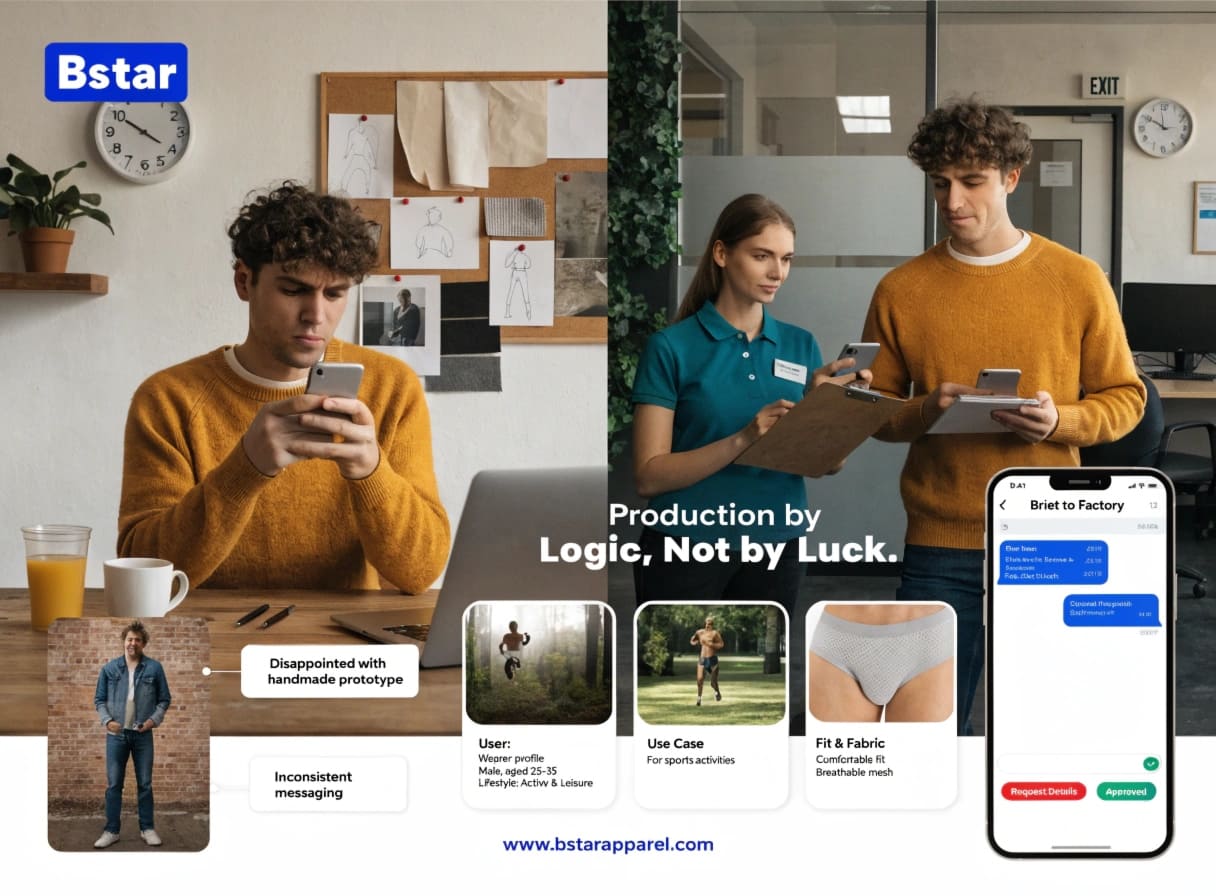
I’ve watched founders go from sending us a single competitor photo to sending a one-page spec sheet that actually leads to a wearable sample. The difference is never a design diploma—it’s learning how to break down an underwear idea into factory-friendly details. Let me walk you through the four steps that matter most.
Can online tech pack templates and freelancers really bring your underwear ideas to life?
You have a sketch on a napkin but no idea how to describe a crotch curve or waistband width in a way a factory understands. That gap stops more launches than a bad fabric ever will.
Yes, combining a simple tech pack template with a pattern maker or tech pack freelancer can turn a rough idea into a factory-ready file—without any formal design training.1
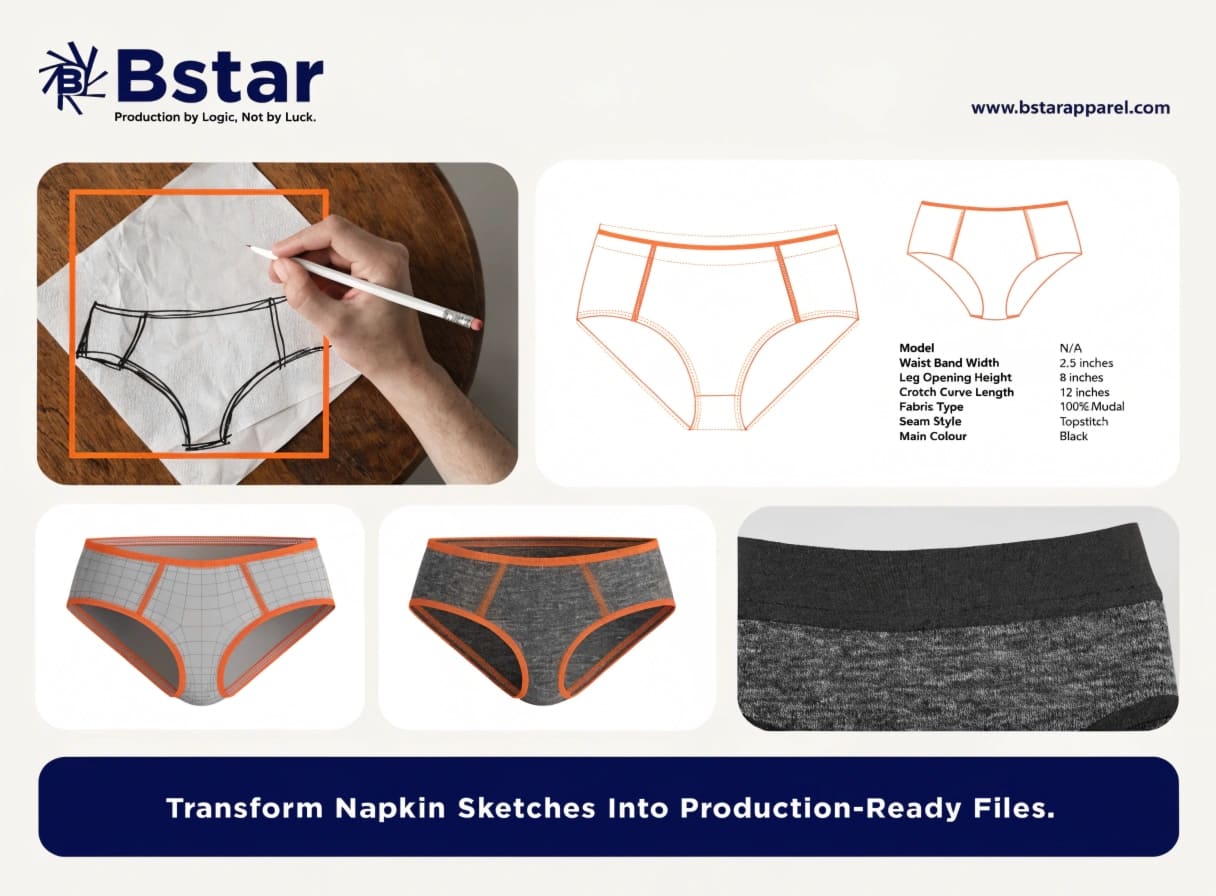
I often see founders freeze because they think a tech pack must look like a 20-page textbook file. It doesn’t need to be fancy. A clean one-page document that lists your main measurements, construction points, and fabric reference is enough to start a conversation with a sample room.2 You can download a basic men’s underwear tech pack template online. Then hire a freelancer who has done underwear tech packs before—not a general fashion assistant. Let them translate your photos or videos into a flat sketch. I remember one client who sent us a messy drawing with hand notes about “more pouch room.” Our sample maker could not guess what that meant. Once the founder worked with a freelancer to build a simple spec with a front rise, back rise, and waistband height, the next sample nailed the fit in one round. You don’t need to learn Illustrator or pattern theory. You need someone who can turn your words into numbers and lines a factory can read. That small investment avoids three or four wasted samples and months of guesswork.3
How can you analyze fit, fabric, and construction by studying existing brands without formal training?
You grab a well-known pair of boxer briefs, stretch the waistband, feel the fabric, and still don’t know why it feels different from your sample. Looking is not enough. You need a simple reverse-engineering habit.
You can learn fit, fabric behavior, and construction logic by cutting open a garment, measuring key points4, and writing down how the stretch, recovery, and handfeel5 change when you wear it—no textile degree needed.
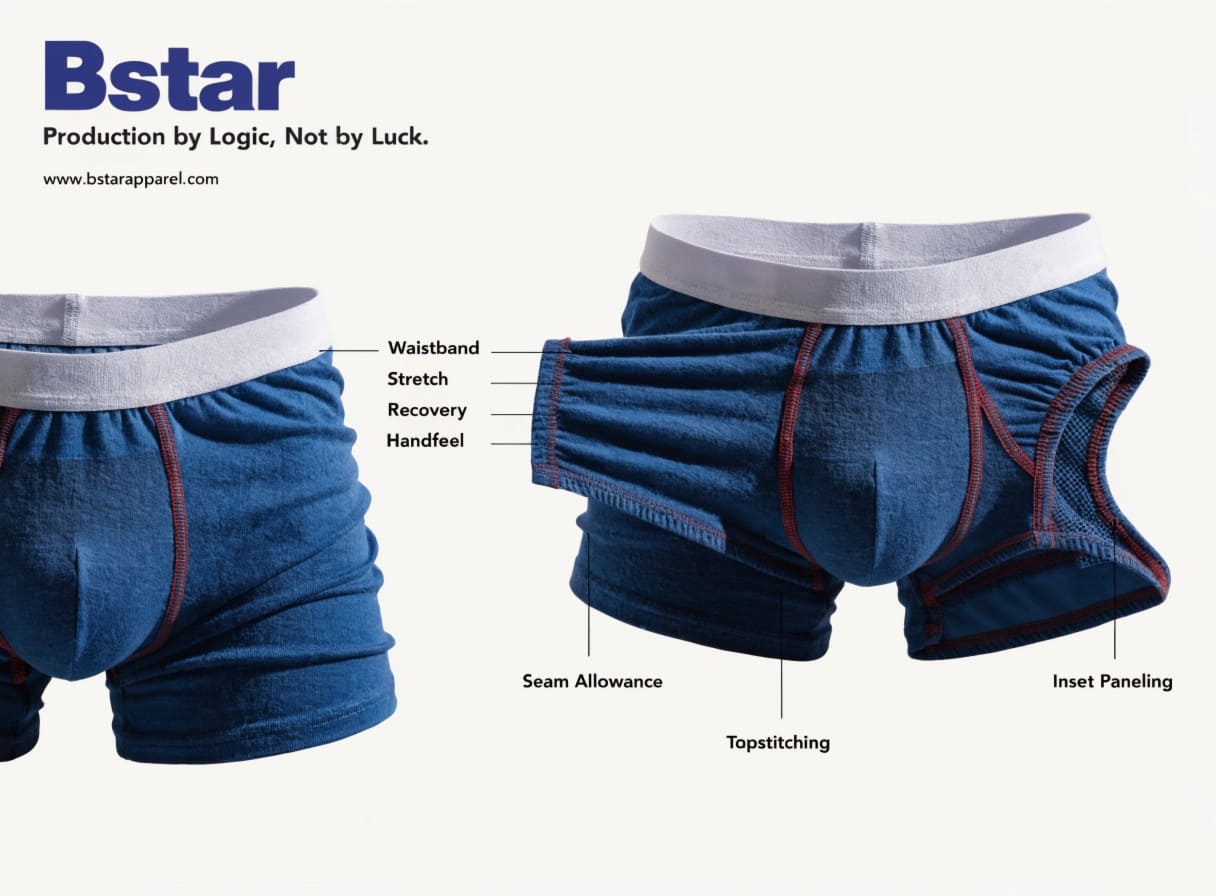
I never tell a founder to copy a competitor’s design. But I do ask them to bring a reference sample and tell me what they like and what they want to fix. For example, one founder showed me a pair they loved for sleeping but hated for daily wear because the waistband rolled down after lunch. They never thought about “compression versus relaxed fit” before. By turning the reference garment inside out, we looked at the elastic width, the stitch type, and the seam placement. We measured the waistband unstretched and stretched. That simple exercise taught them more about fit than a textbook. Another time, a founder noticed the fabric felt “soft” but sagged by afternoon. We checked the fiber blend and realized it was mostly modal with low elastane6. That led to a clear choice: add more elastane for shape retention, or keep the same softness for a home-lounge brief. Don’t just swipe photos. Buy a few pairs you admire, cut one carefully along the seams, measure every panel, and take notes on where you feel pressure or looseness after two hours of wear. That record becomes the basis of your design brief, not a photo.
How does working with a sample maker bridge the gap from sketch to production-ready underwear?
You think you have finalized the design, but the first sample arrives with a fly that gaps open and a leg opening that cuts into your thigh. The sample maker is not just a sewer—they are your first design checkpoint.
A skilled underwear sample maker turns your flat measurements and fabric choice into a physical garment7 that tells you immediately whether your idea works on a real body, and where you need to adjust.
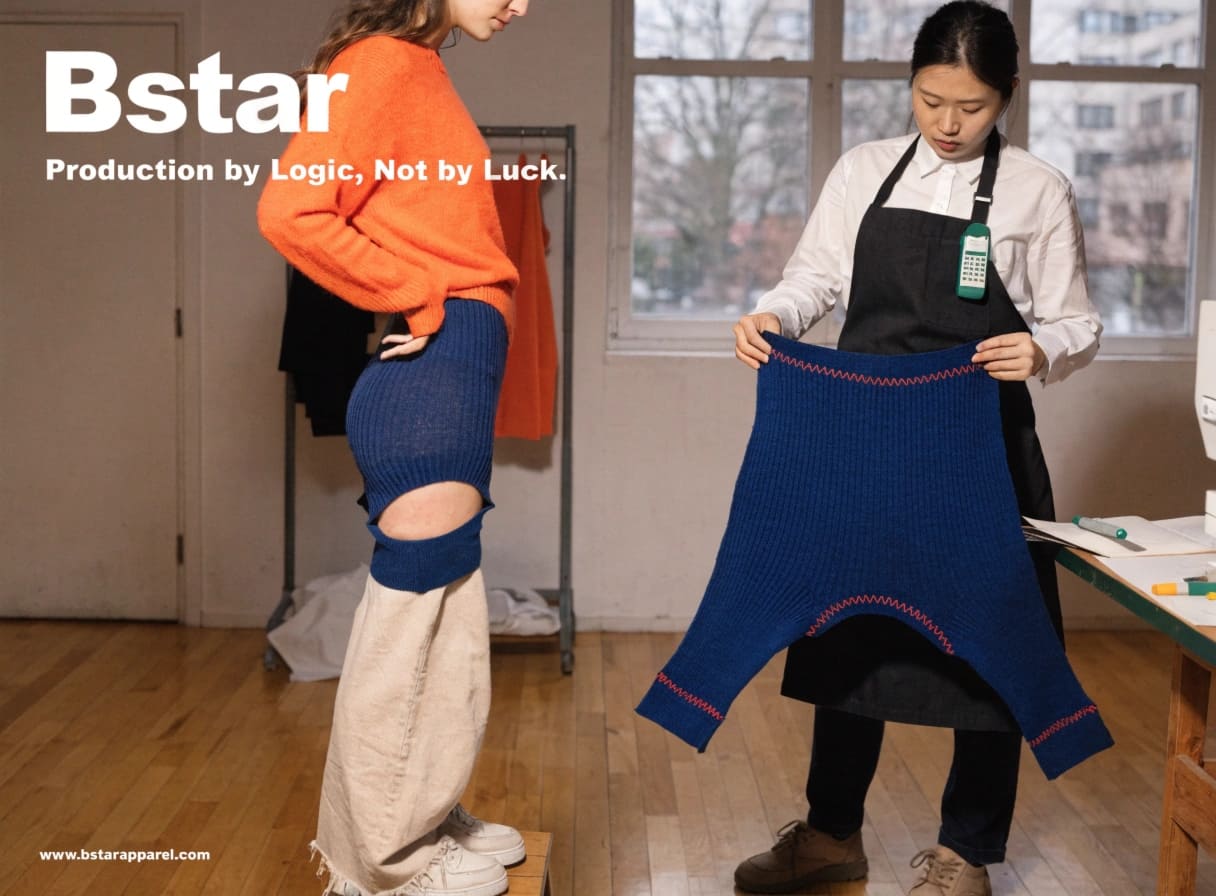
As a factory, we see the moment a sample lands in a founder’s hands for the first time. It’s either excitement or confusion. The most productive way to work with a sample maker is to treat the first sample as a three-dimensional question, not a failure. One founder sent us a spec for a low-rise trunk with a 4 cm waistband. The sample felt too tight in the front rise even though the measurement matched the spec. The sample maker suggested a “front rise drop” adjustment and a softer elastic. That tiny change made the difference between a trunk that kept slipping down and one that stayed in place without pinching. Another founder insisted on a flyless design for a running brief, but the sample’s leg opening caused chafing because the seam fell exactly on a high-movement zone. The sample maker moved the seam 1.5 cm forward and switched to a flatlock stitch. You cannot imagine that from a sketch alone. So when you get the sample, wear it for two hours, note every pinch and mark the problem areas directly on the fabric with a washable pen8. Take a photo and send it back. That loop is worth more than ten design books.
Which key design elements—waistband, fly, leg opening, seam—should you focus on first?
New founders often obsess over print or color, then the sample rides up or flips over at the waist. That kills a brand faster than a boring colorway.
The four make-or-break elements are waistband styling and tension, fly construction, leg opening shape and trim, and seam placement9—because they determine daily comfort, not looks.
I always tell founders to lock in one core brief first, then style it later. Focus on waistband width, elastic recovery10, and whether you want a turnback logo or a bonded edge. A wide waistband can feel supportive during a commute but roll down on a larger belly. A narrower one stays put better on some body shapes. Then the fly: a functional horizontal fly needs specific overlap and button or snap stiffness. A mock fly is simpler but might disappoint a customer who expects access. The leg opening is a silent pain point. Too tight and you get the “sausage effect.” Too loose and the leg rides up.11 The stitch type and the silicone strip or elastic trim can change everything. Last is seam placement. A center back seam looks neat but becomes a friction point on a bike ride. A seamless back panel with side seams works better for active use but adds production complexity. I once helped a founder pick a flatlock seam all-around12 for a swim brief because the standard overlock seam caused redness after a beach day. These choices are not about fashion degrees. They are about imagining one guy wearing your underwear from morning coffee to evening couch. If you can describe that day, a factory can help you pick the right construction path.
Conclusion
Define the wearer, pick one basic style, learn from references, and communicate details directly to your sample maker—no degree needed.
-
"Effectiveness of Technical Packages for the Apparel Production …", https://www.academia.edu/56373178/Effectiveness_of_Technical_Packages_for_the_Apparel_Production_Process_in_the_Global_Apparel_Industry. An apparel-production or technical-design source should define a technical package as the document that communicates sketches, measurements, materials, construction details, and specifications to manufacturers, supporting the claim that a concept can be translated into factory-readable instructions. Evidence role: definition; source type: education. Supports: A tech pack and qualified technical help can translate a rough underwear concept into factory-readable production information.. Scope note: Such a source would support the communication function of tech packs, but not prove that every founder can achieve production readiness without training. ↩
-
"[PDF] Clothing Fashion Fabrics And Construction Student Workbook …", https://sciphilconf.berkeley.edu/default.aspx/mL763E/603596/Clothing%20Fashion%20Fabrics%20And%20Construction%20Student%20Workbook.pdf. A garment-development source should show that initial sample requests commonly rely on core specifications such as measurements, materials, construction details, and sketches, which supports the idea that a concise starter tech pack can initiate sample-room discussion. Evidence role: expert_consensus; source type: education. Supports: A concise starter document with measurements, construction notes, and fabric references can be enough to begin sampling discussions.. Scope note: The evidence may support the required content categories rather than the specific claim that one page is always sufficient. ↩
-
"[PDF] DECODING TACIT KNOWLEDGE IN TECHNICAL DESIGN", https://ecommons.cornell.edu/server/api/core/bitstreams/cdfd9cc4-3018-45d9-ad0c-d367303cc5aa/content. A technical-design or apparel-manufacturing source should explain that complete specifications and clear production documentation reduce sampling errors, miscommunication, and redevelopment cycles, supporting the mechanism behind the claim. Evidence role: mechanism; source type: education. Supports: Clear tech-pack documentation can reduce sampling mistakes and iteration time.. Scope note: The source is unlikely to verify the exact numbers of three or four samples or months saved; those figures should be treated as anecdotal unless separately documented. ↩
-
"(PDF) Various approaches in pattern making for garment sector", https://www.academia.edu/52017759/Various_approaches_in_pattern_making_for_garment_sector. An apparel-design or textile-analysis source should describe garment analysis or reverse engineering as involving disassembly, measurement of components, and recording of construction details, supporting this method as a legitimate way to study fit and construction. Evidence role: mechanism; source type: education. Supports: Disassembling and measuring an existing garment is a valid method for studying garment construction and fit.. Scope note: Such evidence supports analysis for learning and documentation, not copying protected designs. ↩
-
"Kawabata Evaluation System – Wilson College of Textiles", https://textiles.ncsu.edu/tpacc/comfort-performance/kawabata-evaluation-system/. A textile-science source should identify stretch, elastic recovery, and tactile properties as measurable fabric characteristics that affect garment performance and wearer perception, supporting their use as evaluation criteria. Evidence role: definition; source type: paper. Supports: Stretch, recovery, and handfeel are relevant properties for evaluating underwear fabric behavior.. Scope note: The source may address textiles generally rather than underwear specifically. ↩
-
"Impact of the Elastane Percentage on the Elastic Properties of … – PMC", https://pmc.ncbi.nlm.nih.gov/articles/PMC9570736/. A textile-research source should explain that elastane fibers contribute high extensibility and elastic recovery in knitted fabrics, supporting the inference that low elastane content can reduce shape retention in stretch underwear. Evidence role: mechanism; source type: paper. Supports: Low elastane content may contribute to poor recovery or sagging in soft knitted underwear fabrics.. Scope note: Sagging also depends on knit structure, yarn count, fabric weight, finishing, and garment pattern, so fiber blend alone is not direct proof. ↩
-
"Prototype development – Cutting Edge:Product Development", https://courses.cit.cornell.edu/cuttingedge/productDev/11prodDev.htm. An apparel product-development source should describe prototype or sample garments as physical tests of design specifications, materials, fit, and construction, supporting the role of sample making in translating two-dimensional specifications into wearable forms. Evidence role: mechanism; source type: education. Supports: A sample maker converts flat specifications and material choices into a testable physical garment.. Scope note: The source may discuss apparel prototypes broadly rather than underwear sample making specifically. ↩
-
"[PDF] ABSTRACT ANDERSON, KIM SUZANNE. Seamless Textiles with …", https://repository.lib.ncsu.edu/bitstreams/c58dcc7e-69e6-47ff-a42f-d7d828cda2c7/download. A garment-fit or wear-testing source should explain that wearer trials, body-mapping comments, and marked fit corrections are used to identify pressure, restriction, and fit defects before production. Evidence role: mechanism; source type: education. Supports: Wear testing and marking discomfort areas on a sample can guide fit corrections before production.. Scope note: The exact two-hour duration is a practical suggestion and may not be prescribed by the source. ↩
-
"Comfort Performance – Wilson College of Textiles – NC State University", https://textiles.ncsu.edu/tpacc/comfort-performance/. A clothing-comfort or apparel-engineering source should show that garment pressure, closure design, openings, trims, and seam locations influence tactile comfort, mobility, and wearer satisfaction, supporting these features as comfort-critical design elements. Evidence role: expert_consensus; source type: paper. Supports: Waistband, fly, leg opening, trim, and seam placement can materially affect underwear comfort.. Scope note: The source may establish general comfort principles rather than rank these four underwear elements as the only decisive factors. ↩
-
"Study on the Compression Effect of Clothing on the Physiological …", https://pmc.ncbi.nlm.nih.gov/articles/PMC8746162/. A textile or apparel-comfort source should explain that elastic properties, band dimensions, and local pressure distribution affect how waistbands feel and perform during wear, supporting attention to waistband width and recovery. Evidence role: mechanism; source type: paper. Supports: Waistband width and elastic recovery influence fit, pressure, and comfort.. Scope note: Evidence may not specify which waistband width is best for all body shapes, because comfort depends on wearer anatomy, posture, and material properties. ↩
-
"Effects of Compression Pants with Different Pressure Levels on …", https://pmc.ncbi.nlm.nih.gov/articles/PMC12349599/. A garment-fit or clothing-pressure source should show that excessive tightness can create localized compression and visible indentation, while insufficient fit control can allow garment displacement during movement, supporting the stated leg-opening tradeoff. Evidence role: mechanism; source type: paper. Supports: Leg-opening tension affects compression, appearance, and garment ride-up.. Scope note: The colloquial term “sausage effect” may not appear in scholarly sources; evidence will likely address pressure marks, indentation, or garment displacement more generally. ↩
-
"Figure 5 – from Effect of Stitch Density and Stitch Type on", https://www.academia.edu/figures/44639637/figure-5-flatlock-stitch-class-with-spi-spi-spi-and-spi. A sportswear or textile-construction source should describe flatlock seams as low-profile seams used to reduce bulk and skin irritation in close-fitting or active garments, supporting their selection for comfort-sensitive underwear and swimwear. Evidence role: mechanism; source type: paper. Supports: Flatlock seams can reduce seam bulk and potential skin irritation in close-fitting garments.. Scope note: The source would support the general comfort rationale for flatlock seams, not prove that the specific beach-day redness in the anecdote was caused by overlock seams. ↩
Discussion & questions 0 comments