
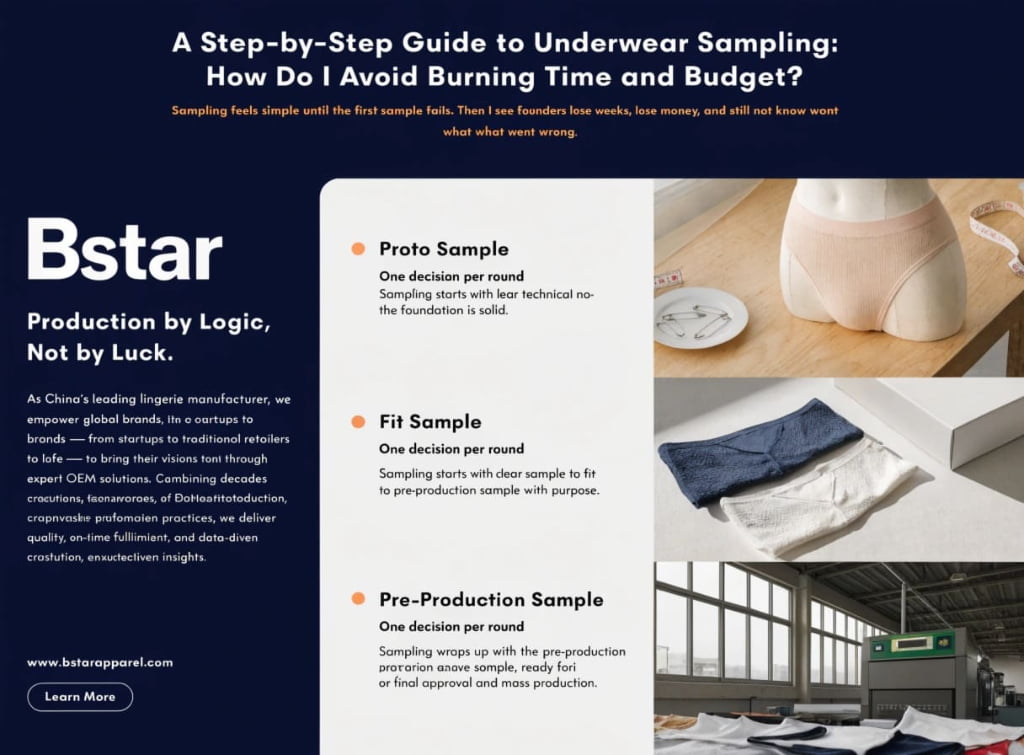
Sampling feels simple until the first sample fails. Then I see founders lose weeks, lose money, and still not know what went wrong.
Underwear sampling works best when I treat it as product development, not free shopping. I start with clear technical information, test one decision per round, approve each detail in writing, and move from proto sample to fit sample to pre-production sample with purpose.
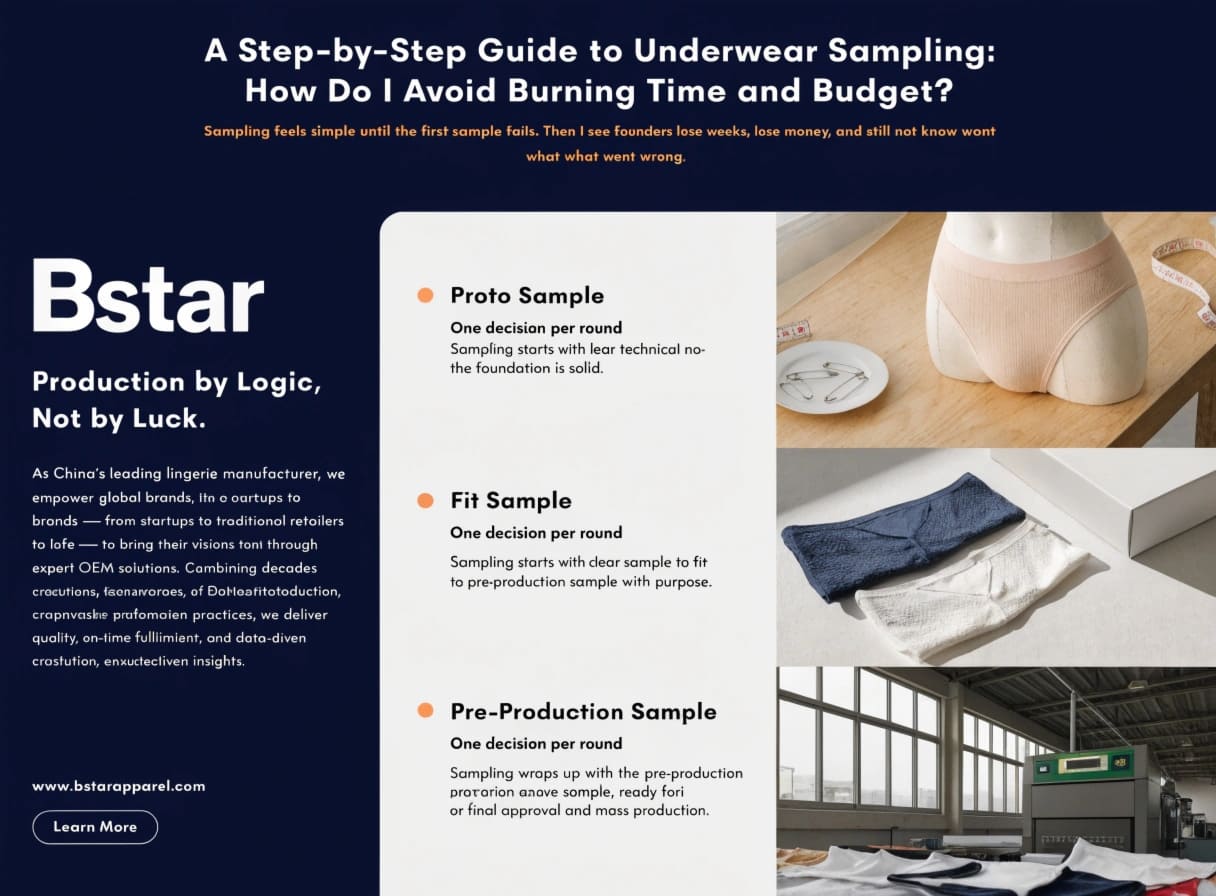
I have handled many sampling emails from new DTC founders. The most dangerous message is still the same: “Just make it like this photo.” In Chinese, we hear it as “按这个图片做.” That one sentence can kill a timeline. A photo gives me a look. It does not give me fabric weight, stitch type, elastic tension, gusset build, label size, or fit rules. If I guess wrong, the sample comes back wrong. If I ask late, the project slows down. So I want to walk through the sampling path from my side of the factory table, before a good idea becomes a three-month headache.
From Tech Pack to Proto Sample: How Is the First Underwear Sample Made?
A vague idea feels exciting at first. But when I open an email with only a front photo, I already know the sample will need extra rounds.
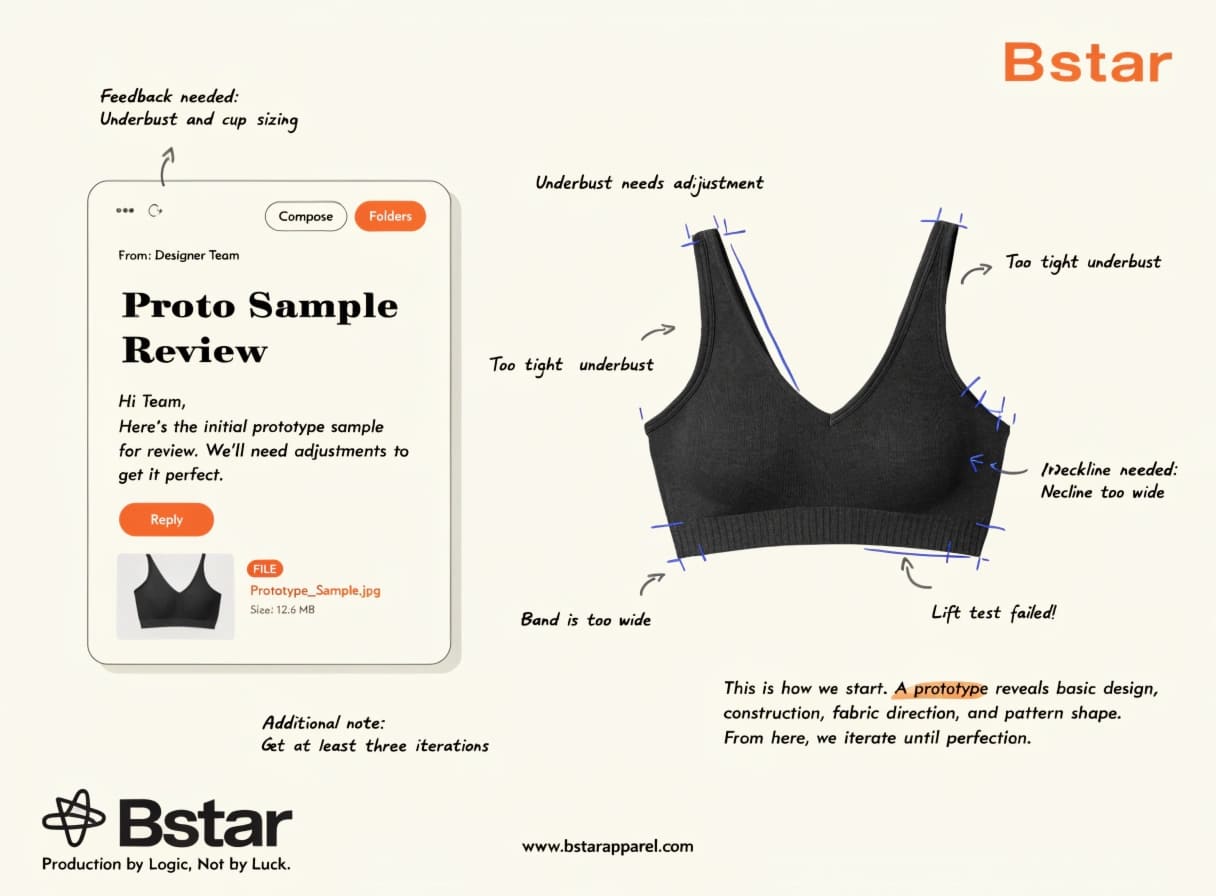
A proto sample is the first physical version of your underwear idea.1 I use it to test the basic design, construction, fabric direction, and pattern shape before I talk about bulk production.
Before my factory touches fabric, the real work is translation. A founder may tell me, “I want it to feel premium but not too expensive.” I cannot cut that sentence. I need to turn it into fabric weight, fiber blend, waistband width, stitch choice, gusset construction, and target unit price.2 This is where many projects either become clear or start drifting.
A photo does not tell me enough. I cannot know the spandex content from an image.3 I cannot know if the waistband has strong recovery or soft pressure. I cannot know if the leg opening uses coverstitch, binding, or folded clean finish. I cannot know if the gusset is single layer, double layer, cotton lined, or self-fabric. I also cannot know how the fit should change from S to XL.
| Brand words I often hear | What I need to translate them into |
|---|---|
| “Premium feel” | Fabric weight, hand feel, fiber blend, stretch recovery |
| “Not too tight” | Waistband tension, leg opening tension, fit measurements |
| “Like this photo” | Pattern shape, seam position, gusset type, stitching method |
| “Good for daily wear” | Breathability, wash stability, comfort seams, fabric cost |
| “Minimal design” | Label placement, trim level, stitch color, finish detail |
One startup once sent me a strong tech pack, size chart, fabric direction, and target price on day one. We made the proto sample, they gave focused comments, and they had a usable sample direction in about two weeks. That was not magic. That was preparation. They did not ask me to guess ten things at once. They gave me enough information to make the first sample a test, not a gamble.
Fit Sample vs. Pre-Production Sample: What Is the Difference and Why Do I Need Both?
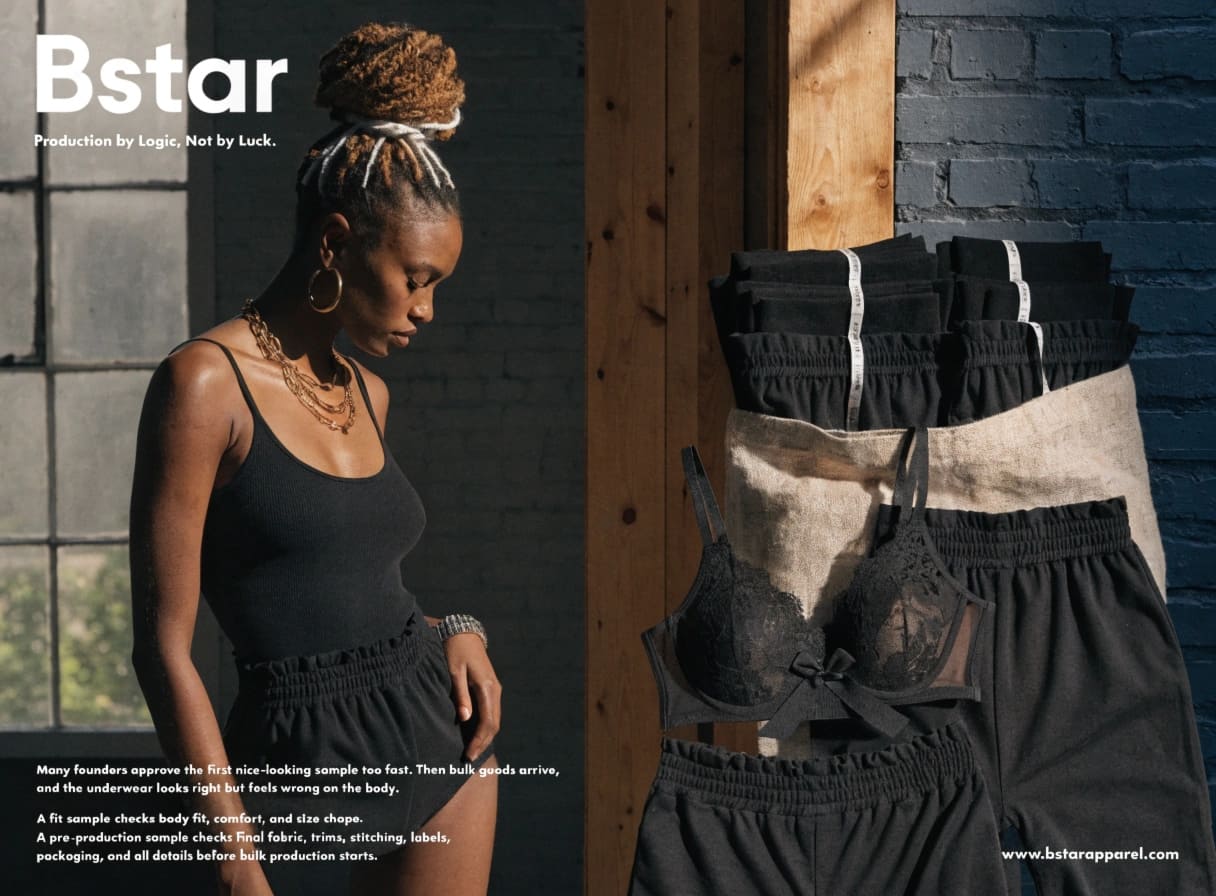
Many founders approve the first nice-looking sample too fast. Then bulk goods arrive, and the underwear looks right but feels wrong on the body.
A fit sample checks body fit, comfort, and size shape.4 A pre-production sample checks final fabric, trims, stitching, labels, packaging, and all details before bulk production starts.5
I separate fit samples and pre-production samples because they answer different questions. A fit sample asks, “Does this underwear sit on the body correctly?” A pre-production sample asks, “Can the factory make this exact product in bulk?” If I mix those two jobs, I lose control.
For underwear, fit is not only waist size. A small change in back rise can change coverage.6 A small change in gusset width can change comfort. A small change in elastic tension can turn “secure” into “digging.”7 So I want the fit sample to focus on the base size first. In many cases, that means M or L, based on the brand’s target customer.
| Sample type | Main question | What I check |
|---|---|---|
| Proto sample | Is the idea workable? | Shape, construction, fabric direction |
| Fit sample | Does it fit the body? | Waist, rise, leg opening, gusset, comfort |
| Size set sample | Does grading work? | S-XL measurement change, balance, coverage |
| Pre-production sample | Is bulk ready? | Final fabric, trims, labels, sewing, packaging |
I once worked with a founder who wanted to skip the pre-production sample to save money. They had already spent money on several fit rounds, and they felt tired. I understood that feeling. But their final waistband supplier had changed, and the new elastic had stronger recovery. If they had gone straight to bulk, every piece would have felt tighter than approved. That small “saving” could have become a full order problem.
The pre-production sample is not a decoration. I treat it like a contract in fabric form. It should match the final bill of materials, final color, final label, final sewing method, and final packing. If something is not approved at this stage, I do not want to discover it after 10,000 pieces are sewn.
How Many Rounds of Sampling Are Typical for Custom Underwear and How Can I Avoid Delays?
Sampling delays rarely come from sewing alone. I see delays start when one round tries to answer ten questions at the same time.
Most custom underwear projects need two to four sample rounds.8 I reduce delays when I test one main variable per round, give clear comments, and avoid changing fabric, fit, and trims together.
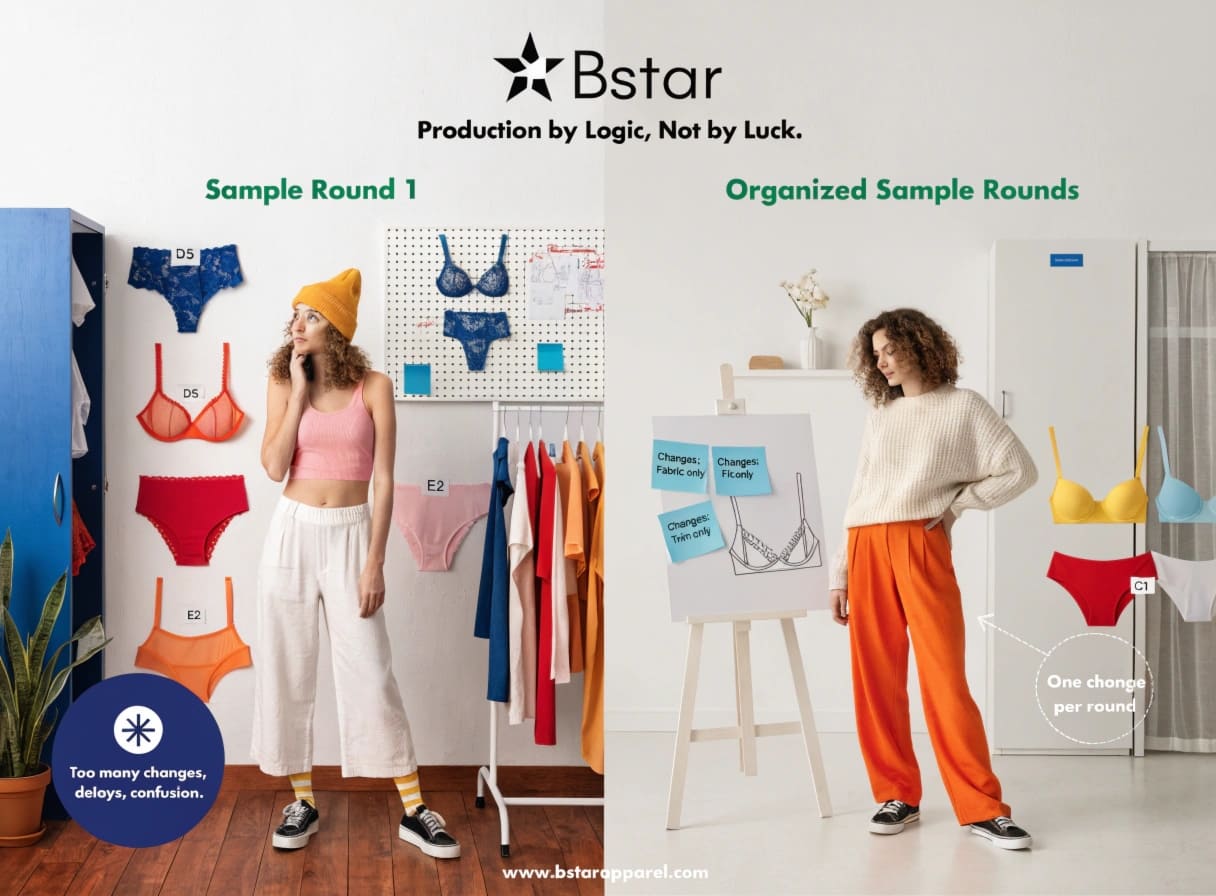
I like “sampling with purpose.” Each sample round should answer one decision. If the first round tests fabric hand feel, then I do not also change the waistband, gusset, stitch color, and label position. If the second round tests fit, then I do not also request three new fabrics. This sounds slow, but it is faster in real life.
The worst pattern I see is this: “Send me a few styles, and I will see what I like.” That turns sampling into a museum tour. The founder looks around, reacts to random pieces, and never builds a product. The factory keeps making samples, but no decision gets locked.
| Round | Best purpose | Bad purpose |
|---|---|---|
| Round 1 | Confirm shape and construction | Try five unrelated ideas |
| Round 2 | Adjust fit on base size | Change fabric, waistband, and fit together |
| Round 3 | Confirm final trims and labels | Restart the full design |
| Round 4 | Pre-production approval | Add new features before bulk |
I remember one project that became a three-month death march. The founder started with only a photo. After the first sample, they changed the fabric. After the second sample, they changed the waistband. After the third sample, they changed coverage. Then they asked why the fit no longer matched the earlier version. Each change moved the target. No one was lazy. No one was cheating. The process was just uncontrolled.
Sample lead time also feels unreasonable when the upstream chain is invisible. One sample may need fabric sourcing, color checking, pattern making, cutting, sewing, finishing, and internal QC.9 Fabric mills may have minimums that are larger than one sample needs.10 Elastic suppliers may not keep every width and color in stock. Pattern work takes time even if we sew only one piece. The setup cost does not shrink to zero because the order is small.
So I tell founders to decide the question before each round. Write it at the top of the email. “This round is for fit only.” “This round is for fabric hand feel only.” “This round is for final label placement only.” That one habit saves more time than any rush fee.
Approving Samples Correctly: What Should I Check for Fabric, Stitching, Waistband, and Label Placement?
A beautiful sample can still be unsafe to approve. If I approve by feeling alone, I may leave key details open to factory interpretation.
I approve underwear samples with a written checklist.11 I check fabric, measurements, stitching, waistband tension, gusset, label placement, color, trims, and packaging before I allow production to move forward.
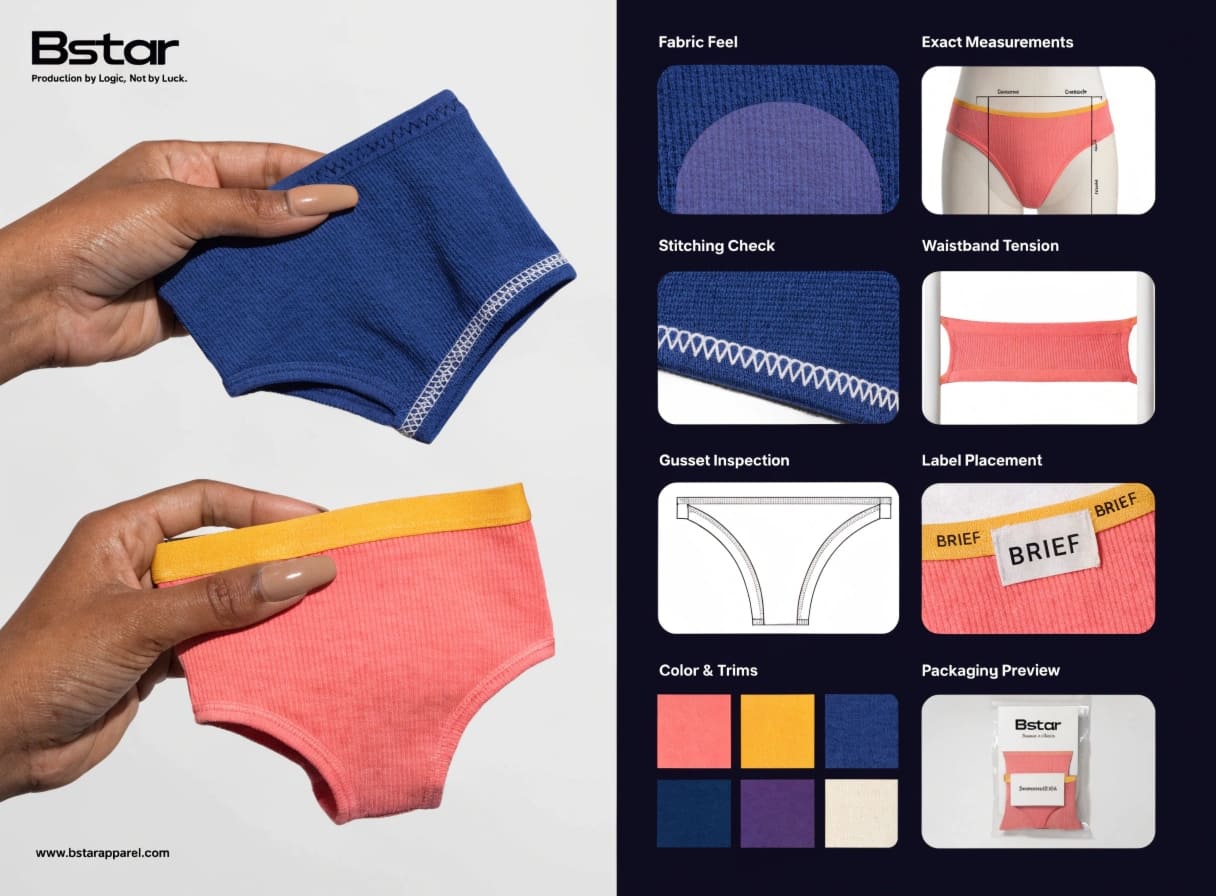
I never like approval comments such as “Looks good, go ahead.” That sentence gives everyone too much room. If there is a dispute later, nobody knows what “good” meant. I prefer clear approval: fabric approved, fit approved, waistband approved, stitching approved, label position approved, packaging pending. Simple words protect both sides.
The budget implosion I remember most came from uncontrolled approvals. A founder ordered many samples across several factories. They paid for express shipping every time. They kept changing colors, fabrics, and labels before locking the base product. After two months, they had a box full of samples and no approved SKU. Their budget for bulk production had already been damaged. The problem was not that sampling costs existed. The problem was that every sample had no decision behind it.
| Approval item | What I check | Common mistake |
|---|---|---|
| Fabric | Blend, weight, stretch, hand feel, color | Approving by photo only |
| Stitching | Stitch type, thread color, seam strength | Ignoring inside seams |
| Waistband | Width, softness, recovery, tension | Choosing only by logo look |
| Gusset | Shape, layers, fabric, seam comfort | Forgetting comfort in wear |
| Label | Position, size, material, skin feel | Placing it where it scratches |
| Measurements | Waist, rise, leg opening, inseam if any | Checking only flat width |
| Packing | Polybag, hangtag, barcode, folding | Leaving it until production |
For fabric, I want the buyer to touch it, stretch it, and wash it if possible. For stitching, I want the inside checked, not only the outside. For waistband, I want both appearance and pressure checked. A branded elastic may look premium, but it can ruin comfort if the recovery is too strong. For label placement, I always ask where it sits on skin. A nice woven label can become a complaint if it scratches the waist or side seam.12
I also ask founders to record comments in one document. Photos with arrows help. Measurements help. Short notes help. Voice messages and scattered chats do not help much when a pattern maker, merchandiser, sewing team, and QC person all need the same answer. I do not need fancy language. I need clear decisions.
Conclusion
I treat underwear sampling as a decision path. Clear inputs, focused rounds, and written approvals help me turn an idea into a product.
-
"Prototype development – Cutting Edge:Product Development", https://courses.cit.cornell.edu/cuttingedge/productDev/11prodDev.htm. An apparel product development source defines a prototype or proto sample as an early physical garment used to evaluate design intent, materials, construction, and fit before production decisions are finalized. Evidence role: definition; source type: education. Supports: A proto sample is the first physical version of an underwear idea and is used to test basic design, construction, fabric direction, and pattern shape before bulk production.. Scope note: This support is general to apparel product development and may not be underwear-specific. ↩
-
"Effectiveness of Technical Packages for the Apparel Production …", https://www.academia.edu/56373178/Effectiveness_of_Technical_Packages_for_the_Apparel_Production_Process_in_the_Global_Apparel_Industry. Apparel technical-design references describe tech packs and product specifications as documents that translate design concepts into measurable requirements such as materials, measurements, construction details, trims, and costing parameters. Evidence role: mechanism; source type: education. Supports: In apparel sampling, subjective design language must be translated into measurable specifications such as fabric weight, fiber blend, trims, construction, and target price.. Scope note: The source would support the general translation process, not the author’s specific factory workflow. ↩
-
"The Textile Products Identification Act | Federal Trade Commission", https://www.ftc.gov/legal-library/browse/rules/textile-products-identification-act-text. Textile identification and testing references note that fiber composition is determined through labeling, documentation, or analytical testing rather than visual inspection alone. Evidence role: mechanism; source type: research. Supports: A photograph alone cannot establish the spandex content or full fiber composition of a fabric.. Scope note: This supports the broader principle that fiber content cannot be reliably confirmed from a photograph, not every individual fabric case. ↩
-
"[PDF] Body Measurement Chart Printable – sciphilconf.berkeley.edu", https://sciphilconf.berkeley.edu/sites/mL6G14/603317/Body%20Measurement%20Chart%20Printable.pdf. Apparel production references describe fit samples as garments evaluated on the body or form to assess fit, comfort, proportions, and measurement accuracy before further production approval. Evidence role: definition; source type: education. Supports: A fit sample is used to check body fit, comfort, and size shape.. Scope note: Definitions vary by company, but the role of fit evaluation is consistent across apparel development sources. ↩
-
"[PDF] SENANAYAKE, MUDITHA MANJULA. MIXED MASS PRODUCTION …", https://repository.lib.ncsu.edu/bitstreams/9f922f66-92cf-4a2e-909a-29d44b3bbaf0/download. Apparel manufacturing references define a pre-production sample as the approved production-standard sample made with final materials, trims, construction, labeling, and packaging details before bulk manufacturing begins. Evidence role: definition; source type: education. Supports: A pre-production sample checks final fabric, trims, stitching, labels, packaging, and other final details before bulk production.. Scope note: The exact checklist can differ by product category and buyer requirements. ↩
-
"[PDF] Pattern Making For Fashion Design – sciphilconf.berkeley.edu", https://sciphilconf.berkeley.edu/filedownload.ashx/mLA1F4/604912/Pattern%20Making%20For%20Fashion%20Design.pdf. Patternmaking and apparel fit sources explain that rise measurements affect garment position and body coverage, particularly in close-fitting lower-body garments. Evidence role: mechanism; source type: education. Supports: Changes in back-rise measurement can affect underwear coverage and fit.. Scope note: The support is likely to be general to pants, briefs, or lower-body patternmaking rather than specific to every underwear style. ↩
-
"The Effect of Waistbands on Intra-Abdominal Pressure … – PubMed", https://pubmed.ncbi.nlm.nih.gov/39178170/. Clothing comfort research links garment pressure and elastic tension to wearer comfort, noting that excessive localized pressure can cause discomfort or a digging sensation. Evidence role: mechanism; source type: paper. Supports: Small changes in elastic tension can alter perceived comfort and may make underwear feel like it digs into the body.. Scope note: The research may discuss clothing pressure generally rather than underwear waistbands specifically. ↩
-
"[PDF] RFID & Analytics Driving Agility in Apparel Supply Chain", https://dspace.mit.edu/bitstream/handle/1721.1/121286/Kumar_Ting_2019.pdf?sequen. Apparel product development sources describe sampling as an iterative process with multiple prototype, fit, and approval rounds before production; this contextual evidence supports the expectation of several rounds, though it may not verify the exact two-to-four range for underwear. Evidence role: general_support; source type: education. Supports: Custom underwear projects commonly require multiple sample rounds before approval, often described here as two to four rounds.. Scope note: The exact number of rounds is likely practice-based and may vary by product complexity, brand requirements, and supplier process. ↩
-
"Garment Production Process | BEVERLY HILLS DESIGN INSTITUTE", https://bhdi.edu/industry/global-market/garment-production-process/. Apparel manufacturing process references outline sequential stages including material sourcing, pattern development, cutting, sewing, finishing, inspection, and quality control, supporting the claim that even a sample can involve multiple production steps. Evidence role: mechanism; source type: education. Supports: Making one apparel sample can require fabric sourcing, color checking, pattern making, cutting, sewing, finishing, and internal quality control.. Scope note: The source may describe general garment production rather than the exact workflow for a single underwear sample. ↩
-
"Threading Your Way Through the Labeling Requirements …", https://www.ftc.gov/business-guidance/resources/threading-your-way-through-labeling-requirements-under-textile-wool-acts. Textile sourcing and manufacturing references discuss minimum order quantities in fabric production, supporting the general point that mills may require purchases above the amount needed for a single sample. Evidence role: general_support; source type: institution. Supports: Fabric mills may set minimum order quantities larger than the fabric required for one prototype sample.. Scope note: Minimums vary by mill, fabric type, dyeing process, and market conditions; the source would support the practice, not a universal rule. ↩
-
"Iso 9001 Requirements Checklist", https://sciphilconf.berkeley.edu/sites/mL0C0E/600320/iso-9001_requirements_checklist.pdf. Quality-management and apparel inspection sources emphasize documented checklists and specifications for verifying product requirements before production, supporting written approval as a control method. Evidence role: expert_consensus; source type: institution. Supports: Underwear samples should be approved with a written checklist covering relevant product requirements before production proceeds.. Scope note: The source may address manufacturing quality systems generally rather than underwear sample approval specifically. ↩
-
"A Brief Review on Factors Affecting the Tribological Interaction …", https://pmc.ncbi.nlm.nih.gov/articles/PMC8948776/. Dermatology and textile-comfort sources note that clothing materials, seams, labels, and friction can contribute to skin irritation or discomfort, supporting the concern that label placement and material can affect wearer comfort. Evidence role: mechanism; source type: paper. Supports: A woven label placed against the skin may cause scratching or discomfort at the waist or side seam.. Scope note: Such sources generally support irritation risk from clothing contact and friction, not complaint rates for a specific underwear label. ↩
Discussion & questions 0 comments