
Contract Manufacturing Agreement: Key Clauses for Underwear OEM?
Most first-time OEM buyers treat the contract as a formality. Sign it, file it, move on. That assumption is expensive.
A contract manufacturing agreement for underwear OEM is a risk map. Every vague clause assigns a cost to someone — and if you don’t know which clauses are vague, that cost lands on you. This guide walks through four clause areas that matter most for small-batch, DTC underwear orders, and where buyers typically get caught off guard.
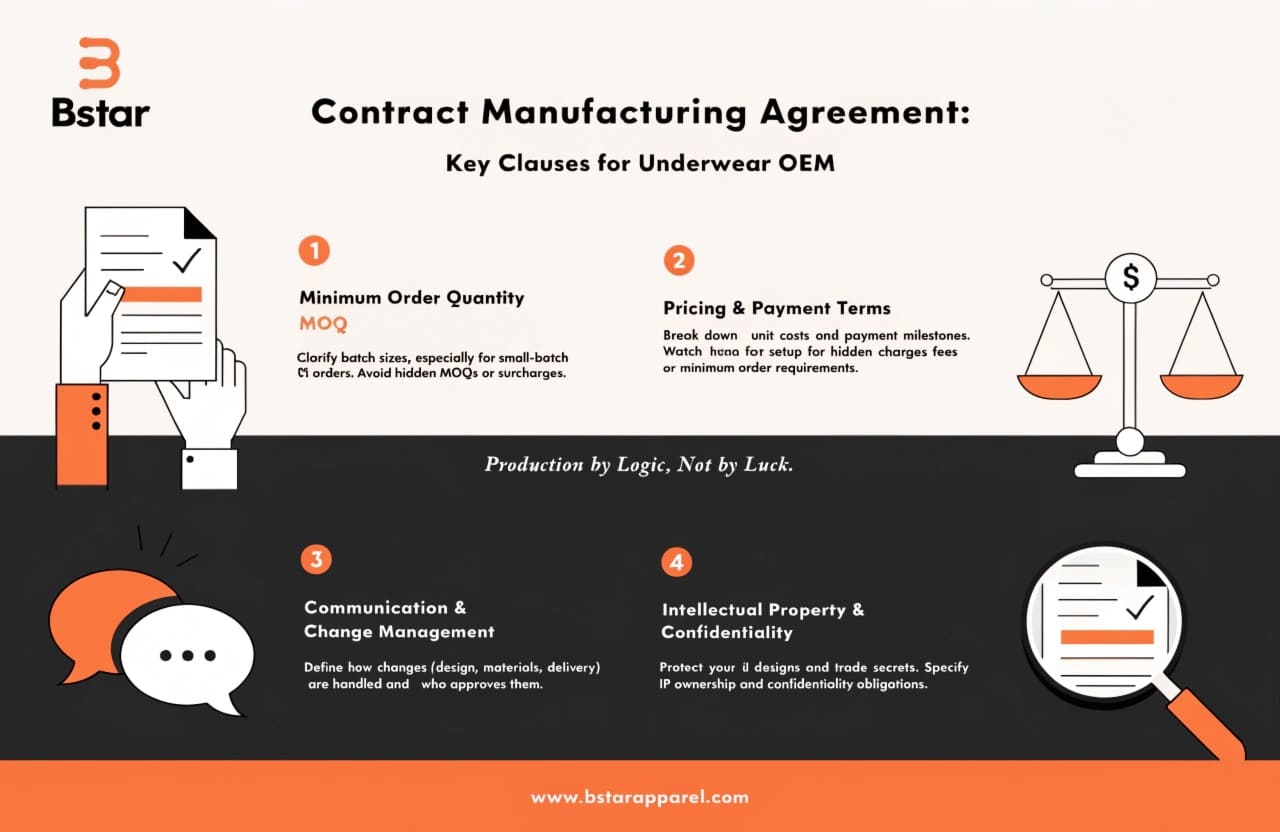
Most buyers come to us with a product concept, a tech pack, and a timeline in their head. What they don’t always have is a clear picture of what the contract is actually allocating between both sides. These four areas are where the gaps show up most often.
Contract Manufacturing Agreement: Key Clauses for Underwear OEM?
Most first-time OEM buyers treat the contract as a formality. Sign it, file it, move on. That assumption is expensive.
A contract manufacturing agreement for underwear OEM is a risk map. Every vague clause assigns a cost to someone — and if you don’t know which clauses are vague, that cost lands on you. This guide walks through four clause areas that matter most for small-batch, DTC underwear orders, and where buyers typically get caught off guard.
Most buyers come to us with a product concept, a tech pack, and a timeline in their head. What they don’t always have is a clear picture of what the contract is actually allocating between both sides. These four areas are where the gaps show up most often.
Intellectual Property Protection: Are Your Designs Actually Protected?
You spent months developing your tech pack, your fit profile, your custom waistband mold. You send everything to a factory to get a quote. What happens to that information if the relationship doesn’t move forward?
NNN agreements — Non-Disclosure, Non-Use, Non-Circumvention — are the standard commercial tool for this in China-based OEM relationships1. They work differently from a Western NDA, and that difference matters. An NDA tells a party not to share your information. An NNN goes further: it also restricts the factory from using your designs independently or cutting you out of the supply chain2 and selling directly to your customers.
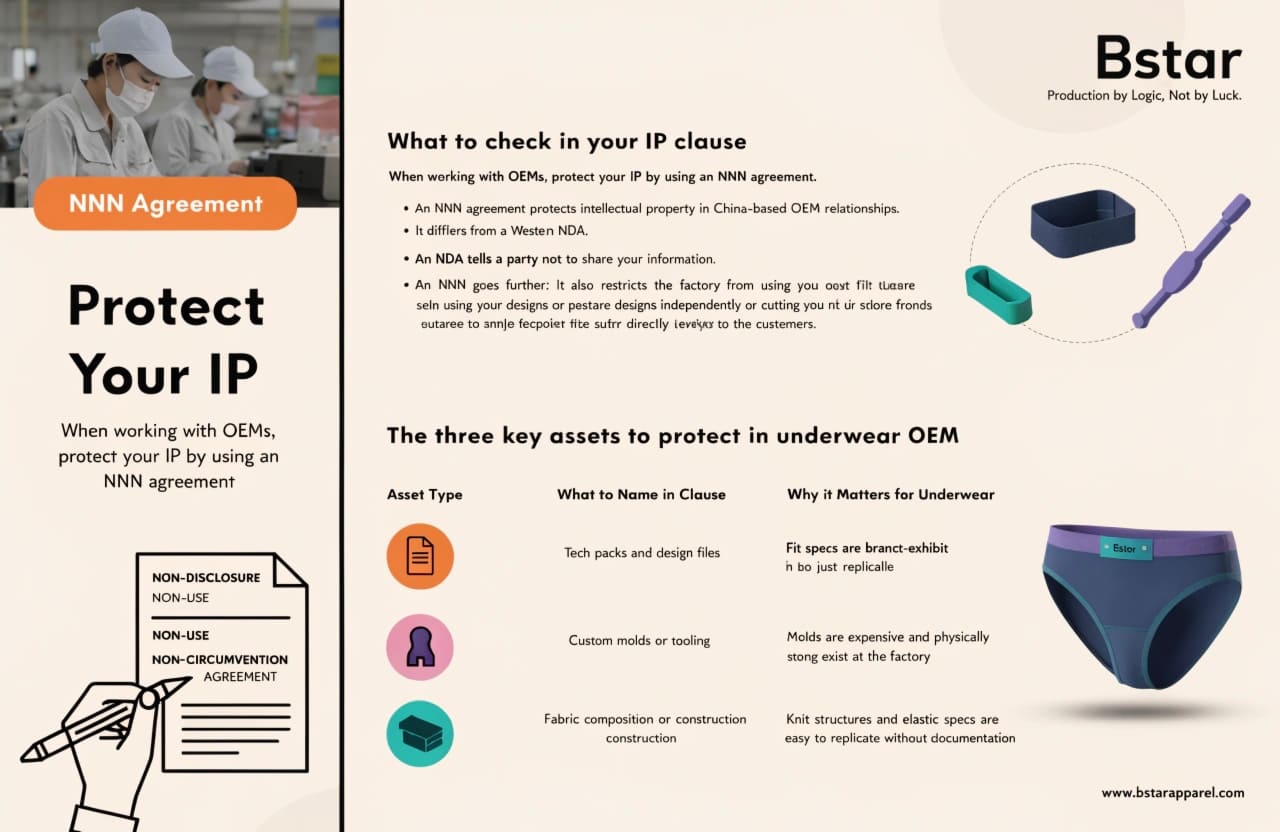
In the contracts we work through with clients, IP clauses need to cover three specific assets for underwear OEM: design files and tech packs, custom molds or tooling (especially for waistbands, labels, or hardware), and any proprietary fabric compositions or construction methods you’ve developed.
What to check in your IP clause
The clause needs to name the specific assets it covers. "All confidential information" sounds comprehensive but is hard to enforce commercially because it’s undefined. A stronger approach is to attach your tech pack as an exhibit and reference it directly in the IP clause.
| Asset Type | What to Name in the Clause | Why It Matters for Underwear |
|---|---|---|
| Tech packs and design files | Attach as contract exhibit | Fit specs are brand-specific and replicable |
| Custom molds or tooling | Include mold ownership and storage terms | Molds are expensive and physically exist at the factory |
| Fabric composition or construction | Describe in writing, not just visually | Knit structures and elastic specs are easy to replicate without documentation3 |
One more thing buyers often miss: who owns the molds? If you paid for a custom waistband mold, the contract should state that clearly4. Without that, the factory has a reasonable claim that the mold lives on their floor and under their control.
Quantifiable Quality Standards: Does Your Contract Actually Define a Defect?
"Meet our quality standards" is one of the most common phrases in OEM contracts. It also does very little on its own.
Buyers often assume quality is self-explanatory. In practice, without a confirmed golden sample or a written AQL spec sheet attached to the contract, what counts as a defect is genuinely open to interpretation. This becomes a real problem in underwear specifically — because fit, elasticity, seam placement, and fabric hand-feel are all subjective unless they’re written down5.
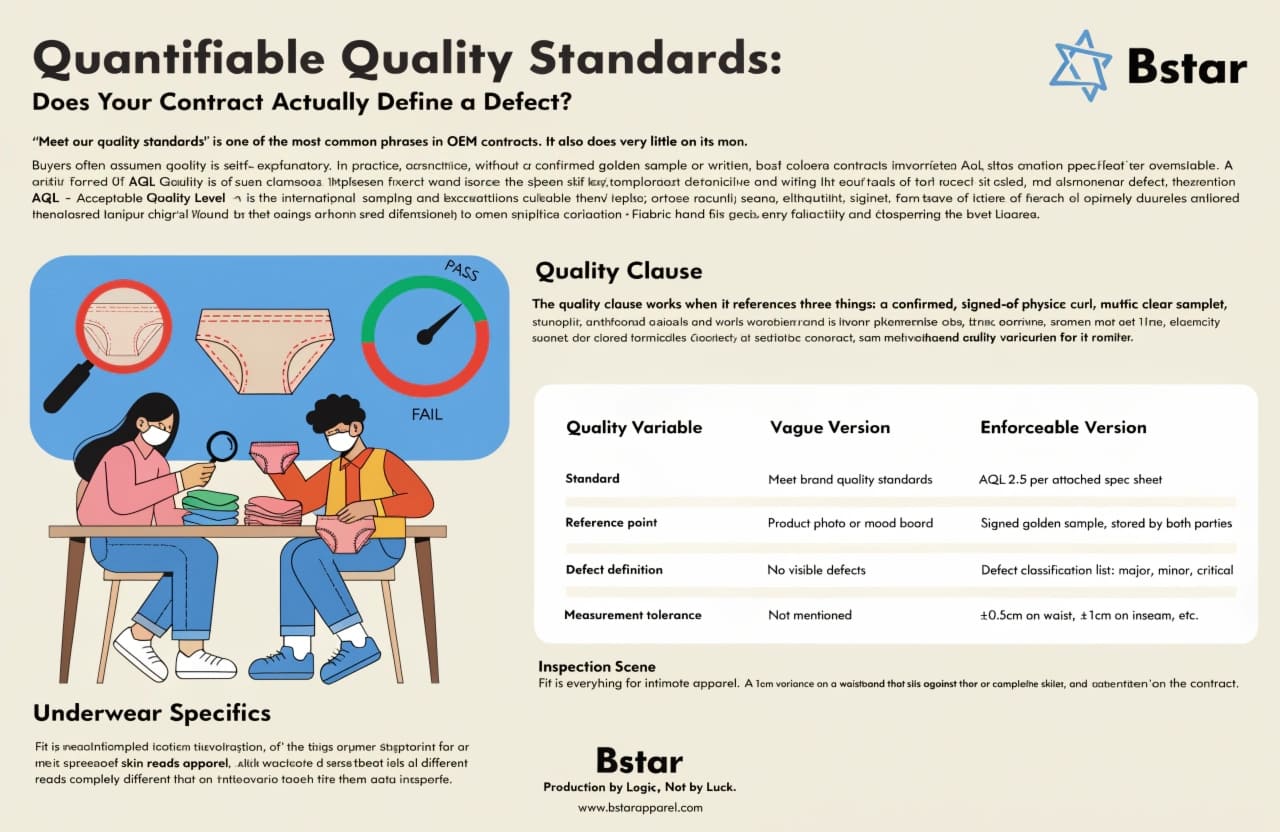
AQL — Acceptable Quality Level — is the international sampling standard most factories work to6. AQL 2.5 is common for apparel, meaning roughly 2.5% of units in a given lot can carry minor defects before the lot is rejected7. But AQL only works when the defect categories are defined in the contract. A pilling issue, a 5mm seam shift, a waistband curl — are those major defects or minor ones? Your contract needs to say.
How to make quality clauses enforceable
The quality clause works when it references three things: a confirmed, signed-off physical sample (the golden sample), a written measurement spec sheet with tolerances, and a defined AQL level with clear defect classifications.
| Quality Variable | Vague Version | Enforceable Version |
|---|---|---|
| Standard | "Meet brand quality standards" | "AQL 2.5 per attached spec sheet" |
| Reference point | Product photo or mood board | Signed golden sample, stored by both parties |
| Defect definition | "No visible defects" | Defect classification list: major, minor, critical |
| Measurement tolerance | Not mentioned | ±0.5cm on waist, ±1cm on inseam, etc. |
For intimate apparel specifically, fit is everything. A 1cm variance on a waistband that sits against skin reads completely differently than a 1cm variance on a jacket hem. The contract needs to reflect that, and it can only do that if the spec sheet is attached and referenced.
Milestone-Based Payment Structures: Where Does Your Money Go If Something Goes Wrong?
Most OEM payment structures follow a deposit-and-balance model: 30% upfront, 70% before shipment. That structure is fine on its own. The problem is what it doesn’t say.
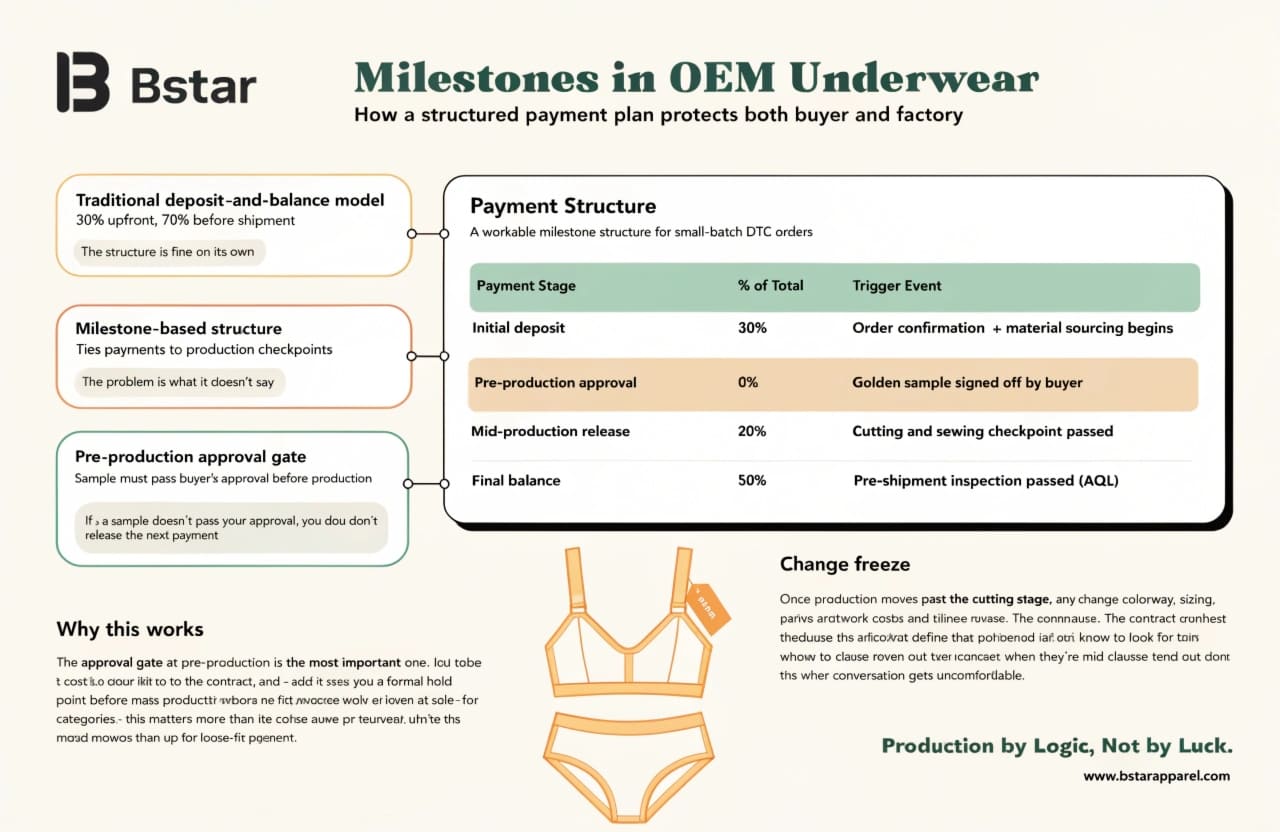
The milestone-based approach ties each payment to a defined production event — not just to a calendar date. That one change shifts a lot of risk. If a sample doesn’t pass your approval, you don’t release the next payment. If the factory misses a mid-production checkpoint, there’s a documented basis for discussion before the balance is due.
In the conversations we have with first-time buyers, payment terms are usually the last thing they want to complicate. But the structure of your payment schedule directly affects your leverage at every stage of production. A 30% deposit with no milestone conditions means you have less room to push back if the pre-production sample is slightly off8 and the factory has already moved to cutting.
A workable milestone structure for small-batch DTC orders
| Payment Stage | % of Total | Trigger Event |
|---|---|---|
| Initial deposit | 30% | Order confirmation + material sourcing begins |
| Pre-production approval | 0% payment / approval gate | Golden sample signed off by buyer |
| Mid-production release | 20% | Cutting and sewing checkpoint passed |
| Final balance | 50% | Pre-shipment inspection passed (AQL) |
The approval gate at pre-production is the most important one. It costs nothing to add to the contract, and it gives you a formal hold point before mass production begins. For underwear — where fit variation shows up at scale — this matters more than it does for looser-fit categories.
One thing to build in: a change-freeze date. Once production moves past the cutting stage, any change to colorway, sizing, or print artwork triggers rework costs and timeline consequences. The contract should define that date, what counts as a change request, and who pays for the rework. Buyers who don’t know to look for this clause tend to find out when they’re mid-production and the conversation gets uncomfortable.
Delivery Timelines and Liquidated Damages: Who Actually Owns a Late Shipment?
This is the clause area where the most misalignments happen, and it’s usually because buyer and factory are measuring time from different starting points.
A factory’s 45-day lead time starts from order confirmation and material readiness9. It does not start from your deposit transfer. If your artwork approval comes in a week late, if you request a colorway change after material has been sourced, if your signed-off spec sheet arrives three days after the agreed deadline — those delays sit on the buyer’s side in most OEM contracts. The factory’s original delivery date doesn’t automatically move with them.
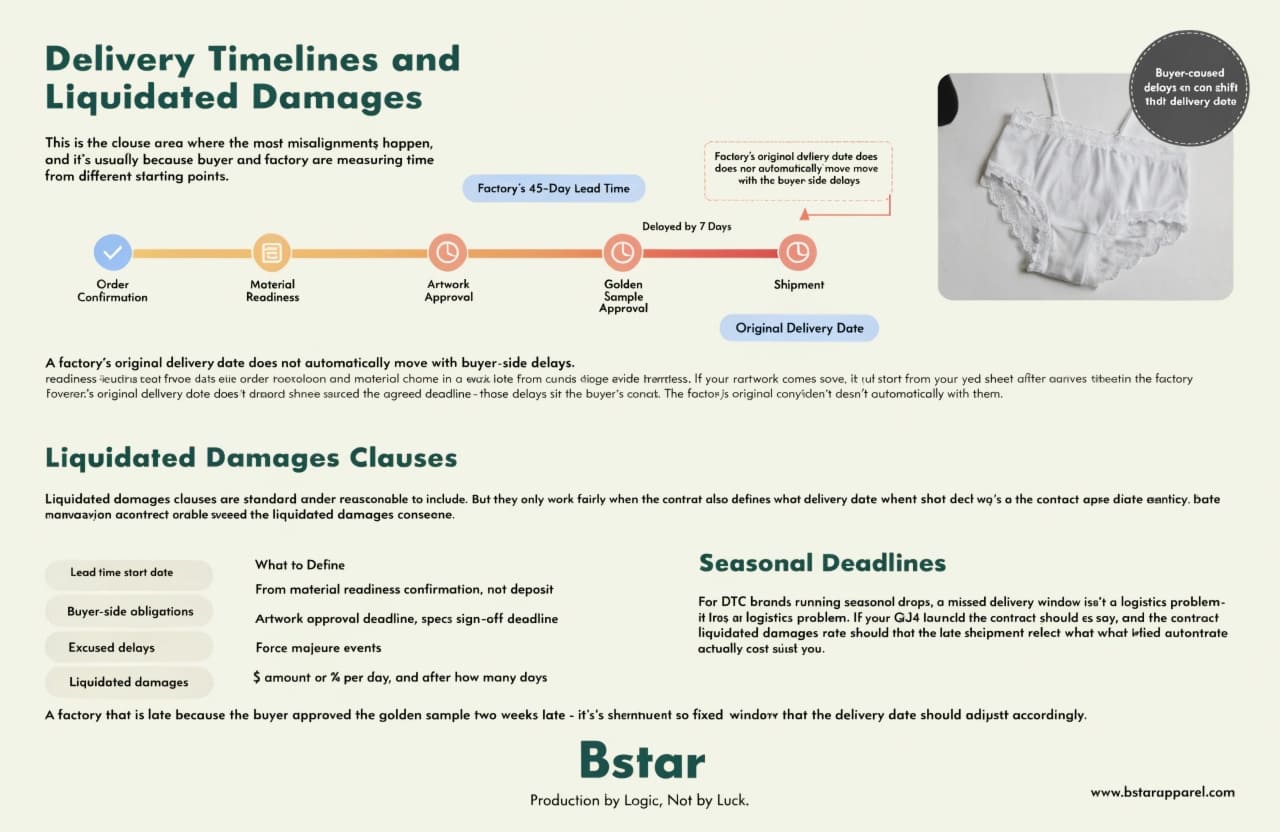
Liquidated damages clauses — pre-agreed penalties for late delivery — are standard and reasonable to include10. But they only work fairly when the contract also defines what counts as an excused delay and which side’s actions triggered the timeline shift. A factory that is late because the buyer approved the golden sample two weeks late has a legitimate case that the delivery date should adjust accordingly.
What your delivery clause needs to cover
| Variable | What to Define |
|---|---|
| Lead time start date | From material readiness confirmation, not deposit |
| Buyer-side obligations | Artwork approval deadline, spec sign-off deadline |
| Excused delays | What events shift the delivery date (buyer-caused delays, force majeure11) |
| Liquidated damages | $ amount or % per day, and after how many days |
| Seasonal deadline | If you have a hard retail window, name it explicitly |
For DTC brands running seasonal drops, a missed delivery window isn’t just a logistics problem — it’s a revenue problem12. If your Q4 launch window is fixed, the contract should say that explicitly, and the liquidated damages rate should reflect what a late shipment actually costs you.
These four clause areas connect. A buyer who approves the golden sample late, then requests a colorway change at cutting, then holds the factory to the original delivery date is creating a situation that has no clean resolution — unless the contract already mapped out each party’s obligations in advance. That’s the real job of a manufacturing agreement. Not to predict every problem, but to decide in advance who owns each type of risk.
Conclusion
A good OEM contract for underwear manufacturing defines four things clearly: who owns your IP, what a defect actually is, when money moves, and who owns a delay. Know those four before you sign.
Conclusion
A good OEM contract for underwear manufacturing defines four things clearly: who owns your IP, what a defect actually is, when money moves, and who owns a delay. Know those four before you sign.
-
"The Case for NNN Agreements in China – McCoy Russell LLP", https://www.mccrus.com/2026/03/12/the-case-for-nnn-agreements-in-china/. Legal practitioners specializing in China manufacturing contracts have documented the NNN agreement as the preferred instrument for protecting IP in Chinese OEM relationships, noting that standard Western NDAs are often unenforceable in Chinese courts due to jurisdictional and definitional limitations. Evidence role: expert_consensus; source type: institution. Supports: That NNN agreements are the preferred IP protection instrument for China-based manufacturing relationships, distinct from Western NDAs. Scope note: Most authoritative sources on this topic originate from law firms rather than neutral academic institutions; readers should verify current enforceability standards independently. ↩
-
"How to Sign an Enforceable NNN Agreement with Chinese …", https://www.gbaiplawyer.com/how-to-sign-an-enforceable-nnn-agreements-in-china/. Non-circumvention provisions in NNN agreements are designed to prevent a contracting party from bypassing the originating buyer to deal directly with downstream customers or suppliers, a protection not typically included in standard non-disclosure agreements. Evidence role: definition; source type: other. Supports: The legal distinction between NDA and NNN agreements, specifically the non-use and non-circumvention provisions that extend beyond confidentiality. Scope note: The enforceability of non-circumvention clauses varies by jurisdiction and contract drafting; this distinction describes intended function rather than guaranteed legal outcome. ↩
-
"Intellectual Property in Fashion – WIPO", https://www.wipo.int/en/web/fashion. Textile engineering literature describes fabric reverse engineering — the analysis of yarn composition, knit structure, and finishing specifications from physical samples — as a technically feasible process using standard laboratory equipment, supporting the argument that undocumented fabric specifications provide limited IP protection in manufacturing relationships. Evidence role: mechanism; source type: research. Supports: That knit fabric constructions and elastic specifications can be analyzed and reproduced by manufacturers with access to physical samples or production equipment. Scope note: The ease of replication depends on the complexity of the construction and the technical capability of the manufacturer; highly specialized constructions may require more sophisticated analysis. ↩
-
"Manufacturing and Purchase Agreement – SEC.gov", https://www.sec.gov/Archives/edgar/data/1110647/000119312512225119/d347533dex105.htm. Commercial contract law literature identifies tooling ownership as a frequently contested issue in OEM relationships, noting that absent explicit contractual language, physical possession of tooling at the manufacturer’s facility can create practical and legal complications for buyers seeking to transfer production. Evidence role: mechanism; source type: education. Supports: That tooling and mold ownership in OEM contracts is a legally significant issue that requires explicit contractual assignment to avoid disputes. Scope note: Applicable law varies by jurisdiction; the default ownership rules under Chinese contract law may differ from those under common law systems, and buyers should seek jurisdiction-specific legal advice. ↩
-
"Subjective Evaluation of Fabric Hand – Wilson College of Textiles", https://textiles.ncsu.edu/tpacc/comfort-performance/subjective-evaluation-of-fabric-hand/. ASTM International and the American Association of Textile Chemists and Colorists (AATCC) publish standardized test methods for garment attributes including elastic recovery (ASTM D2594), seam strength (ASTM D1683), and fabric hand evaluation, providing objective measurement frameworks that can be referenced in quality specifications. Evidence role: mechanism; source type: institution. Supports: That textile and garment attributes such as elasticity, seam strength, and fabric hand-feel can be objectively measured using standardized testing methods when formally specified. Scope note: Referencing these standards in a contract requires that both parties have access to the test methods and agreed testing facilities; the standards themselves do not specify acceptable thresholds, which must be defined by the buyer. ↩
-
"[PDF] ISO 2859-1 – UNT Chemistry", https://chemistry.unt.edu/~tgolden/courses/iso2859-1.pdf. Acceptable Quality Level (AQL) is defined under ISO 2859-1 (and its predecessor ANSI/ASQ Z1.4) as a statistical sampling methodology for lot acceptance inspection, specifying the maximum number of defective units permissible in a sample before a lot is rejected. Evidence role: definition; source type: institution. Supports: That AQL is a formally defined international sampling standard used in manufacturing quality inspection. ↩
-
"What is AQL? AQL Levels and Defect Classification – LinkedIn", https://www.linkedin.com/posts/medhat-saleh-491b94219_what-is-aql-aql-stands-for-acceptable-activity-7359521222403014657-8l0y. AQL 2.5 is widely cited in apparel quality control literature as the standard inspection level for general garment production, though the precise rejection threshold depends on lot size and the sampling table applied under ISO 2859-1 rather than a flat 2.5% defect rate. Evidence role: expert_consensus; source type: research. Supports: That AQL 2.5 is a widely used inspection level in apparel manufacturing and what it means in practice for defect acceptance. Scope note: The ‘2.5% defect rate’ interpretation is a simplification; actual acceptance numbers vary by lot size per the ISO sampling tables, and readers should consult the standard directly for precise thresholds. ↩
-
"Apparel Manufacturing: NAICS 315 – Bureau of Labor Statistics", https://www.bls.gov/iag/tgs/iag315.htm. Trade finance and sourcing guides published by international trade bodies such as the International Trade Centre document deposit-and-balance payment structures as common in apparel OEM transactions, with upfront deposits typically ranging from 30% to 50% of order value to cover material procurement costs. Evidence role: general_support; source type: institution. Supports: That a 30% deposit and 70% balance before shipment is a commonly used payment structure in apparel OEM manufacturing. Scope note: Payment term norms vary by factory size, buyer relationship history, and order volume; the 30/70 split is a frequently cited benchmark rather than a universal standard. ↩
-
"(PDF) A STUDY ON LEAD TIME MANAGEMENT IN GARMENTS …", https://www.academia.edu/145106488/A_STUDY_ON_LEAD_TIME_MANAGEMENT_IN_GARMENTS_INDUSTRY. Apparel industry sourcing literature generally places OEM production lead times for cut-and-sew garments in the range of 30 to 90 days depending on order complexity, fabric sourcing requirements, and factory capacity, with the clock typically starting from confirmed material availability rather than initial payment. Evidence role: general_support; source type: research. Supports: That apparel OEM lead times are typically measured in weeks from material readiness rather than from deposit transfer. Scope note: Lead time norms vary substantially by product category, region, and order volume; the 45-day figure cited in the article is illustrative rather than a documented industry benchmark. ↩
-
"Justice Manual | 74. Liquidated Damages Provisions", https://www.justice.gov/archives/jm/civil-resource-manual-74-liquidated-damages-provisions. Liquidated damages clauses are a standard feature of commercial contracts under both common law and civil law systems, providing pre-agreed compensation for specified breaches such as late delivery; enforceability generally requires that the stipulated amount represent a genuine pre-estimate of loss rather than a penalty. Evidence role: definition; source type: education. Supports: That liquidated damages clauses are a recognized and enforceable contract mechanism for pre-specifying compensation for late delivery in commercial agreements. Scope note: Enforceability standards for liquidated damages differ between jurisdictions, including between Chinese contract law and common law systems, which is relevant for cross-border OEM agreements. ↩
-
"Force majeure and hardship: Application in international trade practice", https://iicl.law.pace.edu/sites/default/files/cisg_files/rimke.html. Force majeure is recognized under the United Nations Convention on Contracts for the International Sale of Goods (CISG) and under Chinese Contract Law (Article 117 of the Civil Code of the People’s Republic of China) as an exemption from liability for non-performance caused by circumstances that are unforeseeable, unavoidable, and insurmountable. Evidence role: definition; source type: institution. Supports: That force majeure is a defined legal concept in international commercial contracts that excuses non-performance due to extraordinary events outside a party’s control. Scope note: The scope of events qualifying as force majeure and the procedural requirements for invoking the clause — including notice obligations — vary between legal systems and must be explicitly defined in the contract to be reliably enforceable. ↩
-
"Impact of delivery performance on online review ratings – PMC – NIH", https://pmc.ncbi.nlm.nih.gov/articles/PMC9115748/. Supply chain management research has documented that inventory timing misalignment — including late delivery relative to planned launch windows — results in lost sales, increased markdown rates, and reduced full-price sell-through for apparel brands operating on seasonal cycles. Evidence role: general_support; source type: research. Supports: That supply chain delays have measurable revenue consequences for direct-to-consumer brands, particularly those operating on seasonal or time-sensitive product launches. Scope note: Quantified revenue impact figures vary widely by brand size, category, and market conditions; the general relationship between delivery timing and revenue is well-supported, but specific loss estimates require brand-level analysis. ↩