
How Is AI Changing Underwear Design and Sizing?
You just got an AI-generated size chart. It looks clean. It looks confident. And now you’re wondering if you can hand it straight to a factory and skip half the sampling process.
AI is changing how underwear brands approach design and sizing — but it is not replacing the judgment calls. It speeds up certain parts of the process, like trend forecasting and body data modeling. The parts that require physical validation, fabric knowledge, and real fit experience still depend on a manufacturer who has seen the failure modes.
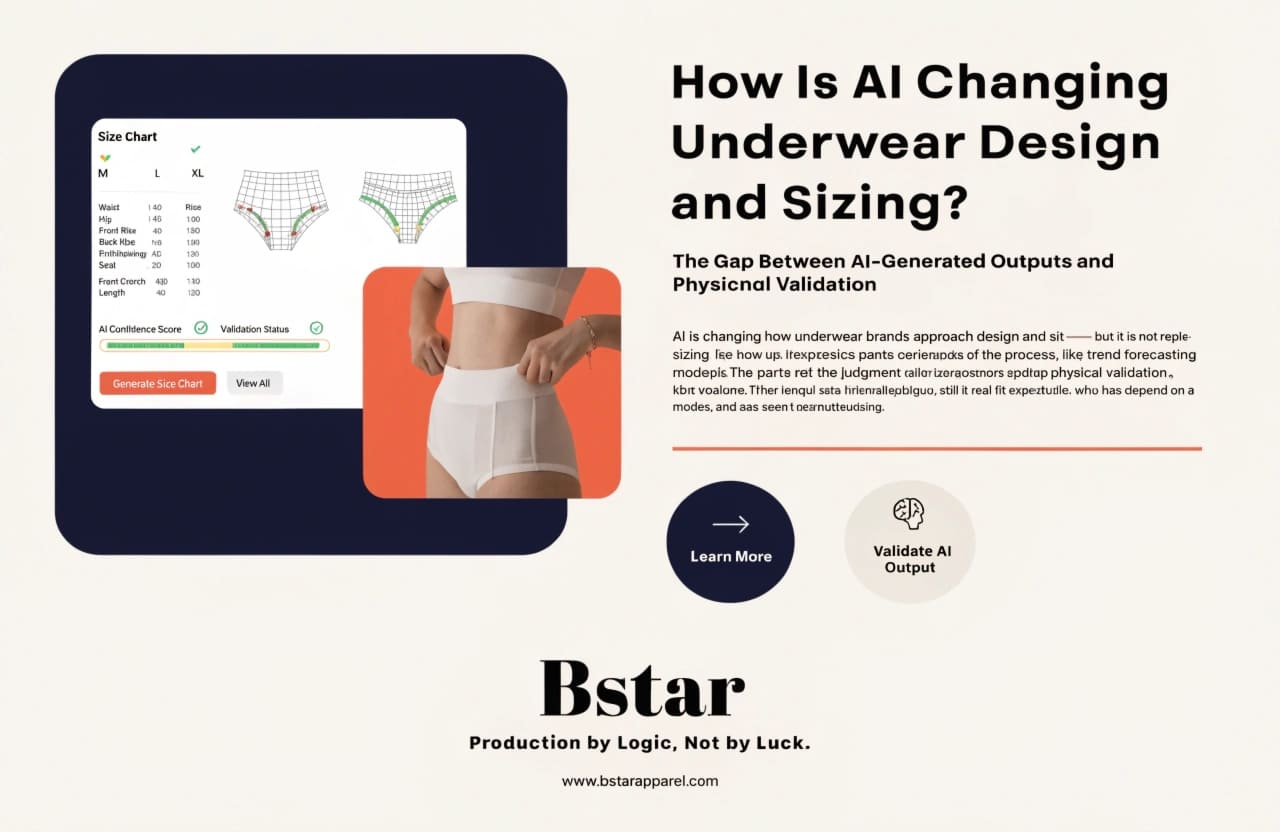
That gap between what AI produces and what actually ships is where most sizing problems live. I see it in the inquiries we receive. Brands arrive with AI-assisted outputs and strong confidence — and then the first sample tells a different story. That story is what this article is about.
Can AI Really Speed Up Underwear Design and Trend Forecasting?
You want to move faster. Your competitors are dropping new styles every few weeks, and your design cycle feels too slow. AI design tools promise to close that gap.
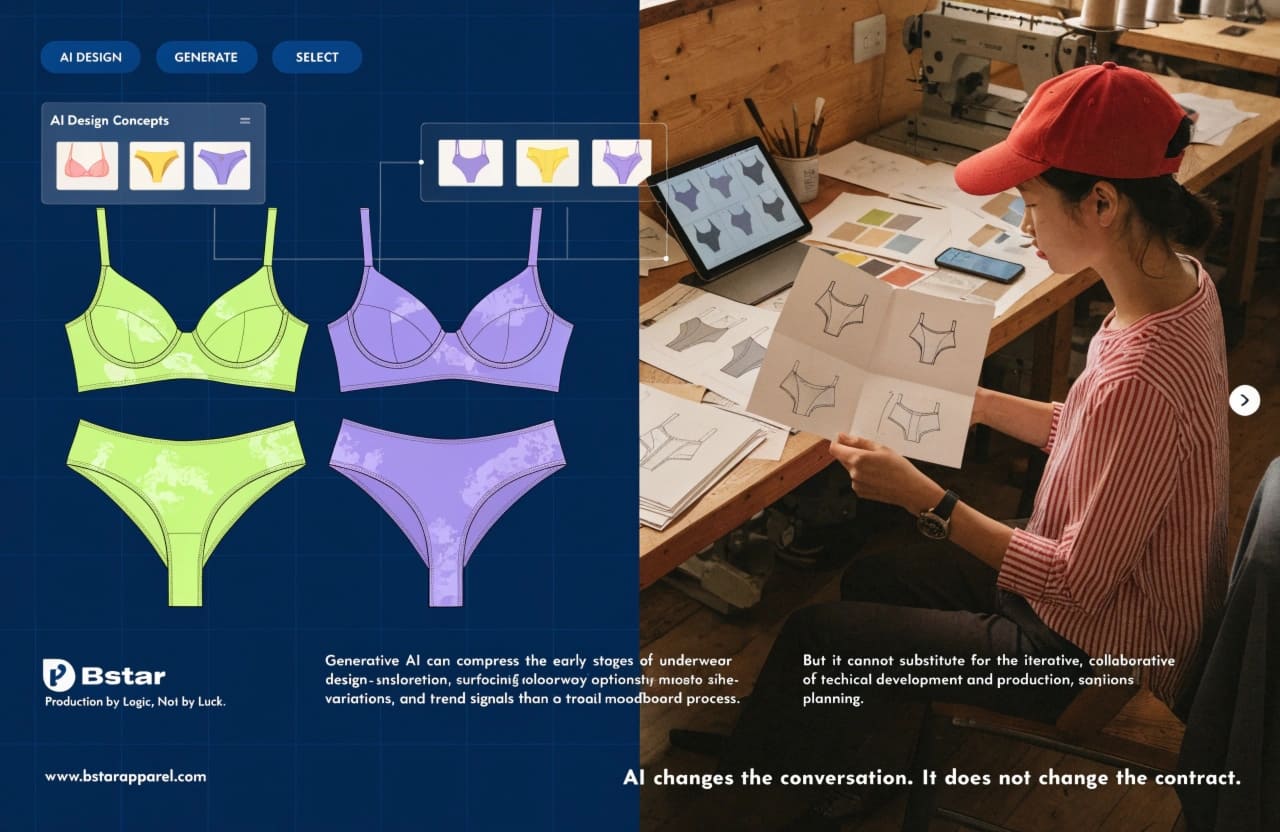
Generative AI can compress the early stages of underwear design — surfacing colorway options, silhouette variations, and trend signals faster than a traditional moodboard process. Brands using these tools report shorter concepting phases and fewer rounds of internal revision before a brief reaches the factory.1
That part is real. But here is where it gets complicated.
What AI Design Tools Actually Change
AI-assisted design software can pull from large datasets — runway images, retail bestseller data, social engagement signals — and produce style directions that are genuinely useful.2 If you are trying to decide between two colorways or testing whether a specific cut has market momentum, these tools give you a faster starting point.
What they do not change is what happens after the brief leaves your desk.
When clients bring us AI-generated design directions, we often find one of two things. Either the design is technically sound but the fabric call is wrong for that silhouette — an issue no image-generation tool can catch. Or the trend signal is real, but the production cost at the required quality level does not match the brand’s margin target.
AI changes the conversation. It does not change the contract. The risk a brand carries — late delivery, fit returns, a compliance failure — still lives entirely in the supplier relationship. AI does not redistribute that risk. It just moves faster getting you to the starting line.
| What AI accelerates | What still requires factory input |
|---|---|
| Colorway and silhouette concepting | Fabric selection for target body behavior |
| Trend signal aggregation | Cost validation against quality requirements |
| Internal design brief iteration | Pattern adjustment for regional fit standards |
| Mood board generation | Production compliance review |
Are 3D Body Scanning and Fit Algorithms Accurate Enough to Trust?
You have seen the case studies. A brand scans thousands of bodies, trains a model, outputs a size curve that is supposed to eliminate fit returns. The numbers look good. So why are brands still calling us to fix sizing problems?
3D body scanning and fit algorithms can produce more accurate baseline size curves than traditional measurement tables.3 They are especially useful for capturing body shape variation across large datasets4. But the output is a statistical model — it does not know how your specific fabric behaves under tension, or how elastic recovery changes after washing5.
That last part is where the model breaks.
Where Fit Algorithms Stop and Factory Experience Starts
Underwear sizing is not a pure geometry problem. A waistband that measures correctly on a body scan will behave differently depending on whether your elastic is 70% nylon or 80%. A brief that fits a European hip-to-waist ratio may need a different crotch depth for Australian or American bodies — and that adjustment does not come from the scan data. It comes from a factory that has built size archives across those markets.
In the inquiries we receive, this is the most common pattern. A brand arrives with AI-generated size specs that are mathematically coherent. Then the first sample comes back, and the fit is off in a way the algorithm did not predict — usually in the gusset depth, the leg opening tension, or the waistband rollover behavior.
The AI model was not wrong. It just could not account for physical constraints that only show up when fabric meets a body.
| Fit variable | AI model capability | Factory correction required |
|---|---|---|
| Base body measurements | High accuracy from scan data | Low — data is reliable |
| Elastic recovery under wear | Cannot model | High — must test with actual material |
| Post-wash dimension change | Limited predictive accuracy | High — depends on yarn and construction |
| Regional fit standard variation | Requires labeled regional datasets | Medium — factory archive fills the gap |
| Gusset and crotch depth | Weak signal in most scan data | High — frequent first-sample correction |
Fewer sample iterations sounds like a win. But fewer samples means each surviving sample carries more weight. The factory’s ability to read a first fit and identify exactly where the AI spec diverged from reality becomes more critical, not less.
Can Virtual Try-On and Digital Sampling Replace Physical Prototypes?
Physical samples are expensive. Shipping them internationally takes time. If a virtual try-on or digital sample can replace even two rounds of physical protos, the math looks attractive.
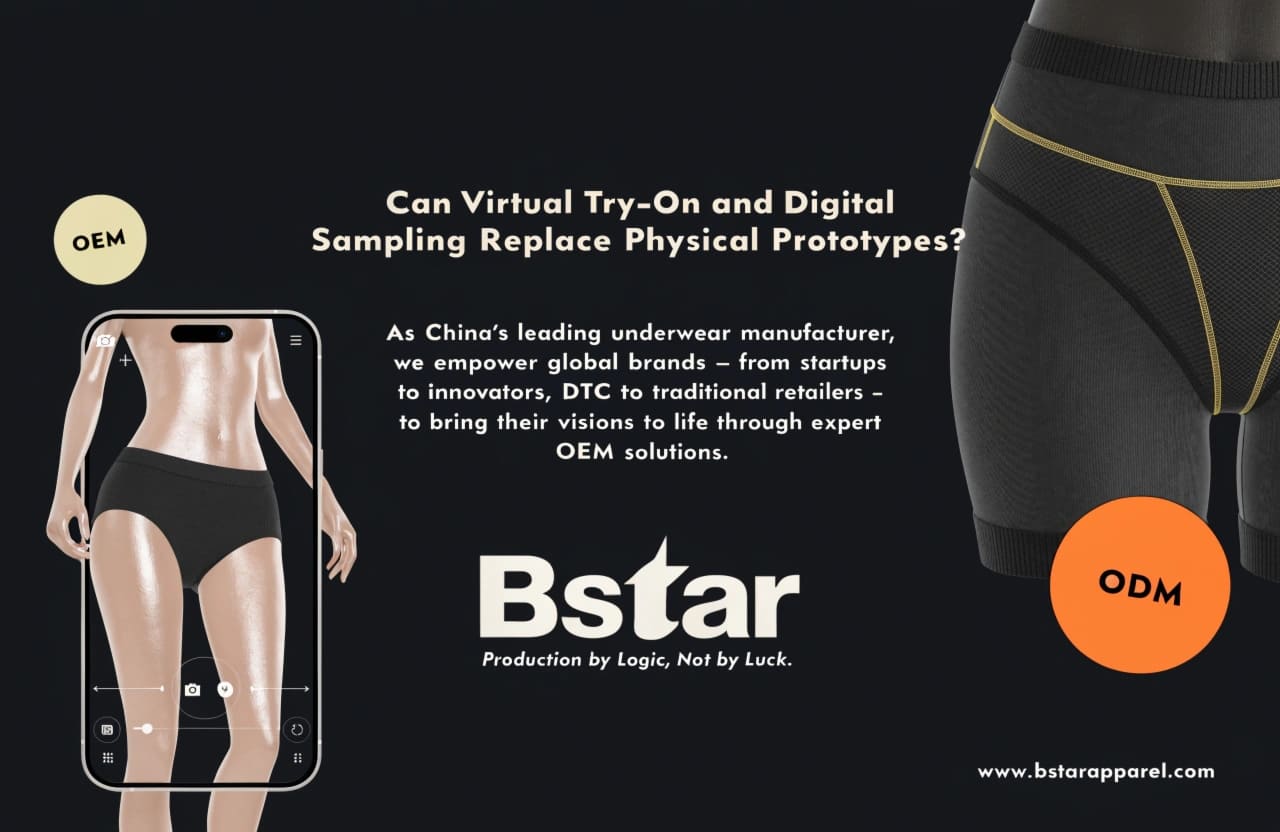
Virtual try-on technology and digital sampling tools have improved significantly. They can simulate drape, color under light, and basic fit silhouette well enough to reduce early-stage physical iterations. For e-commerce, virtual try-on has shown measurable impact on conversion and return rates in categories like outerwear and denim6.
Underwear is harder.
Why Underwear Digital Sampling Has a Ceiling
The simulation quality for stretch fabrics is still behind what works for wovens.7 Underwear — especially performance fabrics, high-stretch knits, and anything with bonded or laser-cut edges — behaves in ways that current simulation engines do not fully capture. The compression feel of a brief, the way a bralette band moves when you reach overhead, the exact tension at the leg opening — these are tactile and mechanical properties that a render cannot communicate.
That said, digital sampling is genuinely useful for eliminating rounds of color and print approval, checking label placement and packaging graphics, and getting internal stakeholder sign-off before committing to a physical sample. Those are real time savings.
The brands we work with who use digital sampling most effectively treat it as a filter — not a replacement. They use it to narrow down options to one or two directions, then go physical. That approach reduces waste without over-trusting the simulation.
For e-commerce, the consumer-facing virtual try-on story is more promising, particularly for reducing size-related returns. But that only works if the size data feeding the try-on model is accurate — which brings us back to the fit algorithm problem above.
Can AI Optimize Your Supply Chain and Cut Return Rates?
Returns are expensive. For underwear specifically, a high return rate is often a sizing signal — not a quality problem. If AI can read return data and adjust size recommendations in near-real-time, that is a meaningful operational improvement.
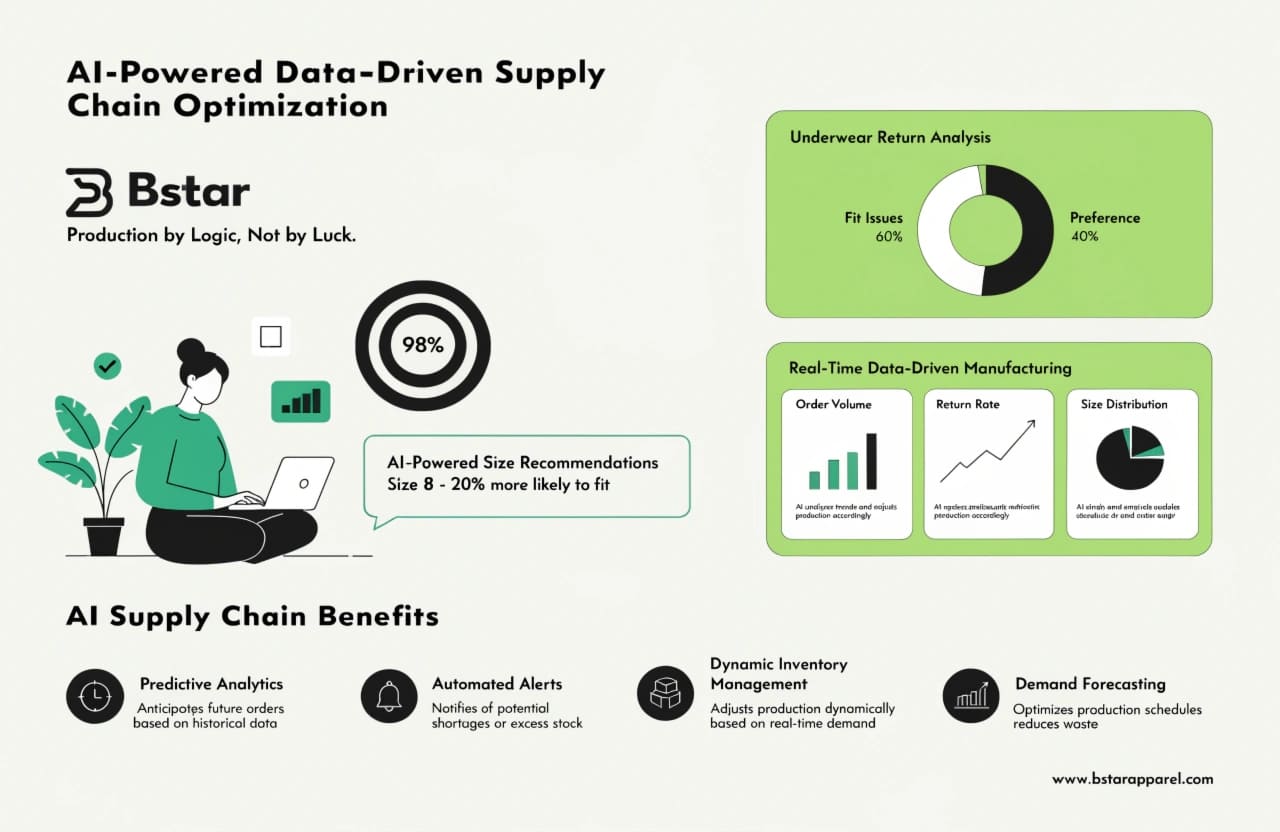
AI-powered demand forecasting and return signal analysis can help brands identify sizing patterns in their return data, adjust reorder quantities, and reduce overproduction.8 Brands with sufficient transaction history can use these tools to make smarter inventory decisions and catch fit problems before they compound across a season.
The operative phrase is "sufficient transaction history." Early-stage brands rarely have it.
What Supply Chain AI Needs to Work — and What It Cannot See
For demand forecasting and return analysis to produce useful outputs, you need a clean data set — large enough to find patterns, tagged well enough to separate fit returns from preference returns. Most DTC brands at the 10,000–50,000 units per year scale do not have that yet.9 They are feeding an AI model noise and expecting signal.
Even for brands with real data volume, there is a layer the model cannot reach. It can tell you that your size medium has a 22% return rate. It cannot tell you whether the problem is in the waistband elastic, the gusset cut, or the fabric weight — because that information does not live in your order management system. It lives in the factory’s first-sample notes and your QC records.
| Supply chain task | AI value | Human/factory input needed |
|---|---|---|
| Demand forecasting | High — with sufficient sales history | Low |
| Return rate pattern detection | Medium — depends on data tagging quality | Medium — root cause still requires physical review |
| Reorder quantity optimization | High — for established SKUs | Low |
| Identifying fit failure root cause | Low — no visibility into production variables | High |
| On-demand manufacturing triggers | Medium — works well for print-on-demand | High — for cut-and-sew, lead time constraints apply |
On-demand manufacturing is a real direction, and AI-assisted order triggers are part of that story.10 But cut-and-sew underwear production has physical lead time floors. A factory needs time to source elastic, cut, sew, and inspect. AI can help a brand get closer to demand-respo
Conclusion
AI makes parts of the underwear design and sizing process faster and smarter. But the judgment calls — fit validation, fabric behavior, regional sizing corrections — still require a manufacturer who has seen what goes wrong.
-
"Here’s How the Fashion Industry Is Using AI", https://textiles.ncsu.edu/news/2024/06/heres-how-the-fashion-industry-is-using-ai/. Industry research on AI adoption in fashion product development has documented reductions in early-stage concepting time, though reported gains vary by brand size, tool maturity, and workflow integration depth. Evidence role: general_support; source type: research. Supports: That generative AI tools measurably reduce time spent in early-stage fashion design concepting and internal iteration cycles.. Scope note: Most available evidence is drawn from self-reported brand surveys or vendor case studies, which may overstate efficiency gains. ↩
-
"[PDF] TRADITIONAL VS. BIG-DATA FASHION TREND FORECASTING", https://udspace.udel.edu/server/api/core/bitstreams/2565859a-a82a-4d49-ad8e-887879e3e5f7/content. Research in computational fashion analysis has demonstrated that multimodal models combining visual runway data, e-commerce sales signals, and social media engagement can generate trend predictions with measurable accuracy against subsequent retail performance. Evidence role: mechanism; source type: paper. Supports: That AI-based fashion forecasting systems are trained on multimodal datasets including runway imagery, sales data, and social media engagement metrics.. Scope note: Published studies often evaluate proprietary or experimental systems; commercial tool performance may differ from research benchmarks. ↩
-
"Evaluating machine learning models for clothing size prediction …", https://pmc.ncbi.nlm.nih.gov/articles/PMC12630603/. Large-scale anthropometric surveys employing 3D whole-body scanning, such as the CAESAR and SizeUSA studies, have demonstrated that scan-derived measurements capture body shape variation with greater dimensional completeness than traditional landmark-based tape measurement protocols. Evidence role: expert_consensus; source type: paper. Supports: That 3D body scanning captures body shape variation more accurately than traditional tape-measure-based sizing tables for apparel size curve development.. Scope note: Accuracy advantages documented in research settings may not fully translate to commercial scanning hardware deployed at varying quality levels. ↩
-
"Precision of the CAESAR scan-extracted measurements – PubMed", https://pubmed.ncbi.nlm.nih.gov/16202970/. National and international anthropometric surveys employing 3D whole-body scanning technology, including the CAESAR study and the SizeUSA and SizeUK programs, have documented body shape variation across large, demographically stratified samples, establishing scan-based methods as the standard for population-level sizing research. Evidence role: historical_context; source type: institution. Supports: That large-scale 3D body scanning surveys have successfully captured body shape variation across demographically diverse populations, providing a more complete anthropometric picture than prior measurement-based surveys.. Scope note: These surveys were conducted at specific points in time and may not reflect current population body shape distributions due to demographic and health trend changes. ↩
-
"[PDF] Effect of Laundering on Dynamic Elastic Behavior of Cotton and …", https://jtatm.textiles.ncsu.edu/index.php/JTATM/article/viewFile/2593/1790. Textile testing standards, including ASTM D2594 for stretch properties of knitted fabrics, provide protocols for measuring elastic recovery before and after laundering, with research confirming that recovery rates decline with repeated wash cycles depending on fiber composition and construction. Evidence role: mechanism; source type: institution. Supports: That repeated laundering cycles measurably degrade elastic recovery in stretch knit fabrics used in underwear, altering dimensional fit properties.. Scope note: The degree of recovery loss is highly material-specific; general findings may not predict behavior for a given brand’s specific elastic specification. ↩
-
"What is a Virtual Fitting Room? Advantages and Early Adopters", https://textiles.ncsu.edu/news/2024/01/what-is-a-virtual-fitting-room-advantages-and-early-adopters/. Studies examining augmented reality and virtual try-on deployments in e-commerce have reported statistically significant reductions in return rates and increases in purchase conversion, with effect sizes varying by product category, with structured garments such as outerwear showing stronger simulation fidelity than high-stretch categories. Evidence role: statistic; source type: research. Supports: That consumer-facing virtual try-on tools have produced documented reductions in return rates and improvements in conversion rates in apparel categories including outerwear and denim.. Scope note: Published results frequently originate from vendor-commissioned studies or single-brand pilots, limiting generalizability across retail contexts. ↩
-
"A B-Spline Finite Element Method for Cloth Simulation – arXiv", https://arxiv.org/html/2506.18867v1. Research in computational garment simulation has identified that accurately modeling the anisotropic stretch behavior and elastic recovery of knit fabrics requires significantly more complex constitutive models than those sufficient for woven textiles, with current commercial simulation tools showing measurable accuracy gaps for high-elongation materials. Evidence role: expert_consensus; source type: paper. Supports: That physics-based garment simulation engines exhibit lower fidelity when modeling high-stretch knit fabrics compared to woven fabrics due to the complexity of multi-directional elastic deformation.. Scope note: Simulation software capabilities are advancing rapidly; published accuracy benchmarks may not reflect the current state of commercial tools. ↩
-
"ai-driven forecasting for sustainable apparel demand planning", https://www.researchgate.net/publication/398038850_AI-DRIVEN_FORECASTING_FOR_SUSTAINABLE_APPAREL_DEMAND_PLANNING. Research comparing machine learning forecasting models to conventional time-series methods in fashion retail has documented improvements in forecast accuracy and associated reductions in excess inventory, though performance gains are strongly conditioned on data volume, SKU complexity, and demand volatility. Evidence role: general_support; source type: research. Supports: That machine learning demand forecasting models improve inventory accuracy and reduce overproduction in apparel retail compared to traditional statistical forecasting methods.. Scope note: Most published studies examine large-scale retailers with substantial historical data; findings may not generalize to smaller DTC brands with limited transaction histories. ↩
-
"Evaluating machine learning models for clothing size prediction …", https://pmc.ncbi.nlm.nih.gov/articles/PMC12630603/. Machine learning forecasting literature has established that model accuracy is sensitive to training data volume, with sparse transaction histories producing high variance predictions; studies of small and medium retail operations have noted that insufficient historical data is a primary barrier to effective AI forecasting deployment. Evidence role: mechanism; source type: paper. Supports: That AI demand forecasting models require minimum transaction data volumes to produce reliable outputs, and that small-scale retailers frequently fall below those thresholds.. Scope note: Specific unit volume thresholds for reliable model performance are context-dependent and not universally established in the literature. ↩
-
"The power of 4th industrial revolution in the fashion industry – PMC", https://pmc.ncbi.nlm.nih.gov/articles/PMC8542431/. Industry and academic research on sustainable fashion production has identified on-demand manufacturing as a viable strategy for reducing overproduction, with pilot programs demonstrating that AI-driven demand signals can be used to trigger production runs closer to confirmed demand, though implementation is constrained by minimum order quantities and physical lead time floors in cut-and-sew production. Evidence role: historical_context; source type: research. Supports: That on-demand and near-demand apparel manufacturing models are an active area of industry development, with AI-driven demand signals being explored as a mechanism to reduce overproduction and inventory risk.. Scope note: On-demand models are more operationally mature for print-on-demand and digital-print categories than for cut-and-sew underwear, where material sourcing and assembly lead times impose structural minimums.
nsive inventory — but it cannot compress the production physics. ↩