
Color Fastness Testing: Does a "Pass" Actually Protect You?
You get a test report back from your supplier. It says "passed." You feel relieved. Then your first batch ships, and customers start complaining about bleeding dye on their white shirts.
Color fastness testing covers multiple separate categories — wash, rub, sweat, and light. A garment can pass one test and still fail in real use. The "pass" on your report only protects you if you specified the right test, the right standard, and the right grade threshold for your market and product.
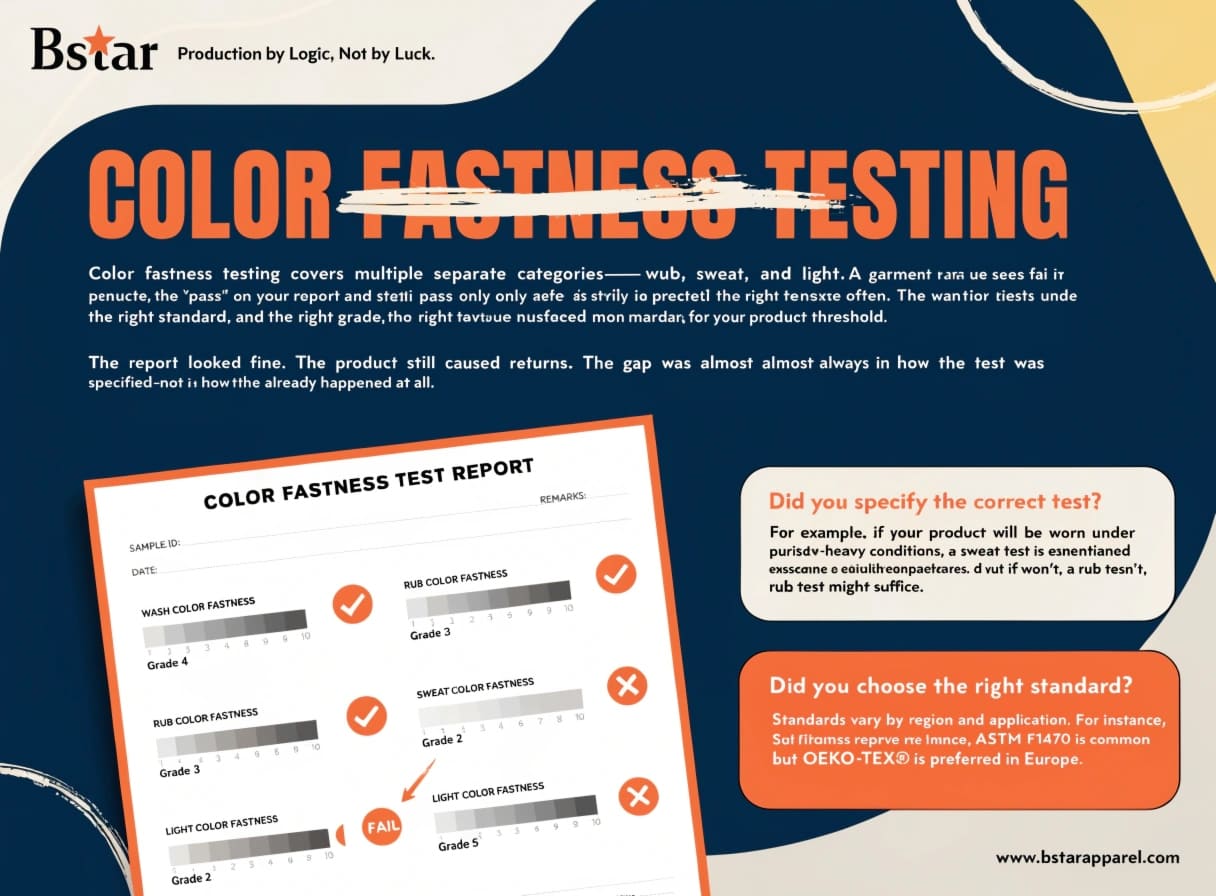
This is a pattern we see often at BSTAR when clients come to us after a problem has already happened. The report looked fine. The product still caused returns. The gap was almost always in how the test was specified — not in whether testing happened at all.
Bleeding vs. Fading: Are You Even Talking About the Same Problem?
Most buyers use "color problem" to describe everything. But bleeding and fading are different failures, caused by different things, and caught by different tests.
Bleeding is dye transferring from one fabric to another — usually wet, during washing or sweating.1 Fading is the loss of color intensity on the garment itself, caused by washing, rubbing, or light exposure.2 Mixing up these two terms when specifying tests is one of the most common sourcing mistakes we see.
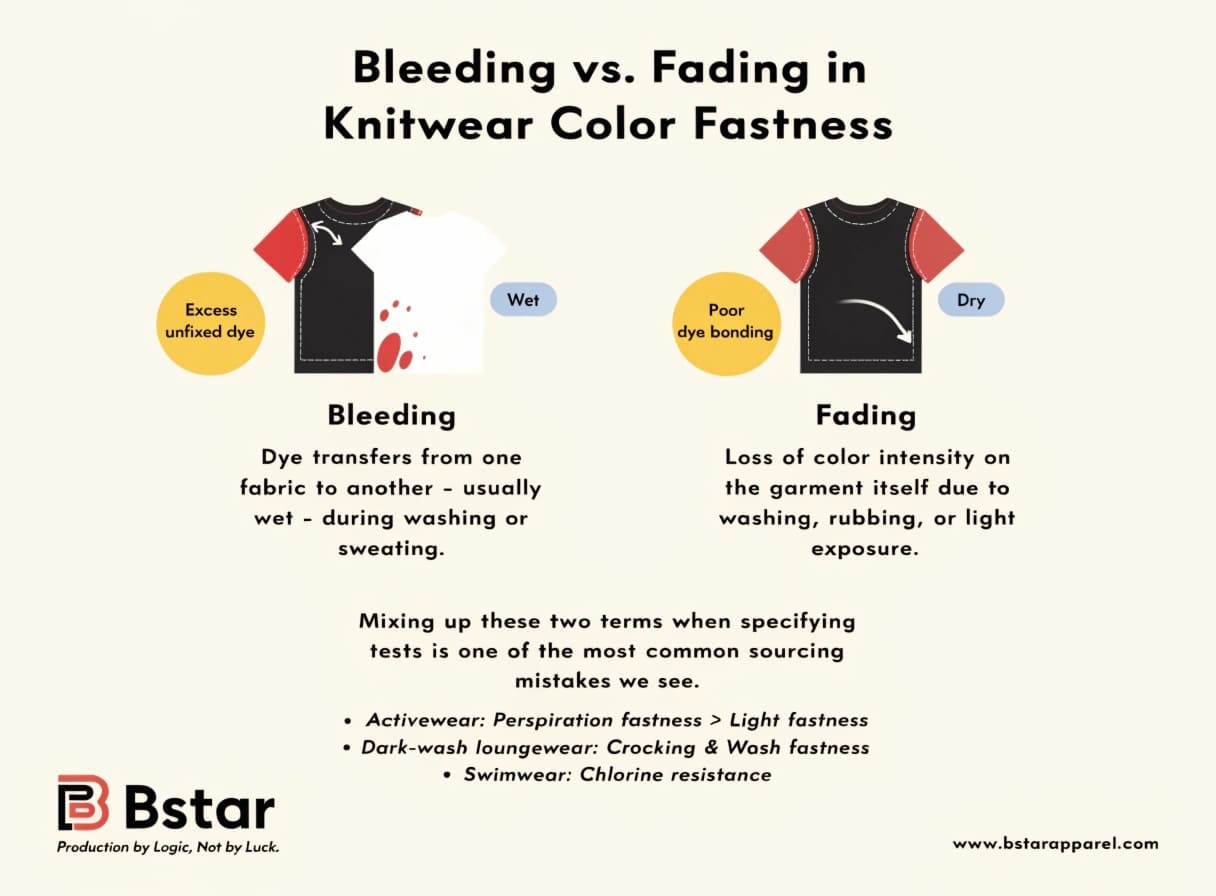
Understanding this difference changes which tests you need to request. If your product is an activewear set worn during workouts, perspiration fastness matters far more than light fastness3. If you are selling dark-wash loungewear, crocking (rub fastness) and wash fastness are your biggest risks. If you are selling swimwear, chlorine resistance becomes relevant4.
Here is a simple breakdown of the main failure types and what drives them:
| Failure Type | What It Looks Like | Primary Cause |
|---|---|---|
| Bleeding | Dye transfers onto adjacent fabric | Excess unfixed dye, especially when wet |
| Fading | Garment loses color over time | Poor dye bonding, repeated wash or UV exposure |
| [Crocking | Dye rubs off onto surfaces or skin | Surface dye, dry or wet friction](https://blogs.extension.iastate.edu/answerline/2019/04/29/color-transfer-bleeding-crocking/)[^5] |
| Perspiration staining | Discoloration under heat and sweat | Dye reacting with acid/alkaline sweat |
Each of these requires its own test. A wash fastness result tells you nothing about crocking performance. A crocking result tells you nothing about perspiration behavior. When a supplier says "we tested color fastness," your first question should always be: which type, which standard, and under what conditions?
AATCC vs. ISO: This Is Not a Preference — It Is a Market Requirement
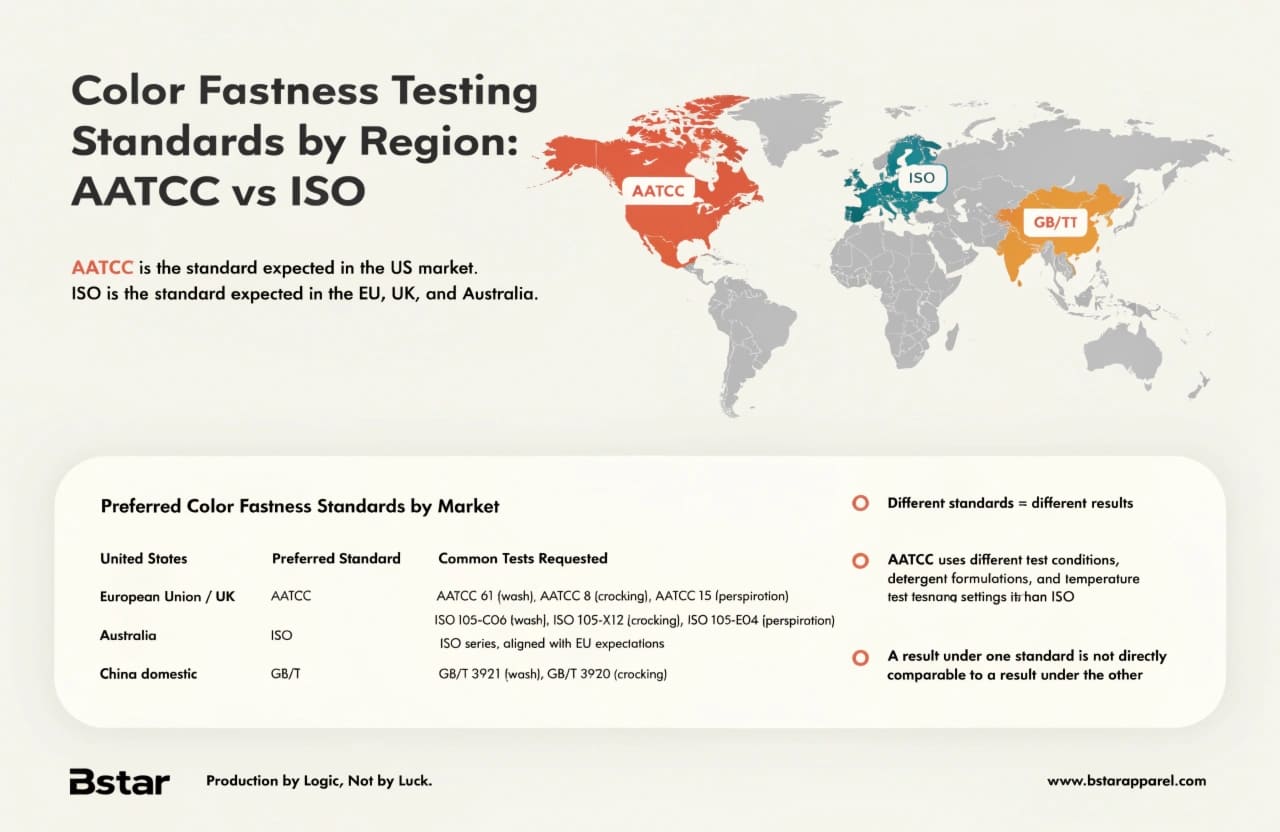
Buyers sometimes treat AATCC and ISO as two versions of the same thing. They are not. They use different test conditions, different detergent formulations, and different temperature settings.5 A result under one standard is not directly comparable to a result under the other.
AATCC is the standard expected in the US market. ISO is the standard expected in the EU, UK, and Australia.6 If you are selling in the US and your supplier provides an ISO wash fastness report, that report is commercially useless for your market — even if the grade is technically valid.
We have reviewed PO documentation from brands who did not specify a standard at all. The factory ran whichever test was easier for their lab, and the buyer accepted the report without checking. This happens more than you would expect, especially with first-time buyers who are unfamiliar with how test reports work.
Here is the practical split you need to know before placing your order:
| Market | Preferred Standard | Common Tests Requested |
|---|---|---|
| United States | AATCC | AATCC 61 (wash), AATCC 8 (crocking), AATCC 15 (perspiration) |
| European Union / UK | ISO | ISO 105-C06 (wash), ISO 105-X12 (crocking), ISO 105-E04 (perspiration) |
| Australia | ISO | ISO series, aligned with EU expectations |
| China domestic | GB/T | GB/T 3921 (wash), GB/T 3920 (crocking) |
If you are selling across multiple markets, you may need to request tests under more than one standard. That is a legitimate ask, and any serious manufacturer should be able to accommodate it. At BSTAR, we regularly run dual-standard testing for clients who sell in both the US and EU. It requires advance planning, but it is not complicated.
The key takeaway: put the standard in writing on your PO or in your product specification sheet. Do not assume the factory will choose the right one.
Reading the Report: Grade 3 Is Not Always a Pass
Color fastness results are reported on a 1–5 scale. Grade 5 means no change. Grade 1 means severe change.7 But the acceptable minimum is not the same for every product or every market.
A grade of 3–4 on wash fastness is commercially acceptable for many basic garments. But it is not acceptable for children’s wear, dark athletic fabrics, or products sold into markets with stricter retailer requirements8. You need to know your acceptable floor before you evaluate any test report.
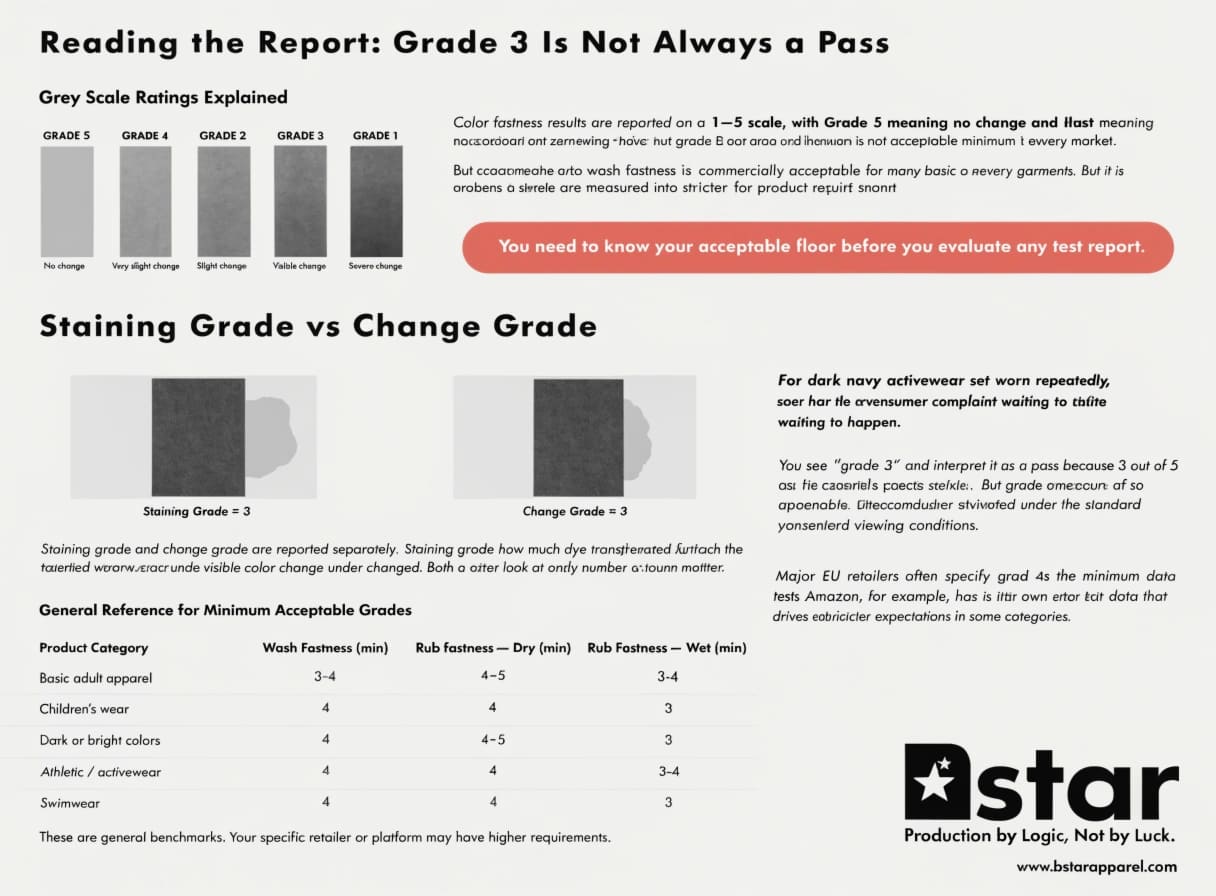
This is where buyers get into trouble. They see "grade 3" and interpret it as a pass because 3 out of 5 sounds reasonable. But grade 3 means visible color change is detectable under standard viewing conditions9. For a dark navy activewear set worn repeatedly, that is a real consumer complaint waiting to happen.
Here is a general reference for minimum acceptable grades by product category:
| Product Category | Wash Fastness (min) | Rub Fastness — Dry (min) | Rub Fastness — Wet (min) |
|---|---|---|---|
| Basic adult apparel | 3–4 | 4 | 3 |
| Children’s wear | 4 | 4–5 | 3–4 |
| Dark or bright colors | 4 | 4 | 3 |
| Athletic / activewear | 4 | 4 | 3–4 |
| Swimwear | 4 | 4 | 3 |
These are general benchmarks. Your specific retailer or platform may have higher requirements. Amazon, for example, has its own return data that drives stricter expectations in some categories. Major EU retailers often specify grade 4 as the minimum across all tests. Always check what your channel or retailer requires before you set your supplier specification.
One more thing: staining grade and change grade are reported separately. The staining grade measures how much dye transferred onto the test cloth. The change grade measures how much the tested fabric itself changed.10 Both matter. Do not look at only one number.
Why Problems Still Happen After Testing: The Conditions Question
The most common pattern we see in client color disputes is not that testing was skipped. It is that the test conditions did not match how the product was actually used.
Factories run tests under default conditions unless you tell them otherwise. If your product is worn during exercise, washed in hot water, or used poolside, those scenarios need to be written into your test specification. Default wash fastness testing does not simulate those conditions.11
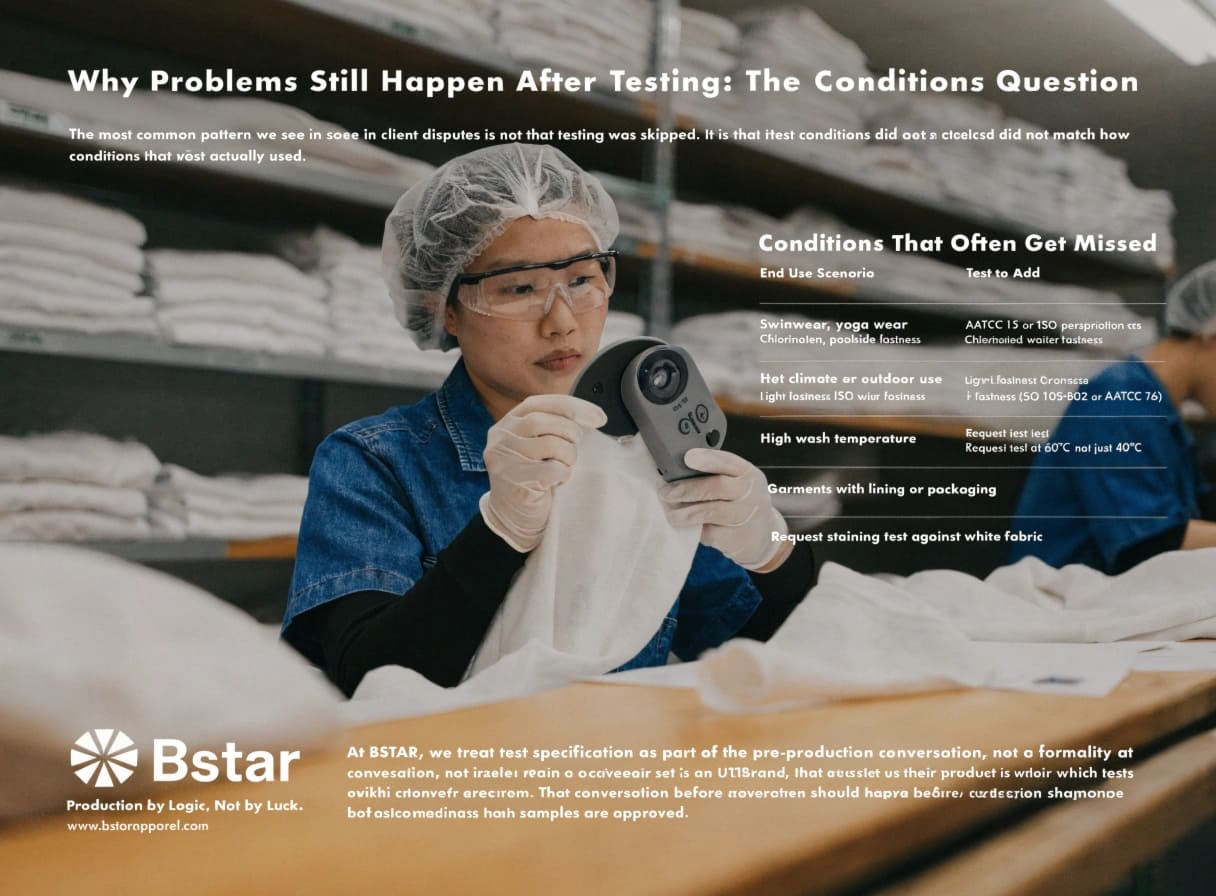
When a client comes to us after a batch has already caused returns, we usually go back and look at what was specified. In most cases, the factory ran a standard 40°C wash test. The consumer was washing at 60°C, or the product was sitting against a light-colored lining in humid heat.
Here are the specific conditions that often get missed:
| End Use Scenario | Test to Add |
|---|---|
| Activewear, yoga wear | AATCC 15 or ISO E04 perspiration fastness |
| Swimwear, poolside use | Chlorinated water fastness, sea water fastness |
| Hot climate or outdoor use | Light fastness (ISO 105-B02 or AATCC 16) |
| High wash temperature | Request test at 60°C, not just 40°C |
| Garments with lining or packaging | Request staining test against white fabric |
The fix is not complicated. You write the test conditions into your specification before production starts. You confirm the factory’s lab can run those specific conditions, or you arrange third-party testing at a lab like SGS, Bureau Veritas, or Intertek. You do not accept a report and then ask whether it covers your use case after the fact.
At BSTAR, we treat test specification as part of the pre-production conversation, not a formality at the end. When a client tells us their product is an activewear set for a US DTC brand, that already tells us which tests and which standard to recommend. That conversation should happen before samples are approved.
Conclusion
A test report only protects you if it covers the right tests, the right standard, and the right grade threshold for your market. Know what you need before you ask for it.
-
"Preventing Color Transfer by Bleeding or Crocking • AnswerLine", https://blogs.extension.iastate.edu/answerline/2019/04/29/color-transfer-bleeding-crocking/. AATCC and ISO standards define color bleeding as the transfer of colorant from a dyed or printed textile to an adjacent material, most commonly occurring under wet conditions such as laundering or perspiration exposure. Evidence role: definition; source type: institution. Supports: That bleeding refers specifically to dye migration from one fabric to an adjacent fabric, typically facilitated by moisture.. Scope note: Definitions may vary slightly between AATCC and ISO frameworks; the source should be checked for the specific standard being referenced. ↩
-
"Environmental Impact of Textile Materials: Challenges in Fiber–Dye …", https://pmc.ncbi.nlm.nih.gov/articles/PMC11991193/. Research in textile chemistry identifies photodegradation, hydrolytic breakdown during laundering, and mechanical abrasion as the principal mechanisms responsible for color fading in dyed fabrics. Evidence role: mechanism; source type: paper. Supports: That color fading in textiles results from dye degradation caused by UV radiation, repeated laundering, and mechanical abrasion.. Scope note: The relative contribution of each mechanism varies by dye class and fiber type; a single source may not address all fabric categories equally. ↩
-
"Advancements in functional smart and wearable textiles for … – PMC", https://pmc.ncbi.nlm.nih.gov/articles/PMC12716241/. Studies on dye–fiber interactions under simulated perspiration conditions demonstrate that acidic and alkaline sweat components, combined with body heat, can accelerate dye hydrolysis and migration, making perspiration fastness a primary performance concern for garments worn during physical activity. Evidence role: mechanism; source type: paper. Supports: That perspiration, due to its acidic or alkaline composition and heat, poses a greater color fastness risk for activewear than UV light exposure under typical use conditions.. Scope note: The relative risk of perspiration versus light exposure depends on garment end use, geographic market, and dye class; this claim is contextual rather than universally applicable. ↩
-
"The Impact of Chlorinated Water and Sun Exposure on the Durability …", https://pmc.ncbi.nlm.nih.gov/articles/PMC11548456/. ISO 105-E03 provides a standardized method for assessing color fastness to chlorinated water, reflecting the recognized risk that hypochlorite in pool water poses to dye stability in swimwear textiles through oxidative degradation of chromophore groups. Evidence role: mechanism; source type: institution. Supports: That chlorinated pool water causes dye degradation in swimwear fabrics, and that standardized tests exist to assess this specific color fastness property.. ↩
-
"ISO 105-C06 vs AATCC 61: The Complete Guide to Converting Test …", https://darongtester.com/iso-105-c06-vs-aatcc-61/. Technical comparisons of AATCC 61 and ISO 105-C06 document differences in reference detergent composition, test temperature ranges, and liquor ratios, which produce results that are not directly interchangeable across the two systems. Evidence role: mechanism; source type: institution. Supports: That AATCC 61 and ISO 105-C06 employ different detergent formulations, wash temperatures, and mechanical action parameters, making results non-equivalent.. Scope note: Specific parameter differences may vary across test method revisions; the most current published versions of each standard should be consulted. ↩
-
"A Guide to United States Apparel and Household Textiles …", https://www.cpsc.gov/s3fs-public/Guide-to-US-Apparel-and-Household-Textiles.pdf. Industry guidance from testing bodies such as AATCC and ISO, as well as third-party laboratory documentation, consistently identifies AATCC methods as the US market norm and ISO 105 methods as the applicable standard for EU, UK, and Australian compliance. Evidence role: expert_consensus; source type: institution. Supports: That AATCC test methods are the prevailing standard in the US apparel market while ISO 105 series methods are standard in EU, UK, and Australian markets.. Scope note: Formal regulatory mandates for specific test standards are uncommon; regional preferences are largely driven by retailer requirements and trade practice rather than law. ↩
-
"Understanding the Gray Scale for Textile Testing – LinkedIn", https://www.linkedin.com/posts/b%CD%8Ei%CD%8El%CD%8Ea%CD%8El%CD%8E-j%CD%8Eh%CD%8Ee%CD%8Ea%CD%8Ed%CD%8Eo%CD%8E-17404531a_textiletesting-qualitycontrol-fabrictesting-activity-7340779333323509760-14N_. ISO 105-A02 and the corresponding AATCC grey scale define a five-step rating system for assessing color change, in which grade 5 denotes no change and grade 1 denotes the most severe degree of color alteration. Evidence role: definition; source type: institution. Supports: That color fastness is assessed using a standardized 1–5 grey scale where grade 5 represents no perceptible change and grade 1 represents severe change.. ↩
-
"[PDF] A Guide to United States Apparel and Household Textiles … – CPSC", https://www.cpsc.gov/s3fs-public/Guide-to-US-Apparel-and-Household-Textiles.pdf. Certification schemes such as OEKO-TEX Standard 100 and regulatory frameworks including EU REACH specify more stringent limits on dye migration and color fastness for products in direct contact with children’s skin, reflecting heightened safety requirements for this product category. Evidence role: expert_consensus; source type: institution. Supports: That children’s wear is subject to higher minimum color fastness grades due to safety concerns related to dye transfer onto skin.. Scope note: Specific minimum grade requirements vary by certification body and market; the source should be verified against the applicable standard for the target market. ↩
-
"Understanding the Gray Scale for Textile Testing", https://www.linkedin.com/posts/b%CD%8Ei%CD%8El%CD%8Ea%CD%8El%CD%8E-j%CD%8Eh%CD%8Ee%CD%8Ea%CD%8Ed%CD%8Eo%CD%8E-17404531a_textiletesting-qualitycontrol-fabrictesting-activity-7340779333323509760-14N_. Under ISO 105-A02, a grade 3 assessment corresponds to a color difference that is clearly perceptible to a trained assessor under D65 illumination, representing a moderate level of color change. Evidence role: definition; source type: institution. Supports: That a grade 3 rating on the ISO or AATCC grey scale corresponds to a perceptible but moderate degree of color change under standardized viewing conditions.. Scope note: Perceptibility thresholds are defined instrumentally and visually; practical consumer perception may differ from laboratory assessment conditions. ↩
-
"Digital Grading the Color Fastness to Rubbing of Fabrics Based on …", https://pmc.ncbi.nlm.nih.gov/articles/PMC10672307/. ISO 105 series test methods specify that results be reported as two separate grades: the change in color of the test specimen, assessed using the grey scale for color change (ISO 105-A02), and the degree of staining on the adjacent test fabric, assessed using the grey scale for staining (ISO 105-A03). Evidence role: definition; source type: institution. Supports: That color fastness test reports under ISO 105 and AATCC methods record two distinct assessments: color change of the specimen and staining of the adjacent multifiber or white test cloth.. ↩
-
"Physical Testing Lab FAQ – Wilson College of Textiles", https://textiles.ncsu.edu/zte/physical-testing-lab-faq/. Textile testing literature notes that standard wash fastness protocols such as AATCC 61 and ISO 105-C06 are conducted under defined reference conditions that may not replicate the full range of consumer laundering temperatures or end-use exposures, necessitating supplementary testing when products are intended for demanding use environments. Evidence role: mechanism; source type: paper. Supports: That standardized wash fastness tests conducted at default conditions (typically 40°C) may not reflect consumer laundering practices at higher temperatures or specialized end-use exposures such as perspiration.. Scope note: This is a general methodological observation; specific evidence of performance divergence between test conditions and real-world outcomes would require product-specific data. ↩