
Defining GSM: What Does This Number Actually Tell You?
You’ve probably seen GSM listed on fabric swatches or supplier spec sheets. But what does it actually measure — and what doesn’t it tell you?
GSM tells you how much one square meter of fabric weighs in grams1. A higher GSM means more fiber is packed into the same area. A lower GSM means the fabric is lighter and typically thinner. For underwear, this number is a starting point for a conversation — not a final spec.
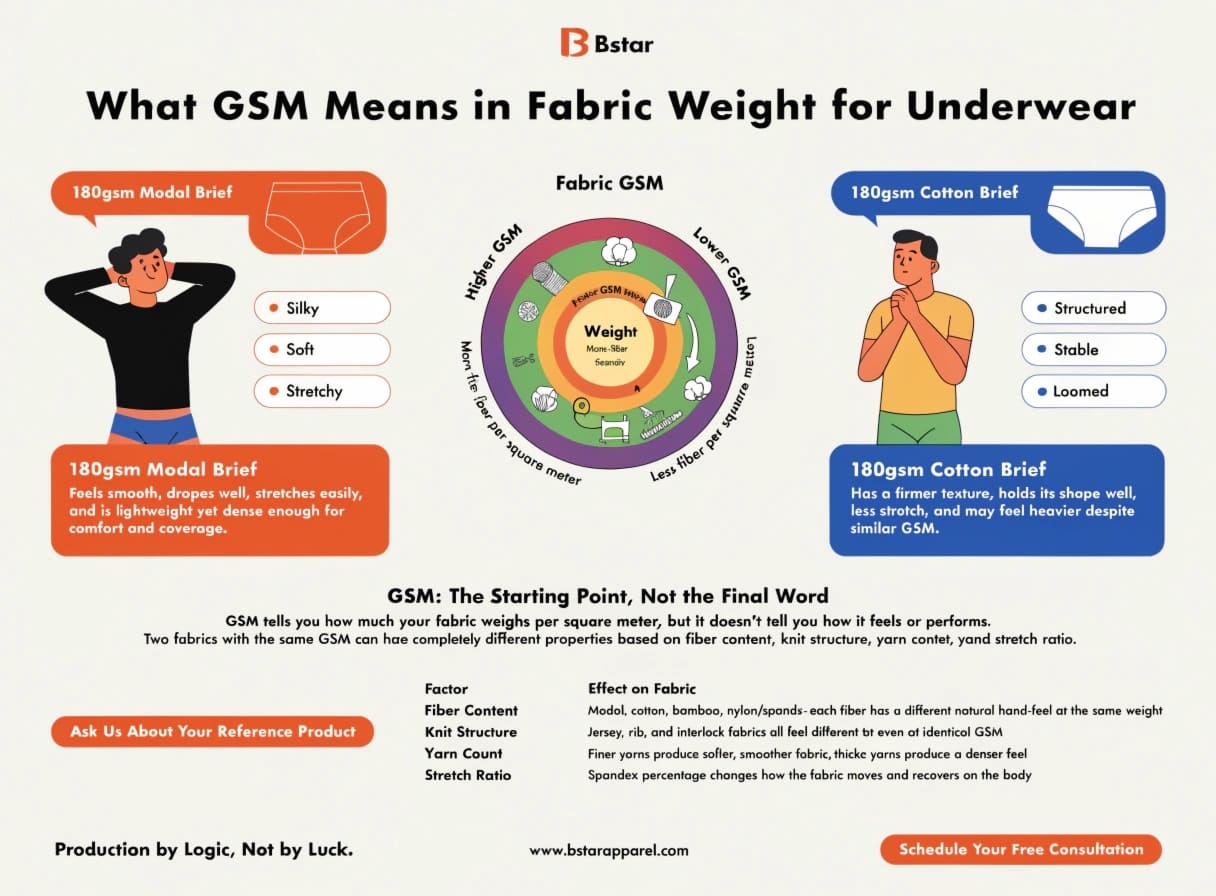
Here’s the part most buyers miss. GSM does not tell you how a fabric feels. And it does not tell you how it performs.
Take 180gsm as an example. A 180gsm modal brief and a 180gsm cotton brief are completely different products. The modal version will feel silky, drape softly, and stretch with very little resistance2. The cotton version will feel more structured, hold its shape differently, and behave differently after washing. Same number. Totally different experience.
This gap shows up in our sampling conversations all the time. A buyer sends a reference product and asks us to match it at "around 180gsm." When we ask about the fiber content and knit structure of the reference, they often don’t know. That’s where the mismatch starts.
What Else Affects How Fabric Actually Feels?
| Factor | What It Does |
|---|---|
| Fiber content | Modal, cotton, bamboo, nylon/spandex — each fiber has a different natural hand-feel at the same weight |
| Knit structure | Jersey, rib, and interlock fabrics all feel different even at identical GSM |
| Yarn count | Finer yarns produce softer, smoother fabric; thicker yarns produce a denser feel3 |
| Stretch ratio | Spandex percentage changes how the fabric moves and recovers on the body4 |
So when a buyer asks "what GSM should I use?" — they’re really asking four or five questions at once. GSM is just the one they know how to name.
Seasonal Weight: How to Think About Light vs. Heavy Fabrics?
GSM does connect to seasonality. But not in a rigid way. Here’s how most brands approach it in the inquiries we handle.
Lightweight fabrics (roughly 130–160gsm) are common in performance and warm-weather underwear. Mid-weight fabrics (roughly 160–200gsm) cover most everyday basics. Heavier fabrics (200gsm and above) tend to appear in premium loungewear, structured fits, or cold-weather base layers. These are starting zones — not rules.
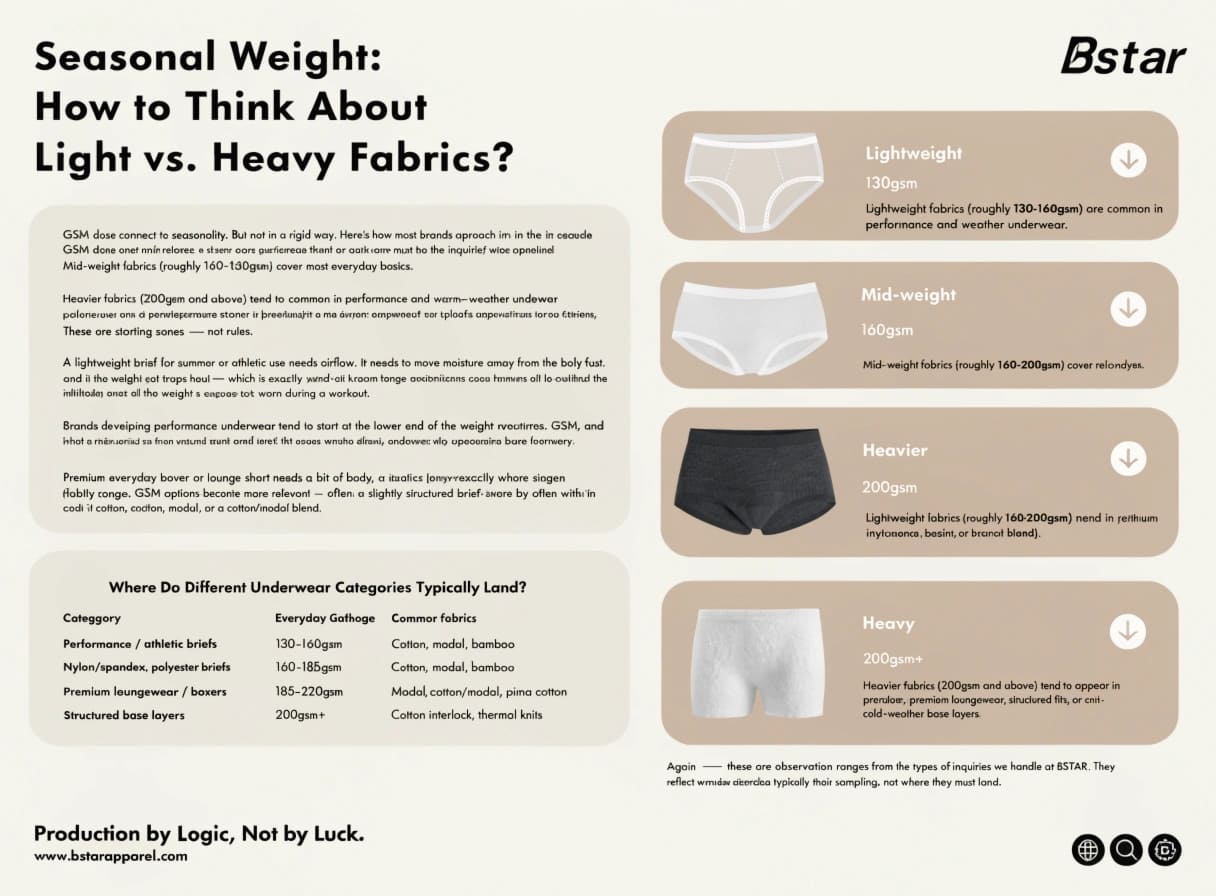
Why do these ranges exist in the first place? It comes down to what the garment needs to do.
A lightweight brief for summer or athletic use needs airflow. It needs to move moisture away from the body fast5. A heavier fabric traps heat — which is exactly what you don’t want in a performance brief worn during a workout. So brands developing performance underwear tend to start at the lower end of the weight range, often with a nylon/spandex or polyester blend that wicks moisture efficiently even at lower GSM6.
On the other end, a premium everyday boxer or lounge short needs a different kind of comfort. It needs a bit of body, a slightly structured feel, and the kind of weight that signals quality when a customer first holds it. That’s where mid-to-heavy GSM options become more relevant — often in cotton, modal, or a cotton/modal blend.
Where Do Different Underwear Categories Typically Land?
| Category | Typical GSM Range | Common Fabric |
|---|---|---|
| Performance / athletic briefs | 130–160gsm | Nylon/spandex, polyester blends |
| Everyday basics (briefs, trunks) | 160–185gsm | Cotton, modal, bamboo |
| Premium loungewear / boxers | 185–220gsm | Modal, cotton/modal, pima cotton |
| Structured base layers | 200gsm+ | Cotton interlock, thermal knits |
Again — these are observation ranges from the types of inquiries we handle at BSTAR. They reflect where brands typically start their sampling, not where they must land.
The GSM-Comfort Trade-off: Does Heavier Always Mean Better?
This is the biggest misunderstanding I hear from first-time buyers. Heavier fabric feels more premium in the hand. So heavier must be better, right?
Heavier GSM does not equal better quality. It means more fiber per square meter. Whether that helps or hurts your product depends on what you’re making. A fabric that feels luxurious for a lounge short can feel suffocating in a performance brief. Matching GSM to use case is more important than maximizing weight.

Here’s how the trade-off actually works in practice.
Higher GSM fabrics are generally more durable. They hold their shape better after repeated washing. They’re less likely to pill quickly7. For a brand positioning itself as a premium basics label — the kind that sells a three-pack for $60 and promises it’ll last five years — that durability story matters. A 200gsm+ modal or cotton interlock fabric supports that positioning.
But higher GSM also means more material cost, more weight in shipping, and a warmer wearing experience. If your buyer is in Australia or the American South, wearing your product in summer, that extra warmth is a problem — not a feature.
How Fabric Structure Changes the Trade-off
| Knit Structure | Feel at Same GSM | Best For |
|---|---|---|
| Single jersey | Soft, lightweight drape | Basics, lightweight briefs |
| Rib knit | Stretchy, textured, snug fit | Waistbands, form-fitting styles |
| Interlock | Smooth on both sides, dense | Premium basics, structured fits |
| French terry | Looped interior, warmer | Lounge shorts, base layers |
The structure multiplies the effect of GSM. An interlock fabric at 180gsm will feel noticeably denser than a single jersey at the same weight8. This is why we always ask buyers to tell us their target silhouette and stretch preference before we confirm a GSM direction.
Talking to Your Supplier: How to Specify GSM Without Getting It Wrong?
Most first-time buyers come to us with a GSM number already written into their tech pack. And quite often, it’s a number they copied from a competitor product or found in a general blog post. That’s a risky starting point.
Before you finalize GSM in your tech pack, cross-reference it with your fabric type, knit structure, target silhouette, and wear scenario. A factory that asks you follow-up questions about these details before confirming your spec is doing exactly what they should be doing.

Here’s what the conversation usually looks like when a buyer comes to us and says "I want something like Brand X."
Our team doesn’t ask "what GSM does Brand X use?" We ask: What’s your target retail price? Where will the customer wear this — gym, everyday, sleep? What washing behavior do you expect — machine wash daily? Do you want the fabric to feel soft out of the bag, or is the softness supposed to develop after a few washes?
Those answers shape the GSM direction. They also shape the fiber recommendation, the knit structure suggestion, and the first sample we send you.
What to Include in Your GSM Spec for Sampling
| What to Specify | Why It Matters |
|---|---|
| Target GSM range (not a single number) | Gives the factory room to match hand-feel over hitting an exact figure |
| Fiber content preference | Modal at 170gsm behaves completely differently from cotton at 170gsm |
| Knit structure | Jersey vs. interlock will change how the number translates to feel |
| Intended use | Performance, everyday basics, or lounge — these require different fabrics |
| Reference product (if available) | A physical sample tells the factory more than any number on a spec sheet |
On the verification side: when your bulk shipment arrives, GSM can be tested by cutting a small fabric swatch to a known area and weighing it9. Reputable manufacturers will provide GSM test reports as part of their quality documentation10. At BSTAR, we run AQL-standard checks across six quality checkpoints11 — from raw material intake through to final packaging — so GSM consistency is part of what gets verified before goods ship, not after.
-
"Understanding Fabric Weights – Core Fabrics", https://corefabricstore.com/blogs/tips-and-resources/fabric-weights-blog?srsltid=AfmBOopkqHQt9QYlGpbtka_i6LAppTfbKntQfHi_0emRpRl6GeAnzcwx. GSM (grams per square meter) is the standard unit used in the textile industry to express fabric weight, typically measured by cutting a known area of fabric and weighing it; ISO 3801 specifies the standard method for determining mass per unit area of woven fabrics, with analogous methods applied to knitted fabrics. Evidence role: definition; source type: institution. Supports: GSM as a standardized unit of fabric weight measurement in the textile industry. Scope note: ISO 3801 applies specifically to woven fabrics; knitted fabric weight measurement follows related but distinct standards, so the citation is contextually applicable rather than a direct specification for all fabric types discussed in the article. ↩
-
"A Systematic Review of AI-Driven Prediction of Fabric Properties …", https://pmc.ncbi.nlm.nih.gov/articles/PMC11509711/. Modal is a type of regenerated cellulosic fiber produced from beech wood pulp; research on cellulosic fiber properties indicates that modal fibers exhibit higher wet strength, finer fiber diameter, and smoother surface morphology than conventional cotton, contributing to the softer hand-feel and improved drape commonly attributed to modal fabrics. Evidence role: mechanism; source type: paper. Supports: Modal fiber’s distinctive softness, drape, and stretch characteristics relative to conventional cotton. Scope note: Sensory properties such as perceived softness are influenced by knit structure, yarn count, and finishing treatments in addition to fiber type, so fiber-level characterizations provide general rather than absolute support for the claim. ↩
-
"Quantitative Analysis of the Impact of Finishing and Washing … – PMC", https://pmc.ncbi.nlm.nih.gov/articles/PMC11314936/. Textile engineering literature establishes that yarn count, expressed in units such as Ne or Nm, influences fabric surface characteristics; finer yarns (higher count numbers) produce fabrics with greater surface smoothness and softer tactile perception due to reduced fiber bundle diameter and more uniform surface geometry. Evidence role: mechanism; source type: paper. Supports: The relationship between yarn fineness and fabric hand-feel characteristics including softness and surface smoothness. Scope note: The relationship between yarn count and perceived softness is modulated by fiber type, twist level, and finishing processes, so yarn count alone is not a complete predictor of hand-feel. ↩
-
"Impact of the Elastane Percentage on the Elastic Properties of … – PMC", https://pmc.ncbi.nlm.nih.gov/articles/PMC9570736/. Elastane (spandex/Lycra) is a segmented polyurethane fiber capable of elongation up to 500–600% with near-complete elastic recovery; research on elastane-containing knitted fabrics demonstrates that increasing elastane content raises fabric extensibility and recovery force, with the specific relationship depending on elastane linear density, yarn structure, and knit construction. Evidence role: mechanism; source type: paper. Supports: The relationship between elastane/spandex content and the stretch and elastic recovery properties of knitted fabrics. Scope note: The quantitative relationship between spandex percentage and stretch/recovery varies with knit structure and base fiber, so the cited mechanism provides general support rather than precise predictive values. ↩
-
"The Role of Sports Clothing in Thermoregulation, Comfort, and …", https://pmc.ncbi.nlm.nih.gov/articles/PMC9051004/. Research on textile comfort in athletic applications indicates that fabric weight and construction influence moisture vapor transmission rate and liquid moisture transport; lighter-weight fabrics with open knit structures generally exhibit higher air permeability and faster moisture evaporation rates, supporting their use in high-activity garments. Evidence role: mechanism; source type: paper. Supports: The relationship between fabric weight and moisture management or breathability in athletic textile applications. Scope note: Moisture management is also strongly influenced by fiber hydrophilicity, yarn structure, and fabric finish, meaning fabric weight alone is an incomplete predictor of athletic performance; the cited relationship is directional rather than deterministic. ↩
-
"Liquid Moisture Transport in Cotton Woven Fabrics with … – PMC – NIH", https://pmc.ncbi.nlm.nih.gov/articles/PMC9504572/. Polyester and nylon fibers are hydrophobic synthetic polymers; their moisture management in athletic textiles relies on capillary action through fiber geometry and fabric structure rather than fiber absorption, enabling effective liquid moisture transport away from the skin surface even in low-weight constructions. Evidence role: mechanism; source type: paper. Supports: The moisture-wicking properties of polyester and nylon fiber blends in performance textile applications. Scope note: Moisture wicking performance in end-use garments depends substantially on knit structure and any applied finishing treatments, so fiber type alone does not fully determine wicking efficiency. ↩
-
"Evaluation of physical and mechanical characteristics of three … – PMC", https://pmc.ncbi.nlm.nih.gov/articles/PMC10685180/. Studies on knitted fabric performance indicate that fabric weight and loop density are among the structural parameters influencing dimensional stability after laundering and resistance to surface pilling; denser fabrics with higher mass per unit area tend to exhibit greater resistance to fiber migration and surface abrasion that leads to pilling. Evidence role: general_support; source type: paper. Supports: The association between higher fabric weight and improved durability, shape retention, and pilling resistance in knitted fabrics. Scope note: Pilling resistance and wash durability are also significantly affected by fiber type, yarn twist, and knit structure, so the relationship between GSM and these properties is correlational and context-dependent rather than universal. ↩
-
"Fiber types and fabric structures influence on weft knitted fabrics – PMC", https://pmc.ncbi.nlm.nih.gov/articles/PMC9204663/. Interlock fabric is produced by interlocking two rib structures, resulting in a double-faced construction with greater dimensional stability and a smoother, denser surface on both sides compared to single jersey; at equivalent mass per unit area, the tighter loop geometry of interlock produces a perceptibly firmer hand-feel and reduced surface extensibility. Evidence role: mechanism; source type: paper. Supports: The structural differences between interlock and single jersey knits and their effect on perceived fabric density and hand-feel. Scope note: Perceived density is a subjective tactile property; the structural explanation supports the directional claim but does not constitute a controlled sensory evaluation study. ↩
-
"Standard Test Method for Mass Per Unit Area (Weight) of Fabric 1", https://www.academia.edu/40943182/Standard_Test_Method_for_Mass_Per_Unit_Area_Weight_of_Fabric_1. The method described — cutting a fabric specimen of known area and weighing it to calculate mass per unit area — corresponds to standardized test procedures such as ISO 3801 (woven fabrics) and ASTM D3776, which specify specimen size, conditioning requirements, and calculation methods to ensure reproducible GSM measurements. Evidence role: definition; source type: institution. Supports: The standardized method for measuring fabric weight per unit area by cutting and weighing a fabric specimen. Scope note: ISO 3801 is formally specified for woven fabrics; knitted fabric weight measurement may follow related standards such as ISO 12127 or manufacturer-specific protocols, so the precise applicable standard depends on fabric construction type. ↩
-
"Apparel Quality Control Testing: A Complete Guide to Standards …", https://www.tradeaiders.com/apparel-quality-control-testing-a-complete-guide-to-standards-and-best-practices.html. Quality management frameworks applied in apparel manufacturing, including those aligned with ISO 9001 and buyer-mandated quality assurance protocols, typically require suppliers to provide material test reports confirming that fabric properties — including weight per unit area — meet specified tolerances before or alongside shipment of finished goods. Evidence role: expert_consensus; source type: institution. Supports: GSM test reporting as a component of standard quality documentation in apparel manufacturing. Scope note: The specific documentation requirements vary by buyer, retailer, and market; there is no single universal mandate requiring GSM test reports, so the claim reflects common industry practice rather than a codified universal standard. ↩
-
"[PDF] ISO 2859-1 – UNT Chemistry", https://chemistry.unt.edu/~tgolden/courses/iso2859-1.pdf. Acceptable Quality Limit (AQL) inspection is defined under ISO 2859-1 (equivalent to ANSI/ASQ Z1.4), which specifies sampling procedures and tables for inspection by attributes; the standard establishes the maximum number of defective units permissible in a sample for a lot to be accepted, and is widely applied in apparel and textile manufacturing quality control. Evidence role: definition; source type: institution. Supports: AQL as a standardized statistical sampling methodology used in manufacturing quality inspection. Scope note: The article’s reference to ‘six quality checkpoints’ is a proprietary process description not defined by the AQL standard itself; the citation supports the AQL methodology as a recognized framework but does not validate the specific checkpoint structure described. ↩