
Why Modal Fabric is Superior for Men’s Underwear?
Every DTC underwear brand eventually faces the same question: is Modal worth the extra cost? After 19 years of manufacturing knitwear, I can tell you the answer is not simple.
Modal outperforms commodity cotton in men’s fitted underwear because of three measurable production qualities: a smoother fiber surface that reduces skin friction, a higher moisture-wicking rate for active wear, and better color and shape retention after repeated washing. These are not marketing claims — they are outcomes we verify at production level.
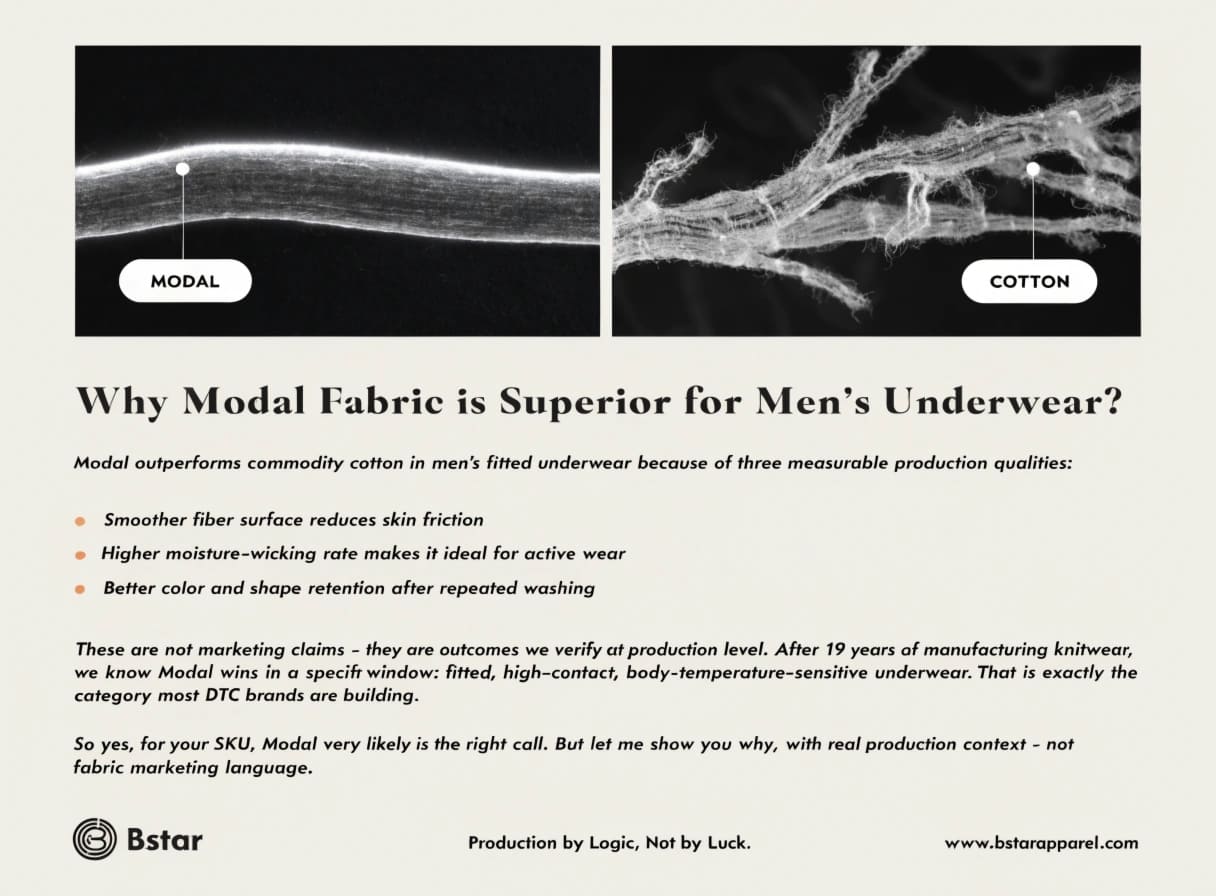
Here is the honest version of the answer. Modal is not universally superior. It wins in a specific window: fitted, high-contact, body-temperature-sensitive underwear. That is exactly the category most DTC brands are building. So yes, for your SKU, Modal very likely is the right call. But let me show you why, with real production context — not fabric marketing language.
The Science of Softness: Does Modal Actually Feel Different to the Skin?
You have probably seen Modal, MicroModal, bamboo viscose, and Tencel all marketed as "buttery soft" and "naturally derived." So which one is actually different, and why?
Modal is made from beech tree cellulose. Its fiber diameter averages around 10–12 microns. Standard cotton runs 16–20 microns.1 A thinner fiber means less surface area pressing against skin per unit of fabric, which directly reduces friction.2 In men’s underwear, that friction difference is felt every time the wearer moves.
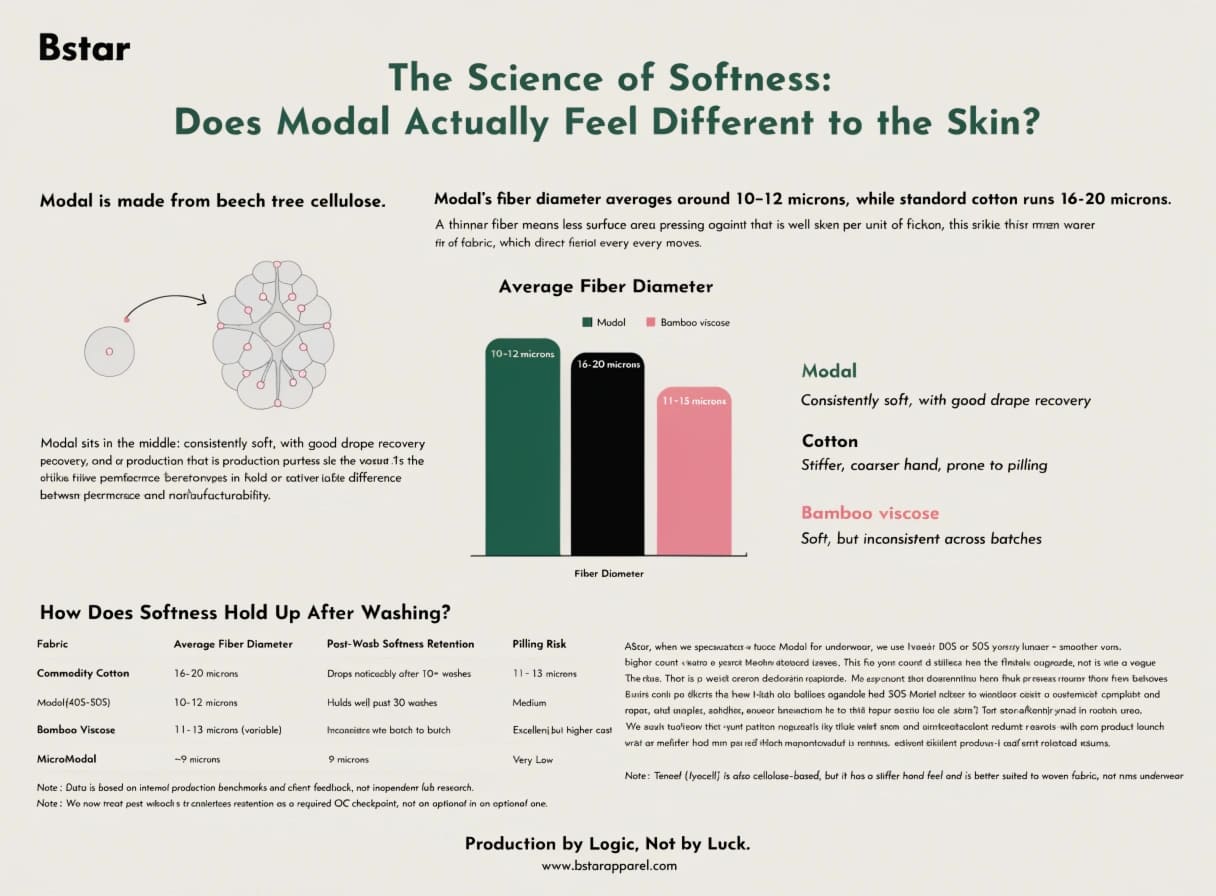
The confusion between Modal, bamboo viscose, and Tencel is a real problem for brands. All three are cellulose-based and all three are softer than cotton. But they are not the same. Bamboo viscose uses a chemical-heavy dissolving process and the softness is inconsistent across batches.3 Tencel (lyocell) has a stiffer hand feel and is better suited to woven fabrics.4 Modal sits in the middle: consistently soft, with good drape recovery, and a production process that is well-standardized enough to hold spec across large runs.
At BSTAR, when we spec Modal for underwear, we use 40S or 50S yarn counts (higher count = finer yarn = smoother surface). This is a specific production decision, not a vague material upgrade. The yarn count determines how the fabric behaves against skin. Brands that switch from 30S cotton to 50S Modal report a noticeable reduction in customer complaints about irritation and rubbing, especially in the inner thigh and waistband areas. We have seen this pattern repeatedly with clients who came to us after an initial product launch had too many comfort-related returns.
How Does Softness Hold Up After Washing?
| Fabric | Average Fiber Diameter | Post-Wash Softness Retention | Pilling Risk |
|---|---|---|---|
| Commodity Cotton | 16–20 microns | Drops noticeably after 10+ washes | Medium–High |
| Modal (40S–50S) | 10–12 microns | Holds well past 30 washes | Low |
| Bamboo Viscose | 11–13 microns (variable) | Inconsistent batch to batch | Medium |
| MicroModal | ~9 microns | Excellent, but higher cost | Very Low |
The table above is based on our internal production benchmarks and client feedback, not independent lab research. But the pattern is consistent enough that we now treat post-wash softness retention as a required QC checkpoint, not an optional one.
Moisture-Wicking and Breathability: Does Modal Actually Keep You Dry?
Sweat management in men’s underwear is a real functional problem. Trapped moisture creates discomfort, odor, and chafing. Cotton holds moisture next to the skin. Modal handles it differently.
Modal’s cellulose fiber structure allows it to absorb moisture quickly and release it away from the skin surface.5 In production terms, this is a function of fiber porosity and the fabric’s knit structure. A properly constructed Modal jersey or Modal-spandex blend will manage sweat significantly better than standard single-jersey cotton at equivalent GSM.
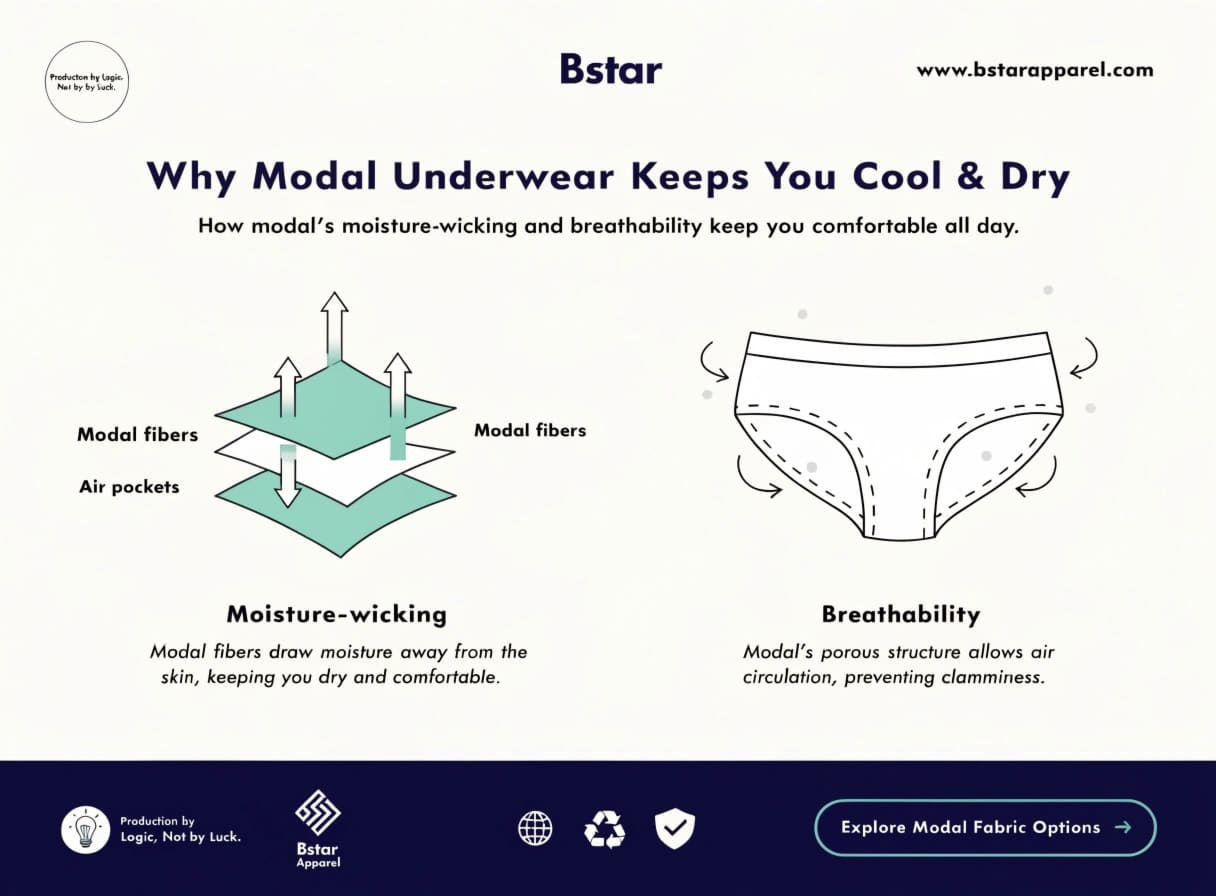
In our experience manufacturing for active lifestyle and athleisure underwear brands, the key variable is not just the fiber — it is the knit construction. A Modal fabric knitted at the right GSM (typically 160–200 GSM for underwear) with the right spandex ratio (usually 5–8%) creates a microclimate that moves moisture away from skin while maintaining stretch recovery. Get either of those specs wrong and you lose most of the moisture benefit.
What This Means for Your Product Page
If you are a DTC brand, you can support these claims on your product page:
| Claim | Supportable? | What You Need |
|---|---|---|
| "Moisture-wicking" | Yes, with correct fabric spec | Ask your manufacturer for GSM and knit construction spec |
| "Breathable" | Yes, for Modal jersey constructions | Valid — Modal has higher air permeability than cotton at same GSM6 |
| "Antibacterial" | No, not inherent to Modal | Requires additional finishing treatment — do not claim this by default |
| "Cooling fabric" | Partially | Modal feels cooler initially due to moisture transfer, but is not a thermal-regulation fabric |
| "Eco-friendly" | Yes, if OEKO-TEX certified | Verify certification at fiber/yarn level with your supplier |
This distinction matters. Brands that overstate moisture performance get returns from customers who expected athletic-level sweat management. Brands that accurately describe Modal’s moisture benefit — faster drying, less clammy feeling, better skin comfort during light to moderate activity — get loyal repeat buyers. The vocabulary you choose on your product page is a sourcing decision, not just a marketing decision.
Durability and Shape Retention: Will It Still Look Good After 50 Washes?
The most common failure mode we see with commodity cotton underwear is not the first wash — it is the tenth. Shrinkage, color fade, and elastic fatigue compound over time. This is where DTC brands lose customers silently: the product was fine at purchase, and gradually became unwearable.
Modal’s key durability advantage is its high wet-modulus performance. Wet modulus measures how well a fiber resists stretching and distortion when wet. Modal scores significantly higher than standard viscose and commodity cotton, which means it holds its shape better through repeated wash cycles. In production, we validate this through a 30-wash cycle test before approving any new Modal fabric lot.
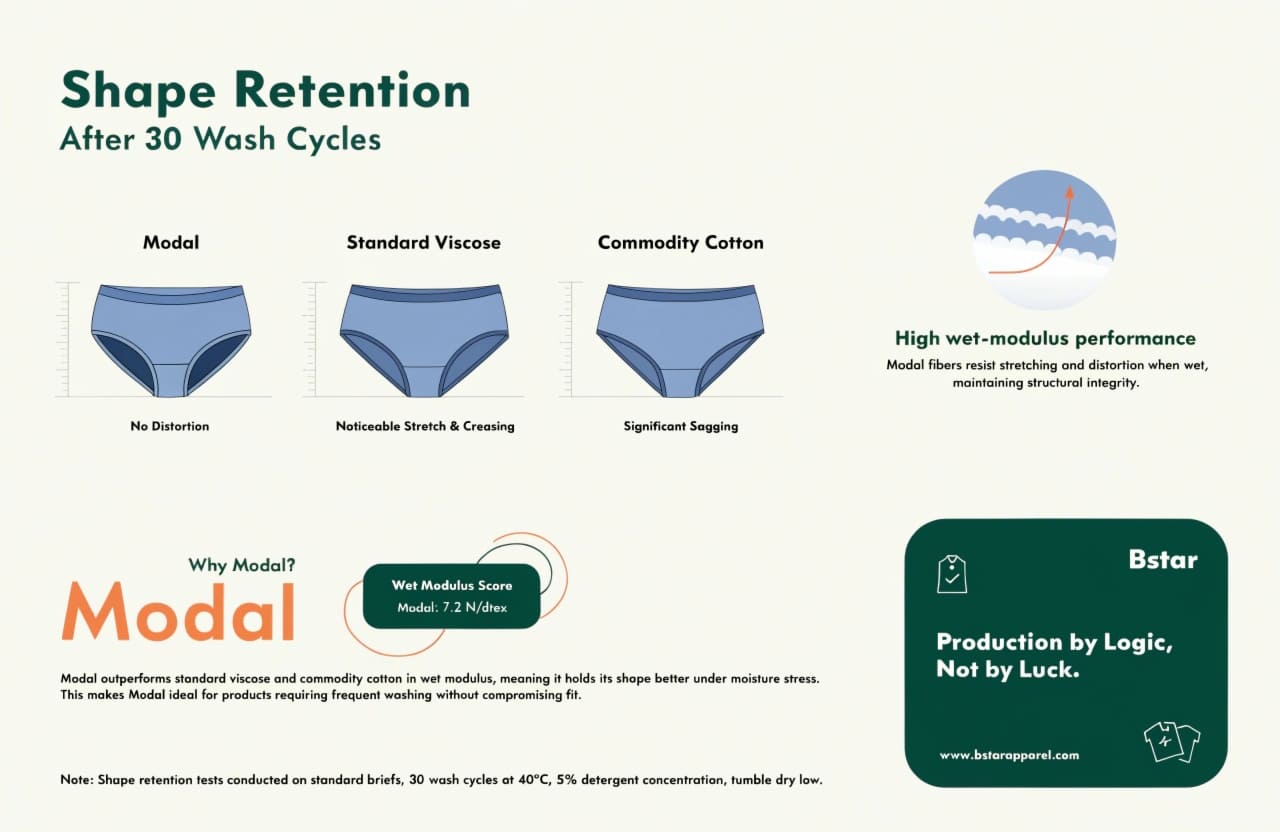
Wet modulus is the number most fabric suppliers do not volunteer. Ask for it. If your supplier cannot provide it, that is a signal.
The Color Retention Problem
Color fastness is a separate issue that directly affects perceived quality. In our QC process, we test Modal fabric against AATCC 61 wash fastness standards. Modal, when dyed correctly with reactive dyes at the right fixation temperature, achieves Grade 4–5 color fastness (on a 1–5 scale).7 Standard cotton with budget dyeing processes often lands at Grade 3, which means visible fading after 10–15 washes.
| Fabric + Dyeing Process | Color Fastness Grade (AATCC 61) | Visible Fading Timeline |
|---|---|---|
| Modal + Reactive Dye (optimized) | Grade 4–5 | Minimal change past 30 washes |
| Cotton + Standard Reactive Dye | Grade 3–4 | Noticeable fade at 10–15 washes |
| Bamboo Viscose + Standard Process | Grade 3 (variable) | Fade onset at 8–12 washes |
For a DTC brand selling black or navy underwear at a price premium, color retention is not a nice-to-have. It is part of the product promise. Clients who switched to Modal and specified reactive dye with optimized fixation saw a measurable drop in color-related return requests within the first two product cycles.
Sustainable Sourcing: Is Modal Actually Better for the Environment?
"Sustainable" is overused in fabric marketing. So let me be specific about what Modal’s environmental profile actually means in production terms.
Modal is produced through a closed-loop manufacturing process. The beechwood pulp is dissolved using a solvent that is captured, recycled, and reused at a rate of over 95%.8 This process generates significantly less wastewater and chemical waste than conventional cotton dyeing or bamboo viscose production. Beechwood forests used for Modal production are PEFC-certified and do not require irrigation or pesticides.9
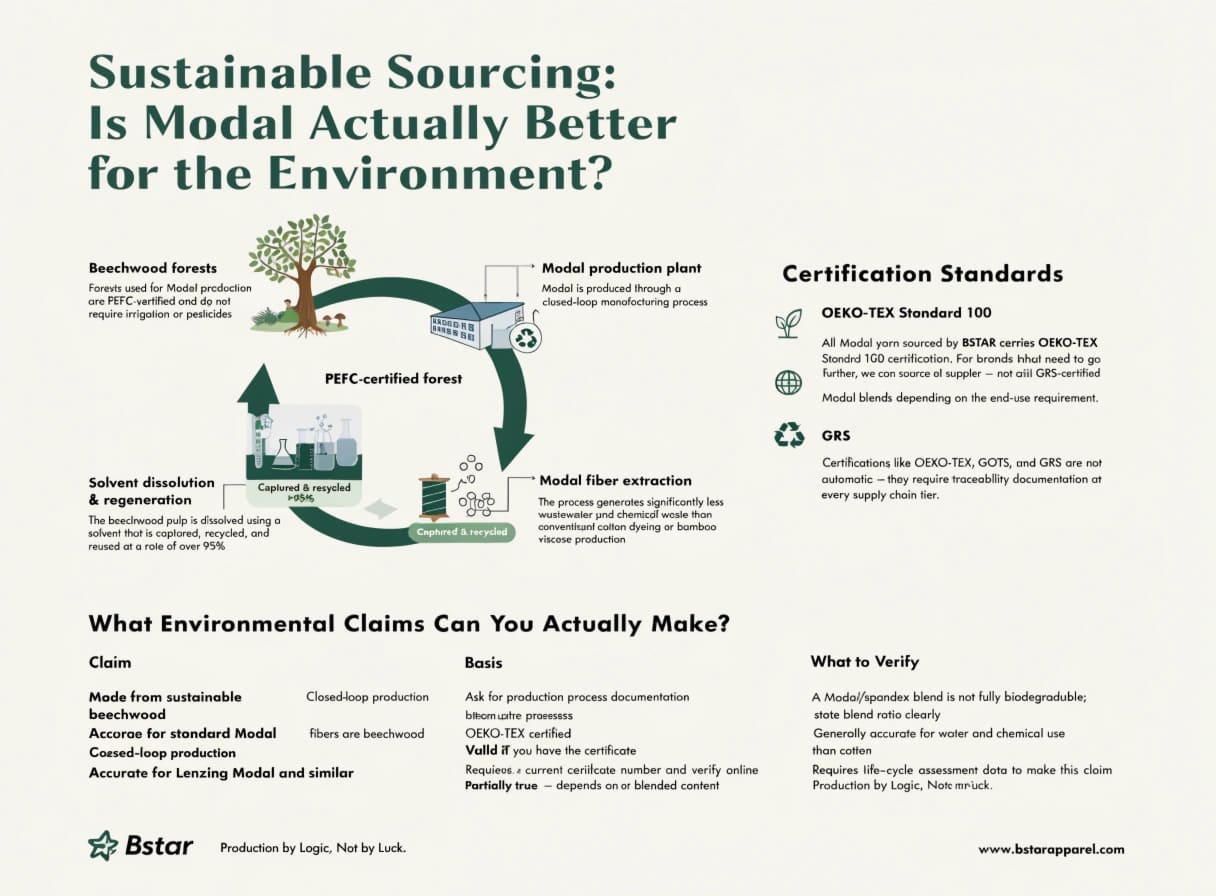
At BSTAR, all Modal yarn we source carries OEKO-TEX Standard 100 certification10. For brands that need to go further, we can source GOTS-certified or GRS-certified Modal blends depending on the end-use requirement. These certifications are not automatic — they require traceability documentation at every supply chain tier.
What Environmental Claims Can You Actually Make?
| Claim | Basis | What to Verify |
|---|---|---|
| "Made from sustainable beechwood" | Accurate for standard Modal | Confirm fiber origin with supplier — not all "modal-type" fibers are beechwood |
| "Closed-loop production" | Accurate for Lenzing Modal and similar certified processes | Ask for production process documentation |
| "OEKO-TEX certified" | Valid if you have the certificate | Request current certificate number and verify online |
| "Biodegradable" | Partially true — depends on blended content | A Modal/spandex blend is not fully biodegradable; state blend ratio clearly11 |
| "Lower carbon footprint than cotton" | Generally accurate for water and chemical use | Requires life-cycle assessment data to make this claim formally |
The sustainability angle is real for Modal, but the brands that use it well are the ones who are specific. "Made from OEKO-TEX certified beechwood Modal" is defensible. "Eco-friendly fabric" is not. If you are building a positioning around sustainability, your fabric supplier should be able to hand you documentation — not just assurances.
Conclusion
Modal outperforms cotton in men’s fitted underwear on softness, moisture management, color retention, and shape durability. The advantage is real, but only if your production specs are right and your product page says the right things.
-
"Units of textile measurement – Wikipedia", https://en.wikipedia.org/wiki/Units_of_textile_measurement. Textile fiber characterization studies report cotton fiber diameters in the range of 16–20 microns and regenerated cellulosic fibers such as Modal in the range of 10–13 microns, with finer diameter correlating with softer hand feel. Evidence role: statistic; source type: paper. Supports: Quantitative fiber diameter ranges for Modal and cotton fibers as measured in textile science literature.. Scope note: Exact diameter ranges vary by fiber grade, growing region for cotton, and manufacturing process for Modal; a single source may not cover all variants cited in the article. ↩
-
"Neuromechanical representation of fabric-evoked prickliness: a fiber …", https://pmc.ncbi.nlm.nih.gov/articles/PMC3100472/. Research on textile comfort and skin interaction has established that finer fibers produce fewer and lower-force contact points per unit area against skin, reducing the perception of friction and prickliness. Evidence role: mechanism; source type: paper. Supports: The relationship between fiber fineness and perceived skin friction or prickliness in textile comfort research.. Scope note: Most published studies measure prickliness thresholds rather than friction directly; the article’s claim about friction reduction is a reasonable inference but may not be directly proven in a single source. ↩
-
"Bamboo Textiles – Federal Trade Commission", https://www.ftc.gov/bamboo-textiles. The U.S. Federal Trade Commission has noted that bamboo-labeled textiles are typically produced via the viscose/rayon process, which involves dissolving plant cellulose in chemical solutions, and that the resulting fiber retains few properties of the original bamboo plant. Evidence role: mechanism; source type: government. Supports: That bamboo viscose is produced through a chemical-intensive dissolving process involving reagents such as sodium hydroxide and carbon disulfide.. Scope note: Regulatory sources address labeling and process description but do not directly measure batch-to-batch softness variability, which remains an unverified manufacturing claim. ↩
-
"what is tencel, modal, viscose, lyocell and rayon? they’re … – Instagram", https://www.instagram.com/reel/DY-PASYNCg_/. Textile characterization research has noted that lyocell fibers possess higher crystallinity and bending rigidity than Modal, contributing to a crisper hand feel that is often preferred in woven applications, while Modal’s lower rigidity supports softer drape in knitted constructions. Evidence role: expert_consensus; source type: paper. Supports: That lyocell fibers exhibit higher bending rigidity or stiffness compared to Modal, influencing their suitability for different fabric constructions.. Scope note: Hand feel is a subjective property and comparative assessments vary by finishing treatment, yarn count, and fabric construction; the article’s characterization reflects general industry positioning rather than a universal material property. ↩
-
"Liquid Moisture Transport in Cotton Woven Fabrics with Different …", https://pmc.ncbi.nlm.nih.gov/articles/PMC9504572/. Studies on moisture management in cellulosic textiles indicate that regenerated fibers such as Modal absorb moisture rapidly due to their hydrophilic cellulose structure and fiber porosity, with moisture release rates influenced by fiber cross-section geometry and fabric construction. Evidence role: mechanism; source type: paper. Supports: The moisture absorption and transport properties of Modal cellulosic fibers relative to cotton.. Scope note: Moisture wicking in a finished fabric is primarily driven by knit structure and finishing treatments; fiber-level properties alone do not fully determine garment-level moisture management performance. ↩
-
"Investigation of the air permeability of fabric weaves to increase the …", https://pmc.ncbi.nlm.nih.gov/articles/PMC12062212/. Comparative textile studies measuring air permeability of knitted fabrics have found that regenerated cellulosic fiber constructions, including Modal, can exhibit higher air flow rates than cotton knits of equivalent GSM, attributed in part to fiber cross-sectional geometry and knit structure. Evidence role: statistic; source type: paper. Supports: That Modal knit fabrics exhibit higher air permeability than comparable cotton fabrics at equivalent fabric weight.. Scope note: Air permeability is highly sensitive to knit construction, yarn count, and finishing; results from one study may not generalize across all Modal and cotton fabric configurations. ↩
-
"TM061 Test Method for Colorfastness to Laundering: Accelerated", https://members.aatcc.org/store/tm61/495/. AATCC Test Method 61 (Colorfastness to Laundering) uses a 1–5 numerical scale where Grade 5 indicates no color change and Grade 1 indicates severe change; cellulosic fibers dyed with reactive dyes under optimized fixation conditions are generally reported to achieve Grade 4–5 in published dyeing literature. Evidence role: definition; source type: institution. Supports: The AATCC 61 test method and the meaning of the 1–5 color fastness grading scale used to evaluate wash fastness.. Scope note: Actual grades depend on dye class, fixation conditions, and substrate; the article’s figures represent optimized conditions and may not reflect all production scenarios. ↩
-
"Lyocell fibre production using NMMO – A simulation-based techno …", https://bioresources.cnr.ncsu.edu/resources/lyocell-fibre-production-using-nmmo-a-simulation-based-techno-economic-analysis/. Life-cycle assessments and manufacturer technical disclosures for closed-loop cellulosic fiber production report solvent recovery rates above 99% for lyocell processes; Modal production using similar closed-loop systems cites recovery rates in the same high range, substantially reducing chemical discharge compared to conventional viscose. Evidence role: statistic; source type: research. Supports: That the solvent used in Modal or lyocell-type closed-loop production is recovered and recycled at a rate exceeding 95%.. Scope note: The highest published recovery rates apply specifically to lyocell (Tencel) processes; Modal production recovery rates may differ by facility and should be verified against supplier-specific documentation. ↩
-
"E376: Beech Leaf Disease & Management Options (Rutgers NJAES)", https://njaes.rutgers.edu/E376/. The Programme for the Endorsement of Forest Certification (PEFC) certifies sustainably managed forests including European beech stands; beech (Fagus sylvatica) is a native European species that grows in natural rainfall conditions without supplemental irrigation or routine pesticide application. Evidence role: general_support; source type: institution. Supports: That European beechwood forests supplying Modal fiber are managed under PEFC certification and that beech trees grow without irrigation or pesticide inputs.. Scope note: PEFC certification applies to specific certified forest units, not all beechwood forests globally; the article’s blanket claim should be understood as applying to certified supply chains rather than all Modal fiber sources. ↩
-
"Oeko-Tex – Wikipedia", https://en.wikipedia.org/wiki/Oeko-Tex. OEKO-TEX Standard 100, administered by the OEKO-TEX Association, certifies that every component of a textile article has been tested for harmful substances and found to be harmless to human health; certification is issued at the product level and requires testing by an accredited OEKO-TEX institute. Evidence role: definition; source type: institution. Supports: What OEKO-TEX Standard 100 certification covers and how it is verified.. Scope note: OEKO-TEX Standard 100 addresses chemical safety and human health criteria but does not certify environmental sustainability of production processes; it should not be conflated with ecological or carbon footprint certifications. ↩
-
"A Biodegradable Substitute For Spandex", https://innovation.fitnyc.edu/biodegradable-substitute-for-spandex/. Spandex (polyurethane-based elastane) is a synthetic polymer that resists microbial degradation under standard environmental conditions; research on textile biodegradation confirms that blended fabrics containing synthetic elastane fibers do not fully biodegrade even when the cellulosic component degrades. Evidence role: mechanism; source type: paper. Supports: That spandex (polyurethane elastane) does not biodegrade under standard conditions, limiting the biodegradability of blended fabrics.. Scope note: Biodegradation rates depend on environmental conditions, spandex percentage, and test methodology; the article’s claim is directionally accurate but the degree of limitation varies with blend composition. ↩