Custom Underwear Sampling: What’s the Real Timeline and What Do You Actually Need to Check?
If you’ve ever sent a sample request and heard nothing useful back for weeks, you already know the problem. Most sampling delays don’t start at the factory. They start with you.
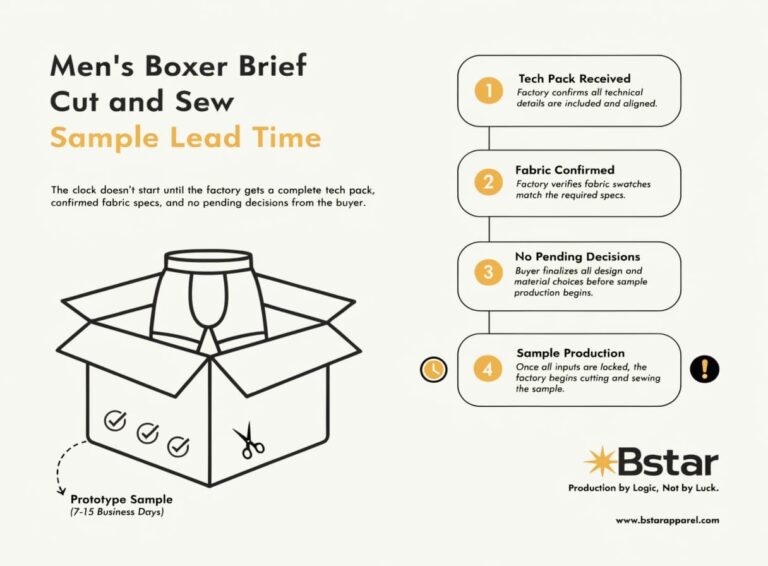
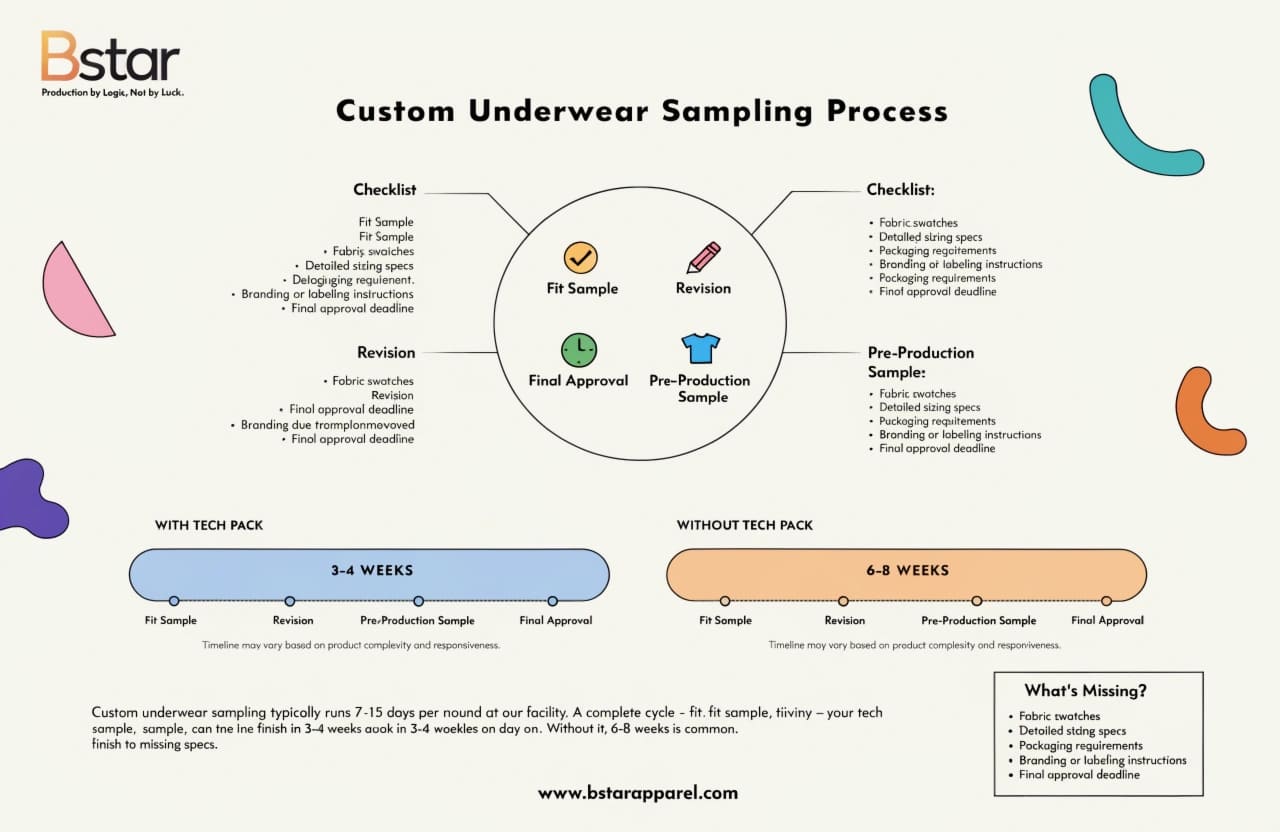
Custom underwear sampling typically runs 7–15 days per round at our facility. A complete cycle — fit sample, revision, pre-production sample, final approval — can finish in 3–4 weeks if your tech pack is complete on day one. Without it, 6–8 weeks is common.
I’ve been on the factory side of this process for 19 years in Zhongshan, Guangdong. I’ve watched DTC brands from the US, EU, and Australia go through sampling cycles that should have taken three weeks and ended up taking three months. The cause is almost always the same. The brand wasn’t ready when they thought they were. This article is about what "ready" actually looks like — and what happens at each stage when it isn’t.
The Sampling Roadmap: What Are Proto, Fit, and Pre-Production Stages Actually For?
Most brands hear "sampling" and picture one round. Send a sketch, get a sample, approve it, start production. That’s not how it works — and if a factory tells you it works that way, you should be nervous.
There are three distinct sample stages: the proto sample (concept proof), the fit sample (construction and wear test), and the pre-production sample (final match to bulk production standards). Each one has a specific approval gate. Skipping or blurring these gates is where expensive mistakes get made.
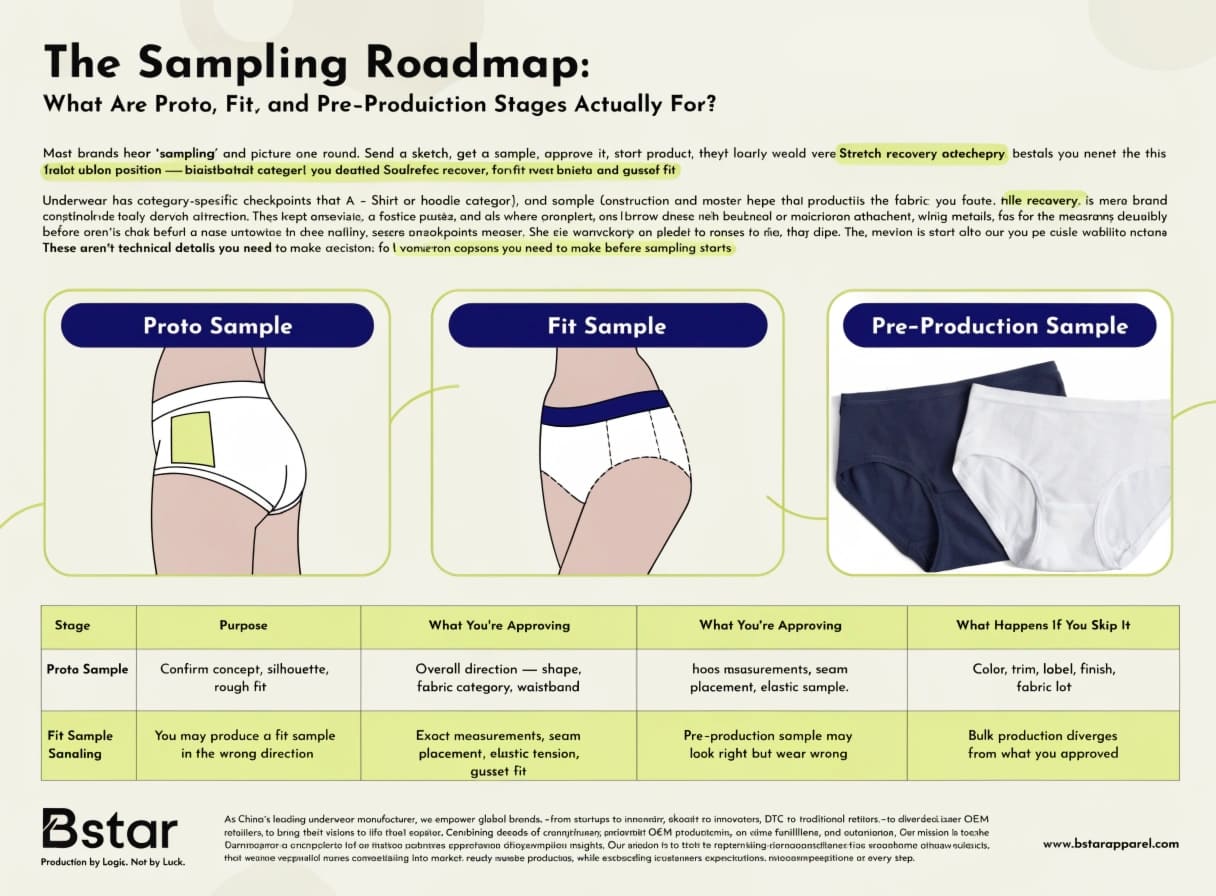
Here’s what each stage actually does — and what you as a brand need to decide at each one:
Stage Breakdown
| Stage | Purpose | What You’re Approving | What Happens If You Skip It |
|---|---|---|---|
| Proto Sample | Confirm concept, silhouette, rough fit | Overall direction — shape, fabric category, waistband position | You may produce a fit sample in the wrong direction entirely |
| Fit Sample | Confirm construction, measurements, stretch behavior | Exact measurements, seam placement, elastic tension, gusset fit | Pre-production sample may look right but wear wrong |
| Pre-Production Sample | Match bulk production exactly | Color, trim, label, finish, fabric lot | Bulk production diverges from what you approved |
Underwear has category-specific checkpoints that a T-shirt or hoodie doesn’t need. Stretch recovery is one. If the fabric doesn’t return to its original shape after wear, your customer returns the product and leaves a review you don’t want1. Waistband attachment is another — the wrong stitch type on a waistband causes rolling, and it shows up in the fit sample, not production2. Gusset fit is the third. Many first-time buyers don’t even think to specify gusset construction3. We ask about it in the first tech pack review because the consequences of getting it wrong show up in wear testing, not visual inspection4.
These aren’t technical details you need to master. They’re decisions you need to make before sampling starts.
Timeline Expectations: How Long Does This Actually Take?
The honest answer is: it depends on you more than it depends on us.
At BSTAR, our internal turnaround per sample round is 7–15 days from confirmed tech pack to physical sample shipped. That number is real. But I’ve seen that number become six weeks because a client took 10 days to send feedback, then sent feedback that required a full new round, then needed internal sign-off from someone who wasn’t in the original email chain.
A realistic full sampling timeline is 4–6 weeks when the client is responsive and the brief is complete5. It stretches to 8–12 weeks when feedback is vague, decision-makers are unclear, or the tech pack arrives incomplete. Your timeline starts before we start cutting.
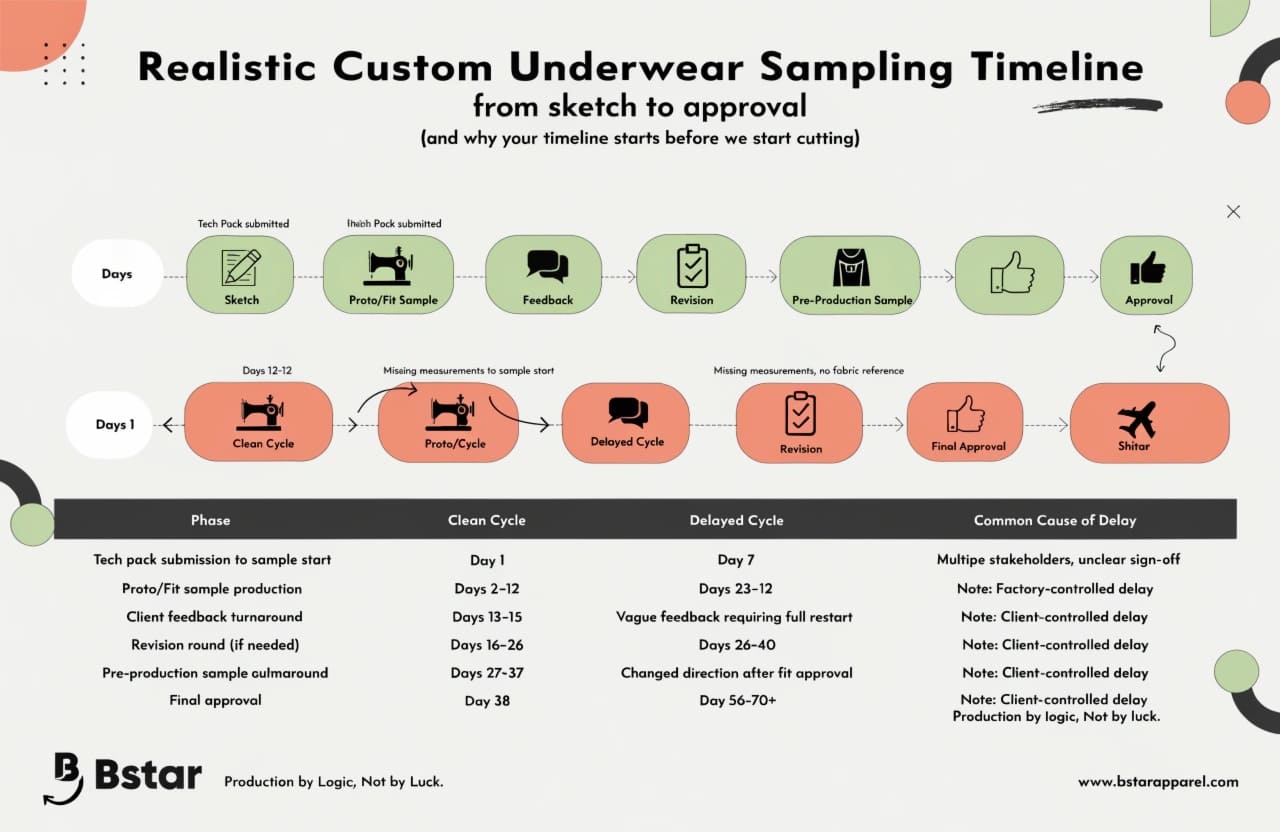
Here’s what a clean cycle looks like versus a typical delayed one:
Timeline Comparison
| Phase | Clean Cycle | Delayed Cycle | Common Cause of Delay |
|---|---|---|---|
| Tech pack submission to sample start | Day 1 | Day 1–7 | Missing measurements, no fabric reference |
| Proto/Fit sample production | Days 2–12 | Days 2–12 | (Factory-controlled) |
| Client feedback turnaround | Days 13–15 | Days 13–25 | Internal review bottlenecks |
| Revision round (if needed) | Days 16–26 | Days 26–40 | Vague feedback requiring full restart |
| Pre-production sample | Days 27–37 | Days 41–55 | Changed direction after fit approval |
| Final approval | Day 38 | Day 56–70+ | Multiple stakeholders, unclear sign-off |
One thing we do differently from most factories: our English-speaking trade team responds within 24 hours. That sounds like a basic thing, but in cross-border sampling, a 3-day response gap per round adds up to weeks across a full cycle6. We’ve had clients tell us we’re the first Chinese factory they’ve worked with where they actually knew what was happening at each step. That’s the goal.
The Sampling Checklist: What You Need to Hand the Factory Before Anything Starts
Most sampling checklists I’ve seen online are factory checklists. They tell you what the factory will check. This one is different. It’s what you need to bring — and what happens if you don’t.
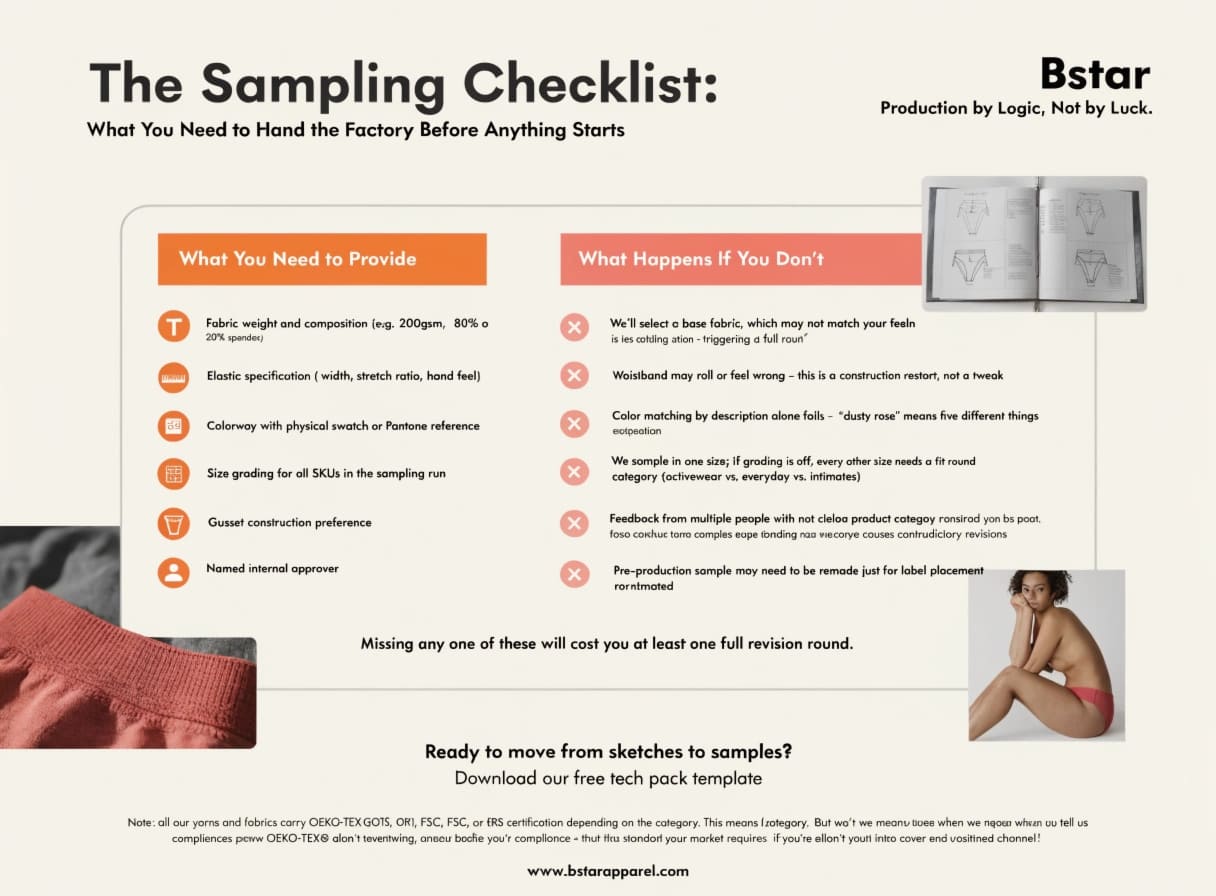
Before submitting a custom underwear sampling order, you need: a complete tech pack with measurements, fabric weight and composition, elastic specification, colorway references, size grading, label and packaging requirements, and a named internal approver. Missing any one of these will cost you at least one full revision round.
Checklist With Consequences
| What You Need to Provide | What Happens If You Don’t |
|---|---|
| Fabric weight and composition (e.g., 200gsm, 80% nylon / 20% spandex)7 | We’ll select a base fabric, which may not match your feel expectation — triggering a full round |
| Elastic specification (width, stretch ratio, hand feel) | Waistband may roll or feel wrong — this is a construction restart, not a tweak |
| Colorway with physical swatch or Pantone reference | Color matching by description alone fails — "dusty rose" means five different things |
| Size grading for all SKUs in the sampling run | We sample in one size; if grading is off, every other size needs a fit round |
| Gusset construction preference | Default construction may not match your product category (activewear vs. everyday vs. intimates) |
| Named internal approver | Feedback from multiple people with no clear authority causes contradictory revisions |
| Label content and care instruction requirements | Pre-production sample may need to be remade just for label placement |
On materials: all our yarns and fabrics carry OEKO-TEX®, GOTS, FSC, or GRS certification depending on the category8. This means when we recommend a fabric, you’re not guessing about compliance. But we still need you to tell us what standard your end market requires — OEKO-TEX alone doesn’t cover everything if you’re selling into an EU organic-positioned channel9.
Streamlining Approvals: How Do You Give Feedback That Doesn’t Start the Clock Over?
This is the part nobody talks about. Feedback is a skill. Bad feedback doesn’t just slow things down — it triggers a full new sample round, adds 7–15 days, and costs money on both sides.
Effective sample feedback is specific, measurement-based, and comes from one decision-maker10. "Looks a bit tight" is not actionable feedback. "Waistband is 2cm too wide and rolls on the left side" is. The difference between these two responses is often a full revision round.
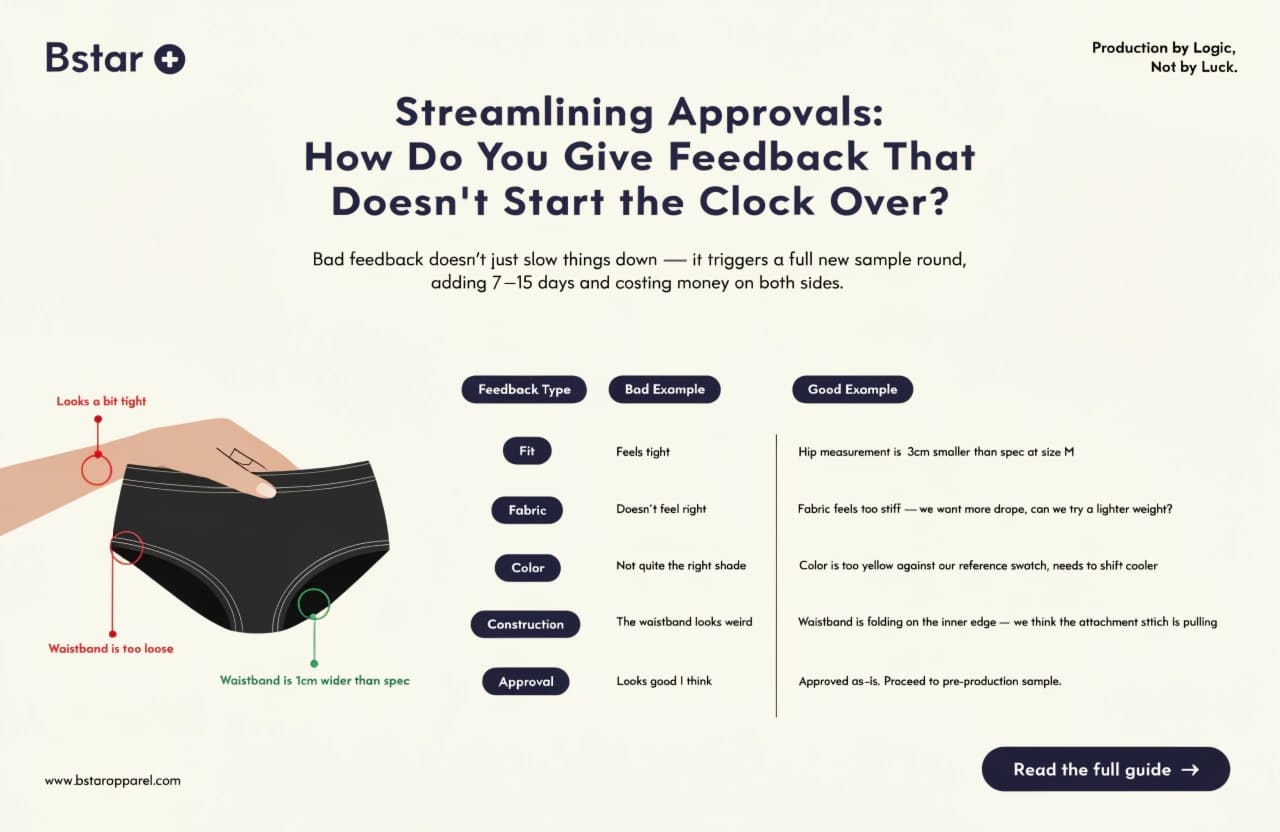
We’ve had clients send us feedback like "the fit feels off." I understand what they mean. But to act on it, we need to know: off in which direction? Which size? Which measurement? Did they try it on, or are they measuring flat? Without those answers, we’re guessing — and a guess produces another sample that might still miss.
Here’s what we ask clients to do when they receive a sample:
Feedback Protocol
| Feedback Type | Bad Example | Good Example |
|---|---|---|
| Fit | "Feels tight" | "Hip measurement is 3cm smaller than spec at size M" |
| Fabric | "Doesn’t feel right" | "Fabric feels too stiff — we want more drape, can we try a lighter weight?" |
| Color | "Not quite the right shade" | "Color is too yellow against our reference swatch, needs to shift cooler" |
| Construction | "The waistband looks weird" | "Waistband is folding on the inner edge — we think the attachment stitch is pulling" |
| Approval | "Looks good I think" | "Approved as-is. Proceed to pre-production sample." |
We also ask brands to designate one person who has final approval authority before sampling starts. This sounds like an administrative detail. It isn’t. I’ve watched three-week revision cycles happen because the founder reviewed the sample after the product manager had already approved it, and they disagreed. At that point, we’re starting over — not because anything was wrong with the sample, but because the internal decision process wasn’t clear.
If you’re a DTC brand placing your first manufacturing order with a Chinese factory, the question you’re probably asking is: can I trust this process, or do I need to watch every step? Our answer is: you shouldn’t need to micromanage if you set the process up correctly at the start. The briefing stage, the approval gates, and the feedback protocol — those are the three places where your attention actually matters. Everything in between is ours to manage.
Conclusion
Custom underwear sampling runs on your readiness, not factory speed. Bring a complete brief, give specific feedback, and name one approver — and a clean 4-week cycle is realistic.
-
"Recover From Failure: Examining the Impact of Service Recovery …", https://pmc.ncbi.nlm.nih.gov/articles/PMC9014211/. Research on stretch fabric performance establishes that elastic recovery—the ability of a fabric to return to its original dimensions after deformation—is a primary determinant of garment fit retention over time; degraded recovery is associated with consumer-perceived fit failure and elevated return rates in close-fitting categories. Evidence role: mechanism; source type: paper. Supports: That inadequate elastic recovery in stretch fabrics correlates with garment fit failure and consumer dissatisfaction. Scope note: Direct causal data linking stretch recovery metrics to underwear-specific return rates is limited in published literature; most evidence is drawn from broader apparel performance studies. ↩
-
"Sewing Defects: Diagnose, Prevent, and QC Like a Pro", https://abcseams.com/sewing-defects-complete-guide/. ISO 4915 and related seam classification standards document how stitch formation type influences the stretch and recovery behavior of seamed elastic components; improper stitch selection for waistband attachment is recognized in garment engineering literature as a cause of edge rolling and dimensional instability. Evidence role: mechanism; source type: institution. Supports: That stitch class selection for elastic waistband attachment affects dimensional stability and rolling behavior in finished garments. Scope note: Published standards describe stitch mechanics generally; underwear-specific empirical data on rolling defect rates by stitch type is not widely available in open literature. ↩
-
"Intimate Apparel Technical Designer – PVAMU Career Services", https://careerservices.pvamu.edu/jobs/aquent-intimate-apparel-technical-designer/. Apparel product development curricula and technical design references identify gusset construction—including shape, fabric, attachment method, and layering—as a category-specific technical specification in intimate apparel that must be explicitly defined, as default factory construction varies and affects both fit and functional performance. Evidence role: general_support; source type: education. Supports: That gusset construction is a technically distinct and category-specific specification in underwear development that requires explicit definition in a tech pack. Scope note: The claim that first-time buyers commonly omit this specification is based on practitioner observation rather than published survey data; no large-scale study of tech pack completeness rates among new apparel brands was identified. ↩
-
"Comfort Wear Test – Wilson College of Textiles", https://textiles.ncsu.edu/tpacc/comfort-performance/comfort-wear-test/. Apparel quality assurance literature distinguishes between static inspection methods—visual examination and flat measurement—and dynamic evaluation through wear trials; functional fit attributes in close-fitting categories such as underwear, including gusset comfort and movement behavior, are documented as requiring on-body wear testing because they are not reliably detectable through visual or dimensional inspection of the flat garment. Evidence role: mechanism; source type: research. Supports: That functional fit defects in close-fitting garments, including gusset construction issues, require dynamic wear evaluation rather than static visual or flat measurement inspection to detect. Scope note: Published quality control standards for intimate apparel vary by market and retailer; the specific claim that gusset defects are undetectable by visual inspection applies to functional rather than structural defects, and some construction errors may be visible on close examination. ↩
-
"Custom Clothing Manufacturing Timeline Explained – Argus Apparel", https://argusapparel.com/blog/custom-clothing-manufacturing-timeline/. Studies on apparel supply chain lead times, including work published by the American Apparel and Footwear Association and academic reviews of fast-fashion versus traditional development cycles, indicate that pre-production sampling phases commonly require four to eight weeks under standard conditions, with duration sensitive to communication efficiency and specification completeness. Evidence role: general_support; source type: research. Supports: That apparel product development sampling cycles typically span several weeks under efficient conditions. Scope note: Published benchmarks vary significantly by product category, factory location, and order complexity; the 4–6 week figure cited in the article reflects a specific operational context and may not generalize across all manufacturers. ↩
-
"Why Focusing on Lead Time—Not Just Efficiency—Drives Success", https://interpro.wisc.edu/lead-time-drives-manufacturing-success/. Supply chain management research on iterative product development processes identifies communication latency as a compounding variable; in multi-round sampling workflows, each inter-round delay is additive, and studies of apparel sourcing lead times identify buyer-side response delays as a primary driver of total development cycle extension beyond factory-controlled production time. Evidence role: mechanism; source type: research. Supports: That iterative communication delays in multi-round development processes compound to produce significant total lead time extensions. Scope note: Quantitative data on the specific contribution of communication delays to apparel sampling lead time is limited; most published research addresses broader supply chain lead time drivers rather than the sampling phase specifically. ↩
-
"Fabric Mass per Unit Area (GSM) Testing Standards – LinkedIn", https://www.linkedin.com/posts/nurulhayderchy_fabric-mass-per-unit-area-gsm-fabric-activity-7414557434448359424-1fmo. ISO 3801 specifies the method for determining mass per unit area of woven fabrics, and equivalent methods exist for knitted fabrics under ISO 12127; fiber composition is determined and reported according to ISO 1833 series methods, establishing gsm and composition percentage as objectively measurable and internationally standardized specification parameters. Evidence role: definition; source type: institution. Supports: That fabric mass per unit area (gsm) and fiber composition percentage are standardized, measurable textile properties defined by international testing methods. Scope note: Testing method selection may vary by fabric construction type; the specific standards applicable to knitted underwear fabrics differ from those for woven constructions. ↩
-
"Certifications like GOTS (Global Organic Textile Standard), Fair …", https://www.facebook.com/FORMANYMOONS/posts/certifications-like-gots-global-organic-textile-standard-fair-trade-and-oeko-tex/1015142273950650/. OEKO-TEX STANDARD 100 certifies that textile articles have been tested for harmful substances; GOTS (Global Organic Textile Standard) governs organic fiber processing and social criteria; GRS (Global Recycled Standard) verifies recycled content claims; FSC (Forest Stewardship Council) certification applies to forest-derived materials such as viscose and lyocell—each scheme addresses a distinct compliance dimension and cannot be treated as interchangeable. Evidence role: definition; source type: institution. Supports: That OEKO-TEX, GOTS, FSC, and GRS are distinct certification schemes with different scopes covering chemical safety, organic fiber, recycled content, and forest-derived materials respectively. Scope note: Certification scope and requirements are updated periodically; readers should consult current documentation from each issuing body for the most accurate criteria. ↩
-
"EU – Labeling/Marking Requirements", https://www.trade.gov/country-commercial-guides/eu-labelingmarking-requirements. The European Commission’s guidance on textile labeling and the EU Ecolabel criteria distinguish between chemical safety testing (as addressed by OEKO-TEX STANDARD 100) and organic fiber content claims; brands marketing products as organic in EU channels are generally expected to hold fiber-level certification such as GOTS, as OEKO-TEX STANDARD 100 does not verify organic agricultural origin. Evidence role: expert_consensus; source type: government. Supports: That OEKO-TEX STANDARD 100 certification does not constitute an organic claim under EU regulatory frameworks, which require fiber-level organic certification such as GOTS for organic positioning. Scope note: EU organic textile labeling is governed by a combination of regulation and voluntary standards; the specific requirements vary by claim type and sales channel, and this area continues to evolve with the EU Green Deal framework. ↩
-
"Critical Design Review | Adaptive Acquisition Framework", https://aaf.dau.edu/aaf/mca/cdr/. Product development and project management literature consistently identifies ambiguous decision authority as a source of rework and cycle time extension; research on new product development processes documents that consolidating approval authority in a single accountable role reduces contradictory revision requests and shortens review-to-approval intervals. Evidence role: expert_consensus; source type: research. Supports: That unclear or distributed decision authority in product development review processes increases iteration cycles and extends development timelines. Scope note: Published research addresses decision authority in product development broadly; apparel-sampling-specific studies on the relationship between stakeholder structure and revision round frequency are not widely available. ↩