Man Underwear Certification 101: Understanding OEKO-TEX, BSCI & ISO Standards
Certification questions show up in almost every pre-sales conversation we have. But most buyers are actually asking the wrong question — and it costs them time.
The three main certifications in underwear manufacturing — OEKO-TEX® STANDARD 100, BSCI, and ISO 9001 — each cover a completely different layer of your supply chain. One checks the material. One checks the factory. One checks the business system. Knowing which layer your target market requires is the only question that actually matters.
We talk to DTC founders and sourcing managers every week. The most common mistake we see is this: a buyer sees "BSCI certified factory" on a supplier page, assumes everything is covered, places an order, and then finds out six months later that their EU retail partner specifically required OEKO-TEX® certified fabric. Those are not the same thing. They never were. This post breaks down each certification by what it actually covers — so you can match the right one to your actual market and channel requirements.
OEKO-TEX® STANDARD 100: Ensuring Chemical Safety and Skin-Friendly Materials?
Underwear sits directly against skin all day. If there are harmful chemicals in the fabric, there is no barrier between those chemicals and your customer.
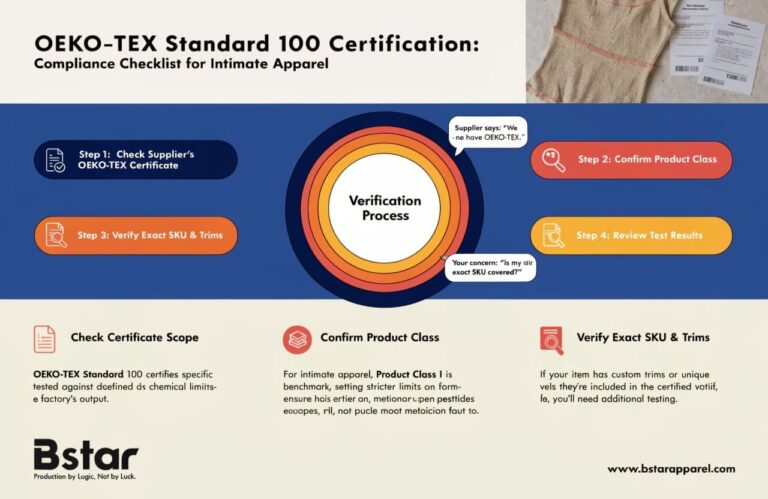
OEKO-TEX® STANDARD 100 certifies that every component of a textile product — fabric, dyes, thread, even buttons — has been tested and found free from harmful levels of regulated substances1. It is a material-level certification. It says nothing about the factory’s labor practices or management systems.
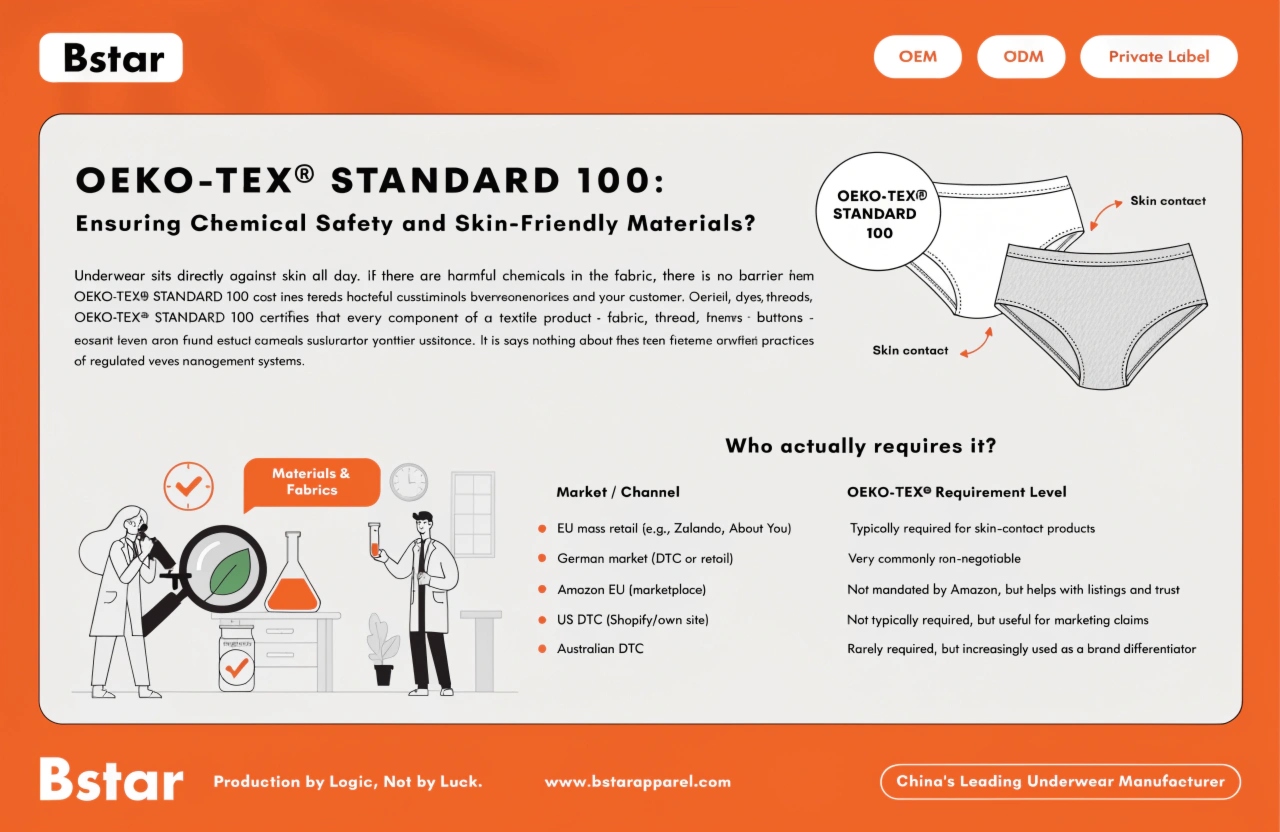
When a client asks us whether our materials are OEKO-TEX® certified, the answer is yes — the yarns and fabrics we source carry this certification. But we always follow up with a clarifying question: is this a requirement from your end retail channel, or a personal brand commitment? Because those two situations call for different levels of documentation.
Here is why that distinction matters in practice:
Who actually requires it?
| Market / Channel | OEKO-TEX® Requirement Level |
|---|---|
| EU mass retail (e.g., Zalando, About You) | Typically required for skin-contact products |
| German market (DTC or retail) | Very commonly required, often non-negotiable |
| Amazon EU (marketplace) | Not mandated by Amazon, but helps with listings and trust |
| US DTC (Shopify/own site) | Not typically required, but useful for marketing claims |
| Australian DTC | Rarely required, but increasingly used as a brand differentiator |
OEKO-TEX® STANDARD 100 is most non-negotiable in the EU market — especially Germany, Switzerland, and Austria, where consumer and retailer sensitivity to chemical safety in textiles is high2. If you are building a brand that plans to enter European retail, this is the certification to prioritize at the material level. If you are launching a DTC brand on your own website in the US or Australia, it is a credibility asset, not a hard requirement. Verify this with your target retailer’s supplier manual or your compliance consultant before making it a budget line item.
ESG concerns are not just a PR topic anymore3. European retail buyers now run supplier audits before they place orders — and BSCI is often the baseline they check against4.
BSCI (Business Social Compliance Initiative) is a factory-level audit program. It evaluates whether a manufacturing facility meets defined standards across labor rights, working hours, wages, health and safety, and management systems5. It does not evaluate the product itself or the materials used to make it.
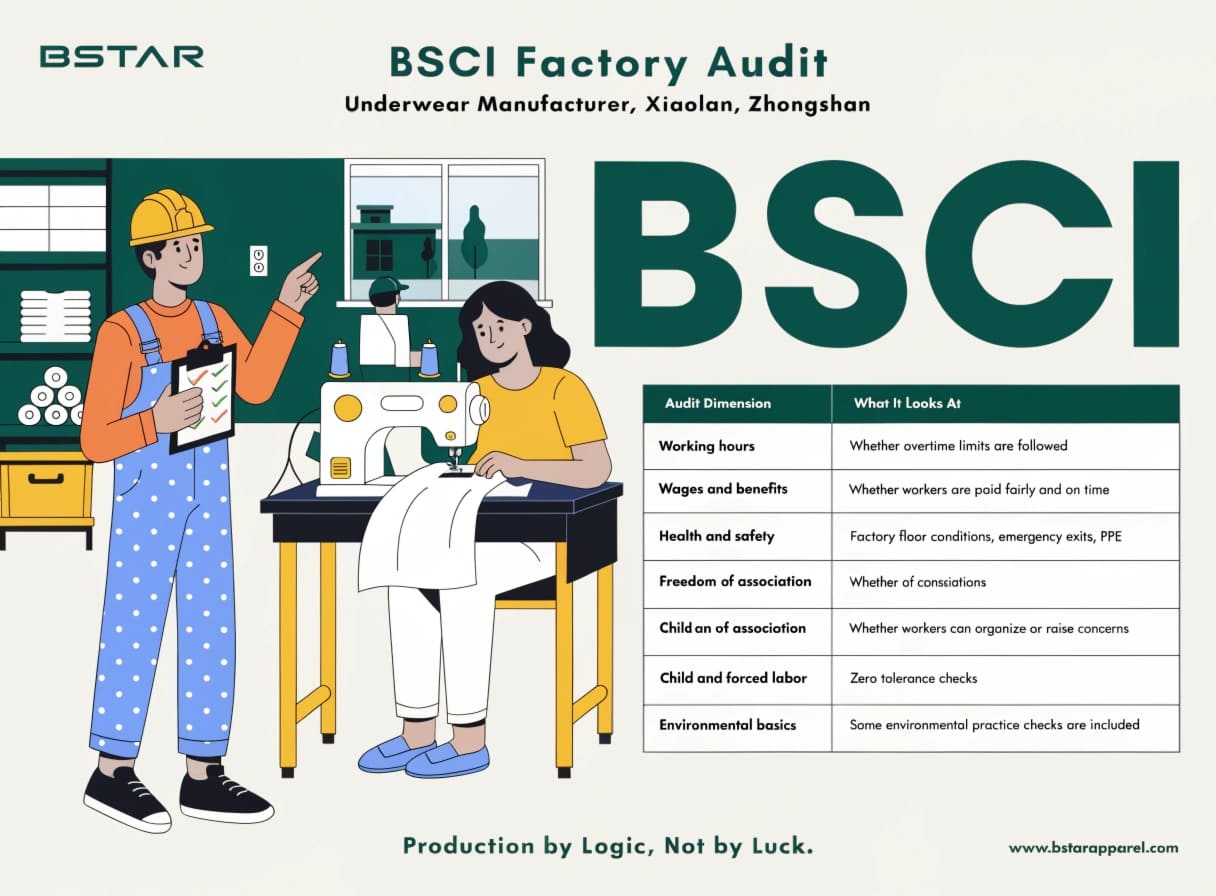
At BSTAR, our BSCI certification covers our factory operations in Xiaolan, Zhongshan. When a European retail buyer asks us for our social compliance status, this is the document that answers their question. But we are clear about what it covers: it covers how we operate as a factory — not what the fabric is made of.
What does BSCI actually check?
BSCI audits use the amfori BSCI Code of Conduct as the benchmark6. An independent auditor visits the factory and evaluates it across multiple dimensions:
| Audit Dimension | What It Looks At |
|---|---|
| Working hours | Whether overtime limits are followed |
| Wages and benefits | Whether workers are paid fairly and on time |
| Health and safety | Factory floor conditions, emergency exits, PPE |
| Freedom of association | Whether workers can organize or raise concerns |
| Child and forced labor | Zero tolerance checks |
| Environmental basics | Some environmental practice checks are included |
A passing BSCI audit gives retail buyers confidence that their supply chain is not creating liability for them on labor or ethics grounds. For DTC brands, it is less of a hard requirement — but more and more conscious consumers and press outlets ask about it7. If you are building a brand story around ethical sourcing, BSCI documentation from your manufacturer is concrete evidence you can actually show.
The practical takeaway: if your growth plan includes entering any major European retailer’s supplier program, ask about BSCI status before you sign a production contract. Discovering your manufacturer has not been audited after you have already committed to a retail partnership is an expensive problem.
ISO Quality Systems: Streamlining Production Consistency and Operational Excellence?
ISO gets mentioned a lot in B2B conversations. But most DTC founders are not sure whether it actually affects their product quality or just lives in a corporate compliance folder somewhere.
ISO 9001 is a management system certification. It certifies that a company has documented, structured processes for quality control, continuous improvement, and operational consistency8. It does not test a specific product. It audits the systems that govern how work is done across the organization.
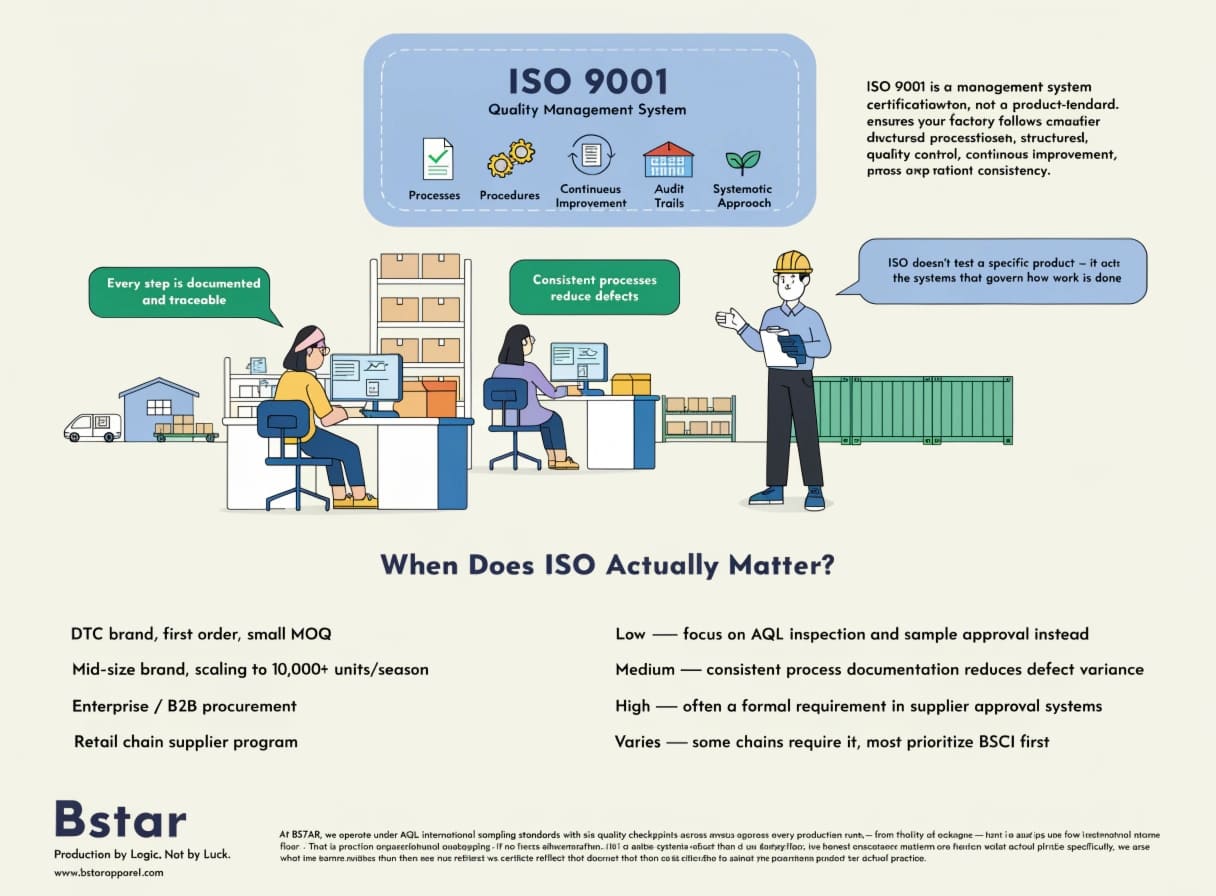
Think of it this way: OEKO-TEX® tells you what the fabric is. BSCI tells you how the factory treats its workers. ISO tells you how reliably the factory runs its own internal processes. For a brand placing repeat orders across multiple seasons, that last point is not trivial.
When does ISO actually matter for underwear buyers?
| Buyer Type | ISO Relevance |
|---|---|
| DTC brand, first order, small MOQ | Low — focus on AQL inspection and sample approval instead |
| Mid-size brand, scaling to 10,000+ units/season | Medium — consistent process documentation reduces defect variance |
| Enterprise / B2B procurement | High — often a formal requirement in supplier approval systems |
| Retail chain supplier program | Varies — some chains require it, most prioritize BSCI first |
At BSTAR, we operate under AQL international sampling standards with six quality checkpoints across every production run9 — from raw material intake to final packaging. That is the practical expression of what ISO-style systems look like on a factory floor. If a buyer asks us for ISO 9001 certification specifically, we are transparent about where we stand and what systems we do run. The honest answer matters more than a certificate that does not reflect actual practice.
The Certification Roadmap: How to Align Standards with Global Market Requirements?
Most buyers come to us with a general question: "Do you have certifications?" That question is almost impossible to answer usefully without more context.
The right way to evaluate certifications is to start from your market destination and retail channel, then work backwards to identify which layer — material, factory, or management system — that channel requires. One or two well-matched certifications will serve you better than a long list that does not map to your actual requirements.
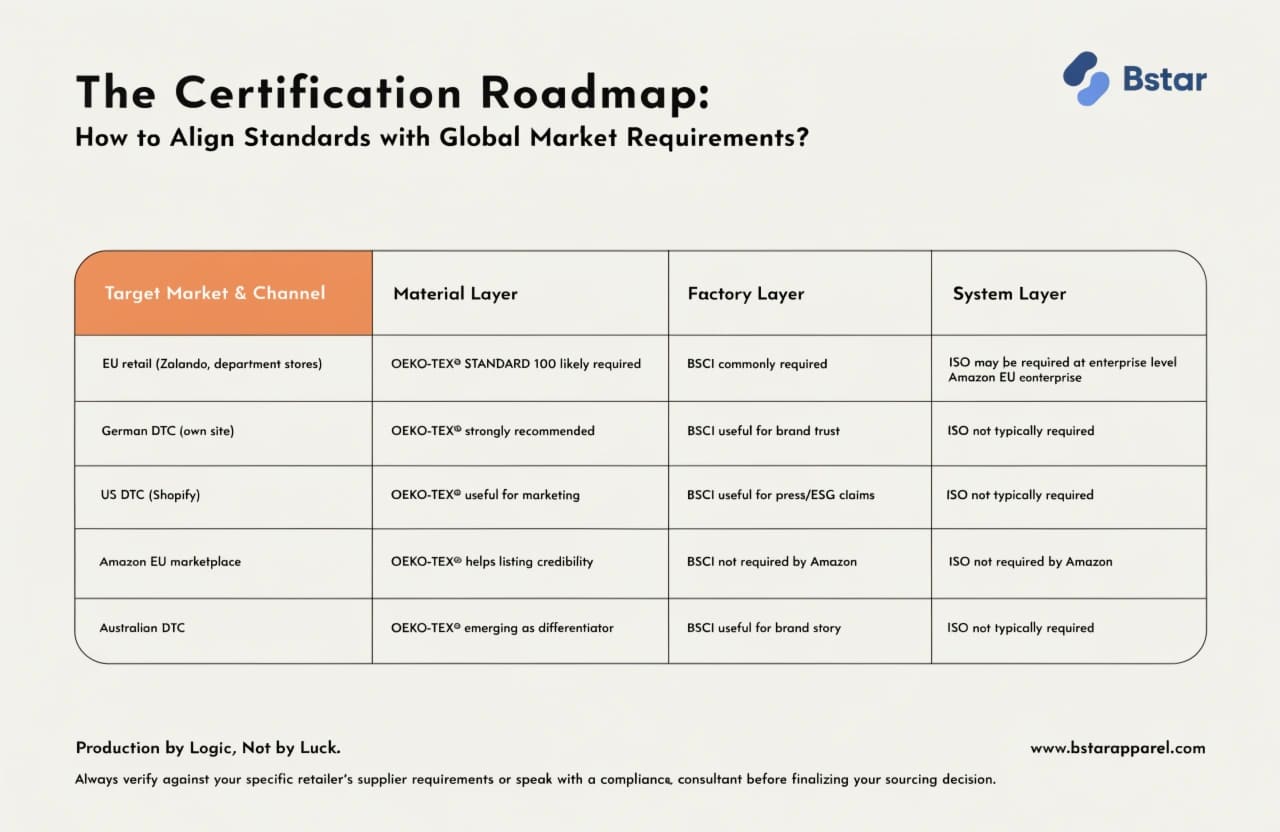
When we start a new client conversation, we ask three questions before we talk about certifications at all. Where are you selling? What channel — DTC, marketplace, or retail? And what does your target retailer’s supplier manual actually say? Those three answers tell us more than any general certification checklist.
A simple market-to-certification map
| Target Market & Channel | Material Layer | Factory Layer | System Layer |
|---|---|---|---|
| EU retail (Zalando, department stores) | OEKO-TEX® STANDARD 100 likely required | BSCI commonly required | ISO may be required at enterprise level |
| German DTC (own site) | OEKO-TEX® strongly recommended | BSCI useful for brand trust | ISO not typically required |
| US DTC (Shopify) | OEKO-TEX® useful for marketing | BSCI useful for press/ESG claims | ISO not typically required |
| Amazon EU marketplace | OEKO-TEX® helps listing credibility | BSCI not required by Amazon | ISO not required by Amazon |
| Australian DTC | OEKO-TEX® emerging as differentiator | BSCI useful for brand story | ISO not typically required |
This is general industry practice based on our experience working with brands across these markets — always verify against your specific retailer’s supplier requirements or speak with a compliance consultant before finalizing your sourcing decision.
The other mistake we see is over-certifying. Each certification has a cost, a renewal cycle, and a scope condition. If you are launching a men’s underwear brand on your own Shopify store in the US, chasing three separate certifications before your first order is a distraction. Get the material certified if you want to make a credibility claim. Verify your factory has BSCI if your press and brand story depend on ethical sourcing claims. That may be all you need for now.
Conclusion
Match your certifications to your market layer — material, factory, or system — not to a generic checklist. One right certification beats three irrelevant ones every time.
-
"[PDF] oeko-tex® standard 100", https://www.oeko-tex.com/importedmedia/downloadfiles/OEKO-TEX_STANDARD_100_Standard_EN_DE.pdf. According to the OEKO-TEX® Association, STANDARD 100 requires that every component of a certified article — including all fabrics, linings, threads, buttons, and other accessories — be tested against a defined list of harmful substances, with limit values set according to the intended use and skin-contact level of the product. Evidence role: definition; source type: institution. Supports: That OEKO-TEX® STANDARD 100 applies to all components of a textile article, including accessories and thread, not only the outer fabric. Scope note: The precise list of regulated substances and limit values is updated annually; the applicable version should be verified against the current OEKO-TEX® STANDARD 100 annex. ↩
-
"Interested consumers’ awareness of harmful chemicals in everyday …", https://pmc.ncbi.nlm.nih.gov/articles/PMC5698398/. Consumer research on sustainable textile purchasing in European markets has consistently identified Germany, Austria, and Switzerland as among the highest-demand regions for verified chemical safety and eco-labeling, correlating with strong regulatory traditions and high consumer awareness of textile-related health risks. Evidence role: general_support; source type: research. Supports: That German-speaking markets demonstrate above-average consumer and retail sensitivity to chemical safety and sustainability certification in textile products. Scope note: Specific survey figures vary by study and year; the claim reflects a general pattern rather than a single definitive measurement. ↩
-
"Corporate sustainability due diligence – European Commission", https://commission.europa.eu/topics/business-and-industry/doing-business-eu/sustainability-due-diligence-responsible-business/corporate-sustainability-due-diligence_en. The European Union’s Corporate Sustainability Due Diligence Directive (CS3D), adopted in 2024, requires large companies operating in the EU to identify, prevent, and mitigate adverse human rights and environmental impacts across their supply chains, giving legal force to what were previously voluntary ESG commitments. Evidence role: historical_context; source type: government. Supports: That ESG obligations in supply chains have acquired regulatory and legal force in European markets, moving beyond voluntary corporate responsibility. Scope note: The directive applies to companies above defined size thresholds and is subject to phased implementation; smaller brands may not face direct legal obligations but are affected indirectly through their retail partners’ compliance requirements. ↩
-
"“Obsessed with Audit Tools, Missing the Goal”: Why Social Audits …", https://www.hrw.org/report/2022/11/15/obsessed-audit-tools-missing-goal/why-social-audits-cant-fix-labor-rights-abuses. amfori reports that its BSCI program encompasses thousands of participating companies and tens of thousands of audited suppliers globally, with European retail and brand members routinely requiring BSCI audit results as part of supplier qualification processes. Evidence role: general_support; source type: institution. Supports: That social compliance auditing, including BSCI, has become a standard pre-qualification requirement among European retail buyers when onboarding manufacturing suppliers. Scope note: Participation figures and specific retailer requirements are subject to annual change; the claim reflects general industry adoption rather than a universal mandate across all European buyers. ↩
-
"amfori BSCI – Business Social Compliance Initiative", https://www.amfori.org/amfori-bsci/. The amfori BSCI program defines itself as a business-driven initiative that audits manufacturing facilities against the amfori BSCI Code of Conduct, assessing dimensions including working hours, remuneration, occupational health and safety, freedom of association, and prohibition of child and forced labor. Evidence role: definition; source type: institution. Supports: That BSCI, administered by amfori, is a factory-level social compliance audit program covering labor rights, working conditions, wages, health and safety, and related management practices. ↩
-
"amfori BSCI", https://www.amfori.org/document_solution/amfori-bsci/. According to amfori, the BSCI Code of Conduct — grounded in international conventions including ILO standards and the UN Guiding Principles on Business and Human Rights — constitutes the normative framework against which accredited auditors evaluate participating factories. Evidence role: definition; source type: institution. Supports: That the amfori BSCI Code of Conduct serves as the normative benchmark against which independent auditors assess manufacturing facilities under the BSCI program. ↩
-
"Fast Fashion and its Effect on Retail Supply Chain Management", https://businessstories.sandiego.edu/fast-fashion-and-its-effect-on-retail-supply-chain-management. Multiple consumer surveys conducted between 2020 and 2024, including research published by McKinsey & Company and the Business of Fashion, indicate rising consumer willingness to consider supply chain ethics and labor practices when making apparel purchasing decisions, particularly among younger demographic segments in Western markets. Evidence role: general_support; source type: research. Supports: That consumer awareness of and demand for ethical supply chain practices in the fashion and apparel sector has grown measurably in recent years. Scope note: Stated consumer preferences in surveys do not always translate to purchasing behavior; the gap between expressed values and actual buying decisions remains a documented limitation in sustainable fashion research. ↩
-
"4.3 Determining the Scope of the Quality Management System [ISO …", https://www.iso-9001-checklist.co.uk/4.3-how-to-write-your-scope-for-iso-9001-with-7-examples.htm. The International Organization for Standardization defines ISO 9001 as a quality management system standard specifying requirements for organizations to demonstrate their ability to consistently provide products and services that meet customer and regulatory requirements, with an emphasis on process documentation, risk-based thinking, and continual improvement. Evidence role: definition; source type: institution. Supports: That ISO 9001 is a quality management system standard that certifies an organization’s processes for consistent quality delivery, continuous improvement, and customer focus rather than certifying specific products. ↩
-
"[PDF] ISO 2859-1 – UNT Chemistry Department", https://chemistry.unt.edu/~tgolden/courses/iso2859-1.pdf. Acceptable Quality Limit (AQL) sampling is codified in ISO 2859-1, which specifies sampling procedures and tables for inspection by attributes, providing a statistically grounded framework for determining the maximum acceptable number of defective units in a production lot before rejection. Evidence role: definition; source type: institution. Supports: That AQL-based sampling is an internationally standardized inspection methodology, codified under ISO 2859, used to determine acceptable defect rates in production batches. Scope note: The specific AQL level applied (e.g., 1.0, 2.5, 4.0) varies by product category and buyer specification; the standard itself does not prescribe a universal threshold. ↩