
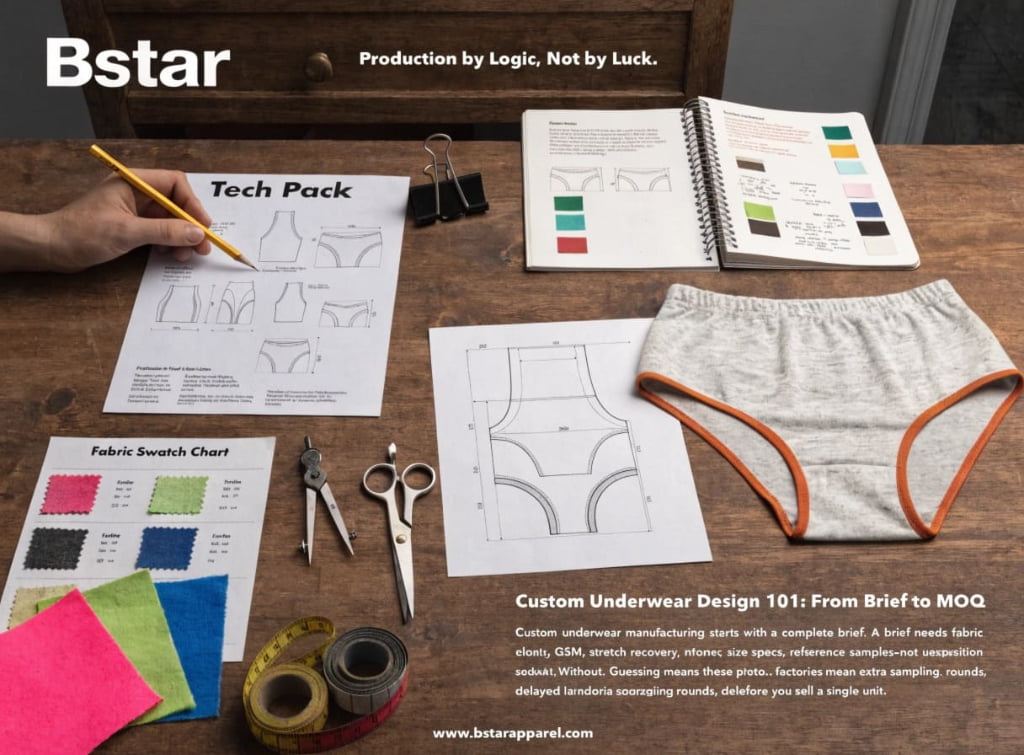
You sent a brief. The sample came back wrong. Now you’re paying for another round. This happens more than you think — and it almost always starts with one missing detail.
Custom underwear manufacturing starts with a complete brief. A brief needs fabric composition, GSM, stretch recovery, size specs, and reference samples — not just a photo. Without these, factories guess. Guessing means extra sampling rounds, delayed launches, and real money lost before you sell a single unit.
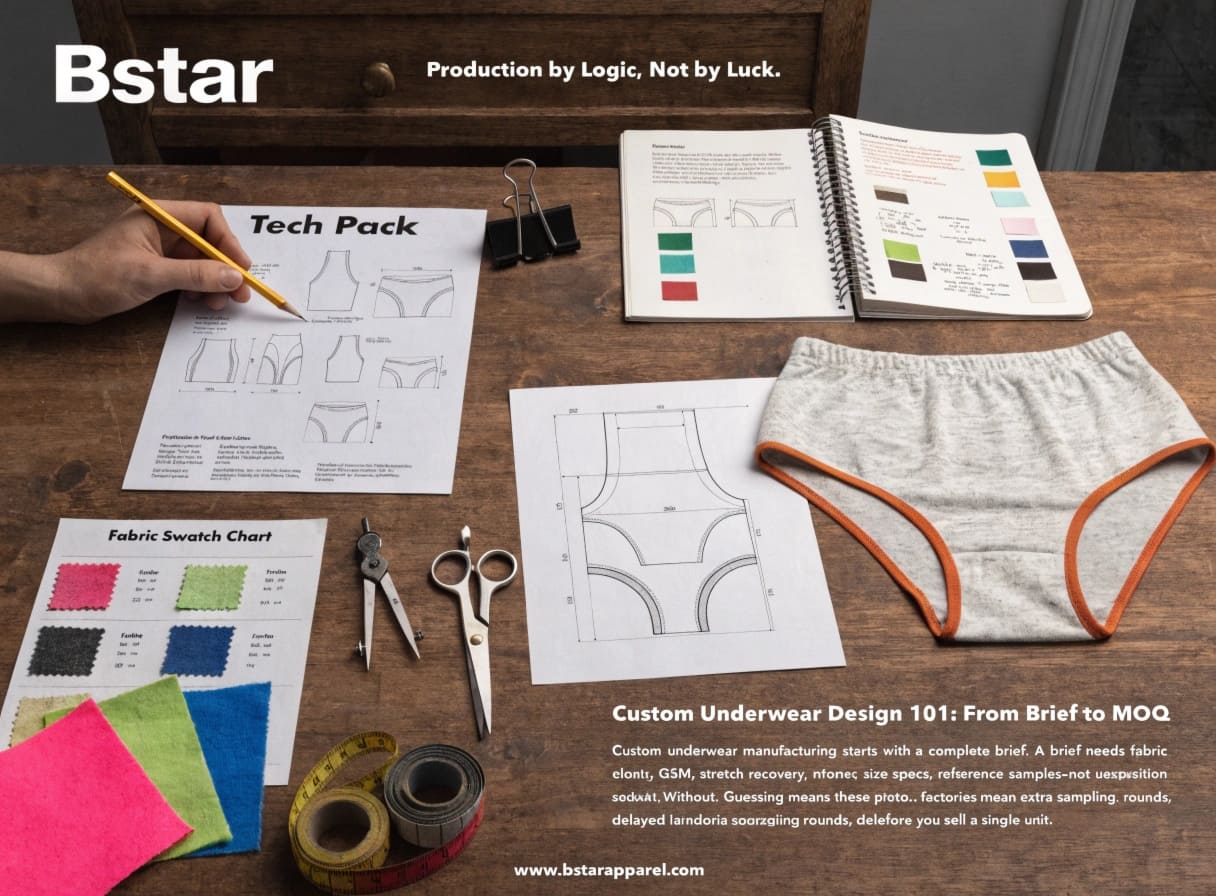
Most first-time buyers come to us with a mood board and a deadline. They’re excited. They have a vision. But the brief they send us is missing the information we actually need to build the product. This article is about those gaps — what they are, why they matter, and how to close them before you talk to a factory.
Defining Your Blueprint: What Does a Real Tech Pack Actually Include?
You’ve seen the term "tech pack" thrown around. But what does it actually need to contain for underwear?
A tech pack for boxer briefs needs flat sketches with measurements, stitch type, seam allowance, waistband width and construction, label placement, and colorways. Every detail you leave out becomes a question the factory has to answer on its own — and their answer may not match yours.
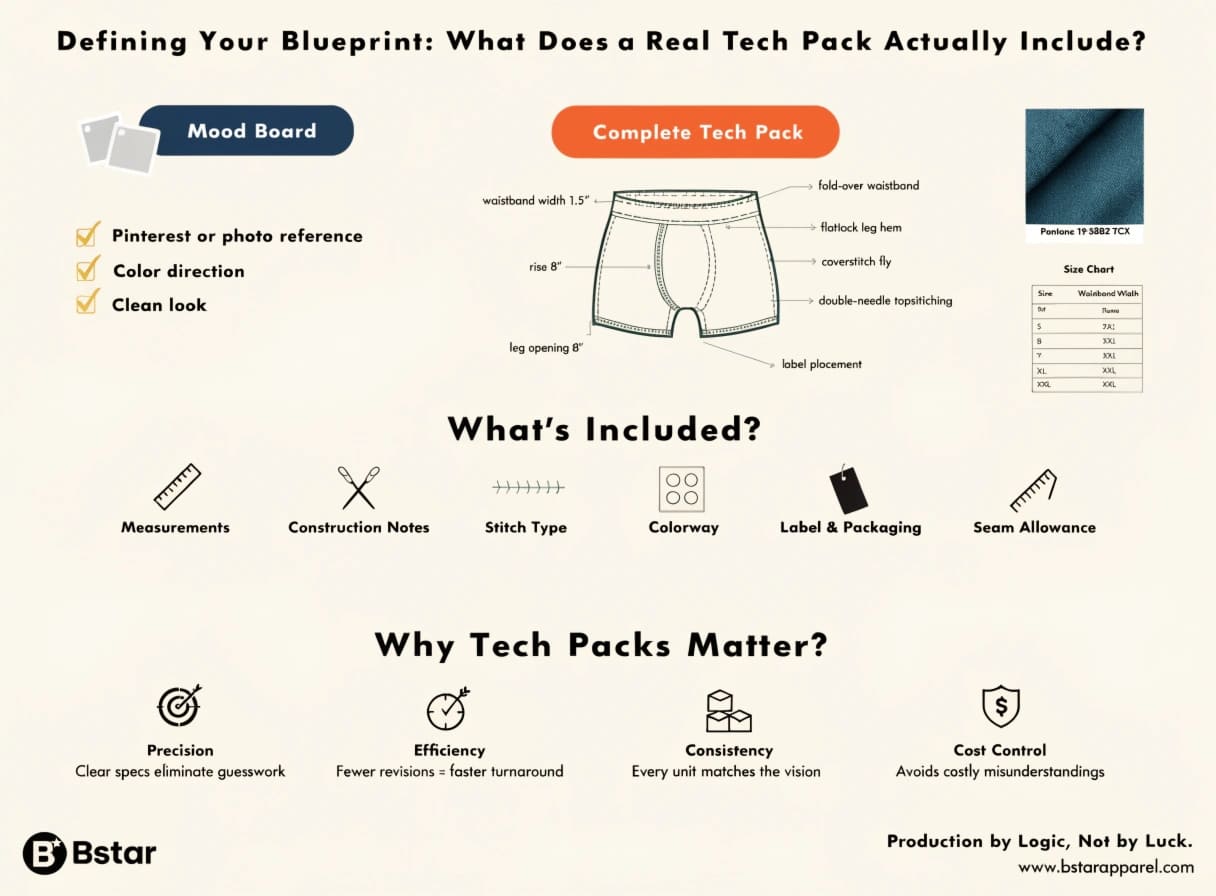
We’ve received briefs that said things like "clean finish, soft waistband, athletic feel." That tells us almost nothing. We still have to make a decision on waistband width, whether it’s a fold-over or sewn-in elastic, what the stitch count looks like, and whether the leg hem is flatlock or coverstitch1. If we guess and you had something different in mind, that’s a wasted sample and a two-week delay.
What Separates a Brief from a Mood Board
| Element | Mood Board | Complete Tech Pack |
|---|---|---|
| Visual reference | ✓ Pinterest or photo | ✓ Flat sketch with callouts |
| Measurements | ✗ Not included | ✓ Waistband width, rise, inseam, leg opening |
| Construction notes | ✗ Vague ("clean look") | ✓ Stitch type, seam finish, hem detail |
| Colorway | ✓ General color direction | ✓ Pantone code or physical swatch2 |
| Label / packaging | ✗ Usually missing | ✓ Size, placement, material |
The more complete your tech pack, the fewer rounds of revision you pay for. It’s that direct.
One more thing people skip: tell us your intended customer. A brief for a size-inclusive loungewear brand needs different grading logic than a performance athletic line3. That context changes pattern decisions from the start.
The Fabric Foundation: How Do You Pick the Right Material?
Most clients say they want something "soft and comfortable." We hear this every week. It’s not a fabric spec.
For underwear, you need to specify fabric composition (e.g., 95% cotton / 5% elastane), GSM (grams per square meter, typically 160–220 for underwear4 — verify with your supplier), and minimum stretch recovery. Without these three numbers, the factory cannot source the right fabric or guarantee consistent feel across production runs.
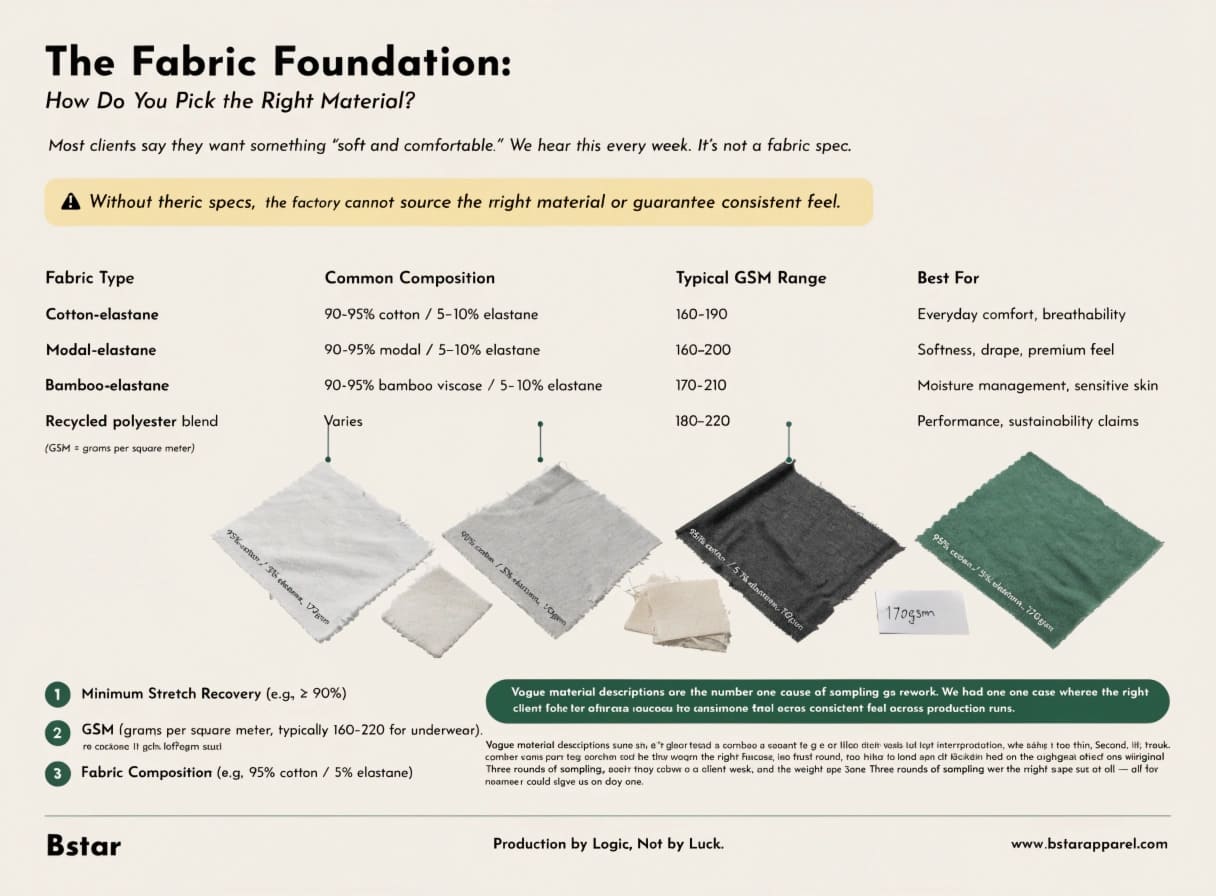
Vague material descriptions are the number one cause of sampling rework in our experience5. We had one case where a client wanted a "buttery soft" feel for a bamboo blend product. We made our best interpretation. The first sample came back and they said it was too thin. Second round, too thick. It took a third round to land on the right GSM because the original brief had no weight spec at all. Three rounds of sampling, eight extra weeks, and real shipping cost — all for a number the client could have given us on day one.
Common Fabric Choices for Underwear (Typical Ranges — Verify With Your Supplier)
| Fabric Type | Common Composition | Typical GSM Range | Best For |
|---|---|---|---|
| Cotton-elastane | 90–95% cotton / 5–10% elastane | 160–190 | Everyday comfort, breathability |
| Modal-elastane | 90–95% modal / 5–10% elastane | 160–200 | Softness, drape, premium feel |
| Bamboo-elastane | 90–95% bamboo viscose / 5–10% elastane | 170–210 | Moisture management, sensitive skin |
| Recycled polyester blend | Varies | 180–220 | Performance, sustainability claims |
If you’re building a sustainable product line, materials certified under OEKO-TEX® or GOTS are available as sourcing options6. We can source these for clients who need them, but make sure your brief calls this out specifically — certified materials affect cost and lead time.
Perfecting the Fit: Why Sampling Without a Size Spec Wastes Everyone’s Time
A photo tells us what you want it to look like. A size chart tells us how it should fit. These are not the same thing.
Fit for underwear is determined by millimeter-level grading decisions. If you don’t provide a measurement spec or a physical reference sample, the factory will grade from their existing block7. That block may not match your target customer. The result is almost always a first sample that misses the fit.
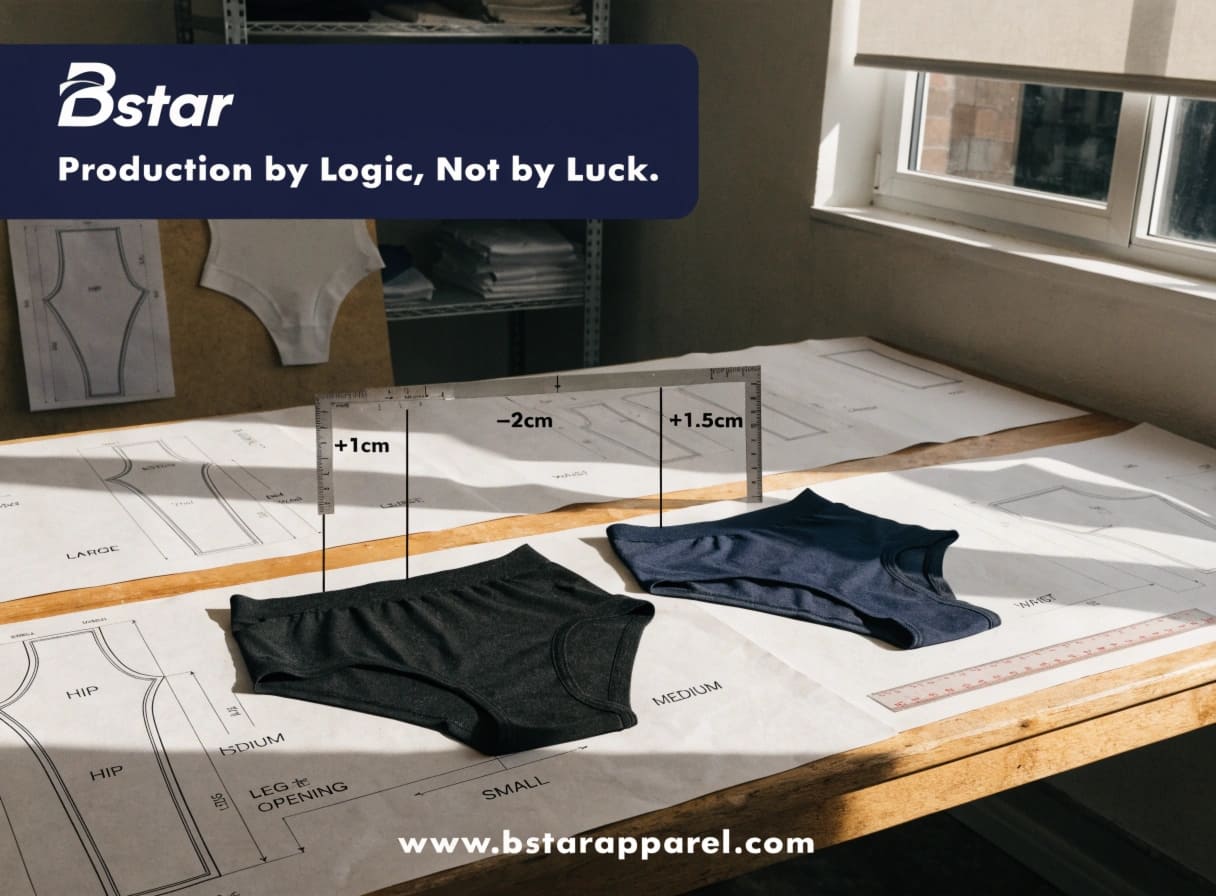
This is one of the most common issues we see with new clients. They send a reference photo from a competitor’s website and say "like this, but with our branding." What we don’t know from that photo: the rise height, the waistband width, the leg opening circumference, the seat shaping, or the crotch gusset construction. All of those are fit decisions. All of them require a number or a sample to calibrate from.
Two Paths to a First Sample — Pick the Right One
There are two ways to approach sampling, and they have very different cost and timeline profiles.
Option 1: Customize on an existing block. We have established blocks for boxer briefs, trunks, and briefs. If your spec is close to one of our existing patterns, we modify from there. This is faster — typically 7 to 15 days for a first sample8 — and it has a lower cost floor. It also means your MOQ may be more flexible because we’re not building a pattern from zero.
Option 2: Develop a new pattern from scratch. If your design has a unique cut, a proprietary waistband construction, or a silhouette that doesn’t fit an existing block, we develop a new pattern. This takes longer, costs more in development, and typically carries a higher MOQ floor to justify the investment. Many first-time clients assume the lower-cost path is always available — it isn’t, if your design requires original pattern work.
If you don’t know which path your product sits on, bring us a physical reference sample or a detailed measurement chart in your first conversation. That’s the fastest way to get an honest timeline and cost estimate.
Bridging Design and Production: How Do MOQs Actually Work?
Most first-time buyers anchor on the MOQ numbers they see on wholesale platforms — 50 to 100 pieces. Custom manufacturing works differently.
In custom manufacturing, MOQ is calculated per style-color SKU, not per order total9. If you have 3 styles × 4 colors, that is 12 separate MOQ calculations. Each one has its own cutting run, fabric cut, and material minimum. Misunderstanding this is the most common reason brands overbuy inventory or hit unexpected cost floors on their first production order.
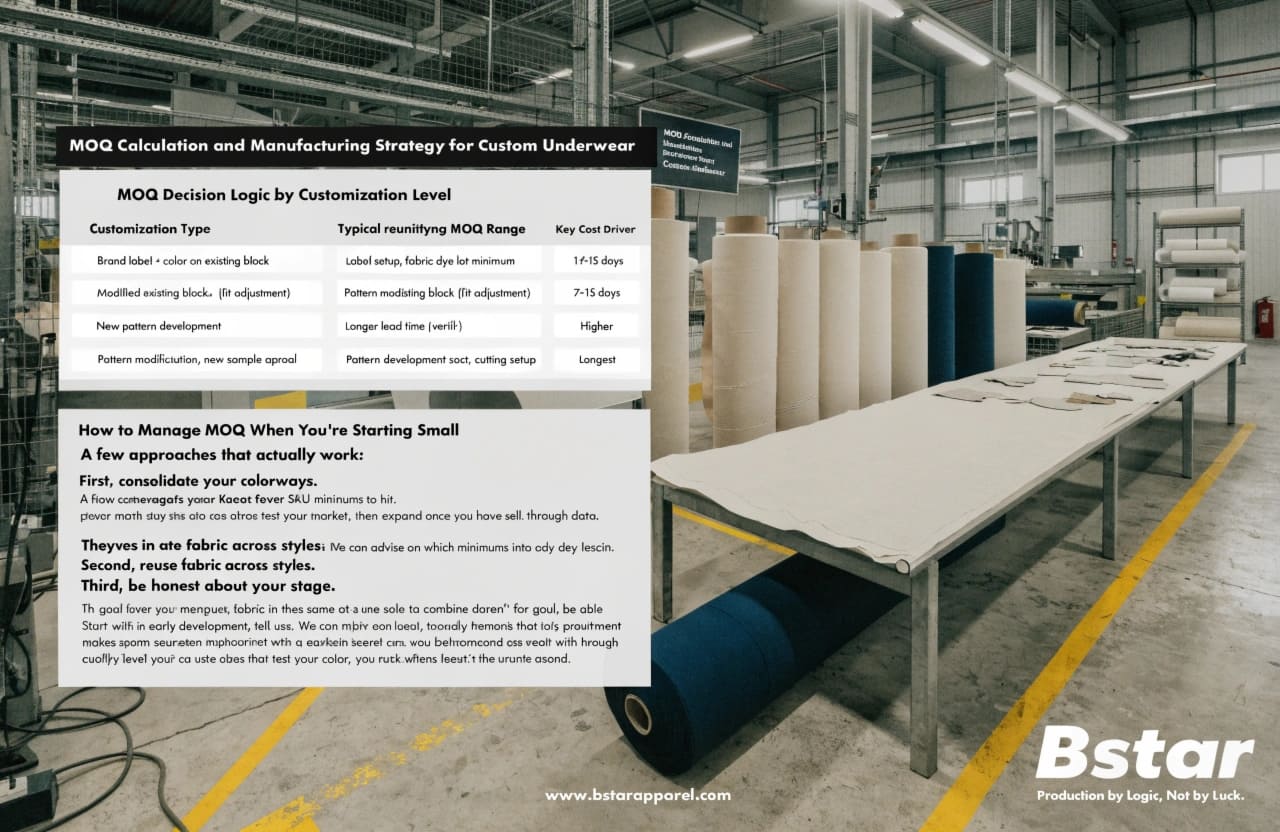
The factory’s MOQ is not an arbitrary number. It reflects the minimum quantity where a cutting run becomes efficient, and where material minimums from the fabric supplier are met. When a client asks us to cut a new color in a small quantity, the cutting efficiency drops and the per-unit cost goes up10. This is the actual logic behind MOQ — it’s a cost-efficiency threshold, not a sales tactic.
MOQ Decision Logic by Customization Level
| Customization Type | Typical MOQ Range | Sample Turnaround | Key Cost Driver |
|---|---|---|---|
| Brand label + color on existing block | Lower (verify with supplier) | 7–15 days | Label setup, fabric dye lot minimum |
| Modified existing block (fit adjustment) | Medium | 7–15 days | Pattern modification, new sample approval |
| New pattern development | Higher | Longer lead time (verify) | Pattern development cost, cutting setup |
| Proprietary fabric + new pattern | Highest | Longest | Fabric development + pattern development |
How to Manage MOQ When You’re Starting Small
A few approaches that actually work:
First, consolidate your colorways. Fewer colors per style means fewer SKU minimums to hit. Start with two to three colors that test your market, then expand once you have sell-through data.
Second, reuse fabric across styles. If two styles use the same base fabric in the same color, you may be able to combine fabric minimums into one dye lot order.
Third, be honest about your stage. If you’re in early development, tell us. We can advise on which customization path makes sense for your current volume so you’re not committing to a development cost that doesn’t match your order size.
The goal is to get your first production run done at a quality level you can sell, at a volume that doesn’t break your cash position.
Conclusion
A complete brief saves time, money, and sampling rounds. Know your fabric specs, provide a size chart, and understand that MOQ is per SKU — not per order. Start there, and your first factory conversation will go very differently.
-
"Flatlocking compared to cover stitching and overlocking", https://fashion-incubator.com/flatlocking-compared-to-cover-stitching-and-overlocking/. ISO 4915, the international standard for stitch types, classifies flatlock (class 600 multi-thread chain stitches) and coverstitch (class 400) as separate stitch formations; flatlock stitching joins fabric edges flat for a smooth seam with minimal bulk, while coverstitch applies a looped finish to a folded hem, each producing different stretch recovery and surface appearance in knit underwear. Evidence role: definition; source type: institution. Supports: That flatlock and coverstitch are technically distinct stitch formations with different structural and aesthetic outcomes in knit garment construction. Scope note: Industry usage of these terms is not always consistent with ISO classifications; the functional distinction described here reflects common apparel manufacturing practice rather than a single authoritative definition. ↩
-
"Pantone – Wikipedia", https://en.wikipedia.org/wiki/Pantone. The Pantone Matching System (PMS) is a proprietary standardized color space used across design and manufacturing industries, including apparel and textiles, to communicate color specifications numerically, enabling consistent color reproduction across geographically dispersed suppliers and production facilities. Evidence role: definition; source type: institution. Supports: That the Pantone Matching System is a widely used standardized color reference system in apparel and textile manufacturing for communicating precise color specifications across supply chains. Scope note: Pantone codes specify a target color but do not guarantee exact color matching in dyed textiles, as fiber type, dye chemistry, and finishing processes affect final color output; physical swatches on the actual fabric substrate are typically required for final approval. ↩
-
"Towards more inclusivity in pattern making – Ready To Sew", https://readytosew.fr/en/journal/sharing-my-research-and-methods-towards-more-inclusivity-in-pattern-making-b124.html?rewrite=sharing-my-research-and-methods-towards-more-inclusivity-in-pattern-making&id=124&module=leoblog. Research in apparel pattern engineering and anthropometric sizing studies indicates that standard proportional grading rules, which apply uniform increments across a size range, become less accurate at extended sizes because body proportions change non-linearly; size-inclusive grading therefore requires adjusted grade rules informed by body scan data or anthropometric surveys of the target population. Evidence role: mechanism; source type: research. Supports: That grading rules for size-inclusive apparel differ from standard grading because proportional body measurements do not scale linearly across a wide size range. Scope note: Grading methodology differences between size-inclusive and performance categories are well documented in pattern-making literature, but the specific adjustments required depend on the brand’s target size range and the body measurement data used to develop the base block. ↩
-
"Fabric GSM & weight | A guide to GSM meaning – with chart – SANVT", https://sanvt.com/blogs/journal/fabric-weight-a-guide-to-gsm?srsltid=AfmBOoqvis2IN72wEcGsVmHira0Exdi0KxrUn0F7sP3xgNZM9d5Qhm9T. Textile industry references and fabric supplier technical guides document typical GSM ranges for knit underwear fabrics, generally situating everyday underwear constructions between approximately 160 and 220 g/m², though exact ranges vary by fiber composition and end-use performance requirements. Evidence role: statistic; source type: institution. Supports: That underwear fabrics typically fall within a defined GSM range, distinguishing them from heavier or lighter knit applications. Scope note: Published GSM benchmarks vary across sources and fiber types; the cited range should be verified against current supplier specifications rather than treated as a universal standard. ↩
-
"minimization of reworks in quality and productivity improvement in …", https://www.academia.edu/30923070/MINIMIZATION_OF_REWORKS_IN_QUALITY_AND_PRODUCTIVITY_IMPROVEMENT_IN_THE_APPAREL_INDUSTRY. Research on apparel product development processes identifies incomplete technical documentation—including underspecified material requirements—as a recurring source of sampling errors, revision cycles, and associated cost overruns, though the relative ranking of causes varies across studies and manufacturing contexts. Evidence role: expert_consensus; source type: research. Supports: That incomplete or ambiguous technical specifications are a significant driver of sampling iterations and rework costs in apparel product development. Scope note: The claim as stated reflects one manufacturer’s operational experience; published research may rank specification gaps among several contributing factors rather than identifying them as the singular leading cause. ↩
-
"OEKO-TEX® STANDARD 100", https://www.oeko-tex.com/en/our-standards/oeko-tex-standard-100/. OEKO-TEX® Standard 100, administered by the OEKO-TEX Association, certifies that every component of a textile article has been tested for harmful substances; the Global Organic Textile Standard (GOTS), governed by an international consortium of organic fiber organizations, sets requirements for organic fiber content and responsible processing throughout the supply chain. Evidence role: definition; source type: institution. Supports: That OEKO-TEX® and GOTS are established third-party certification systems with defined criteria governing textile production and chemical safety. Scope note: Certification scope and requirements are updated periodically; readers should consult the current published standards from each governing body for precise criteria. ↩
-
"What is Pattern Grading in Fashion? | Basic Pattern Making", https://patternlab.london/home/what-is-pattern-grading-basic-pattern-making/. Apparel production literature describes pattern grading as the process of proportionally scaling a base block to produce a size range; when a client does not supply a measurement specification, factories default to their established base block, which may reflect a different target body than the client’s intended customer. Evidence role: mechanism; source type: education. Supports: That apparel manufacturers typically grade new styles from pre-existing pattern blocks when client-supplied measurement specifications are absent. Scope note: This describes a general industry practice; individual factories may follow different protocols depending on their internal systems and client agreements. ↩
-
"Ways To Reduce Lead Time In Garment Manufacturing – TLD apparel", https://tld-apparel.com/news-inspired/lead-time-in-garment-manufacturing/. Industry guides on apparel product development note that sample turnaround times depend on factors including factory capacity, complexity of construction, and supply chain location, with simple modifications to existing patterns generally requiring shorter lead times than original pattern development. Evidence role: general_support; source type: institution. Supports: That first-sample lead times in apparel manufacturing vary based on customization level, factory workload, and geographic location. Scope note: The 7–15 day figure cited in the article reflects one manufacturer’s stated range and may not be representative of industry-wide timelines, which vary considerably by region and factory. ↩
-
"MOQ (Minimum Order Quantity) plays a crucial role in textile …", https://www.instagram.com/reel/DX9MRaRoCN1/. Sourcing and supply chain references for apparel manufacturing describe MOQ as a per-SKU threshold driven by cutting efficiency and fabric dye lot minimums, meaning that a brand with multiple style-color combinations must meet separate minimums for each, rather than aggregating units across an entire order. Evidence role: mechanism; source type: institution. Supports: That minimum order quantities in apparel contract manufacturing are typically applied at the SKU level, meaning each distinct style-color combination carries its own minimum. Scope note: MOQ structures vary by factory and agreement type; the per-SKU model described reflects common practice but is not universal across all manufacturers or sourcing arrangements. ↩
-
"Have you heard of the concept of “economy of scale”? In clothing …", https://www.instagram.com/reel/C6tyqDyriv8/. Apparel manufacturing operations literature describes cutting room efficiency as dependent on spreading and cutting setup costs that are largely fixed per run; as the number of units in a cutting run decreases, these fixed costs are distributed across fewer garments, increasing the per-unit cost contribution from the cutting operation. Evidence role: mechanism; source type: education. Supports: That garment cutting operations involve fixed setup costs that are spread across units in a run, causing per-unit costs to rise as run size decreases. Scope note: The magnitude of this cost effect varies by factory, equipment type, and fabric characteristics; the general principle of fixed-cost spreading is well established, but specific cost curves differ across production environments. ↩
Discussion & questions 0 comments