
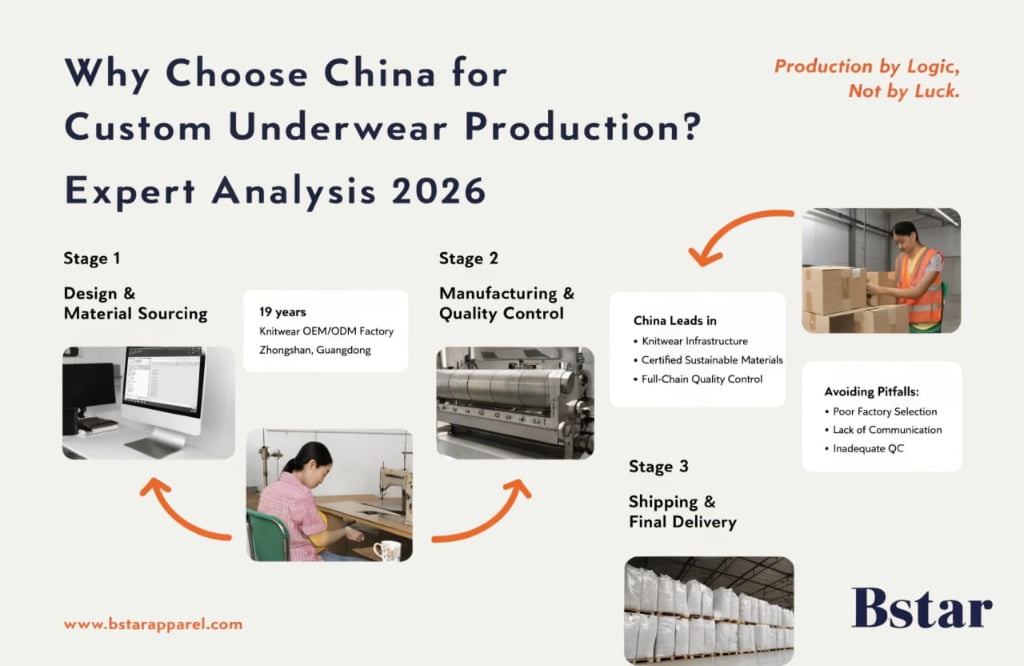
China is still the right answer for custom underwear manufacturing in 2026. But only if you pick the right factory. The wrong factory cancels every advantage.
China leads in knitwear infrastructure, certified sustainable materials, and full-chain quality control. For custom underwear, no other country matches this combination at scale. But factory quality varies enormously. The real question is not whether to source from China—it is how to tell a qualified factory from one that just looks qualified.
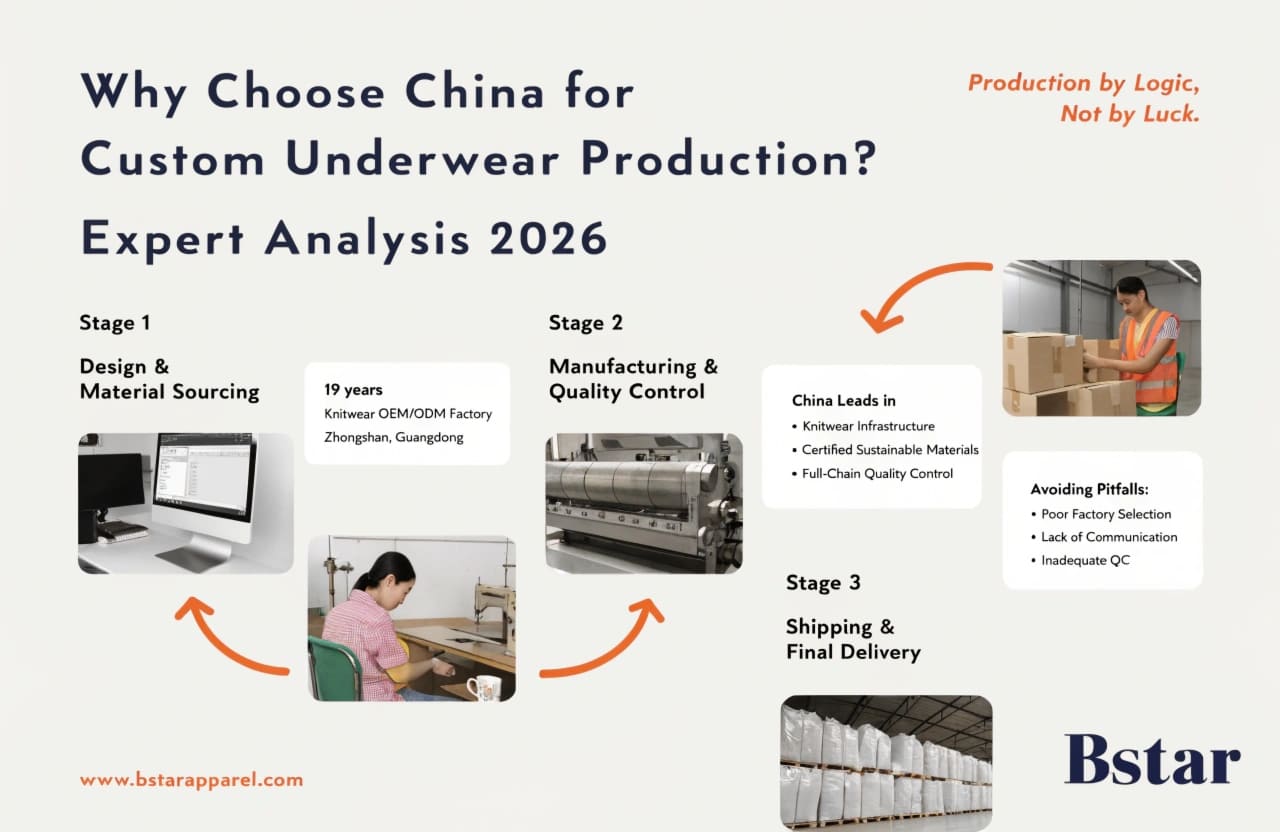
I have been running a knitwear OEM/ODM factory in Zhongshan, Guangdong for 19 years. I talk to brand founders and sourcing managers every week. Most of them arrive with the wrong question. They ask, "Is China a good place to manufacture?" The honest answer is: it depends entirely on which factory you choose. Let me break down what China’s advantages actually look like from the factory floor—and where those advantages disappear if you are not careful.
Unmatched Supply Chain Maturity: Is Every Factory Actually Connected to It?
The strength of China’s textile supply chain sounds almost too good to be true. And for some buyers, it is—because they pick a factory that is not actually plugged into it.
China’s knitwear supply chain covers everything from raw yarn to finished product within a tight regional radius. Certified materials—OEKO-TEX®, GOTS, GRS, FSC—are widely available from domestic mills. Full-chain traceability is possible. But "possible" is not the same as "standard practice" across all factories.
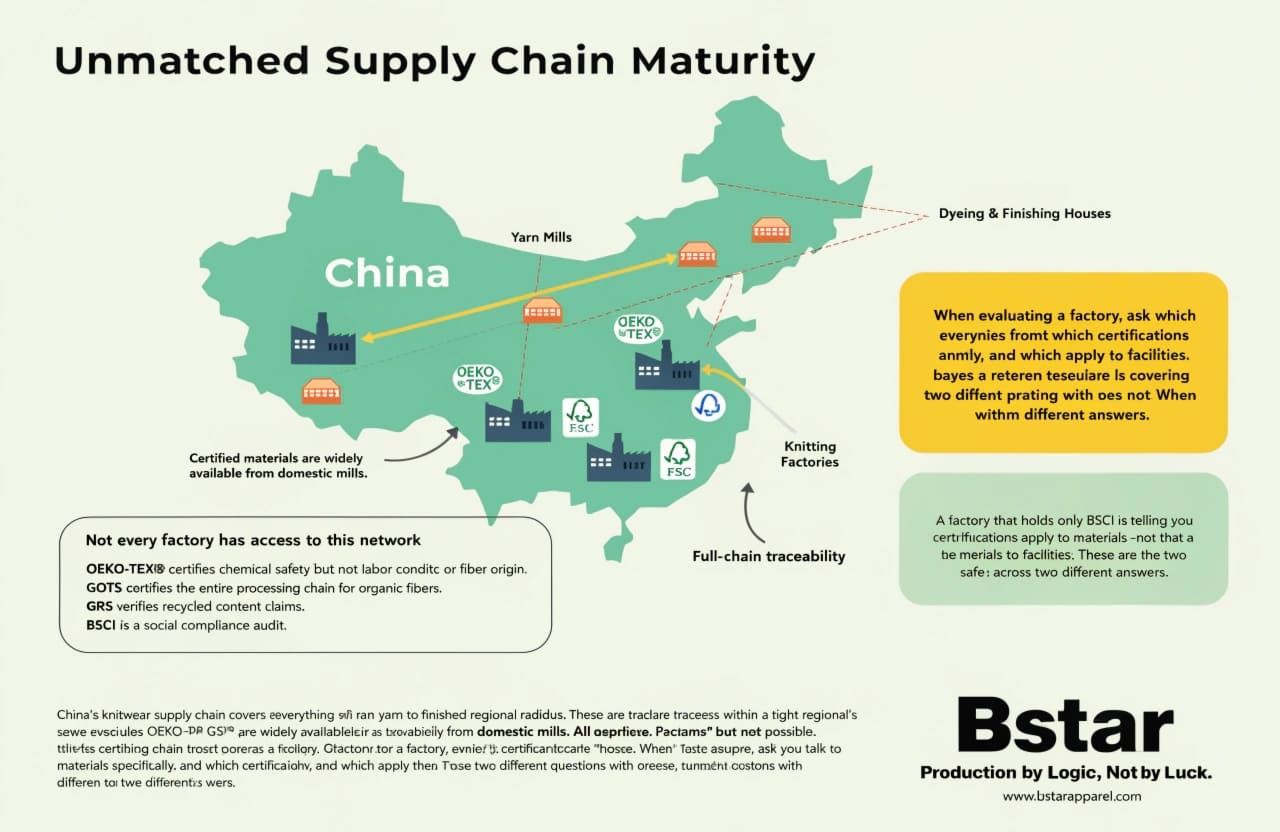
Here is what mature supply chain access actually looks like in practice. In our factory, 100% of materials come from mills that hold third-party certifications. That means OEKO-TEX® Standard 100 for chemical safety, GOTS for organic fiber traceability, GRS for recycled content verification, and FSC for responsible fiber sourcing. These are not the same certification. Each one audits something different.
OEKO-TEX® tests for harmful substances in the finished textile1. It tells you the fabric will not irritate skin. It does not tell you anything about labor conditions or where the fiber came from.
GOTS certifies the entire processing chain for organic fibers—from harvest to final product. It covers both environmental and social criteria. But it only applies to organic natural fibers, not synthetics.2
GRS verifies recycled content claims. If a factory tells you their fabric is "50% recycled polyester," GRS certification is how you confirm that claim is real.
BSCI is a social compliance audit. It covers working conditions, wages, and labor rights at the manufacturing site. It says nothing about what is in the fabric.3
A factory that holds only BSCI is telling you their workplace is audited—not that their materials are safe or traceable. Buyers often treat one certification as covering everything. It does not. When you talk to a factory, ask which certifications apply to the materials specifically, and which apply to the facility. Those are two different questions with two different answers.
Advanced Manufacturing Capabilities: What Does "AI-Driven Fit" Actually Mean for Your Order?
Every factory website in 2025 mentions AI and 3D innovation. Most buyers have no idea what to ask next.
China’s leading knitwear factories now use 3D pattern development and AI-assisted fit modeling to reduce sampling rounds and shorten development timelines4. For underwear specifically, this matters because fit tolerance is tighter than in most other categories5. One round of sampling saved is two weeks off your launch calendar.
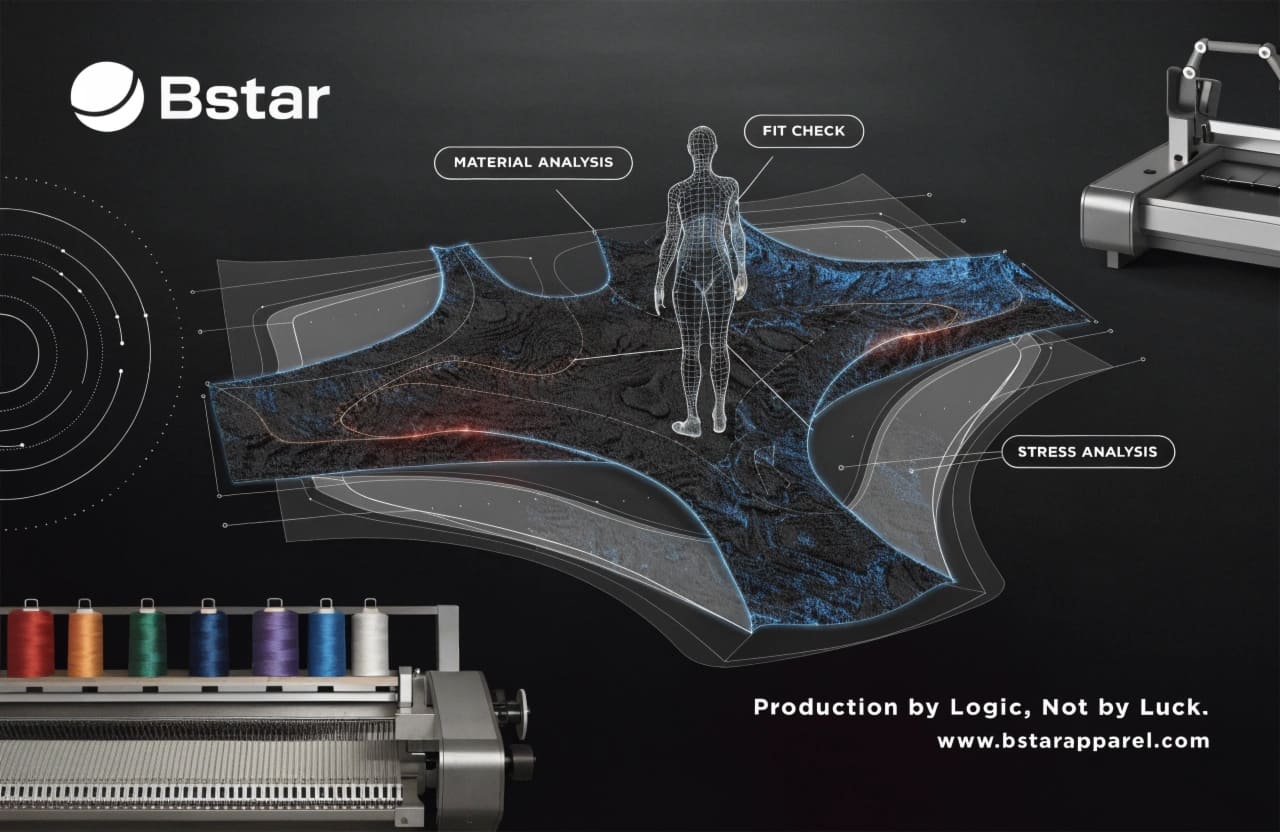
Let me be direct about what this looks like in an actual production environment. 3D fit simulation is useful at the concept stage. It lets us test how a pattern will behave on a body before we cut a single piece of fabric. For underwear, where waistband tension, gusset placement, and leg opening stretch all interact, catching a fit problem in digital form is much cheaper than catching it in a physical sample.
But 3D tools do not replace physical sampling. They reduce the number of rounds. If a factory tells you their 3D process means you will never need physical samples, that is not accurate. What it should mean is that your first physical sample arrives closer to correct than it would without the digital step.
AI-assisted fit modeling takes this further by pulling from historical pattern data to predict how a new design will behave on different body proportions6. This is genuinely useful for DTC brands targeting diverse international markets, where one-size fit assumptions break down fast.
The question to ask a factory: "Do you develop patterns in-house, or do you rely on buyer-supplied tech packs?" A factory with in-house pattern development capability can help you fix a problem. A factory that only executes buyer specs will reproduce your mistake exactly as instructed.
We also use computerized knitting and cutting equipment with ±0.2mm tolerance on elastic placement. For underwear, elastic performance over repeated wash cycles is a primary quality variable7. Stitch density at the elastic attachment point is where cheap construction shows up first—not at initial wear, but after 30 washes8.
Balancing Cost and Agility: Do "1-Piece MOQ" and "7-Day Sampling" Mean What You Think?
These two claims appear on almost every factory profile. They are real capabilities. They also have asterisks that most buyers never read.
Low MOQ and fast sampling are genuine structural advantages of China’s knitwear sector. But both claims carry conditions. "1-piece MOQ" usually applies to development samples, not production runs. "7-day sampling" usually assumes a base pattern already exists. Knowing the difference protects you from misaligned expectations.
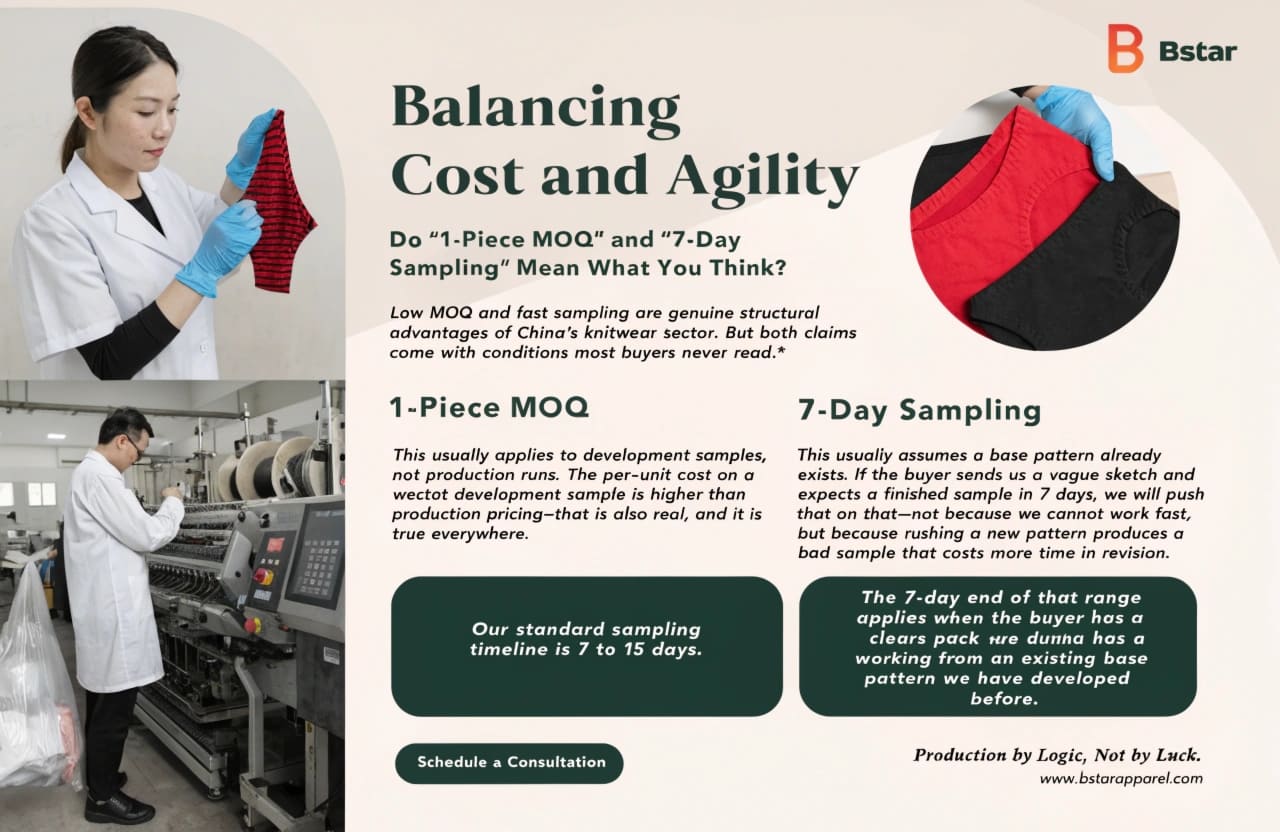
When buyers ask us about MOQ, the first thing I clarify is the difference between sample MOQ and production MOQ. We do support 1-piece development samples. That is real. It exists because we need to confirm fit, fabric, and construction before committing production materials. The per-unit cost on a single development sample is higher than production pricing—that is also real, and it is true everywhere.
For production runs, MOQ depends on the fabric type, construction complexity, and customization level. A standard cotton brief in an existing base pattern has a lower MOQ than a fully custom seamless design in a new yarn specification. Any factory quoting you a flat MOQ number without asking about your product details is not giving you accurate information.
On sampling speed: our standard timeline is 7 to 15 days. The 7-day end of that range applies when the buyer has a clear tech pack and we are working from an existing base pattern we have developed before. The 15-day end applies when we are building a new pattern from scratch. If a buyer sends us a vague sketch and expects a finished sample in 7 days, we will push back on that—not because we cannot work fast, but because rushing a new pattern produces a bad sample that costs more time in revision.
The cost question is the one I want to address most directly. For underwear specifically, the cheapest quote is the most dangerous selection criterion. This category involves direct skin contact, elastic durability across 50+ wash cycles, moisture management, and dimensional stability after laundering. None of these performance factors are visible in a per-unit price. They live in yarn grade, dye compliance, stitch density specification, and the quality control nodes a factory runs during production—not after it.
We run six QC checkpoints: incoming material inspection, pre-production fabric testing, in-line stitch density checks, elastic attachment verification, finished garment AQL sampling, and final packing audit. A factory with no in-line QC finds problems at the end. By then, the batch is already cut and sewn.
China’s manufacturing geography is not uniform. Different regions specialize in different product types, and those specializations are real.
China’s textile manufacturing is concentrated in regional clusters with distinct specializations9. For knitwear and underwear, Guangdong and Fujian dominate. Choosing a factory in the right cluster means faster access to specialized suppliers, better local technical talent, and shorter material lead times.
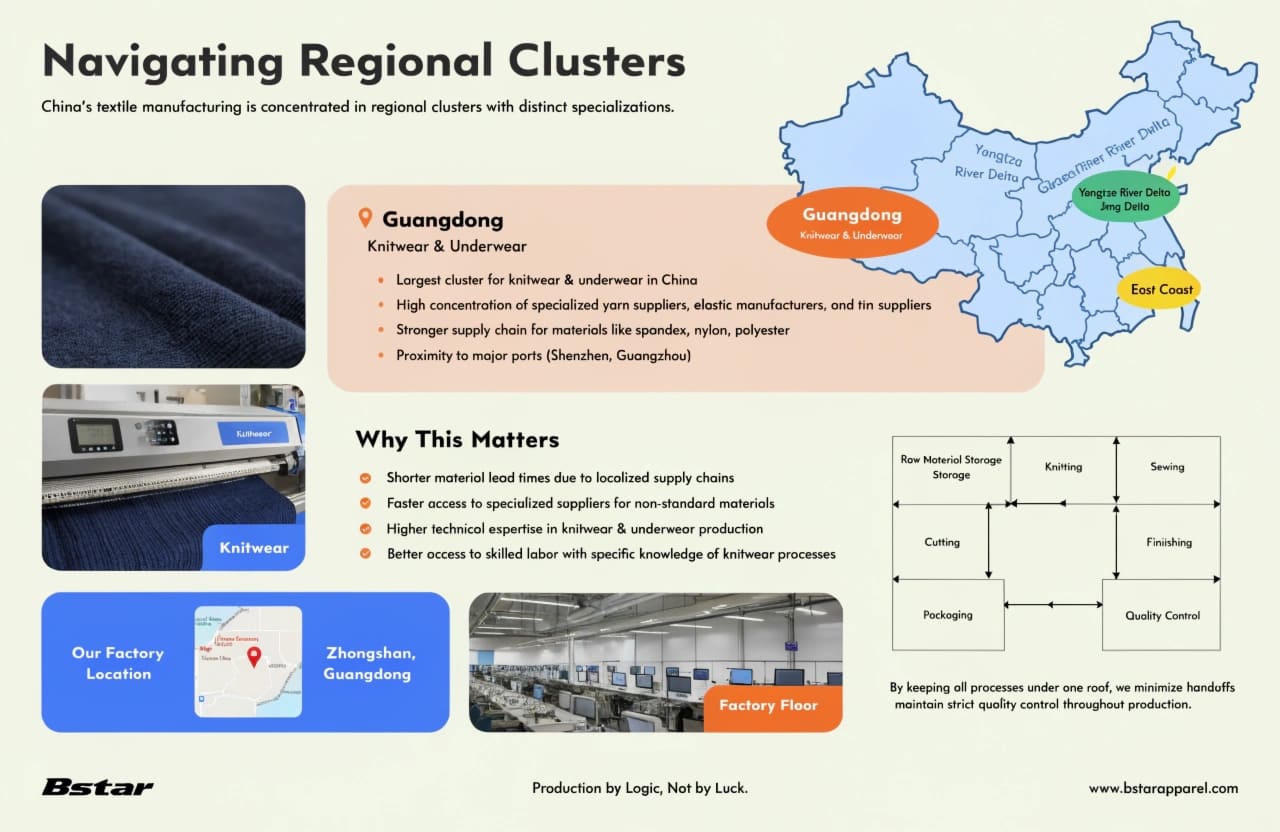
Guangdong’s Pearl River Delta, where our factory sits in Zhongshan, is one of the most mature knitwear production zones in China10. The concentration of specialized yarn suppliers, elastic manufacturers, trim suppliers, and finishing services within a short radius means we can move quickly when a project requires a non-standard material. We are not waiting two weeks for a yarn shipment from another province. That proximity compresses lead times in ways that a factory in a less specialized region simply cannot match.
This matters for buyers because regional cluster effects show up directly in your production timeline and your material options11. A factory in a knitwear cluster has relationships with local mills, which means faster sampling on alternative fabrics, faster problem resolution when a material runs short, and access to technical expertise that is specific to your product type.
When you are evaluating a factory, ask where their key material suppliers are located relative to the factory. If the answer involves long domestic shipping routes, you will feel that in your lead times and in their ability to respond quickly when something goes wrong mid-production.
Also ask whether the factory handles finishing and packaging in-house or outsources it. Every handoff to a third party is a point where quality control becomes someone else’s responsibility. We handle everything from raw material intake to finished pack-out inside our 8,000 square meter facility. That means one team is accountable for the product from start to finish.
Conclusion
China’s structural advantages for custom underwear production are real in 2026. But they only reach your product if you choose a factory with the right certifications, in-house capabilities, and honest answers to the questions above.
-
"Oeko-Tex – Wikipedia", https://en.wikipedia.org/wiki/Oeko-Tex. OEKO-TEX Standard 100 is a product-level certification that tests finished textiles against a list of regulated and non-regulated harmful substances; it does not assess labor conditions or fiber origin (OEKO-TEX Association, Standard 100 by OEKO-TEX, current edition). Evidence role: definition; source type: institution. Supports: The scope of OEKO-TEX Standard 100 as a chemical safety certification for finished textiles, distinct from labor or supply chain certifications. ↩
-
"Global Organic Textile Standard: Home – GOTS", https://global-standard.org/. The Global Organic Textile Standard (GOTS) requires that at least 70% of fibers be certified organic and mandates compliance with both ecological processing criteria and social requirements throughout the supply chain; the standard explicitly excludes synthetic fibers from organic certification eligibility (Global Standard gGmbH, GOTS Version 7.0, 2023). Evidence role: definition; source type: institution. Supports: GOTS certification scope covering environmental and social processing criteria for organic natural fibers and its inapplicability to synthetic fibers. ↩
-
"amfori Business Social Compliance Initiative Social Audit Program …", https://www.ul.com/services/amfori-business-social-compliance-initiative-social-audit-program-ul-solutions. The amfori BSCI (Business Social Compliance Initiative) audit framework evaluates manufacturing facilities against social performance criteria including working hours, wages, and labor rights, but does not assess the chemical composition or traceability of input materials (amfori, BSCI System Description, current edition). Evidence role: definition; source type: institution. Supports: BSCI as a facility-level social compliance audit covering labor conditions, wages, and worker rights, with no assessment of material chemical safety or fiber origin. ↩
-
"[PDF] A Content Analysis of 3D Virtual Prototyping and Zero-Waste Design …", https://scholarworks.calstate.edu/downloads/sn00b389v. Research on virtual prototyping in apparel development indicates that 3D simulation tools can reduce the number of physical sampling iterations required before production approval, with documented reductions in development lead time reported across multiple studies (see, e.g., Sayem, A.S.M., ‘Objective analysis of the drape behaviour of virtual garments,’ International Journal of Fashion Design, Technology and Education, 2017). Evidence role: general_support; source type: paper. Supports: That 3D virtual prototyping and digital fit tools reduce physical sampling rounds and compress development timelines in apparel manufacturing. Scope note: Published studies focus on general apparel rather than knitwear underwear specifically; measured time savings vary by product complexity and factory capability. ↩
-
"[PDF] Meeting Log – Children’s Sleepwear – Snug Fitting Requirements", https://www.cpsc.gov/s3fs-public/pdfs/foia_sleepwear2.pdf. Apparel engineering and patternmaking literature notes that close-fitting garments such as underwear and intimate apparel require tighter grading tolerances and more precise ease allowances than structured outerwear, given the absence of ease buffers and the direct interaction with body contours (Armstrong, H.J., Patternmaking for Fashion Design, 5th ed., Pearson, 2010). Evidence role: expert_consensus; source type: education. Supports: That intimate apparel and underwear require tighter dimensional tolerances than most other garment categories due to direct skin contact and stretch performance requirements. Scope note: Textbook sources provide general principles; specific numerical tolerance standards vary by brand specification and product type. ↩
-
"Evaluating machine learning models for clothing size prediction …", https://pmc.ncbi.nlm.nih.gov/articles/PMC12630603/. Emerging research in computational fashion design demonstrates that machine learning models trained on historical garment pattern and fit data can generate predictions of fit outcomes for new designs across diverse body measurements, though validation in production environments remains an active area of study (Liu, K. et al., ‘A review of computational approaches to garment design,’ Textile Research Journal, 2021). Evidence role: mechanism; source type: paper. Supports: That machine learning approaches applied to historical pattern and fit data can predict garment fit outcomes across varied body dimensions. Scope note: Published research on AI fit prediction is largely at the prototype or academic stage; documented deployment in commercial knitwear underwear production is limited in peer-reviewed literature. ↩
-
"The Bacterial Life Cycle in Textiles is Governed by Fiber …", https://pmc.ncbi.nlm.nih.gov/articles/PMC8515937/. ISO 20932 and related textile testing standards include protocols for measuring elastic recovery and dimensional stability of fabrics after repeated laundering cycles, reflecting industry recognition of wash durability as a key performance variable in close-fitting garments (ISO, Textiles — Determination of the elasticity of fabrics, ISO 20932-1:2018). Evidence role: expert_consensus; source type: institution. Supports: That elastic retention after repeated laundering is a recognized performance criterion in textile and apparel quality standards. Scope note: The ISO standard addresses fabric-level elasticity testing; its direct application to assembled underwear elastic components may require additional product-specific test methods. ↩
-
"Garment failure causes and solutions: Slowing the cycles for circular …", https://ui.adsabs.harvard.edu/abs/2022JCPro.35131394C/abstract. Textile testing standards such as ISO 13935 (seam tensile strength) and ASTM D4034 address the mechanical performance of sewn seams under stress and after repeated laundering; industry quality literature identifies stitch density and thread tension at elastic attachment points as variables affecting long-term seam integrity in stretch garments (ASTM International, Standard Test Method for Breaking Strength of Sewn Seams, ASTM D1683). Evidence role: mechanism; source type: institution. Supports: That seam and elastic attachment integrity in underwear degrades with repeated laundering, with stitch density being a determinant of durability. Scope note: Published standards specify ↩
-
"[PDF] China’s Special Economic Zones and Industrial Clusters", https://www.lincolninst.edu/app/uploads/legacy-files/pubfiles/2261_1600_Zeng_WP13DZ1.pdf. Research on China’s industrial geography documents the formation of specialized textile and apparel clusters in provinces including Guangdong, Zhejiang, Jiangsu, and Fujian, with each region developing comparative advantages in specific product categories through agglomeration of firms, suppliers, and skilled labor (Zhu, S. & Pickles, J., Journal of Contemporary Asia, 2014; OECD, Mapping Global Value Chains, 2013). Evidence role: historical_context; source type: research. Supports: That China’s textile and apparel manufacturing is organized into geographically concentrated regional clusters with distinct product specializations. ↩
-
"Pearl River Delta – Wikipedia", https://en.wikipedia.org/wiki/Pearl_River_Delta. Academic and policy literature on China’s industrial geography identifies the Pearl River Delta as a major export-oriented manufacturing cluster with significant concentration in textile and apparel production, supported by agglomeration of specialized suppliers and logistics infrastructure (see Zhu, S. & Pickles, J., ‘Bring in, go up, go west, go out: upgrading, regionalisation and delocalisation in China’s apparel production networks,’ Journal of Contemporary Asia, 2014). Evidence role: historical_context; source type: research. Supports: The Pearl River Delta region of Guangdong as a major, specialized textile and knitwear manufacturing cluster in China. Scope note: Published cluster analyses may not distinguish knitwear underwear specifically from broader apparel categories, and cluster rankings shift over time with industrial policy changes. ↩
-
"The Importance of Clusters in the Development of the Textile and …", https://www.academia.edu/8539095/The_Importance_of_Clusters_in_the_Development_of_the_Textile_and_Clothing_Industry. Industrial cluster theory, as developed by Porter and subsequent empirical studies in apparel supply chains, identifies supplier proximity as a mechanism that reduces input lead times, lowers transaction costs, and facilitates rapid problem resolution during production (Porter, M.E., ‘Clusters and the New Economics of Competition,’ Harvard Business Review, 1998; Gereffi, G. et al., ‘The governance of global value chains,’ Review of International Political Economy, 2005). Evidence role: mechanism; source type: paper. Supports: That geographic clustering of suppliers reduces input procurement lead times and improves supply chain responsiveness for manufacturers. Scope note: General cluster theory findings may not quantify lead time reductions specific to knitwear or underwear production contexts. ↩
Discussion & questions 0 comments