
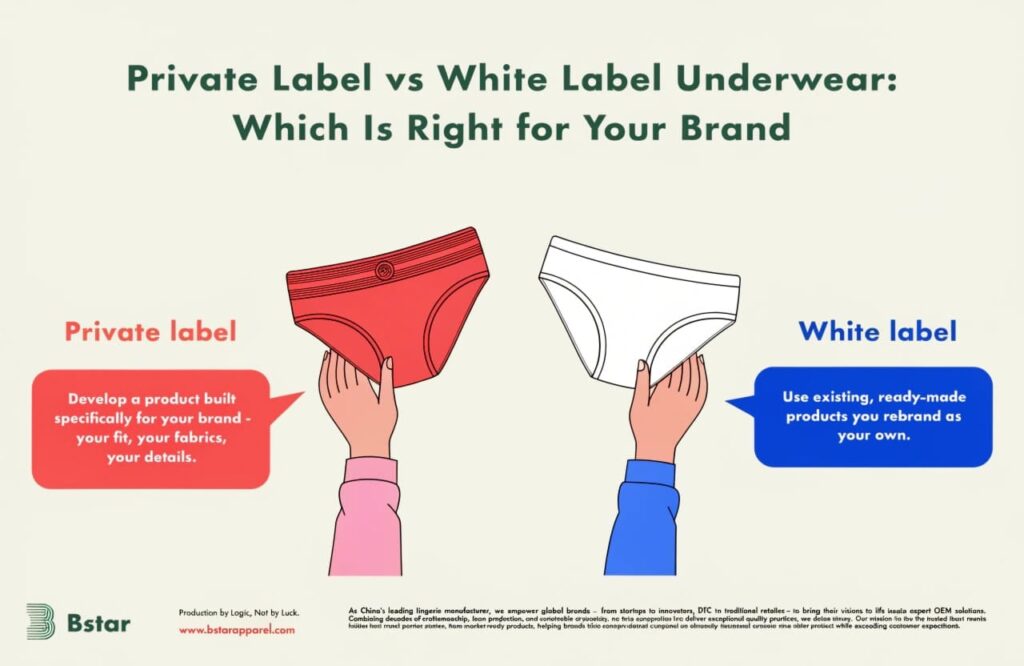
You want to launch an underwear brand. But you are stuck on one question: do you go private label or white label? The wrong choice can cost you months and money.
White label underwear uses existing, ready-made products you rebrand as your own. Private label means you develop a product built specifically for your brand — your fit, your fabrics, your details. Neither is better by default. The right choice depends on where your brand is right now.
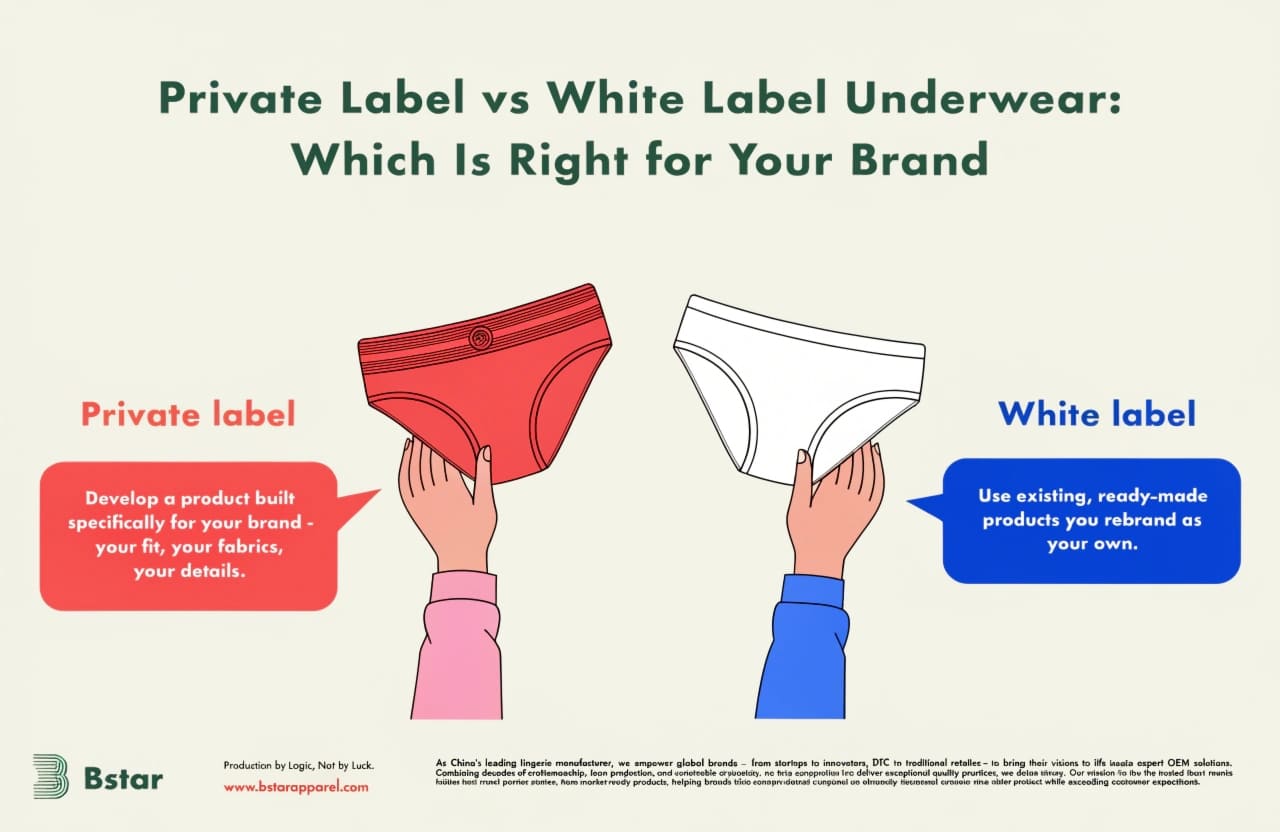
Most brand founders frame this as a quality debate. It is not. It is a timing and strategy debate. The real question is: what stage is your brand in, and what does your brand actually need right now? Let me break this down the way I see it from the factory side.
Defining the Models: What Actually Makes Them Different?
A lot of guides give you textbook definitions. But what does this look like in practice?
White label means you take a product that already exists in production, add your branding, and sell it. Private label means the product is developed specifically for you — the fit, fabric, construction, and details are yours.
Here is how these two models play out in real conversations I have with brand founders.
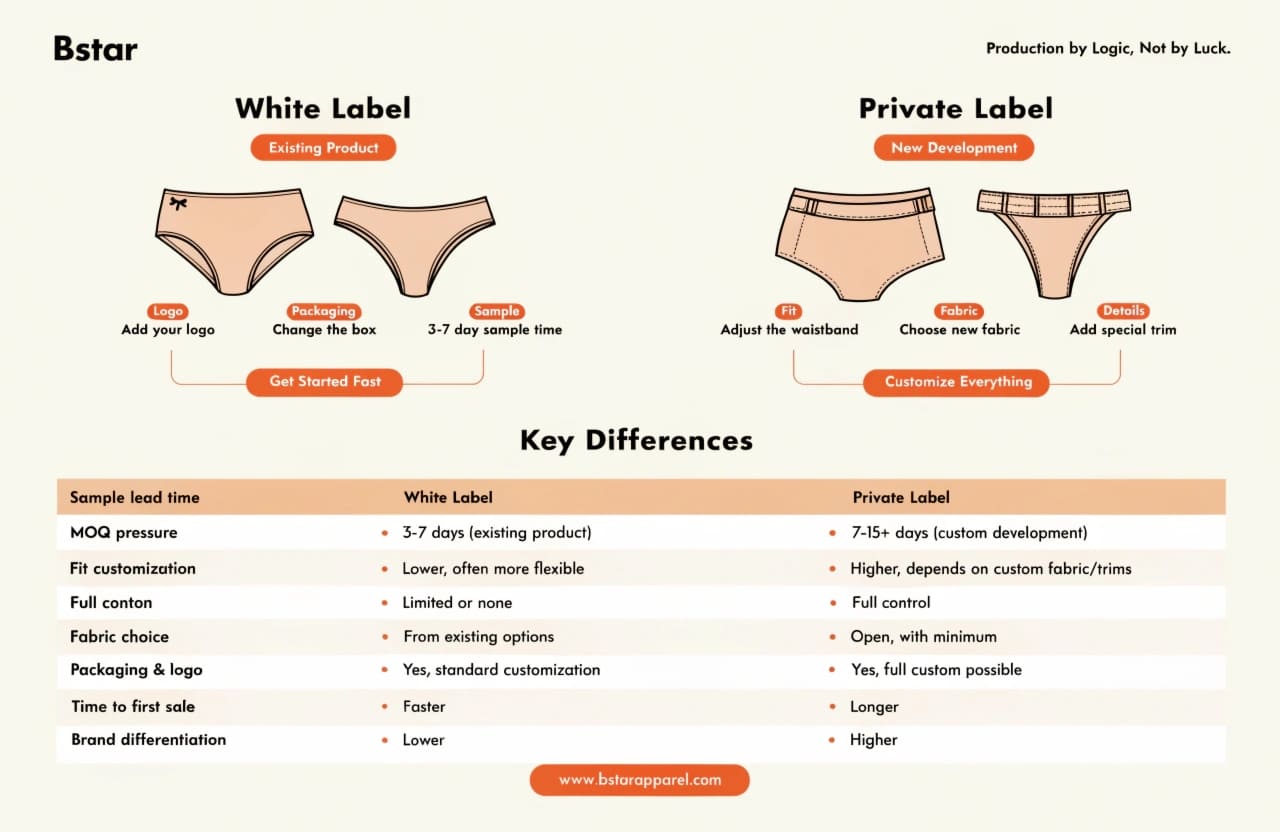
With white label, the questions are simple: Can I add my logo? Can I change the packaging? How fast can I get samples? These projects move fast. There is usually no major pattern work, no fabric development, and no long back-and-forth on fit blocks. You are working with a product that already passes quality checks and production runs smoothly.
With private label, the questions go deeper: Can we adjust the waistband height? Can we use a softer modal blend1? Can we change the sizing run to fit a curvier body2? These are the right questions — but they each add time, cost, and decisions to the process.
| Decision Variable | White Label | Private Label |
|---|---|---|
| Sample lead time | 3–7 days (existing product) | 7–15+ days (custom development) |
| MOQ pressure | Lower, often more flexible | Higher, depends on custom fabric/trims |
| Fit customization | Limited or none | Full control |
| Fabric choice | From existing options | Open, with minimums |
| Packaging & logo | Yes, standard customization | Yes, full custom possible |
| Time to first sale | Faster | Longer |
| Brand differentiation | Lower | Higher |
If you are a first-time brand founder, white label is not a shortcut. It is a legitimate starting point. It lets you test whether your target customer will buy from you before you invest in deeper development.
Speed to Market vs. Brand Exclusivity: Which One Do You Actually Need?
Speed matters. But exclusivity matters too. The problem is most founders want both at the same time, and that is where projects get complicated.
If your goal is to launch fast, test demand, and learn what your customers want, speed wins. If your goal is to own a unique product experience that competitors cannot copy, exclusivity wins. The mistake is trying to solve both in the same first order.
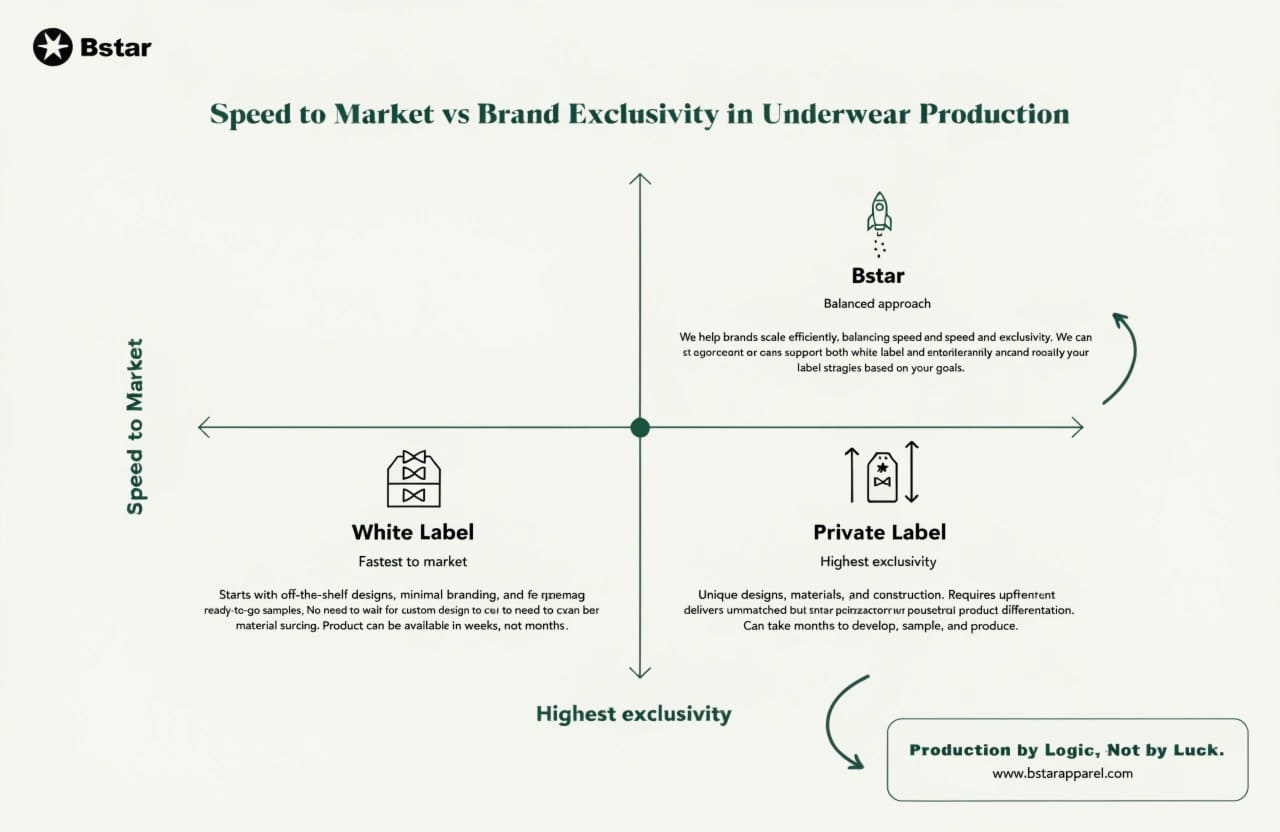
In my experience talking with early-stage DTC brands, the most common mistake is committing to full private label development before they have any sales data3. They spend three to four months on sampling, fit revisions, and fabric approvals. Then the product launches and they find out that their sizing assumptions were wrong, or the waistband style they picked does not resonate with their audience.
That is a painful and expensive lesson.
White label gives you something that private label cannot in the early stage: real customer feedback without the development cost4. You learn which sizes move, which styles get returns, and what your customers actually complain about. That feedback is worth more than any internal fit session.
On the other hand, white label has a ceiling. If your competitor is selling the exact same base product with a different logo, you cannot win on product alone5. At some point, differentiation matters. That point usually comes after you have stable sales, repeat customers, and a clear view of what your product needs to do differently.
The practical path I see work most often is this: launch with white label or light customization, gather data, then move into private label development with real feedback driving your decisions6. This is not a compromise. It is a smarter sequence.
Profit Margins and Pricing Power: How Does Each Model Affect Your Numbers?
Here is what most articles skip. The financial difference between these models is not just about unit cost. It is about pricing power, inventory risk, and where your margin actually comes from.
White label typically has a lower per-unit development cost, but limited pricing power because the product is not unique. Private label can command higher retail prices due to perceived exclusivity, but it comes with higher upfront development cost and usually a higher MOQ.
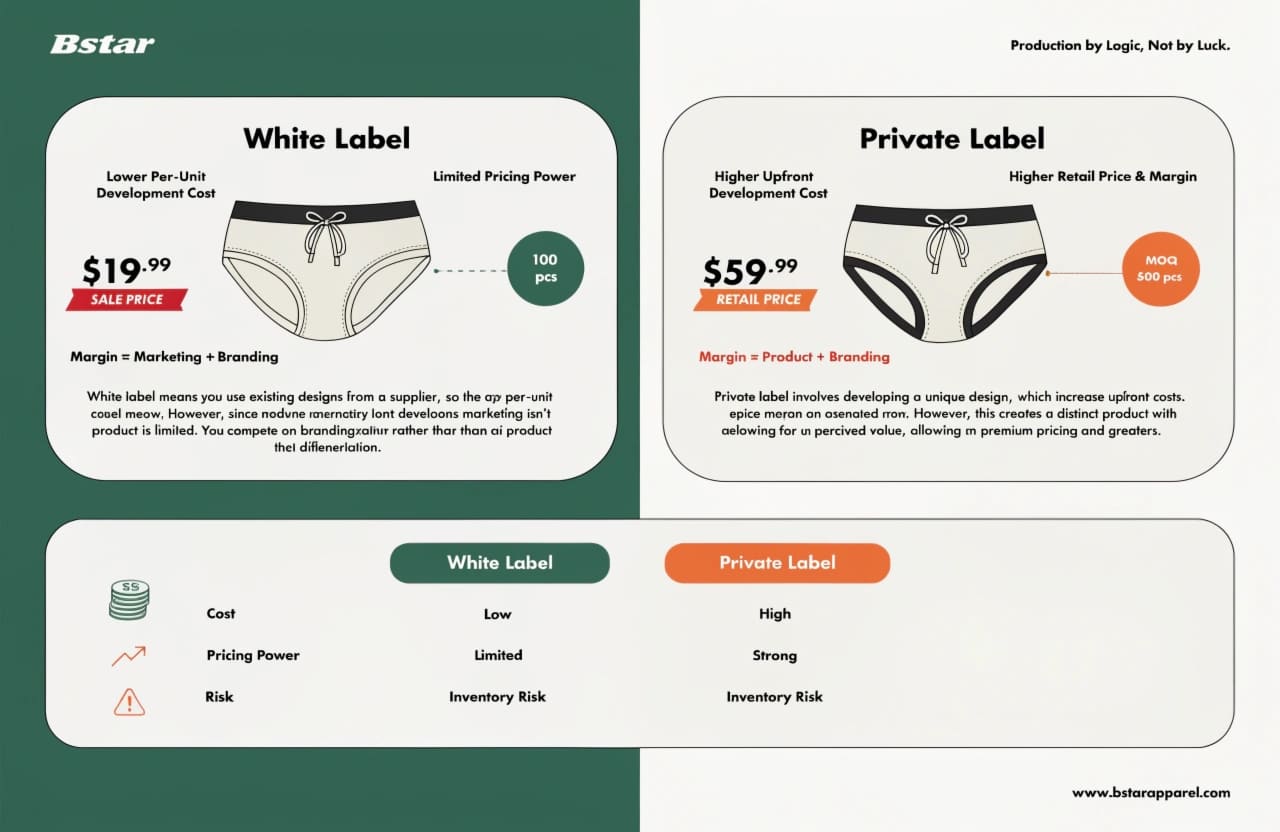
Let me be direct about how I see this from the production side.
With white label, your margin depends heavily on your marketing and branding. The product is not the differentiator. Your story, your positioning, and your customer acquisition strategy carry the product. That can work well — many successful brands are built this way7. But your margin is exposed if a competitor undercuts you with the same base product at a lower price8.
With private label, your margin has more protection because the product itself is harder to copy. A unique fabric composition, a specific fit, a waistband construction that your customers love — these are defensible9. Customers come back because of the product, not just the brand story.
But here is the risk: private label requires you to commit higher quantities to justify custom fabric minimums and development costs10. If sales do not hit your projections, you are sitting on inventory that was expensive to make.
What actually drives the cost difference?
| Cost Factor | White Label | Private Label |
|---|---|---|
| Pattern/fit development | None | Yes, adds time and cost |
| Fabric sourcing | Standard, in-stock options | Custom or semi-custom, with minimums |
| Sampling rounds | Fewer, faster | More rounds likely |
| MOQ requirement | More flexible | Higher for custom materials |
| Packaging customization | Logo and pack, standard | Fully custom possible |
| Pricing power at retail | Moderate | Higher, if differentiation is real |
The honest answer is that private label builds a stronger long-term margin structure11 — but only if you have the volume and customer clarity to justify the investment.
Making the Right Choice: Aligning Production Models With Your Brand’s Growth Stage
So how do you decide? I do not think the answer is a single recommendation. I think it is a self-check based on where your brand actually is.
The right production model is the one that matches your brand’s current stage: validating demand, building a loyal base, or defending differentiation. Choosing the wrong model for your stage wastes time and capital.
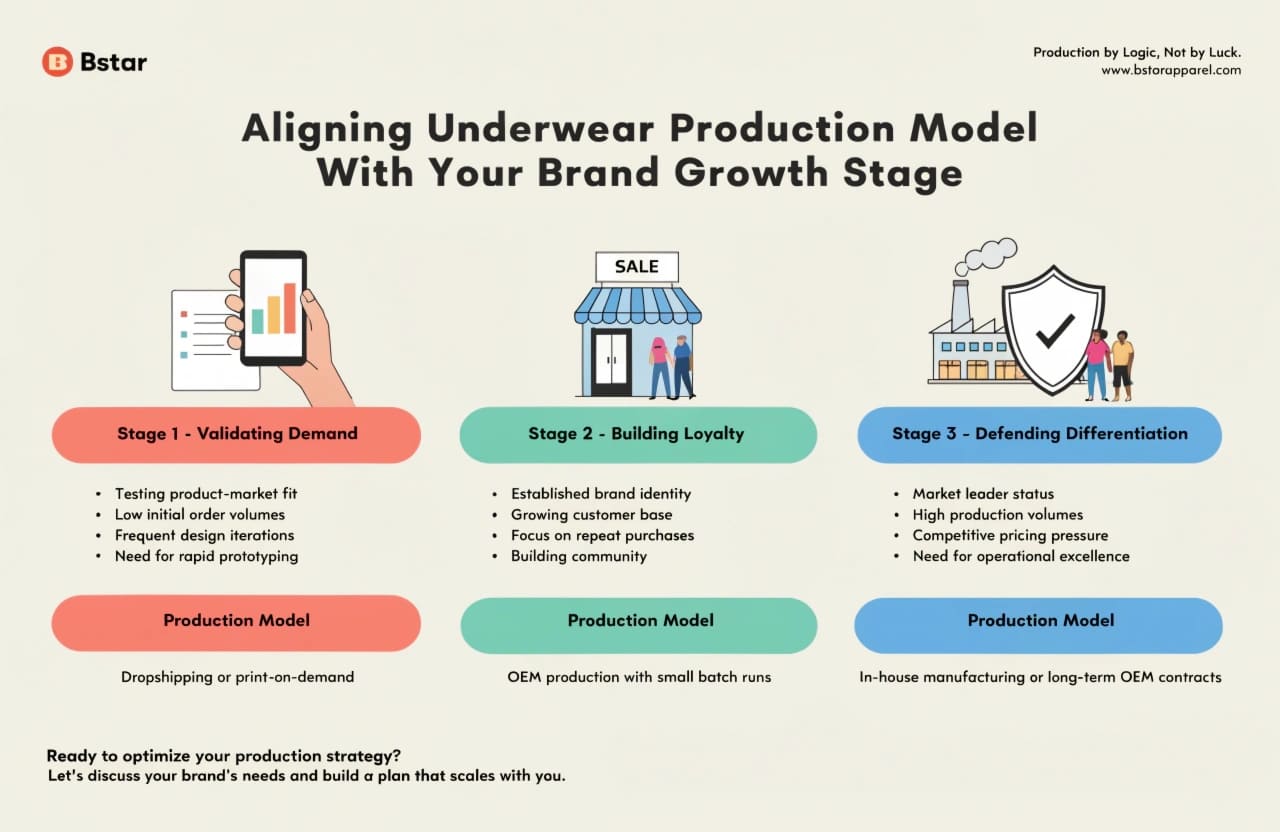
From the conversations I have with brand founders, here is a simple framework I use to help them think through the decision.
Ask yourself these questions before choosing a model:
Stage 1 — Validating demand (new brand, no sales history)
- Do you know which styles and sizes your customers want?
- Have you tested your pricing with real buyers?
- Do you have the cash to absorb unsold private label inventory?
If you answer no to most of these, white label or light customization is the smarter starting point. Move fast, learn fast.
Stage 2 — Building a base (some sales, early repeat customers)
- Are customers giving you consistent feedback about fit or fabric?
- Are you seeing specific complaints or requests that a base product cannot fix?
- Can you forecast demand well enough to commit to a higher MOQ?
If yes, light customization — adjusting the fit, adding a custom fabric option, changing the waistband — is a good middle step. You do not need full private label yet, but you can start moving toward it.
Stage 3 — Defending differentiation (stable sales, clear brand identity)
- Do you have a product that competitors can replicate too easily?
- Is your customer retention strong enough to justify a deeper product investment?
- Do you have the team and budget to manage a longer development cycle?
If yes, this is when full private label development makes sense and pays off.
| Brand Stage | Recommended Model | Key Reason |
|---|---|---|
| New, no sales data | White label | Speed, lower risk, fast learning |
| Early sales, clear feedback | Light customization | Start building differentiation without full risk |
| Stable sales, strong brand | Private label | Product becomes defensible, higher pricing power |
Conclusion
Private label and white label are both valid. The right one depends on your stage, your risk tolerance, and what your brand actually needs to grow right now.
-
"Synthetic fiber – Wikipedia", https://en.wikipedia.org/wiki/Synthetic_fiber. Modal is a type of rayon produced from beech tree pulp; according to textile science literature and the Wikipedia entry on modal fabric, it is characterized by high softness, resistance to shrinkage, and moisture absorption approximately 50% greater than cotton, making it a common choice for underwear and activewear. Evidence role: definition; source type: encyclopedia. Supports: That modal is a semi-synthetic cellulosic fiber known for softness, moisture-wicking properties, and use in intimate apparel. Scope note: Softness perception is partly subjective and influenced by fabric construction, finishing treatments, and blend ratios, so modal’s softness advantage is not absolute across all applications. ↩
-
"Inclusive Sizing Gains Ground in Global Intimate Apparel – andCircus", https://www.andcircus.com/blogs/industry-news/inclusive-sizing-gains-ground-in-global-intimate-apparel?srsltid=AfmBOoooeOnXWfcFlxnCFaP9CFguoSK-1QY2i0t_utm61gHS5jqn5nvI. Market research from firms including NPD Group and Euromonitor International documents sustained growth in the plus-size and inclusive-sizing intimate apparel segment, with surveys indicating that a substantial proportion of consumers report difficulty finding well-fitting underwear in standard size runs. Evidence role: statistic; source type: research. Supports: That consumer demand for extended and inclusive sizing in intimate apparel represents a significant and growing market segment. Scope note: Specific market share figures vary by source and year; the general trend toward inclusive sizing is well documented, but the magnitude of demand differs across demographics and price tiers. ↩
-
"Most people think startups fail because of poor execution … – LinkedIn", https://www.linkedin.com/posts/lillianpierson_most-people-think-startups-fail-because-of-activity-7449798963156746241-g0vU. CB Insights analyses of startup failure post-mortems consistently identify ‘no market need’ and premature scaling — including over-investment in product development ahead of validated demand — among the leading causes of early-stage company failure across consumer product categories. Evidence role: expert_consensus; source type: research. Supports: That premature investment in product development before demand validation is a common cause of early-stage startup failure. Scope note: CB Insights data covers startups broadly and is not specific to apparel or intimate wear; the pattern is directionally consistent but category-specific evidence is limited. ↩
-
"5 Steps to Validate Your Business Idea | HBS Online", https://online.hbs.edu/blog/post/market-validation. The lean startup methodology, formalized by Eric Ries and grounded in earlier work on iterative product development, prescribes using minimum viable products to generate validated learning from real customers before committing resources to full-scale development, a principle widely adopted in entrepreneurship education. Evidence role: mechanism; source type: education. Supports: That launching a minimum viable or existing product to gather real customer feedback before committing to full custom development reduces financial risk. Scope note: The lean startup framework was developed primarily in the software context; its direct translation to physical apparel product development involves additional constraints such as MOQs and longer production cycles. ↩
-
"Marketing Strategies | Ag Decision Maker – Iowa State Extension", https://www.extension.iastate.edu/agdm/wholefarm/html/c5-18.html. Marketing strategy literature, including foundational work by Kotler and Keller in ‘Marketing Management,’ establishes that commodity-like products competing on identical functional attributes shift competitive dynamics entirely to price, brand perception, and customer experience, as product quality ceases to function as a differentiator. Evidence role: expert_consensus; source type: education. Supports: That when products are functionally identical across competitors, differentiation must be achieved through branding, positioning, customer experience, or other non-product dimensions. Scope note: The degree to which consumers perceive two white label products as truly identical depends on branding execution, packaging, and customer communication, meaning the competitive disadvantage is not automatic. ↩
-
"[PDF] Stage-Gate® – Your Roadmap for New Product Development", https://athena.ecs.csus.edu/~buckley/CSc233/Stage_Gate_Project.pdf. The stage-gate product development process, introduced by Robert G. Cooper and widely adopted in consumer goods industries, prescribes incremental investment gated by market validation at each stage, supporting the principle that brands should confirm demand before committing to full custom development. Evidence role: mechanism; source type: education. Supports: That phased or stage-gate product development — validating at lower investment before committing to full custom development — reduces risk and improves product-market fit. Scope note: Stage-gate literature addresses new product development broadly; its specific application to the white-label-to-private-label transition in apparel has not been studied as a distinct pathway in published academic research. ↩
-
"DTC Marketing Playbook: How Direct-To-Consumer Brands Win …", https://nordmedia.com/blog-posts/dtc-marketing. Research on direct-to-consumer brand strategy, including work published by the Harvard Business Review and McKinsey & Company, documents that many DTC entrants differentiate primarily through customer experience, storytelling, and positioning rather than through exclusive product development. Evidence role: general_support; source type: research. Supports: That DTC brands frequently compete on branding and positioning rather than proprietary product formulation or construction. Scope note: General DTC brand strategy literature does not specifically address the underwear or intimate apparel category, so applicability is contextual. ↩
-
"Price Competition and Product Differentiation Based on the …", https://pmc.ncbi.nlm.nih.gov/articles/PMC7038382/. Porter’s framework of competitive strategy, widely taught in business education, identifies product differentiation as a primary mechanism for protecting profit margins; firms selling undifferentiated products compete predominantly on price, which structurally compresses margins over time. Evidence role: mechanism; source type: education. Supports: That selling undifferentiated or commoditized products reduces a firm’s pricing power and exposes margins to competitive price-cutting. Scope note: The theoretical mechanism is well established, but the degree of margin exposure depends on market concentration, switching costs, and brand equity, which vary by category. ↩
-
"Unveiling the drivers of competitive success in the apparel sector", https://pmc.ncbi.nlm.nih.gov/articles/PMC12151375/. Resource-based view theory in strategic management, as articulated by Barney (1991) and subsequent scholars, holds that firm-specific resources that are valuable, rare, and difficult to imitate — including proprietary product designs and material specifications — form the basis of sustainable competitive advantage. Evidence role: mechanism; source type: education. Supports: That proprietary product attributes contribute to sustainable competitive advantage by raising barriers to imitation. Scope note: Academic competitive strategy frameworks are general; their direct applicability to intimate apparel private label specifically has not been empirically tested in published literature. ↩
-
"Understanding Minimum Order Quantities in Apparel Manufacturing", https://www.leftyproductionco.com/post/understanding-minimum-order-quantities-in-apparel-manufacturing-key-considerations-for-your-brand. Sourcing documentation from textile trade bodies, including the International Textile Manufacturers Federation, indicates that custom fabric development at mills typically requires minimum yardage commitments substantially higher than those for in-stock constructions, reflecting the fixed costs of dyeing, finishing, and weaving setup. Evidence role: statistic; source type: institution. Supports: That custom or semi-custom fabric development at textile mills carries higher minimum order requirements than purchasing from in-stock fabric inventories. Scope note: Specific MOQ thresholds vary widely by mill, fiber type, and geographic region; the article’s general claim is directionally supported but precise figures require supplier-specific verification. ↩
-
"Apparel Profit Margin Benchmarks for 2026 (Gross, Operating & Net)", https://trueprofit.io/blog/apparel-profit-margin. Research by Deloitte, McKinsey, and academic studies in the Journal of Retailing consistently find that private label products generate gross margins 25–40% higher than comparable national or commodity branded products, attributed to elimination of third-party brand premiums and greater supply chain control. Evidence role: statistic; source type: research. Supports: That private label products typically yield higher gross margins for retailers and brands than equivalent branded or commoditized alternatives. Scope note: Most private label margin research focuses on grocery and mass retail rather than DTC apparel specifically; margin advantages depend on achieving sufficient volume to amortize development costs. ↩
Discussion & questions 0 comments