
A wrong underwear factory choice looks cheap at first. Then fit issues, rough seams, and returns appear. I have seen trust become expensive to rebuild.
I should choose a specialized underwear factory when my product needs close fit, stretch recovery, skin comfort, support, or repeatable sizing. A general garment factory may make basic underwear, but a specialized partner reduces development, material, fit, compliance, and bulk production risks.
I often meet DTC founders who ask one direct question: can my current garment factory make underwear? I think a better question is this: what risks must this underwear product control before I sell it to real customers? If I answer that question well, the factory choice becomes much clearer.
Precision Engineering: Why Does Specialized Machinery Matter for Intimate Apparel?
A pair of underwear looks simple on a table. It becomes complex on the body. I have seen small seam choices change comfort, fit, and reviews.
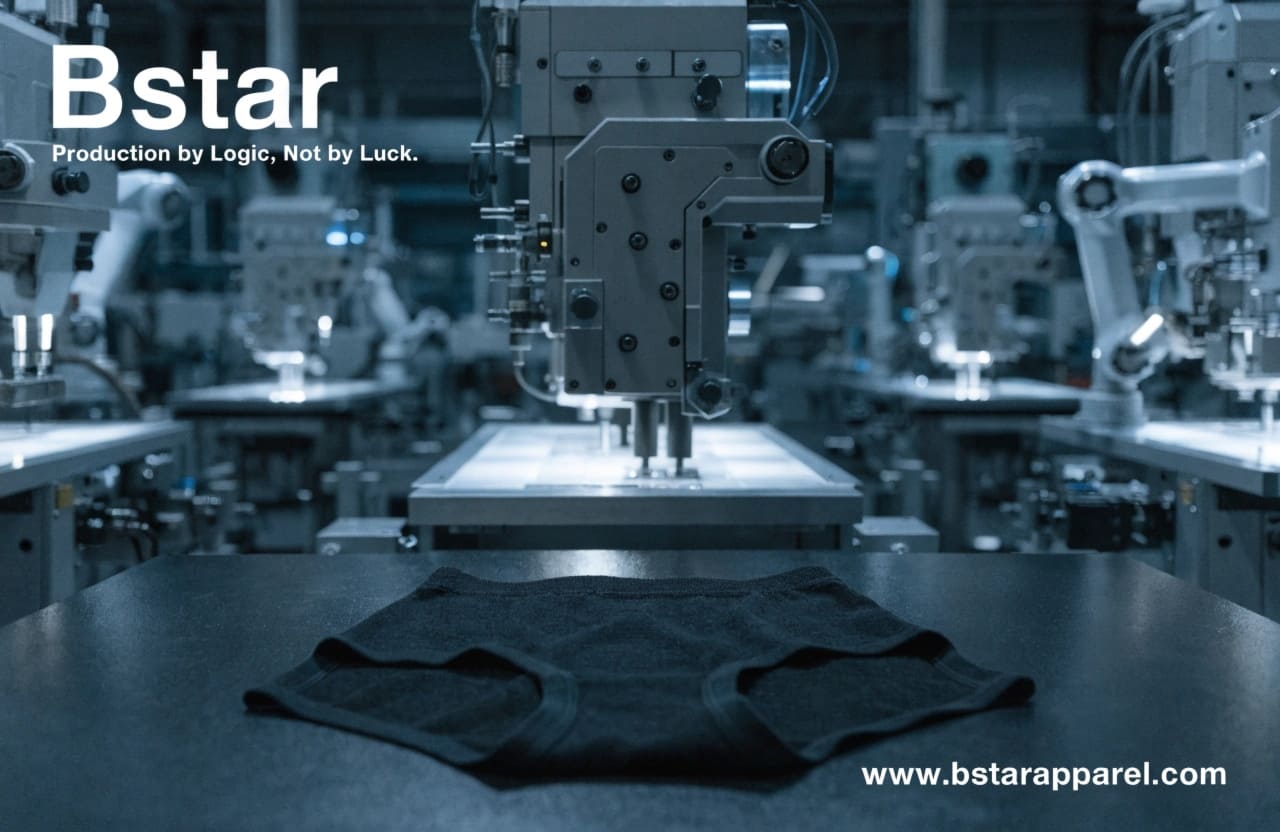
A specialized underwear factory uses machines and production methods that support small seams, stable waistbands, clean leg openings, and close-to-skin finishing1. These details matter because underwear sits tight on the body and moves all day2.
I do not believe that every general garment factory is weak. Some general knitwear factories can make basic briefs or simple trunks. But I also know that underwear has less room for error than many outerwear items. A T-shirt can hide a slightly uneven seam. Underwear cannot hide a rough edge, a twisted waistband, or a tight leg opening.
What I look for before I trust production
I usually start with the product shape. I ask if the style needs support, a seamless effect, bonded edges, soft elastic, pouch shaping, or high stretch recovery. These needs affect machine choice and worker handling. They also affect how the sample becomes bulk production.
| Area I check | Why I check it | Risk if I ignore it |
|---|---|---|
| Seam type3 | I need the seam to feel soft against skin | The wearer may feel rubbing |
| Elastic attachment | I need even tension around the body | The waistband may roll or dig in |
| Leg opening finish | I need comfort during movement | The garment may ride up |
| Pouch or gusset shape | I need the fit to match real use | The product may feel unstable |
| Bulk repeatability | I need the same result across sizes | Customers may complain about sizing |
I see machinery as only one part of the answer. I also look at operator skill, sample notes, tension control, and inline inspection. A specialized underwear factory should not only own the right machines. It should also know when a seam is technically correct but still uncomfortable. That judgment is hard to buy after production starts.
Fabric Expertise: How Do I Master Stretch, Breathability4, and Comfort?
The wrong fabric can make a good design feel bad. I have seen buyers focus on hand feel, then miss recovery, shrinkage, and skin contact.
Underwear fabric must balance stretch, recovery, softness, breathability, and wash stability.5 A specialized underwear factory helps me choose fabric and trims that match the design, target price, and customer comfort expectations.
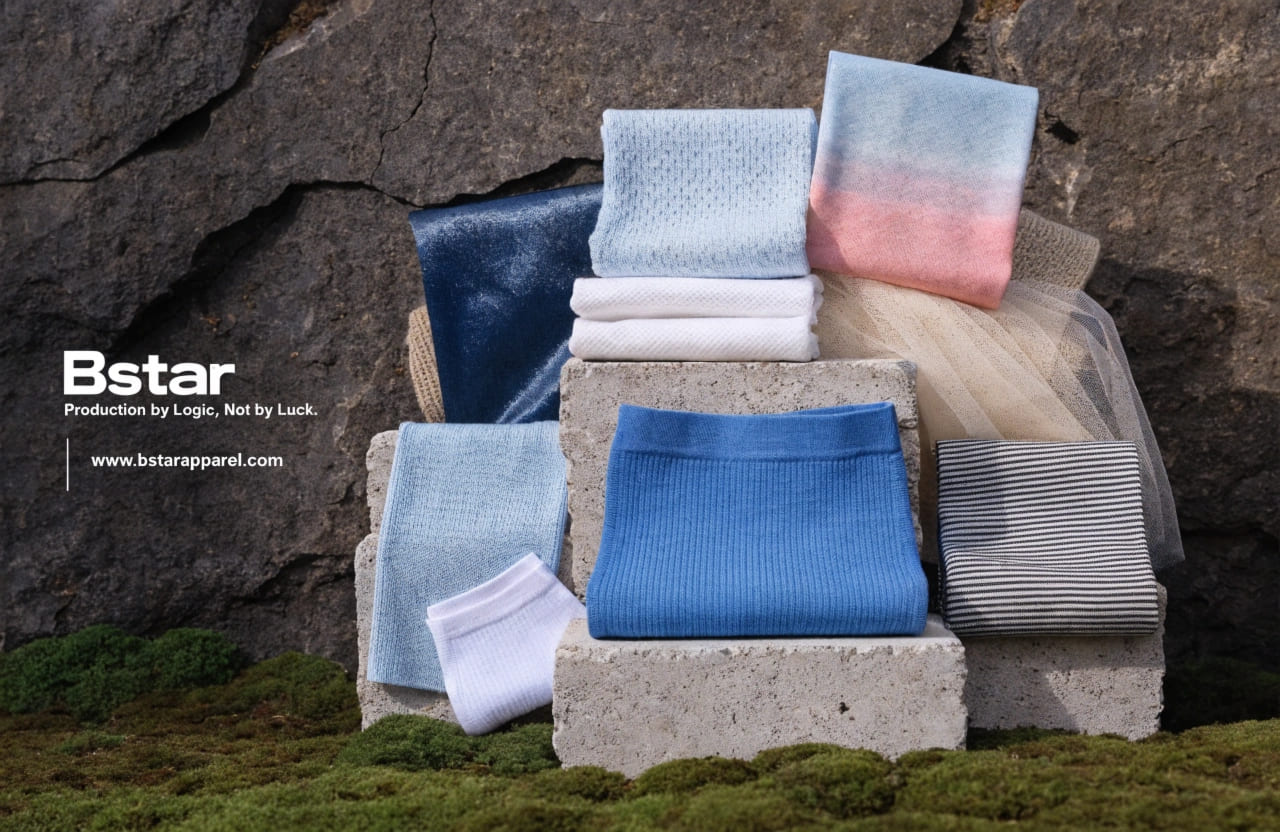
I see underwear fabric as a performance choice, not only a style choice. Cotton, modal, bamboo viscose, nylon, polyester, spandex blends, and recycled materials can all work. But each material behaves differently after cutting, sewing, washing, and wearing6. A soft fabric in a swatch book may lose shape after several washes.7 A fabric with strong stretch may feel too tight if the pattern does not allow enough ease.
Questions I ask before I approve fabric
I like to ask simple questions first. Does the product need daily comfort, sport support, light compression, no-show edges, or premium softness? Does the brand sell in a hot climate, a cold climate, or both? Does the customer expect natural fiber, recycled fiber, or certified material?
| Fabric point | My buyer-friendly meaning | What can go wrong |
|---|---|---|
| Stretch | The fabric can expand with the body | The size may feel too small |
| Recovery | The fabric returns after being stretched | The seat or waistband may become loose |
| Breathability | The wearer feels less trapped heat | The product may feel sweaty |
| Shrinkage | The size stays stable after washing | Customers may say the fit changed |
| Skin feel | The surface feels smooth and safe | The product may cause irritation |
I also pay close attention to trims. Underwear is not only fabric. Elastic, labels, thread, heat transfer marks, lace, mesh, and waistband materials all touch the body or sit close to it.8 A beautiful waistband can still fail if it scratches skin or loses tension. A printed label can still be a problem if it cracks or feels rough. For DTC brands, these small details become public reviews. I cannot treat them as small details.
Quality Control: Why Do Higher Standards Matter for Seams, Elasticity, and Durability?
A product can pass a quick visual check and still fail the customer. Underwear quality must survive movement, washing, and close body contact.
A specialized underwear factory controls seam strength, elastic tension, size consistency, shrinkage, color fastness, and finishing comfort9. These controls help reduce returns, bad reviews, and unstable repeat orders.
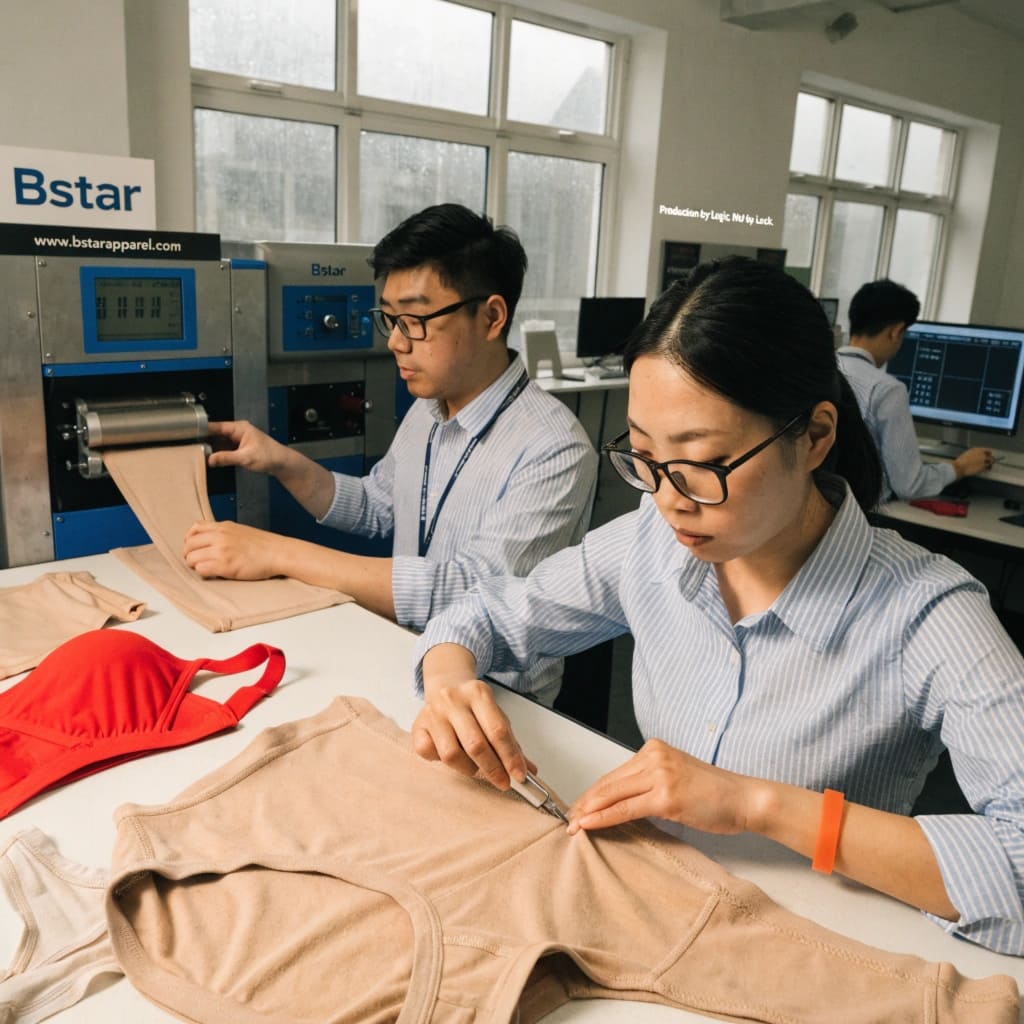
I see quality control in underwear as a chain. If one link is weak, the whole product feels wrong. The first link is material inspection. The second link is cutting accuracy. The third link is sewing control. The fourth link is size and appearance checking. The last link is packing and final inspection. I do not want quality to depend only on a final check because final checks often find problems too late10.
My practical QC map for underwear
I like a clear inspection plan because underwear orders often include many sizes and colors. A small grading error can create big customer frustration. A medium size in black should not feel different from a medium size in grey just because the fabric batch or sewing tension changed11.
| QC point | What I check | Why it matters |
|---|---|---|
| Fabric before cutting | Width, shade, defects, stretch | I need stable input before production |
| Cutting | Size panels and grain direction | I need shape consistency |
| Sewing | Seam line, skipped stitches, tension | I need comfort and durability |
| Elastic | Length, stretch, recovery, attachment | I need a stable waistband and leg fit |
| Size measurement | Key points across sizes | I need the size chart to match bulk goods |
| Wash check | Shrinkage and appearance | I need the product to survive real use |
I also think about how quality affects the business model. A retail brand may absorb some issues through store channels. A DTC brand often faces the customer directly. If the underwear feels tight, loose, scratchy, or different from the first order, the customer may not buy again. The cost is not only one refund. The cost can be lost trust, lower lifetime value, and weaker word of mouth. This is why I see specialized QC as a commercial tool, not only a factory process.
Compliance can feel like paperwork until a shipment faces questions. I have seen first-time brands discover material rules later than they should.
For underwear, compliance should cover skin-contact safety, material claims, restricted substances, labeling, and target-market expectations12. A specialized underwear factory can help me prepare the right documents and choose suitable certified materials earlier.
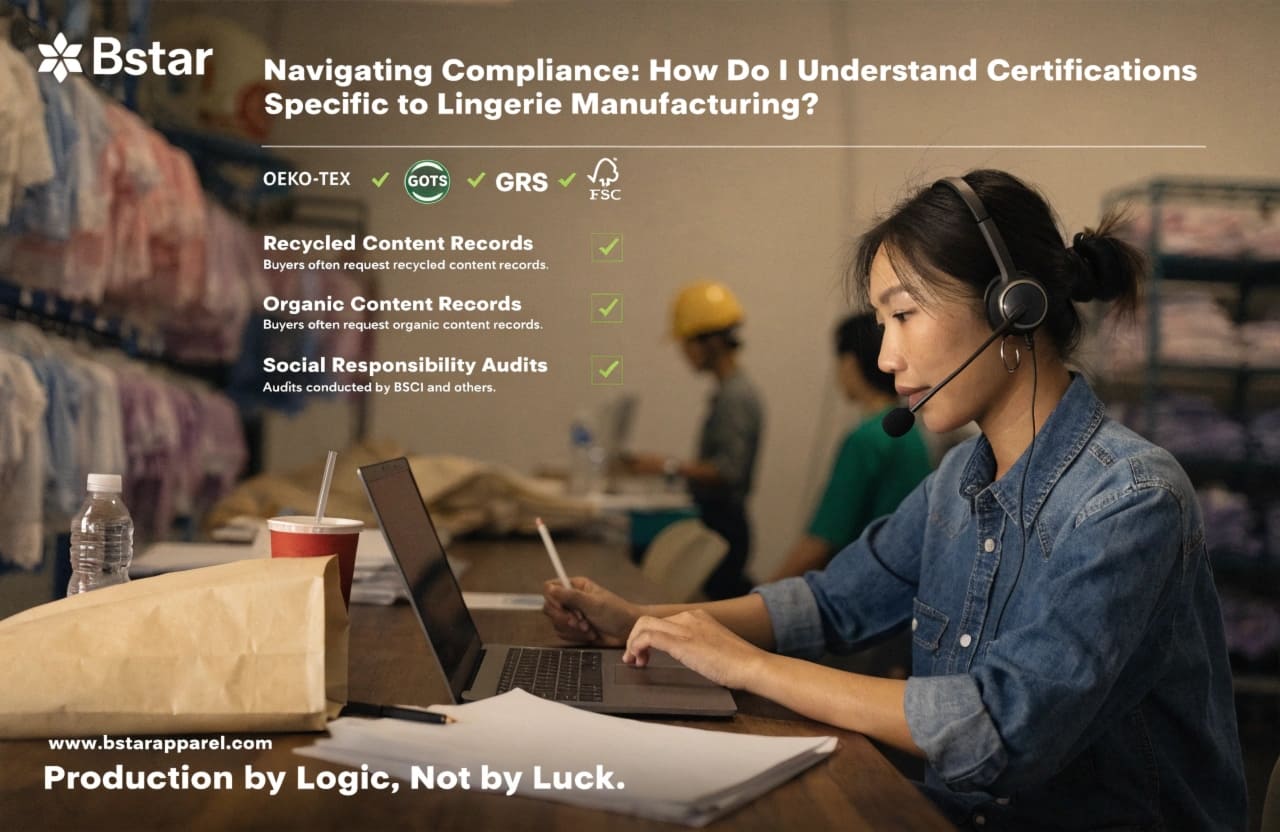
I do not treat certifications as decorations. I treat them as risk control. Underwear sits close to sensitive skin, so buyers often ask about OEKO-TEX, GOTS, GRS, FSC, recycled content records, organic content records, and social responsibility audits such as BSCI. The exact need depends on the market, sales channel, and brand promise. I do not think every style needs every certification. I do think every claim needs support.
What I confirm before development moves too far
I prefer to ask compliance questions during sampling, not after bulk production. If the brand wants organic cotton, I need to know that before fabric sourcing. If the brand wants recycled nylon or recycled polyester, I need to confirm the chain of documents early. If the product enters the EU, UK, US, or Australian market, I also need to think about labels, fiber content, care instructions, and restricted substance expectations.
| Compliance area | What I ask | Why I ask early |
|---|---|---|
| Skin-contact safety | Does the material meet buyer safety needs? | I want to reduce irritation and claim risk |
| Fiber claim | Is the fiber content correct and supported? | I want labels to match the product |
| Organic claim | Is certified organic material required? | I need the right supply chain |
| Recycled claim | Is recycled content documented? | I need traceable records |
| Social audit | Does the buyer require factory audit support? | I need to match retailer or brand rules |
| Label rules | What market will sell this product? | I need correct care and content labels |
I also believe compliance affects design choices. A heat transfer label may be more comfortable than a woven label, but it still needs to survive washing and match safety expectations. A dyed elastic may look premium, but it must meet color fastness needs. A lace trim may look beautiful, but it must feel safe and stable on skin. A specialized underwear factory should raise these points before I lock the product. That early advice can save time, money, and stress.
Conclusion
I choose a specialized underwear factory when I want better control over fit, comfort, materials, compliance, and repeatable bulk quality.
-
"The impact of knitted linked seams on comfort and friction perception", https://pubmed.ncbi.nlm.nih.gov/39210587/. Research on apparel comfort identifies seam structure, fabric-skin friction, and localized pressure as factors that can influence perceived comfort in garments worn next to the body. Evidence role: mechanism; source type: paper. Supports: Small seams, stable waistbands, clean leg openings, and close-to-skin finishing are important construction details for underwear comfort.. Scope note: The evidence would justify the importance of these construction features generally, not prove that any particular factory can achieve them. ↩
-
"Comfort Evaluation of Wearable Functional Textiles – PMC – NIH", https://pmc.ncbi.nlm.nih.gov/articles/PMC8585350/. A peer-reviewed review of clothing comfort explains that garments worn close to the skin are evaluated through tactile, pressure, thermal, and moisture sensations during body movement. Evidence role: mechanism; source type: paper. Supports: Underwear sits close to the body and moves with the wearer throughout the day, making comfort-sensitive construction important.. Scope note: The source would support the general clothing-comfort mechanism rather than underwear manufacturing specifically. ↩
-
"[PDF] The effects of different fabric types and seam designs on the seams …", https://commons.emich.edu/cgi/viewcontent.cgi?article=1052&context=honors. Textile engineering literature describes seam type and stitch parameters as determinants of seam strength, extensibility, bulk, and appearance in sewn garments. Evidence role: mechanism; source type: paper. Supports: Seam type affects softness, comfort, and durability in underwear production.. Scope note: The source would support the technical relevance of seam choice, while comfort outcomes still depend on fabric, fit, and wearer sensitivity. ↩
-
"Moisture Vapor Permeability and Thermal Wear Comfort of … – PMC", https://pmc.ncbi.nlm.nih.gov/articles/PMC8539243/. Textile comfort research links air permeability and moisture vapor transmission to thermophysiological comfort by affecting heat and moisture exchange between the body and environment. Evidence role: mechanism; source type: paper. Supports: Breathability helps reduce trapped heat and moisture discomfort in underwear.. Scope note: The source would support breathability as a comfort factor, while perceived sweatiness also depends on climate, activity, fit, and wearer physiology. ↩
-
"Evaluation of physical and mechanical characteristics of three … – PMC", https://pmc.ncbi.nlm.nih.gov/articles/PMC10685180/. Textile performance references and research describe stretch and recovery, air/moisture transport, hand feel, and dimensional stability after laundering as standard functional properties for apparel fabrics. Evidence role: expert_consensus; source type: paper. Supports: Underwear fabric selection should consider stretch, recovery, softness, breathability, and wash stability together.. Scope note: The support would establish these as recognized textile properties, not define a universal ideal balance for every underwear style. ↩
-
"[PDF] Effect of Laundering on Dynamic Elastic Behavior of Cotton and …", https://jtatm.textiles.ncsu.edu/index.php/JTATM/article/download/2593/1790. Textile science sources explain that fiber type, yarn structure, knit construction, and finishing influence shrinkage, stretch recovery, moisture behavior, and durability during manufacture and laundering. Evidence role: mechanism; source type: paper. Supports: Different underwear materials can behave differently during cutting, sewing, washing, and wear.. Scope note: The source would support material-dependent behavior in general; individual fabric performance still requires testing of the exact material. ↩
-
"The effect of fabric structure parameters on dimensional stability …", https://www.academia.edu/111358273/The_effect_of_fabric_structure_parameters_on_dimensional_stability_after_domestic_washing. Standards and studies on dimensional stability after laundering show that fabrics can shrink, grow, skew, or otherwise change dimensions after repeated washing and drying. Evidence role: mechanism; source type: institution. Supports: A fabric that feels soft in a swatch may lose shape after repeated washing.. Scope note: The evidence would support the possibility of post-laundering shape change, not predict the behavior of a specific swatch without test results. ↩
-
"Contact dermatitis in the textile industry: a review of 72 patients", https://pubmed.ncbi.nlm.nih.gov/8955486/. Dermatology and textile-allergy references note that textile components such as dyes, elastic materials, labels, seams, and finishing chemicals can contribute to irritation or allergic contact dermatitis in skin-contact garments. Evidence role: general_support; source type: paper. Supports: Underwear trims and components can affect wearer comfort because they contact or sit near the skin.. Scope note: Such sources support skin-contact risk generally and do not show that every listed component commonly causes irritation. ↩
-
"Clothing Quality Control Techniques for Apparel Factories", https://nofalapparel.com/clothing-quality-control/. Apparel quality-control texts and textile standards identify seam strength, dimensional stability, size measurement, elastic performance, and color fastness as measurable quality characteristics for sewn garments. Evidence role: expert_consensus; source type: institution. Supports: Underwear quality control commonly includes seam strength, elastic tension, size consistency, shrinkage, color fastness, and finishing comfort.. Scope note: The source would establish recognized QC criteria, not verify the article’s claim that these controls reduce returns in a specific business. ↩
-
"[PDF] Cost of quality tradeoffs in manufacturing process and – DSpace@MIT", https://dspace.mit.edu/bitstream/handle/1721.1/76133/821686496-MIT.pdf?sequence=2. Quality-management literature emphasizes in-process inspection and process control because detecting defects only at final inspection can increase rework, scrap, and late-stage correction costs. Evidence role: expert_consensus; source type: institution. Supports: Relying only on final inspection can detect production defects too late to prevent cost and rework.. Scope note: The evidence would support the general quality-management principle rather than provide underwear-specific production data. ↩
-
"Dimensional stability (fabric) – Wikipedia", https://en.wikipedia.org/wiki/Dimensional_stability_(fabric). Textile and apparel manufacturing sources describe fabric lot variation and sewing-thread tension as factors that can affect seam appearance, puckering, elasticity, and finished garment dimensions. Evidence role: mechanism; source type: paper. Supports: Changes in fabric batch or sewing tension can make the same nominal size feel different across colors or production lots.. Scope note: The support would explain potential causes of variation; it would not quantify their impact for the specific product described. ↩
-
"The Textile Products Identification Act | Federal Trade Commission", https://www.ftc.gov/legal-library/browse/rules/textile-products-identification-act-text. Regulatory guidance for textile products commonly addresses fiber-content labeling, care labeling, restricted chemicals, and substantiation of environmental or material claims for consumer goods. Evidence role: general_support; source type: government. Supports: Underwear compliance should consider skin-contact safety, material claims, restricted substances, labeling, and target-market expectations.. Scope note: Requirements differ by jurisdiction and product category, so a source can support the compliance categories but not replace market-specific legal advice. ↩
Discussion & questions 0 comments