
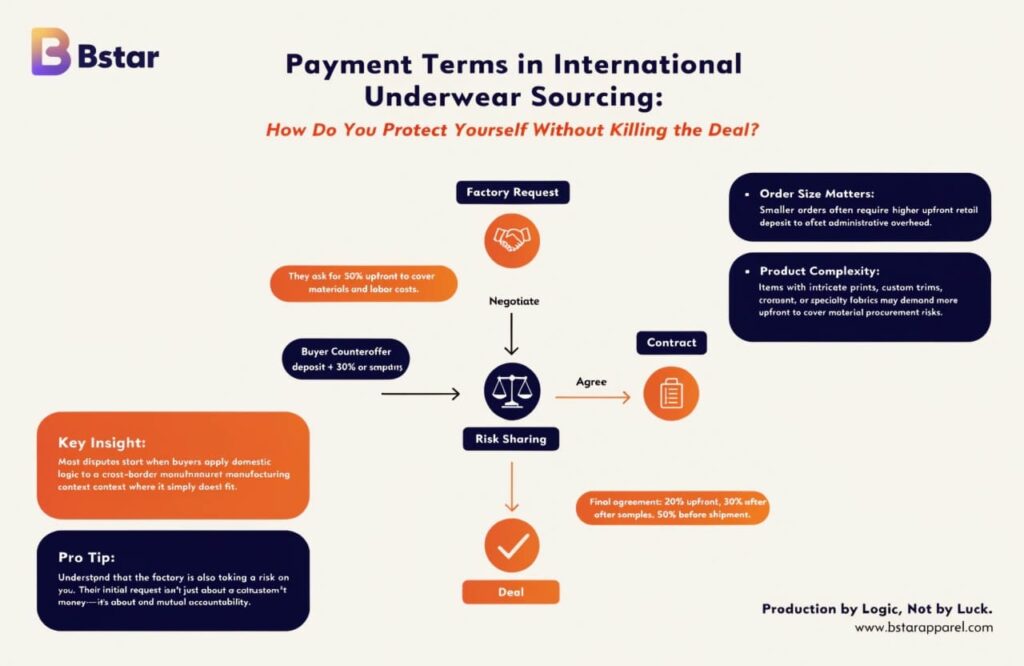
You found a factory. Samples look good. Price works. Then they ask for 30% upfront. You hesitate—and suddenly the whole deal feels uncertain.
Payment terms in international underwear sourcing are not a fixed standard. They are a negotiated structure shaped by trust, order size, and how both sides share risk. Most disputes start when buyers apply domestic retail logic to a cross-border manufacturing context where it simply does not fit.
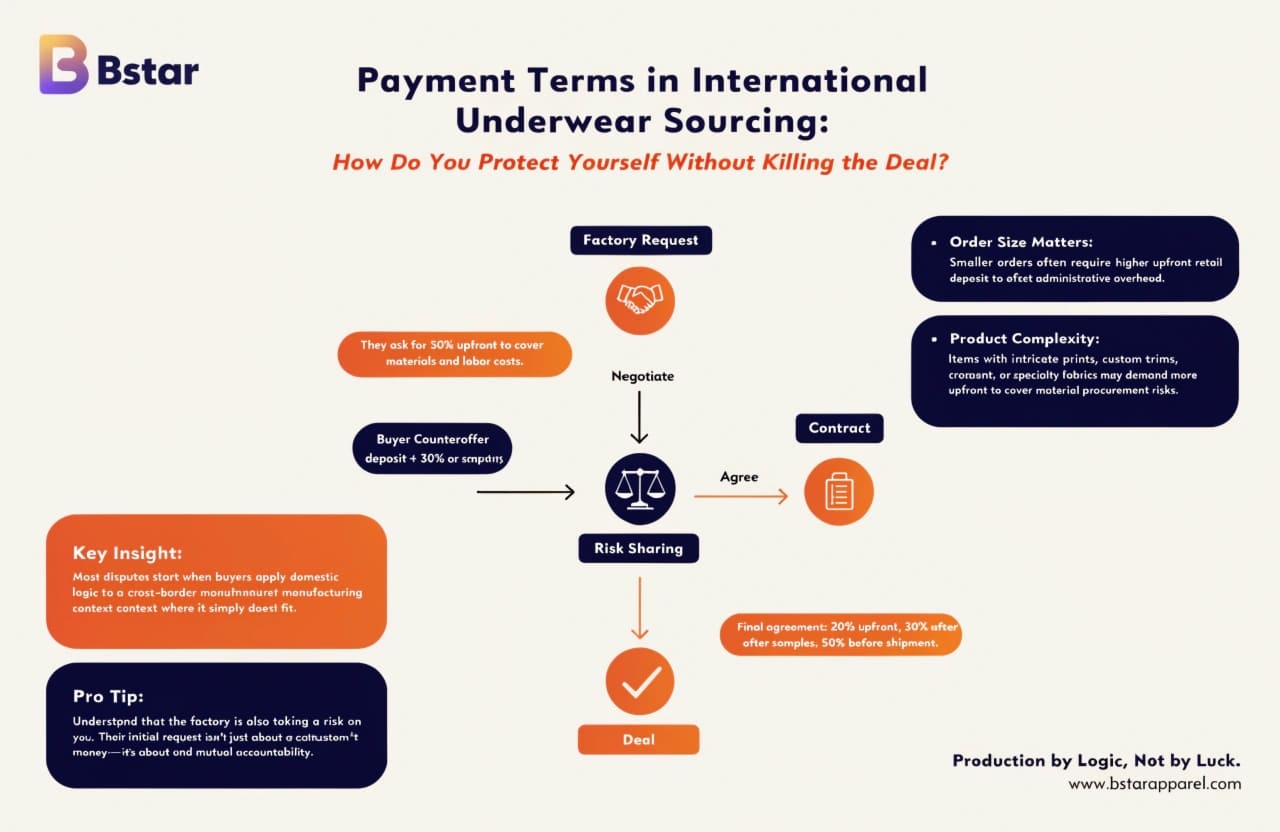
Here is the thing most buyers do not hear early enough: the factory is also taking a risk on you. Understanding that changes how you approach the entire conversation. Let me walk you through what we actually see on our end—and how to use that knowledge to move faster and protect yourself better.
You have options. But each one protects different things, and each one costs something.
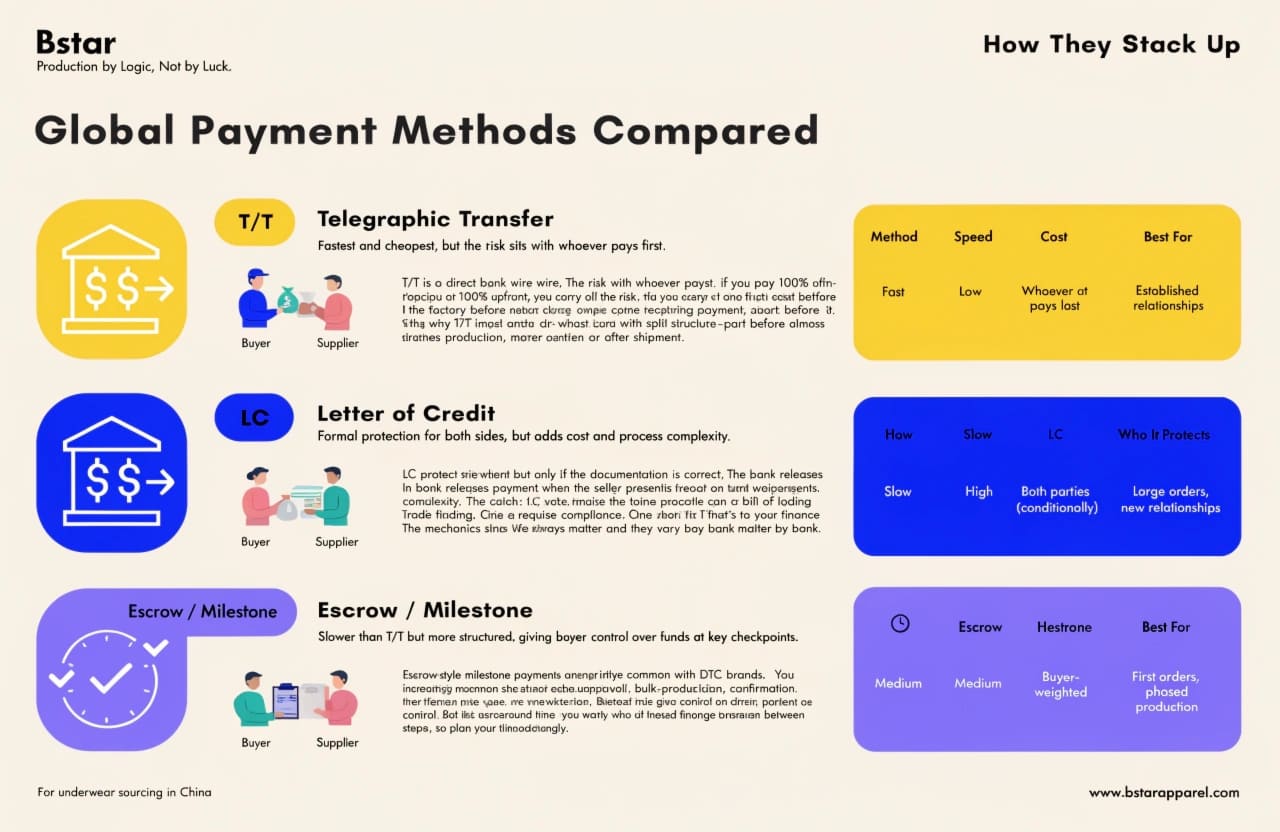
The most common methods in international underwear sourcing are T/T (telegraphic transfer), Letter of Credit (LC), and escrow-style milestone payments1. T/T is the fastest and cheapest. LC offers the most formal protection but adds cost and process complexity. Escrow sits in the middle—slower than T/T but more structured.
What Each Method Actually Protects Against
Most buyers pick a payment method based on what they have heard, not what they need. That is a problem.
T/T (Telegraphic Transfer) is a direct bank wire. It is fast and simple. The risk sits with whoever pays first. If you pay 100% upfront, you carry all the risk. If the factory ships before receiving full payment, they carry it. That is why T/T almost always comes with a split structure—part before production, part before or after shipment.
| Method | Speed | Cost | Who It Protects | Best For |
|---|---|---|---|---|
| T/T | Fast | Low | Whoever pays last | Established relationships |
| Letter of Credit | Slow | High | Both parties (conditionally) | Large orders, new relationships |
| Escrow / Milestone | Medium | Medium | Buyer-weighted | First orders, phased production |
LC protects both sides—but only if the documentation is correct. The bank releases payment when the seller presents the right shipping documents. The catch: LCs require precise compliance. One wrong detail on the bill of lading can delay payment2. We always tell buyers who want to use LC: talk to your trade finance provider first. The mechanics matter and they vary by bank.
Escrow-style milestone payments are increasingly common with DTC brands. You release funds at defined checkpoints—pre-production sample approval, bulk production sign-off, shipment confirmation. This gives you control. But it also adds turnaround time between each step, so plan your timeline accordingly.
Structuring Payment Terms: What Does a Balanced Split Actually Look Like?
"30% deposit, 70% before shipment" is the default you will hear most often. But is it actually balanced?
A typical first-order structure from a China-based factory runs 30% deposit at order confirmation and 70% before shipment3. Returning buyers with established order history may negotiate 30/70, 50/50, or milestone-based structures depending on order volume and relationship stage.
Why Trust Stage Changes the Numbers
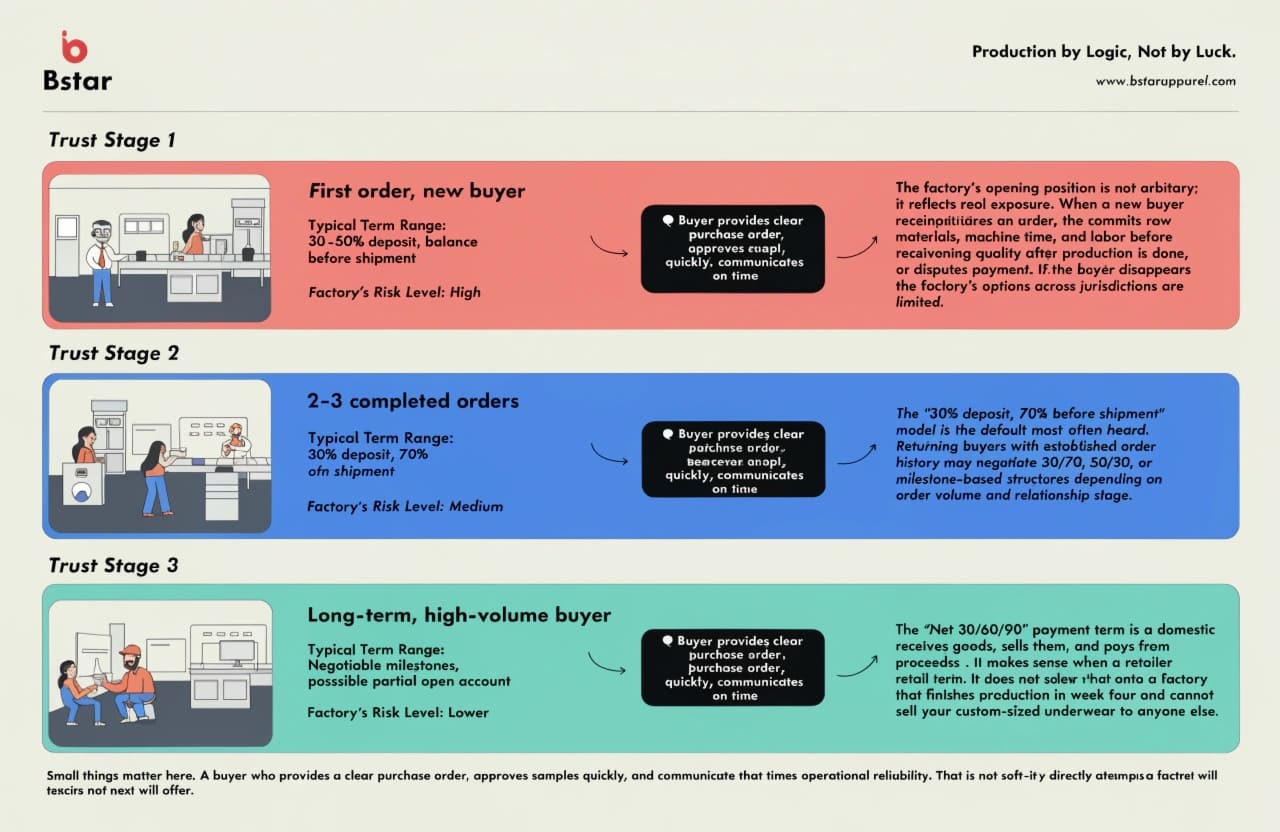
In our experience handling first-time international orders, the factory’s opening position is not arbitrary. It reflects real exposure.
When a new buyer places an order, the factory commits raw materials, machine time, and labor before receiving full payment. If the buyer disappears or disputes quality after production is done, the factory’s options across jurisdictions are limited4. That is the asymmetry that Net 30 or Net 60 buyers do not always see5.
Net 30/60/90 is a domestic retail term. It makes sense when a retailer receives goods, sells them, and pays from proceeds. It does not map cleanly onto a factory that finishes production in week four and cannot sell your custom-sized underwear to anyone else.
| Trust Stage | Typical Term Range | Factory’s Risk Level |
|---|---|---|
| First order, new buyer | 30–50% deposit, balance before shipment | High |
| 2–3 completed orders | 30% deposit, 70% after inspection or on shipment | Medium |
| Long-term, high-volume buyer | Negotiable milestones, possible partial open account | Lower |
The question is not "how do I get better terms." The question is "how do I lower the factory’s perceived risk?" Those are different questions, and they lead to different conversations.
Small things matter here. A buyer who provides a clear purchase order, approves samples quickly, and communicates on time signals operational reliability. That is not soft—it directly affects what terms a factory will offer on the next order.
Managing Currency & Hidden Costs: What Actually Eats Your Budget?
The invoice says one number. Your bank account says another. The gap is not a mistake—it is a cost you did not plan for.
Currency exchange rates, international wire fees, and intermediary bank charges are real costs in cross-border sourcing. On a USD-denominated order paid from a EUR or GBP account, the combined impact of rate spread and transfer fees can add 1–3% to your effective cost6 if you do not plan for it.
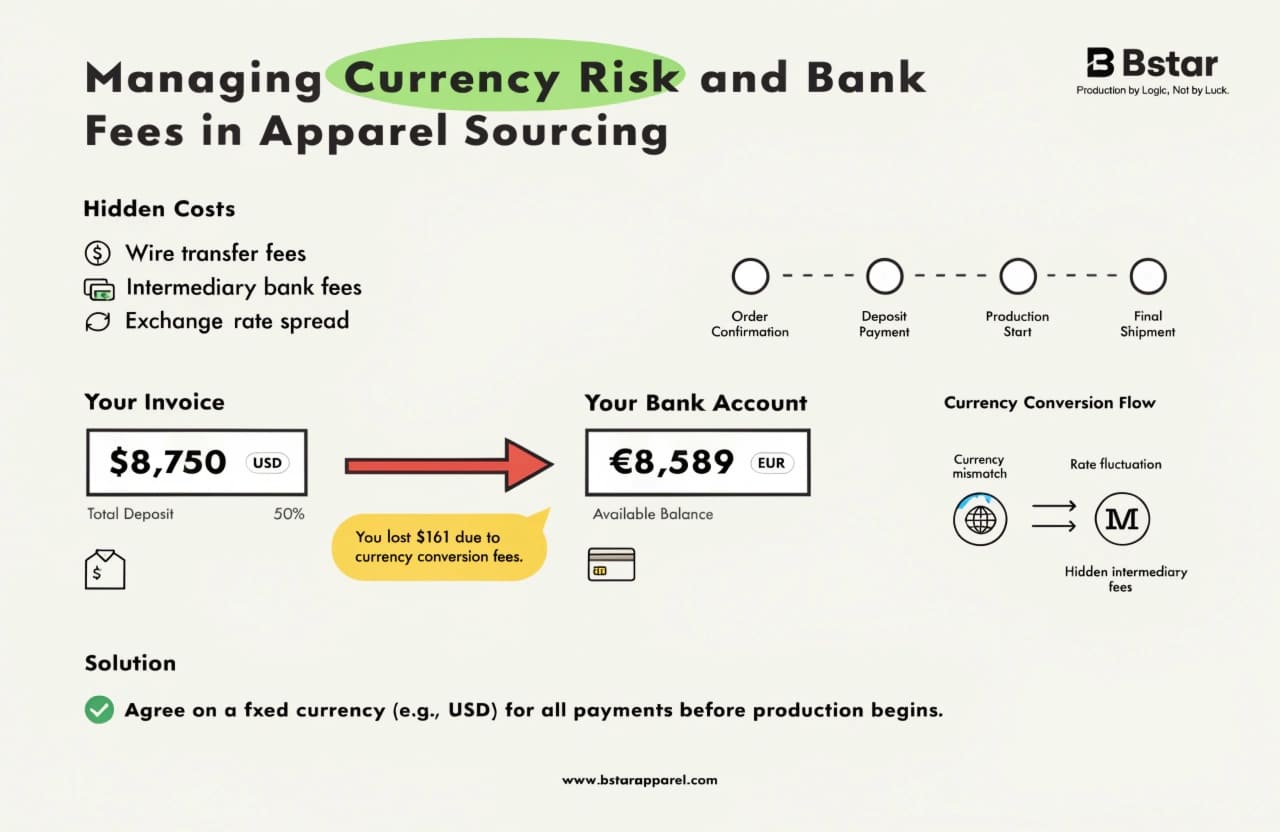
The Costs Most First-Time Buyers Miss
We see this pattern often with European DTC buyers. They confirm a price, wire the deposit, and then realize the exchange rate moved between quote and payment. Or they get hit by an intermediary bank fee they did not expect.
Here is a basic breakdown of what to watch:
| Cost Type | Typical Range | Notes |
|---|---|---|
| Wire transfer fee | $15–$50 per transaction | Charged by your bank |
| Intermediary bank fee | $10–$30 per transaction | Not always disclosed upfront |
| Exchange rate spread | 0.5–2% | Depends on your bank or FX provider |
| Rate fluctuation | Variable | Can move significantly over a 60-day production cycle |
A few things that help: get your invoice in a fixed currency (usually USD) and agree on it before production starts. If your order has multiple payment stages, consider using a dedicated FX provider instead of a standard bank wire—the rate difference adds up across a full order. And build a small buffer into your landed cost calculation from day one.
None of this is complicated. It just requires you to ask the question before you wire the deposit, not after.
Mitigating Sourcing Risks: How Do You Vet a Factory and Protect the Order?
Better payment terms do not matter if the factory cannot deliver. Vetting and contractual structure are part of the same risk management picture.
The most effective risk mitigation in international underwear sourcing combines supplier vetting (certifications, audit history, reference orders), clear contractual terms (tech pack, quality standards, delivery schedule), and practical safeguards like phased shipments and trade insurance for high-value orders.
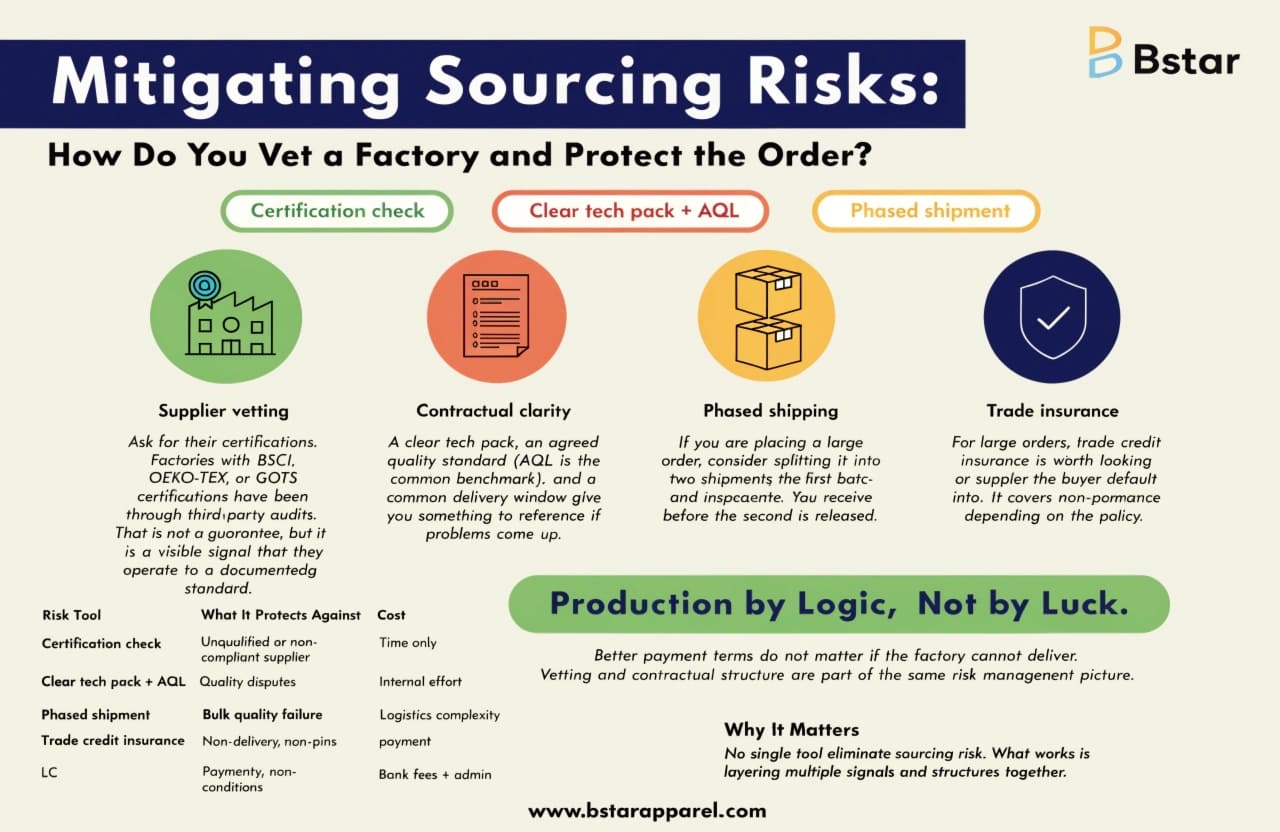
Building a Risk Stack That Actually Works
No single tool eliminates sourcing risk. What works is layering multiple signals and structures together.
Supplier vetting starts before any negotiation. Ask for their certifications. Factories with BSCI, OEKO-TEX, or GOTS certifications have been through third-party audits7. That is not a guarantee, but it is a visible signal that they operate to a documented standard. Ask for photos of the factory floor. Ask which brands they have shipped to. A factory that regularly exports to European or North American buyers understands compliance documentation.
Contractual clarity protects you more than payment terms alone. A clear tech pack, an agreed quality standard (AQL is the common benchmark8), and a defined delivery window give you something to reference if problems come up. Vague agreements create vague disputes.
Phased shipments are underused by first-time buyers. If you are placing a large order, consider splitting it into two shipments. You receive and inspect the first batch before the second is released. This adds some logistics complexity but significantly reduces your exposure9 on a new relationship.
Trade credit insurance is worth looking into for large orders. It covers buyer default or supplier non-performance depending on the policy. We are not insurance advisors—talk to a trade finance provider—but for orders above a certain value, the premium can be small relative to the protection.
| Risk Tool | What It Protects Against | Cost |
|---|---|---|
| Certification check | Unqualified or non-compliant supplier | Time only |
| Clear tech pack + AQL | Quality disputes | Internal effort |
| Phased shipment | Bulk quality failure | Logistics complexity |
| Trade credit insurance | Non-delivery, non-payment | Premium cost |
| LC | Payment release conditions | Bank fees + admin |
The negotiation around all of this is not adversarial. In our experience, buyers who come prepared—who know what they are asking for and why—move through the process faster. Factories extend better terms not from generosity but from reduced risk. If you show up as a low-risk buyer, you get treated like one.
Conclusion
Payment terms are a risk conversation, not a pricing battle. Know your trust stage, plan for hidden costs, and build your protections in layers before you wire anything.
-
"Methods of Payment – International Trade Administration", https://www.trade.gov/methods-payment. The International Chamber of Commerce and World Trade Organization trade finance surveys document the relative prevalence of open account, documentary credit, and bank-intermediated payment instruments in cross-border goods transactions, providing context for the claim that these three methods dominate international sourcing. Evidence role: general_support; source type: institution. Supports: That T/T, LC, and escrow-style payments are the predominant instruments used in international manufacturing trade. Scope note: Available surveys typically cover all goods trade rather than apparel or underwear sourcing specifically, so sector-level prevalence figures may not be directly available. ↩
-
"[PDF] Letters of Credit and the Computerization of Maritime Trade", https://scholarship.law.ufl.edu/cgi/viewcontent.cgi?article=1130&context=fjil. The ICC Banking Commission has reported in successive trade finance surveys that a substantial proportion of first-presentation LC documents contain discrepancies, frequently involving shipping documents such as bills of lading, which can trigger payment delays or refusals under UCP 600 rules. Evidence role: statistic; source type: institution. Supports: That documentary discrepancies in LC presentations are common and result in delayed or refused payment. Scope note: Specific discrepancy rates vary by survey year and region; the figures reflect global banking practice rather than apparel-sector transactions exclusively. ↩
-
"What Are The Payment Terms For Clothing Manufacturers?", https://shanghaigarment.com/what-are-the-payment-terms-for-clothing-manufacturers/. Reports from the International Trade Centre and industry sourcing guides document deposit-based payment structures as the norm for new buyer–supplier relationships in Chinese manufacturing, with advance payments typically ranging from 30–50% of order value, reflecting supplier risk exposure prior to full payment. Evidence role: general_support; source type: institution. Supports: That a 30% upfront deposit with the balance due before shipment is a widely observed payment structure for first-time orders with Chinese manufacturers. Scope note: Publicly available data on exact split percentages is largely anecdotal or survey-based rather than derived from comprehensive transaction records, so the 30/70 figure represents a common benchmark rather than a statistically verified standard. ↩
-
"[PDF] CROSS-BORDER CONTRACTING", https://iicl.law.pace.edu/sites/default/files/cisg/cross-border_contracting.pdf. World Bank Doing Business indicators and UNCITRAL research on cross-border contract enforcement document that enforcing commercial judgments across jurisdictions involves substantial cost, time, and procedural complexity, particularly for SME suppliers in developing economies pursuing claims against buyers in different legal systems. Evidence role: mechanism; source type: institution. Supports: That suppliers in manufacturing countries face significant practical and legal barriers to enforcing payment claims against foreign buyers who default. Scope note: Enforcement difficulty varies considerably by country pair and contract structure; the general principle of limited recourse is well-supported, but the specific context of Chinese apparel factories and their buyer relationships is not always directly addressed in available legal research. ↩
-
"Trade Finance Guide – International Trade Administration", https://www.trade.gov/report/trade-finance-guide. Academic literature on supply chain finance and buyer–supplier power dynamics, including work published by the World Bank and academic journals on trade credit, documents how open-account payment terms transfer working capital risk to suppliers and are less viable when goods are custom-produced and jurisdictional enforcement is limited. Evidence role: mechanism; source type: research. Supports: That open-account net terms common in domestic retail are structurally misaligned with the risk profile of international manufacturing relationships. Scope note: The specific claim about underwear or apparel manufacturing is an application of a general principle; direct empirical studies on net-term adoption rates in apparel sourcing are limited. ↩
-
"[PDF] Measuring the Cost of Cross-Border Business-to-Business …", https://fastpayments.worldbank.org/sites/default/files/2025-08/B2B%20Payment%20Costs%20in%20Western%20Balkans_2025.pdf. The World Bank’s Remittance Prices Worldwide database and BIS research on cross-border payment costs document that total transaction costs for international transfers—including FX margin and correspondent bank fees—commonly range from 1–3% for non-retail business payments, though costs vary by corridor, bank, and transaction size. Evidence role: statistic; source type: institution. Supports: That the combined cost of exchange rate spread and wire transfer fees on cross-border business payments typically falls in the 1–3% range. Scope note: Available cost data is most granular for consumer remittances; business-to-business trade payment cost data is less systematically published, making the 1–3% figure an approximation rather than a precisely sourced benchmark. ↩
-
"Oeko-Tex – Wikipedia", https://en.wikipedia.org/wiki/Oeko-Tex. The Global Organic Textile Standard (GOTS), OEKO-TEX Association, and amfori BSCI each publish certification and audit methodology documentation confirming that certification requires on-site inspection by accredited third-party bodies, covering social compliance, chemical safety, or organic fiber chain-of-custody respectively. Evidence role: definition; source type: institution. Supports: That BSCI, OEKO-TEX, and GOTS certifications require third-party audits of manufacturing facilities. Scope note: Audit scope and rigor differ substantially across the three schemes; BSCI audits social compliance while OEKO-TEX and GOTS focus on chemical and organic standards, so treating them as equivalent signals of overall factory quality has limitations. ↩
-
"[PDF] ISO 2859-1 – UNT Chemistry Department", https://chemistry.unt.edu/~tgolden/courses/iso2859-1.pdf. The ISO 2859-1 standard (Sampling procedures for inspection by attributes) defines the Acceptable Quality Level framework that underpins AQL-based garment inspection; its adoption as the de facto quality benchmark in apparel sourcing is documented in industry quality management literature and referenced in buyer compliance manuals across the sector. Evidence role: definition; source type: institution. Supports: That AQL is the widely adopted quality inspection standard in international apparel and textile manufacturing. Scope note: ISO 2859-1 defines the statistical methodology; its specific application thresholds (e.g., AQL 2.5 for major defects) are set by individual buyers or industry convention rather than mandated by the standard itself. ↩
-
"Risk assessment in supply chains: a state-of-the-art review of … – PMC", https://pmc.ncbi.nlm.nih.gov/articles/PMC9063627/. Supply chain risk management literature, including research published in journals such as the International Journal of Production Economics, identifies staged or phased delivery as a recognized mechanism for reducing buyer exposure to bulk quality failure, as it creates inspection checkpoints that limit the volume of non-conforming goods accepted before corrective action is possible. Evidence role: mechanism; source type: research. Supports: That splitting large orders into phased shipments reduces buyer financial exposure by enabling quality inspection before committing to full order release. Scope note: Empirical studies quantifying the specific risk reduction from phased versus single shipments in apparel sourcing are limited; the mechanism is theoretically well-grounded but the claim of ‘significant’ reduction is qualitative rather than empirically calibrated. ↩
Discussion & questions 0 comments