
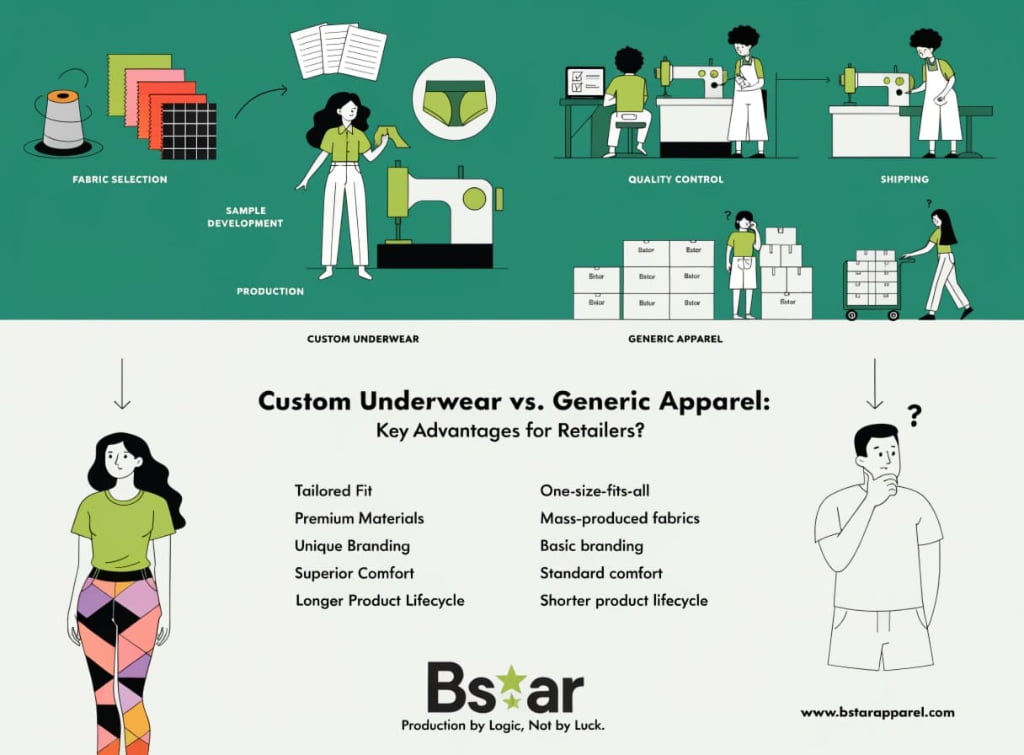
There’s a problem most DTC brand founders hit at the same point. You’ve found a white-label supplier, the product looks fine, but customers buy once and don’t come back. Sound familiar?
Custom underwear gives retailers control over fit, fabric, and brand identity in a way generic sourcing cannot. For DTC brands targeting a specific customer, that control is what drives repeat purchases — not just a logo on the waistband.
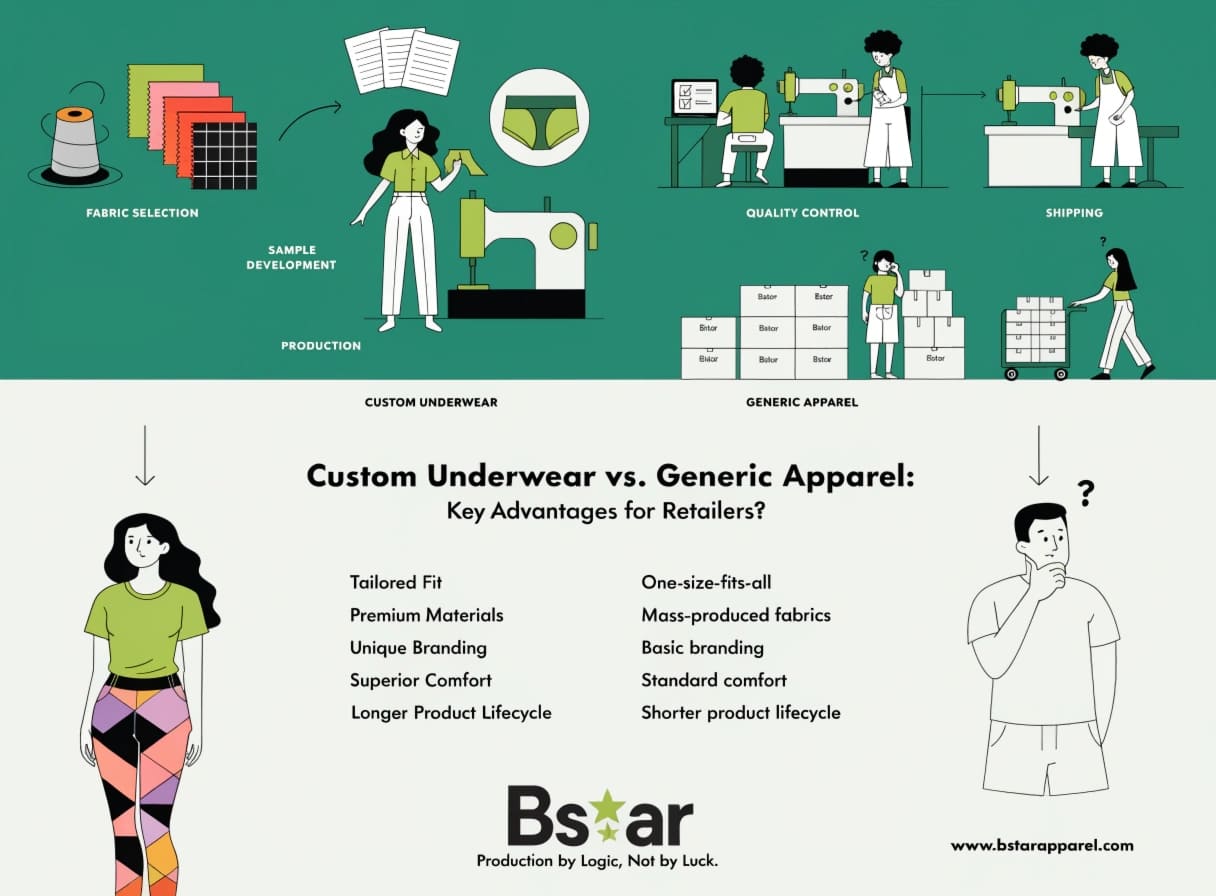
I want to be honest with you upfront. Custom underwear is not the right move for every brand at every stage. But if you’re a DTC founder who’s already selling and wondering why customers aren’t coming back, or you’re planning a first private-label launch and want to avoid the most common money-wasting mistakes — this article is for you. Let me walk through what I’ve actually seen in the projects we’ve handled at BSTAR, and let you decide if this path makes sense for your situation.
Differentiation Through Design: Building a Unique Brand Identity in a Saturated Market?
You’ve seen the problem. You search "men’s underwear" on any major platform and the first three pages look identical. Same cuts, same neutral colors, same generic brand voice1. How do you compete with that?
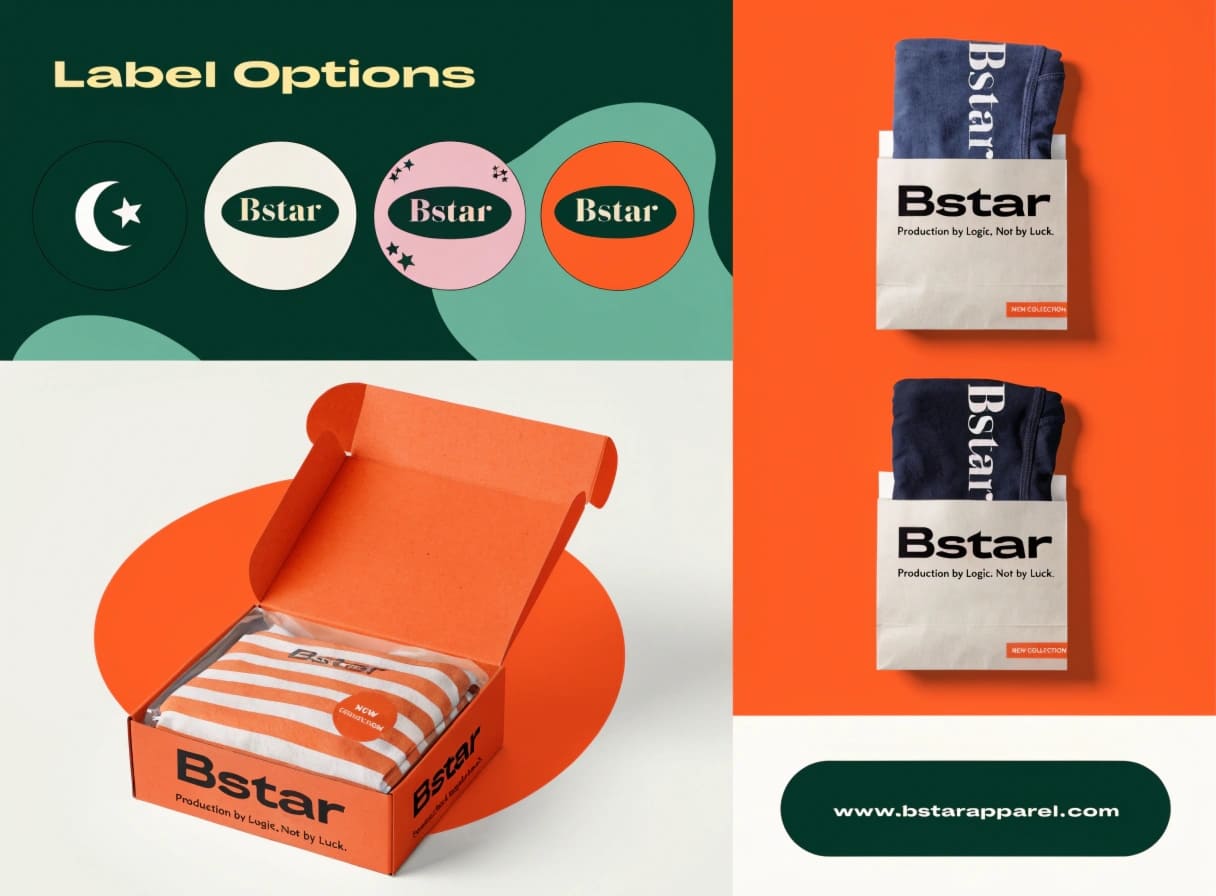
Custom underwear lets you own the full visual and tactile identity of your product — colorway, fabric texture, label design, packaging — so your product looks and feels different before a customer even tries it on.
The most damaging misconception I run into is this: "We just want to add our logo to a basic product." That thinking will cost you customers.
Here’s what I mean. When a brand comes to us for the first time, they sometimes assume custom means screen-printing their name on a white-label pair of boxers. But custom development actually means deciding the cut, the waistband height, the color palette, the fabric hand-feel, and the packaging — all of it. Those decisions are what make a product feel like yours and not like something a customer could find cheaper on Amazon.
Let me break down what brand differentiation actually looks like in practice:
| Element | Generic Product | Custom Product |
|---|---|---|
| Colorway | Supplier’s standard options | Brand-defined seasonal palette |
| Label & Packaging | Generic or basic print | Fully designed, brand-consistent |
| Fabric texture | Fixed by supplier’s stock | Chosen for target customer feel |
| Cut & silhouette | Average market block | Designed for your specific demographic |
The brands that stand out in saturated markets are the ones that made these decisions intentionally. In the projects we’ve run, the brands that treated underwear as a brand asset — not just a commodity — were the ones that generated word-of-mouth2. From our production side, that usually starts with a single focused decision: what does this product need to feel like when the customer opens the package?
Superior Fit and Comfort: How Tailored Specifications Enhance Customer Satisfaction and Retention?
Here’s something that comes up in almost every first project conversation we have. The brand founder says they want a great logo, great packaging, great colorways. Then about twenty minutes in, we start talking about the fit block — and that’s where the real work begins.
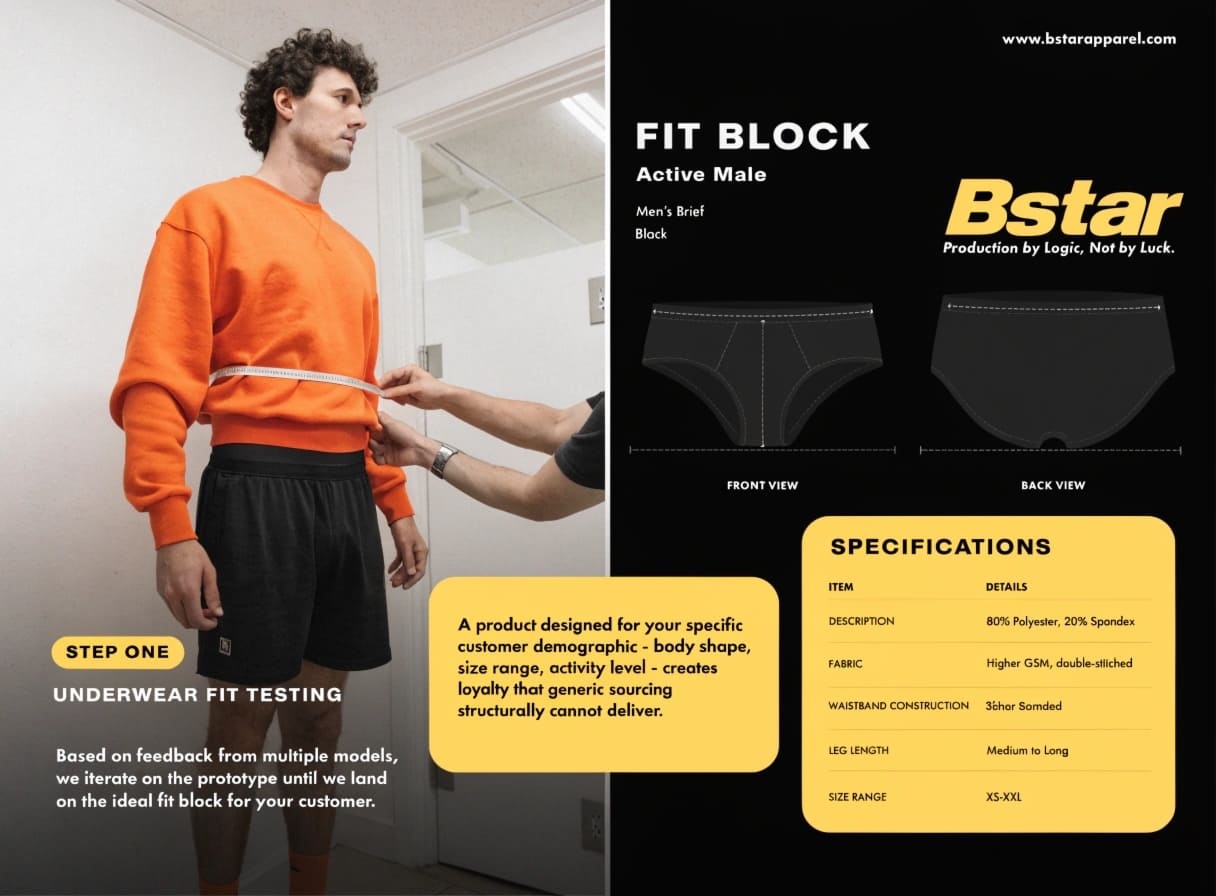
Fit is the single most defensible advantage in custom underwear. A product designed for your specific customer demographic — body shape, size range, activity level — creates loyalty that generic sourcing structurally cannot deliver.
Generic underwear is built for average. That’s not a criticism — it’s just commercial reality. A generic supplier designs one block that fits an acceptable range. But "acceptable" is not the same as "designed for you."
Take STEP ONE in Australia as an example. When we worked on their development, the early conversations were almost entirely about fit — specifically how the product needed to perform for an active male customer in the Australian market. That’s a different starting point than taking a standard block and printing a logo on it. The fit brief shaped the fabric weight, the waistband construction, and the leg length. Each of those decisions reduced a specific complaint that a generic product would have left unresolved.
This is why fit customization is a business argument, not just a comfort argument:
| Customer Pain Point | Generic Product Response | Custom Product Response |
|---|---|---|
| Waistband rolldown during activity | No change — fixed spec | Higher-GSM waistband added3 |
| Sizing inconsistency across runs4 | Supplier-controlled | Brand-controlled spec sheet |
| Poor fit for specific body type | Not addressed | Block designed for target demo |
| Customer returns fit-related | Absorbed as cost | Reduced through proto iteration |
Yes, getting the fit right takes iteration. A proto, a fit test, adjustments, sometimes a second proto. That process costs time and money upfront. But consider the alternative: a generic product that generates fit-related returns5 and one-time customers. From our side, the brands that invest in fit testing early almost always scale more confidently6 because they know what they’re reordering.
Optimizing Profit Margins: The Financial Benefits of Private Labeling Over Reselling Generic Brands?
Let’s talk about the commercial side, because this is where a lot of DTC founders are surprised.
When you resell a generic or white-label product, the margin ceiling is set by someone else7. The supplier sets the base price, the market sets the retail ceiling, and you’re working in whatever’s left.
Private-label underwear removes a margin layer from the equation. When you own the specification, you control the cost inputs and the retail positioning — which means you set the price ceiling, not the supplier.
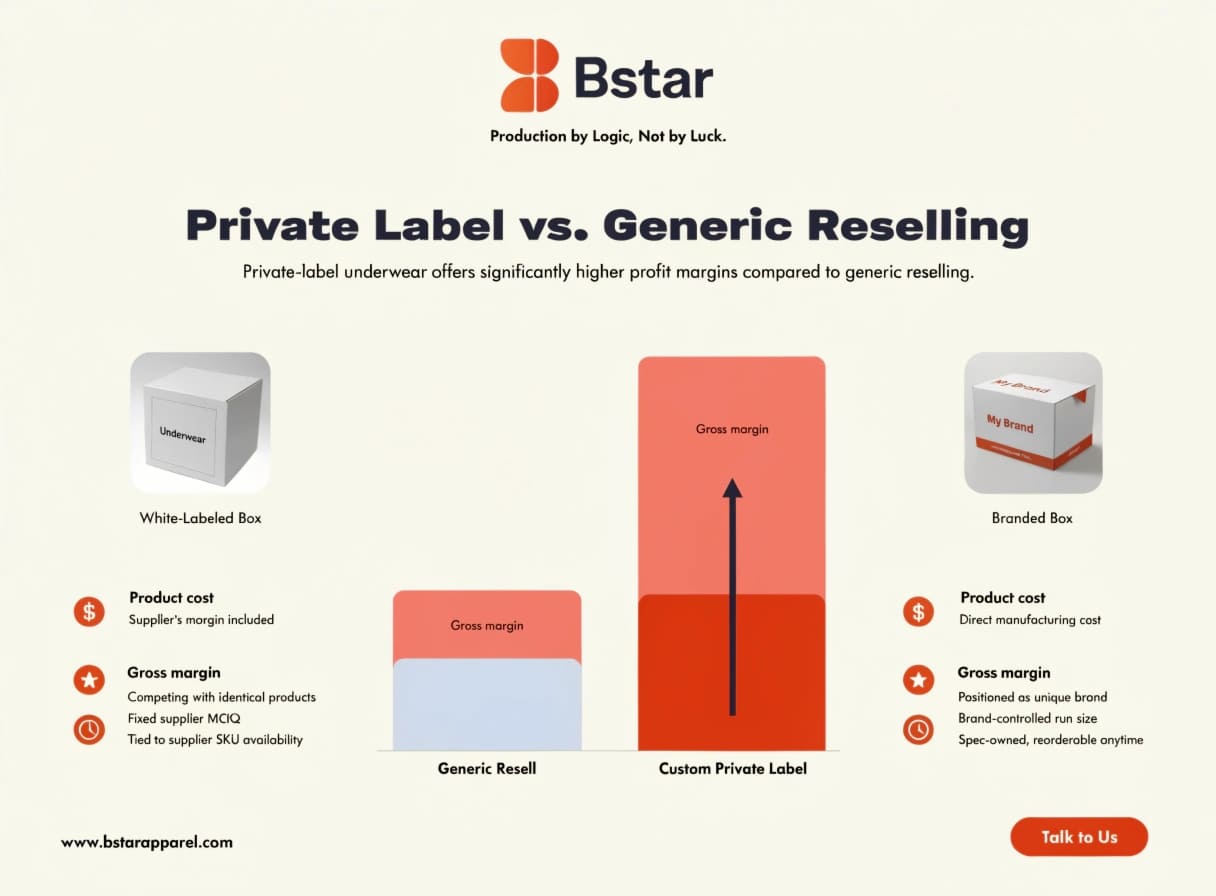
Here’s how the math looks structurally — not exact numbers, because every project is different, but the logic holds:
| Cost Factor | Generic Resell | Custom Private Label |
|---|---|---|
| Product cost | Supplier’s margin included | Direct manufacturing cost |
| Retail positioning | Competing with identical products | Positioned as unique brand |
| Reorder flexibility | Fixed supplier MOQ | Brand-controlled run size |
| Inventory risk | Tied to supplier SKU availability | Spec-owned, reorderable anytime |
The other piece that doesn’t get talked about enough is inventory discipline. When you own the specification, you control when and how much you reorder. You’re not locked into a supplier’s SKU minimums or forced to over-buy because they’re discontinuing a colorway. That control reduces dead stock — one of the biggest margin killers for early-stage DTC brands8.
I’ll be direct about the cost of entry. Early-stage custom development includes proto costs, fit iteration, and an initial run that might be smaller than you’d like. Those are real costs. But they’re one-time learning investments, not recurring margin losses. A generic product that doesn’t retain customers costs you more over time, just less visibly.
Agility and Control: Adapting Quickly to Trends with Custom Fabric and Feature Selection?
Here’s the scenario I see brands get stuck in. A trend moves — a color, a silhouette, a fabric type — and the brand is locked into existing inventory or supplier availability9. By the time they react, the moment has passed.
Custom development gives you supply chain agility. When you own the spec, you can adjust fabric, color, or features at the reorder stage — without starting over from scratch.
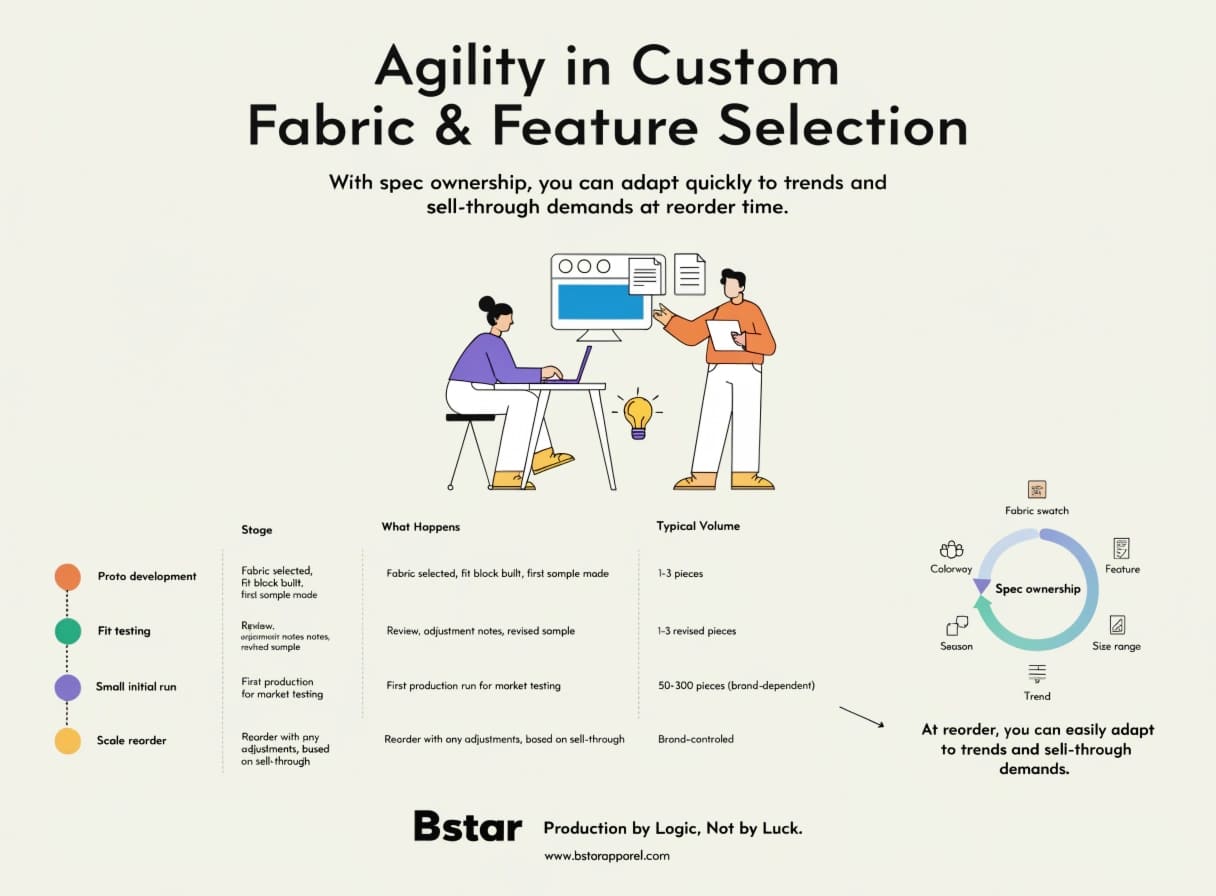
This matters more than most brands realize at the evaluation stage. Let me explain why through how the development pathway actually works:
The Development Pathway: Proto to Scale
Most brands self-disqualify from custom development because they assume "custom" means massive MOQs from day one. That’s not how it works in practice. The actual path looks like this:
| Stage | What Happens | Typical Volume |
|---|---|---|
| Proto development | Fabric selected, fit block built, first sample made | 1–3 pieces |
| Fit testing | Review, adjustment notes, revised sample | 1–3 revised pieces |
| Small initial run | First production run for market testing | 50–300 pieces (brand-dependent) |
| Scale reorder | Reorder with any adjustments, based on sell-through | Brand-controlled |
Once you’re past the proto stage, you own the specification. That means when you want to add a new colorway for summer, you’re not starting a new product — you’re running the same spec in a new color. When a fabric trend changes, you can test a new material on the next small run without committing to warehouse-filling quantities.
From our production side, brands that build this kind of spec ownership early are the ones that move fastest when market conditions change. They’re not waiting for a supplier to update their standard range. They’re making the call themselves.
What Supply Chain Control Actually Gives You
- Reorder on your timeline, not the supplier’s discontinuation schedule10
- Test new features (new waistband style, new inseam length) in small runs before committing
- Respond to customer feedback with a real product change, not just a customer service reply
- Hold less inventory because you can reorder smaller, more frequently
This is the commercial control argument for custom development. It’s not about logistics — it’s about staying competitive without over-investing in inventory at any single point.
Conclusion
Custom underwear isn’t universally better than generic. But if you’re building a DTC brand that needs repeat customers, margin control, and supply chain flexibility — it’s the structure that makes all three possible.
-
"Determinants of consumer attitudes and re-purchase intentions …", https://pmc.ncbi.nlm.nih.gov/articles/PMC7829058/. Market analyses of the men’s innerwear segment have documented high SKU density and limited product differentiation among mass-market offerings, contributing to price-driven competition rather than brand-driven loyalty. Evidence role: general_support; source type: research. Supports: The degree of product homogeneity and competitive saturation in the men’s underwear or basics apparel category. Scope note: Most available market reports are produced by commercial research firms and may reflect category-level trends rather than platform-specific search result composition ↩
-
"[PDF] Effects of Word-of-Mouth Versus Traditional Marketing", https://www.anderson.ucla.edu/documents/areas/fac/marketing/bucklin_effects.pdf. Research in consumer behavior has found that product experiences perceived as distinctive or emotionally resonant are more likely to be shared through word-of-mouth, with brand identity coherence identified as a moderating factor in referral likelihood. Evidence role: mechanism; source type: paper. Supports: That distinctive product experiences and strong brand identity are positively associated with consumer word-of-mouth behavior. Scope note: Most studies examine word-of-mouth in general consumer goods contexts; direct evidence specific to the innerwear category is limited ↩
-
"Fabric Weight Guide: 7 Must-Know GSM Myths in … – Tris Apparel", https://trisapparel.com/fabric-weight-guide-gsm-durability/. Textile and performance apparel engineering literature has examined the relationship between fabric weight, elastic composition, and waistband structural integrity, finding that higher-density constructions generally exhibit greater resistance to deformation under repeated mechanical stress such as that encountered during physical activity. Evidence role: mechanism; source type: research. Supports: That waistband fabric weight and construction specifications influence the stability and rolldown resistance of underwear waistbands during movement. Scope note: Direct experimental studies on GSM as an isolated variable for waistband rolldown in underwear are limited; most evidence is drawn from broader performance apparel or elastic fabric research ↩
-
"[PDF] The Influence of Self-Construal on Consumer Responses to Sizing …", https://scholarworks.utrgv.edu/cgi/viewcontent.cgi?article=1055&context=marketing_fac. Quality management research in apparel manufacturing has documented that dimensional tolerances in garment production can vary significantly between production runs when specifications are supplier-controlled rather than buyer-specified, contributing to consumer-perceived sizing inconsistency. Evidence role: general_support; source type: research. Supports: That apparel produced without brand-controlled specification sheets is subject to dimensional variation across production runs, resulting in inconsistent fit for consumers. Scope note: Published tolerance data typically addresses industrial standards rather than the specific context of white-label underwear sourcing ↩
-
"Determinants of consumer attitudes and re-purchase intentions …", https://pmc.ncbi.nlm.nih.gov/articles/PMC7829058/. Consumer surveys and logistics research have consistently identified fit and sizing as the primary reason for apparel returns in e-commerce, with some studies estimating that fit-related returns account for the majority of all clothing returns in direct-to-consumer channels. Evidence role: statistic; source type: research. Supports: That fit and sizing issues are among the leading causes of product returns in apparel e-commerce. Scope note: Published figures vary by category and channel; innerwear-specific return rate data is less commonly disaggregated from broader apparel statistics ↩
-
"Navigating new product development: Uncovering factors and …", https://pmc.ncbi.nlm.nih.gov/articles/PMC10788447/. New product development research has consistently found that front-loaded investment in prototype testing and iterative refinement reduces downstream failure rates and improves market performance, a finding that has been replicated across consumer goods categories including apparel. Evidence role: expert_consensus; source type: paper. Supports: That early-stage prototype testing and iterative refinement in product development is associated with improved commercial outcomes at scale. Scope note: The research base addresses new product development broadly; underwear-specific or innerwear-specific longitudinal scaling data is not widely published ↩
-
"[PDF] Private Label Introduction: Does it Benefit the Supply Chain?1", https://www.iese.edu/media/research/pdfs/DI-0832-E.pdf. Retail economics literature has documented that private-label programs typically yield higher gross margins than equivalent national-brand or generic resale, attributable to the elimination of supplier brand premiums and greater control over cost inputs and retail price positioning. Evidence role: mechanism; source type: research. Supports: That private-label product development enables higher gross margins compared to reselling branded or generic third-party goods by removing intermediary margin layers. Scope note: Margin advantage figures vary substantially by category, volume, and retailer scale; the comparison may not hold at the low-volume early-stage context described in the article ↩
-
"Retail’s Inventory Glut | Robert H. Smith School of Business", https://www.rhsmith.umd.edu/research/retails-inventory-glut. Operations management and retail finance research has identified excess inventory as a primary driver of margin erosion for small consumer goods brands, with carrying costs, storage fees, and forced markdowns collectively reducing effective gross margin on affected SKUs. Evidence role: statistic; source type: research. Supports: That unsold inventory represents a significant financial liability for small and early-stage consumer goods brands, eroding gross margins through carrying costs, markdowns, and write-offs. Scope note: Quantitative estimates of dead stock impact are typically drawn from broader retail studies and may not reflect the specific economics of low-MOQ DTC innerwear operations ↩
-
"Fast Fashion and its Effect on Retail Supply Chain Management", https://businessstories.sandiego.edu/fast-fashion-and-its-effect-on-retail-supply-chain-management. Supply chain management literature has identified supplier dependency and long replenishment lead times as key constraints on apparel brand responsiveness to trend shifts, with brands lacking specification ownership shown to face longer reaction cycles than vertically integrated or private-label operators. Evidence role: mechanism; source type: paper. Supports: That supply chain inflexibility and dependence on supplier-controlled SKUs reduces a brand’s ability to respond to market trend changes in a timely manner. Scope note: Most agility research focuses on large-scale fast-fashion retailers; applicability to small DTC brands with low MOQs involves extrapolation ↩
-
"Do private labels always benefit the supply chain? | IESE Insight", https://www.iese.edu/insight/articles/private-labels-benefit-supply-chain/. Supply chain risk management literature has identified single-source supplier dependency and lack of specification ownership as vulnerability factors for downstream brands, with supplier-initiated product changes or discontinuations documented as a source of unplanned inventory gaps and assortment disruption. Evidence role: mechanism; source type: research. Supports: That reliance on supplier-controlled product specifications exposes brands to inventory disruption risk when suppliers alter or discontinue SKUs. Scope note: Most supply chain risk research addresses larger-scale procurement contexts; the specific risk profile for small DTC brands sourcing low-MOQ generic apparel is less thoroughly studied ↩
Discussion & questions 0 comments