
How Do I Source High-Quality Fabrics for Men’s Boxers?
A boxer fabric can feel perfect on a swatch. Then reviews mention sagging, twisting, and heat. I avoid that by sourcing from real use cases first.
I source high-quality fabrics for men’s boxers by matching fiber, weight, knit structure, stretch, testing, finish, and supplier stability to the wearer’s daily needs. I never judge fabric by composition alone. I verify shrinkage, colorfastness, pilling, recovery, hand feel, and bulk consistency before production.
When I help a DTC brand develop men’s boxer briefs, I do not start with the question, “Which fabric is best?” I start with a better question. I ask how the customer will wear the product. Daily work wear needs comfort and shape. Gym use needs stronger recovery. Hot markets need breathability. Premium positioning needs a stable hand feel after washing. This is where many mistakes begin, so I want to break the sourcing process into simple checks that can protect fit, comfort, reviews, and repeat orders.
How Do I Select Fibers That Balance Modal, Cotton, and Performance Blends?
A soft fiber can still fail in daily wear. If I choose only by touch, I may create boxers that lose shape, trap heat, or age fast.
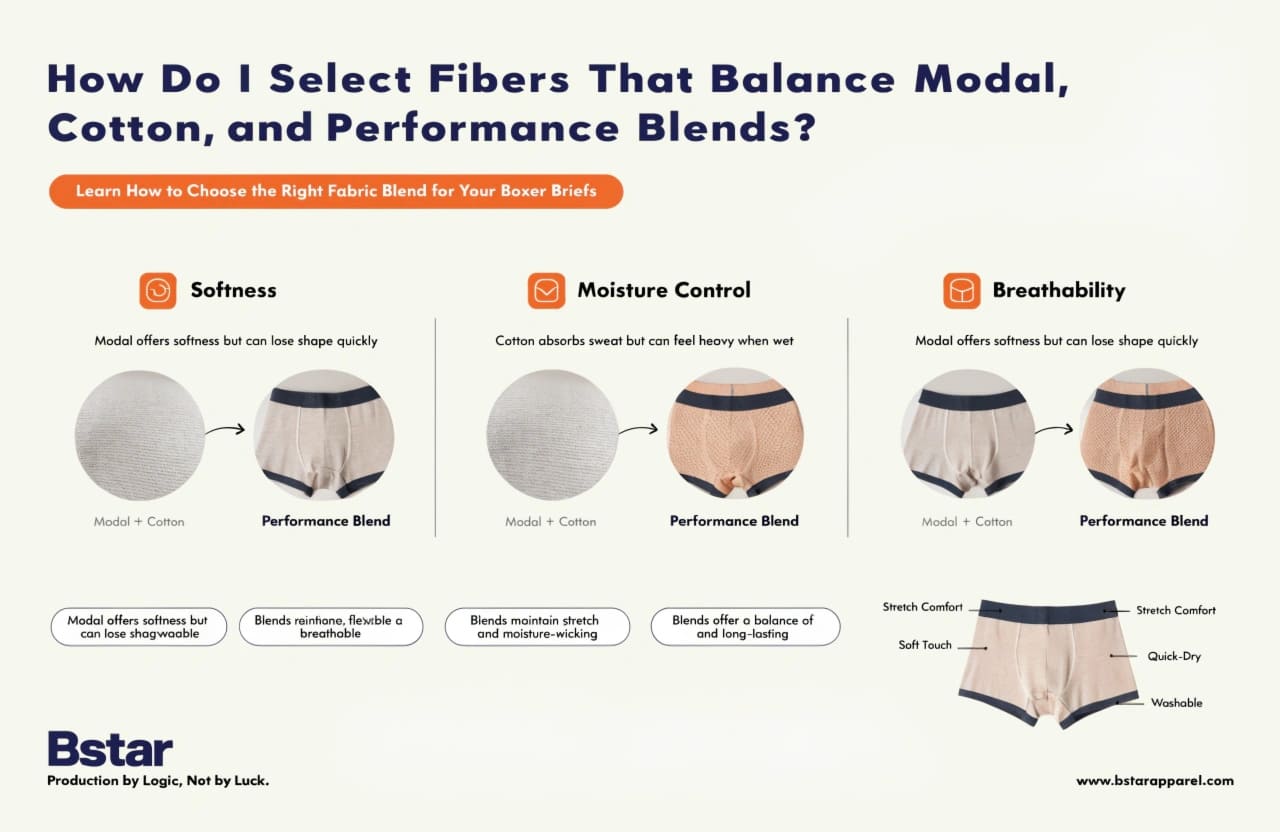
I choose fibers by matching softness, moisture control, breathability, support, price point, and washing needs. Modal, cotton, bamboo, and performance blends can all work, but I must confirm how each blend behaves in the final knit fabric.
I Start With The Wearing Scenario
In boxer brief projects, I see brands often fall in love with the softest sample. I understand that reaction. A soft swatch feels premium in the hand. Still, the wearer does not use a swatch. He wears a close-fit garment for many hours. The fabric must move, breathe, recover, and stay smooth after many washes.1
I do not treat modal, cotton, bamboo, or polyester blends as good or bad by name. I look at how the fiber works with yarn quality, fabric weight, knit structure, and spandex content. A modal blend can feel smooth and cool. A cotton blend can feel natural and familiar. A performance blend can dry faster and support active use.2 Each choice has a trade-off.
| Fabric Direction | What I Like | What I Must Verify |
|---|---|---|
| Modal blend | I like the smooth hand feel and drape | I check recovery, pilling, and shrinkage |
| Cotton blend | I like the natural touch and everyday appeal | I check softness after washing and shape stability |
| [Bamboo blend | I like the cool touch and comfort story | I check batch consistency and test documents](https://www.ftc.gov/bamboo-textiles)[^3] |
| Performance blend | I like moisture control and faster drying | I check hand feel and skin comfort |
I also connect fiber choice to brand position. A low-weight fabric may feel light, but it may look less premium after wear. A heavier fabric may feel rich, but it may feel warm in summer. I usually ask the brand to approve fabric by wearing trials, not by a desk review only. That small step helps reduce bad reviews later.
How Do I Read Fabric Specifications Like Yarn Count And Spandex Ratio?
A fabric spec sheet can look technical and safe. Still, if I read it too quickly, I may miss the reason a boxer bags out.
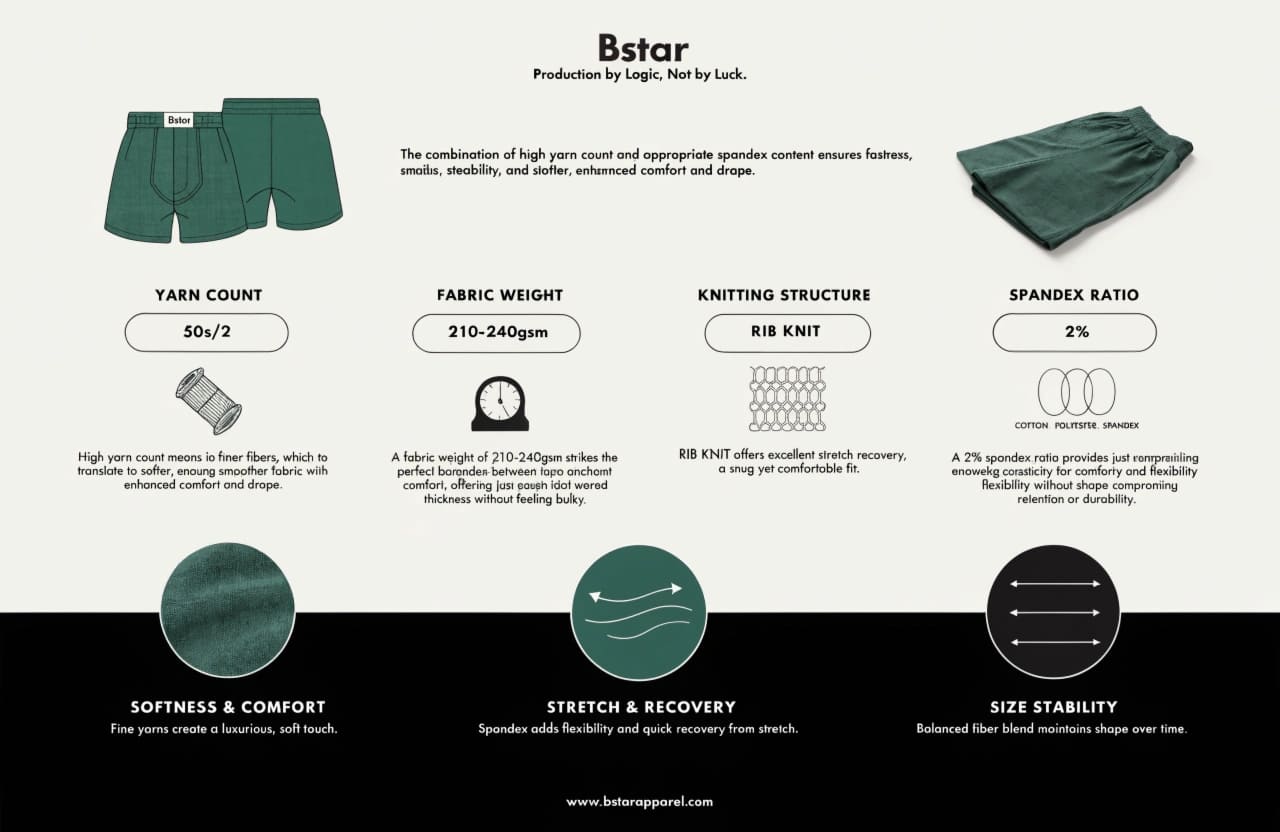
I read yarn count, fabric weight, knitting structure, and spandex ratio together. A good boxer fabric needs softness, enough stretch, strong recovery, stable size, and a hand feel that can survive bulk production and washing.
I Look Beyond Composition Percentages
Many new brands ask for “95% modal, 5% spandex” or “95% cotton, 5% spandex” because they saw that label in the market. I understand why. It feels like a clear formula. But in production, the same composition can feel very different. Yarn count, fiber grade, knitting tension, dyeing process, and finishing can change the final result.
Yarn count affects smoothness, density, and hand feel. Fabric weight affects coverage, drape, and durability. Spandex ratio affects stretch, but it does not guarantee recovery by itself.3 The fabric must return after being stretched. I also check whether the fabric twists, curls, or changes width after washing.
| Specification | Why I Check It | What Can Go Wrong |
|---|---|---|
| Yarn count | I use it to judge fineness and surface feel | The fabric may feel rough or weak |
| Fabric weight | I use it to balance coverage and breathability | The boxer may feel too thin or too hot |
| Spandex ratio | I use it to plan stretch and fit | The leg may loosen or squeeze too much |
| Knit structure | I use it to control movement and stability | The garment may twist or lose shape |
For boxer briefs, fit and fabric must be developed together. A high-stretch fabric may need a different pattern from a low-stretch fabric. A very soft fabric may need stronger waistband planning. If I approve fabric without checking the pattern, I may create comfort in the sample room and problems in the customer’s drawer. That is why I always connect fabric specs with sample fitting, wash testing, and bulk repeatability.
How Do I Evaluate Antibacterial And Cooling Finishes For Boxer Fabrics?
A finish can sound impressive on a product page. But if I cannot confirm its safety, durability, and hand feel, it may become a risk.
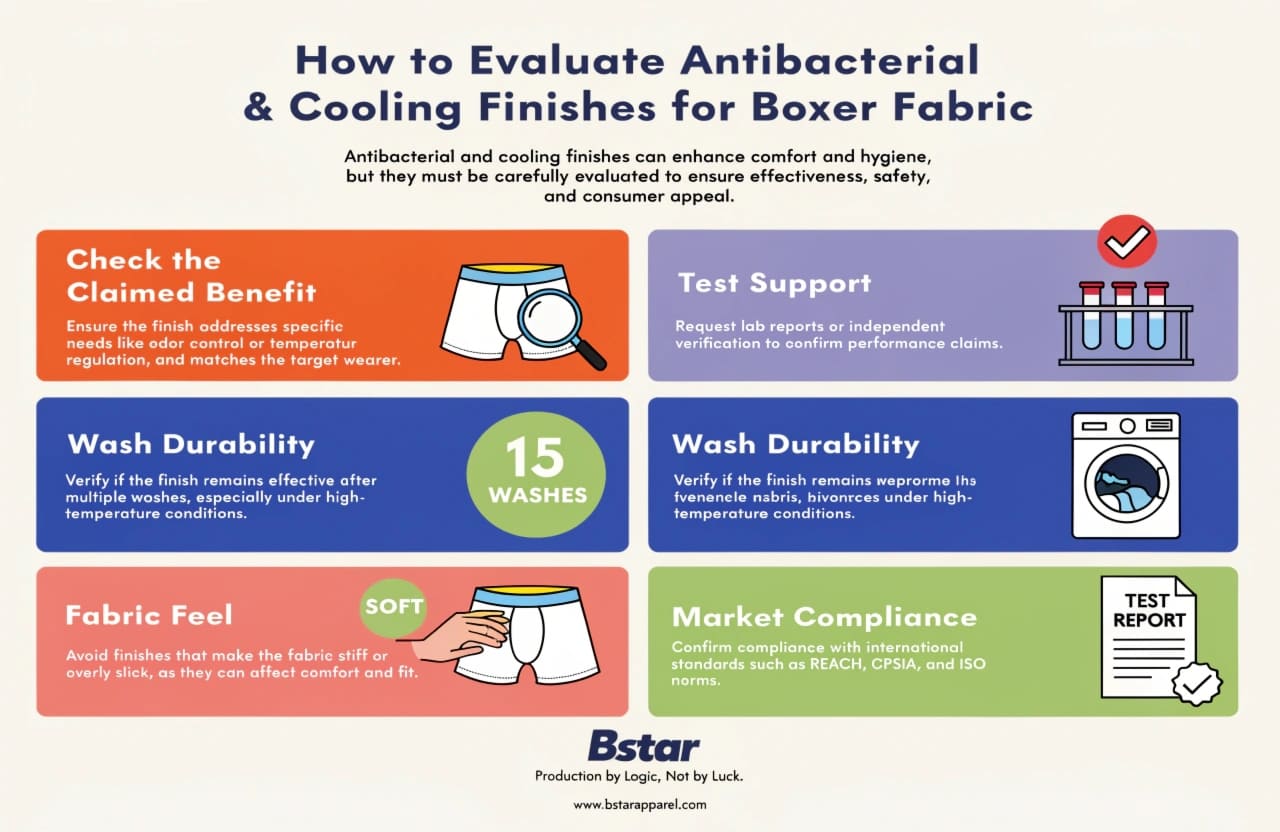
I evaluate functional finishes by checking the claimed benefit, testing support, wash durability, market compliance, and fabric feel. Antibacterial and cooling technologies should match the target wearer and must be verified for each project.
I Treat Claims As Something To Prove
In sampling and production discussions, I see more brands ask for antibacterial, cooling, moisture-wicking, or odor-control functions. These features can help a boxer brief stand out. They can also create confusion if the claim is vague. I do not reject functional finishes. I just treat every claim as something that needs proof.
A cooling hand feel can come from fiber choice, yarn structure, finishing, or a mix of these.4 Moisture-wicking can also depend on fabric surface, knit construction, and finishing.5 Antibacterial performance may need clear test support, and the needed standard can change by sales market.6 I avoid making broad promises before project-specific testing is confirmed.
| Function | What I Ask First | What I Verify Before Bulk |
|---|---|---|
| Cooling | I ask if the buyer wants touch cooling or wear comfort | I verify hand feel after washing |
| Moisture-wicking | I ask if it is for daily wear or sport use | I verify performance by project needs |
| Antibacterial | I ask what claim will be printed or marketed | I verify test documents and compliance needs |
| Odor control | I ask how strong the claim should be | I verify wash durability and safety support |
I also watch the effect on hand feel. Some finishes may make the fabric feel dry, slick, or less natural. Some finishes may change color shade or fabric stability. That matters for underwear because the garment touches skin all day. I prefer to compare finished and unfinished samples side by side.7 I also ask the brand to test the language used in marketing. A simple comfort claim is often safer than a strong technical claim that lacks support.8 The goal is not to add every feature. The goal is to add the right feature and prove it.
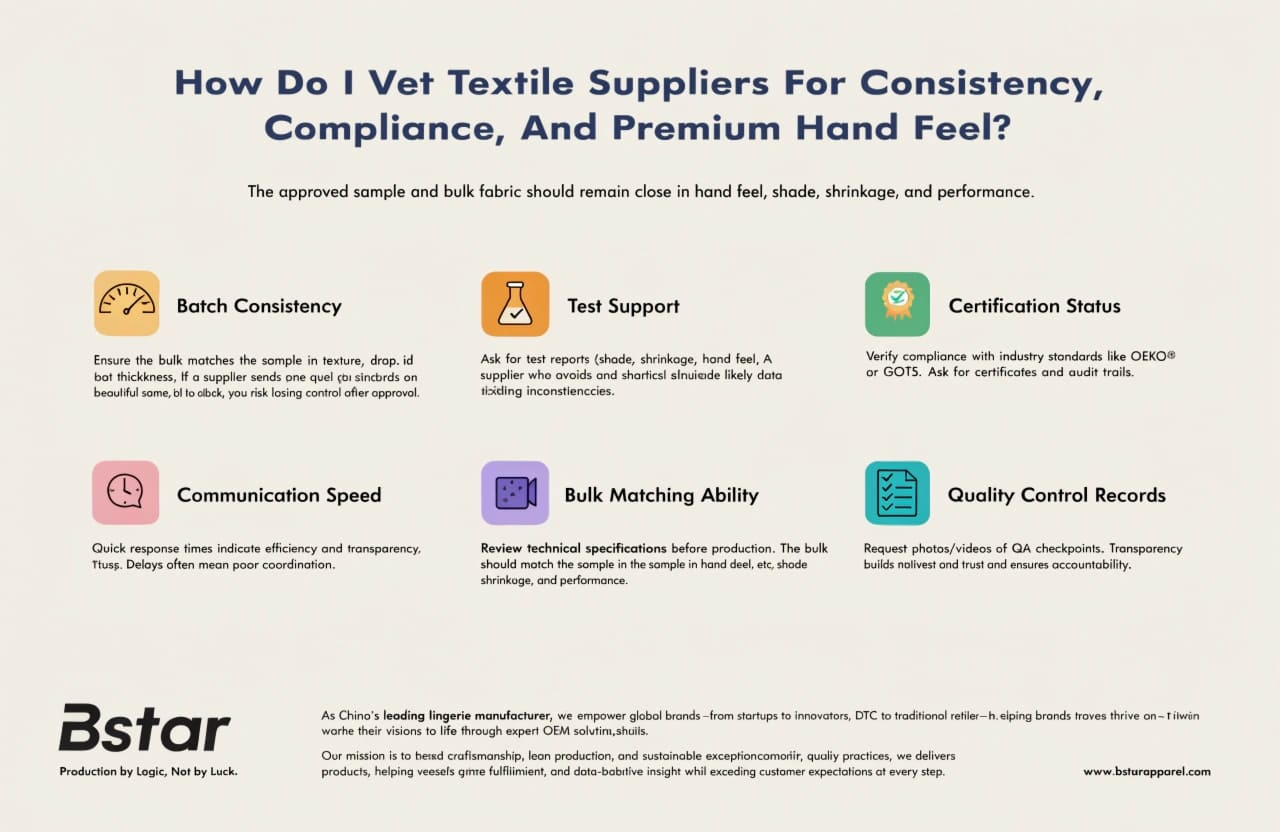
How Do I Vet Textile Suppliers For Consistency, Compliance, And Premium Hand Feel?
A supplier can send one beautiful sample and still fail in bulk. If I skip supplier checks, I may lose control after approval.
I vet textile suppliers by checking batch consistency, test support, certification status, communication speed, bulk matching ability, and quality control records. I need the approved sample and bulk fabric to stay close in hand feel, shade, shrinkage, and performance.
I Source For Repeat Orders, Not Only For One Sample
When I develop boxer briefs, I care about the first sample, but I care more about the second and third bulk order. A DTC brand builds trust through repeat buying. If the first bulk batch feels different from the sample, customers notice.9 If the next batch changes again, the brand gets returns and poor reviews. This is why supplier vetting is a real sourcing step, not paperwork.
I look at whether the textile mill can keep the same yarn source, knitting setting, dyeing process, and finishing route. I also check whether the supplier can provide the right documents when the market needs them. For some projects, FSC, OEKO-TEX, GOTS, GRS, or other support may be needed10. I do not treat certification as a decoration. I treat it as part of the risk checklist.
| Supplier Check | Why I Use It | What I Want To See |
|---|---|---|
| Lab dips and shade control | I use it to manage color risk | I want stable shade approval steps |
| Shrinkage testing | I use it to protect fit | I want clear wash test results |
| Pilling and colorfastness | I use it to protect long-term wear | I want results that match project needs |
| Bulk fabric matching | I use it to protect brand trust | I want bulk close to approved sample |
| Compliance documents | I use it to reduce market risk | I want valid and relevant support |
I also rely on touch, but I do not rely on touch alone. Premium hand feel must stay after washing. It must also work during cutting and sewing. Some fabrics roll at the edge. Some fabrics stretch during sewing. Some fabrics need special handling to keep the leg opening smooth.11 A strong textile supplier understands these production issues. A strong garment partner also checks them before bulk. That is how I reduce surprises between the swatch, the fit sample, the sales sample, and the final shipment.
Conclusion
I source boxer fabrics by proving comfort, fit, wash stability, and bulk consistency before production, not by trusting fiber names or soft swatches alone.
-
"Comfort Evaluation of Wearable Functional Textiles – PMC – NIH", https://pmc.ncbi.nlm.nih.gov/articles/PMC8585350/. Research in textile ergonomics and apparel comfort science identifies stretch recovery, moisture management, and dimensional stability after laundering as primary functional requirements for close-fitting garments worn over extended periods. Evidence role: expert_consensus; source type: paper. Supports: That close-fitting garments require specific functional properties including stretch recovery, breathability, and wash durability to maintain comfort during extended wear. Scope note: Most published comfort research addresses sportswear or medical textiles; direct studies on everyday underwear fabric performance criteria are less common in peer-reviewed literature. ↩
-
"The Impact of Blending Wool-Modal Fibers on the Properties of …", https://www.sciencepg.com/article/10.11648/j.ajad.20251001.11. Textile fiber science characterizes modal as a high-wet-modulus regenerated cellulosic fiber with a notably smooth surface and moderate moisture absorption, cotton as a natural cellulosic fiber valued for tactile familiarity, and synthetic performance fibers such as polyester for rapid moisture transport and quick-drying properties. Evidence role: definition; source type: encyclopedia. Supports: The distinct sensory and functional properties attributed to modal, cotton, and synthetic performance fibers. Scope note: Perceived hand feel is subjective and varies with yarn count, knit structure, and finishing treatments, so fiber-level descriptions are indicative rather than absolute. ↩
-
"Low-bagging (growth) stretch denim yarn production by spinning …", https://pmc.ncbi.nlm.nih.gov/articles/PMC9988486/. Textile engineering literature establishes that yarn count determines fiber fineness and surface characteristics, fabric weight governs drape and cover factor, and that elastic recovery in elastane-containing knits depends on the interaction of elastane content, yarn tension during knitting, and loop geometry rather than elastane percentage alone. Evidence role: mechanism; source type: paper. Supports: That yarn count influences surface smoothness and density, fabric weight affects drape and durability, and that elastane content alone is insufficient to determine elastic recovery without considering knit structure and yarn interaction. Scope note: Published studies often examine individual variables in isolation; combined effects in commercial boxer brief fabrics may not be directly addressed. ↩
-
"Advanced Cooling Textiles: Mechanisms, Applications, and … – PMC", https://pmc.ncbi.nlm.nih.gov/articles/PMC10933611/. Studies on textile thermophysiological comfort identify contact cooling (qmax) as a function of fiber thermal conductivity, fabric surface contact area determined by yarn and knit structure, and finishing treatments that alter surface moisture absorption or thermal properties. Evidence role: mechanism; source type: paper. Supports: That perceived fabric cooling arises from multiple sources including fiber thermal conductivity, yarn surface geometry, and chemical or physical finishing treatments. Scope note: Quantitative thresholds for consumer-perceptible cooling differences across fiber and finish combinations are not uniformly established in the literature. ↩
-
"Mechanism of Liquid Water Transport in Fabrics ; a Review", https://www.academia.edu/121516611/Mechanism_of_Liquid_Water_Transport_in_Fabrics_a_Review. Textile research on moisture management demonstrates that liquid transport in knit fabrics results from capillary pressure differences driven by yarn surface energy, fabric loop geometry, and finishing treatments that modify fiber wettability, making wicking performance a multi-variable outcome rather than a property of fiber composition alone. Evidence role: mechanism; source type: paper. Supports: That moisture transport in knit fabrics is governed by capillary action influenced by yarn surface energy, loop geometry from knit construction, and hydrophilic or hydrophobic finishing treatments. Scope note: Test method variability across standards (e.g., AATCC 195 vs. ISO 9073-6) means published wicking performance data may not be directly comparable across studies. ↩
-
"Advancements in Antimicrobial Textiles: Fabrication, Mechanisms of …", https://pmc.ncbi.nlm.nih.gov/articles/PMC11983210/. Antibacterial textile performance is evaluated under market-specific standards, including AATCC 100 and AATCC 30 in North America, ISO 20743 in international and European contexts, and JIS L 1902 in Japan, with regulatory bodies in each market setting distinct thresholds and claim substantiation requirements. Evidence role: general_support; source type: institution. Supports: That antibacterial performance claims on textiles are governed by different test standards and regulatory requirements depending on the target sales market. Scope note: Regulatory requirements for antibacterial textile claims are subject to revision; the cited standards reflect general practice and may not capture the most current market-specific enforcement positions. ↩
-
"Subjective Evaluation of Fabric Hand – Wilson College of Textiles", https://textiles.ncsu.edu/tpacc/comfort-performance/subjective-evaluation-of-fabric-hand/. Textile quality evaluation literature supports the use of paired specimen comparison as a method for isolating the sensory effects of finishing treatments, with assessors evaluating hand feel, surface character, and drape against an unfinished control under standardized conditions to attribute observed differences to the finishing process. Evidence role: general_support; source type: paper. Supports: That paired or side-by-side comparison of finished and unfinished fabric specimens is a recognized method for assessing the sensory impact of textile finishing treatments. Scope note: Formal sensory evaluation protocols typically require trained panels and controlled conditions; informal side-by-side comparison in a production context may not meet the reproducibility standards of published test methods. ↩
-
"Penalty Offenses Concerning Textiles – Federal Trade Commission", https://www.ftc.gov/enforcement/penalty-offenses/textiles. Consumer protection frameworks, including the U.S. Federal Trade Commission’s guidelines on advertising substantiation, require that objective performance claims be supported by competent and reliable evidence prior to publication; textile-specific claims such as antibacterial efficacy or moisture-wicking performance are subject to this standard, and enforcement actions have been taken against brands making unsubstantiated functional textile claims. Evidence role: general_support; source type: government. Supports: That specific technical performance claims on textile products require substantiation under consumer protection and advertising standards, and that unsubstantiated claims expose brands to regulatory enforcement risk. Scope note: Regulatory requirements vary by jurisdiction; the FTC framework applies to the U.S. market, and equivalent requirements under EU or other national consumer protection laws may differ in scope and enforcement approach. ↩
-
"Determinants of consumer attitudes and re-purchase … – PMC", https://pmc.ncbi.nlm.nih.gov/articles/PMC7829058/. Consumer behavior research on direct-to-consumer apparel brands identifies product quality consistency as a significant predictor of repeat purchase intention and brand trust, with quality variation between orders associated with increased return rates and negative word-of-mouth. Evidence role: general_support; source type: paper. Supports: That perceived product consistency across purchases is a driver of repeat buying and brand trust in direct-to-consumer apparel contexts. Scope note: Published studies on DTC apparel consistency often focus on sizing rather than fabric hand feel specifically; the claim as applied to tactile fabric properties is an extrapolation from broader quality consistency findings. ↩
-
"OEKO-TEX® STANDARD 100", https://www.oeko-tex.com/en/our-standards/oeko-tex-standard-100/. OEKO-TEX Standard 100 certifies that textile articles have been tested for harmful substances; the Global Organic Textile Standard (GOTS) covers organic fiber processing and social criteria throughout the supply chain; and the Global Recycled Standard (GRS) verifies recycled content and chain of custody, each administered by independent international bodies with distinct audit and renewal requirements. Evidence role: definition; source type: institution. Supports: That OEKO-TEX, GOTS, and GRS are distinct third-party certification systems covering chemical safety, organic fiber processing, and recycled content respectively in textile supply chains. Scope note: Certification scope and requirements are periodically updated by their respective governing bodies; the descriptions above reflect general program intent rather than the most current version of each standard. ↩
-
"[PDF] Sewing with Knit Fabric – University of Kentucky", https://fcs.mgcafe.uky.edu/sites/fcs.mgcafe.uky.edu/files/ct-mmb-165.pdf. Apparel engineering literature identifies edge curl in single-jersey and other weft-knit structures as a consequence of unbalanced loop stress, and documents fabric elongation during sewing as a function of presser foot pressure and feed dog interaction, both of which require controlled handling procedures to maintain seam and edge quality in finished garments. Evidence role: mechanism; source type: paper. Supports: That knit fabrics are prone to edge curling due to loop stress imbalance and to dimensional distortion during sewing due to fabric feed tension, requiring specific handling protocols in garment production. Scope note: The severity of these effects varies substantially with specific knit structure, yarn type, and machine settings, so general descriptions may not apply uniformly to all boxer brief fabric constructions. ↩
Discussion & questions 0 comments