
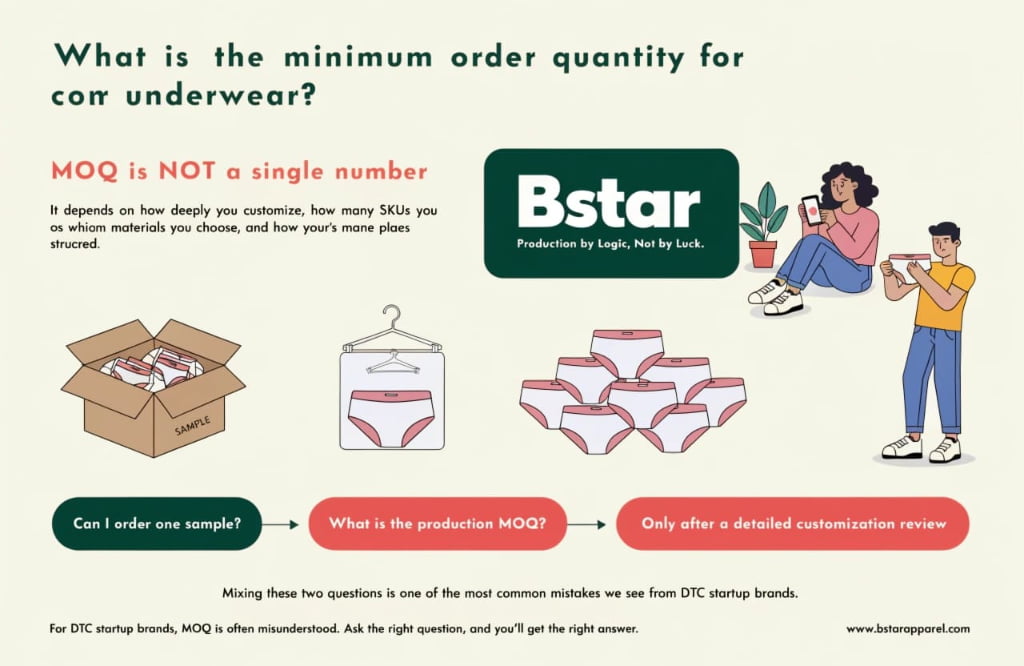
If you are planning your first custom underwear order, MOQ is probably the first number you want to know. But ask the wrong question, and you will get the wrong answer.
MOQ for custom underwear is not one fixed number. It depends on how deeply you customize, how many SKUs you plan, which materials you choose, and how your size range is structured. In many inquiry discussions, the real MOQ only becomes clear after a detailed customization review.
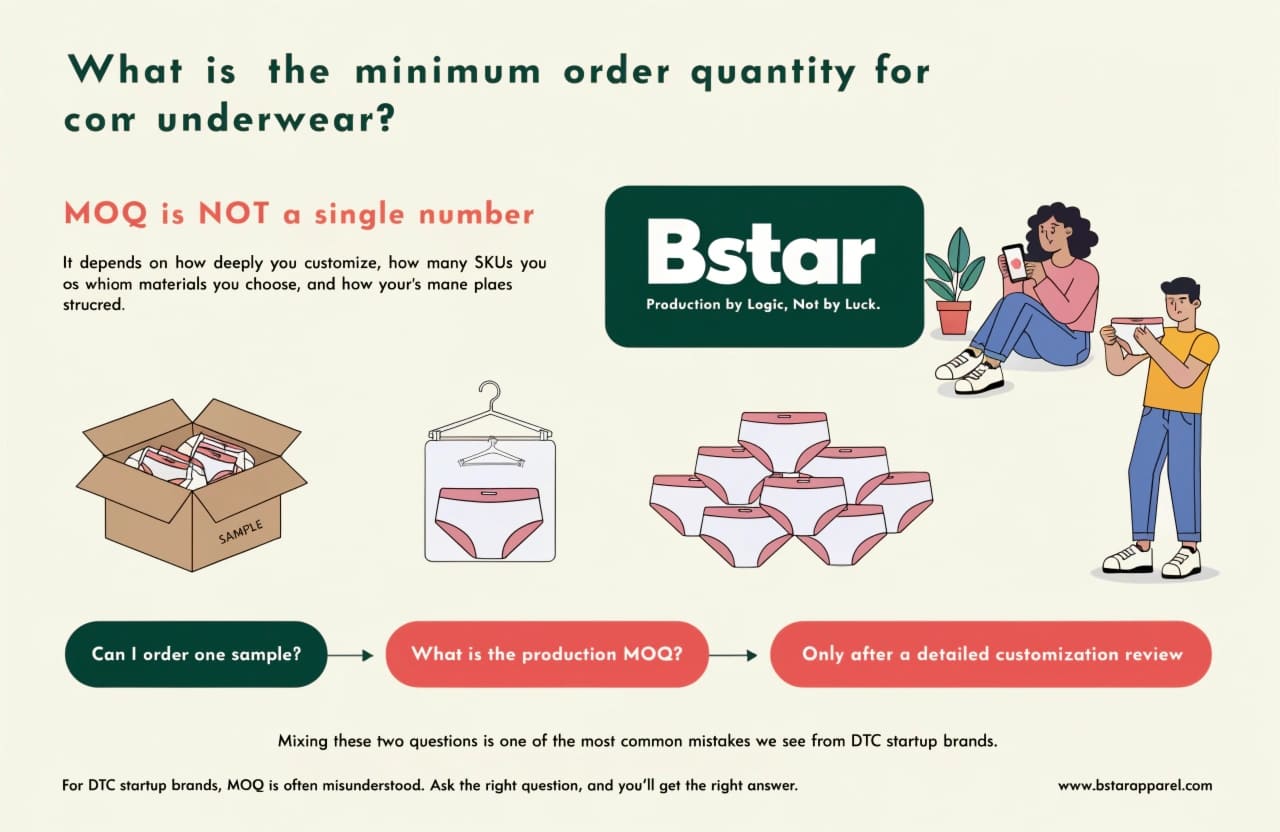
There is a big difference between "Can I order one sample?" and "What is the production MOQ?" Mixing these two questions is one of the most common mistakes we see from DTC startup brands. Let me break this down properly so you can plan your first order with clear eyes.
What Should Be Noted About Customization Factors?
A lot of brands come to us with one question: "What is your MOQ?" What they really mean is: "How small can my first order be?" These are two different questions.
The MOQ you will face is directly shaped by how much you are customizing. Light customization like adding a logo or changing a label sits at one end. Full custom development with a new pattern, new fabric, and a custom waistband sits at the other end. Each level carries a different MOQ reality.
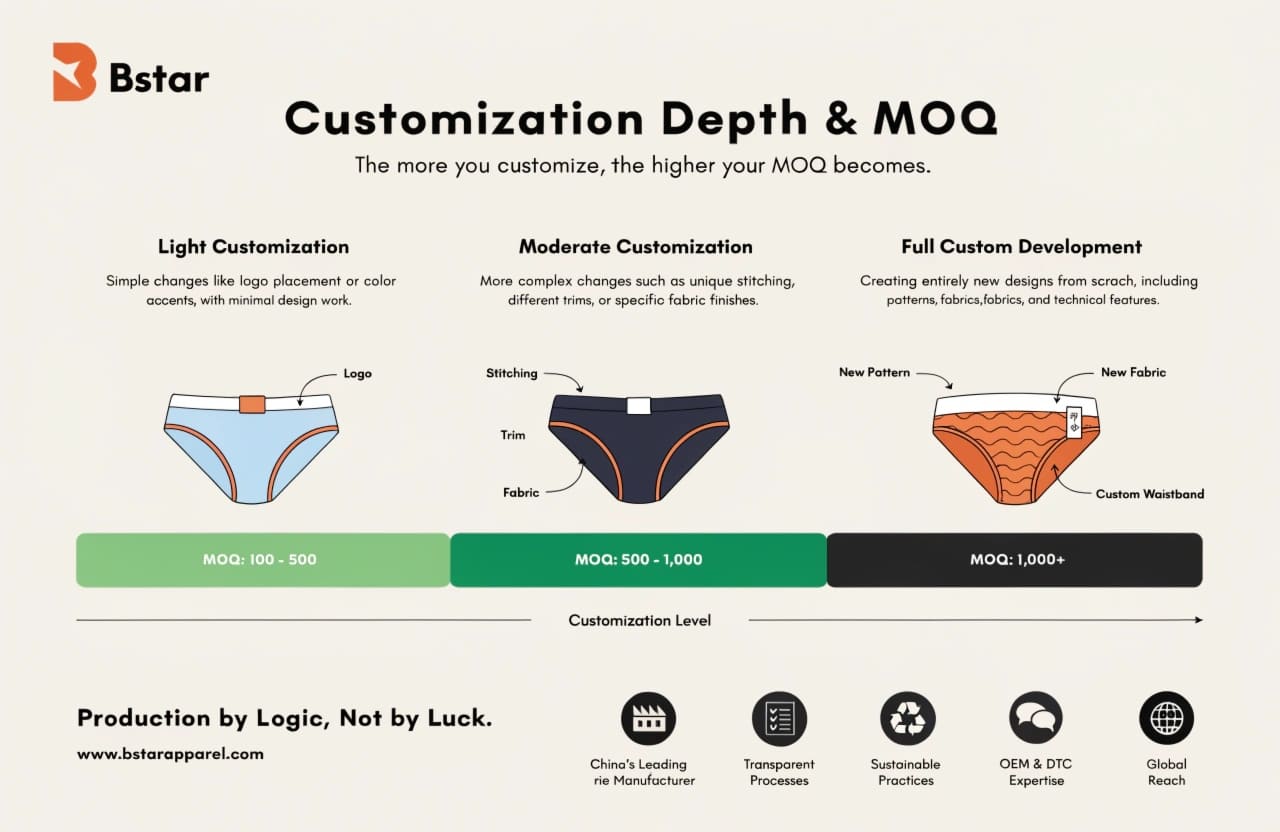
Here is how we think about customization depth in practice:
Light Customization
This means you are working with an existing base style and adding your brand identity. Think woven labels, hangtags, custom packaging, and basic print placement. Because the base construction is already established, production setup is simpler. This is where smaller runs are most achievable.
Semi-Custom Changes
This is where most DTC brands actually land. You want a specific fabric composition, a particular waistband width, a custom color, or a print that is yours. Each of these changes adds a sourcing or production variable. Fabric minimums from mills exist. Color matching requires lab dips.1 Print setups have their own run requirements. Add them together and your practical MOQ starts to grow, even if you only planned one style.
Full Custom Development
New pattern development, new construction, new trims, new everything. This is the most resource-intensive level. It requires pattern making, sampling rounds, and material development before a single production piece is cut.2 MOQ at this level is evaluated entirely based on the scope of work. There is no shortcut number here.
| Customization Level | Key Variables | MOQ Pressure |
|---|---|---|
| Light (logo, label, packaging) | Existing base style | Lower |
| Semi-custom (fabric, color, print) | Mill minimums, dye lots, setup fees | Medium to High |
| Full custom (new pattern, new trim) | Full development scope | Evaluated per project |
How to Understand the Minimum Order Quantity Details in the Industry?
When you ask a factory for their MOQ, you will often get a number. But that number rarely tells the whole story. Understanding what drives that number helps you make smarter sourcing decisions.
In the underwear manufacturing industry, MOQ is driven by fabric sourcing minimums, color count, size range, size ratio, accessories, packaging specs, and production scheduling. The more SKUs you add, the faster your practical minimum order grows.
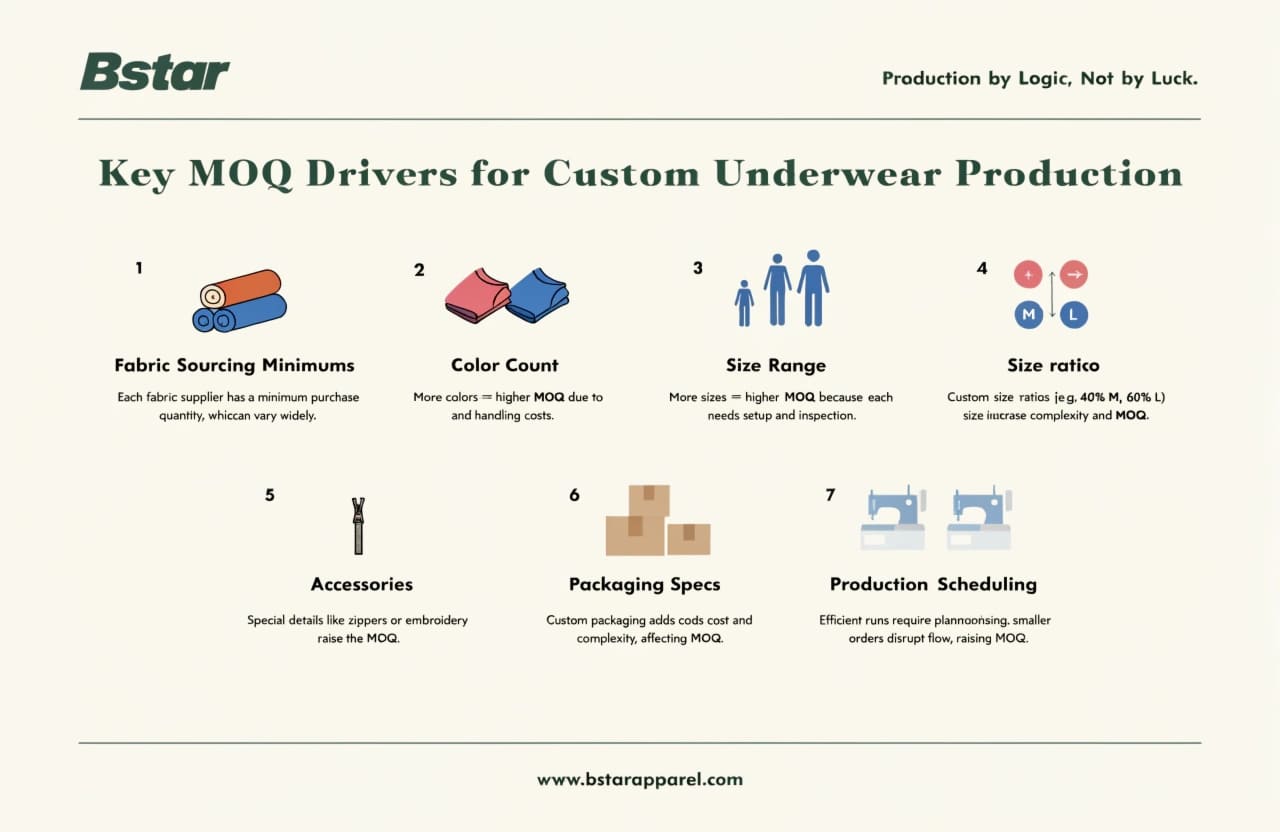
Let me walk through the real drivers one by one.
Fabric and Material Minimums
Fabric mills have their own minimums. If you want a specific fabric composition, the mill may require a minimum yardage order.3 This yardage translates into a minimum piece count before the factory even starts cutting. If you are working with multiple fabric types across your styles, each one carries its own minimum.
Color Count and Dye Lots
Every colorway you add is a separate dye lot. Dye lots require minimum yardage to be worth running.4 If you want five colors in one style, you are effectively running five small fabric orders. The cost and complexity multiply. In many cases, this is where a brand’s first order becomes unexpectedly large.
Size Range and Size Ratio
Underwear comes in multiple sizes. When you spread your order across XS through XL, the pieces per size shrink quickly. If your total order is small, some sizes may fall below efficient cut-and-sew batch sizes.5 This either raises your unit cost or pushes your total order quantity up.
Accessories and Trims
Custom waistbands, woven elastics, custom hardware, specialty labels — these all come from separate suppliers with their own minimums. A custom woven elastic waistband, for example, may require a minimum meter order that only makes sense if your production volume justifies it.6
Production Scheduling
Factories plan their cutting and sewing lines ahead of time. A very small order may need to wait for a compatible production slot or be bundled with other orders.7 This affects both your MOQ and your lead time.
How to Find Suppliers With Minimum Order Quantity Options?
Finding a supplier that fits your order size is not just about searching for "low MOQ underwear manufacturer." It is about finding a supplier whose production model actually matches your customization plan.
To find suppliers with MOQ options that work for your brand, you need to present your full customization brief, not just a target order number. Suppliers who can give you a real MOQ answer are the ones who ask you detailed questions back.
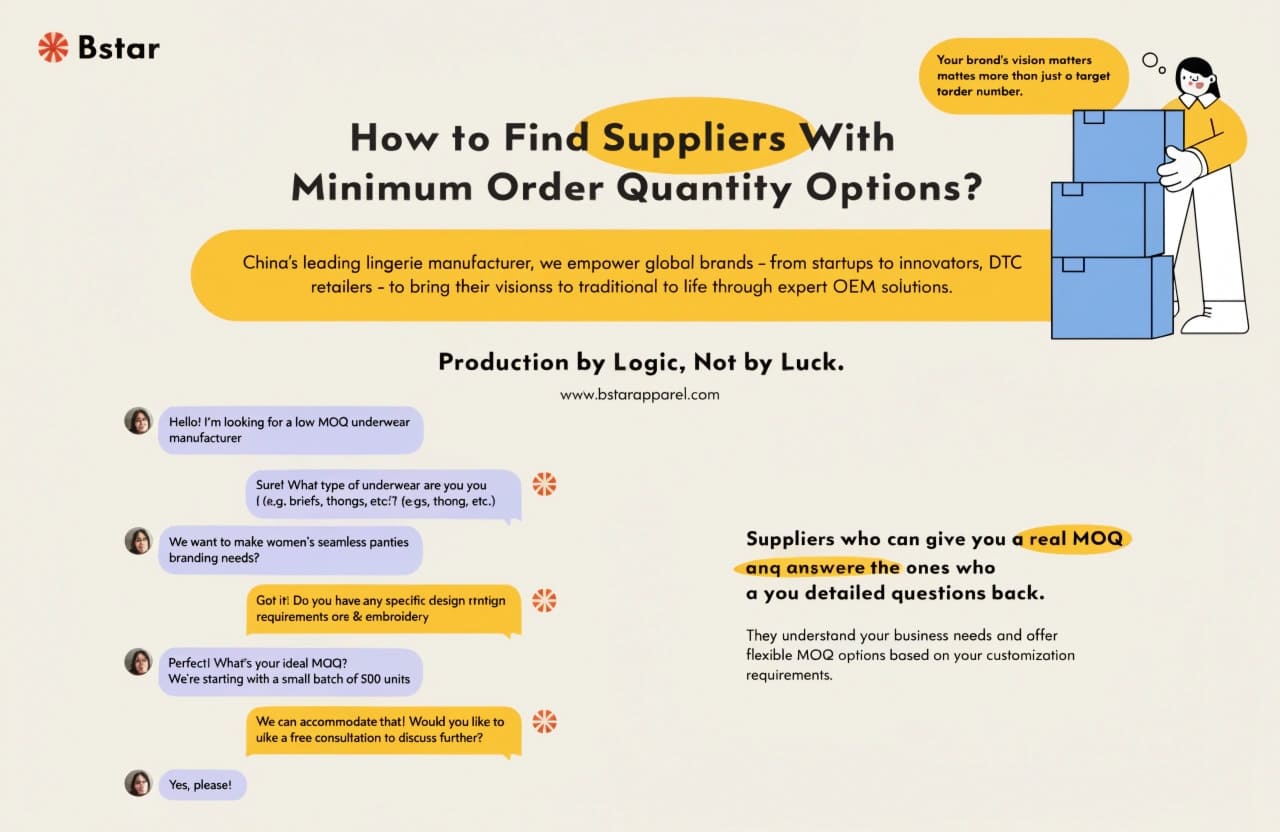
Here is what a serious supplier conversation looks like from our side:
Questions We Ask Before Quoting MOQ
When a brand sends us an inquiry, the first thing we do is ask back. We need to know:
- What base style are you starting from, or is this new pattern development?
- What fabric composition and weight do you need?
- How many colors per style?
- What is your size range and size ratio?
- Do you need custom trims, labels, or packaging?
- What is your target launch quantity, and what is your reorder plan?
Without these answers, any MOQ we give you is just a guess. And a guess is not useful for your planning.
What "1 Piece MOQ" Actually Means
We support single-piece sample and development orders. This is real and it matters for product validation. But a sample order and a production order are completely different things. When someone says "MOQ is 1 piece," they almost always mean sampling, not bulk production. Do not let that number set your expectation for your production run.
Red Flags to Watch For
Be cautious of suppliers who give you a fixed MOQ number without asking any questions about your customization plan. A real manufacturer needs your product brief before they can give you a real number. A supplier who skips that step may be telling you what you want to hear, not what is actually possible.
How to Negotiate and Manage MOQs?
Even when you understand your MOQ, you may still need to work with a supplier to find a structure that fits your cash flow and inventory risk. There are real ways to do this, and there are trade-offs you need to understand before you push for a smaller number.
Negotiating MOQ is possible, but it usually comes with a trade-off. Smaller runs can raise unit cost, limit material choices, affect lead time, or reduce your margin after launch.8 The goal is to find a quantity that balances inventory risk with a unit cost you can actually sell at.
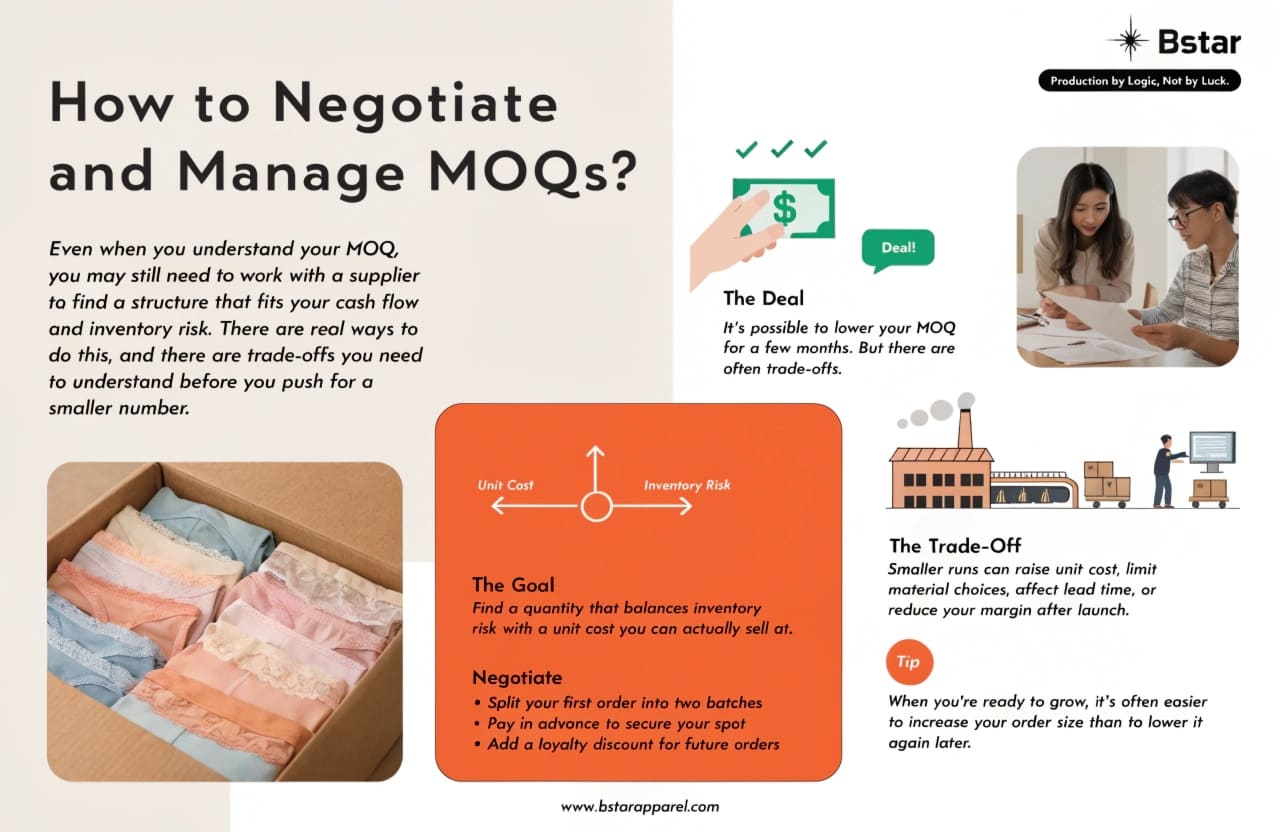
Ways to Reduce Your Effective MOQ
Reduce SKU complexity. Start with one or two colors, not five. Start with three sizes, not six. Every reduction in complexity reduces your practical minimum.9 You can always expand in your second order once you know what sells.
Use a base style first. If the factory has an existing base style that is close to your vision, starting from that base reduces development cost and sampling rounds.10 It also reduces material sourcing complexity, which directly affects MOQ.
Consolidate your order. Instead of splitting a small quantity across many styles, consolidate into fewer styles with a stronger quantity per style. This makes production scheduling easier and often unlocks better unit cost.11
Plan your reorder before your first order. Suppliers are more willing to work with lower initial quantities when they can see a clear reorder plan.12 Showing that you understand your demand and are planning for growth changes the conversation.
The Real Trade-Off Table
| Action | Benefit | Trade-Off |
|---|---|---|
| Reduce color count | Lower MOQ pressure | Fewer market options at launch |
| Start from base style | Faster development, lower setup | Less brand differentiation |
| Smaller total quantity | Lower inventory risk | Higher unit cost |
| Fewer size options | Simpler production | May miss part of your market |
| Commit to reorder plan | Better supplier cooperation | Requires demand confidence |
The point is this: a smaller first order is not free. It is a trade-off. The right MOQ for your brand is the one where your unit cost still works, your inventory risk is manageable, and your customization level actually delivers the product your customer will pay for.
Conclusion
MOQ for custom underwear depends on your customization depth, SKU count, material choices, and size range. Know your brief before you ask for a number, and plan your trade-offs carefully before you push for the smallest possible order.
-
"What is a Lab Dip and Why is it Important for Your Fashion Designs?", https://thefashionbusinesscoach.com/blog/whatisalabdip. In textile production, a lab dip refers to a small sample of fabric dyed to a specified color standard and submitted for buyer approval before bulk dyeing commences; multiple rounds of lab dips may be required to achieve acceptable color accuracy, adding time and cost to the development process. Evidence role: definition; source type: encyclopedia. Supports: A lab dip is a small-scale dyeing test used to match a target color before committing to bulk fabric production, adding iterative approval rounds to the development timeline.. Scope note: The number of lab dip rounds and associated costs vary by dye chemistry, fiber content, and the precision of the target color specification. ↩
-
"All About Samplemaking – Garmenta Apparel", https://www.garmentaapparel.com/blog/all-about-samplemaking. Apparel product development curricula and industry handbooks describe a standard development sequence for custom garments that includes pattern drafting, prototype (proto) sample construction, fit and wear testing, pre-production sampling, and material approval, each stage requiring iterative revisions before production authorization. Evidence role: historical_context; source type: education. Supports: Custom garment development follows a multi-stage process including pattern drafting, prototype sampling, fit evaluation, and material approval before bulk production is authorized.. Scope note: The number of sampling rounds and total development time vary by product complexity, brand requirements, and factory capability; no single universal standard governs the process. ↩
-
"Wholesale Fabric Supply with Low MOQ – Fabriclore", https://fabriclore.com/blogs/fashion-business-lifestyle-trends/wholesale-fabric-supply-platform-low-minimum-order-quantities?srsltid=AfmBOorPED2ltjF7ywtSG4cY6Y0kCyEEo-UxZhXB-kAPsELNRmURjyoH. Industry analyses of apparel supply chains document that textile mills typically impose minimum order quantities measured in meters or yards per colorway, which propagate upstream constraints to garment manufacturers determining their own MOQs. Evidence role: mechanism; source type: research. Supports: Fabric mills set minimum yardage thresholds that constrain downstream garment production quantities.. Scope note: Published figures for mill minimums vary widely by fiber type, mill size, and geography; a single authoritative threshold does not exist across the industry. ↩
-
"Sustainable Dyeing Techniques: Innovations in Coloring Fabrics", https://www.rmcad.edu/blog/sustainable-dyeing-techniques-innovations-in-coloring-fabrics/. Textile science literature defines a dye lot as a quantity of fabric dyed in a single batch under identical conditions; producing multiple colorways therefore requires separate batches, each subject to the mill’s minimum run length to ensure color uniformity and economic viability. Evidence role: definition; source type: encyclopedia. Supports: A dye lot represents a single dyeing batch; color consistency is only guaranteed within one lot, and each new lot requires a minimum quantity to achieve uniform results economically.. Scope note: Minimum lot sizes differ by dyeing method (e.g., piece dyeing vs. yarn dyeing) and are not uniform across mills or fiber types. ↩
-
"Best Cut and Sew Manufacturers USA | Low Minimum", https://manufacturer.clothing/cut-and-sew-manufacturer/. Operations management research on apparel production documents that cutting and sewing operations involve fixed setup times per style and size marker, meaning that smaller batch sizes increase the proportion of non-productive setup time and elevate per-unit costs. Evidence role: mechanism; source type: research. Supports: Apparel manufacturing exhibits economies of scale at the cutting and sewing stages, where smaller per-size quantities increase setup-to-run ratios and raise unit costs.. Scope note: Specific minimum batch sizes vary by factory configuration, machinery type, and product complexity; no universal threshold applies across the industry. ↩
-
"Narrow Fabric and Other Smallware Mills: Cotton, Wool, Silk … – OSHA", https://www.osha.gov/sic-manual/2241. Trade and industry sources on apparel trim supply chains indicate that narrow fabric producers, including woven elastic manufacturers, set minimum order quantities per design and colorway, typically expressed in meters, reflecting the setup costs of jacquard or needle loom machinery. Evidence role: general_support; source type: institution. Supports: Narrow fabric and elastic trim suppliers impose minimum order quantities in meters that are independent of the garment manufacturer’s own MOQ.. Scope note: Publicly available data on specific meter minimums from elastic suppliers is limited; figures vary substantially by supplier, design complexity, and yarn type. ↩
-
"(PDF) Scheduling in the Textile Industry – Academia.edu", https://www.academia.edu/102612849/Scheduling_in_the_Textile_Industry. Supply chain and operations management literature on apparel manufacturing describes production scheduling as a constrained optimization problem in which factories allocate sewing line capacity weeks in advance; small orders that do not fill a line efficiently are typically deferred or consolidated, extending their lead times. Evidence role: mechanism; source type: research. Supports: Apparel factories use advance production scheduling that allocates line capacity to orders, causing small or non-standard orders to experience longer lead times or require consolidation with other work.. Scope note: The extent of scheduling delays for small orders depends on factory size, order mix, and season; empirical data specific to underwear manufacturing is not widely published. ↩
-
"Understanding Minimum Order Quantities in Apparel Manufacturing", https://www.leftyproductionco.com/post/understanding-minimum-order-quantities-in-apparel-manufacturing-key-considerations-for-your-brand. Economic analyses of manufacturing cost structures demonstrate that fixed costs—including pattern setup, machinery changeover, and material sourcing overhead—are amortized across total units produced; smaller production runs therefore yield higher per-unit costs, a relationship documented in apparel industry cost modeling literature. Evidence role: mechanism; source type: research. Supports: In apparel manufacturing, smaller order quantities spread fixed setup and overhead costs across fewer units, resulting in higher per-unit costs compared to larger runs.. Scope note: The magnitude of the cost premium for small runs varies by product type, factory overhead structure, and degree of customization; published figures for underwear specifically are limited. ↩
-
"Consolidated MOQ for Multiple SKU Orders on Alibaba.com", https://seller.alibaba.com/blogs/2026/southeast-asia/apparel-accessories/consolidated-moq-multiple-sku-guide-alibaba-b2b. Supply chain and inventory management literature identifies SKU proliferation as a driver of increased supply chain complexity and higher aggregate minimum order requirements; reducing the number of color and size variants decreases the number of independent material and production minimums that must be simultaneously satisfied, lowering the effective total order floor. Evidence role: mechanism; source type: research. Supports: Each additional color or size variant creates an independent SKU with its own material sourcing and production setup requirements, so reducing variant count lowers the aggregate minimum quantities imposed by upstream suppliers and production scheduling.. Scope note: The precise reduction in MOQ per eliminated SKU depends on whether each variant draws on shared or independent material sources; shared base fabrics across colors reduce but do not eliminate this effect. ↩
-
"New software designs eco-friendly clothing that can reassemble into …", https://news.mit.edu/2025/refashion-software-designs-eco-friendly-clothing-that-can-reassemble-new-items-1017. Apparel product development literature notes that pattern blocks or slopers representing established fit standards serve as starting points that reduce the number of fit corrections and sampling iterations required; adapting a block to a new style is documented as less resource-intensive than drafting a new pattern from first principles. Evidence role: mechanism; source type: education. Supports: Adapting an existing pattern block reduces the number of development iterations needed to achieve fit and construction approval, lowering both time and cost relative to creating a new pattern from scratch.. Scope note: The degree of savings depends on how closely the existing block matches the target design; significant design departures may require iterations comparable to new pattern development. ↩
-
"How to Assess Cost Efficiency in High Volume Apparel …", https://www.fabrikn.com/blog/how-to-assess-cost-efficiency-in-high-volume-apparel-production/. Operations research on apparel manufacturing documents that style changeovers—requiring re-threading, re-setting machinery, and switching materials—represent a significant source of non-productive time; consolidating volume into fewer styles reduces changeover frequency, improving line efficiency and reducing per-unit overhead allocation. Evidence role: mechanism; source type: research. Supports: Reducing the number of styles in a production order decreases the frequency of line changeovers and material switches, improving throughput efficiency and lowering per-unit costs.. Scope note: The quantitative impact of style consolidation on unit cost depends on factory-specific changeover times and line configurations, which are not uniform across manufacturers. ↩
-
"MOQs in Textile Sourcing: Strategies for Smarter Negotiation", https://www.linkedin.com/pulse/understanding-moqs-textile-sourcing-how-buyers-can-negotiate-yang-pml5c. Supply chain management research on buyer-supplier relationships identifies demand uncertainty as a primary driver of supplier-imposed minimum order quantities; credible commitments to future orders, such as documented reorder plans, reduce this uncertainty and are associated with greater supplier flexibility on initial order size. Evidence role: expert_consensus; source type: research. Supports: Buyer commitments to future orders reduce supplier uncertainty about demand, which supply chain research identifies as a factor that can lead suppliers to accept lower initial order quantities.. Scope note: Empirical studies on this dynamic in the apparel or underwear manufacturing sector specifically are limited; most evidence comes from broader supply chain management literature. ↩
Discussion & questions 0 comments