
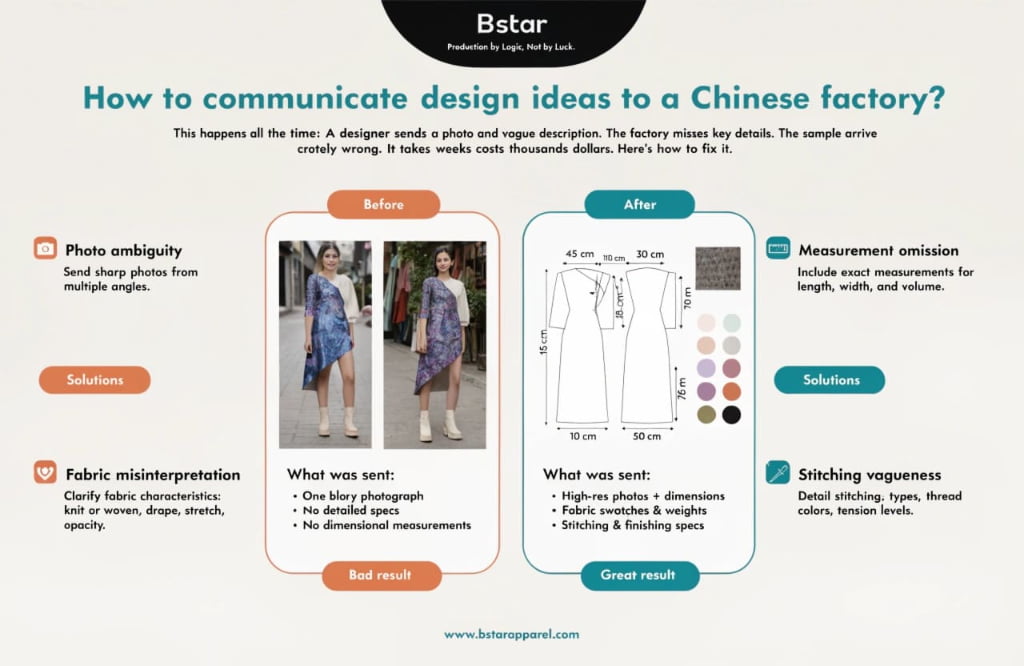
A designer sent us a photo of a dress and asked us to copy it. The sample we shipped back looked like a different garment. Weeks of time and thousands of dollars just vanished.
You need to hand over a complete set of measurable instructions—fabric weight, stitch type, seam construction, tolerances—not a mood board or a paragraph of adjectives. When you treat the handoff like a technical data transfer, the factory delivers what you actually want.
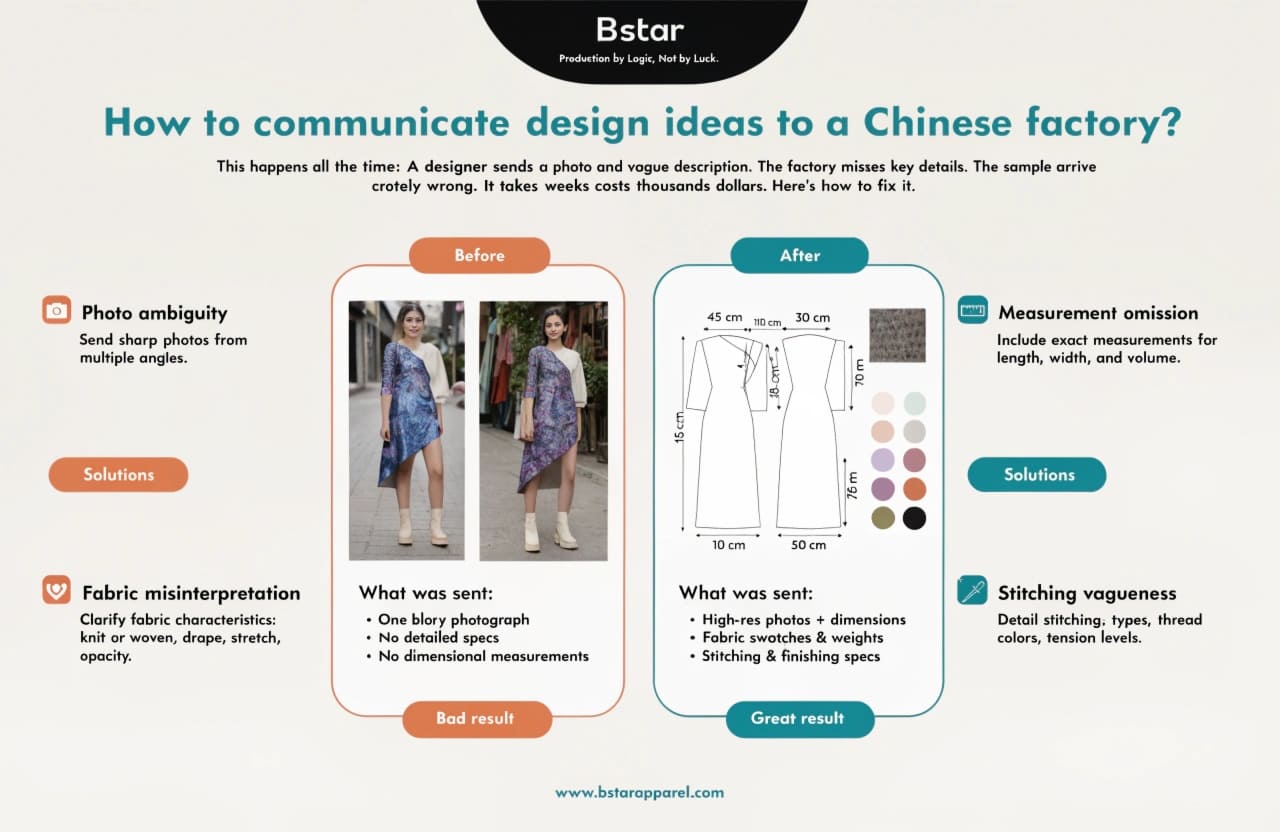
Every week, our knitting factory in Zhongshan receives briefs that are destined to fail. I’m not talking about language mistakes. I’m talking about a gap between what a designer imagines and what a sewing line actually needs. You can close that gap by changing what you send, not by sending more messages. Here are four places where the handoff breaks—and how we’ve fixed them with clients.
What makes a tech pack a real blueprint for manufacturing success?
A DTC founder once emailed us a sketch she drew on a restaurant napkin. She had a clear visual in her head. Our pattern maker spent days guessing, and the first sample was completely off. The brand paid double because nobody had defined the basics.
A tech pack must spell out measurements, construction notes, material codes, and acceptable variances1. Without those, every empty field becomes a decision your factory makes without you2—usually wrong.
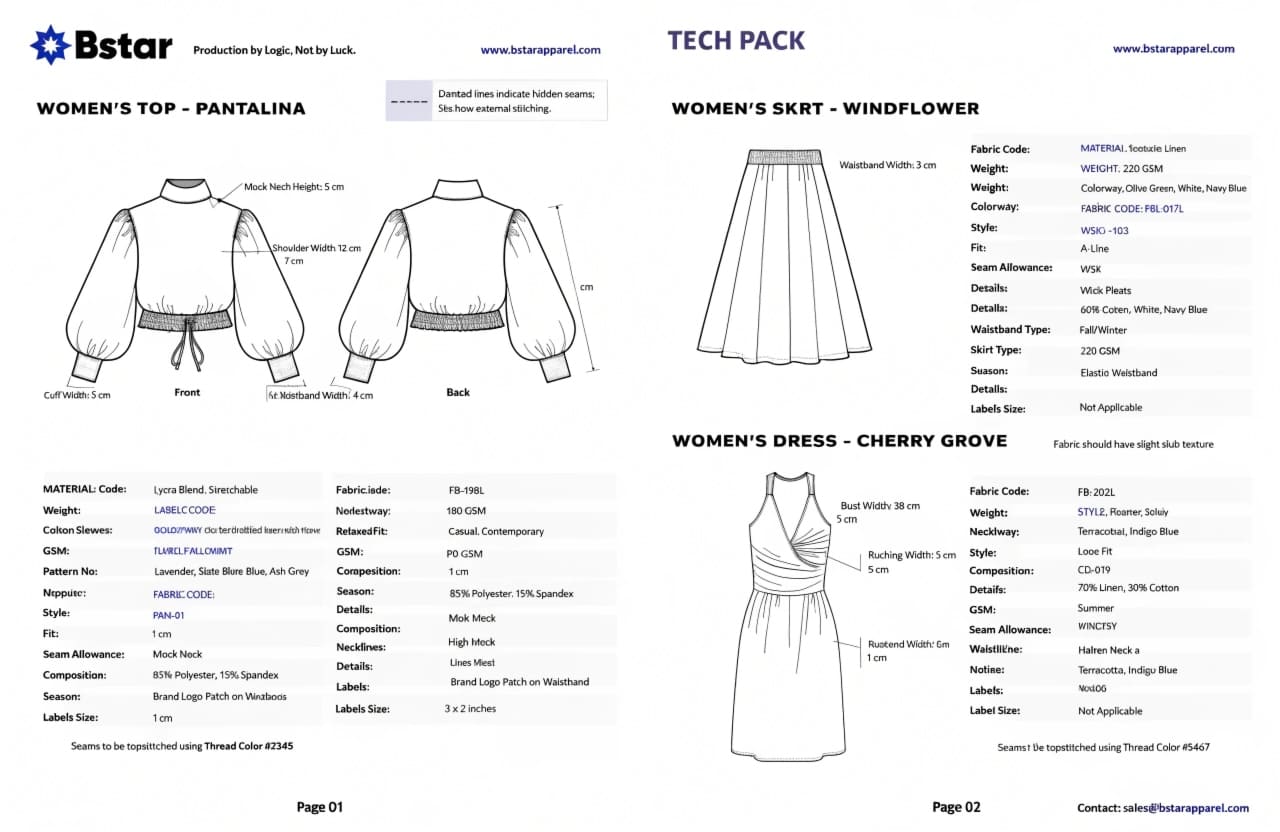
When we open a tech pack, we look for GSM, stitch density, seam finish call-outs, and grading rules3. A photo cannot tell me if the fabric should weigh 180 or 220 grams. A sketch cannot tell me if the neck binding is self-fabric or rib. Last year, a brand sent us a beautiful line sheet and said, “Just make it look like this.” We had to pause everything and request a spec sheet. Turns out they wanted a rolled hem, not a blind stitch. The delay cost them a full month. Now we ask every new client to fill in a simple template with 12 fields before we even cut a swatch. When a designer fills those fields, I can hand the sheet to my sewing line supervisor and she starts production without a single phone call.
How do you bridge the language gap with clear specifications?
Clients often write “soft cotton” or “nice drape” in a brief. Those words mean nothing on our factory floor. I can show you ten fabrics that feel soft to me but stiff to you.
Replace every subjective adjective with a physical reference. A Pantone code locks color4. A hand feel swatch locks touch5. A stitch sample locks texture. That’s the only language both sides understand—physical proof.
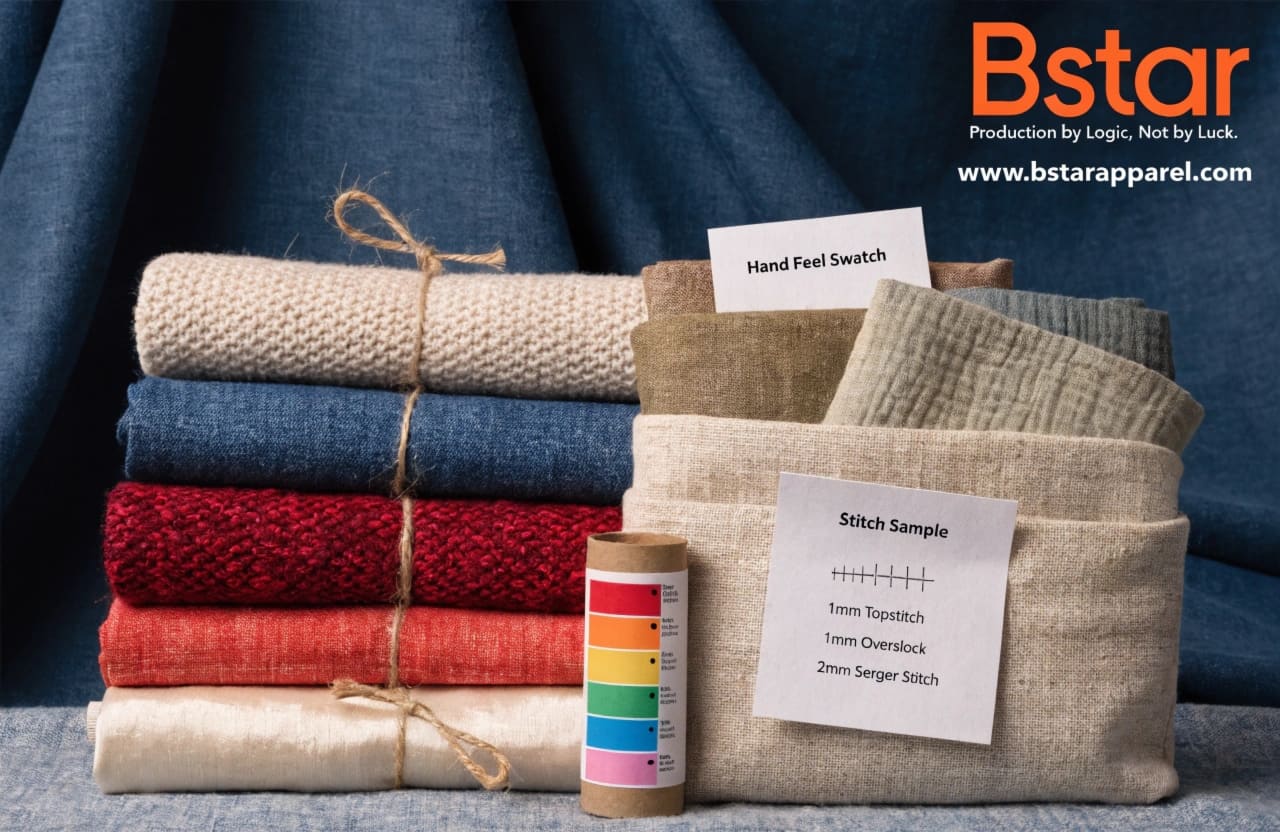
We once worked with a brand that described its signature blue as “sky blue.” Our dye house sent six lab dips. The buyer rejected every single one. We lost two weeks chasing a color that existed only in her memory. The moment she couriered a Pantone chip, we matched the shade in two days. Hand feel is the same. A founder told us a hoodie needed to feel “cozy like clouds.” We guessed wrong. Now we ask every client to send two swatches: one they love and one they hate. The hate reference is just as powerful. Our fabric sourcer touches both and lands on the right hand within one trial. You don’t need perfect vocabulary. You need a small piece of cloth and an exact color number.
Can mood boards and samples actually align expectations?
Mood boards inspire. They don’t build garments.6 I’ve seen gorgeous inspiration decks that lead to samples that look like cheap knockoffs because the real materials behaved differently.
Every round of sampling answers one question: silhouette first, then fit, then drape, then finishing details.7 Skipping a round doesn’t save time; it pushes the guesswork into a final product you’ve never even touched.
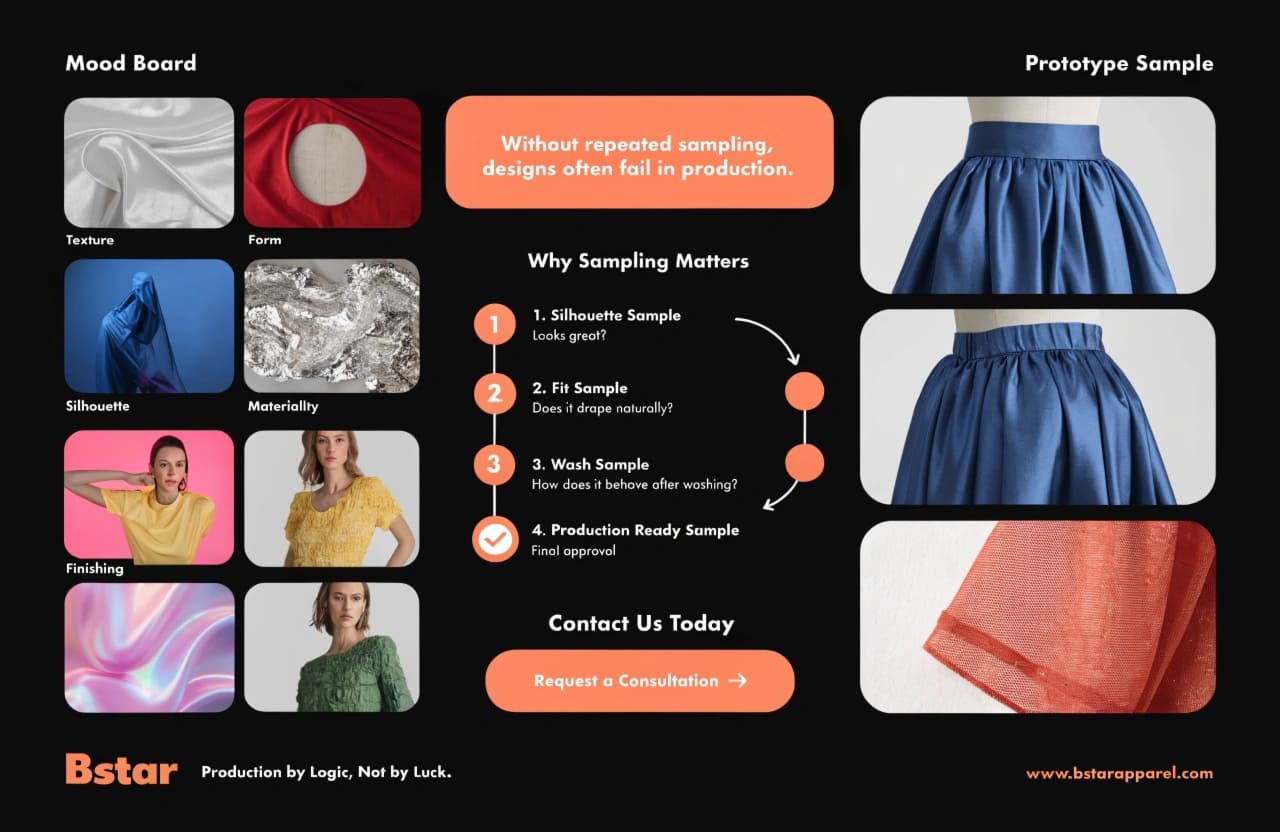
A founder once asked us to skip the fit sample and go straight to production samples so she could meet a launch date. She had only approved a digital 3D render. We followed the original tech pack, but the actual knit fabric had more stretch than the render assumed8. The entire production run of 500 units fit two sizes too big. We had to re-cut and re-sew at a loss. Since then, we tell every client: the first sample confirms the shape, the second confirms the measurements on a body, the third confirms the fabric behavior after wash9. Each round costs money and days, but each round removes a risk. The brands that rush to one sample always pay more later.
Are there effective strategies for managing revisions and approvals?
A designer once asked us to change the collar seam from overlock to flatlock after the pre-production sample. She thought it was a tiny tweak. On our side, it meant re-cutting collar bands, resetting machines, and moving three operators off their main tasks.
Every revision has a real factory cost and a real clock. When a client knows that moving a pocket takes 30 minutes but changing a main seam takes three hours plus fabric loss, requests become precise and rare.
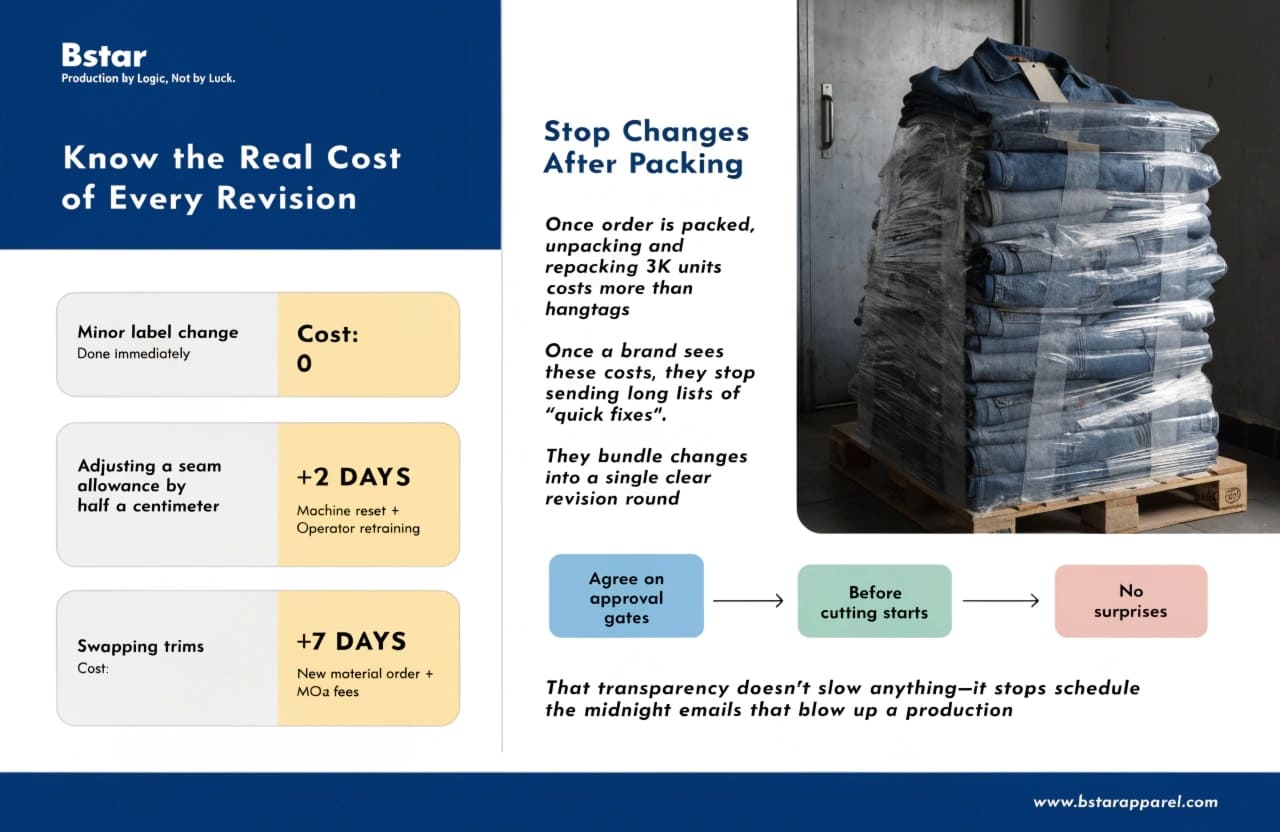
We built a simple revision cost table for our clients. Minor label changes: zero cost, done immediately. Adjusting a seam allowance by half a centimeter: machine reset and operator retraining, adds two days. Swapping trims: we might need to order new material, adding seven days and a minimum order fee. Once a brand saw those numbers, they stopped sending long lists of “quick fixes” and started bundling changes into a single clear revision round. Another case: a retailer requested a new hangtag after the entire order was packed. Unpacking and repacking 3,000 units cost more than the hangtags themselves. Now we agree on approval gates before cutting starts10. That transparency doesn’t slow anything—it stops the midnight emails that blow up a production schedule.
Conclusion
The factory doesn’t need your creative vision; it needs executable numbers and physical samples. When you send those, your design arrives exactly as you thought it would.
-
"[PDF] El Paso Community College Syllabus Part II Official Course …", https://www.epcc.edu/Academics/Catalog/2018/FSHD2371.pdf. Apparel product-development references describe technical packages as documents that communicate specifications such as measurements, materials, construction details, and tolerances to manufacturers. Evidence role: definition; source type: education. Supports: A tech pack should specify measurements, construction notes, material codes, and acceptable variances.. Scope note: The source may describe common industry practice rather than prescribe a universal mandatory tech-pack format. ↩
-
"Problem driven innovation design strategies research for product …", https://pmc.ncbi.nlm.nih.gov/articles/PMC12019239/. Manufacturing documentation literature treats incomplete or ambiguous specifications as a source of interpretation, rework, and communication error between design and production teams. Evidence role: mechanism; source type: paper. Supports: Missing tech-pack fields shift manufacturing decisions to the factory and increase the risk of incorrect outcomes.. Scope note: The source is likely to support the general mechanism of ambiguity in manufacturing specifications, not this specific factory scenario. ↩
-
"Effect of Different Types of Seam, Stitch Class and Stitch Density on …", https://www.academia.edu/89001389/Effect_of_Different_Types_of_Seam_Stitch_Class_and_Stitch_Density_on_Seam_Performance. Apparel specification and quality-control resources identify fabric weight, stitch construction, seam type, and size grading as measurable production parameters used to communicate garment requirements. Evidence role: general_support; source type: education. Supports: GSM, stitch density, seam finishes, and grading rules are important apparel production specifications.. Scope note: The cited source may list these parameters across different sections rather than as one fixed checklist. ↩
-
"Pantone – Wikipedia", https://en.wikipedia.org/wiki/Pantone. References on the Pantone Matching System describe it as a standardized color-reproduction system used to identify and communicate specific colors across production contexts. Evidence role: definition; source type: encyclopedia. Supports: Using a Pantone code provides a standardized reference for communicating color.. Scope note: A Pantone code improves color communication but does not by itself guarantee an exact match across all materials, dyes, lighting conditions, or production processes. ↩
-
"[PDF] Evaluating Expected Real-World Tactile Experience From Virtual …", https://repository.rit.edu/cgi/viewcontent.cgi?article=13693&context=theses. Textile evaluation sources note that fabric hand refers to tactile properties assessed through touch and that physical fabric samples are commonly used to communicate and evaluate these sensory characteristics. Evidence role: definition; source type: education. Supports: Physical swatches help communicate fabric hand feel more reliably than subjective adjectives alone.. Scope note: A swatch provides a tactile reference but does not eliminate all variation caused by fiber content, finishing, laundering, or production-lot differences. ↩
-
"Fashion Mood Board Design of Sportswear Using Photomontage …", https://www.academia.edu/126910025/Fashion_Mood_Board_Design_of_Sportswear_Using_Photomontage_Technique. Fashion design and product-development sources distinguish inspirational design tools such as mood boards from technical production documents, which provide the specifications needed for manufacturing. Evidence role: general_support; source type: education. Supports: Mood boards are useful for design inspiration but are not sufficient manufacturing specifications.. Scope note: The source will support the distinction between concept communication and production specification, not the rhetorical wording of the sentence. ↩
-
"(PDF) 1 AO Sampling – Academia.edu", https://www.academia.edu/4117192/1_AO_Sampling. Apparel product-development literature describes iterative sample stages—such as prototype, fit, pre-production, and production samples—as checks for design, fit, materials, and construction before bulk manufacturing. Evidence role: expert_consensus; source type: education. Supports: Apparel sampling is commonly used in stages to validate silhouette, fit, material behavior, and finishing before production.. Scope note: Sampling terminology and sequence vary by company and product category, so the source may not match this exact four-step order. ↩
-
"Analysis of Woven Fabric Mechanical Properties in the … – PMC", https://pmc.ncbi.nlm.nih.gov/articles/PMC12349057/. Research on textile simulation notes that accurate garment rendering and fit prediction depend on measured material properties, including stretch and mechanical behavior of fabrics. Evidence role: mechanism; source type: paper. Supports: Digital garment renders can misrepresent fit if the fabric’s stretch and mechanical properties are not accurately modeled.. Scope note: Such sources support the limitation of digital simulation generally and may not evaluate the specific rendering software or knit fabric described in the article. ↩
-
"Dimensional stability (fabric) – Wikipedia", https://en.wikipedia.org/wiki/Dimensional_stability_(fabric). Textile-testing standards and educational resources identify laundering as a key condition for assessing dimensional change, shrinkage, and appearance retention in fabrics and garments. Evidence role: mechanism; source type: institution. Supports: Wash testing helps confirm how fabric or garments behave after laundering.. Scope note: A general laundering or dimensional-stability source supports the need for wash testing, not the specific three-sample process described by the author. ↩
-
"Phase-gate process – Wikipedia", https://en.wikipedia.org/wiki/Phase-gate_process. Stage-gate and production-planning literature describes formal approval points as controls that reduce late changes, rework, and downstream disruption before committing resources to production. Evidence role: mechanism; source type: paper. Supports: Approval gates before cutting can help prevent late-stage changes from disrupting production schedules.. Scope note: The evidence is likely to come from general product-development or manufacturing-process literature rather than apparel cutting specifically. ↩
Discussion & questions 0 comments