
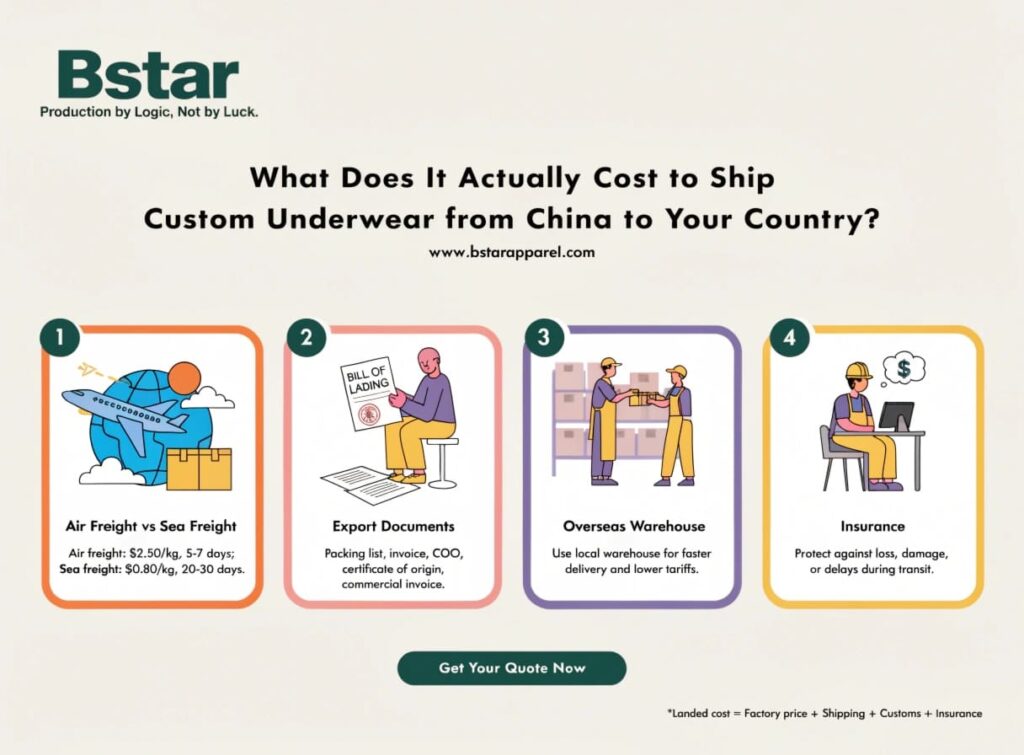
Most first-time buyers get a factory quote and think the hard part is over. Then the goods are ready, and suddenly there are freight costs, customs fees, and document requirements that nobody mentioned.
Shipping custom underwear internationally involves four key decisions: choosing between air freight and sea freight, preparing the right export documents, deciding whether to use overseas warehousing, and protecting your cargo with insurance. Getting these right before you order can save weeks of delay and thousands in unexpected costs.
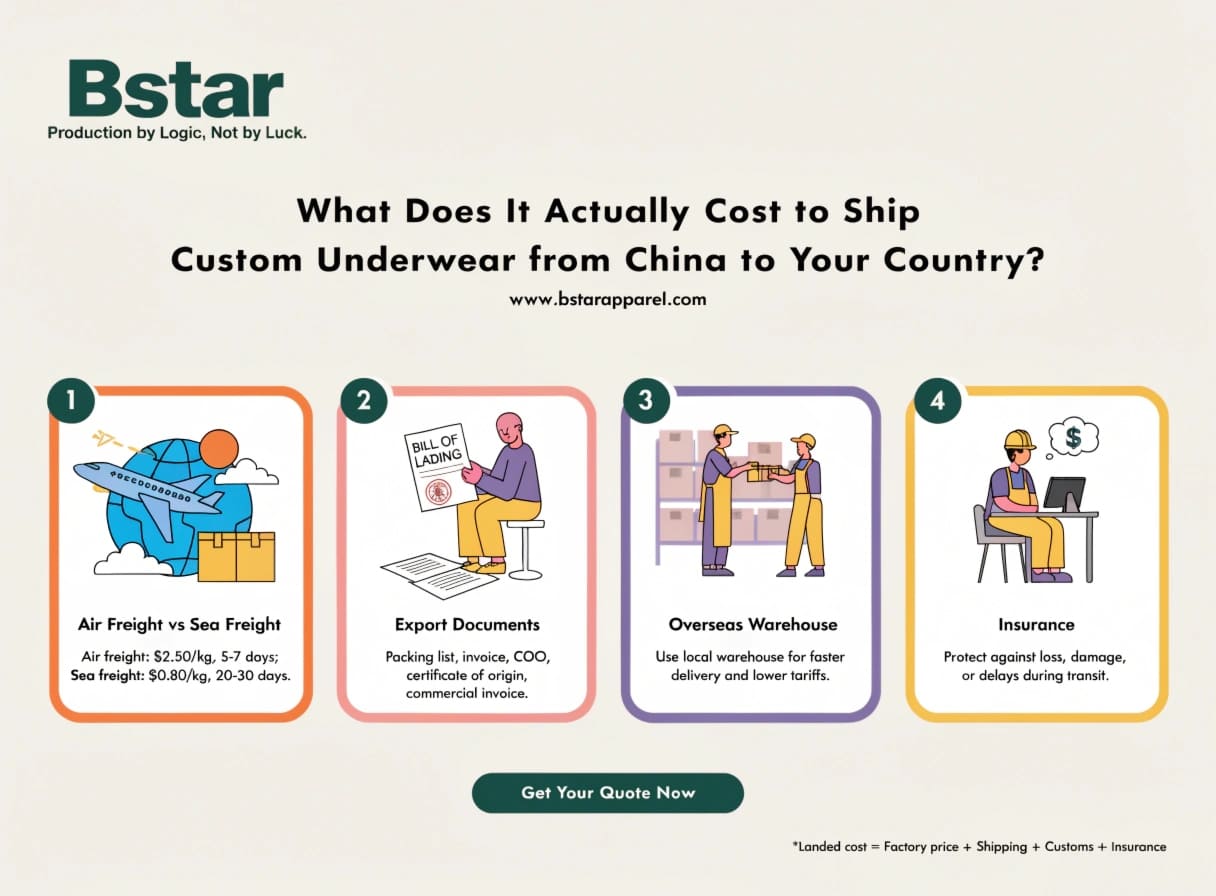
Here’s the thing — the factory price is just the starting point. The real question is: what is your actual landed cost, and when will the goods actually be in your hands? I’ve seen this catch new buyers off guard more times than I can count. Let me walk you through what you actually need to know before you place that first international underwear order.
Air Freight vs. Sea Freight: Which One Actually Makes Sense for Your Order?
You need samples fast. Your bulk order is sitting in the factory ready to go. Which shipping method do you pick — and does it even matter?
For underwear orders, express courier (DHL/FedEx) is the right choice for samples and small test runs under roughly 50–100 kg. Once your shipment crosses that weight or volume threshold, sea freight becomes significantly cheaper per unit — often by 60–80%1 — even after you account for the longer transit time.
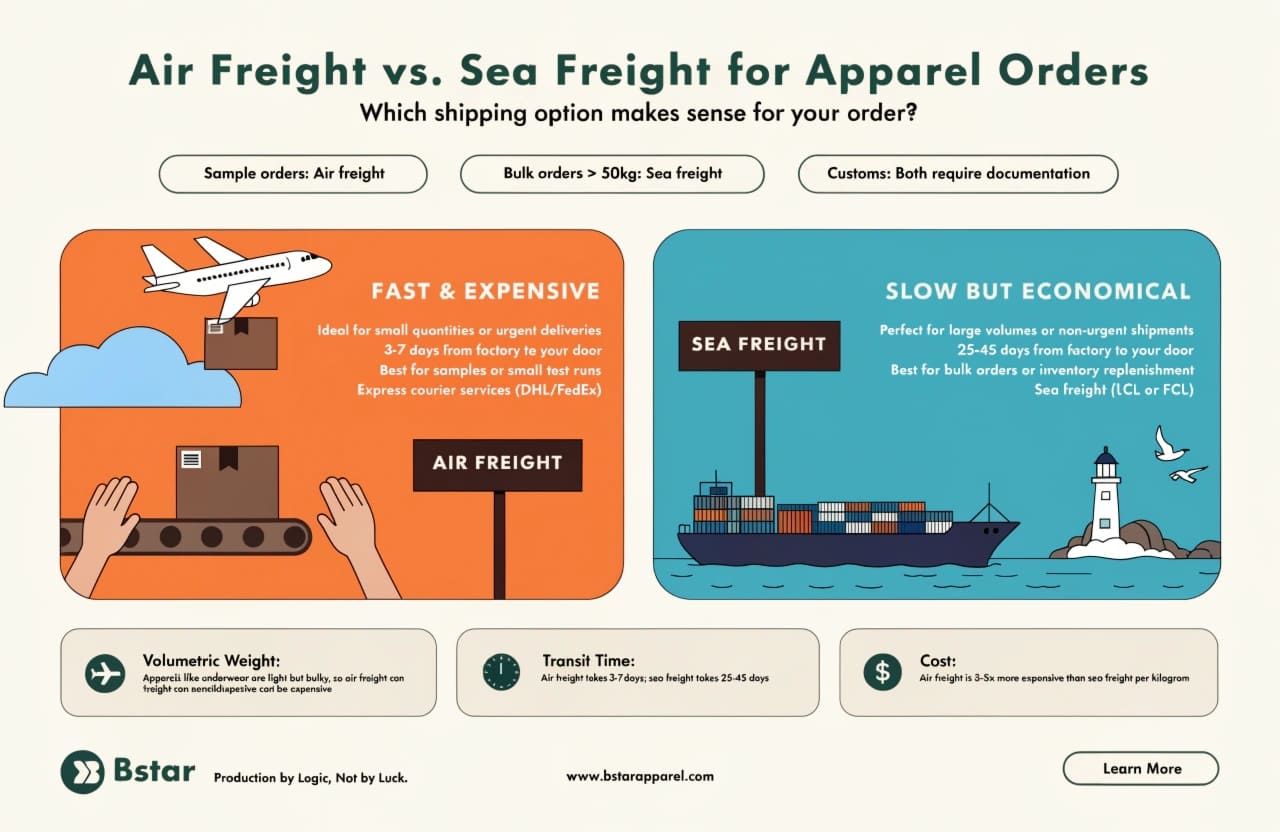
The math is simple, but it trips people up. Express couriers charge by volumetric weight, not actual weight. Underwear and intimate apparel are light but bulky when packed. A box of bras or boxer briefs can easily have a volumetric weight two to three times the actual weight2. That surcharge adds up fast on larger orders.
Here is what we actually see in practice when we coordinate shipments for clients:
| Order Size | Recommended Method | Typical Transit Time | Notes |
|---|---|---|---|
| 1–50 units (samples) | Express courier | 3–7 days | Fast, trackable, worth the cost |
| 50–200 units (test run) | Express or air freight | 5–10 days | Check volumetric weight first |
| 200+ units (bulk) | Sea freight (LCL or FCL) | 25–45 days | Major cost saving at scale |
The transit time difference is real. Sea freight from China to Rotterdam or Los Angeles runs roughly 25–40 days3 depending on routing and season. Add customs clearance time on the destination end — usually 3–7 working days if documents are clean4 — and you are looking at 5–7 weeks minimum from factory to your warehouse.
This matters enormously for launch planning. A lot of new brands plan their timeline based on production lead time alone. Production for a first custom underwear order typically runs 30–45 days after sample approval5. Add sea freight plus customs, and your realistic time-to-shelf for a Europe or US-bound order is 10–14 weeks from order confirmation6. Plan for that, not for the 4-week production window alone.
One more thing: your factory quote almost certainly ends at the port. Terms like EXW (Ex Works) and FOB (Free on Board) mean different things7. EXW means you are responsible for everything from the factory gate. FOB means the supplier handles export costs to the port, and you take over from there. Either way, you still need to hire a freight forwarder to move the goods from China to your door. Many buyers discover this after the goods are ready.
Customs Clearance: What Documents Do You Actually Need for an Underwear Shipment?
You found your freight forwarder. The goods are on the way. Then your broker calls — there is a problem with your documentation, and the shipment is on hold.
For importing custom underwear from China, you typically need a commercial invoice, packing list, bill of lading or airway bill, fabric composition certificate, and a certificate of origin. Missing or incorrect documents are the most common reason underwear shipments get held at customs.
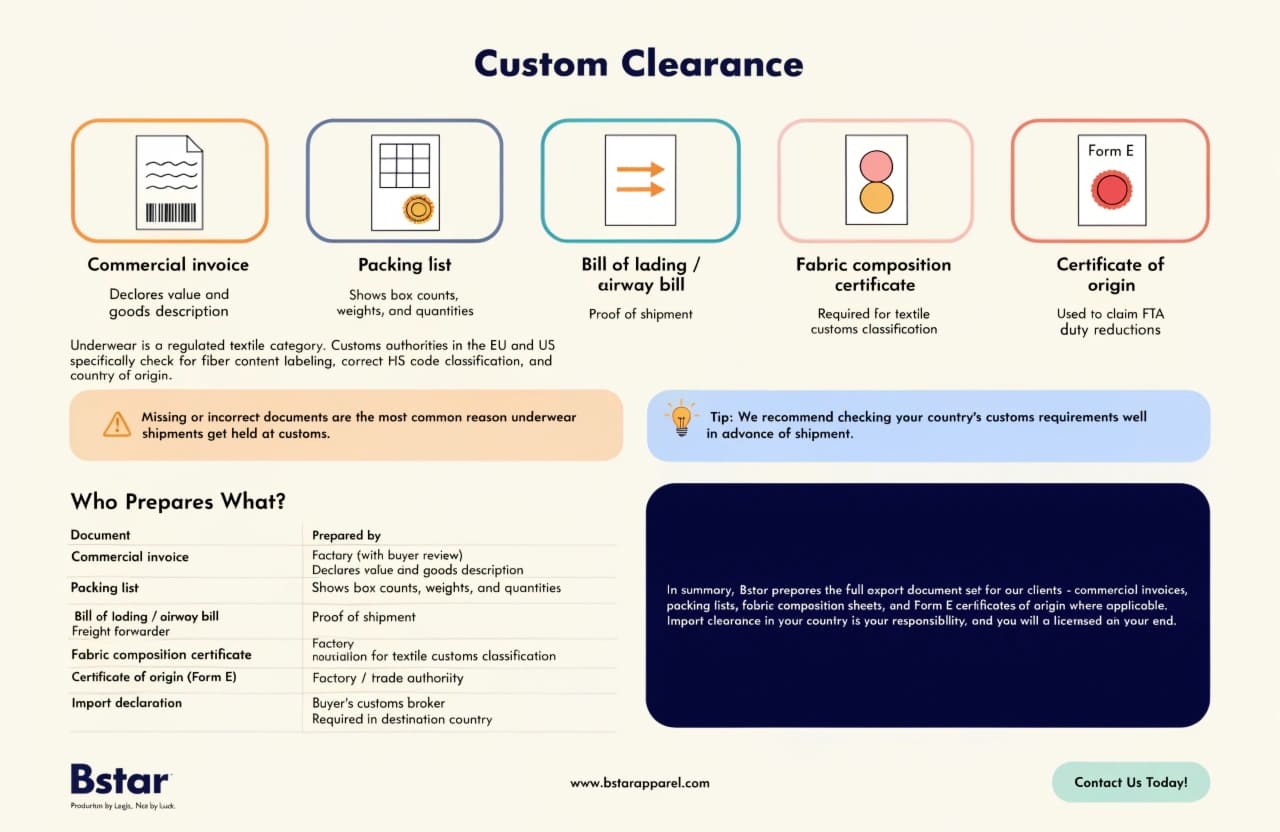
Underwear is a regulated textile category. Customs authorities in the EU and US specifically check for fiber content labeling, correct HS code classification, and country of origin.8 These are not optional.
Here is who typically prepares which document:
| Document | Who Prepares It | What It’s For |
|---|---|---|
| Commercial invoice | Factory (with buyer review) | Declares value and goods description |
| Packing list | Factory | Shows box counts, weights, and quantities |
| Bill of lading / airway bill | Freight forwarder | Proof of shipment |
| Fabric composition certificate | Factory | Required for textile customs classification |
| Certificate of origin (Form E) | Factory / trade authority | Used to claim FTA duty reductions |
| Import declaration | Buyer’s customs broker | Required in destination country |
At BSTAR, we prepare the full export document set for our clients — commercial invoice, packing list, fabric composition sheets, and Form E certificates of origin where applicable. Form E is particularly useful for buyers in countries that have free trade agreements with China through ASEAN or RCEP9 — it can reduce import duties significantly. Check with your customs broker whether your country qualifies.
One thing I want to be direct about: we handle the export side of the paperwork. Import clearance in your country is your responsibility, and you will need a licensed customs broker on your end. Do not assume the factory can handle that for you. We had a new brand client a couple of years ago whose shipment was held for 11 days at the destination port. The issue was a missing fiber content certificate. We had prepared the document, but the buyer had not passed it to their broker in time. The demurrage cost alone came to several hundred dollars. It was fully avoidable — the document existed, it just didn’t reach the right person. We now send clients a document checklist at least two weeks before shipment.
One more thing on HS codes: do not guess. The correct HS code for your specific underwear style depends on fiber content, construction, and gender10. Wrong classification can trigger audits, fines, or delays. Confirm the correct code with your customs broker before shipment, not after.
Overseas Warehousing: Does Your Business Actually Need It?
Your orders are growing. Shipping direct from China every time is slow and expensive. Is renting an overseas warehouse the right move?
Overseas warehousing makes sense when you sell in one market consistently, need faster delivery times than direct ocean freight allows, and have enough order volume to justify the monthly storage fees. For most early-stage DTC brands, it becomes worth considering once monthly outbound volume is consistent enough to cover fixed warehouse costs.
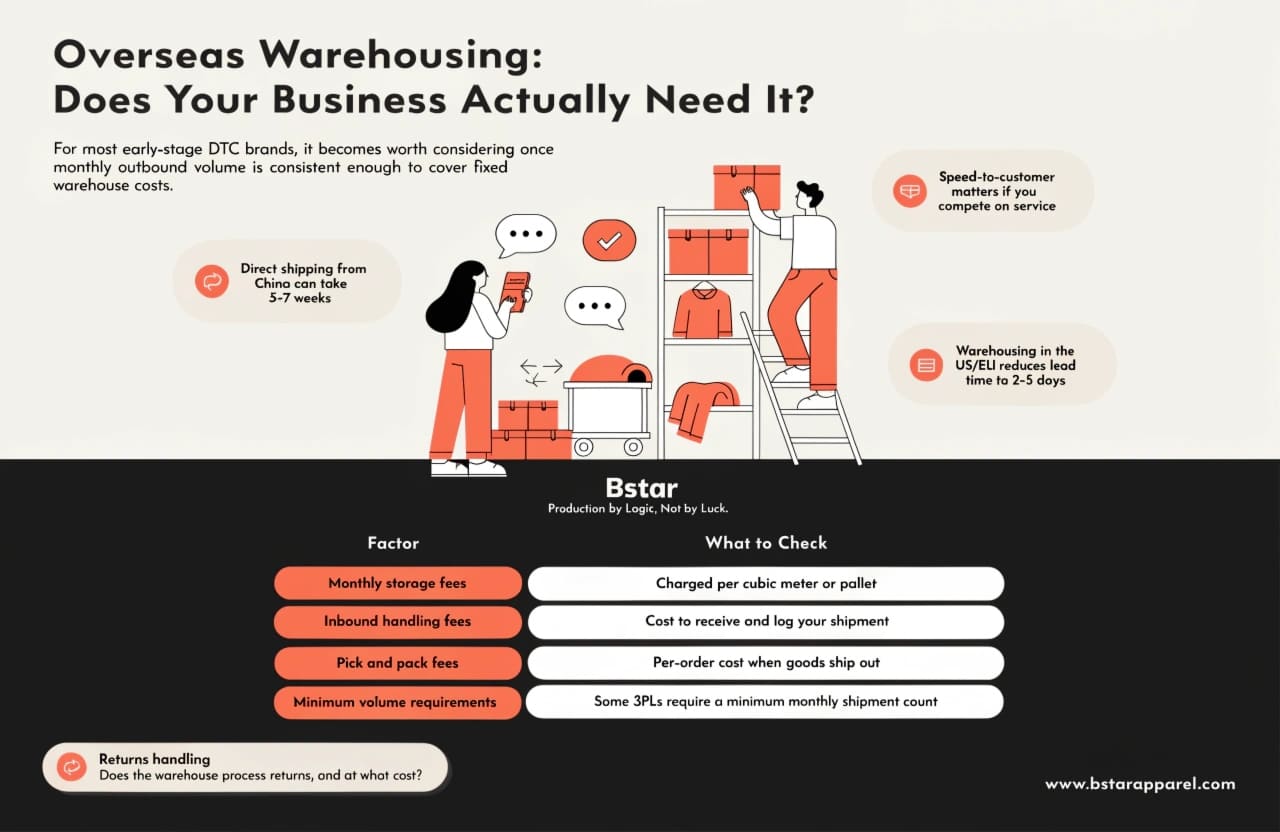
The core benefit is speed-to-customer. If your warehouse is already in the US or EU, your end customer gets their order in 2–5 days instead of 5–7 weeks. For a DTC underwear brand competing on service, that difference is significant.
But there are real costs to weigh:
| Factor | What to Check |
|---|---|
| Monthly storage fees | Charged per cubic meter or pallet |
| Inbound handling fees | Cost to receive and log your shipment |
| Pick and pack fees | Per-order cost when goods ship out |
| Minimum volume requirements | Some 3PLs require a minimum monthly shipment count |
| Returns handling | Does the warehouse process returns, and at what cost? |
The practical question for a first order is usually: do I need warehousing yet? Probably not. For your first bulk order, direct-to-warehouse shipping to your own facility or a small 3PL is usually the cleanest option. Overseas warehousing becomes a serious conversation once you are running multiple shipments per quarter into the same market.
Cargo Insurance, Tracking, and Returns: Protecting Your Order End to End
Your container is somewhere on the Pacific. You have no updates. What happens if something goes wrong?
Cargo insurance is not included by default in most freight arrangements. You need to arrange it separately. For custom underwear orders, cover the commercial invoice value plus freight costs — aim for at least 110% of the total shipment value to account for recovery costs.
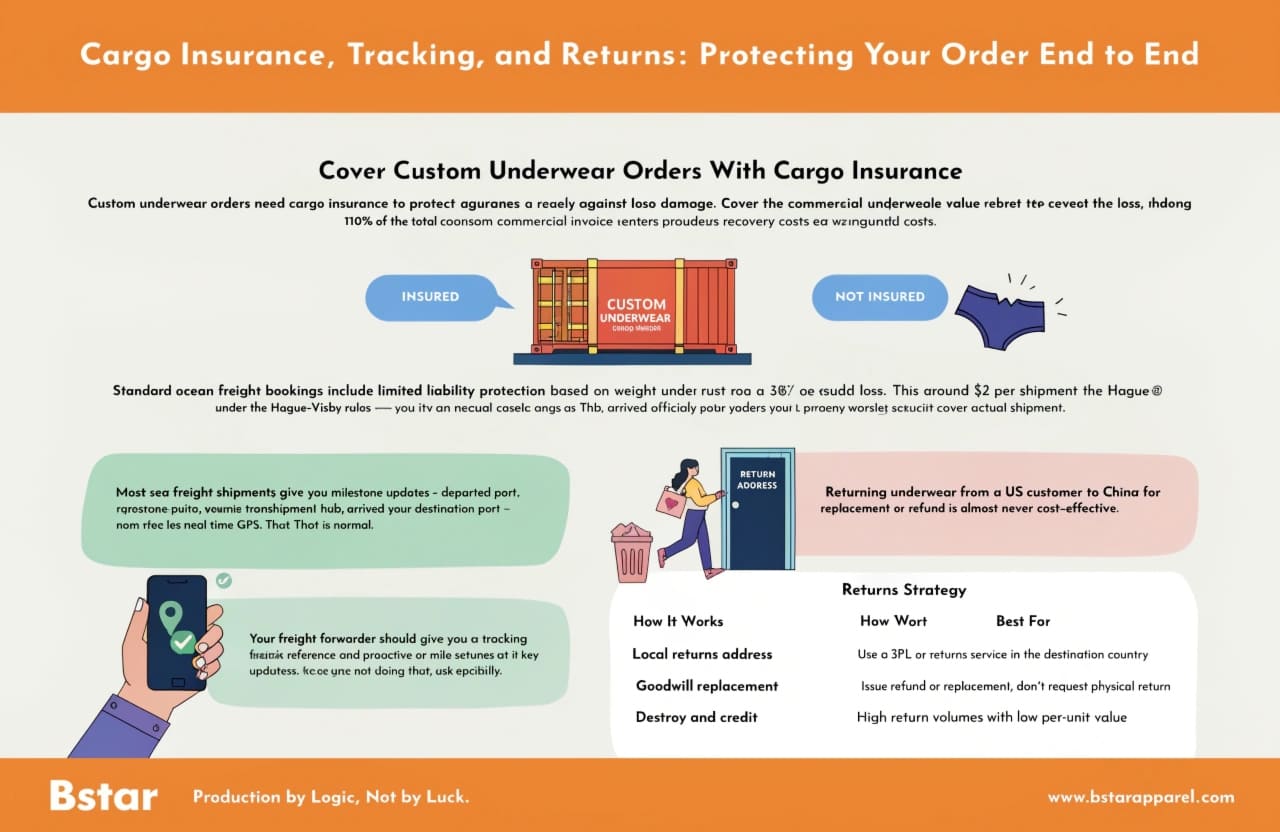
A standard ocean freight booking gives you liability protection based on weight under the Hague-Visby rules — which works out to a very small amount per kilogram11, far below the actual value of a clothing shipment. That protection sounds official but rarely covers your actual loss. Separate cargo insurance from a licensed insurer or your freight forwarder’s insurance product is what you actually need.
On tracking: most sea freight shipments give you milestone updates — departed port, arrived transshipment hub, arrived destination port — not real-time GPS12. That is normal. Your freight forwarder should give you a tracking reference and proactive updates at key milestones. If they are not doing that, ask explicitly.
On returns: this is where international DTC brands hit an unexpected wall. Returning underwear from a US customer to China for replacement or refund is almost never cost-effective. Most brands handle returns one of two ways:
| Returns Strategy | How It Works | Best For |
|---|---|---|
| Local returns address | Use a 3PL or returns service in the destination country | Brands with ongoing sales volume |
| Goodwill replacement | Issue refund or replacement, don’t request physical return | Low-value items, first orders |
| Destroy and credit | 3PL destroys unsellable returns, you log the loss | High return volumes with low per-unit value |
The right strategy depends on your margins, your return rate, and your order volume. There is no one-size-fits-all answer here, but you need a plan before your first shipment lands — not after a customer asks for a return.
Conclusion
The factory price is just the start. Real launch planning means budgeting for freight, clearing customs with the right documents, protecting your cargo, and knowing your realistic delivery timeline before you commit.
-
"The Impact of the COVID-19 Pandemic on Freight Transportation …", https://www.usitc.gov/research_and_analysis/tradeshifts/2020/special_topic.html. Industry freight rate analyses and logistics research consistently document sea freight as substantially less expensive per kilogram than air freight for manufactured goods, with cost differentials varying by route, commodity, and market conditions. Evidence role: statistic; source type: research. Supports: The magnitude of cost difference between air and sea freight for textile or apparel shipments. Scope note: Published benchmarks typically report ranges across commodity types and trade lanes; the specific 60–80% figure for underwear may not be directly verifiable from a single authoritative source. ↩
-
"Dimensional weight – Wikipedia", https://en.wikipedia.org/wiki/Dimensional_weight. Major express carriers including DHL and FedEx publish volumetric weight formulas (typically length × width × height divided by a dimensional factor) that result in billable weights significantly exceeding actual weights for low-density packaged goods such as folded garments. Evidence role: mechanism; source type: institution. Supports: How volumetric weight is calculated by express couriers and why low-density goods such as apparel are disproportionately affected. Scope note: The specific ratio of two to three times actual weight depends on packaging density and box dimensions; carrier documentation describes the formula but does not publish commodity-specific ratios. ↩
-
"A short guide on ocean freight transit times – Maersk", https://www.maersk.com/logistics-explained/transportation-and-freight/2023/09/27/sea-freight-guide. Shipping line schedules and freight industry databases document typical container transit times of approximately 28–35 days from major Chinese ports to Rotterdam and 14–21 days to Los Angeles, with total door-to-door times extended by inland transport, port congestion, and transshipment routing. Evidence role: statistic; source type: institution. Supports: Typical ocean freight transit times on the China–Europe and China–US West Coast trade lanes. Scope note: Transit times fluctuate with seasonal demand, port congestion, and carrier routing changes; published schedules represent standard service levels rather than guaranteed delivery windows. ↩
-
"Internet Purchases | U.S. Customs and Border Protection", https://www.cbp.gov/trade/basic-import-export/internet-purchases. U.S. Customs and Border Protection and European Union customs authorities publish guidance indicating that compliant commercial shipments with complete documentation are typically released within a few working days, though actual clearance times vary by port, examination selection, and document accuracy. Evidence role: statistic; source type: government. Supports: Typical customs processing and release times for textile and apparel imports in major destination markets. Scope note: Official guidance describes standard processing targets rather than guaranteed timelines; actual clearance duration depends on examination rates, staffing, and documentation completeness. ↩
-
"Best Underwear Manufacturer in China: Ultimate 2026 Guide", https://sinofinetex.com/best-underwear-manufacturer-in-china-ultimate-2026-guide/. Apparel sourcing industry reports and trade publications document production lead times for custom garment orders at Chinese factories commonly ranging from 30 to 60 days depending on order complexity, fabric sourcing requirements, and factory capacity utilization. Evidence role: statistic; source type: research. Supports: Typical production lead times for custom apparel or underwear orders at Chinese manufacturers. Scope note: Published lead time data covers broad apparel categories; specific lead times for underwear with custom fabrics or trims may differ, and the 30–45 day figure reflects the article author’s operational experience rather than a cited industry benchmark. ↩
-
"(PDF) Effect of Supply Chain Practices on Lead Time in Textile and …", https://www.academia.edu/37167092/Effect_of_Supply_Chain_Practices_on_Lead_Time_in_Textile_and_Apparel_Industry_in_Kenya. Supply chain research on apparel sourcing from China documents total lead times from order placement to destination warehouse commonly ranging from 10 to 16 weeks when accounting for production, ocean transit, and customs clearance, with variation driven by order complexity, port conditions, and seasonal demand. Evidence role: general_support; source type: research. Supports: Typical end-to-end supply chain lead times for apparel sourced from China and imported to the US or Europe. Scope note: Published lead time data reflects industry averages across product categories and sourcing arrangements; actual timelines for specific underwear orders depend on factory capacity, shipping schedules, and customs processing at the time of shipment. ↩
-
"Know Your Incoterms", https://www.trade.gov/know-your-incoterms. The International Chamber of Commerce Incoterms® 2020 rules define Ex Works (EXW) as placing maximum obligation on the buyer from the seller’s premises, while Free on Board (FOB) requires the seller to deliver goods on board the vessel at the named port of shipment, with risk transferring to the buyer at that point. Evidence role: definition; source type: institution. Supports: The formal definitions and responsibility boundaries of EXW and FOB under internationally recognized trade terms. ↩
-
"Threading Your Way Through the Labeling Requirements Under the …", https://www.ftc.gov/business-guidance/resources/threading-your-way-through-labeling-requirements-under-textile-wool-acts. In the United States, the Textile Fiber Products Identification Act (enforced by the FTC) requires fiber content disclosure on imported textiles, while U.S. Customs and Border Protection enforces country of origin marking under 19 U.S.C. § 1304; in the European Union, Regulation (EU) No 1007/2011 mandates fiber composition labeling for textile products placed on the market. Evidence role: expert_consensus; source type: government. Supports: US and EU regulatory requirements for fiber content labeling, HS classification, and country of origin on imported textile and apparel products. ↩
-
"Regional Comprehensive Economic Partnership – Wikipedia", https://en.wikipedia.org/wiki/Regional_Comprehensive_Economic_Partnership. The ASEAN–China Free Trade Agreement and the Regional Comprehensive Economic Partnership (RCEP) provide preferential tariff rates for qualifying goods originating in member countries; Form E (ACFTA Certificate of Origin) is the instrument used to claim these rates, with eligibility and applicable duty reductions varying by product HS code and importing country. Evidence role: mechanism; source type: government. Supports: The role of Form E certificates of origin in claiming preferential tariff rates under the ASEAN–China Free Trade Agreement and RCEP. Scope note: Preferential rates and rules of origin requirements differ by product category and bilateral country pair within RCEP; importers must verify eligibility with their national customs authority. ↩
-
"[PDF] Harmonized Tariff Schedule of the United States Revision 7 (2026)", https://hts.usitc.gov/reststop/file?release=currentRelease&filename=Chapter%2061. The World Customs Organization Harmonized System schedule classifies underwear primarily within Chapters 61 (knitted or crocheted) and 62 (woven), with subheadings differentiated by gender (e.g., HS 6107 for men’s, 6108 for women’s) and further subdivided by predominant fiber content, making accurate classification dependent on product-specific technical details. Evidence role: mechanism; source type: institution. Supports: The classification criteria that determine the correct HS code for underwear, including fiber content, construction method, and gender. ↩
-
"Creating Uniform Worldwide Liability Standards for Sea …", https://digitalcommons.du.edu/cgi/viewcontent.cgi?article=1366&context=tlj. The Hague-Visby Rules (the International Convention for the Unification of Certain Rules of Law relating to Bills of Lading, as amended by the 1968 Brussels Protocol) establish carrier liability limits of 2 Special Drawing Rights per kilogram or 666.67 SDR per package, whichever is higher, amounts that typically fall well below the commercial value of manufactured textile goods. Evidence role: mechanism; source type: institution. Supports: The Hague-Visby Rules’ carrier liability limits and their inadequacy for high-value manufactured goods such as apparel. Scope note: Applicable liability limits depend on whether the destination country has ratified the Hague-Visby Rules or applies the original Hague Rules or Hamburg Rules; the specific limit in force varies by jurisdiction. ↩
-
"Automatic identification system – Wikipedia", https://en.wikipedia.org/wiki/Automatic_identification_system. Ocean freight container tracking relies primarily on carrier event reporting at port milestones (loading, transshipment, arrival) supplemented by vessel-level AIS (Automatic Identification System) data, which provides vessel position rather than individual container location; this contrasts with express courier networks that offer parcel-level scan events throughout transit. Evidence role: mechanism; source type: research. Supports: The nature of tracking visibility available for ocean freight shipments compared to express courier services. Scope note: Emerging supply chain visibility platforms and some carrier portals offer enhanced tracking by aggregating AIS and terminal data, meaning tracking granularity varies by carrier and technology provider. ↩
Discussion & questions 0 comments