
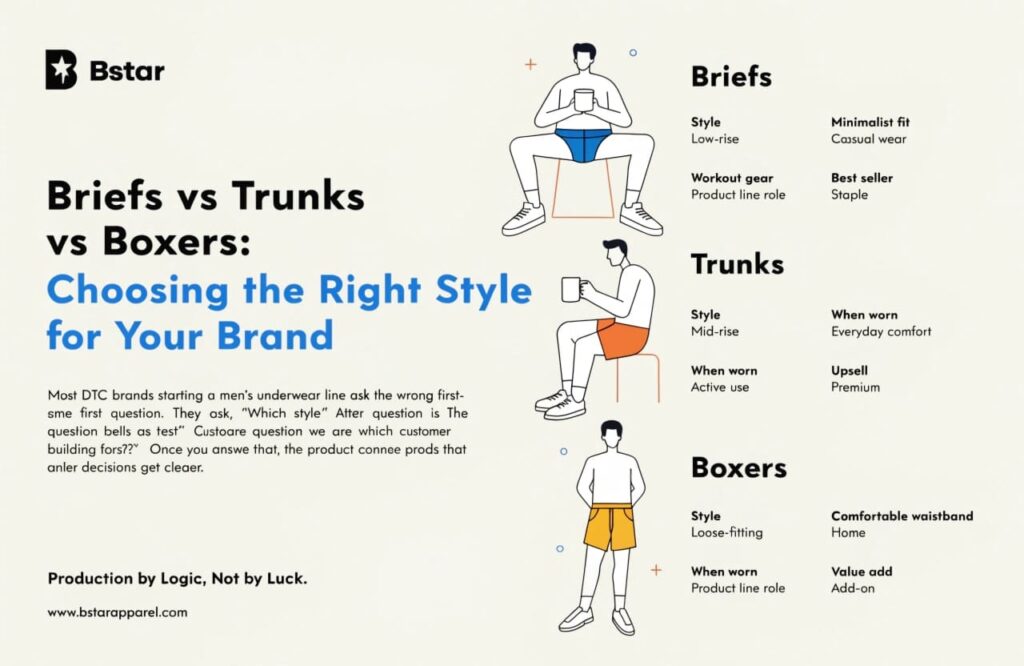
You picked a category. Now you need to pick a style. And if you get this wrong at the sampling stage, you will pay for it in returns, complaints, and dead inventory.
Briefs, trunks, and boxers are not just different shapes. Each one serves a different customer need, wearing scenario, and product-line role. Choosing between them means understanding who buys from you, when they wear the product, and what job you want that SKU to do.
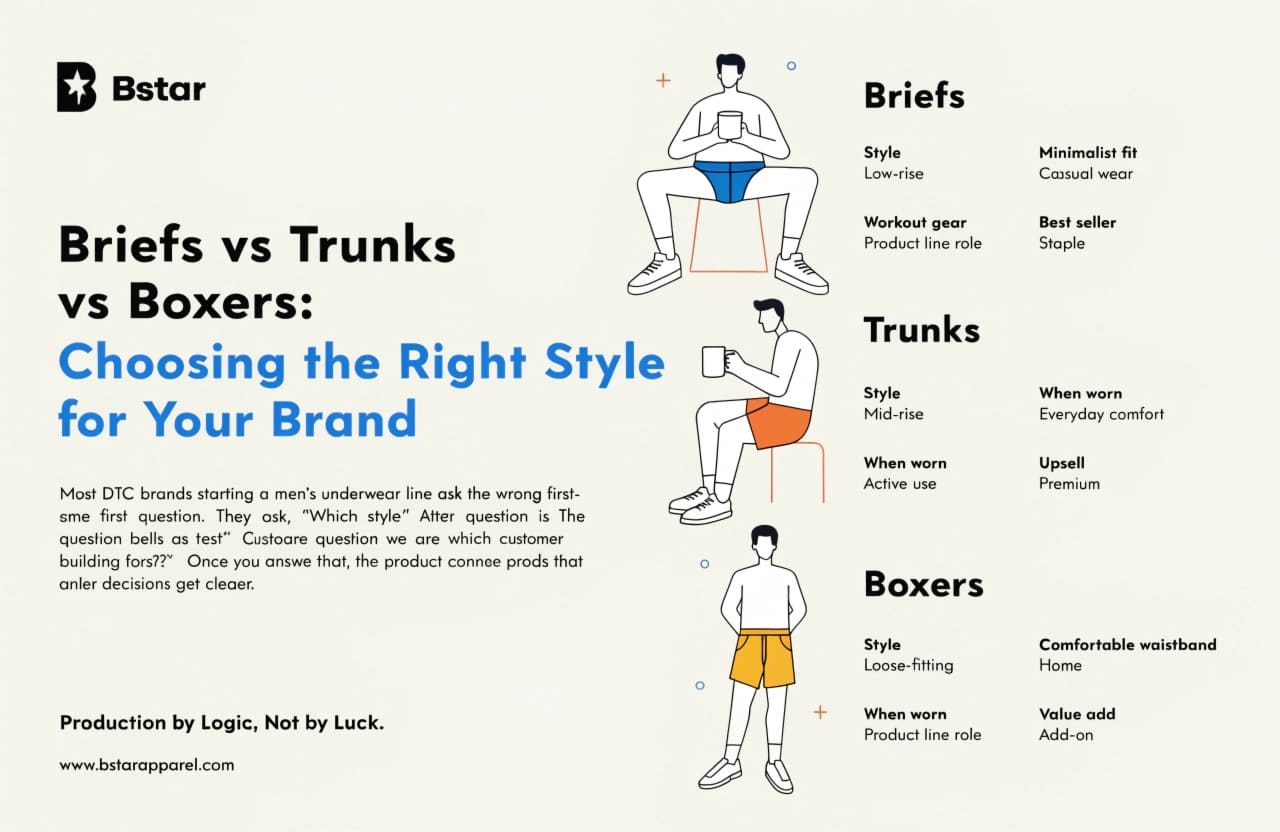
Most DTC brands starting a men’s underwear line ask the wrong first question. They ask, "Which style sells best?" The better question is, "Which style fits the customer we are building for?" Once you answer that, the product decisions get a lot clearer.
What Actually Separates Briefs, Trunks, and Boxers From Each Other?
It is easy to say briefs are short, trunks are medium, and boxers are long. But that does not help you make a product decision. What matters is how each cut behaves on a body and in a wearing scenario.
Briefs give maximum support with minimum fabric. Trunks cover more of the thigh and stay in place through movement. Boxers offer a relaxed fit with little to no compression, which makes them better for low-activity or sleep-oriented use cases1.
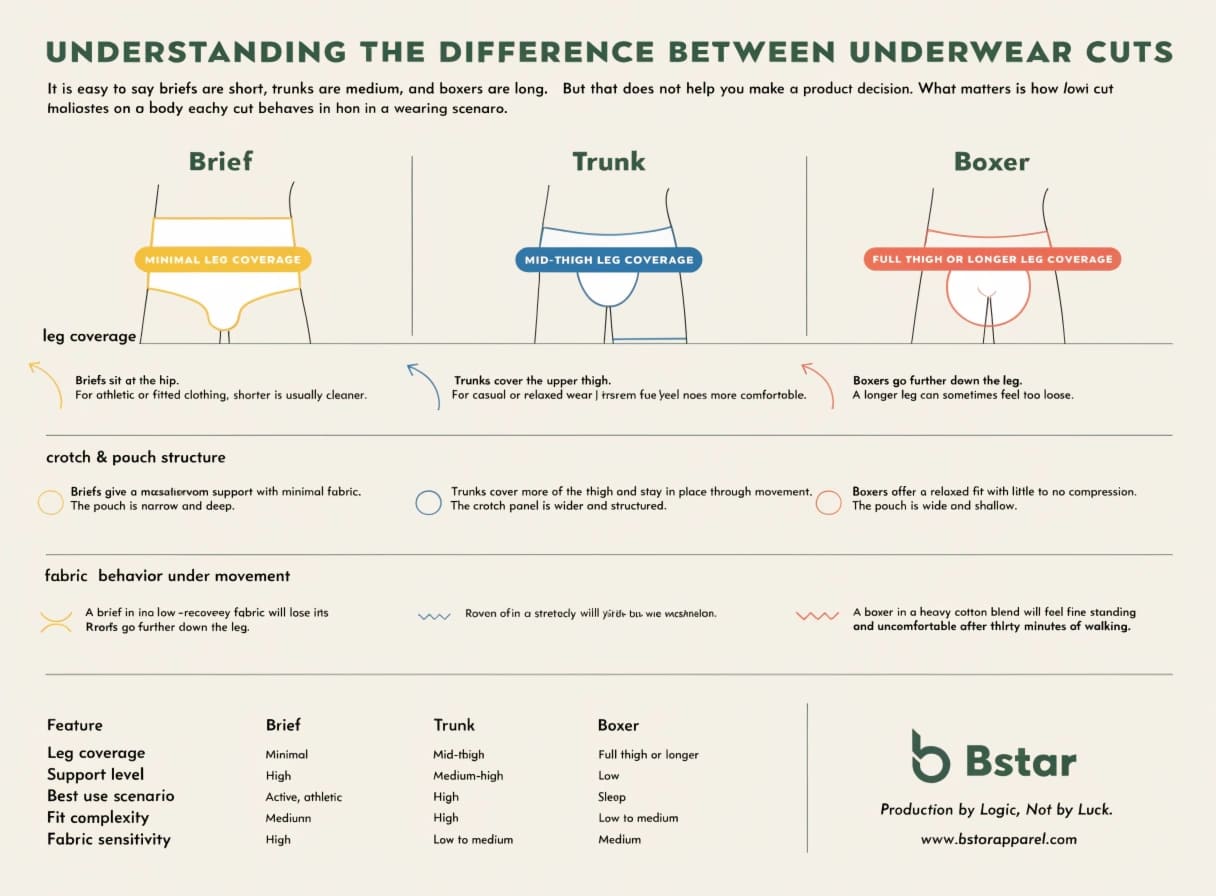
The real difference shows up in three areas: leg coverage, crotch structure, and fabric behavior under movement.
Leg Coverage
Leg length affects how the underwear interacts with outerwear. Briefs sit at the hip. Trunks cover the upper thigh. Boxers go further down the leg. For athletic or fitted clothing, shorter is usually cleaner. For casual or relaxed wear, longer feels more comfortable.
Crotch and Pouch Structure
This is where most first-time underwear brands underestimate complexity. A brief with no structured pouch will feel flat and unsupportive. A trunk with a poorly sewn crotch panel will bunch and shift. In OEM development discussions, we often see brands focus on the external silhouette and miss the internal construction details that determine actual comfort. The pouch depth, panel count, and seam placement all change how the product feels in real wear.
Fabric Behavior Under Movement
A boxer in a heavy cotton blend will feel fine standing still and uncomfortable after thirty minutes of walking2. A brief in a low-recovery fabric will lose its shape after a few washes3. The category name tells you the cut. The fabric tells you whether the cut actually works.
| Feature | Brief | Trunk | Boxer |
|---|---|---|---|
| Leg coverage | Minimal | Mid-thigh | Full thigh or longer |
| Support level | High | Medium-high | Low |
| Best use scenario | Active, athletic | Daily wear | Relaxed, sleep |
| Fit complexity | Medium | High | Low to medium |
| Fabric sensitivity | High | High | Medium |
Who Is Actually Buying, and What Are They Expecting?
Before you decide which style to sample, you need to map the style to a real customer profile. Not a demographic table. A real use case.
Different underwear styles attract different buyer expectations. A customer who wants everyday comfort needs something different from a customer who wants performance support or weekend relaxation. Getting this wrong at the product level means attracting buyers whose expectations your product cannot meet.
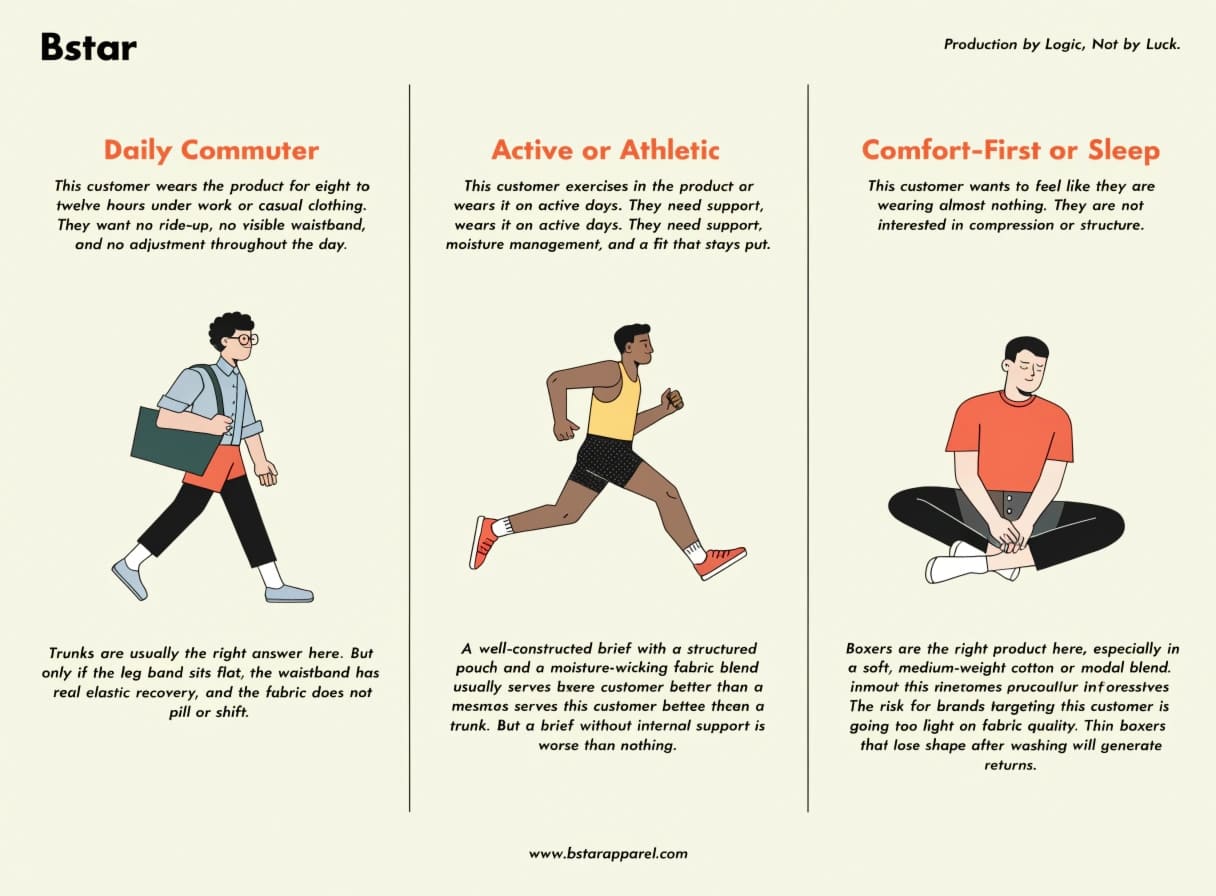
Here is how we usually think about it in product development conversations.
The Daily Commuter Profile
This customer wears the product for eight to twelve hours under work or casual clothing. They want no ride-up, no visible waistband, and no adjustment throughout the day. Trunks are usually the right answer here. But only if the leg band sits flat, the waistband has real elastic recovery, and the fabric does not pill or shift. A trunk that looks right in a photo can still fail this customer if the construction is off.
The Active or Athletic Profile
This customer exercises in the product or wears it on active days. They need support, moisture management4, and a fit that stays put. A well-constructed brief with a structured pouch and a moisture-wicking fabric blend usually serves this customer better than a trunk. But a brief without internal support is worse than nothing.
The Comfort-First or Sleep Profile
This customer wants to feel like they are wearing almost nothing. They are not interested in compression or structure. Boxers are the right product here, especially in a soft, medium-weight cotton or modal blend. The risk for brands targeting this customer is going too light on fabric quality. Thin boxers that lose shape after washing will generate returns.
The First-Range Decision
If you are launching a first SKU and need to minimize risk, trunks are usually the safest entry point. They work across more body types, cover more wearing scenarios, and are easier to explain to a new customer. But safe does not mean easy to execute. A poorly developed trunk is still a bad product.
Should You Follow Trends or Build a Core Range First?
Every season there is a new silhouette, a new fabric story, or a new waistband detail getting attention. The question for a small brand is whether to chase that or build something that lasts.
Trend-led products can drive early attention, but a core underwear range needs to work across seasons5. For most DTC brands, the smarter move is to build one reliable, well-constructed hero SKU before adding trend-driven styles.
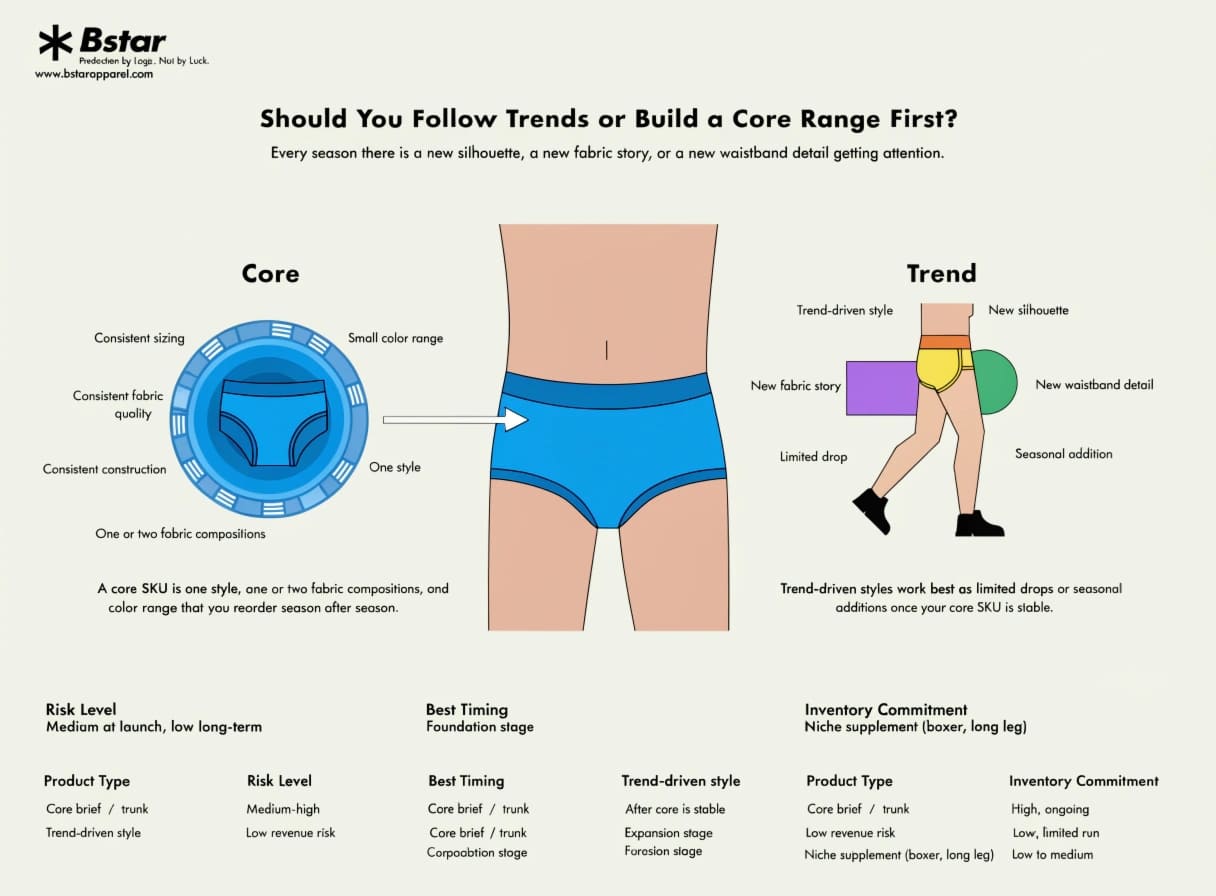
From a manufacturing and product-development perspective, trend-chasing at small order volumes creates real cost and risk problems.
What Core Means in Practice
A core SKU is one style, one or two fabric compositions, and a small color range that you reorder season after season. It needs consistent sizing, consistent fabric quality, and consistent construction. That consistency is harder to achieve than most brands expect. Fabric dye lots shift. Elastic suppliers change specs6. A core product requires active quality management, not just a one-time sample approval.
Where Trends Fit In
Trend-driven styles work best as limited drops or seasonal additions once your core SKU is stable. They let you test new silhouettes or fabrics with lower inventory risk. If a trend-driven style sells, you learn something about your customer. If it does not, you have not broken your core business.
| Product Type | Risk Level | Best Timing | Inventory Commitment |
|---|---|---|---|
| Core brief / trunk | Medium at launch, low long-term | Foundation stage | High, ongoing |
| Trend-driven style | Medium-high | After core is stable | Low, limited run |
| Niche supplement (boxer, long leg) | Low revenue risk | Expansion stage | Low to medium |
How Do You Actually Stand Out Once You Pick a Style?
Choosing a style is step one. Making that style better than what already exists in the market is step two.
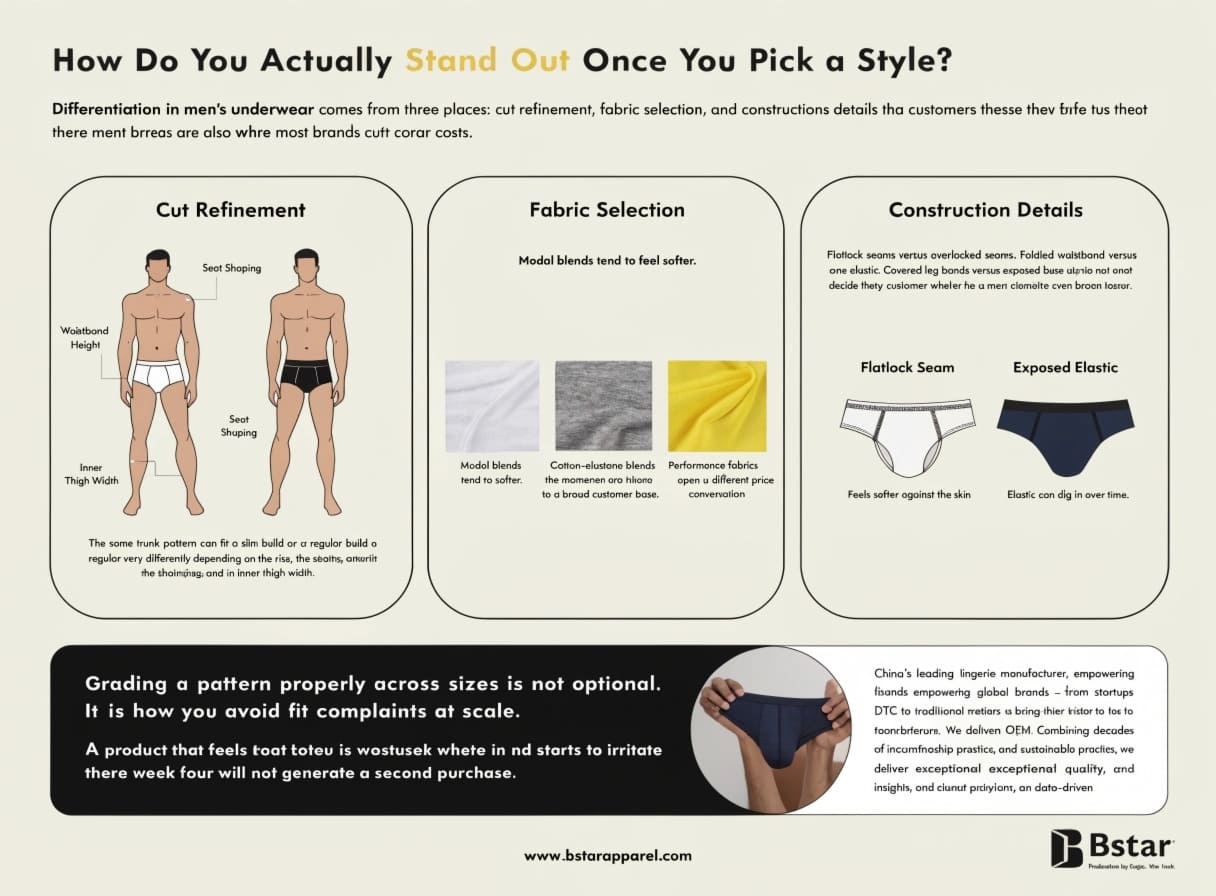
Differentiation in men’s underwear comes from three places: cut refinement, fabric selection, and small construction details that customers feel but rarely describe. These are also the areas where most brands cut corners to reduce sampling cost.
Cut Refinement
The same trunk pattern can fit a slim build or a regular build very differently depending on the rise, the seat shaping, and the inner thigh width. In OEM development discussions, we often see brands approve a sample on one fit model and then discover after bulk production that the sizing does not translate across their customer base. Grading a pattern properly across sizes is not optional. It is how you avoid fit complaints at scale7.
Fabric Selection
Fabric is where most of the perceived quality lives. A customer cannot see your seam allowances. They can feel whether the waistband digs in, whether the fabric softens after washing, and whether the product holds its shape. Modal blends tend to feel softer8. Cotton-elastane blends tend to be more familiar to a broad customer base9. Performance fabrics open a different price conversation. The right fabric depends on your positioning, not on which fiber sounds best in a product description.
Construction Details
Flatlock seams versus overlocked seams10. Folded waistband versus exposed elastic. Covered leg bands versus bare elastic. These details do not make headlines, but they decide whether a customer reorders. A product that feels good in week one and starts to irritate in week four will not generate a second purchase11.
Conclusion
Pick your style based on your customer and their real use case, not on what looks popular. Build one thing well before you build many things fast.
-
"Influence of the type of undertrousers and physical activity on scrotal …", https://pubmed.ncbi.nlm.nih.gov/15618251/. Research on scrotal thermoregulation, including studies published in reproductive medicine journals, suggests that tight-fitting underwear elevates scrotal temperature relative to loose-fitting alternatives; sleep medicine literature additionally notes that restrictive garments can disrupt sleep comfort, providing indirect support for preferring low-compression styles during sleep. Evidence role: general_support; source type: paper. Supports: Wearing loose-fitting, low-compression underwear during sleep may support scrotal thermoregulation and reduce discomfort associated with tight garments. Scope note: Direct experimental studies comparing underwear styles on objective sleep quality metrics are limited; the thermoregulation evidence is stronger than the sleep quality evidence. ↩
-
"Synthetic garments enhance comfort, thermoregulatory response …", https://pubmed.ncbi.nlm.nih.gov/25463694/. Research on textile performance indicates that cotton fibers absorb and retain moisture rather than wicking it away from the skin, which can increase friction and discomfort during sustained physical activity. Evidence role: mechanism; source type: paper. Supports: Cotton’s low moisture-wicking capacity and tendency to retain sweat contribute to discomfort during prolonged physical movement compared to synthetic or blended fabrics. Scope note: Most textile comfort studies focus on athletic outerwear or socks rather than underwear specifically; findings may not translate directly to the underwear use case described. ↩
-
"[PDF] Effect of Laundering on Dynamic Elastic Behavior of Cotton and …", https://jtatm.textiles.ncsu.edu/index.php/JTATM/article/viewFile/2593/1790. Textile testing standards, such as those published by ASTM International, include protocols for measuring elastic recovery and dimensional stability after laundering, which directly affect garment shape retention over time. Evidence role: mechanism; source type: institution. Supports: Fabrics with insufficient elastane content or low elastic recovery ratings degrade dimensionally after repeated laundering cycles. Scope note: Specific thresholds for ‘low recovery’ vary by standard and end-use category; the article does not specify a fiber composition, making direct citation to a single standard approximate. ↩
-
"A Case-Series Observation of Sweat Rate Variability in Endurance …", https://pmc.ncbi.nlm.nih.gov/articles/PMC8226773/. Exercise physiology research documents elevated sweat rates in the groin region during moderate to vigorous physical activity; textile studies on moisture transport confirm that fabrics with higher wicking capacity reduce skin wetness and associated discomfort in this area. Evidence role: mechanism; source type: paper. Supports: The groin and perineal region generates significant sweat during physical activity, making moisture transport properties of underwear fabric relevant to comfort and skin health. Scope note: Studies on groin-specific sweat rates are less common than whole-body sweat research; extrapolation from general thermoregulation literature involves some inference. ↩
-
"Best 3PLs for Apparel Brands in 2026 [Complete Guide] – ShipCalm", https://www.shipcalm.com/blog/best-3pls-for-apparel-brands/. Product portfolio management frameworks in marketing and operations research, including work on SKU rationalization and new product development, generally recommend establishing a stable, high-velocity core assortment before committing resources to trend-sensitive extensions, as core products provide predictable demand and support supply chain efficiency. Evidence role: expert_consensus; source type: paper. Supports: Product management literature supports establishing a reliable core offering before expanding into trend-sensitive SKUs as a risk-reduction strategy for consumer goods brands. Scope note: This principle is drawn from general product management literature; empirical studies focused specifically on DTC underwear brand strategy are not available in the academic literature. ↩
-
"Sustainable and cleaner production of elastic core-spun yarns for …", https://pmc.ncbi.nlm.nih.gov/articles/PMC10875377/. Quality management standards applicable to textile and apparel manufacturing, including ISO 105 series for color fastness and AATCC test methods for color consistency, acknowledge inter-lot variation as an inherent production risk requiring active monitoring and control. Evidence role: expert_consensus; source type: institution. Supports: Dye lot variation and component specification drift are recognized quality risks in apparel supply chains, addressed by standards bodies and quality management frameworks. Scope note: These standards describe testing protocols rather than quantifying how frequently dye lot or elastic specification shifts occur in practice. ↩
-
"[PDF] The Influence of Self-Construal on Consumer Responses to Sizing …", https://scholarworks.utrgv.edu/cgi/viewcontent.cgi?article=1055&context=marketing_fac. Apparel engineering literature on size grading documents that proportional increments applied during grading must account for body shape variation across size ranges; failure to do so produces garments that fit the base size but deviate from expected fit at larger or smaller sizes, a recognized driver of consumer returns. Evidence role: mechanism; source type: paper. Supports: Inconsistent pattern grading across sizes produces fit deviations that increase consumer dissatisfaction and return rates in apparel. Scope note: Quantitative data linking grading errors specifically to return rates in the underwear category is limited in published literature. ↩
-
"Hand-Feel Touch Cues and Their Influences on Consumer … – PMC", https://pmc.ncbi.nlm.nih.gov/articles/PMC6678767/. Modal is a type of rayon produced from beech tree cellulose; its finer fiber diameter relative to conventional cotton is associated with a softer tactile quality, as documented in fiber characterization literature from producers such as Lenzing AG and corroborated in textile science references. Evidence role: general_support; source type: research. Supports: Modal fibers, derived from beech wood pulp, have a finer diameter than standard cotton fibers, which contributes to a softer perceived hand feel. Scope note: Perceived softness is partly subjective and influenced by fabric construction and finishing treatments, not fiber composition alone. ↩
-
"Study on the Permeability and Absorption Performance of the Crotch …", https://pmc.ncbi.nlm.nih.gov/articles/PMC10935086/. Industry reports from organizations such as the International Cotton Advisory Committee indicate that cotton accounts for a substantial share of global underwear fabric consumption, supporting the assertion that cotton-based blends represent the most familiar category to broad consumer audiences. Evidence role: statistic; source type: institution. Supports: Cotton remains the dominant fiber used in underwear globally, making cotton-based blends the most commonly encountered fabric type for consumers. Scope note: Market share data varies by region and product segment; ‘familiarity’ as a consumer perception metric is not directly measured by fiber consumption statistics. ↩
-
"Performance Characteristics of the Merrow Infused ActiveSeam®: A …", https://www.iastatedigitalpress.com/itaa/article/id/13532/. In garment construction, a flatlock stitch joins fabric panels so that the seam allowances lie flat rather than standing upright; this construction method is widely documented in apparel engineering literature as reducing skin abrasion in close-fitting garments. Evidence role: definition; source type: encyclopedia. Supports: Flatlock seams lie flat against the skin and distribute stress across a wider area, reducing the ridge that overlocked seams can create and thereby lowering friction-related irritation. Scope note: Comparative comfort studies specifically on underwear seam types are limited; most evidence comes from activewear and hosiery research. ↩
-
"(PDF) A Study On The Drivers Of Customer Satisfaction And Repeat …", https://www.academia.edu/99068482/A_Study_On_The_Drivers_Of_Customer_Satisfaction_And_Repeat_Purchase_In_Online_Shopping_For_Apparel_A_Structural_Equation_Modeling_Approach. Consumer behavior research in apparel marketing consistently identifies post-purchase satisfaction—driven by product performance over time rather than initial impression alone—as a primary antecedent of repurchase intention and brand loyalty. Evidence role: mechanism; source type: paper. Supports: Post-purchase product performance, including durability and sustained comfort, is a significant predictor of repeat purchase intention in apparel categories. Scope note: Most cited studies examine apparel broadly; underwear-specific repeat purchase research is sparse in the academic literature. ↩
Discussion & questions 0 comments