
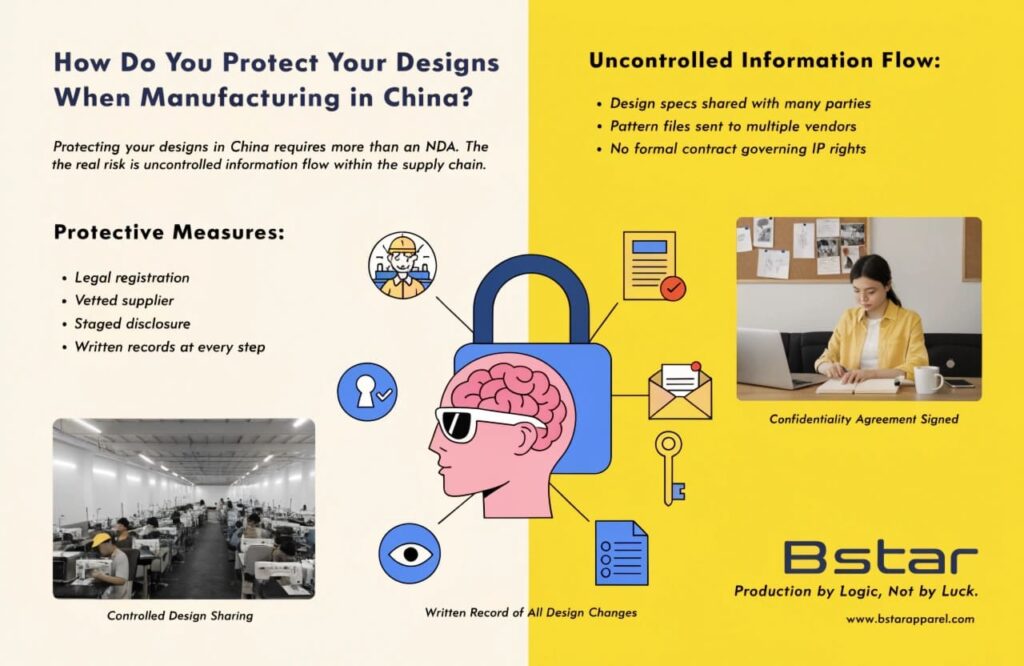
You spent months developing your designs. Now you are about to hand them to a factory overseas. That fear of losing control is real — and it is worth taking seriously.
Protecting your designs in China requires more than an NDA. The real risk is uncontrolled information flow inside the supply chain. You need legal registration, a vetted supplier, staged disclosure, and written records at every production step.
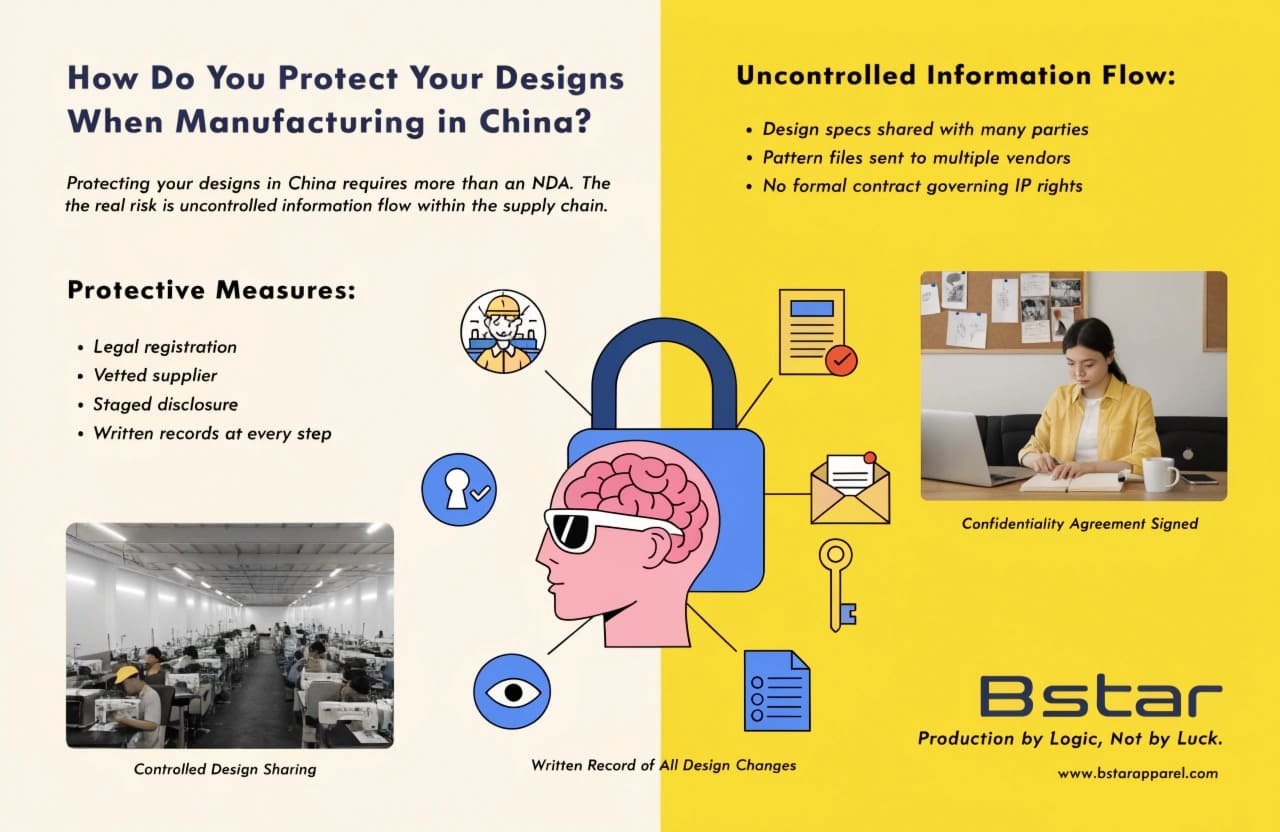
Most brands I talk to come in with the same question: "Can I trust a Chinese factory with my designs?" But that is not quite the right question. The better question is: "How do I choose and manage a supplier so my designs stay under control before launch?" That shift in framing changes everything about how you approach this.
Should You Register Your IP in China First?
A lot of founders skip this step because it feels slow or expensive. Then they regret it later.
China follows a "first-to-file" system. If you do not register your trademark or patent in China, someone else can.1 Registration is not a guarantee, but it gives you a legal foundation to act on if something goes wrong.
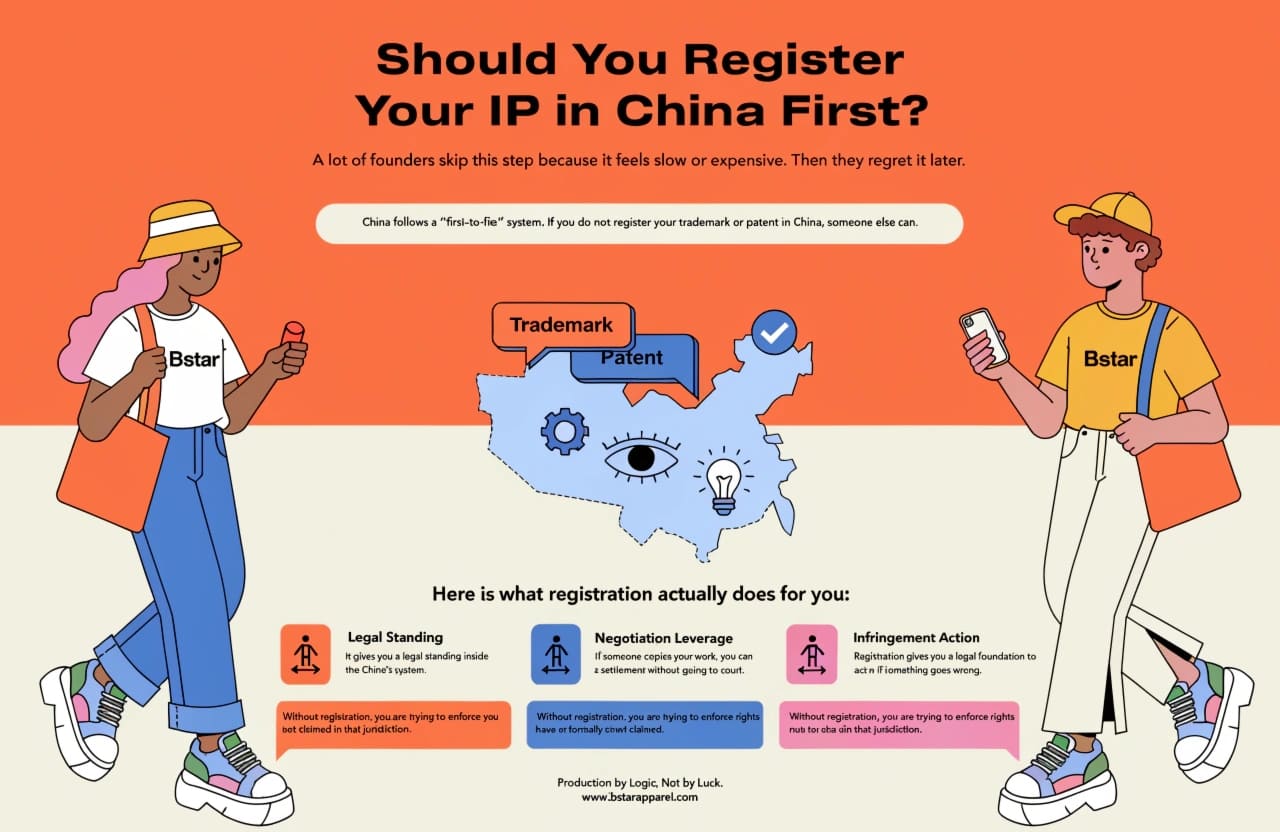
Here is what registration actually does for you. It gives you a legal standing inside China’s system. Without it, you are trying to enforce rights you have not formally claimed in that jurisdiction.
What should you actually register?
This depends on your product and business stage. Here is a basic breakdown:
| IP Type | What It Covers | Who Should Consider It |
|---|---|---|
| Trademark | Brand name, logo, label | Any brand selling or sourcing from China |
| Patent (Design) | Visual appearance of a product | Brands with original product shapes or details |
| [Copyright | Original artwork, prints, graphics | Brands using custom prints or surface designs](https://en.wikipedia.org/wiki/Intellectual_property_in_China)[^2] |
You do not need to register everything at once. But your trademark is the minimum baseline. If you are using a factory to develop a product that has a distinctive visual design — a unique cut, a signature detail — a design patent is worth discussing with an IP lawyer who works in China.2
I want to be clear here: I am a manufacturer, not a law firm. For anything involving contracts, registration timelines, or enforcement filings, you need to speak with a qualified IP attorney who handles China. What I can tell you is that brands who arrive with registered trademarks are in a much stronger position if a dispute ever comes up.
How Do You Know If a Factory Will Handle Your IP Carefully?
This is where the real work happens, and it is not about nationality. It is about process.
The risk is not "China" as a category. The risk is an uncontrolled factory — one that shares your tech pack with subcontractors, uses your sample photos without permission, or has no clear process for who handles your files.
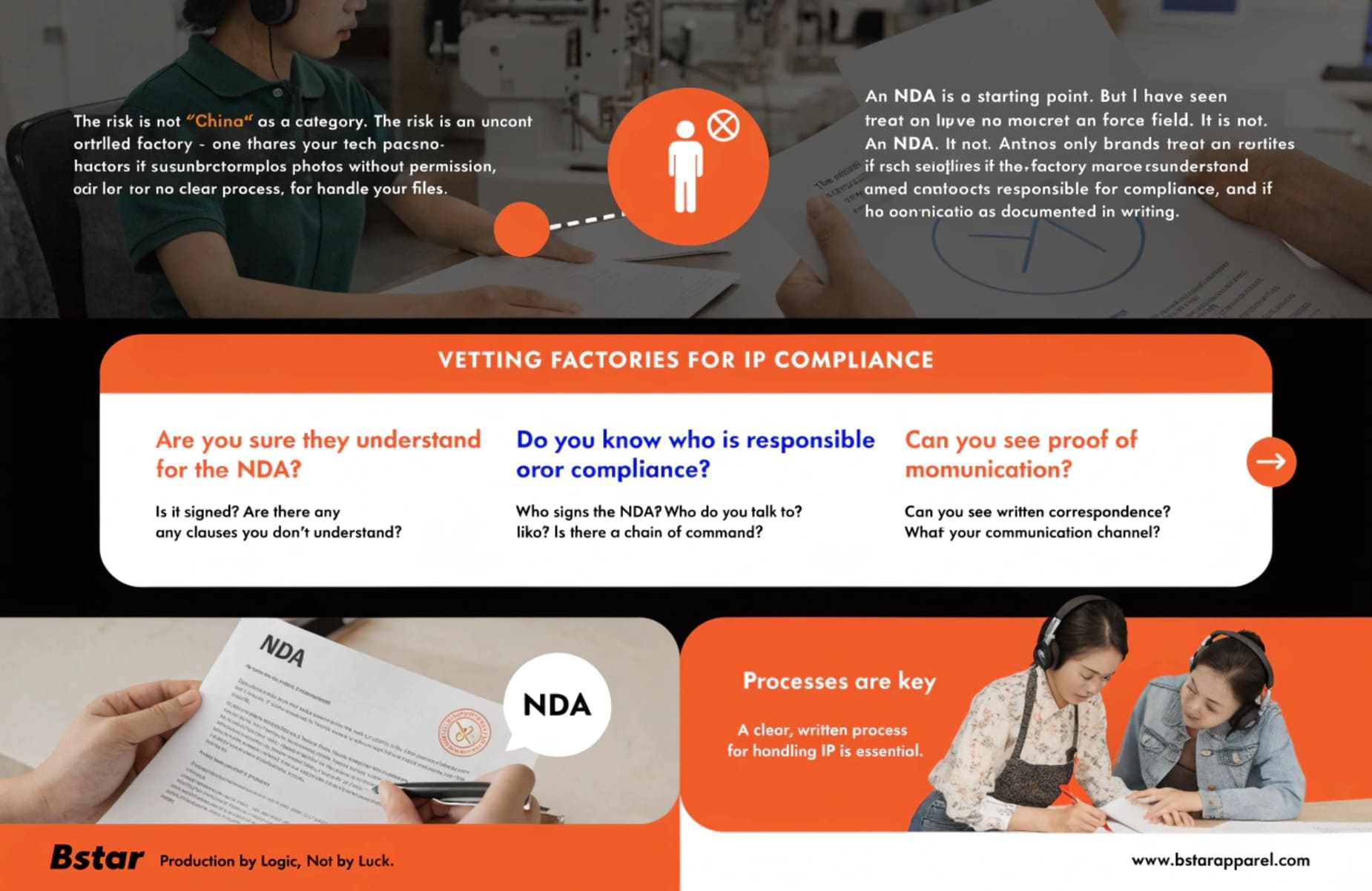
An NDA is a starting point. But I have seen brands treat an NDA like a force field. It is not.3 An NDA only matters if the factory understands it, if there are named contacts responsible for compliance, and if communication is documented in writing.
What to ask a factory before you share anything
Before you send a tech pack or reference image, ask these questions directly:
| Question | Why It Matters |
|---|---|
| Who inside your team will see my tech pack and patterns? | Limits internal exposure |
| Is any part of sampling or production outsourced? | Subcontractors are outside your NDA4 |
| How do you store and share sample photos? | Images can be used in factory portfolios without permission5 |
| Is there one contact person responsible for my project? | Scattered communication means scattered accountability |
| How do you document approvals and changes? | Written records are your evidence if something goes wrong6 |
A factory that cannot answer these questions clearly is a red flag — not because they are dishonest, but because they do not have a controlled process. At BSTAR, when a new brand asks us these questions, we walk them through exactly who handles each stage: who sees the pattern, who does the stitching, who photographs the sample, and whether any trim or process is handled outside our facility. That transparency should be the baseline, not a bonus.
Most first-time brands share too much, too early. You do not need to hand over your full tech pack to get a quote.
Disclose design information in stages. Share enough for the factory to sample accurately, but hold back sensitive details — like proprietary constructions or unreleased print files — until the working relationship is established and NDAs are signed.7
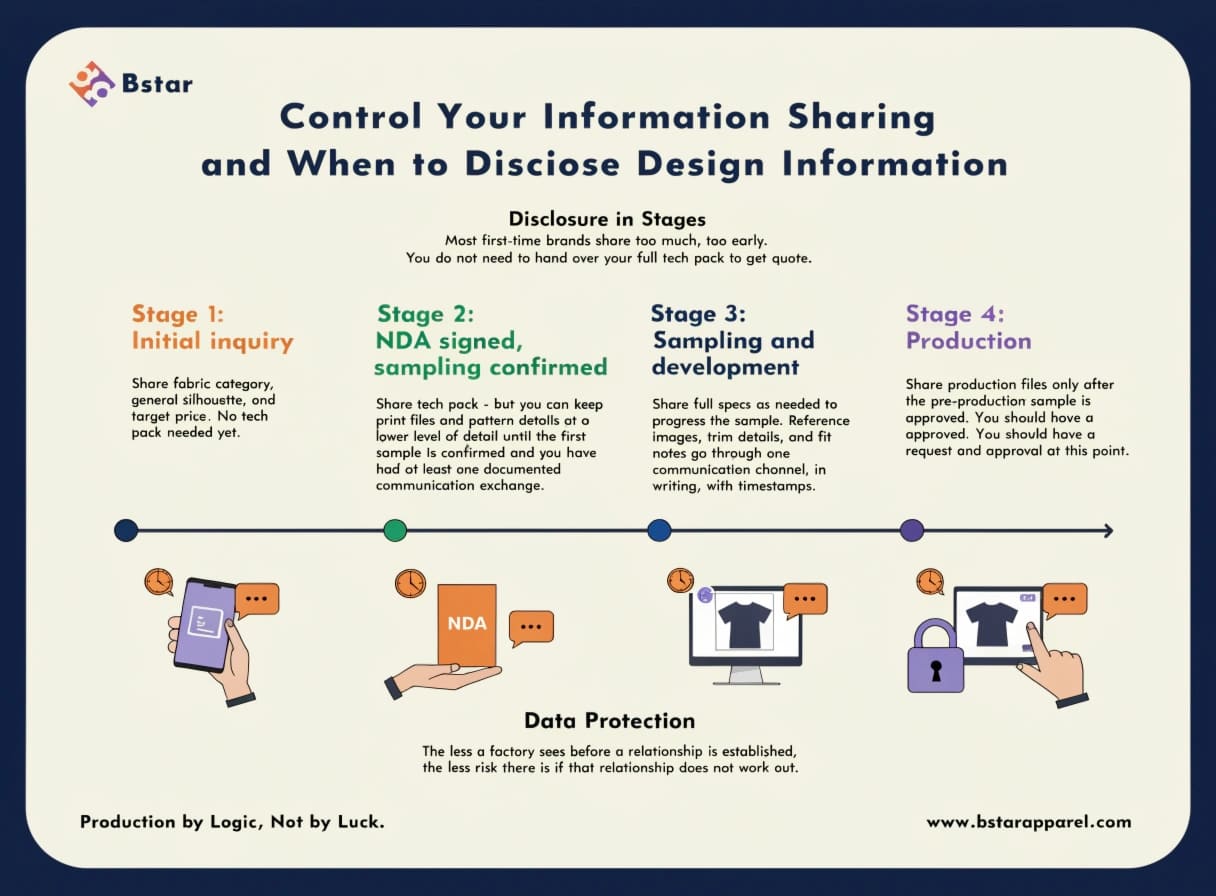
This is how a staged disclosure approach works in practice:
Stage 1: Initial inquiry
Share fabric category, general silhouette, and target price. No tech pack needed yet. This is enough for a factory to tell you if they can make what you need.
Stage 2: NDA signed, sampling confirmed
Now you share a tech pack — but you can keep print files and pattern details at a lower level of detail until the first sample is confirmed and you have had at least one documented communication exchange.
Stage 3: Sampling and development
Full specs are shared as needed to progress the sample. Reference images, trim details, and fit notes go through one communication channel, in writing, with timestamps.
Stage 4: Production
Production files are shared only after the pre-production sample is approved. You should have a written record of every change request and approval at this point.
This is not about distrust. It is about limiting your exposure at each step. The less a factory sees before a relationship is established, the less risk there is if that relationship does not work out.
What Do You Do If Your Designs Are Copied?
This is the scenario everyone dreads. Let me give you a realistic picture.
If infringement happens, your options depend almost entirely on what you registered, what you documented, and whether your supplier agreements are in writing. Without those three things, enforcement is very difficult.
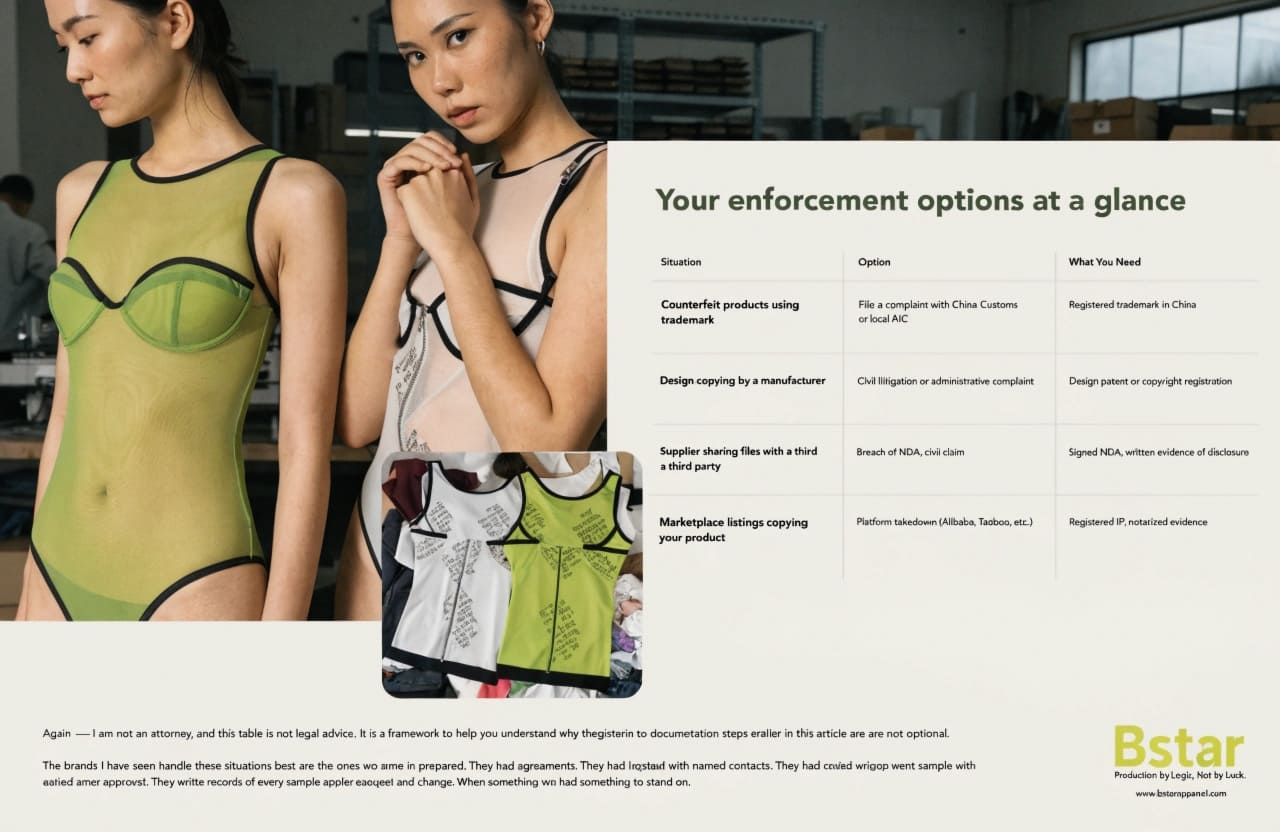
Your enforcement options at a glance
| Situation | Option | What You Need |
|---|---|---|
| Counterfeit products using your trademark | File a complaint with China Customs or local AIC8 | Registered trademark in China |
| [Design copying by a manufacturer | Civil litigation or administrative complaint | Design patent or copyright registration](https://www.uspto.gov/sites/default/files/documents/china-admin-enforcement-2024.pdf)[^10] |
| Supplier sharing files with a third party | Breach of NDA, civil claim | Signed NDA, written evidence of disclosure |
| Marketplace listings copying your product | Platform takedown (Alibaba, Taobao, etc.)9 | Registered IP, notarized evidence |
Again — I am not an attorney, and this table is not legal advice. It is a framework to help you understand why the registration and documentation steps earlier in this article are not optional.
The brands I have seen handle these situations best are the ones who came in prepared. They had registered trademarks. They had signed agreements with named contacts. They had written records of every sample approval and change request. When something went wrong, they had something to stand on.
The brands who struggled had none of that. They had a handshake and a hope.
Conclusion
Protecting your designs in China comes down to registration, supplier selection, staged disclosure, and written records — not just an NDA.
-
"China’s New Trademark Law – WIPO", https://www.wipo.int/en/web/wipo-magazine/articles/chinas-new-trademark-law-39007. China’s trademark regime, administered by the China National Intellectual Property Administration (CNIPA), operates on a first-to-file basis under the Trademark Law of the People’s Republic of China, meaning that registration priority is generally awarded to the earliest applicant rather than the earliest user of a mark. Evidence role: definition; source type: institution. Supports: That China’s trademark system grants rights based on filing date rather than prior commercial use. ↩
-
"[PDF] The Design Patent in China – WIPO", https://www.wipo.int/edocs/mdocs/mdocs/en/wipo_dm_sym_bue_07/wipo_dm_sym_bue_07_www_78207.pdf. Under China’s Patent Law, a design patent (外观设计专利) protects the new design of the shape, pattern, or combination thereof of a product, as well as the combination of color with shape or pattern, which creates an aesthetic feeling and is fit for industrial application. Evidence role: definition; source type: institution. Supports: That Chinese design patents cover the ornamental or aesthetic appearance of a product. Scope note: Protection scope depends on the specific registration and examination outcome; not all distinctive visual features will qualify. ↩
-
"Open innovation and confidentiality agreements as key factors of …", https://pmc.ncbi.nlm.nih.gov/articles/PMC11104656/. Legal scholarship and supply chain management research indicate that non-disclosure agreements function primarily as deterrents and evidentiary instruments rather than preventive controls; their effectiveness in protecting trade secrets depends substantially on accompanying operational safeguards such as access controls, documented communication, and clear accountability structures. Evidence role: expert_consensus; source type: paper. Supports: That NDAs provide limited practical protection without complementary operational controls and documentation. Scope note: Direct empirical studies on NDA effectiveness in Chinese garment manufacturing specifically are limited; this support is drawn from broader trade secret and supply chain literature. ↩
-
"2. Contract Formation, Privity of Contract, and Other Contract …", https://pressbooks.lib.vt.edu/constructioncontracting/chapter/contract-formation-privity-of-contract-and-other-contract-relationships/. Under the doctrine of privity of contract, a non-disclosure agreement creates enforceable obligations only between the parties who execute it; subcontractors engaged by a signatory are generally not bound by the agreement’s confidentiality terms unless they independently sign or are explicitly incorporated. Evidence role: mechanism; source type: education. Supports: That a non-disclosure agreement binds only the signing parties and does not automatically extend obligations to subcontractors engaged by one of those parties. Scope note: Specific enforceability may vary by jurisdiction and contract drafting; some agreements include flow-down clauses that attempt to bind subcontractors. ↩
-
"What Photographers Should Know about Copyright", https://www.copyright.gov/engage/photographers/. Photographs of product samples may be protected as original works under copyright law, and where samples embody confidential design information, their unauthorized reproduction or display by a manufacturing partner may constitute both copyright infringement and breach of trade secret or confidentiality obligations, depending on applicable law and the terms of any agreement in place. Evidence role: mechanism; source type: education. Supports: That photographs of a brand’s product samples may constitute protectable intellectual property and that unauthorized use by a factory in its portfolio could constitute infringement or breach of confidentiality. Scope note: Ownership of photographs taken by the factory of samples it produced may be contested; explicit contractual assignment of image rights is advisable. ↩
-
"China Judicial Assistance Information – Travel", https://travel.state.gov/content/travel/en/legal/Judicial-Assistance-Country-Information/China.html. Under China’s Civil Procedure Law and associated judicial interpretations, written documents — including contracts, correspondence, and electronic records — constitute recognized categories of evidence in civil litigation; courts assess their authenticity, relevance, and probative value, making contemporaneous written records of contractual performance and approvals significant in disputes over IP ownership or breach of agreement. Evidence role: mechanism; source type: government. Supports: That written records and documented communications are recognized forms of evidence in Chinese civil proceedings, including IP and contract disputes. Scope note: Admissibility and weight of specific evidence types, including electronic communications, may depend on authentication requirements under Chinese evidentiary rules. ↩
-
"[PDF] Trade Secret Intellectual Property Toolkit – USPTO", https://www.uspto.gov/sites/default/files/documents/tradesecretsiptoolkit.pdf. Trade secret protection frameworks, including those codified in the Defend Trade Secrets Act (US) and analogous statutes, recognize that reasonable measures to limit access — including disclosing confidential information only to those with a demonstrated need — are a prerequisite for legal protection and a practical risk-reduction strategy in supplier relationships. Evidence role: mechanism; source type: paper. Supports: That limiting information disclosure to what is necessary at each stage of a manufacturing relationship reduces trade secret exposure. Scope note: The specific staged-disclosure framework described in the article is the author’s operational formulation; the underlying principle of need-to-know access control is the supported concept. ↩
-
"[PDF] China Customs Protection of Intellectual Property Rights – WIPO", https://www.wipo.int/edocs/mdocs/mdocs/en/wipo_webinar_aspac_2024_1/wipo_webinar_aspac_2024_1_custom.pdf. China Customs administers an Intellectual Property Rights (IPR) recordal system through which trademark and copyright holders may register their rights to enable customs officers to detain suspected infringing goods at the border; enforcement action generally requires a valid Chinese IP registration. Evidence role: mechanism; source type: government. Supports: That China Customs operates an IP recordal system allowing trademark owners to request seizure of infringing goods at the border. Scope note: Customs recordal is a separate process from trademark registration itself and involves additional procedural requirements. ↩
-
"[PDF] USTR-2012-0011 – Regulations.gov", https://downloads.regulations.gov/USTR-2012-0011-0021/attachment_1.pdf. Alibaba Group operates an Intellectual Property Protection (IPP) platform through which rights holders may submit takedown requests for listings alleged to infringe registered trademarks or copyrights; the platform’s procedures generally require submission of valid IP registration certificates and supporting evidence. Evidence role: mechanism; source type: institution. Supports: That Alibaba and affiliated platforms operate IP complaint systems requiring rights holders to submit proof of registered intellectual property. Scope note: Platform policies are subject to change, and acceptance of complaints does not guarantee removal; outcomes vary by case. ↩
Discussion & questions 0 comments