
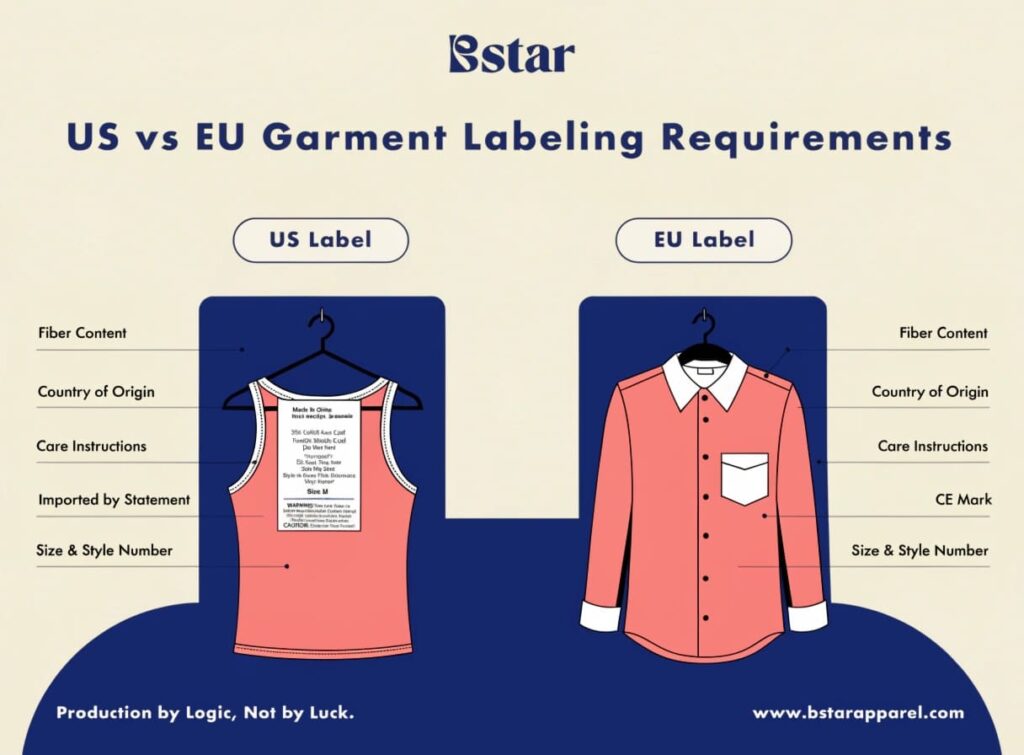
If your garments arrive at customs or retail without the right labels, you do not just face a delay. You face rejected shipments, relabeling costs, and a missed launch window.
Garment labeling in the US and EU requires specific information on every item: fiber content, country of origin, care instructions, and responsible party details. The exact rules differ by market, so you need to confirm requirements by sales destination before production starts — not after.
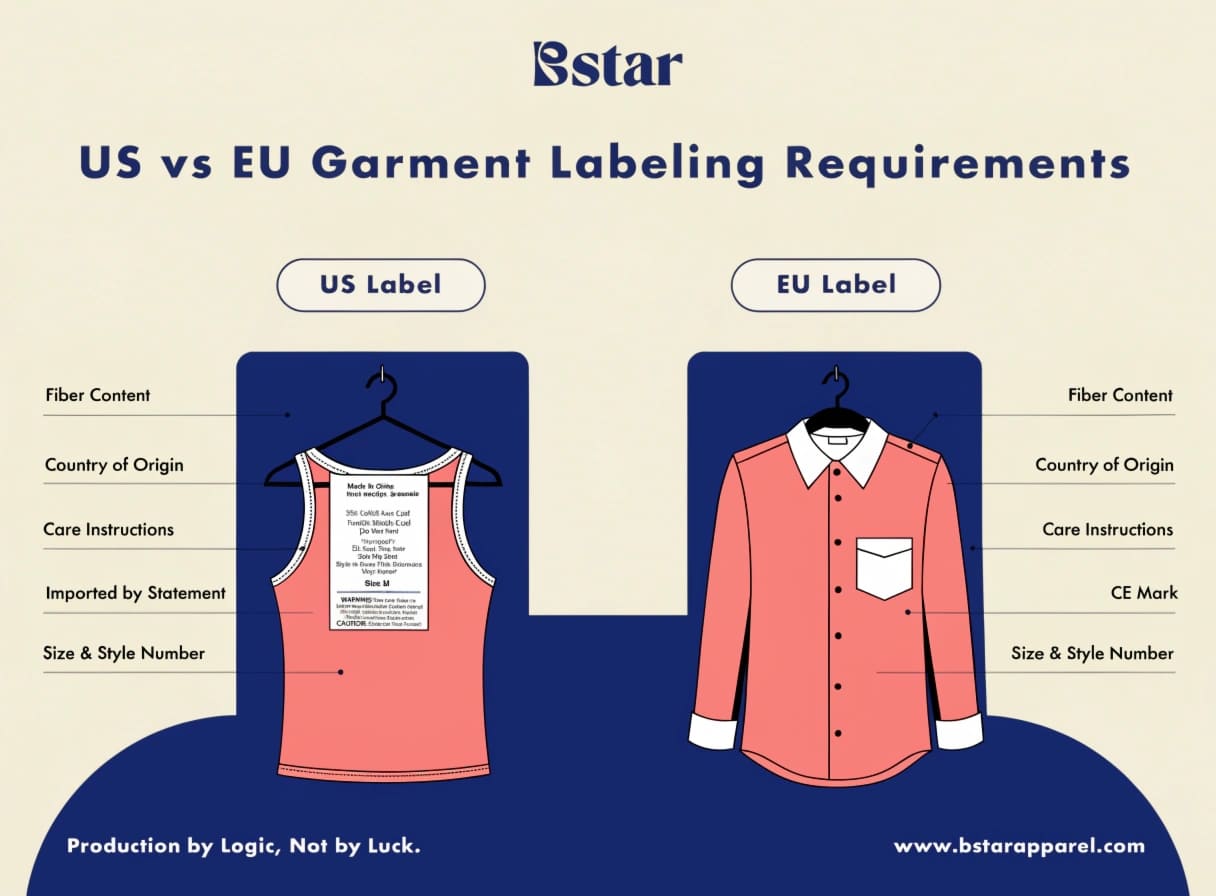
Most brands I work with treat labeling as a finishing step. They focus on fabric, fit, and price first — then deal with labels at the end. That approach creates real problems. At BSTAR, we see label-related delays push back sampling, bulk production, and shipment more often than almost any other single issue. This article walks you through what you actually need to know, and what you need to prepare before production begins.
US vs. EU Garment Labeling Rules: Are They the Same?
A lot of brands assume one label template works everywhere. It does not. The US and EU have separate regulatory systems, and the differences matter in practice.
The US is governed mainly by the FTC’s Textile Fiber Products Identification Act1, the Care Labeling Rule, and the Country of Origin rules from US Customs. The EU follows the EU Textile Regulation (No. 1007/2011)2 plus additional directives on care symbols, origin marking, and chemical compliance. These are not the same rules.
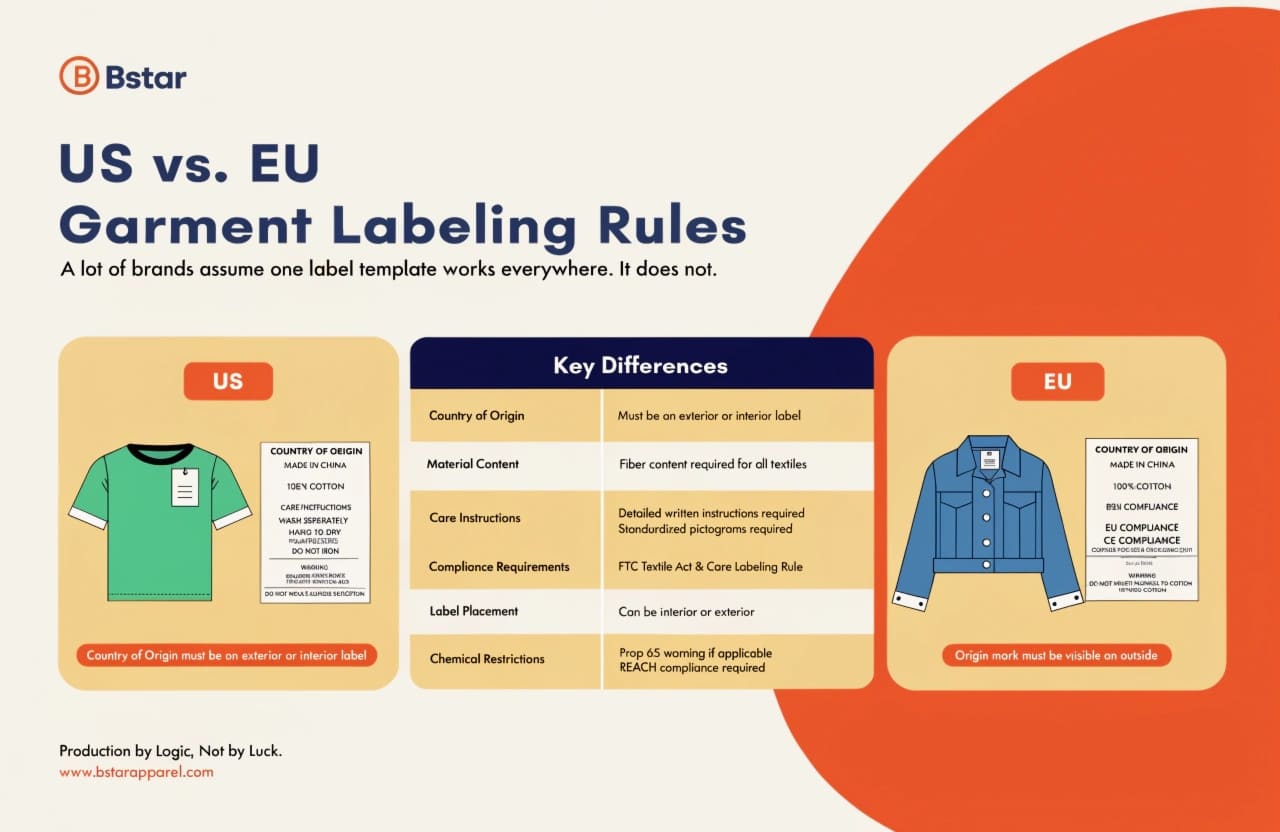
Here is where the practical differences show up when we are managing orders at the production level.
Regulatory Structure
| Area | US | EU |
|---|---|---|
| Fiber content rules | FTC Textile Act | EU Textile Regulation 1007/2011 |
| Care labeling | FTC Care Labeling Rule | GINETEX symbols (ISO 3758) widely used3 |
| Country of origin | US Customs & Border Protection | Varies; EU origin marking rules differ from US |
| Language requirement | English required | Language of the member state where sold |
| Responsible party | US importer/dealer name and address required | Manufacturer or EU-authorized representative |
The language requirement alone creates a production split. If you are selling in Germany and France, your labels may need two different language versions. If you are also selling in the US, that is a third label version. We see brands try to combine these onto one label to save cost, and it works in some cases — but only if it is planned before sampling, not after.
One more point: the EU has introduced extended producer responsibility and sustainability disclosure requirements that are expanding4. Some of these are already active, and more are coming. If you are making claims about organic, recycled, or sustainable materials on your EU labels, those claims need to meet current local standards. Having a certified material does not automatically make a label claim compliant. Confirm this with a qualified compliance adviser who knows the current rules in your target market.
What Must Every Garment Label Actually Include?
This is the question most brands ask first. The honest answer is: it depends on your sales market, product type, fiber composition, and the claims you are making.
At minimum, most US and EU garment labels must include: fiber content with accurate percentages, country of origin, care instructions, and the name and address of the responsible party (importer or manufacturer). Some markets require a size label and a registered identifier for the EU.
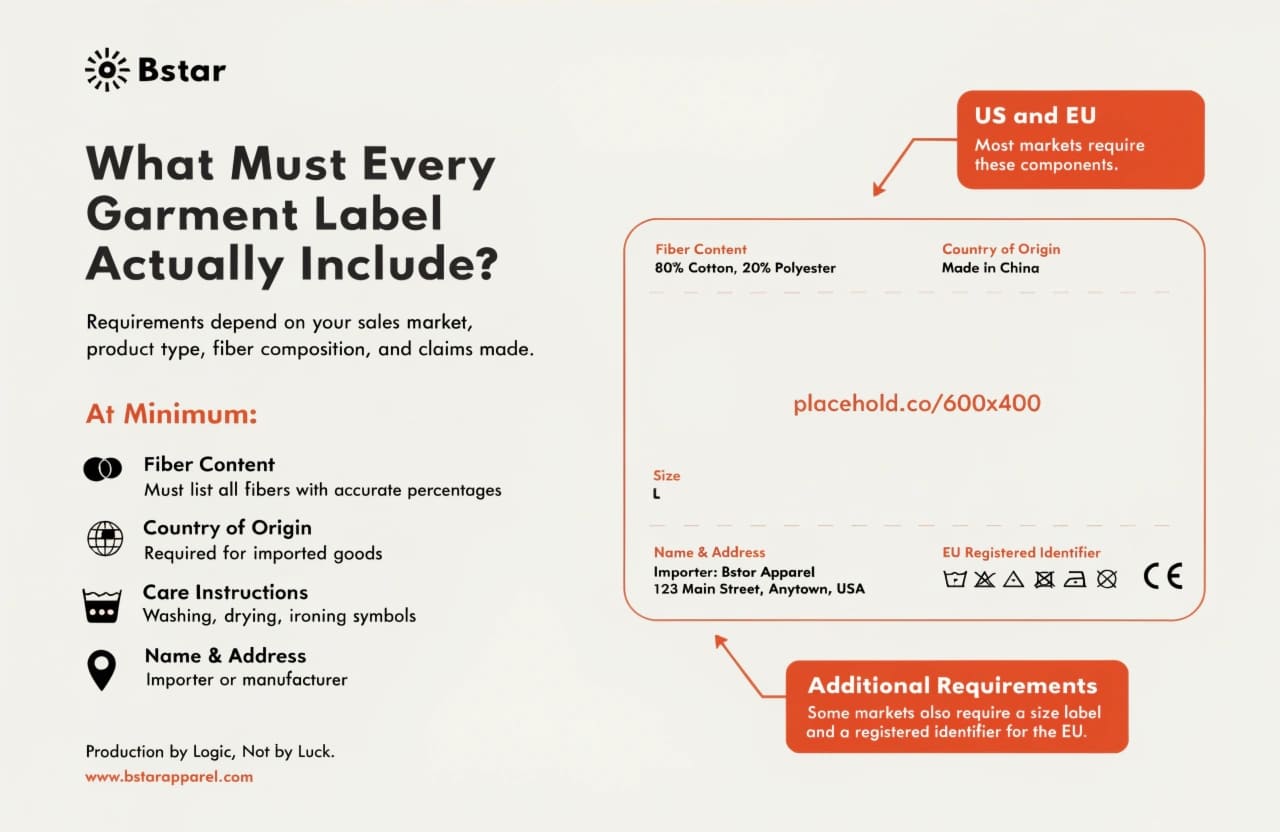
Let me break this down by category so you can use it as a working checklist before you come to your manufacturer.
Fiber Content
Fiber content must reflect the actual composition of the fabric, including linings, interlinings, and trims if they meet the minimum threshold weight. In the US, fiber names must use FTC-approved terminology5. In the EU, fiber names must match the annex of the EU Textile Regulation6. Small differences in how fibers are named can trigger a compliance issue. Do not guess — verify your fiber composition from your fabric supplier and confirm the correct naming format for each market.
Country of Origin
"Made in China" is a standard declaration we place on labels for most of our orders. But origin rules are not just about printing a country name. In the US, origin is enforced by CBP and must reflect where the garment underwent substantial transformation7. In the EU, rules on origin marking for textiles depend on the destination country and the trade context. If your supply chain touches multiple countries — fabric from one, cut and sew in another — you need to understand where the origin claim lands. This is a compliance and customs question, not just a label-printing question.
Care Instructions
US rules require permanent care labels with instructions that are accurate, clear, and based on actual testing or reasonable expectation8. EU rules use the ISO 3758 care symbol system, which is widely adopted across member states. If you are producing for both markets, you may want a label that carries both written instructions (for the US) and symbols (for the EU). We can produce this, but we need the final care instruction spec from you before we set up the label artwork.
Responsible Party Details
In the US, every garment must identify the dealer, distributor, or retailer by name and address9. In the EU, the responsible person for the product’s compliance must be identified — and if the manufacturer is not based in the EU, an EU-authorized representative may be required depending on the regulatory context10. This is a detail that startup brands often miss. Figure it out before sampling.
Size Label
Size labeling is not always mandatory in the same legal sense as fiber content, but retail buyers and customs authorities in both markets expect it. Confirm your size convention — US, EU, or both — and where labels should be placed.
What Happens If Your Labels Are Wrong?
Non-compliance is not just a paperwork problem. The consequences are real, and they hit you at different stages of the supply chain.
Non-compliant garment labels can result in goods being held at customs, fines from regulatory authorities, forced recalls, delistings from retail buyers, and customer complaints. In the US, FTC enforcement can include civil penalties11. In the EU, market surveillance authorities can require product withdrawal12.
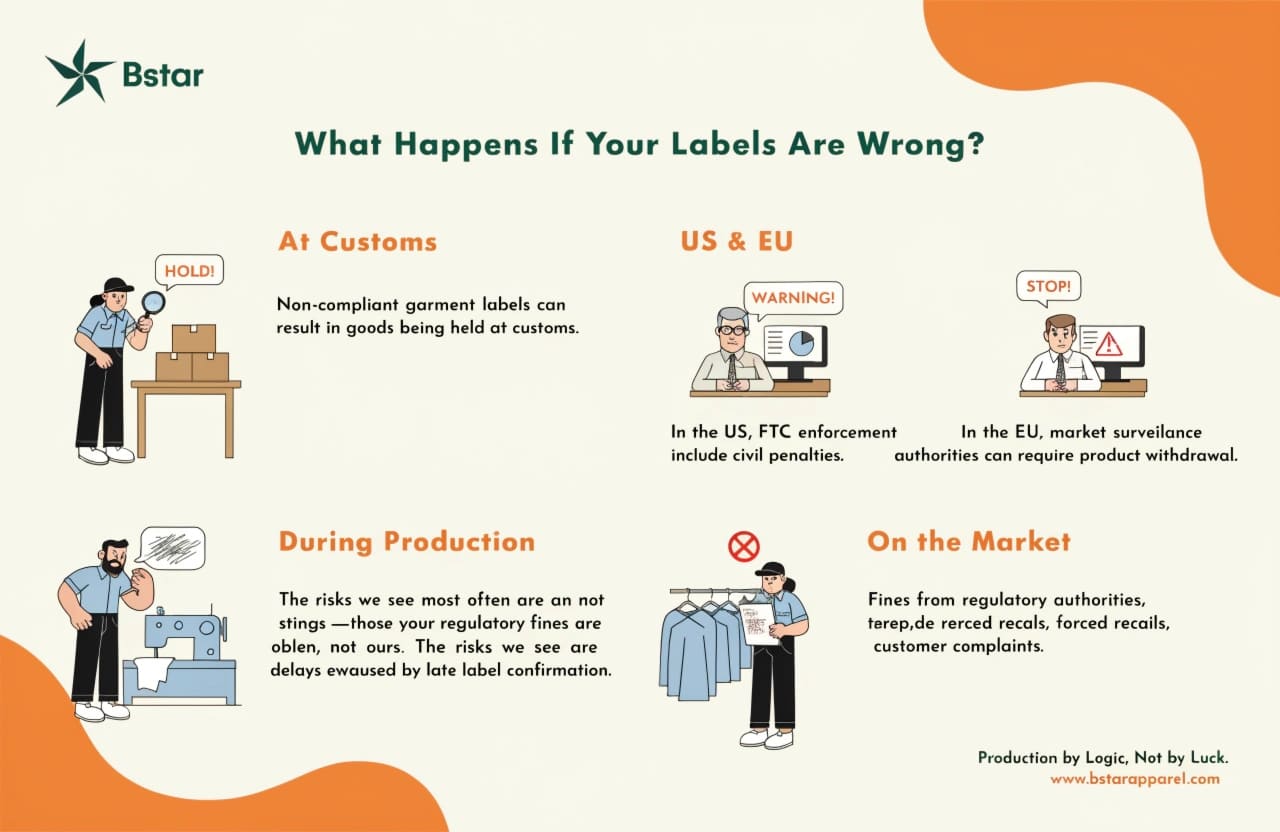
From the manufacturing side, the risks we see most often are not regulatory fines — those are your problem, not ours. The risks we see are production delays caused by late label confirmation.
How Late Label Decisions Break Your Production Timeline
This is the part no one talks about enough. Here is what actually happens when a brand sends us label artwork late or changes label content mid-production.
| Stage | Impact of Late Label Confirmation |
|---|---|
| Sampling | Sample cannot be completed without care label and main label in place |
| Bulk fabric cutting | Label placement affects cut pattern layout on some garments |
| Sewing and assembly | Care labels must be sewn in during production, not added later |
| Finishing and packing | Hangtags, barcode stickers, and packaging must be ready before packing begins |
| Shipment | A label issue found at final inspection can hold the entire order |
| Market launch | Any rework after shipment adds weeks and cost |
We have had orders where the customer changed their EU language requirement after bulk production started. That meant reprinting labels, pulling finished goods off the shelf, and re-attaching. The cost and delay were entirely avoidable. Label decisions need to happen at the development stage, not the packing stage.
How to Get Label Compliance Right Before Production Starts
The best way to handle labeling is to treat it as a pre-production market-entry decision, the same way you treat fabric selection or fit approval.
To manage garment label compliance effectively, confirm your target sales market, fiber content data, care rules, origin and responsible party details, sustainability claims, and final artwork before sampling begins. Work with a compliance adviser for market-specific legal requirements, and give your manufacturer a complete label brief early.
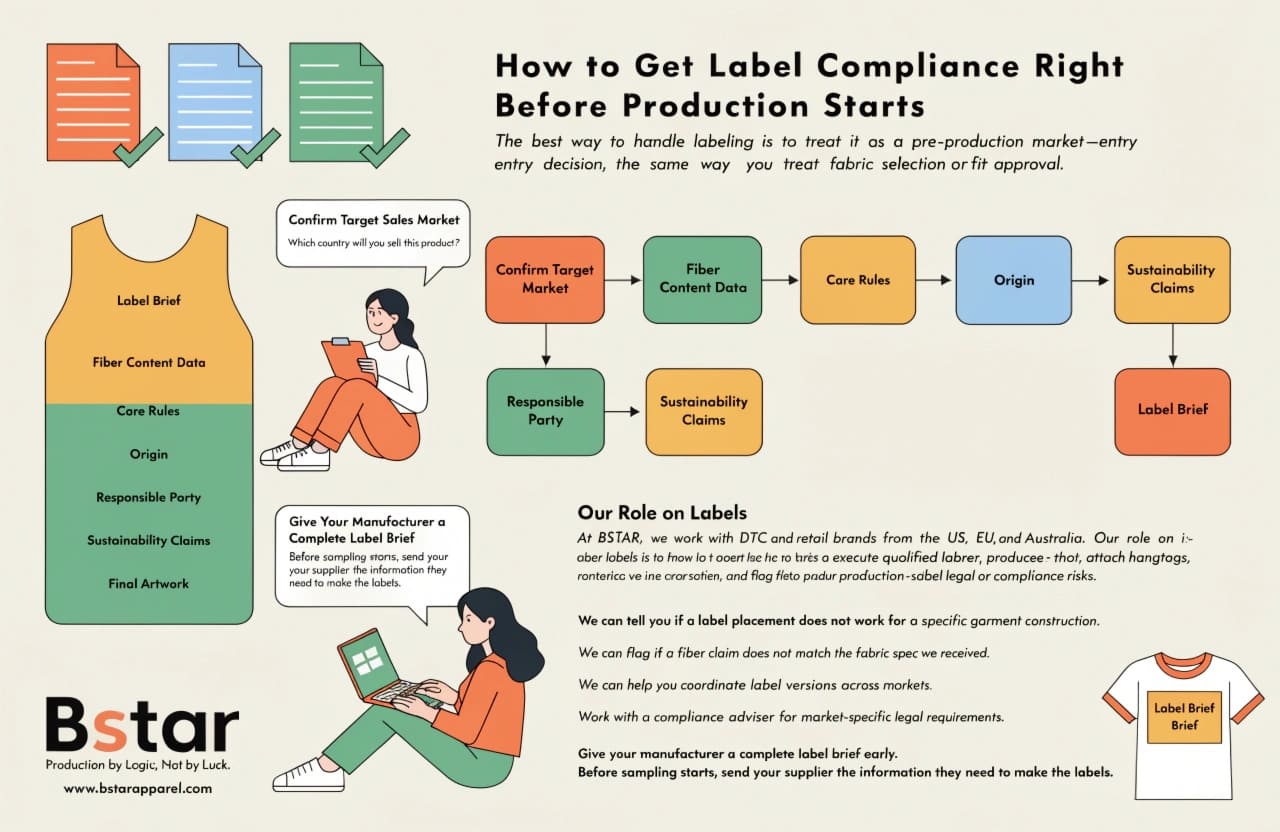
At BSTAR, we work with DTC and retail brands from the US, EU, and Australia. Our role on labels is to execute — produce care labels, attach hangtags, manage packaging, and flag production-side risks. We can tell you if a label placement does not work for a specific garment construction. We can flag if a fiber claim does not match the fabric spec we received. We can help you coordinate label versions across markets.
What we cannot do — and what no manufacturer should claim to do — is confirm that your label is legally compliant for your sales market. That is a brand responsibility, and it requires qualified legal or compliance input.
What to Prepare Before You Brief Your Manufacturer
Use this as a working checklist.
| What You Need | Why It Matters |
|---|---|
| Target sales market(s) | Determines language, regulatory format, and responsible party rules |
| Confirmed fiber composition | Must be accurate and in approved terminology for each market |
| Care instruction spec | Must be tested or verified before it goes on a label |
| Country of origin | Confirmed based on supply chain and customs rules |
| Responsible party name and address | Required in both US and EU, details differ |
| Sustainability or certified material claims | Must be verified against current market-specific rules |
| Barcode, size, and packaging details | Needed before packing setup begins |
| Final artwork and label placement diagram | Required before sampling |
| Confirmation workflow | Who approves labels, and by what deadline |
If you have all of this ready before sampling, your label process will run in parallel with development — not behind it.
Conclusion
Garment labeling is a pre-production decision. Get your market, fiber data, care rules, origin, and artwork confirmed early — or pay for it later in delays and rework.
-
"The Textile Products Identification Act | Federal Trade Commission", https://www.ftc.gov/legal-library/browse/rules/textile-products-identification-act-text. The Textile Fiber Products Identification Act (15 U.S.C. §§ 70–70k) requires that textile fiber products sold in the United States bear labels disclosing fiber content, country of origin, and the identity of the manufacturer or dealer; the FTC is the administering agency. Evidence role: definition; source type: government. Supports: The Textile Fiber Products Identification Act is the primary US federal statute governing fiber content disclosure on textile products, administered by the FTC.. ↩
-
"[PDF] revised FAQs on Regulation 1007-2011 – European Union", https://single-market-economy.ec.europa.eu/document/download/34fcf863-59ef-4352-8489-a2577102fd8f_en?filename=revised%20FAQs%20on%20Regulation%201007-2011%20-%20published.pdf. Regulation (EU) No 1007/2011 of the European Parliament and of the Council lays down rules on textile fibre names and related labelling and marking of fibre composition of textile products, repealing earlier Council and European Parliament directives on the subject. Evidence role: definition; source type: government. Supports: EU Regulation No. 1007/2011 establishes harmonised rules on textile fibre names, labelling, and marking of fibre composition across EU member states.. ↩
-
"Laundry symbol – Wikipedia", https://en.wikipedia.org/wiki/Laundry_symbol. ISO 3758:2005 (Textiles — Care labelling code using symbols) specifies a system of symbols for labelling textile articles with care instructions; GINETEX, the international association for textile care labelling, licenses and administers the symbol system in participating countries. Evidence role: definition; source type: institution. Supports: ISO 3758 defines the system of care symbols used on textile labels, and GINETEX administers the symbol system that is widely adopted in European markets.. Scope note: ISO 3758 is a voluntary international standard; its adoption as the de facto EU care labelling system reflects widespread industry practice rather than a direct legal mandate under EU Textile Regulation 1007/2011. ↩
-
"Revised Waste Framework Directive enters into force – Environment", https://environment.ec.europa.eu/news/revised-waste-framework-directive-enters-force-2025-10-16_en. The EU Strategy for Sustainable and Circular Textiles (COM/2022/141) and the Ecodesign for Sustainable Products Regulation (EU) 2024/1781 establish a framework for expanding sustainability requirements for textile products, including digital product passports and extended producer responsibility schemes to be phased in across member states. Evidence role: historical_context; source type: government. Supports: The EU has adopted and is implementing regulatory measures expanding producer responsibility and sustainability disclosure obligations for textile products.. Scope note: Implementation timelines and specific obligations under these instruments are subject to delegated acts and member-state transposition, meaning the precise requirements applicable at any given time may differ from the high-level framework described. ↩
-
"The Textile Products Identification Act | Federal Trade Commission", https://www.ftc.gov/legal-library/browse/rules/textile-products-identification-act-text. Under 16 C.F.R. Part 303 (Rules and Regulations Under the Textile Fiber Products Identification Act), fiber content must be disclosed using the generic names established or recognised by the FTC; use of trade names or coined terms without the accompanying generic name is prohibited. Evidence role: definition; source type: government. Supports: The FTC maintains a list of approved generic fiber names that must be used on US textile labels under 16 C.F.R. Part 303.. ↩
-
"Regulation – 1007/2011 – EN – EUR-Lex – European Union", https://eur-lex.europa.eu/eli/reg/2011/1007/oj/eng. Annex I of Regulation (EU) No 1007/2011 sets out the list of textile fibre names to be used exclusively for labelling and marking purposes within the EU; the annex has been amended by subsequent Commission delegated regulations to add new fibre names as they are developed. Evidence role: definition; source type: government. Supports: Annex I of EU Regulation No. 1007/2011 contains the authoritative list of textile fibre names that must be used on labels sold in the EU.. ↩
-
"Rules of Origin: Substantial Transformation", https://www.trade.gov/rules-origin-substantial-transformation. U.S. Customs and Border Protection applies the ‘substantial transformation’ doctrine to determine country of origin for textile products, generally holding that a garment originates in the country where it was cut and sewn into its finished form, as established through CBP rulings and 19 C.F.R. Part 102. Evidence role: mechanism; source type: government. Supports: US Customs and Border Protection applies the ‘substantial transformation’ test to determine the country of origin for textile and apparel products for marking purposes.. Scope note: The substantial transformation standard is applied on a case-by-case basis through CBP rulings, and outcomes can vary depending on the specific manufacturing operations performed in each country. ↩
-
"16 CFR Part 423 — Care Labeling of Textile Wearing Apparel and …", https://www.ecfr.gov/current/title-16/chapter-I/subchapter-D/part-423. 16 C.F.R. Part 423 (Care Labeling of Textile Wearing Apparel and Certain Piece Goods) requires manufacturers and importers to attach permanent care labels to textile wearing apparel and to have a reasonable basis for the care instructions provided, which may be established through testing or reliable industry knowledge. Evidence role: definition; source type: government. Supports: The FTC Care Labeling Rule requires that care instructions on garment labels be based on a reasonable basis, such as testing or industry knowledge, and that labels be permanently attached.. ↩
-
"The Textile Products Identification Act | Federal Trade Commission", https://www.ftc.gov/legal-library/browse/rules/textile-products-identification-act-text. Under 16 C.F.R. § 303.33, textile fiber products must bear the name or registered identification number of the manufacturer, importer, or other firm marketing the product; a full street address is not required if a registered number is used in lieu of the name. Evidence role: definition; source type: government. Supports: The FTC’s Textile Fiber Products Identification Act and implementing regulations require that garment labels identify the manufacturer, importer, or dealer by name.. Scope note: The FTC permits use of a registered identification number as an alternative to a full name and address, a nuance the article does not reflect. ↩
-
"EU Consumer Goods General Product Safety Regulation (GPSR)", https://www.trade.gov/market-intelligence/eu-consumer-goods-general-product-safety-regulation-gpsr. Regulation (EU) 2019/1020 on market surveillance introduces the concept of an ‘economic operator’ established in the EU who is responsible for compliance tasks where the manufacturer is located outside the EU; the specific obligation to appoint such a representative depends on the applicable product legislation and is being progressively extended across product categories. Evidence role: mechanism; source type: government. Supports: EU product compliance regulations may require non-EU manufacturers to designate an EU-established authorised representative responsible for compliance obligations.. Scope note: The authorised representative requirement under EU Regulation 2019/1020 applies where referenced by specific product legislation; its applicability to textile products under EU Textile Regulation 1007/2011 specifically should be confirmed against current implementing measures. ↩
-
"Nordstrom, Bed Bath & Beyond, Backcountry.com, and J.C. Penney …", https://www.ftc.gov/news-events/news/press-releases/2015/12/nordstrom-bed-bath-beyond-backcountrycom-jc-penney-pay-penalties-totaling-13-million-falsely. Under the Textile Fiber Products Identification Act and the FTC Act, the Federal Trade Commission may seek civil monetary penalties for violations of textile labeling rules; penalty amounts are subject to periodic adjustment under the Federal Civil Penalties Inflation Adjustment Act. Evidence role: statistic; source type: government. Supports: The FTC has authority to seek civil penalties for violations of the Textile Fiber Products Identification Act and the Care Labeling Rule.. Scope note: Actual penalty amounts in enforcement actions vary and are determined by the courts; the article does not specify a figure, and published penalty levels may have changed since any referenced enforcement action. ↩
-
"Mechanisms enabling the Free Movement of Goods – Efta.Int", https://www.efta.int/eea-relations-eu/policy-areas/free-movement-goods/mechanisms-enabling-free-movement-goods. Regulation (EU) 2019/1020 on market surveillance and compliance of products grants national market surveillance authorities powers to order the withdrawal, recall, or restriction of non-compliant products placed on the EU market, applicable across product categories including textiles. Evidence role: mechanism; source type: government. Supports: EU market surveillance authorities have legal powers to require withdrawal or recall of non-compliant products, including textiles, from the market.. ↩
Discussion & questions 0 comments