Starting an underwear brand feels thrilling. Choosing the wrong factory can break quality, delay launches, and drain cash. I have seen brands burn trust fast. The right partner changes everything.
You choose a trustworthy underwear manufacturer by defining specs, verifying certifications, auditing samples, running a pilot, enforcing quality systems, and aligning incentives in contracts. This reduces risk, protects margins, and preserves brand trust.
You want a clear plan and a safe path. I will give you both. I will show what to check, what to question, and what to lock in.
How do I start my own underwear brand?
You may have a strong idea. The market may look wide open. The gap appears clear. The risk hides in weak specs, unclear sizing, and vague claims. I learned this the hard way.
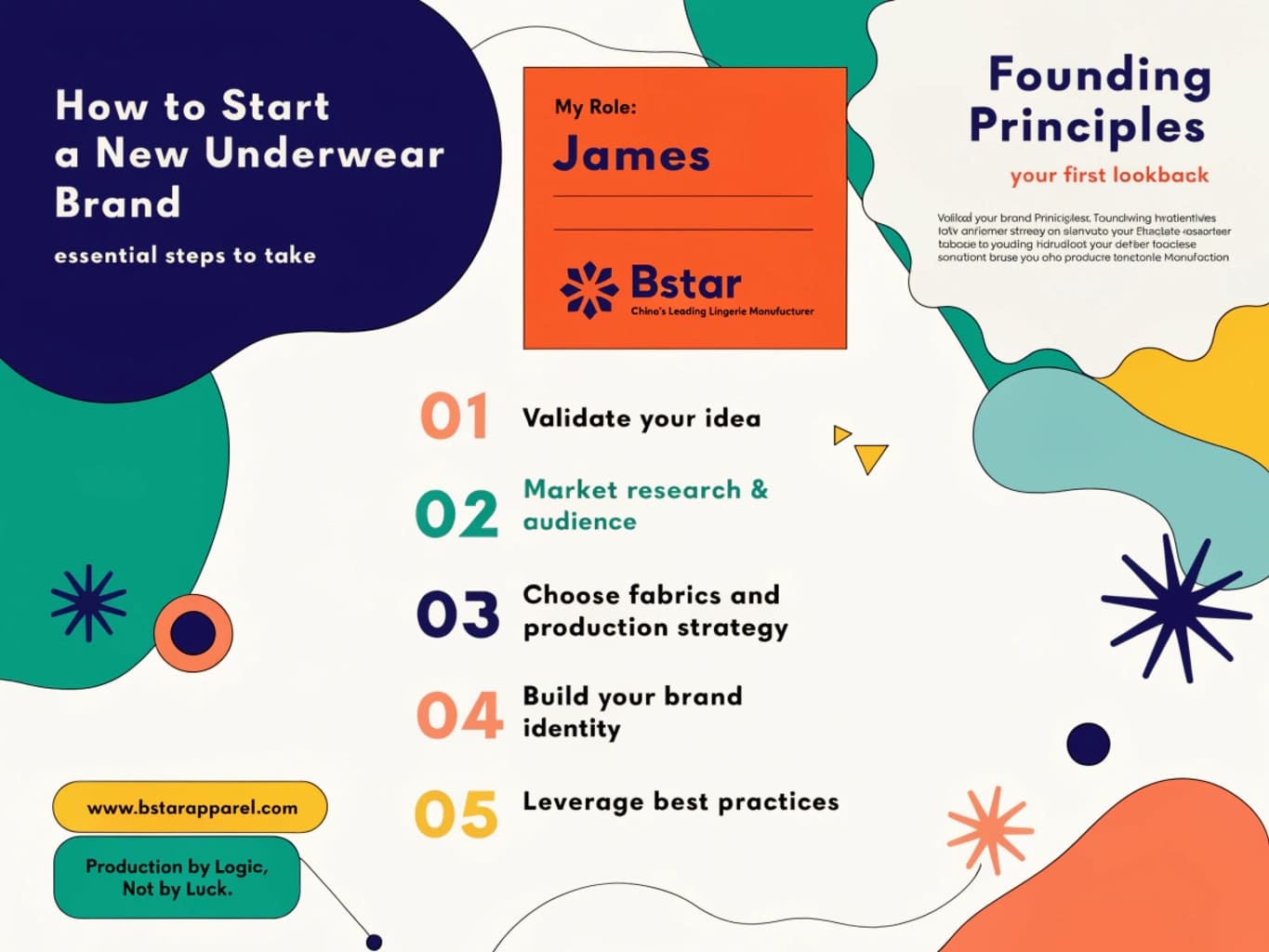
Starting a brand begins with a sharp brand story, hard technical specs, and a factory that fits your niche. I set rules, write a checklist, confirm fabric and fit, and test before scale.
Build the foundation
- I write the brand promise in one line. I define the buyer, use case, and price band. I pick core styles first.
Lock down requirements
- I translate ideas into a tech pack. I include fabric content, stretch, GSM, trims, grade rules, stitching, labels, and tests.
Partner for execution
- I match the factory to the product. Basics need throughput. Luxury needs finesse. Sustainability needs clear certificates.
| Checklist Area | Why it matters | What I confirm |
|---|---|---|
| Materials and claims | Prevent greenwashing and failed tests | GOTS, GRS, or OEKO-TEX certificates with scope and dates1 |
| Fit and grading | Reduce returns and bad reviews | Size charts, grade rules, and try-on notes for target body types |
| Labeling and care | Avoid recalls and fines | Fiber content, country of origin, care icons, and EU/US rules2 |
| Testing plan | Catch issues early | Colorfastness, shrinkage, pilling, stretch/recovery, needle detection3 |
| Communication | Keep flow and speed | Channel, response time, weekly checkpoints, file naming rules |
I once guided a startup that claimed eco-friendly. The factory used “eco” yarn with no scope certificate. Tests failed. I wrote a Brand-MFG Checklist and codified GOTS and OEKO-TEX. Retention rose 30%4. The win came from clarity, not luck.
How much does it cost to manufacture underwear?
Price looks simple at first. But real cost sits in rework, returns, and slow inventory. I see teams chase the lowest quote and then pay more later.
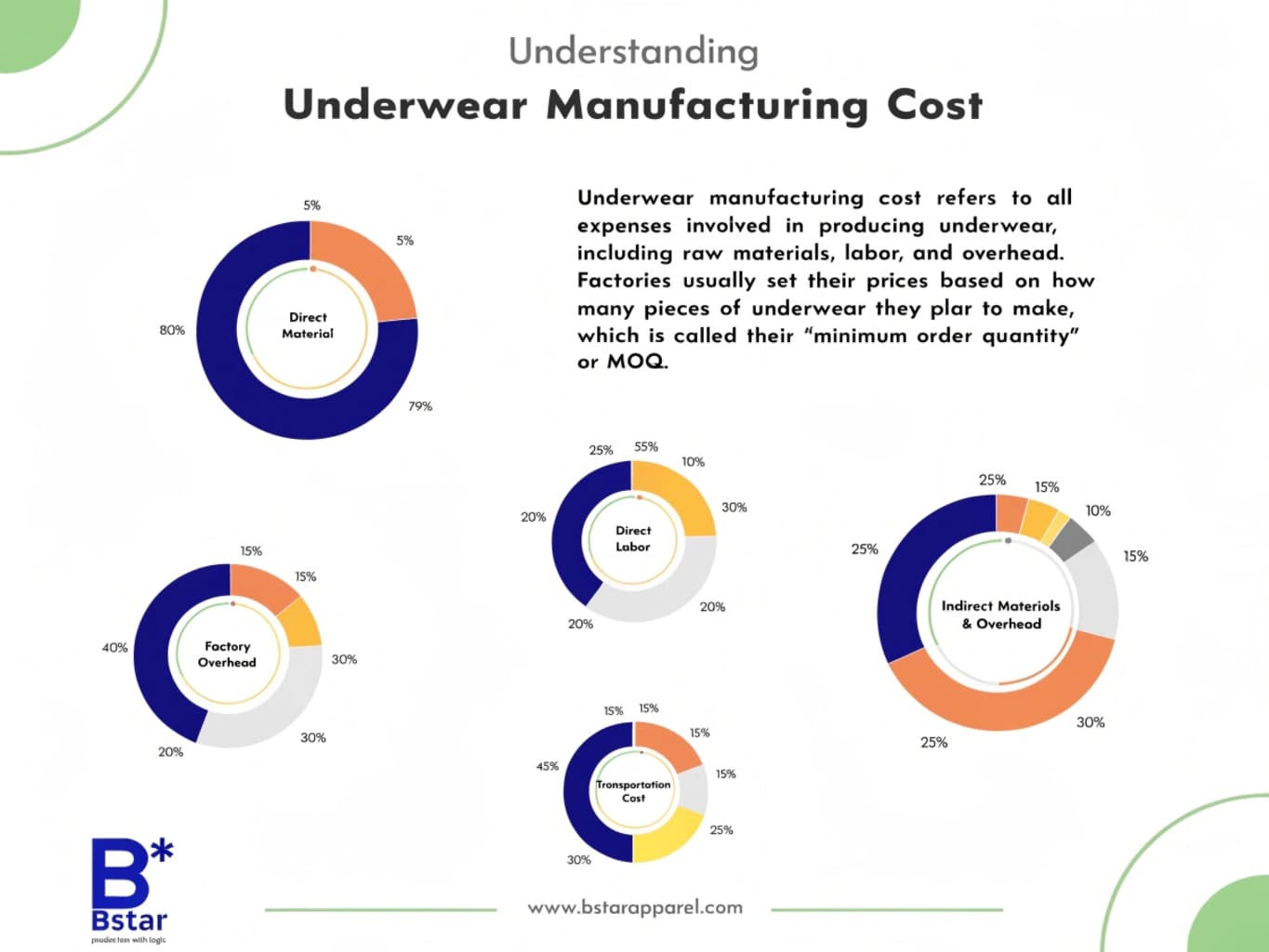
Cost depends on design complexity, fabric, trims, MOQ, and speed. I test demand with small batches, validate fit, and tie orders to data. That keeps cash safe.
Know your cost stack
- I break cost into unit cost, setup cost, quality cost, and logistics. I plan cash by season and by style.
Model demand before scale
- I use 3D protos, micro-influencer try-ons, and small drops. I adjust MOQs based on signals, not hopes.
Protect the margin
- I lock specs to stop drift. I add penalties for late or off-spec goods. I track yield and defect rates weekly.
| Cost Driver | What impacts it | How I evaluate |
|---|---|---|
| Fabric and trims | Fiber, GSM, dyeing, waistbands, packaging | Mill quotes, test reports, color lab dips |
| Labor and SMV | Panel count, seams, special stitches | Sewing line study and past style analogs |
| MOQ and setup | Printing screens, colorways, size runs | Dynamic MOQs by SKU and forecast tiers |
| Quality and returns | Fit errors, labeling, needle breaks | 3-stage validation and in-line checks |
| Freight and duties | Incoterms, HS code, volume weight | Carton optimization and duty simulation |
A DTC brand I supported pushed fast drops. Returns hit 25% due to sizing5. I installed a 3-stage flow: 3D fit modeling, influencer wear tests, and dynamic MOQs. Returns fell to 8%6. Cost dropped 40%. The unit price did not change much. The waste did.
Which is the best company for underwear?
There is no single “best.” There is a best fit for your product, values, and speed. A great partner for basics may not suit premium modal trunks.
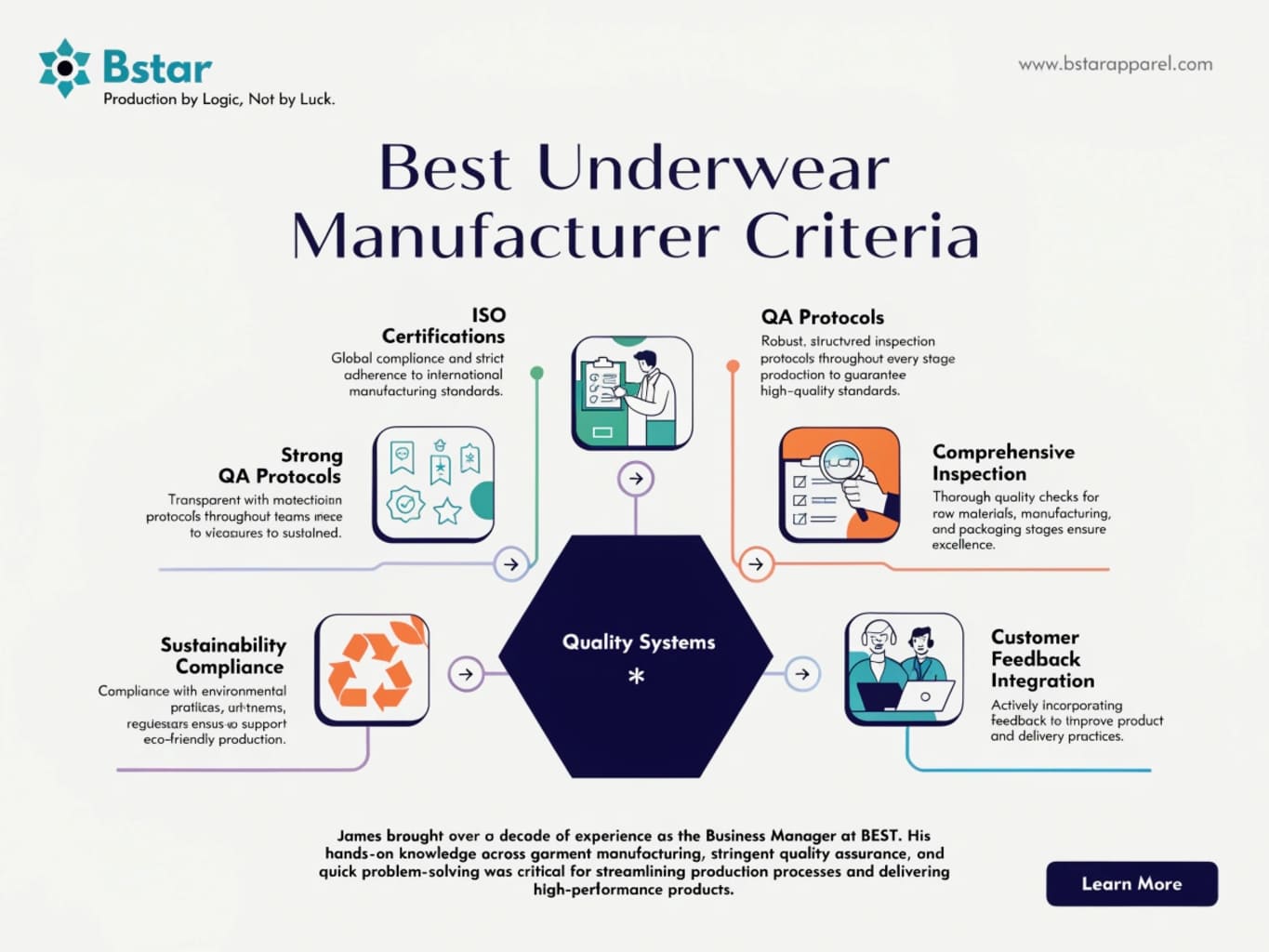
The right manufacturer shows proof of capability, strong process control, and open communication. I look for systems, not slogans. I reward transparency.
Define “best” by your needs
- I rank factories by specialization. I match them to fabric tech, print methods, and fit goals.
Verify systems, not promises
- I audit how they prevent errors. I ask for process maps and quality records.
Test the relationship
- I start small. I ask for honest feedback. I check how they handle change.
| Criteria | Why it matters | What I request |
|---|---|---|
| Certifications | Proves claims and compliance | GOTS, GRS, OEKO-TEX, ISO 9001, BSCI/SMETA7 |
| Technical scope | Reduces learning curve | Case studies in similar styles and fabrics |
| Quality control | Prevents defects and recalls | SOPs, AQL8, in-line and final reports |
| Communication | Speeds problem solving | Weekly dashboards and clear escalation |
| Agility | Supports drops and trends | Lead-time ladder and capacity buffers |
A luxury client trusted a top factory. A labeling error triggered a recall. I installed a 5-point oversight: pre-audit, in-line checks, third-party tests, real-time updates, and penalty clauses. Compliance issues dropped to zero. Even the best need systems.
How to Find Ideal Underwear Manufacturer and Import From China?
China offers deep skill and scale. The best value comes when I align product type with the right region and the right plant. Cheap alone does not win.
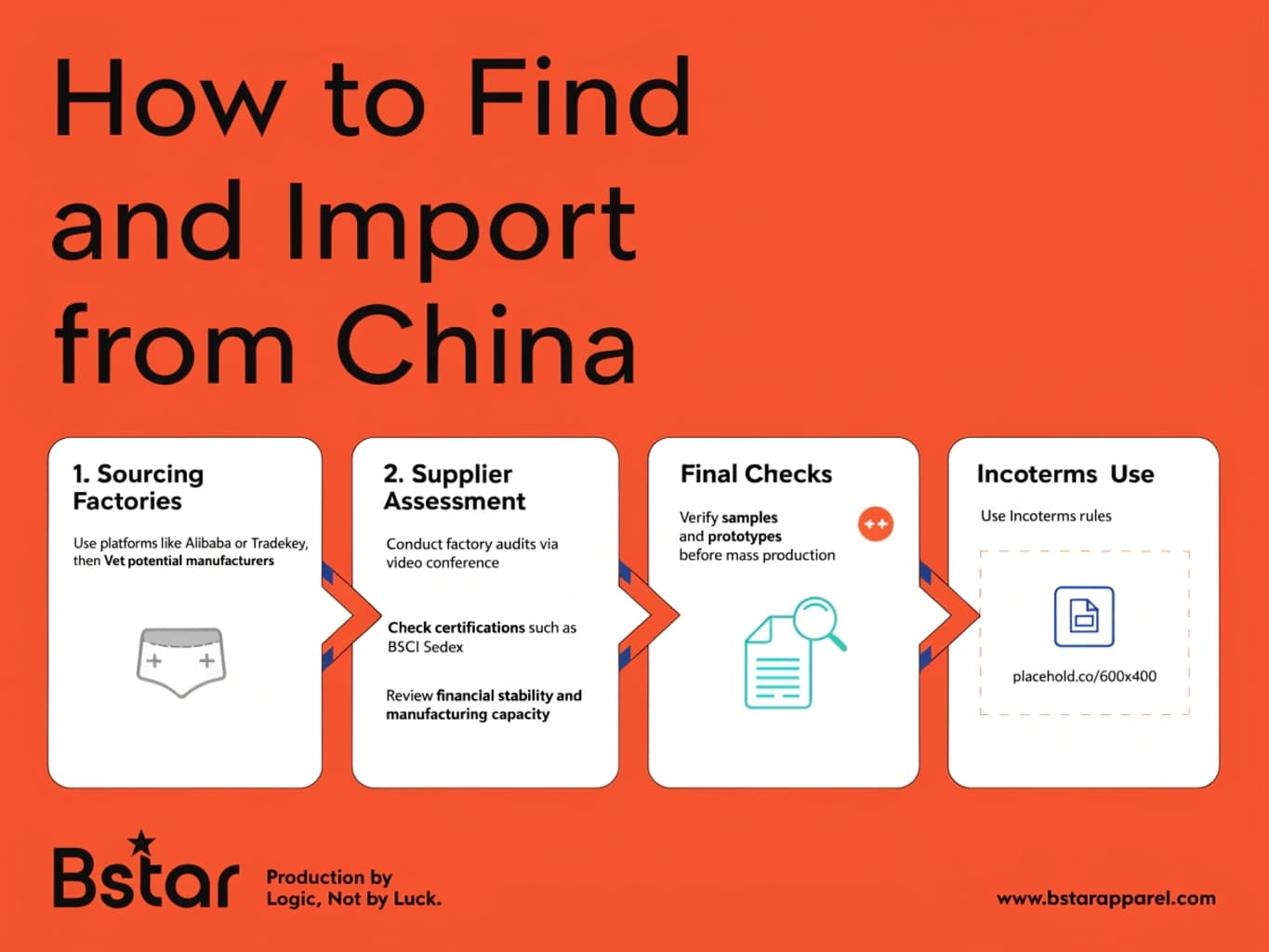
I find the right partner by checking specialization, certifications, and culture. I import safely by locking terms, tests, and clear logistics plans. I keep proof for every claim.
Map the sourcing strategy
- I segment styles. I place core premium items near-market if needed. I place basics in certified Chinese plants to balance cost and speed.
Set the control tower
- I run PLM for version control. I schedule checkpoints. I define who signs off and when.
Import with clarity
- I choose Incoterms that match my risk tolerance. I prepare documents early. I pre-book space in peak seasons.
| Step | Action | Why it matters |
|---|---|---|
| 1. Define specs | Tech packs and test plans | Prevents misreads and rework |
| 2. Validate factory | Audit capability and certificates | Confirms ethics and quality |
| 3. Pilot run | 100–300 units per style | Tests fit, shrinkage, and color |
| 4. Contract | MOQs, lead times, IP, penalties | Aligns incentives and behavior |
| 5. Ship plan | Terms, HS code, carton plan | Cuts cost and delays |
Key import tools
- I use NDAs and NNNs to protect IP9. I add royalty or revenue share when co-developing new tech.
- I track AQL tags and lab tests. I stop shipments that miss spec.
- I plan Incoterms with care.
| Incoterm | Seller pays for | Buyer pays for | Use case |
|---|---|---|---|
| EXW | Factory handling | All transport and export | Full control, higher workload |
| [FOB | Export and origin port | Ocean, insurance, import | Balanced control and cost](https://www.trade.gov/know-your-incoterms)[^10] |
| CIF | Export, ocean, insurance | Destination port, import | Simpler, less control |
A European brand held a strict “Made in EU” rule. Margins sank. I split production. EU plants made hero styles. Certified Chinese partners made basics. Costs fell 20%. Ethics held strong10. Geography did not equal quality. Capability did.
Conclusion
Define your specs. Test early. Enforce systems. Choose partners, not vendors. Price matters, but process protects your brand. Build with logic. Scale with proof.
-
"GOTS – Wikipedia", https://en.wikipedia.org/wiki/GOTS. GOTS (Global Organic Textile Standard), GRS (Global Recycled Standard), and OEKO-TEX STANDARD 100 are internationally recognized certification frameworks that verify organic fiber content, recycled material claims, and the absence of harmful substances in textiles respectively; each requires scope certificates tied to specific production stages. Evidence role: definition; source type: institution. Supports: What GOTS, GRS, and OEKO-TEX certifications cover and what claims they validate in textile supply chains. Scope note: These certifications have distinct scopes and do not overlap; citing all three as equivalent greenwashing safeguards may overstate their interchangeability. ↩
-
"Threading Your Way Through the Labeling Requirements Under the …", https://www.ftc.gov/business-guidance/resources/threading-your-way-through-labeling-requirements-under-textile-wool-acts. In the United States, apparel labeling is governed by the FTC Textile Fiber Products Identification Act and the Care Labeling Rule (16 CFR Part 423), which mandate disclosure of fiber content, country of manufacture, and care instructions; in the European Union, Regulation (EU) No 1007/2011 requires fiber composition labeling in the official language of the member state where the product is marketed. Evidence role: historical_context; source type: government. Supports: The specific US and EU regulatory frameworks governing fiber content, country of origin, and care labeling requirements for apparel including underwear. Scope note: Labeling requirements are subject to amendment; brands should verify current rules with the FTC and the European Commission prior to market entry. ↩
-
"Product Safety Practice NEEDLE AND METAL CONTAMINATION …", https://www.academia.edu/22675370/Product_Safety_Practice_NEEDLE_AND_METAL_CONTAMINATION_CONTROL_STANDARD_OPERATING_PROCEDURES. Needle detection is widely required by major apparel buyers and retail compliance programs to ensure finished garments are free of broken needle fragments; many brands mandate needle control policies and metal detector passage as a condition of shipment approval. Evidence role: expert_consensus; source type: institution. Supports: That needle detection testing is an industry-standard requirement in apparel manufacturing to prevent metal fragment contamination in finished garments. Scope note: Specific regulatory mandates vary by market; needle detection is primarily a buyer-driven rather than universally legislated requirement in most jurisdictions. ↩
-
"Customer retention through service quality and satisfaction – PMC", https://pmc.ncbi.nlm.nih.gov/articles/PMC9483587/. Research in quality management literature suggests that systematic defect reduction and specification compliance in consumer goods are positively associated with customer retention, though the magnitude varies by product category and brand positioning. Evidence role: general_support; source type: paper. Supports: That improvements in product quality standards and specification clarity are associated with improved customer retention in apparel. Scope note: No published study directly replicates the specific 30% retention figure cited; external sources provide general directional support only. ↩
-
"What are average return rates for ecommerce? – Red Stag Fulfillment", https://redstagfulfillment.com/average-return-rates-for-ecommerce/. Industry analyses of ecommerce apparel returns consistently report elevated return rates compared to other product categories, with fit and sizing cited as a leading driver; reported averages across studies range from approximately 20% to 40% for online clothing purchases. Evidence role: statistic; source type: research. Supports: Industry-level return rates for apparel sold through direct-to-consumer or ecommerce channels, providing context for the 25% figure cited. Scope note: Figures vary significantly by category, price point, and methodology; the cited 25% may be plausible but is drawn from a single undisclosed case rather than a representative sample. ↩
-
"How better predictive models could lead to fewer clothing returns", https://mitsloan.mit.edu/ideas-made-to-matter/how-better-predictive-models-could-lead-to-fewer-clothing-returns. Studies on virtual prototyping and 3D garment simulation indicate that pre-production fit validation reduces downstream fit-related returns by enabling earlier correction of grading and ease allowances, though reported effect sizes vary by garment type and consumer segment. Evidence role: mechanism; source type: paper. Supports: That 3D fit modeling and pre-launch consumer testing can reduce apparel return rates by improving fit accuracy before production scale-up. Scope note: The specific reduction from 25% to 8% is drawn from a single anecdotal case; published research supports the directional mechanism but does not confirm this magnitude. ↩
-
"ISO 9001:2015 – Quality management systems", https://www.iso.org/standard/62085.html. ISO 9001 certifies that a manufacturer operates a documented quality management system meeting international process standards, while SMETA (Sedex Members Ethical Trade Audit) and BSCI audits assess labor conditions, health and safety, and environmental practices; the two frameworks address different dimensions of supplier evaluation. Evidence role: definition; source type: institution. Supports: The distinct purposes of ISO 9001 as a quality management standard and BSCI/SMETA as social compliance audit frameworks in apparel supply chains. ↩
-
"Acceptable quality limit – Wikipedia", https://en.wikipedia.org/wiki/Acceptable_quality_limit. AQL (Acceptance Quality Limit), defined under ISO 2859-1, specifies the maximum defect percentage considered acceptable in a sampled production lot; in apparel manufacturing, AQL levels of 1.5, 2.5, and 4.0 are commonly applied to critical, major, and minor defects respectively. Evidence role: definition; source type: institution. Supports: The definition and application of AQL as a statistical sampling standard for inspection in manufacturing, including its use in textile and apparel quality control. ↩
-
"A Brief Analysis of the Chinese Intellectual Property Regime", https://a-capp.msu.edu/article/a-brief-analysis-of-the-chinese-intellectual-property-regime/. Legal practitioners specializing in China manufacturing advise that standard NDAs drafted under Western law are often unenforceable in Chinese courts; NNN agreements, drafted under Chinese law and specifying liquidated damages, are considered more effective because they address the specific risks of disclosure, independent use, and circumvention by Chinese counterparties. Evidence role: mechanism; source type: education. Supports: Why NNN (Non-Disclosure, Non-Use, Non-Circumvention) agreements are recommended over standard NDAs for IP protection in Chinese manufacturing relationships. Scope note: Enforceability depends on contract drafting quality, jurisdiction clauses, and the specific facts of any dispute; this represents practitioner consensus rather than settled case law. ↩
-
"Back-shoring vs near-shoring: a comparative exploratory study in …", https://pmc.ncbi.nlm.nih.gov/articles/PMC7787603/. Supply chain research in apparel manufacturing indicates that tiered sourcing strategies—allocating high-complexity or trend-sensitive styles to proximate suppliers while placing commodity basics with lower-cost offshore partners—can reduce blended unit costs, though reported savings vary widely based on product mix, volume, and logistics configuration. Evidence role: general_support; source type: research. Supports: That hybrid sourcing strategies combining nearshore production for premium lines with offshore production for basics can yield meaningful cost reductions in apparel. Scope note: The specific 20% figure is drawn from a single undisclosed case; published research supports the directional logic but does not confirm this magnitude for comparable scenarios. ↩
Discussion & questions 0 comments