
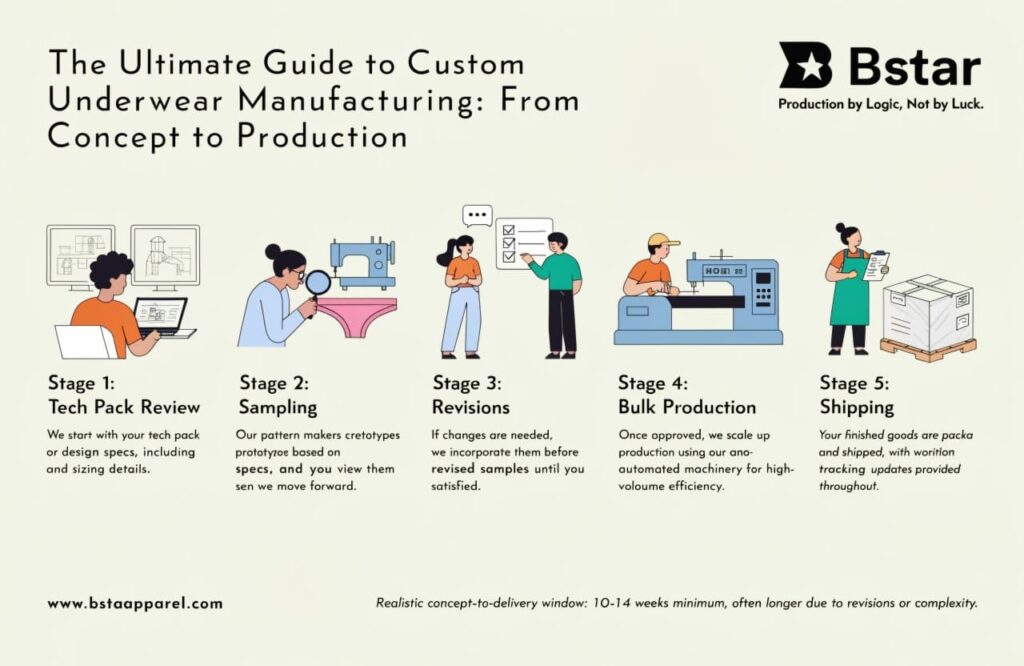
Most first-time founders come to us with a design file, a launch date, and a budget. What they’re missing is a clear picture of everything that happens in between.
Custom underwear manufacturing runs in stages — tech pack review, sampling, revisions, bulk production, and shipping. Each stage has its own timeline and cost. A realistic concept-to-delivery window is 10–14 weeks minimum, sometimes longer depending on order complexity and revision rounds.
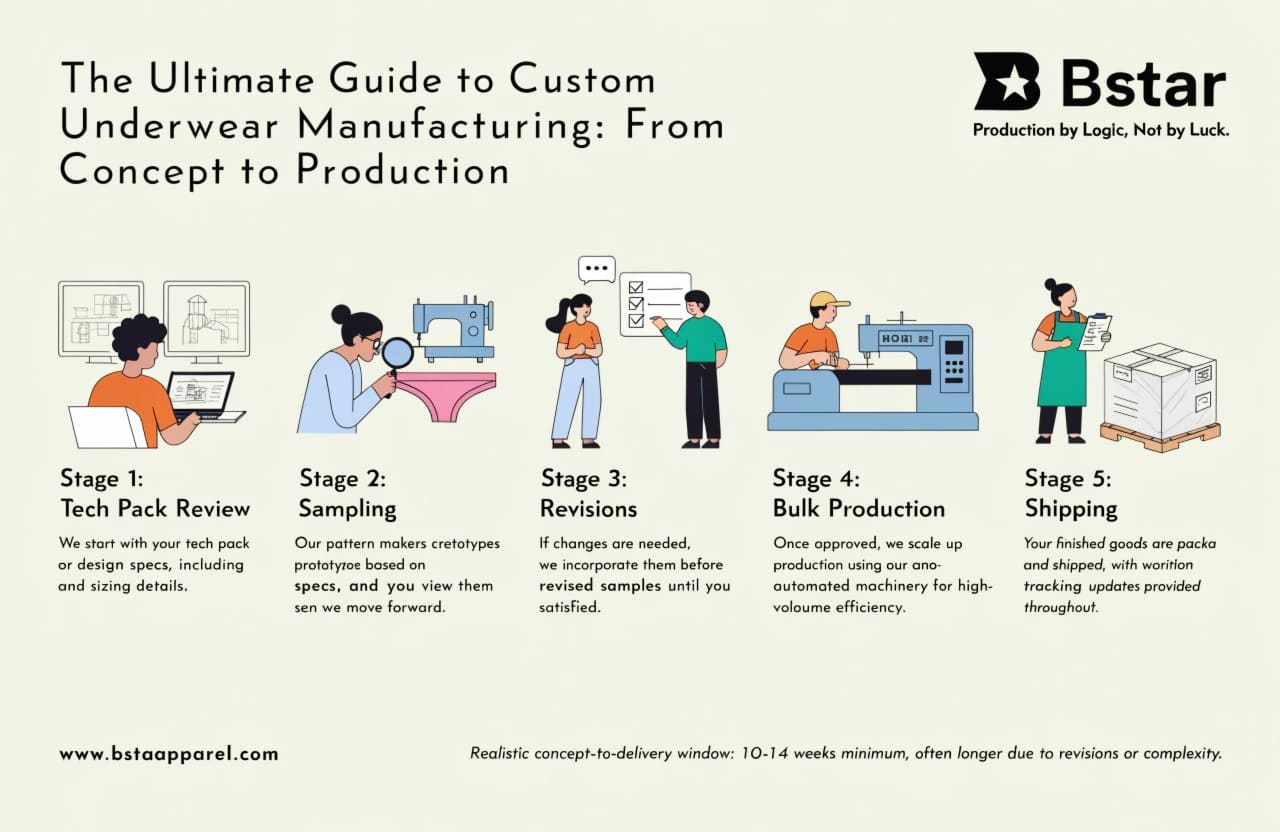
I’ve worked with DTC brands from the Netherlands, Australia, and the US through this exact process. The ones who struggle aren’t the ones with bad designs. They’re the ones who didn’t know what they were walking into. This guide maps out the full process so you can plan it properly.
Mastering Project Management: From Tech Packs to Production Timelines — Where Does the Time Actually Go?
A lot of founders think placing a sample order is like placing a Shopify order. You upload the files, confirm the details, and wait for the package.
That’s not how it works. Before any sample is cut, your factory needs a complete tech pack — technical drawings, measurements, fabric specs, colorways, and construction details. Missing information at this stage is the single most common reason timelines get pushed back.
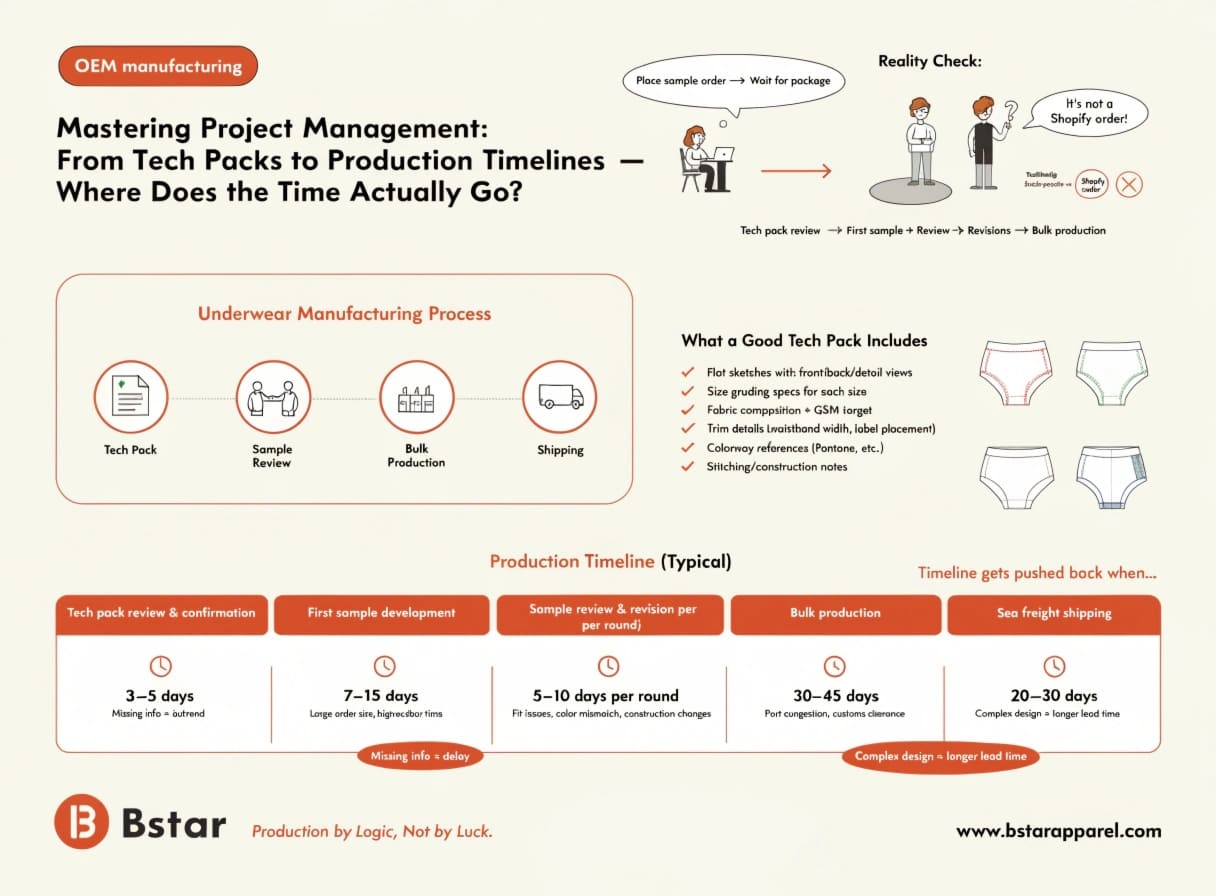
Here’s what the actual process looks like, phase by phase.
What a Realistic Timeline Looks Like
| Phase | Typical Duration | What Can Extend It |
|---|---|---|
| Tech pack review & confirmation | 3–5 days | Incomplete specs, unclear measurements |
| First sample development | 7–15 days | Complex construction, custom trims |
| Sample review & revision round | 5–10 days per round | Fit issues, color mismatch, construction changes |
| Bulk production | 30–45 days (volume-dependent) | Large order size, high-detail finishing |
| [Sea freight shipping | 20–30 days | Port congestion, customs clearance](https://www.elibrary.imf.org/view/journals/001/2022/059/article-A001-en.xml)[^1] |
Most founders plan for 2–4 weeks total. The real number is closer to 10–14 weeks for a straightforward first order1. If you need 2–3 sample rounds — which is normal — add another 2–3 weeks on top.
A common situation we see with first-time DTC clients is this: they come in with a launch date already set, then discover the sampling phase alone takes longer than their entire planned timeline. The fix isn’t to rush the factory. The fix is to build the timeline before you set the launch date.
What a Good Tech Pack Includes
A tech pack is your factory’s instruction manual. If it’s vague, the sample will be a guess. At minimum, your tech pack should cover:
- Flat sketches with front, back, and detail views
- Size grading specs for each size in your range
- Fabric composition and GSM target
- Trim details — waistband width, label placement, hardware specs
- Colorway references — Pantone codes, not just color names2
- Stitching and construction notes — stitch type, seam allowance, finishing method
The more specific your tech pack, the fewer rounds of sampling you need. That saves you both time and money.
Material & Design Optimization: Fabric Selection, 3D Design, and Fit Testing — Are You Optimizing the Right Variable?
Most founders spend 80% of their early decisions on aesthetics — color, print, branding. Fabric gets picked last, often based on price alone.
Fabric choice affects cost, comfort, durability, and how your product feels to the customer. Getting this wrong doesn’t just hurt reviews — it can make your product unmarketable in your target category.
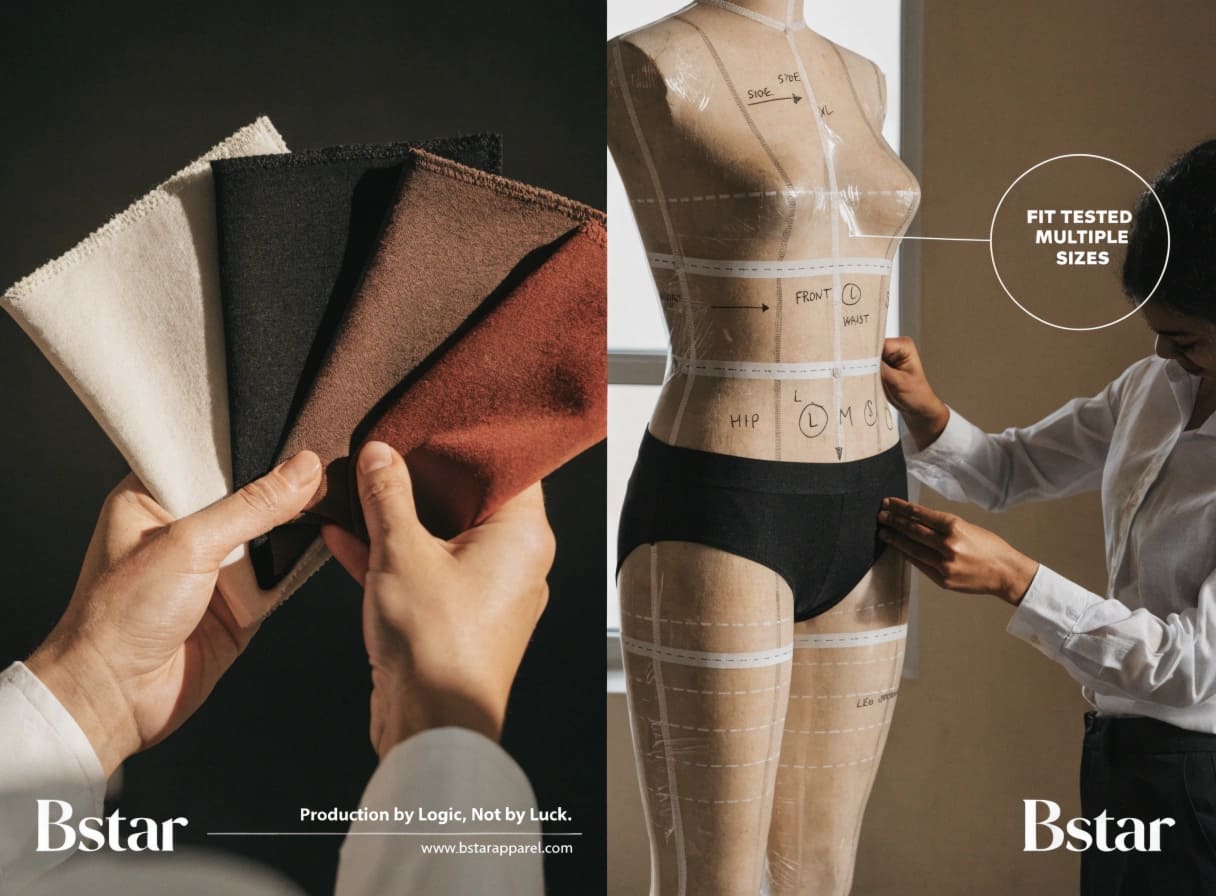
Here’s how I’d reframe material selection: it’s not a product decision, it’s a business decision.
The Fabric Decision Framework
| Fabric Type | Common Use Case | Key Trade-off |
|---|---|---|
| Nylon/Spandex blend | Performance, seamless | Higher cost, excellent recovery |
| Cotton/Spandex blend | Everyday comfort, basics | Lower cost, less shape retention |
| Modal/Spandex blend | Soft-touch, premium positioning | Mid-high cost, strong skin feel |
| Recycled Polyester/Spandex | Sustainability-focused brands | GRS3 certification required, cost premium |
GSM (grams per square meter) matters more than most founders realize4. A 180 GSM fabric and a 220 GSM fabric with the same composition will feel completely different — and carry different costs. If your brand is positioned as premium, a lightweight fabric that pills after 10 washes will undercut everything else you’ve built.
Elasticity is the other variable people underestimate. Underwear needs to stretch and recover cleanly across a size range5. A fabric that performs well at size S may look completely different at size XL if the recovery rate isn’t right.
For fit testing specifically: don’t approve a sample on one size. If you’re producing a size range, test fit across at least two sizes — typically your smallest and your largest. Fit issues that don’t show at size S often appear clearly at size XL.
Quality Assurance & Compliance: In-Line Inspection and International Standards — What Does "Quality Control" Actually Mean?
Every factory says they do quality control. What that actually looks like varies a lot.
Real quality assurance in underwear manufacturing isn’t a final check before shipping — it’s a system built into every production stage. Without in-line inspection checkpoints, defects compound and don’t surface until the goods are already packed.
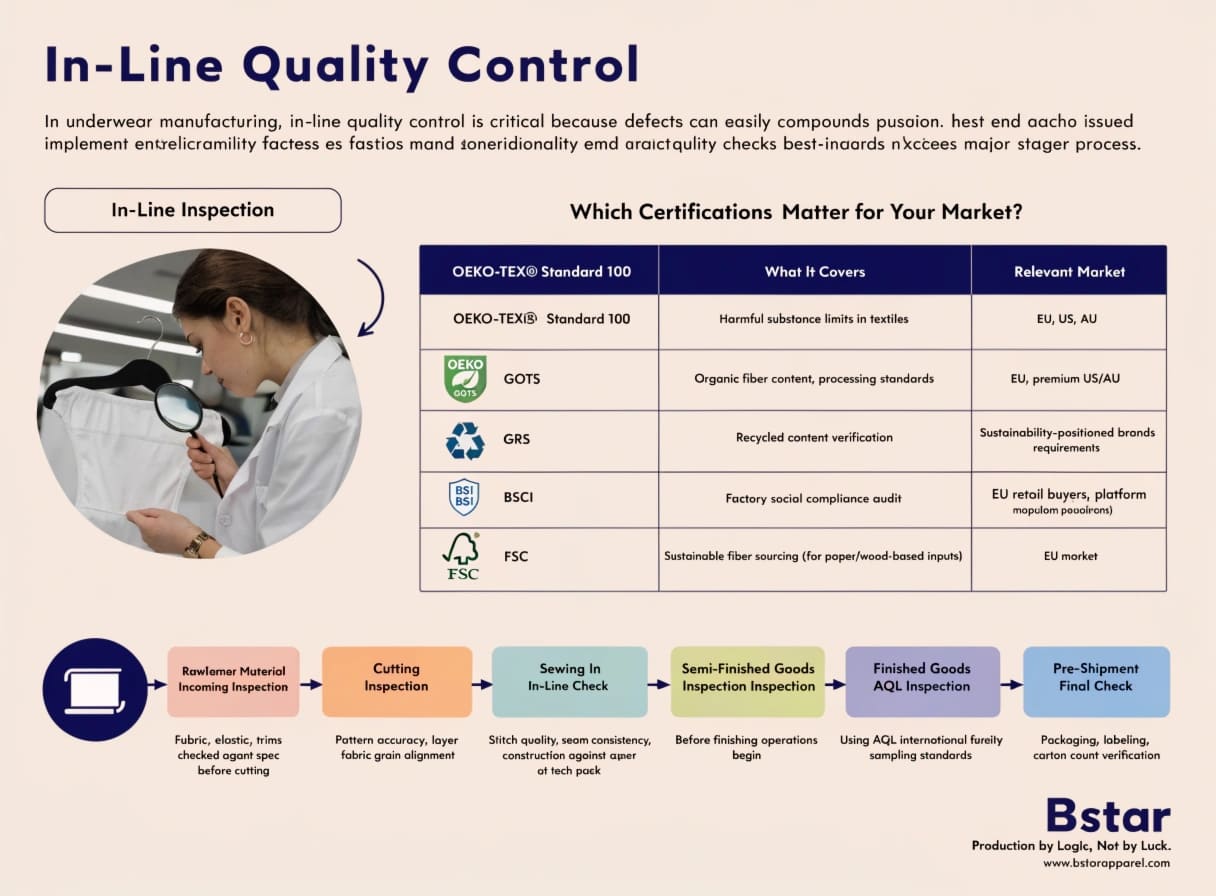
Here’s what a structured QC system looks like in practice, and what certifications you actually need for your market.
In-Line QC: What to Ask Your Factory
A factory running proper quality control should be able to describe specific checkpoints, not just say "we check everything." The checkpoints we run at BSTAR cover six stages:
- Raw material incoming inspection — fabric, elastic, trims checked against spec before cutting
- Cutting inspection — pattern accuracy, layer count, fabric grain alignment
- Sewing in-line check — stitch quality, seam consistency, construction against tech pack
- Semi-finished goods inspection — before finishing operations begin
- Finished goods AQL inspection — using AQL international sampling standards6
- Pre-shipment final check — packaging, labeling, carton count verification
When you’re evaluating a factory, ask them specifically which of these stages they inspect. If the answer is "we check before shipping," that’s a single checkpoint — not a system.
Which Certifications Matter for Your Market
This is an area where first-time founders often get caught off guard. Certifications aren’t optional extras — for many markets, they’re baseline requirements for retail distribution or direct-to-consumer sales.
| Certification | What It Covers | Relevant Market |
|---|---|---|
| OEKO-TEX® Standard 1007 | Harmful substance limits in textiles | EU, US, AU |
| GOTS8 | Organic fiber content, processing standards | EU, premium US/AU |
| GRS | Recycled content verification | Sustainability-positioned brands globally |
| BSCI9 | Factory social compliance audit | EU retail buyers, platform requirements |
| FSC | Sustainable fiber sourcing (for paper/wood-based inputs) | EU market |
If you’re selling into the EU and you can’t confirm your manufacturer’s fabrics are OEKO-TEX certified, you’re carrying a compliance risk. The same applies for Australian DTC brands — STEP ONE, for example, operates in a market where customer trust around materials is high and non-certified claims are a liability, not just a marketing miss.
Scaling Smarter: Cost-Effective Strategies for Volume Expansion — When and How Do You Increase Your Order Size?
Your first order is rarely your cheapest. That sounds counterintuitive, but it’s accurate.
Sampling fees, development costs, and unit pricing at low MOQ all come down once you’re in a stable production relationship with a confirmed product. The question isn’t just "how do I reduce cost per unit" — it’s "what do I need to lock in before scaling."
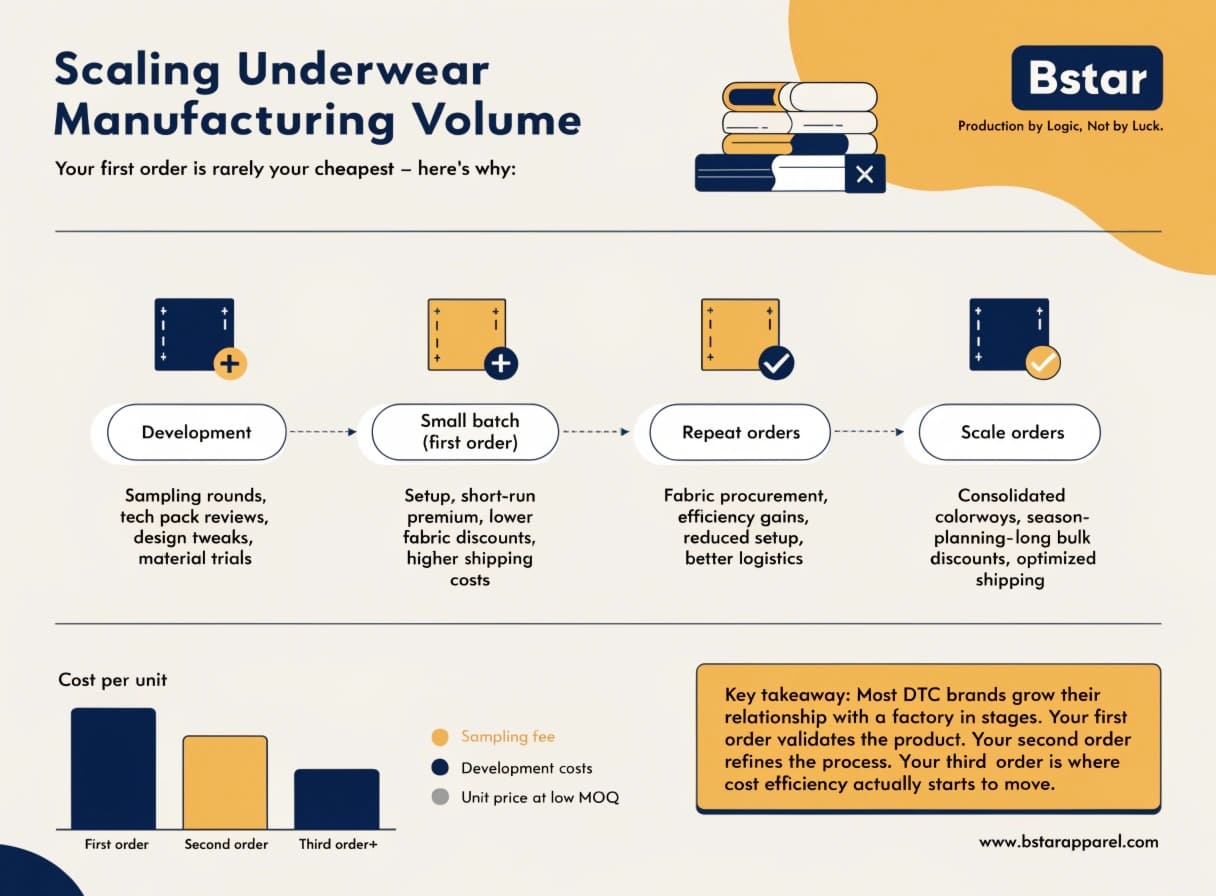
Here’s how I think about cost structure across the order lifecycle.
Cost Drivers at Each Stage
| Stage | Primary Cost Driver | How to Reduce It |
|---|---|---|
| Development | Sampling rounds | Invest in a complete tech pack before first sample |
| Small batch (first order) | Setup, short-run premium | Accept higher unit cost, focus on product confirmation |
| Repeat orders | Fabric procurement, efficiency | Lock in fabric specs, increase volume progressively |
| Scale orders | Logistics, lead time planning | Consolidate colorways, plan seasonal orders in advance |
Most DTC brands grow their relationship with a factory in stages. Your first order validates the product. Your second order refines the process. Your third order is where cost efficiency actually starts to move.
One practical move that saves money early: limit your colorway count on first orders. Each colorway requires its own dye lot, testing, and minimum fabric purchase10. A 3-color launch at 500 units per color is more expensive per unit than a 1-color launch at 1,500 units. Pick the hero color, prove the product, then expand.
On MOQ: for development stage sampling, we support 1-piece minimum. That’s not a sales pitch — it’s a practical point. You shouldn’t be committing to bulk fabric purchases before you’ve confirmed the fit and construction are right.
Conclusion
Custom underwear manufacturing rewards preparation. Know your timeline, get your tech pack right, choose materials intentionally, verify your factory’s QC process, and don’t scale before your product is confirmed.
-
"a study on lead time management in garments industry", https://www.academia.edu/145106488/A_STUDY_ON_LEAD_TIME_MANAGEMENT_IN_GARMENTS_INDUSTRY. Industry sources such as the American Apparel & Footwear Association and trade publications document typical apparel production lead times ranging from several weeks to multiple months depending on order complexity, factory location, and shipping method, broadly consistent with the 10–14 week estimate cited here. Evidence role: general_support; source type: institution. Supports: Typical end-to-end lead times for apparel manufacturing, including sampling and production phases. Scope note: Published lead-time figures vary widely by product category, region, and order size; no single authoritative benchmark covers all scenarios described in this article. ↩
-
"Pantone Color Systems – For Textiles", https://www.pantone.com/color-systems/for-textiles?srsltid=AfmBOopRX3JokeJ7XiNQNP97-jDmMKDcns5XLP1qSxpdFqIAaaobBjr_. The Pantone Matching System (PMS), developed by Pantone LLC, is an internationally recognized color standardization system used across apparel, textile, and product design industries to provide unambiguous color references between designers and manufacturers. Evidence role: definition; source type: institution. Supports: The Pantone Matching System is a widely adopted color communication standard used in apparel and textile manufacturing to ensure consistent color reproduction across suppliers. Scope note: This citation supports the general use of Pantone as an industry standard; it does not independently verify that Pantone codes are universally required by all factories or that alternative systems are inadequate. ↩
-
"Recycled Claim Standard (RCS) + Global Recycled Standard (GRS)", https://textileexchange.org/recycled-claim-global-recycled-standard/. The Global Recycled Standard (GRS), administered by Textile Exchange, is an international voluntary standard that sets requirements for third-party certification of recycled content and responsible processing, social, and chemical practices; it is used by brands to substantiate recycled material claims in consumer-facing communications. Evidence role: definition; source type: institution. Supports: The Global Recycled Standard (GRS) is a voluntary product standard that verifies recycled content and responsible social, environmental, and chemical practices in production. Scope note: GRS is a voluntary standard; the article’s description of it as ‘required’ reflects market and buyer expectations for sustainability claims rather than a universal legal obligation. ↩
-
"Understanding Fabric Weights – Core Fabrics", https://corefabricstore.com/blogs/tips-and-resources/fabric-weights-blog?srsltid=AfmBOoqC2JWi_3p_6jOmPZlcZV1RCmrMDq3cIbFjJ3e6Fv555JadDFqN. GSM (grams per square meter) is a standard metric used in textile science to quantify fabric weight; research in textile engineering confirms that GSM influences mechanical properties such as tensile strength, pilling resistance, and thermal comfort, making it a key specification in garment manufacturing. Evidence role: definition; source type: education. Supports: GSM is a standard textile measurement that correlates with fabric weight, thickness, and performance characteristics including durability and hand feel. Scope note: The specific claim that a 180 GSM versus 220 GSM fabric of identical composition will pill differently after ten washes is illustrative rather than empirically verified by the cited source. ↩
-
"Textile performance – Wikipedia", https://en.wikipedia.org/wiki/Textile_performance. Elastic recovery, typically measured by standards such as ASTM D2594 (Standard Test Method for Stretch Properties of Knitted Fabrics), quantifies a fabric’s ability to return to its original dimensions after extension; textile engineering literature identifies recovery rate as a key determinant of garment fit consistency and long-term shape retention across size ranges. Evidence role: mechanism; source type: education. Supports: Elastic recovery is a measurable textile property that determines how well a fabric returns to its original dimensions after stretching, directly affecting garment fit and shape retention. Scope note: The specific claim that recovery rate differences manifest more visibly at larger sizes is a practical observation; direct empirical studies comparing recovery performance across garment size ranges are limited in the published literature. ↩
-
"[PDF] ISO 2859-1 – UNT Chemistry Department", https://chemistry.unt.edu/~tgolden/courses/iso2859-1.pdf. Acceptable Quality Limit (AQL) sampling is governed by ISO 2859-1 (Sampling procedures for inspection by attributes), an international standard that defines statistical sampling plans used to determine whether a production lot meets specified quality thresholds; it is widely applied in textile and apparel manufacturing. Evidence role: definition; source type: institution. Supports: AQL sampling is defined by ISO 2859 and is a widely used statistical method for acceptance sampling in manufacturing quality control. Scope note: ISO 2859 defines the statistical framework; its specific application protocols vary by factory and buyer agreement, so citing the standard supports the general claim but not any particular implementation described here. ↩
-
"OEKO-TEX® STANDARD 100", https://www.oeko-tex.com/en/our-standards/oeko-tex-standard-100/. OEKO-TEX Standard 100, administered by the OEKO-TEX Association (an international association of textile and leather testing institutes), certifies that every component of a textile article has been tested for harmful substances and that the article is harmless in terms of human ecology; it is recognized across EU, US, and other major consumer markets. Evidence role: definition; source type: institution. Supports: OEKO-TEX Standard 100 is an independent certification system administered by OEKO-TEX Association that tests textile products for harmful substances against defined limit values. Scope note: OEKO-TEX Standard 100 is a voluntary certification rather than a legally mandated requirement in most markets; the article’s framing as a ‘compliance risk’ for non-certified products may overstate its legal obligation in some jurisdictions. ↩
-
"Certification – GOTS – Global Organic Textile Standard", https://global-standard.org/certification-and-labelling/certification. The Global Organic Textile Standard (GOTS), governed by Global Standard gGmbH, specifies requirements for the organic status of textiles from harvesting of raw materials through environmentally and socially responsible manufacturing to labelling, and is recognized by retailers and regulators in the EU and other major markets. Evidence role: definition; source type: institution. Supports: GOTS is an internationally recognized standard for organic textiles that covers both fiber content and processing criteria including environmental and social conditions. Scope note: GOTS is a voluntary certification; its relevance as a market requirement depends on specific retail buyer contracts or platform policies rather than universal legal mandate. ↩
-
"amfori BSCI – Business Social Compliance Initiative", https://www.amfori.org/amfori-bsci/. The Business Social Compliance Initiative (BSCI), now operating under the amfori association, is a supply chain management system used primarily by European retailers to assess and improve social compliance in supplier factories, covering areas including working hours, wages, and health and safety conditions. Evidence role: definition; source type: institution. Supports: BSCI is a social compliance audit program administered by amfori that assesses factory working conditions against defined social performance criteria and is used by EU-based retailers. Scope note: BSCI audit requirements are imposed by individual retailers or platforms rather than by EU law; the degree to which BSCI is a baseline requirement varies by buyer and sector. ↩
-
"Sustainable Dyeing Techniques: Innovations in Coloring Fabrics", https://www.rmcad.edu/blog/sustainable-dyeing-techniques-innovations-in-coloring-fabrics/. In textile manufacturing, each dye lot represents a discrete batch of fabric dyed under specific conditions; industry and academic sources on textile processing confirm that dye lot preparation, colorimetric testing, and minimum batch requirements generate fixed costs per colorway, making multi-colorway orders at low volumes proportionally more expensive per unit than single-colorway orders at equivalent total volume. Evidence role: mechanism; source type: education. Supports: Textile dyeing is conducted in discrete dye lots, each requiring separate preparation, dyeing, and quality testing, which creates fixed costs per colorway that increase total cost at low order volumes. Scope note: Specific minimum dye lot sizes and associated costs vary significantly by mill, fiber type, and dyeing method; the general mechanism is well-supported but precise figures depend on individual supplier agreements. ↩
Discussion & questions 0 comments