
You placed an order. Now you’re watching the calendar. Your launch date is locked, your ads are booked, and you still don’t know when your underwear will actually ship.
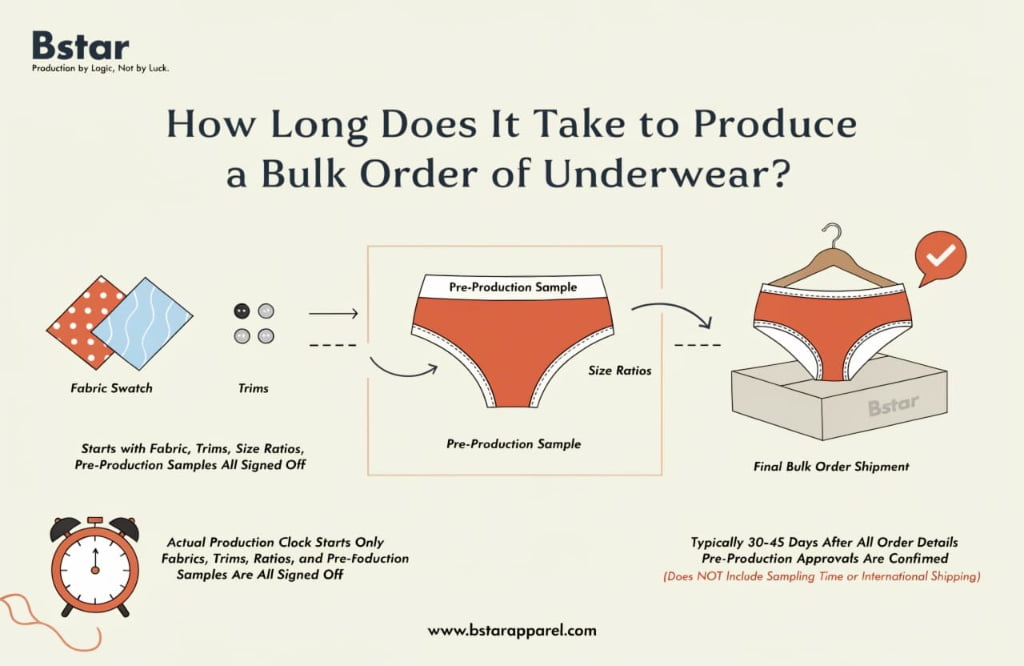
A typical bulk underwear order takes 30–45 days after all order details and pre-production approvals are confirmed. This does not include sampling time or international shipping. The actual clock starts only when fabrics, trims, size ratios, and pre-production samples are all signed off.
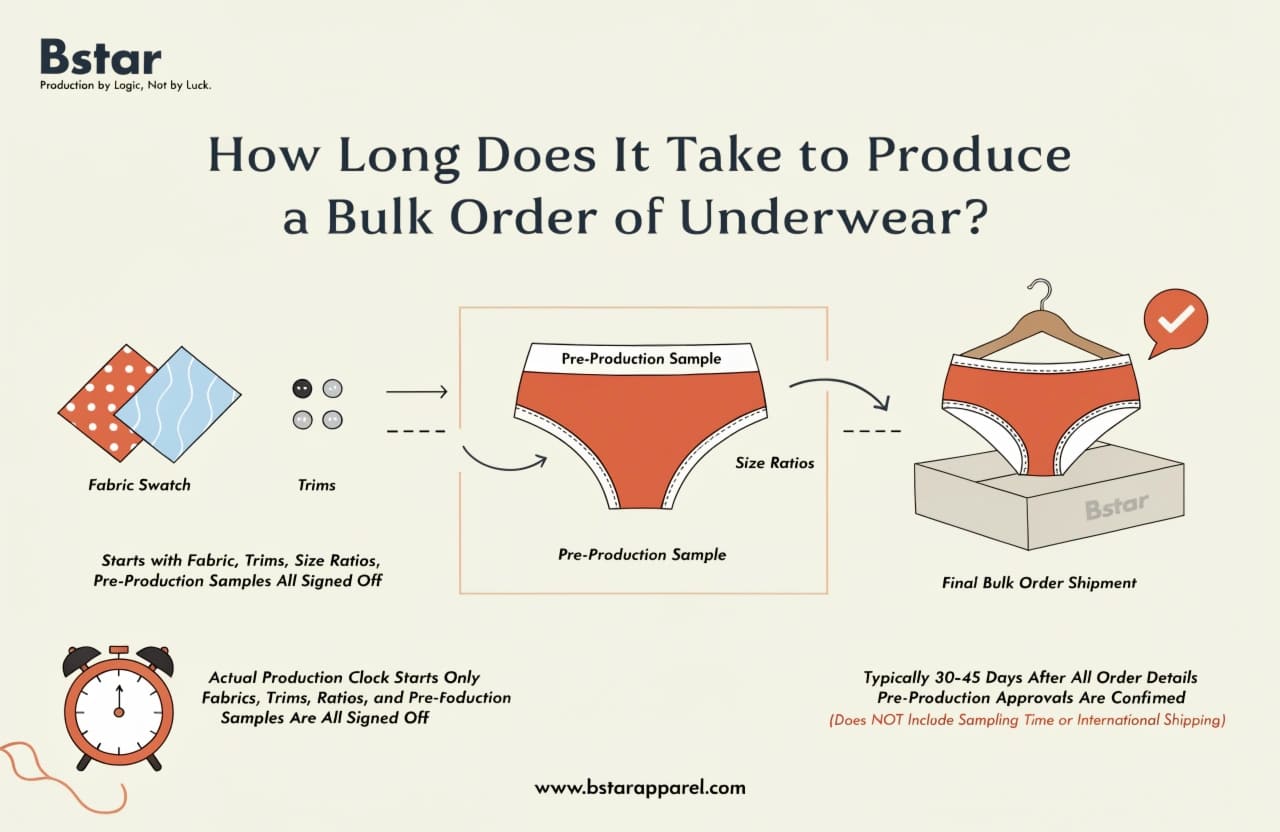
Most delays we see don’t happen on the sewing line. They happen before production even starts. Understanding where the time actually goes is the first step to protecting your launch date.
What Are the Key Production Stages from Sampling to Shipment?
Many buyers think about production time as sewing time. It isn’t. There are several stages before a single stitch is made in bulk.
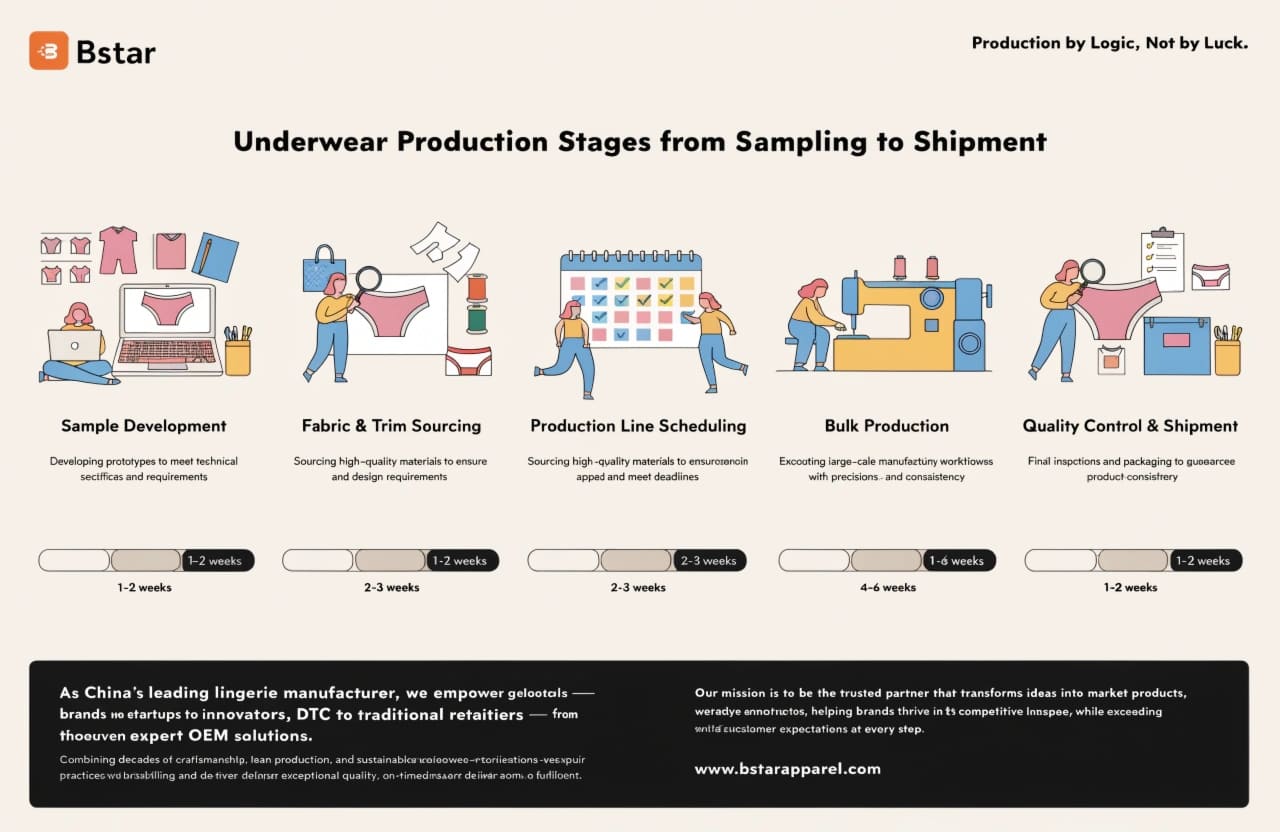
The full process from order confirmation to cargo-ready typically moves through five stages: pre-production sample approval, fabric and trim sourcing, production line scheduling, bulk sewing and finishing, and final quality inspection. Each stage has its own timeline and its own risks.
Breaking Down Each Stage
Here is how each stage typically looks in a real underwear bulk order:
| Stage | Typical Duration | What Can Slow It Down |
|---|---|---|
| Pre-production sample approval | 5–10 days | Revision requests, slow buyer feedback |
| Fabric & trim sourcing | 7–15 days | Custom dye lots, elastic lead times |
| Line scheduling | 3–7 days | Factory capacity conflicts |
| Bulk sewing & finishing | 10–20 days | Size ratio complexity, style count |
| QC inspection & cargo-ready | 3–5 days | Rework, re-inspection |
The number that surprises most buyers is the pre-production stage. We’ve had orders where the buyer took 10 days to approve a sample that needed no changes. That 10 days came directly out of their launch window.
The stage people underestimate most is fabric and trim sourcing. Underwear is not a simple garment. It uses specific performance fabrics, narrow elastics, hook-and-eye hardware, moisture-wicking liners, and branded labels1. If any of these are custom or not in stock, the clock is running before a single sewing machine is turned on.
The sewing and finishing stage is actually the most predictable part. With our current daily capacity, bulk runs move efficiently once the line is loaded. The chaos lives upstream.
How Do MOQ, Fabric Sourcing, and Design Complexity Impact Delivery?
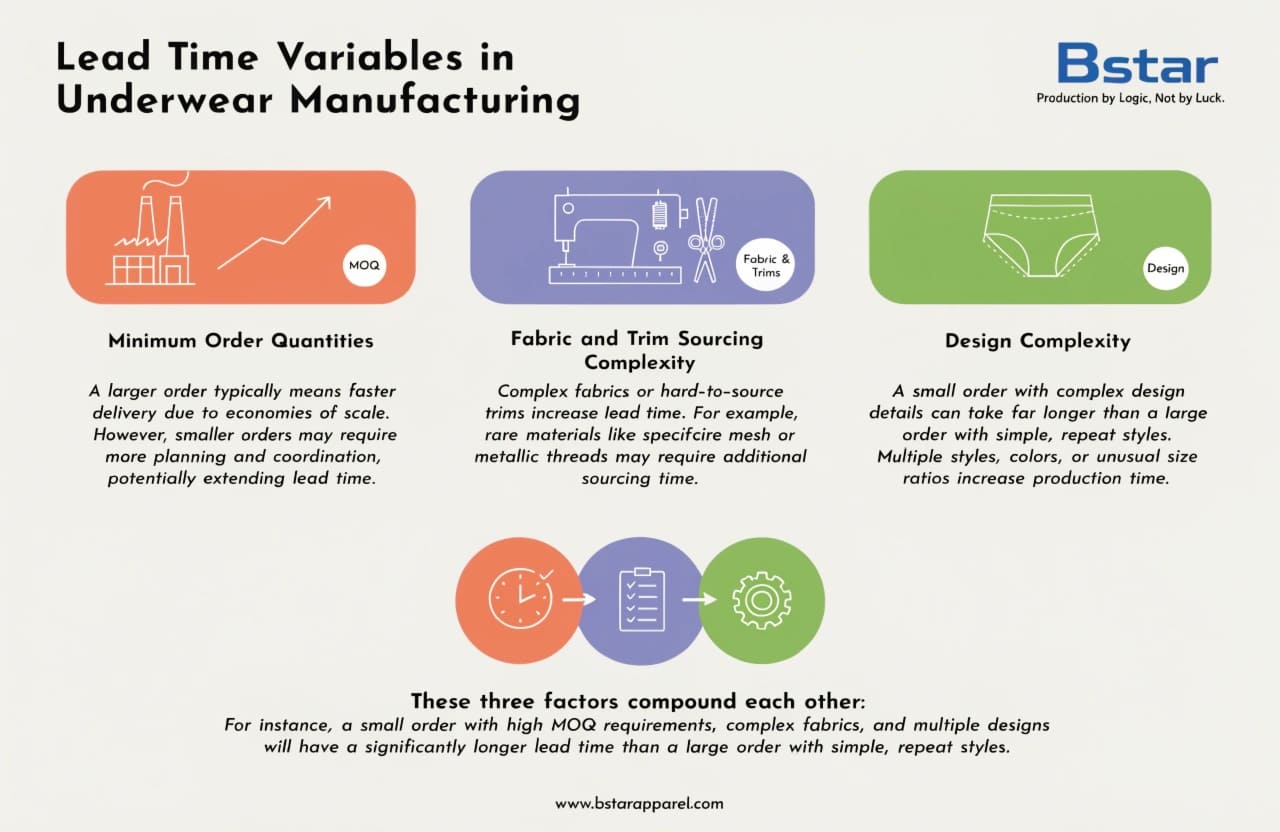
You might expect a larger order to take longer. That’s not always true. Sometimes a small order with complex design details takes far longer than a large order with simple, repeat styles.
Lead time in underwear production is shaped by three main variables: minimum order quantities and how they affect material commitments, fabric and trim sourcing complexity, and the number of styles, colors, and size ratios in the order. These factors compound each other.
How Each Variable Affects Your Timeline
MOQ and material commitments work together. If your order quantity is below the minimum for a specific fabric or custom elastic, the mill may not start weaving or dyeing until orders from other buyers fill the run2. Your production start date depends on someone else’s order. This happens more than buyers expect.
Fabric sourcing is where we see the most variance. Standard fabrics from stock move fast. Custom colors, sustainable certified fabrics like GOTS or GRS materials, or performance blends with specific certifications can add 10–20 days to sourcing alone3. We always recommend buyers confirm fabric options early, not after styles are approved.
Design complexity affects both pre-production approval time and bulk production speed. A brief with three colors, two size ratios, and one fabric is straightforward. An order with six colorways, a wide size range from XS to 3XL, custom packaging, hang tags, woven labels, and three different fabrics is not4. Each variable adds decision points. Each decision point is a potential delay if the buyer isn’t responsive.
Here is a simple way to think about it:
| Order Type | Estimated Lead Time (Post-Confirmation) |
|---|---|
| Simple reorder, same materials | 25–35 days |
| New style, stock fabrics | 35–45 days |
| New style, custom fabrics or trims | 45–60+ days |
| Multiple styles, custom everything | 60+ days, plan earlier |
What Can You Actually Do to Speed Up a Bulk Order?
Buyers often ask us: can you go faster? The honest answer is: sometimes yes, but the speed is usually in your hands, not ours.
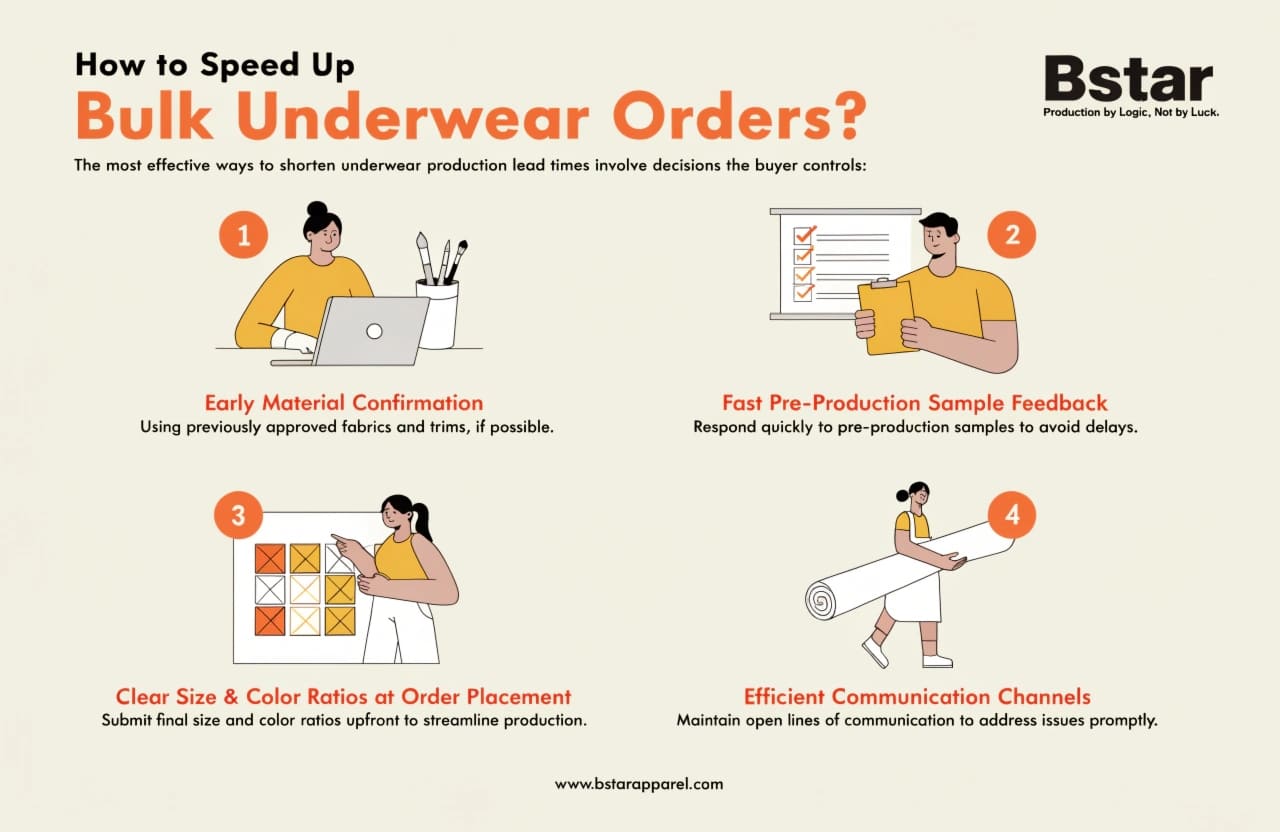
The most effective ways to shorten underwear production lead times involve decisions the buyer controls: early material confirmation, fast pre-production sample feedback, clear size and color ratios submitted at order placement, and using previously approved fabrics and trims where possible.
What Speeds Things Up on the Buyer Side
The biggest time-saver we’ve seen is buyers who come to us with a complete brief. That means:
- Fabric type and color confirmed
- Size ratio and total quantity confirmed
- Packaging, labels, and hang tag artwork ready
- A clear deadline with context (launch date, not just "ASAP")
When a buyer submits all of this at once, we can overlap some sourcing and sampling stages. When a buyer submits pieces slowly over two weeks, those two weeks are lost before production even begins.
Just-in-time scheduling is a strategy some of our DTC clients use for replenishment orders. Once a style is fully approved and materials are pre-confirmed, we can hold production slots and move faster on repeat runs. This works well for core products that sell year-round5. It doesn’t work well for new launches where approvals are still open.
One thing we never recommend: compressing QC inspection time to hit a deadline. We’ve seen brands push for early shipment and skip thorough inspection. The result is quality issues discovered after the product is already in customers’ hands6. That cost is always higher than a delayed launch.
| Action | Time Saved |
|---|---|
| Submit complete brief at order placement | Up to 7 days |
| Use previously approved fabrics | Up to 15 days |
| Fast pre-production sample approval (within 48 hrs) | Up to 5 days |
| Pre-confirm packaging and labels before sampling ends | Up to 5 days |
How Does Shipping and Customs Add to Your Total Timeline?
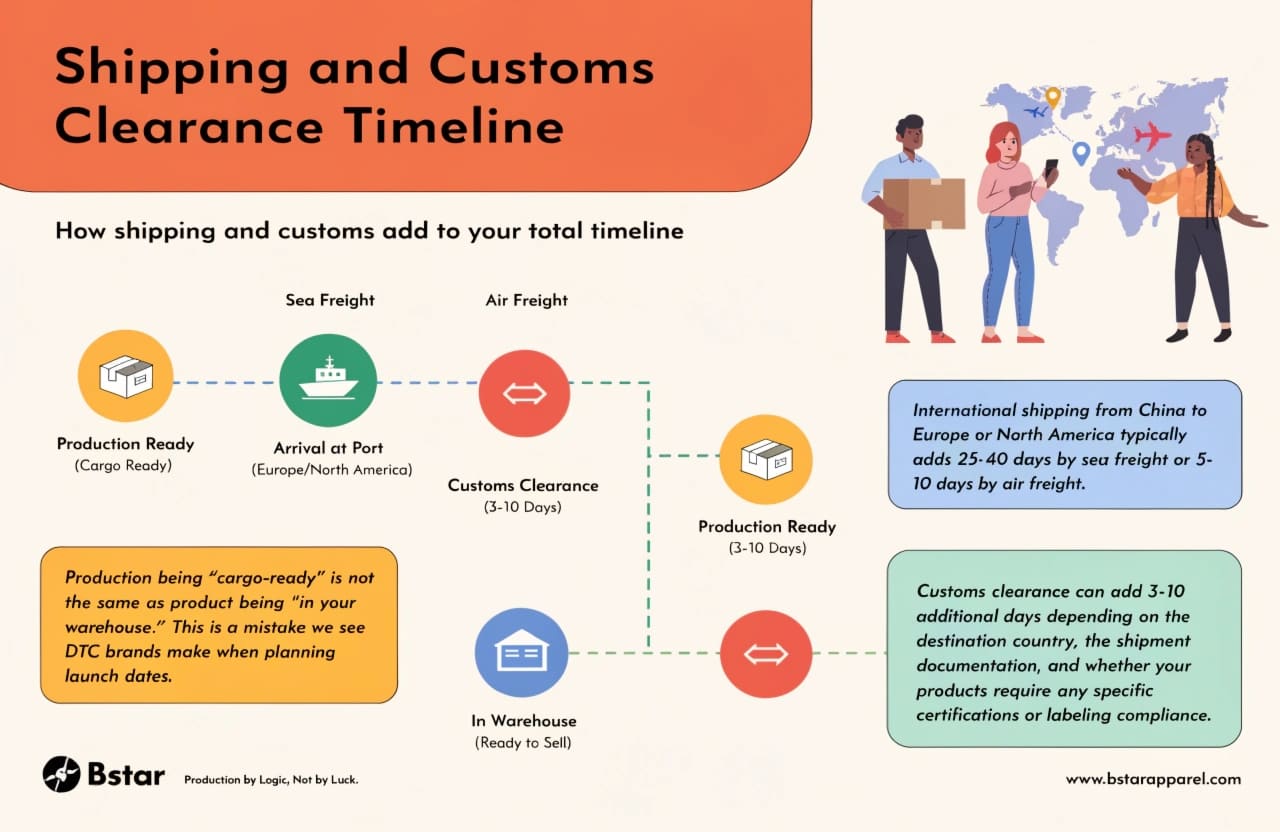
Production being "cargo-ready" is not the same as product being "in your warehouse." This is a mistake we see DTC brands make when planning launch dates.
International shipping from China to Europe or North America typically adds 25–40 days by sea freight or 5–10 days by air freight7. Customs clearance can add 3–10 additional days depending on the destination country, the shipment documentation, and whether your products require any specific certifications or labeling compliance8.
Planning Your Full Timeline Backward from Launch
The right way to plan is to start from your launch date and work backward9. Here is how a realistic DTC brand should think about it:
| Phase | Time Required |
|---|---|
| Bulk production (post-confirmation) | 30–45 days |
| Sea freight (China to EU/US) | 25–35 days |
| Customs clearance and local delivery | 5–10 days |
| Buffer for delays | 7–14 days |
| Total minimum planning window | 67–104 days |
If you need product in your warehouse by a specific date, count backward from that date using the table above. Then add your sampling and approval time before that. Most DTC brands need to place a confirmed order at least 3–4 months before a planned launch, especially for new styles.
Customs documentation matters more than many buyers expect. Underwear imported into the EU or US may need specific fiber content labeling, country-of-origin documentation, and compliance with chemical safety standards10. Our team helps prepare these documents, but buyers should confirm their local import requirements early. An incorrect label discovered at customs can hold an entire shipment11.
Conclusion
A bulk underwear order realistically takes 30–45 days in production, plus sourcing, approvals, shipping, and customs. Plan 3–4 months out from your launch date to stay safe.
-
"The Complete Guide to Modern Underwear Manufacturing", https://sinofinetex.com/the-complete-guide-to-modern-underwear-manufacturing-from-product-development-to-large-scale-production/. Apparel manufacturing and textile engineering literature identifies intimate apparel as a technically complex product category requiring narrow elastic trims, performance knit fabrics (including moisture-management and stretch constructions), functional hardware such as hook-and-eye closures, and specialty liners, each of which may be sourced from distinct suppliers with independent minimum order and lead time requirements. Evidence role: general_support; source type: education. Supports: The range of specialized materials and components used in underwear and intimate apparel manufacturing. Scope note: Component specifications vary significantly by product type within the underwear category; the complexity described is more characteristic of structured or performance styles than basic commodity briefs. ↩
-
"Textile – Wikipedia", https://en.wikipedia.org/wiki/Textile. Textile supply chain research documents that fabric mills, particularly for custom dye lots and specialty constructions, operate on minimum production run quantities determined by equipment setup costs and dye batch economics; when a single buyer’s order falls below this threshold, mills may consolidate orders from multiple buyers before initiating production, introducing indeterminate delays into the buyer’s sourcing timeline. Evidence role: mechanism; source type: research. Supports: How textile mills manage minimum order quantities and the effect on buyer lead times when orders fall below minimums. Scope note: This practice varies by mill size, fabric type, and buyer relationship; large or preferred buyers may negotiate exceptions to standard minimum run requirements. ↩
-
"Certification – GOTS – Global Organic Textile Standard", https://global-standard.org/certification-and-labelling/certification. The Global Organic Textile Standard (GOTS), administered by Global Standard gGmbH, and the Global Recycled Standard (GRS), administered by Textile Exchange, impose chain-of-custody certification requirements on all supply chain actors handling certified materials; these requirements restrict sourcing to certified mills and suppliers, which reduces the available supplier pool and can extend material procurement timelines compared to conventional fabrics. Evidence role: definition; source type: institution. Supports: What GOTS and GRS certifications require of textile supply chains and why certified materials may have longer sourcing lead times. Scope note: The article’s specific 10–20 day delay estimate is not directly verifiable from certification body documentation; actual lead time impact depends on supplier relationships and stock availability. ↩
-
"[PDF] Inclusivity in the fashion industry -research paper – City Tech OpenLab", https://openlab.citytech.cuny.edu/hania-gad-eportfolio/files/2024/08/Inclusivity-in-the-fashion-industry-research-paper.pdf. Operations management research in apparel manufacturing identifies SKU proliferation—driven by extended size ranges and colorway expansion—as a significant driver of production scheduling complexity, increasing cutting room setup time, work-in-process inventory, and line changeover frequency, all of which contribute to longer total production lead times relative to simplified product assortments. Evidence role: mechanism; source type: research. Supports: How extended size ranges and multiple colorways increase production scheduling complexity and lead times in apparel manufacturing. Scope note: The magnitude of lead time impact from size range extension depends on factory configuration and whether graded patterns are pre-approved; some manufacturers specialize in extended sizing and may not experience the same degree of added complexity. ↩
-
"Rethinking Your Just-in-Time Supply Chain – Wharton", https://executiveeducation.wharton.upenn.edu/thought-leadership/wharton-at-work/2021/08/rethinking-your-supply-chain/. Supply chain management literature on lean and just-in-time manufacturing in the apparel industry documents that pre-positioning materials and reserving production capacity for replenishment orders can substantially reduce effective lead times compared to new-order scheduling, particularly for stable, high-velocity SKUs where demand patterns support advance material commitment. Evidence role: mechanism; source type: research. Supports: How pre-confirmed materials and reserved production capacity reduce lead times for repeat apparel orders. Scope note: JIT approaches in apparel manufacturing carry inventory risk and require accurate demand forecasting; the benefits described apply primarily to core replenishment products rather than fashion-forward or seasonal styles. ↩
-
"The Analysis of Quality Control in Garment Company Using Statistic …", https://www.academia.edu/94772000/The_Analysis_of_Quality_Control_in_Garment_Company_Using_Statistic_in_Controling_Product. Quality management research in apparel and textile manufacturing demonstrates that pre-shipment inspection serves as a critical defect detection stage; studies document that defects not identified before shipment result in higher rates of customer returns, warranty claims, and brand reputation costs that consistently exceed the cost of delayed shipment due to rework or re-inspection. Evidence role: mechanism; source type: research. Supports: The relationship between pre-shipment quality inspection practices and downstream product defect rates in apparel manufacturing. Scope note: Quantitative estimates of cost differentials vary by product category, defect type, and market; the general principle is well-supported but specific figures depend on context. ↩
-
"Latest Supply Chain and Freight Indicators", https://www.bts.gov/freight-indicators. Industry freight data and port authority statistics document average container shipping transit times from major Chinese ports (e.g., Shanghai, Shenzhen) to European and North American destinations, generally ranging from 25–35 days westbound to Europe and 14–21 days transpacific, with variation by routing and carrier; air freight typically completes the same routes in 5–10 days. Evidence role: statistic; source type: institution. Supports: Typical ocean freight transit times from Chinese ports to major European and North American ports. Scope note: Transit times vary by origin port, destination port, carrier, and routing; published averages may not reflect current congestion or seasonal variation. ↩
-
"Average time to clear imports through customs (days)", https://data.worldbank.org/indicator/IC.CUS.DURS.IM?locations=EU. U.S. Customs and Border Protection (CBP) and European Union customs authorities publish guidance indicating that standard import entries for compliant shipments are typically processed within 1–5 business days, though holds for examination, documentation deficiencies, or compliance review can extend clearance to 10 or more days. Evidence role: statistic; source type: government. Supports: Typical customs clearance processing times for apparel imports into the US and EU. Scope note: Clearance times are highly variable and depend on entry type, port of entry, and whether the shipment is selected for examination; published averages represent routine clearances only. ↩
-
"Analysis of the Critical Path Methods Impacts on the Basic T-Shirt …", https://www.academia.edu/100668742/Analysis_of_the_Critical_Path_Methods_Impacts_on_the_Basic_T_Shirt_Manufacturing_Process_in_the_Apparel_Industries. Backward scheduling, also referred to as reverse scheduling or pull-based planning, is a recognized operations management technique in which a required completion date is used as the starting point for calculating the latest allowable start dates for each preceding production stage; the method is documented in supply chain management literature as particularly appropriate for deadline-driven manufacturing contexts such as seasonal apparel launches. Evidence role: definition; source type: education. Supports: Backward scheduling as an established supply chain and project management methodology applicable to production planning. Scope note: Backward scheduling assumes reliable duration ↩
-
"Threading Your Way Through the Labeling Requirements Under the …", https://www.ftc.gov/business-guidance/resources/threading-your-way-through-labeling-requirements-under-textile-wool-acts. In the United States, the Textile Fiber Products Identification Act (15 U.S.C. § 70) and FTC regulations require fiber content and country-of-origin labeling on textile apparel; in the European Union, Regulation (EU) No 1007/2011 mandates fiber composition labeling, while REACH Regulation (EC) No 1907/2006 governs chemical substance restrictions applicable to imported textiles. Evidence role: definition; source type: government. Supports: Legal requirements for fiber content labeling and chemical safety compliance for apparel imported into the US and EU. Scope note: Specific labeling and chemical compliance requirements differ between the US and EU and may be subject to amendment; importers should consult current regulatory texts and legal counsel. ↩
-
"Regulations for importing textiles – help.CBP.gov", https://www.help.cbp.gov/s/article/Article-1070. U.S. Customs and Border Protection enforcement procedures provide that textile and apparel shipments found to have labeling deficiencies or country-of-origin misrepresentation may be detained, refused entry, or subjected to redelivery demands under 19 C.F.R. Part 134 and applicable FTC regulations, potentially delaying release of the entire shipment until compliance is demonstrated. Evidence role: mechanism; source type: government. Supports: Customs authorities’ authority to detain or hold shipments found to have labeling violations. Scope note: The frequency and severity of enforcement actions depend on the nature of the violation and port of entry; not all labeling deficiencies result in full shipment holds. ↩
Discussion & questions 0 comments