
I have seen strong underwear ideas fail because small production risks were ignored until bulk goods were already moving.
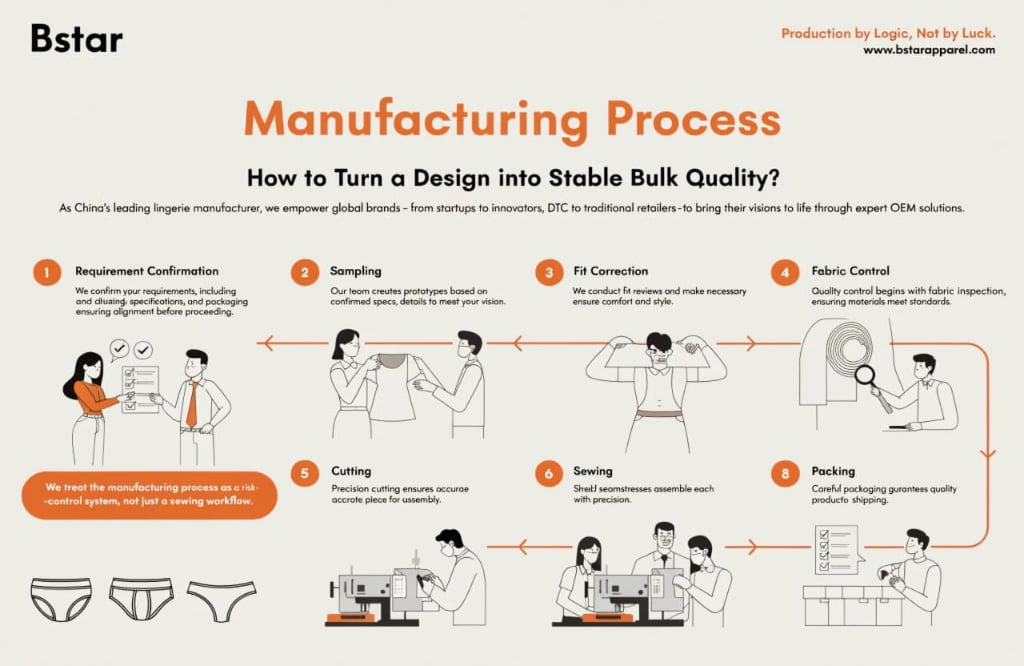
The men’s underwear manufacturing process turns a design into repeatable bulk quality through requirement confirmation, sampling, fit correction, fabric control, cutting, sewing, inspection, and packing. I treat it as a risk-control system, not only as a sewing workflow.
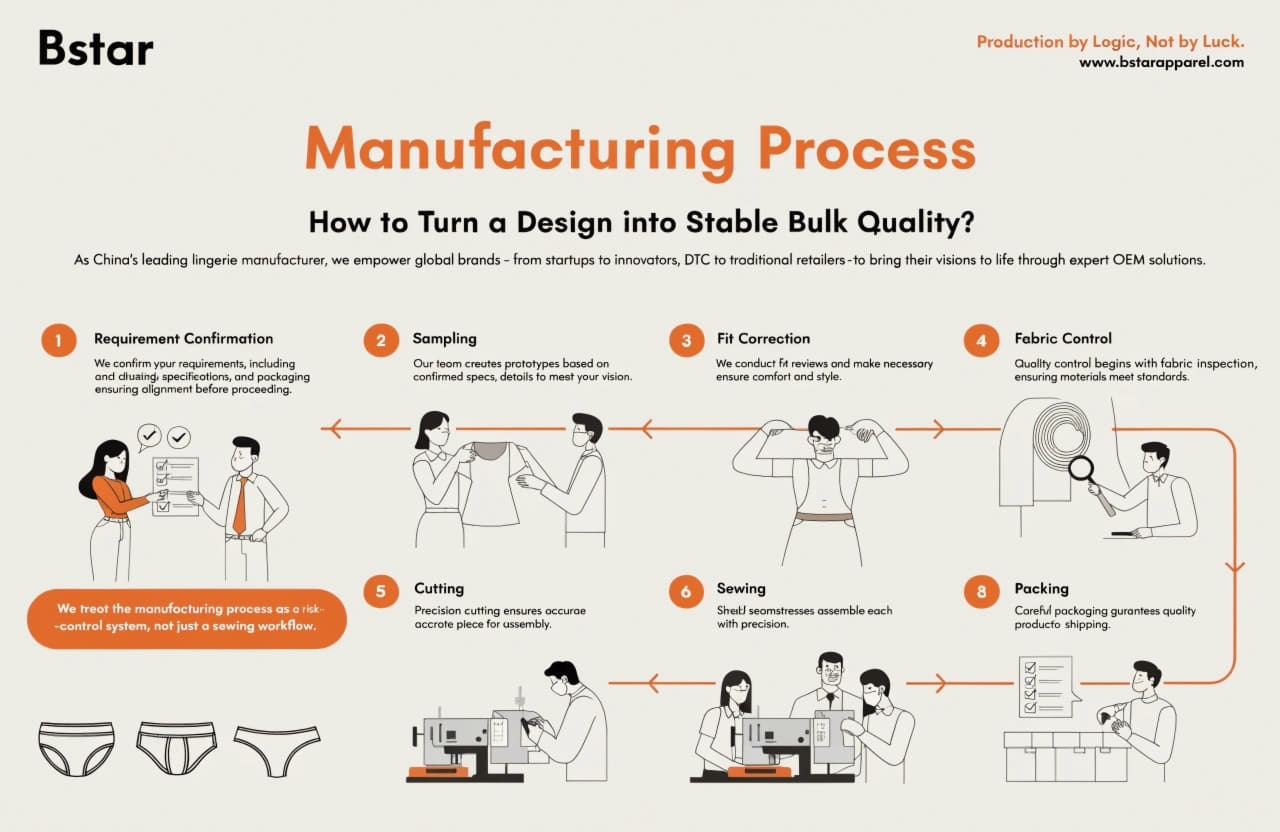
I work from the factory side in Guangdong, so I see the gap between a clean design file and real production every day. A buyer may send a tech pack, a waistband idea, and a launch date. We then have to ask simple but important questions. What fabric can hold the fit? What seam will feel smooth? What shrinkage can the size spec accept? What packing method will protect the garment? If we miss these points early, the problem will come back later as delays, rework, bad reviews, or weak repeat orders.
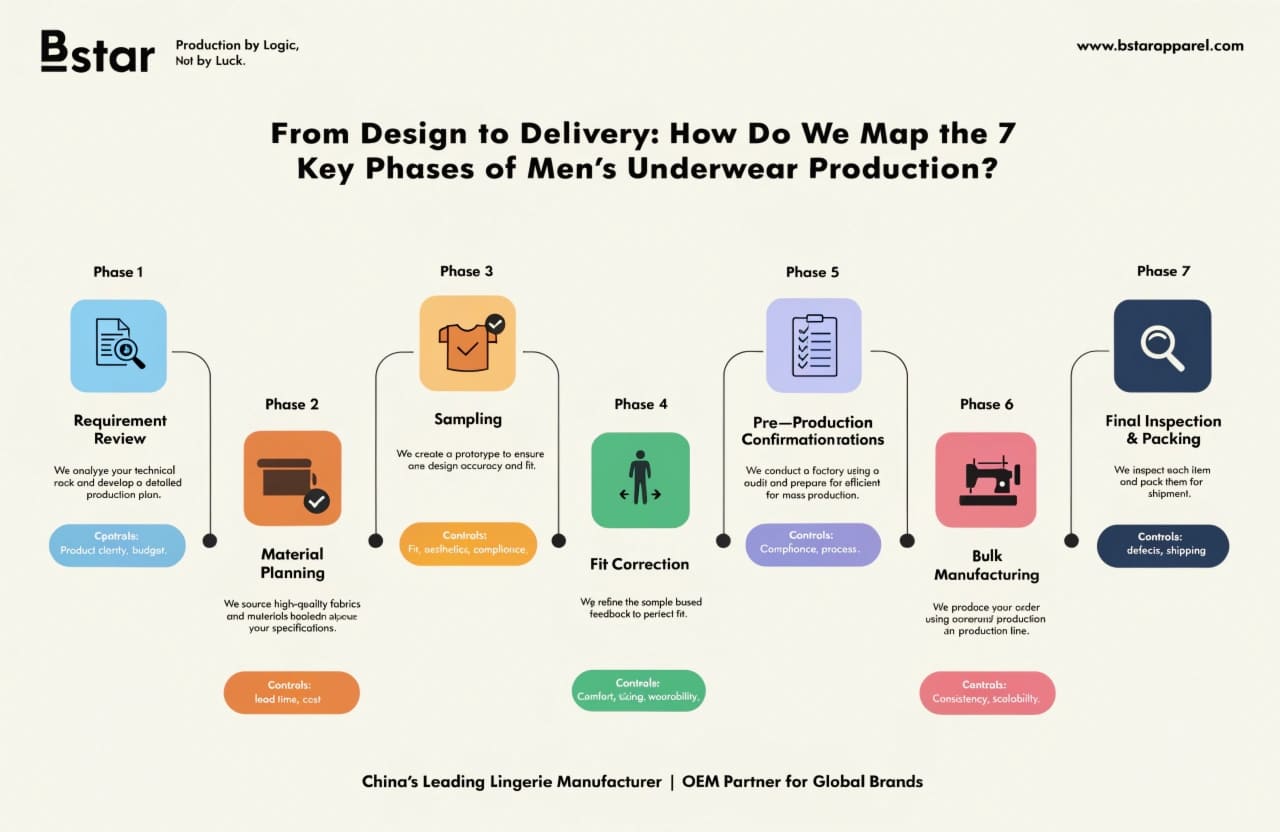
From Design to Delivery: How Do We Map the 7 Key Phases of Men’s Underwear Production?
I often meet buyers who think production starts at cutting, but the real work starts when we confirm the product requirement.
We map men’s underwear production through seven phases: requirement review, material planning, sampling, fit correction, pre-production confirmation, bulk manufacturing, and final inspection with packing. Each phase controls a different buyer risk.
I start with risk, not fabric
When I review a men’s underwear project, I do not ask only, “Can we make it?” I ask, “Can we make it again and again with the same fit?” A design file may look ready, but it may not show how the waistband should recover after stretch. It may not explain the crotch lining, seam placement, size grading, label position, wash target, or retail packaging. These details affect cost, lead time, sampling, and bulk stability.
In one anonymized order, a brand came to us with a boxer brief design for a DTC launch. The artwork was clear, but the waistband tension was not defined1. We made two sample versions. One looked premium on the table. The other felt better after wear simulation and washing. The buyer chose the second one because the repeat order risk was lower.
| Phase | What I confirm | Buyer risk I reduce |
|---|---|---|
| Requirement review | Design file, size spec, fabric, trims, packing | Wrong cost and wrong timeline |
| Material planning | Yarn, fabric weight, stretch, color | Comfort gap and color delay |
| Sampling | Pattern, stitching, waistband, crotch | Poor first impression |
| Fit correction | Wear feel, size balance, recovery | Bad reviews after launch |
| Pre-production | Approved sample and process sheet | Bulk not matching sample |
| Bulk manufacturing | Cutting, sewing, in-line checks | Rework and late shipment |
| Final inspection | AQL check, packing, carton marks | Claims after delivery |
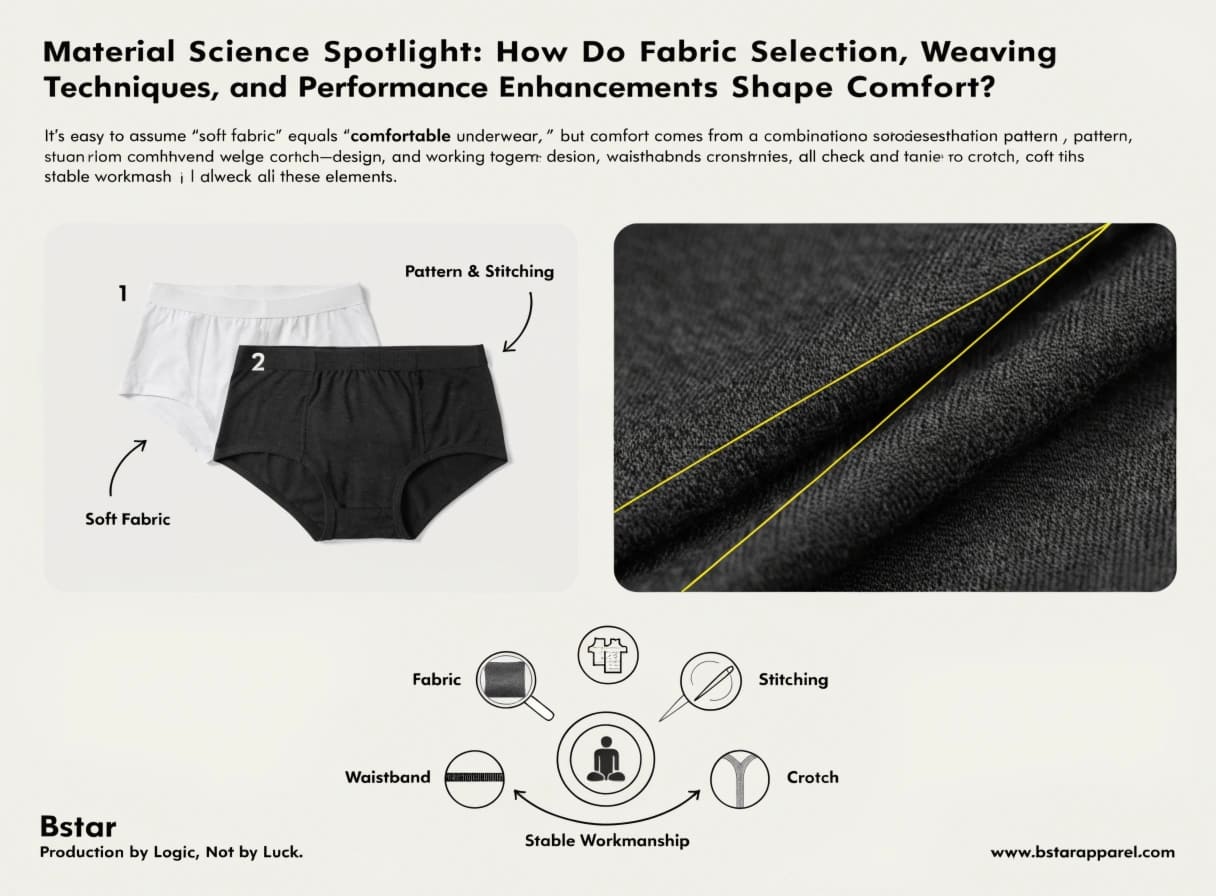
Material Science Spotlight: How Do Fabric Selection, Weaving Techniques, and Performance Enhancements Shape Comfort?
I have seen buyers ask for “soft fabric” as if softness alone can make underwear comfortable. It cannot.
Fabric selection matters, but comfort comes from fabric, pattern, stitching, waistband construction, crotch design, and stable workmanship working together. I check these parts together before I trust a style for bulk production.
I treat fabric as one part of the full comfort system
Men’s underwear sits close to the body, so fabric mistakes show up fast. A fabric may feel soft in the hand, but it may twist after washing2. It may stretch well, but it may not recover well. It may look thin and light, but it may not give enough support. This is why I avoid judging fabric by one claim.
For knitted underwear, we often discuss cotton, modal, bamboo viscose3, recycled polyester blends4, spandex content, and different jersey or rib structures. I do not present these as magic choices. I look at the target wearer, market price, washing habits, climate, and brand position. A North American athletic-style boxer brief may need a different hand feel and support than a European lounge brief.
| Fabric point | What I check | Why the buyer should care |
|---|---|---|
| Fiber blend | Cotton, modal, bamboo viscose, polyester, spandex | Hand feel, support, cost, washing behavior |
| Knit structure | Single jersey, rib, interlock, jacquard | Stretch direction and surface feel |
| Fabric weight | GSM range and tolerance | Coverage, support, shipping cost |
| Elastic recovery | Stretch and return behavior | Fit after long wear |
| Shrinkage | Wash change before and after sewing | Size complaints |
| Color and dye | Lab dip and bulk shade control | Brand consistency |
I connect material decisions to real product risks
If a buyer wants a very soft modal boxer brief5, I will also discuss seam strength and shape retention. If a buyer wants recycled materials, I will ask for target certifications or supplier documents before we confirm claims. At BSTAR, we can work with certified material sources when the project needs FSC, OEKO-TEX®6, GOTS7, or GRS support, but I still ask buyers to verify documents for their own compliance files.
This keeps the conversation practical. Fabric can help comfort, but the wearer judges the final garment, not the fabric roll.
Tech-Driven Production: How Do 3D Modeling and Seamless Knitting Improve Efficiency?
I like technology when it removes guesswork, but I do not use it as a decoration in the sales story.
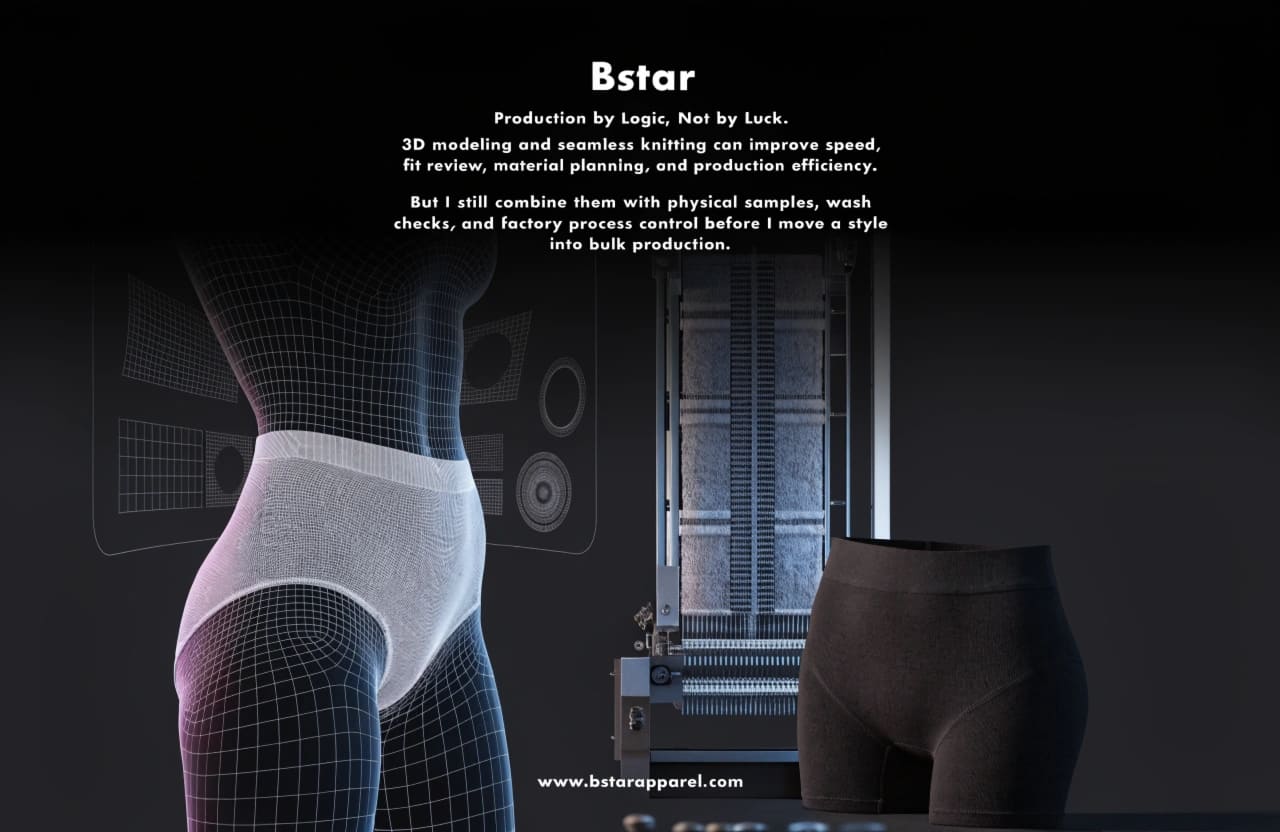
3D modeling and seamless knitting can improve speed, fit review, material planning, and production efficiency8. I still combine them with physical samples, wash checks, and factory process control before I move a style into bulk production.
I use digital tools to shorten the wrong kind of waiting
For many DTC brands, time is the pressure point. A founder may need product photos, fit approval, and launch timing at the same time. Digital tools can help us show pattern intent, panel placement, print position, waistband proportion, and color direction earlier. They help teams make decisions before every change becomes a new physical sample.
Still, I do not tell buyers that 3D review replaces wear testing. Underwear fit is too close to the body. The model may show shape, but it cannot fully show waistband bite, crotch comfort, seam rubbing, or fabric recovery after washing. I use 3D work as an early filter. I use physical samples as the real gate.
| Tool or method | What it helps | What I still verify physically |
|---|---|---|
| 3D modeling | Shape, panels, print view, early comments | Wear feel and fabric behavior |
| Digital pattern work | Faster size adjustment | Real fit on body or fit form |
| Seamless knitting | Fewer seams and smooth areas | Support, recovery, and sizing |
| Digital production tracking | Progress visibility | Actual workmanship and inspection |
| Automated cutting support | Better cutting consistency | Fabric layer control and size accuracy |
I see seamless production as a fit and process choice
Seamless knitting can reduce seam lines and improve a smooth feel for some underwear styles. It can also support body mapping and clean design. But it does not fit every brand, every MOQ, or every price target. Some premium styles still need cut-and-sew construction because the brand wants a certain pouch shape, waistband look, fabric mix, or panel design.
This is where factory judgment matters. I do not push one method as the only answer. I compare the design goal, target price, order volume, sample time, and repeat-order plan. If the technology reduces risk, I recommend it. If it adds cost without solving the buyer’s main problem, I say that clearly. A good production decision should protect both the wearer experience and the business plan.
Quality Assurance and Compliance: How Do Testing Protocols and International Standards Protect Premium Underwear?
I have seen brands lose money because they thought QC was only a final inspection before shipment.
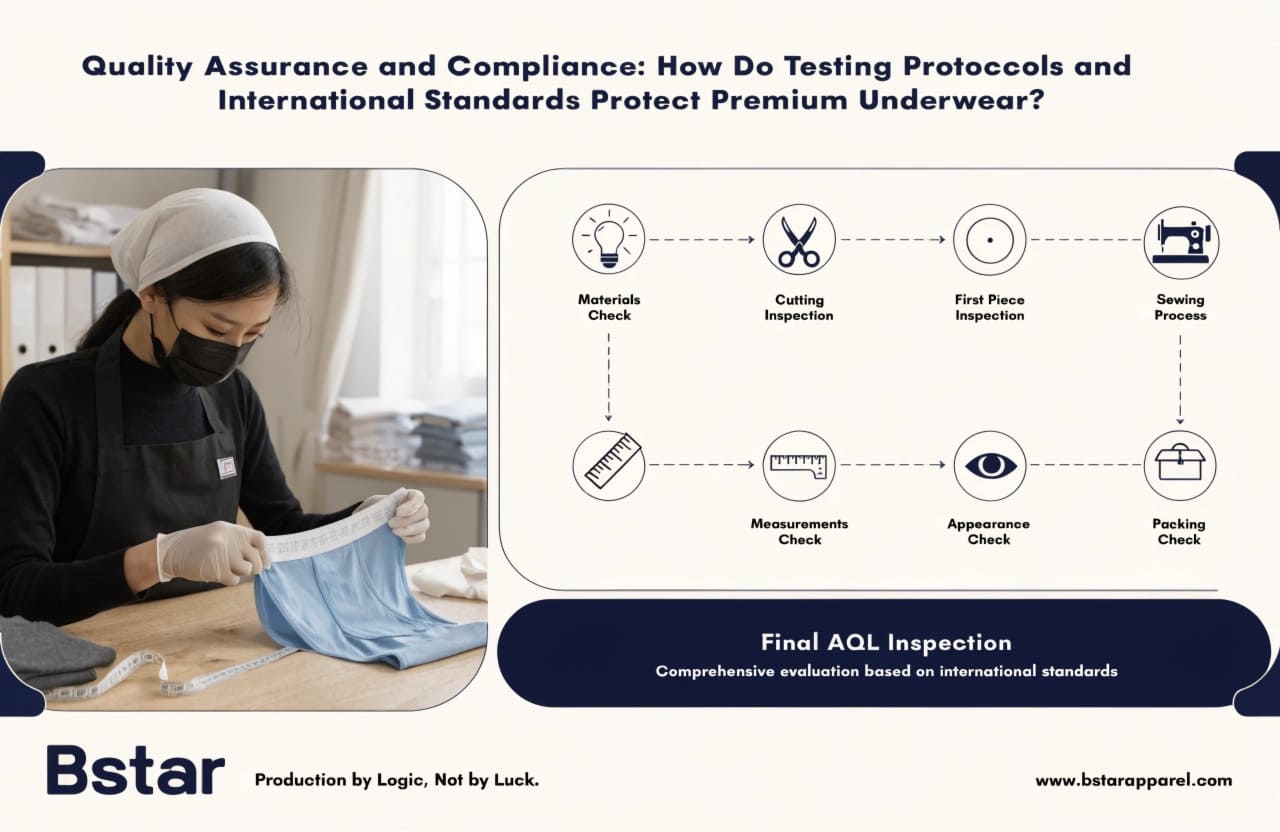
Quality assurance in men’s underwear should work as in-process prevention. I check materials, cutting, first pieces, sewing, measurements, appearance, packing, and final AQL inspection so problems are found before they become bulk defects.
I build quality into each step
Final inspection is important, but it is too late to depend on it alone. If cutting is wrong, sewing cannot fully fix the size. If waistband tension changes during production, final inspection may find the issue after hundreds or thousands of pieces are already made. If packing labels are wrong, the product may be good, but the warehouse may still reject the shipment.
In our workflow, we use first-piece confirmation before bulk sewing9. This means we compare the first completed garment with the approved sample, measurement spec, workmanship standard, and packing requirement. We then check the line during production. We also do a final inspection under the agreed standard, often based on AQL requirements10 when the buyer asks for that structure.
| Checkpoint | What I look at | Problem I try to prevent |
|---|---|---|
| Incoming material check | Fabric shade, width, defects, trims | Color mismatch and shortage |
| Cutting check | Pattern accuracy, layer control, size marks | Uneven size in bulk |
| First-piece confirmation | Fit points, stitching, waistband, label | Bulk not matching approved sample |
| In-line sewing check | Seam strength, stitch density, appearance | High rework rate |
| Measurement check | Waist, rise, inseam, leg opening | Fit complaints |
| Final inspection | Appearance, defects, packing, carton | Shipment claims |
| Packing confirmation | Polybag, barcode, carton mark | Warehouse or retail problems |
I link compliance to the target market
European and North American buyers often need more than a nice product. They may need social responsibility documents, fabric safety documents, recycled content documents, or brand-specific packing rules. As a factory, I can support this process when the requirement is clear before production. For example, BSTAR holds BSCI social responsibility certification11, and we can work with material suppliers that provide documents such as FSC, OEKO-TEX®, GOTS, or GRS when the project needs them.
I still tell buyers not to treat compliance as an afterthought. If the product claim says organic, recycled, or eco-friendly, the document trail should be planned from the material stage. If the packaging needs a special barcode, warning label, or retailer format, it should be confirmed before mass packing starts. Compliance is not only paperwork. It protects market entry, brand trust, and repeat orders.
Conclusion
I see underwear manufacturing as controlled decision-making. When we control fit, fabric, process, quality, and compliance early, bulk production becomes safer.
-
"How To Judge Elastic Band Quality When Buying In Bulk – Lightspot", https://lightspottrim.com/blog/how-to-judge-elastic-band-quality-when-buying-in-bulk/. ASTM D2594 and related test methods establish procedures for measuring stretch and recovery of knitted fabrics, providing a technical basis for specifying waistband performance prior to bulk production. Evidence role: mechanism; source type: institution. Supports: That elastic recovery in waistbands is a measurable, standardized property requiring defined specifications before production. Scope note: These standards address fabric-level testing; they do not directly prescribe how manufacturers should document waistband tension in a product specification sheet. ↩
-
"Study Effect of Twist Multipliers on Loop Length, Loop Shape, and …", https://www.academia.edu/62158133/Study_Effect_of_Twist_Multipliers_on_Loop_Length_Loop_Shape_and_Tightness_Factors_of_Single_Jersey_and_1_1_Rib_Knitted_Fabrics. AATCC Test Method 179 (Skewness Change in Fabric and Garment Twist Resulting from Automatic Home Laundering) provides a standardized procedure for quantifying the twisting behavior of knitted fabrics after washing, supporting the claim that hand feel alone does not predict post-wash stability. Evidence role: mechanism; source type: institution. Supports: That knitted fabrics, including soft cotton blends, are subject to measurable skewness and dimensional change after laundering. Scope note: The standard measures skewness as a discrete property; it does not directly correlate subjective softness ratings with twist outcomes. ↩
-
"Bamboo Textiles – Federal Trade Commission", https://www.ftc.gov/bamboo-textiles. The U.S. Federal Trade Commission has issued guidance clarifying that fabrics made from bamboo through a chemical viscose process must be labeled as ‘rayon’ or ‘bamboo rayon’ rather than simply ‘bamboo,’ a distinction with implications for both compliance and sustainability claims. Evidence role: definition; source type: government. Supports: That bamboo viscose is a chemically processed regenerated fiber subject to specific labeling requirements distinct from mechanically processed bamboo fiber. Scope note: FTC guidance applies specifically to the U.S. market; labeling requirements differ across jurisdictions and the article addresses a global buyer audience. ↩
-
"Effect of Recycling PET Fabric and Bottle Grade on r-PET Fiber …", https://pmc.ncbi.nlm.nih.gov/articles/PMC10224041/. The Global Recycled Standard, administered by Textile Exchange, defines requirements for third-party certification of recycled input materials and chain of custody, providing the documentary basis for recycled polyester claims referenced in the article. Evidence role: definition; source type: institution. Supports: That the Global Recycled Standard (GRS) provides third-party verification for recycled content claims in polyester and other fibers used in textile production. Scope note: GRS certification addresses chain-of-custody and content claims; it does not certify the performance properties of the resulting fabric. ↩
-
"What is Modal Fabric: Properties, How its Made and Where", https://sewport.com/fabrics-directory/modal-fabric. Modal is classified as a type of regenerated cellulose fiber under ISO 2076, produced from beech wood pulp; research on cellulosic fibers documents its higher moisture absorption and softer hand feel relative to conventional cotton, properties relevant to underwear comfort. Evidence role: definition; source type: research. Supports: That modal is a cellulosic fiber with defined moisture absorption and softness characteristics that differentiate it from standard cotton in close-to-skin applications. Scope note: Performance comparisons vary by fabric construction and finishing; fiber-level data does not fully predict garment-level comfort outcomes. ↩
-
"Oeko-Tex – Wikipedia", https://en.wikipedia.org/wiki/Oeko-Tex. OEKO-TEX Standard 100 classifies tested products into four categories based on intended use; underwear and other garments worn directly against the skin fall under Product Class I or II, which carry the most stringent limits for harmful substances including formaldehyde, heavy metals, and pesticide residues. Evidence role: definition; source type: institution. Supports: That OEKO-TEX Standard 100 tests textiles for harmful substances and assigns product classes based on skin contact level, with underwear falling under the most stringent class for direct skin contact. Scope note: OEKO-TEX Standard 100 certifies the absence of harmful substances but does not address social compliance, organic fiber sourcing, or environmental production processes. ↩
-
"The Standard – GOTS – Global Organic Textile Standard", https://global-standard.org/the-standard. The Global Organic Textile Standard (GOTS) requires a minimum of 70% certified organic natural fibers and sets binding criteria for chemical inputs, wastewater treatment, and social compliance at each processing stage, making it a supply-chain-wide standard rather than a product-only test. Evidence role: definition; source type: institution. Supports: That GOTS sets criteria for both the organic status of fiber inputs and the environmental and social conditions of processing throughout the textile supply chain. Scope note: GOTS applies to natural fiber inputs and does not cover synthetic or recycled synthetic fibers, limiting its applicability to blended or fully synthetic underwear constructions. ↩
-
"[PDF] exploring design processes integrating browzwear, clo, and unreal en", https://rex.libraries.wsu.edu/view/pdfCoverPage?instCode=01ALLIANCE_WSU&filePid=13417189480001842&download=true. Academic and industry research on virtual prototyping in apparel product development reports reductions in physical sample rounds and associated lead times, with studies noting that 3D simulation enables earlier design decisions on panel placement, proportion, and colorway before physical samples are produced. Evidence role: general_support; source type: paper. Supports: That 3D virtual prototyping tools reduce physical sample iterations and shorten product development lead times in apparel. Scope note: Quantified efficiency gains vary widely by product category, software platform, and team experience; close-fitting garments such as underwear present greater simulation accuracy challenges than structured outerwear, and published studies may not reflect underwear-specific workflows. ↩
-
"First article inspection – Wikipedia", https://en.wikipedia.org/wiki/First_article_inspection. First Article Inspection (FAI) is a documented quality assurance practice formalized in standards such as AS9102 (aerospace) and referenced in ISO 9001-aligned quality management systems; in apparel manufacturing, the equivalent first-piece confirmation step serves to verify that the initial production unit matches the approved sample and measurement specification before bulk sewing commences. Evidence role: mechanism; source type: institution. Supports: That first-article or first-piece inspection is a recognized quality management practice used to verify that production output conforms to specifications before full-scale manufacturing proceeds. Scope note: Formal FAI standards originate in aerospace and defense sectors; their direct applicability to apparel is by analogy, and no single international standard mandates first-piece confirmation specifically for garment production. ↩
-
"[PDF] ISO 2859-1 – UNT Chemistry Department", https://chemistry.unt.edu/~tgolden/courses/iso2859-1.pdf. ISO 2859-1 (Sampling Procedures for Inspection by Attributes) establishes the statistical framework underlying AQL-based inspection, defining sampling plans, inspection levels, and acceptance numbers used to make accept/reject decisions on production lots in apparel and other industries. Evidence role: definition; source type: institution. Supports: That AQL-based inspection is governed by international sampling standards that define sample sizes and acceptance criteria for attribute inspection of manufactured goods. Scope note: ISO 2859-1 provides the statistical framework; specific AQL levels and inspection severity are typically negotiated between buyer and supplier and are not mandated by the standard itself. ↩
-
"amfori BSCI – Business Social Compliance Initiative", https://www.amfori.org/amfori-bsci/. amfori BSCI is a supply chain management program administered by amfori that audits manufacturing facilities against an 11-area code of conduct derived from international labor standards including ILO conventions, providing buyers with a structured social compliance assessment of their suppliers. Evidence role: definition; source type: institution. Supports: That BSCI (now amfori BSCI) is a business-driven social compliance initiative that audits supplier factories against a code of conduct covering labor rights, health and safety, and management systems. Scope note: BSCI audits assess compliance at a point in time and are not equivalent to certification by an independent standards body; audit outcomes and corrective action follow-up vary by auditing firm and buyer engagement. ↩
Discussion & questions 0 comments