
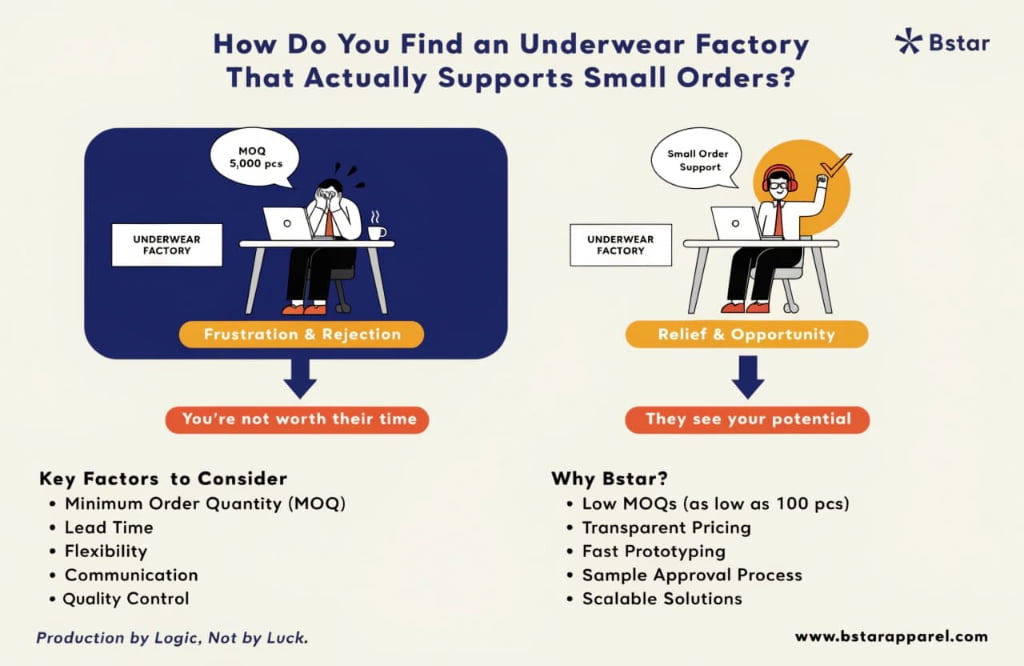
You have a design ready. You want to test it before committing to 5,000 pieces. But every factory you contact either ignores you or quotes a minimum you can’t afford.
Finding a small-order underwear factory is not just about finding the lowest MOQ. You need a factory that can keep quality consistent from sample to bulk, be transparent about real costs, and grow with you as your brand scales. The right partner reduces your risk, not just your order size.
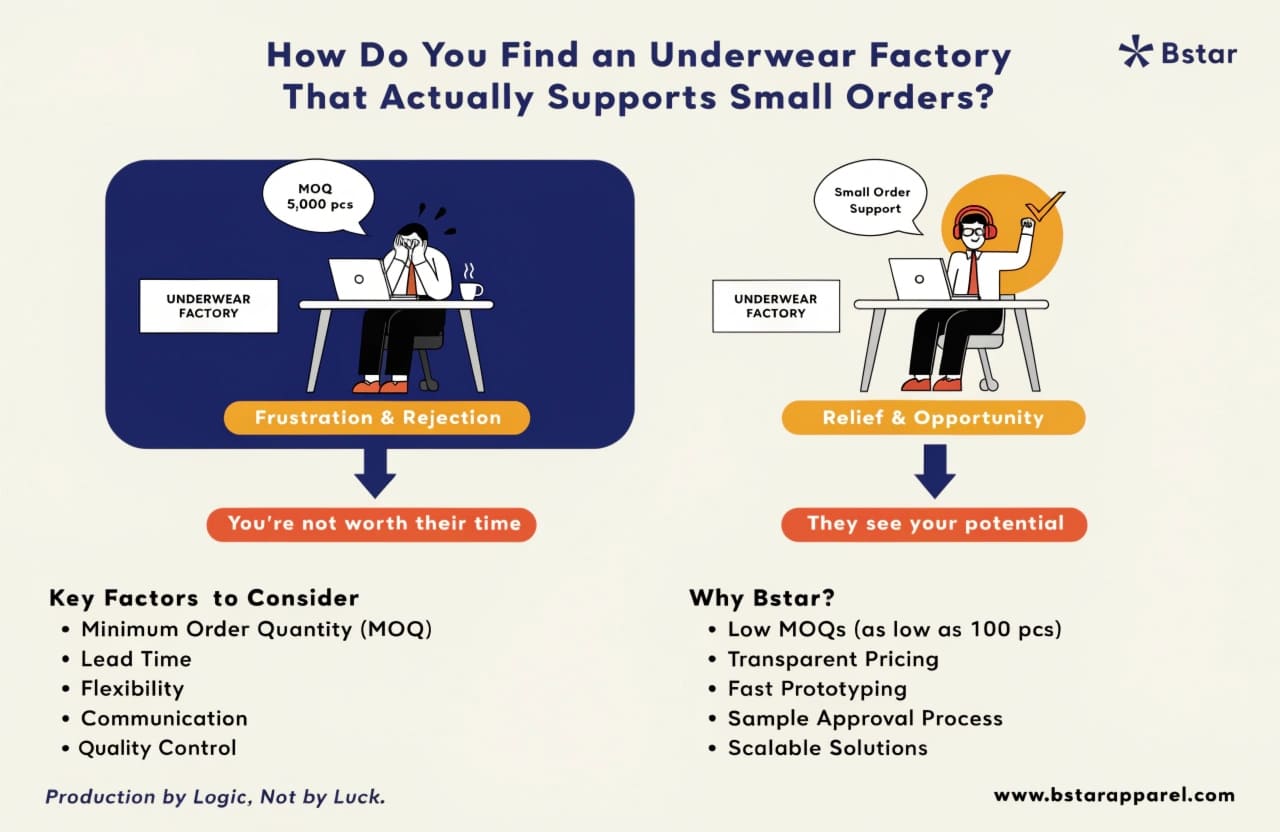
This problem is more common than people think. Early-stage DTC brands and existing brands testing new styles run into the same wall. The good news is that the right factory is out there. The challenge is knowing how to find it, and how to tell the difference between a factory that truly supports small runs and one that just says it does.
Online Platforms & Trade Shows: Where Do You Actually Find MOQ-Friendly Underwear Manufacturers?
You open Google, type "underwear manufacturer small MOQ," and get a hundred results. Most of them are trading companies, not factories. It’s frustrating.
The most reliable sourcing channels for small-order underwear factories are B2B platforms like Alibaba, Made-in-China, and Global Sources1, combined with trade shows like Canton Fair, Magic Las Vegas, and Première Vision2. These channels give you direct factory access and let you compare MOQ terms, certifications, and communication quality side by side.
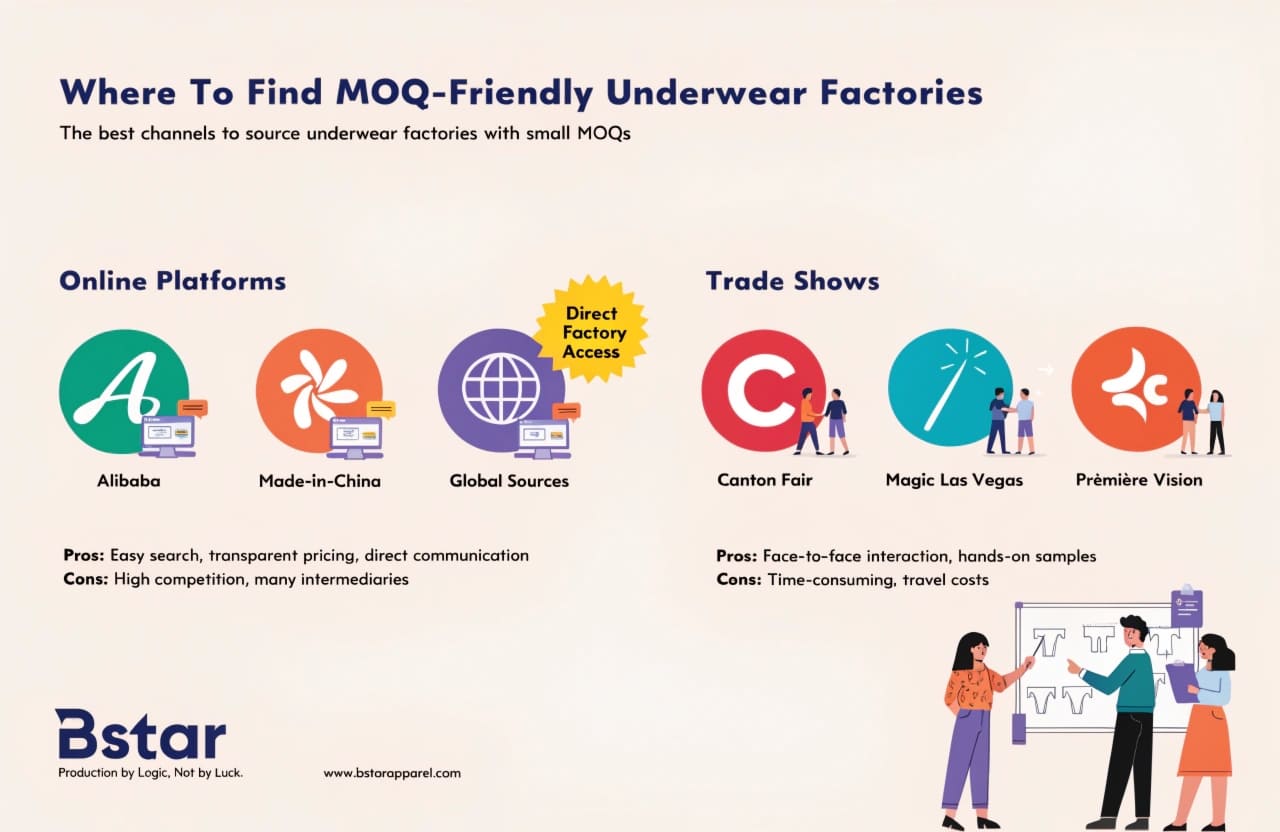
Each channel has its strengths and weaknesses, and using them well takes some strategy.
Breaking Down the Sourcing Channels
| Channel | Best For | Watch Out For |
|---|---|---|
| Alibaba / Made-in-China | Quick first contact, filtering by certifications | Many listings are trading companies, not factories3 |
| Canton Fair (China)4 | Meeting factories face to face, seeing samples | Travel cost, time investment |
| Magic Las Vegas | Meeting suppliers catering to US brands | Fewer China factories attend directly |
| Première Vision | Premium fabric and product suppliers | More relevant for fabric sourcing |
| LinkedIn / Referrals | Finding vetted factories through other founders | Takes longer, but higher trust |
When you use B2B platforms, filter by factory type, not just MOQ. Look for verified badges, audit reports, and whether the factory lists actual product photos instead of stock images. When you go to trade shows, bring your tech pack or reference sample. A factory that looks at your product and asks smart questions right away is already a better sign than one that just hands you a price list.
One thing I always tell brands: don’t stop at the MOQ number on the listing. That number means nothing until you understand what’s included in it, and what isn’t. We’ll cover that next.
Key Vetting Criteria: What 5 Things Tell You If a Factory Can Really Handle Small Orders?
A factory says it supports small orders. That’s a starting point, not an answer. The real question is whether it can handle your specific product, your size run, your materials, and your timeline without the quality falling apart.
The five key factors to evaluate are: sampling capability and turnaround time, transparency on total cost including development fees and fabric minimums, size and color SKU flexibility, quality control process from sample to bulk, and communication speed and language ability. A factory that scores well on all five is worth your time.
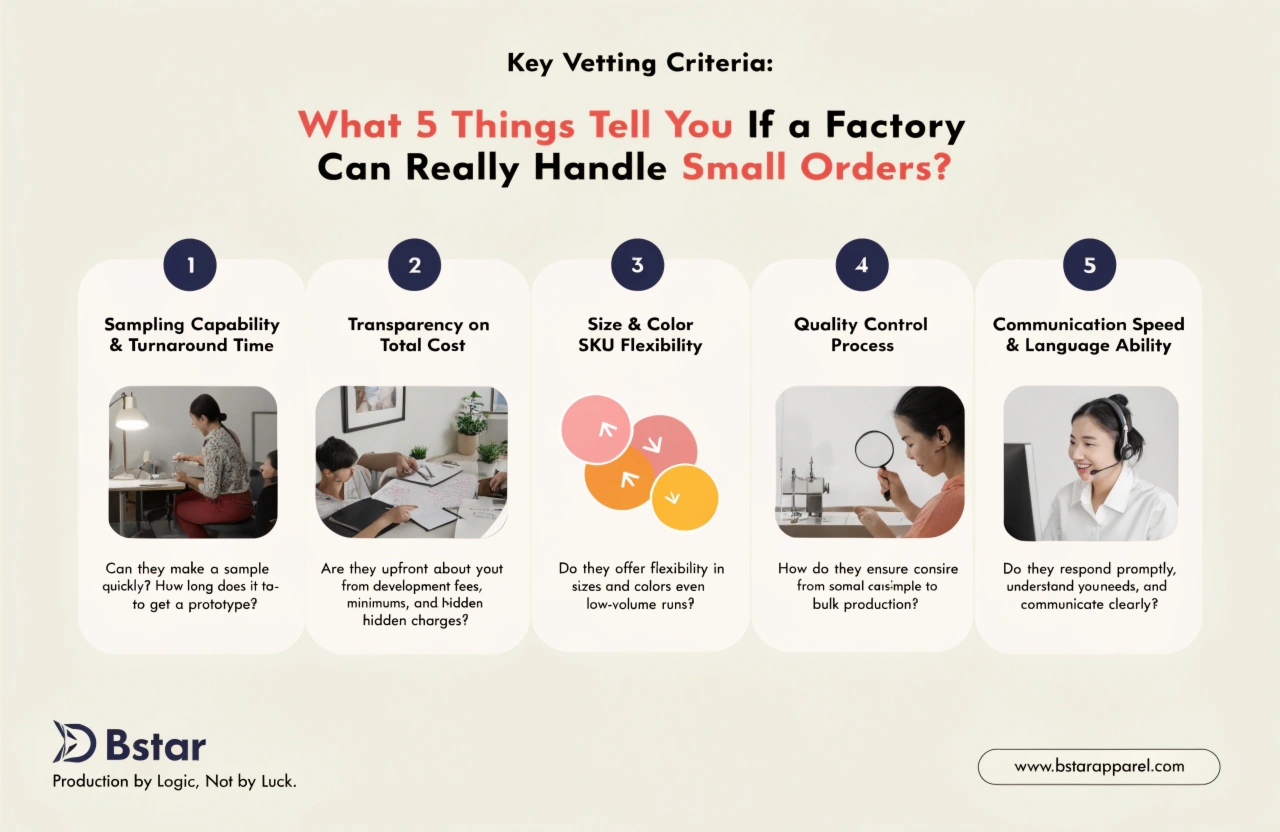
Let me walk through each one.
The 5 Vetting Factors in Detail
1. Sampling capability
Can they make a sample from your tech pack alone, or do they need a physical reference? How long does sampling take? We typically turn around underwear samples in 7 to 15 days. If a factory quotes 4 to 6 weeks for a first sample, that’s a red flag for small-order agility.
2. Total cost transparency
This is the one most brands get burned on. A "low MOQ" factory might charge you a development fee, a fabric sourcing fee, and a trim setup fee on top of the unit price. The per-piece cost on a 100-piece order can end up higher than a 500-piece order at a more structured factory.
3. SKU flexibility
Underwear comes in sizes and colors. A 100-piece order spread across 5 sizes and 3 colors is not the same as a 100-piece order in one size and one color. Ask how they handle SKU splits and whether their fabric minimums go by total order weight or per colorway.
4. Sample-to-bulk quality consistency
This is where many small-order factories fail. The sample looks great. The bulk shipment has inconsistent stitching, color variation, or sizing drift. Ask for their QC checkpoints and whether they use AQL sampling standards5. A factory with a real QC system will be able to describe it clearly.
5. Communication and responsiveness
If a factory takes 4 days to reply to a basic inquiry, think about what happens when there’s a production problem. You need a team that responds within 24 hours6 and can communicate clearly in English. This matters more than many buyers expect.
Negotiating Success: How Do You Actually Get a Factory to Lower Their MOQ?
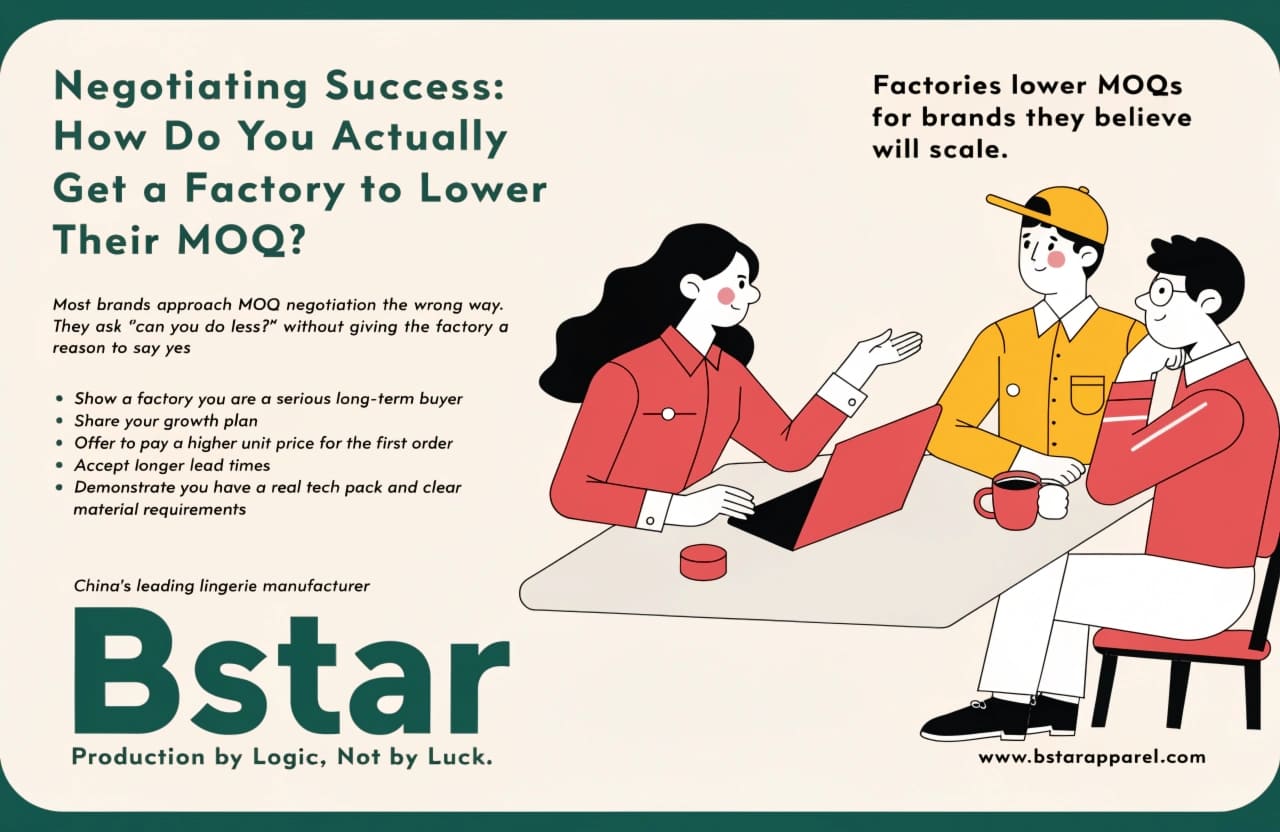
Most brands approach MOQ negotiation the wrong way. They ask "can you do less?" without giving the factory a reason to say yes.
The most effective way to lower MOQ is to show a factory you are a serious long-term buyer. Share your growth plan, offer to pay a higher unit price for the first order7, accept longer lead times, and demonstrate you have a real tech pack and clear material requirements. Factories lower MOQs for brands they believe will scale.
Here’s what actually works in practice.
Practical Negotiation Moves
Show your roadmap, not just your first order
Tell the factory your first order is 200 pieces, but if the market responds well, your next order will be 1,000 pieces. Factories are businesses. They think about customer lifetime value, not just one transaction.
Offer a unit price premium
Small orders cost factories more per piece in setup time, material handling, and line changeovers8. If you offer to pay 10 to 15 percent above their standard unit price, many factories will agree to a lower total quantity.
Come prepared with a real tech pack
A buyer who arrives with a complete tech pack, a size chart, and a material reference is not a risk. A buyer who asks a factory to "figure it out" is. Your preparation directly affects the factory’s willingness to work with you.
Ask about development orders vs. production orders
Some factories have a separate "development" or "sampling" tier that is designed exactly for small quantities. It has different pricing and different terms. You won’t find this on their website. You have to ask.
Tech-Driven Solutions: Can Digital Tools Actually Help You Produce Smaller Runs?
This is a newer part of the conversation, and it’s worth paying attention to.
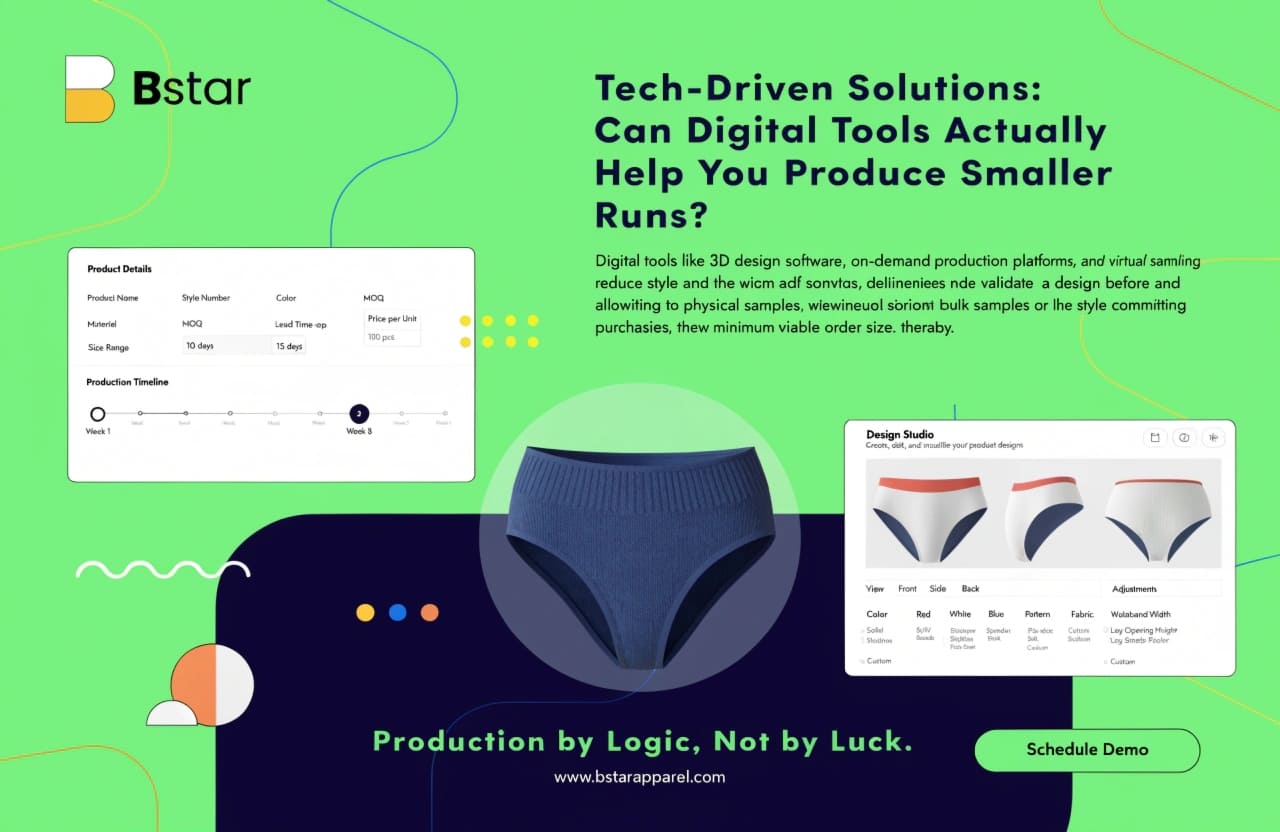
Digital tools like 3D design software, on-demand production platforms9, and virtual sampling reduce the cost and time of developing a new style. They allow brands to validate a design before committing to physical samples or bulk fabric purchases, which directly reduces the minimum viable order size.
Here’s how these tools change the economics of small-order production.
How Digital Tools Shift the Small-Order Equation
| Tool | What It Does | How It Helps Small Orders |
|---|---|---|
| 3D design software (e.g., CLO3D)10 | Creates virtual garment prototypes | Reduces rounds of physical sampling, saving cost and time |
| Digital fabric libraries | Shows how fabrics look and behave on a virtual model | Lets you choose materials before buying minimums |
| On-demand production platforms | Produces single units or very small batches via digital printing or cut-and-sew | Good for initial market testing, not for performance underwear at scale |
| Factory management portals | Real-time order tracking and quality update sharing | Reduces miscommunication risk on small runs |
One honest note here: on-demand platforms work well for printed styles or basic jersey products. For structured underwear with molded cups, bonded seams, or technical fabrics11, you still need a specialized knit factory. Digital tools reduce the friction of early development, but they don’t replace the need for proper sampling and quality checks on the final product.
What digital tools do best is give you more information before you spend money. You can see how a design looks, confirm your material choice, and refine your size grading12 before you commit to a fabric purchase or a production deposit.
Conclusion
Finding the right small-order underwear factory means finding a real partner: one that is transparent about costs, consistent from sample to bulk, and ready to grow with your brand.
-
"The role of sourcing dynamics on B2B e-marketplaces in shaping …", https://mospace.umsystem.edu/items/30bfbabb-6334-4f6a-a563-173425a8b33d. Research on global B2B e-commerce platforms documents Alibaba, Made-in-China, and Global Sources as among the most trafficked digital marketplaces for connecting international buyers with Chinese manufacturers across product categories including apparel. Evidence role: general_support; source type: research. Supports: That major B2B platforms are widely used channels for connecting buyers with apparel manufacturers. Scope note: Available studies typically cover platform usage broadly and may not isolate underwear or small-MOQ sourcing specifically. ↩
-
"Building Competing Fashion Textile Fairs in Europe, 1970 – 2010", https://www.academia.edu/57335919/Building_Competing_Fashion_Textile_Fairs_in_Europe_1970_2010_Premiere_Vision_Paris_vs_Interstoff_Frankfurt_. Première Vision, held primarily in Paris, is an internationally recognized trade show for premium fabrics, yarns, and textile innovations, attended by manufacturers and brands seeking high-specification materials; it is generally regarded as more relevant to fabric sourcing and design development than to finished-goods supplier discovery. Evidence role: historical_context; source type: institution. Supports: That Première Vision is an established international trade show focused on premium textiles and materials, attended by fabric suppliers and fashion brands. Scope note: The show’s relevance to underwear-specific fabric sourcing versus broader apparel categories is not separately documented in publicly available event data. ↩
-
"How to tell if your Alibaba supplier is actually a factory or a trading …", https://www.reddit.com/r/Alibaba/comments/1tc69fh/how_to_tell_if_your_alibaba_supplier_is_actually/. Academic and industry analyses of B2B marketplace supplier composition have noted that trading companies frequently list alongside factories on platforms such as Alibaba, sometimes misrepresenting their role, which complicates direct-factory sourcing for buyers seeking to minimize intermediary costs. Evidence role: statistic; source type: research. Supports: That a notable share of supplier listings on major B2B platforms represent intermediary trading companies rather than direct manufacturers. Scope note: Precise platform-wide statistics on the trading company versus factory ratio are not consistently published, and proportions vary by product category and platform verification tier. ↩
-
"Canton Fair – Wikipedia", https://en.wikipedia.org/wiki/Canton_Fair. The China Import and Export Fair, commonly known as the Canton Fair, has been held biannually in Guangzhou since 1957 and is widely recognized as one of the largest trade fairs in the world by number of exhibitors and buyers, covering product categories including textiles and garments. Evidence role: historical_context; source type: encyclopedia. Supports: That the Canton Fair is one of the largest and longest-running trade fairs in China, serving as a major venue for international buyers to meet manufacturers. Scope note: General fair statistics do not confirm the proportion of underwear-specific or small-MOQ-friendly exhibitors. ↩
-
"[PDF] ISO 2859-1 – UNT Chemistry Department", https://chemistry.unt.edu/~tgolden/courses/iso2859-1.pdf. AQL, or Acceptable Quality Limit, is defined under ISO 2859-1 as the quality level that is the worst tolerable process average when a continuing series of lots is submitted for acceptance sampling; it is widely applied in textile and apparel manufacturing to determine pass/fail thresholds during production inspections. Evidence role: definition; source type: institution. Supports: That AQL is a recognized international standard for acceptance sampling used in quality control inspections, including in garment manufacturing. ↩
-
"(PDF) The effect of supplier manufacturing capabilities on buyer …", https://www.researchgate.net/publication/235273477_The_effect_of_supplier_manufacturing_capabilities_on_buyer_responsiveness_The_role_of_collaboration. Supply chain management research identifies communication responsiveness as a key determinant of buyer-supplier relationship quality, with faster response times associated with higher buyer trust, reduced order errors, and improved problem resolution speed, particularly in short-run or time-sensitive production contexts. Evidence role: expert_consensus; source type: research. Supports: That supplier communication responsiveness is a significant factor in buyer-supplier relationship quality and sourcing outcomes. Scope note: The specific 24-hour threshold cited in the article is a practitioner convention rather than an empirically validated cutoff from published research. ↩
-
"Apparel MOQs: Why Small Orders Cost More Per Piece – Work+Shelter", https://www.workshelter.co/learn/production-lifecycle/apparel-moqs-explained. Supply chain literature on buyer-supplier negotiation in contract manufacturing notes that price premiums are a recognized lever for offsetting the higher per-unit setup and handling costs factories incur on small-batch orders, though the specific premium required varies by factory size, product complexity, and capacity utilization. Evidence role: general_support; source type: research. Supports: That buyers offering a price premium above standard unit cost can incentivize manufacturers to accept lower minimum order quantities. Scope note: The 10–15% figure cited in the article is not directly corroborated by published research and should be treated as a practitioner estimate rather than an empirically established threshold. ↩
-
"Small Batch Manufacturing Startup Costs: $465K CAPEX", https://financialmodelslab.com/blogs/startup-costs/small-batch-production?srsltid=AfmBOorA0Zh3mqL2HYL4gekOvRfqpqy4uEk3WM2udJbZichdobiUG7hn. Operations management literature establishes that per-unit production costs in batch manufacturing are inversely related to order size due to fixed setup and changeover costs; in apparel manufacturing specifically, machine reconfiguration, thread changes, and material staging contribute to elevated per-piece costs on short runs. Evidence role: mechanism; source type: research. Supports: That smaller production runs incur higher per-unit costs due to fixed setup, changeover, and material handling costs being spread over fewer units. ↩
-
"On-Demand Apparel Manufacturing: What It Is and How It Works", https://www.netsuite.com/portal/resource/articles/erp/on-demand-apparel-manufacturing.shtml. Research on on-demand apparel manufacturing documents the growth of digital printing and modular cut-and-sew platforms that enable single-unit or micro-batch production, with adoption concentrated in basic jersey and printed garment categories rather than technically complex constructions requiring specialized machinery. Evidence role: general_support; source type: research. Supports: That on-demand and print-on-demand production models enable very small or single-unit apparel runs, primarily suited to simpler product constructions. Scope note: Published data on on-demand production is more developed for outerwear and printed apparel than for performance or structured underwear categories. ↩
-
"[PDF] A Content Analysis of 3D Virtual Prototyping and Zero-Waste Design …", https://scholarworks.calstate.edu/downloads/sn00b389v. Studies on digital product development in the apparel industry indicate that 3D virtual prototyping software can reduce the number of physical sampling rounds by enabling design review and fit evaluation in a virtual environment prior to fabric cutting, thereby lowering development lead times and material costs. Evidence role: mechanism; source type: research. Supports: That 3D virtual prototyping tools in apparel development can reduce the number of physical sample iterations required before production. Scope note: Quantified savings vary significantly by product complexity and factory adoption level; structured underwear with technical components may see smaller reductions than basic cut-and-sew styles. ↩
-
"(PDF) Innovation in the Comfort of Intimate Apparel – Academia.edu", https://www.academia.edu/70393665/Innovation_in_the_Comfort_of_Intimate_Apparel. Textile and apparel engineering literature documents that bonded seam technology requires ultrasonic or heat-bonding machinery, while molded cup production depends on thermoforming equipment and specialized foam or fabric composites, both of which are distinct from the standard sewing and digital printing infrastructure used in on-demand production platforms. Evidence role: mechanism; source type: education. Supports: That molded cups, bonded seams, and technical fabric constructions in underwear require specialized equipment and processes not available on standard cut-and-sew or digital printing platforms. ↩
-
"Evaluating machine learning models for clothing size prediction …", https://pmc.ncbi.nlm.nih.gov/articles/PMC12630603/. Size grading in apparel manufacturing refers to the systematic process of proportionally scaling a base pattern to produce a range of sizes; digital grading software enables brands to generate and review full size runs virtually before pattern cutting, reducing the risk of fit errors that would otherwise require costly re-sampling or fabric waste. Evidence role: definition; source type: education. Supports: That size grading is a defined technical process in apparel production and that digital tools can improve its accuracy and efficiency prior to fabric commitment. Scope note: Evidence on cost savings from digital grading is more established for large production runs; benefits for micro-batch or small-MOQ orders are less thoroughly documented in published research. ↩
Discussion & questions 0 comments