
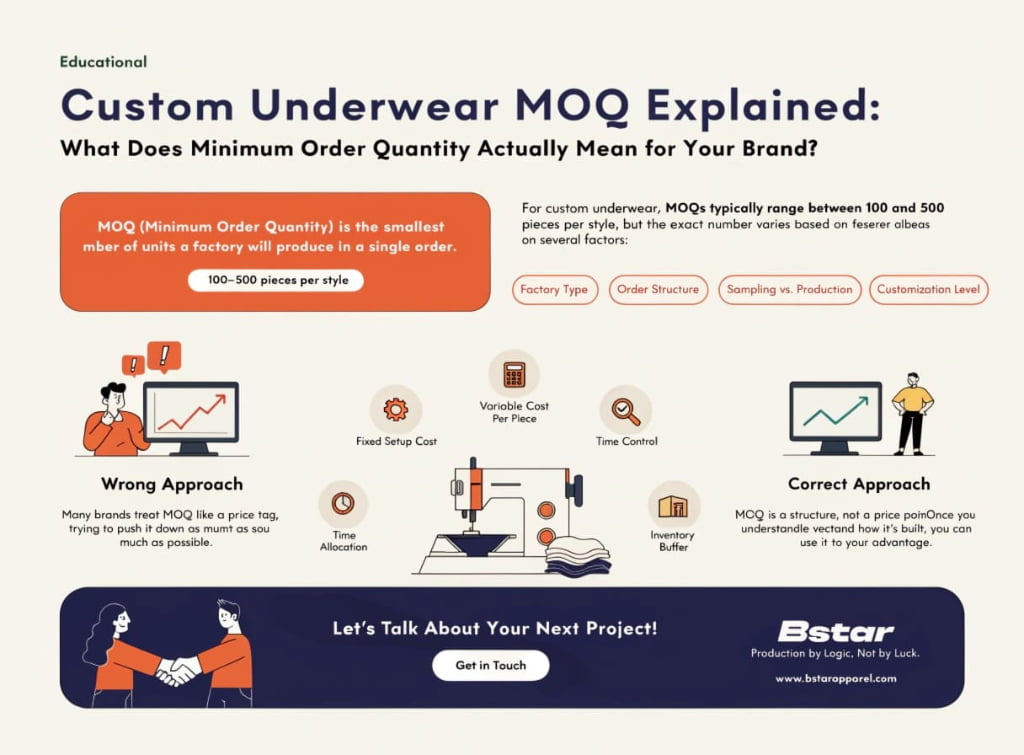
Confused about MOQ? You’re not alone. Most brands I talk to come in with the wrong question—and it costs them time, money, and bad supplier relationships.
MOQ (Minimum Order Quantity) is the smallest number of units a factory will produce in a single order. For custom underwear, this typically ranges from 100 to 500 pieces per style at production level—but the real number depends on the factory type, how the order is structured, and whether you’re sampling or producing.
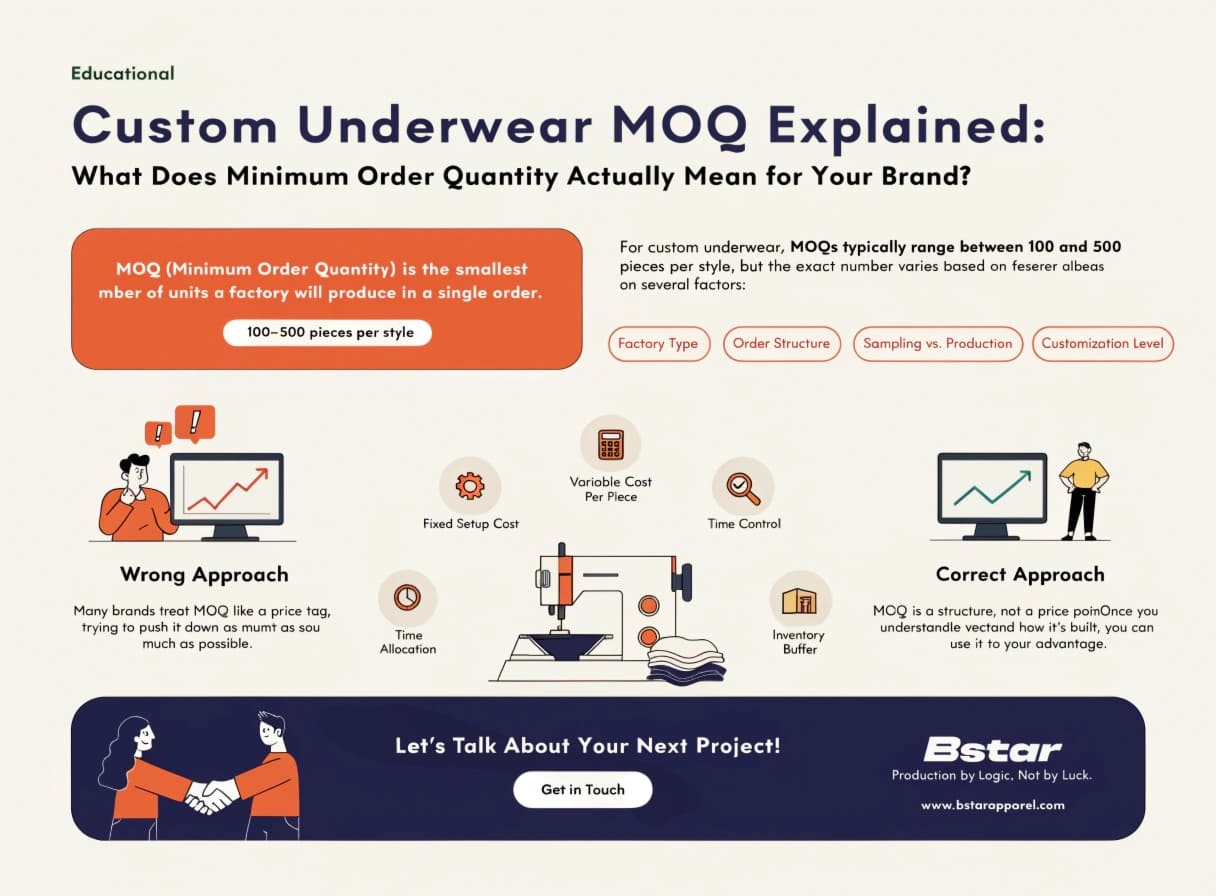
Most brands treat MOQ like a price tag—something to push down as far as possible. But that’s the wrong way to look at it. MOQ is a structure. Once you understand how it’s built, you stop fighting it and start using it to your advantage. Let me walk you through what actually matters.
Understanding MOQ Fundamentals: Are Sampling and Production MOQs the Same Thing?
This is the number one confusion I see from first-time inquiries. A brand emails us asking for "samples to test MOQ"—and those two things are actually completely separate conversations.
Sampling MOQ and production MOQ are different commitments. Sampling is a development step: you’re testing fit, fabric, and construction1. Production is a manufacturing commitment: the factory schedules machines, allocates materials, and runs a full batch. Mixing them up leads to misaligned expectations and wasted time.
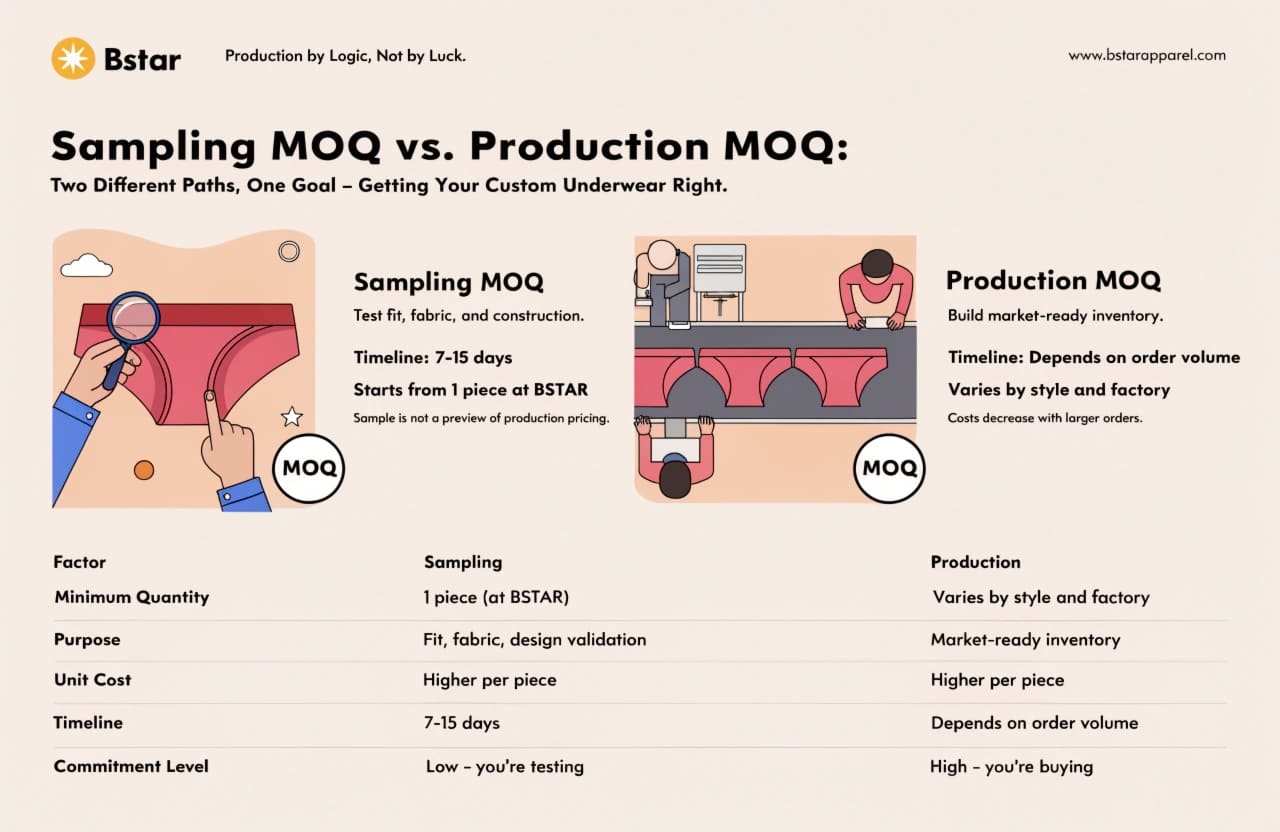
At BSTAR, we accept sample requests starting from 1 piece. That policy exists because we work with early-stage DTC brands that need to validate before they commit. But a 1-piece sample is not a preview of production pricing. It’s a development prototype.
Here’s the key difference broken down:
Sampling vs. Production: A Direct Comparison
| Factor | Sampling | Production |
|---|---|---|
| Minimum Quantity | 1 piece (at BSTAR) | Varies by style and factory |
| Purpose | Fit, fabric, design validation | Market-ready inventory |
| Unit Cost | Higher per piece | Lower per piece at scale |
| Timeline | 7–15 days | Depends on order volume |
| Commitment Level | Low — you’re testing | High — you’re buying |
The question I always ask brands in the sampling stage is: do you have a target retail price yet? If not, you’re too early to be worried about production MOQ. Get the sample right first. Then we can talk production structure.
The Economics of Scale: How Does Order Quantity Actually Affect Your Unit Cost?
Here’s where a lot of DTC founders get surprised. They push hard for a low MOQ—say, 100 pieces—and then complain the unit cost is too high. Those two things are directly connected.
The fewer units you order, the more expensive each unit becomes. This is because factory setup costs—machine configuration, thread changes, cut planning—are fixed per run2. Spreading those costs across 100 pieces instead of 500 pushes your unit cost up significantly, sometimes by 30–50%3.
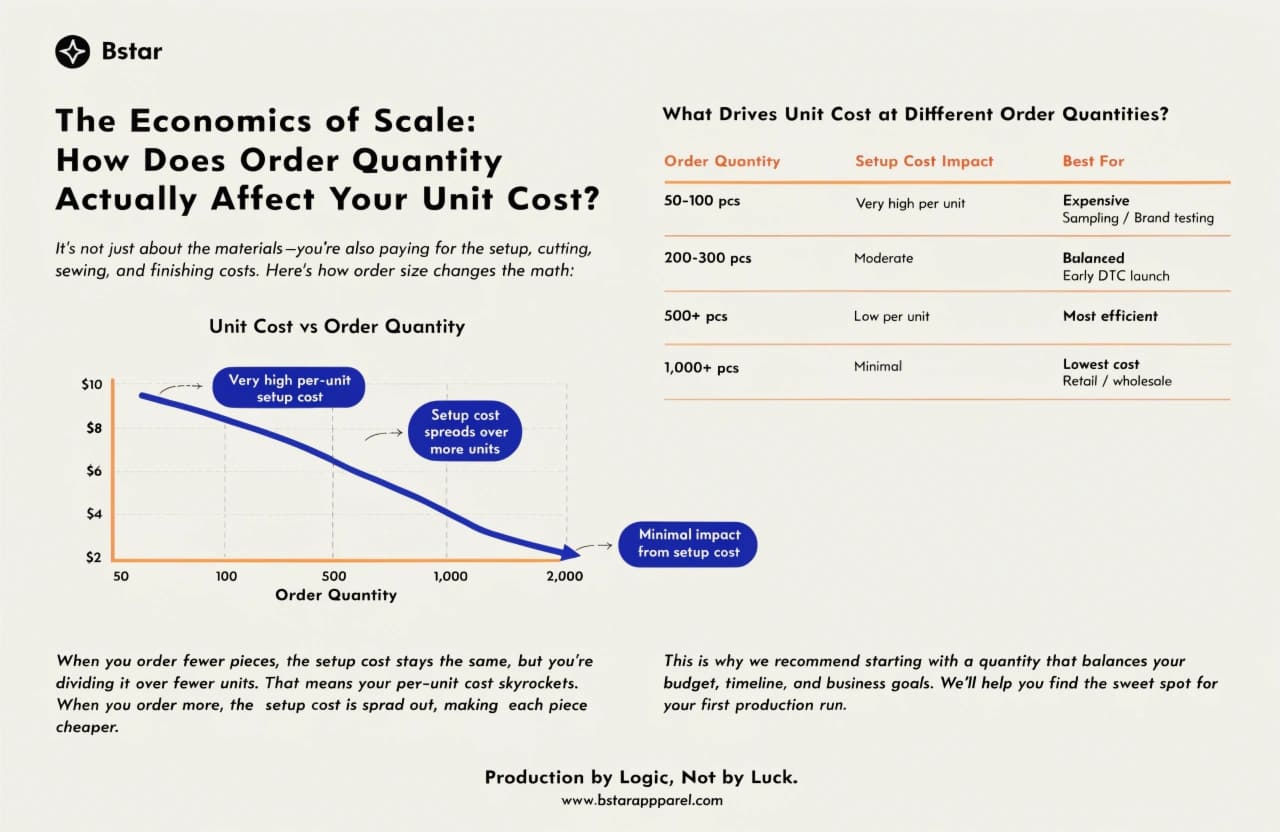
This is not a factory being greedy. It’s math. And once you understand it, you stop anchoring on the lowest MOQ and start thinking about what quantity makes your margin work.
What Drives Unit Cost at Different Order Quantities?
| Order Quantity | Setup Cost Impact | Unit Cost Trend | Best For |
|---|---|---|---|
| 50–100 pcs | Very high per unit | Expensive | Sampling / Brand testing |
| 200–300 pcs | Moderate | Balanced | Early DTC launch |
| 500+ pcs | Low per unit | Most efficient | Scaling brands |
| 1,000+ pcs | Minimal | Lowest cost | Retail / wholesale |
The real question is never "what’s the lowest MOQ?" The real question is: at what quantity does my margin and launch timeline work together?
That’s the question we ask every brand before we quote. Because quoting without understanding that is a waste of both our time.
One thing worth knowing: not all factories are built the same. A large commodity factory is optimized for 10,000-piece runs4. Their MOQ floor is structurally higher because their machines, staffing, and cost model require it. A flexible OEM/ODM factory like BSTAR is set up differently—smaller batch runs, more SKU variety, faster changeovers. That structural difference is why MOQ ranges vary so much when you’re comparing quotes. A lower price from a large factory at 500 pieces might actually mean they’re discounting to fill a gap in their schedule. That’s not a long-term sourcing strategy.
Strategic Negotiation: How Do You Actually Get More Flexibility on MOQ?
Most brands go into MOQ conversations trying to negotiate a number down. That’s the least effective approach. What actually works is restructuring how the MOQ is counted.
Instead of negotiating a lower MOQ per SKU, ask if the factory allows MOQ splits—meaning the minimum is met across styles, colorways, or size runs rather than per individual item. This gives you more flexibility without asking the factory to change its cost structure.
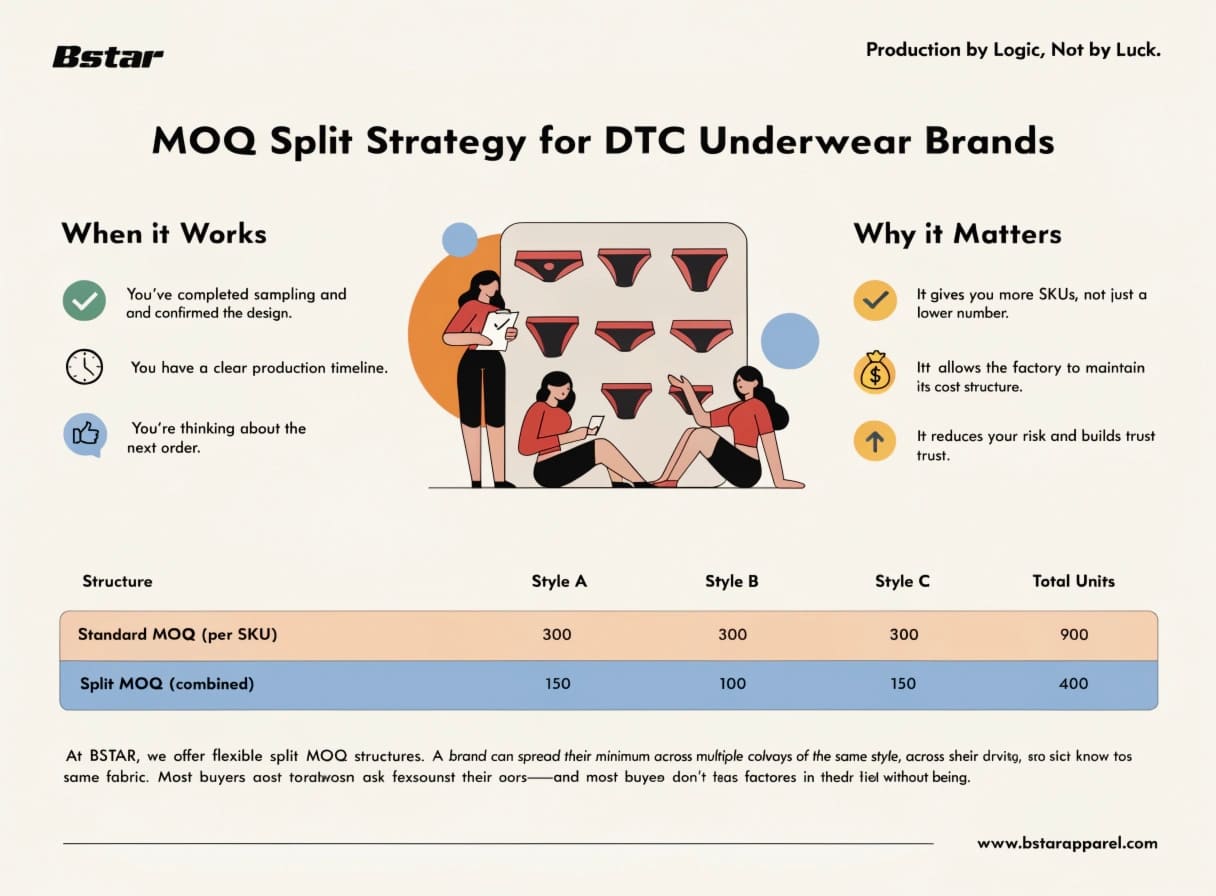
At BSTAR, we offer flexible split MOQ structures. A brand can spread their minimum across multiple colorways of the same style, or across different styles in the same fabric5. Most buyers don’t know to ask for this—and most factories don’t offer it without being asked.
Here’s how a split MOQ approach might work in practice:
Example: Splitting MOQ Across a Launch Collection
| Structure | Style A | Style B | Style C | Total Units |
|---|---|---|---|---|
| Standard MOQ (per SKU) | 300 | 300 | 300 | 900 |
| Split MOQ (combined) | 150 | 100 | 150 | 400 |
The factory still gets a viable production run. You get three SKUs instead of one. Everyone moves forward.
A few things that actually make a factory more willing to offer flexibility:
- You’ve completed sampling and confirmed the design. This signals you’re serious, not browsing.
- You have a clear production timeline. Uncertainty makes factories cautious. A committed date gives them something to plan around.
- You’re thinking about the next order. Factories are more flexible with brands they see as long-term relationships, not one-off orders6.
What doesn’t work: opening the conversation with "what’s your lowest MOQ?" before you’ve even shared what you’re making. That signals you’re shopping on price only, and factories respond accordingly.
Smart Inventory Planning: How Do You Match Your MOQ to Real Demand?
Getting the MOQ right is only half the problem. The other half is making sure you can actually sell what you order.
The biggest inventory mistake DTC brands make is ordering to the factory’s MOQ rather than to their own demand forecast7. If your MOQ forces you to hold 6 months of unsold stock, the low unit cost stops looking attractive very quickly.
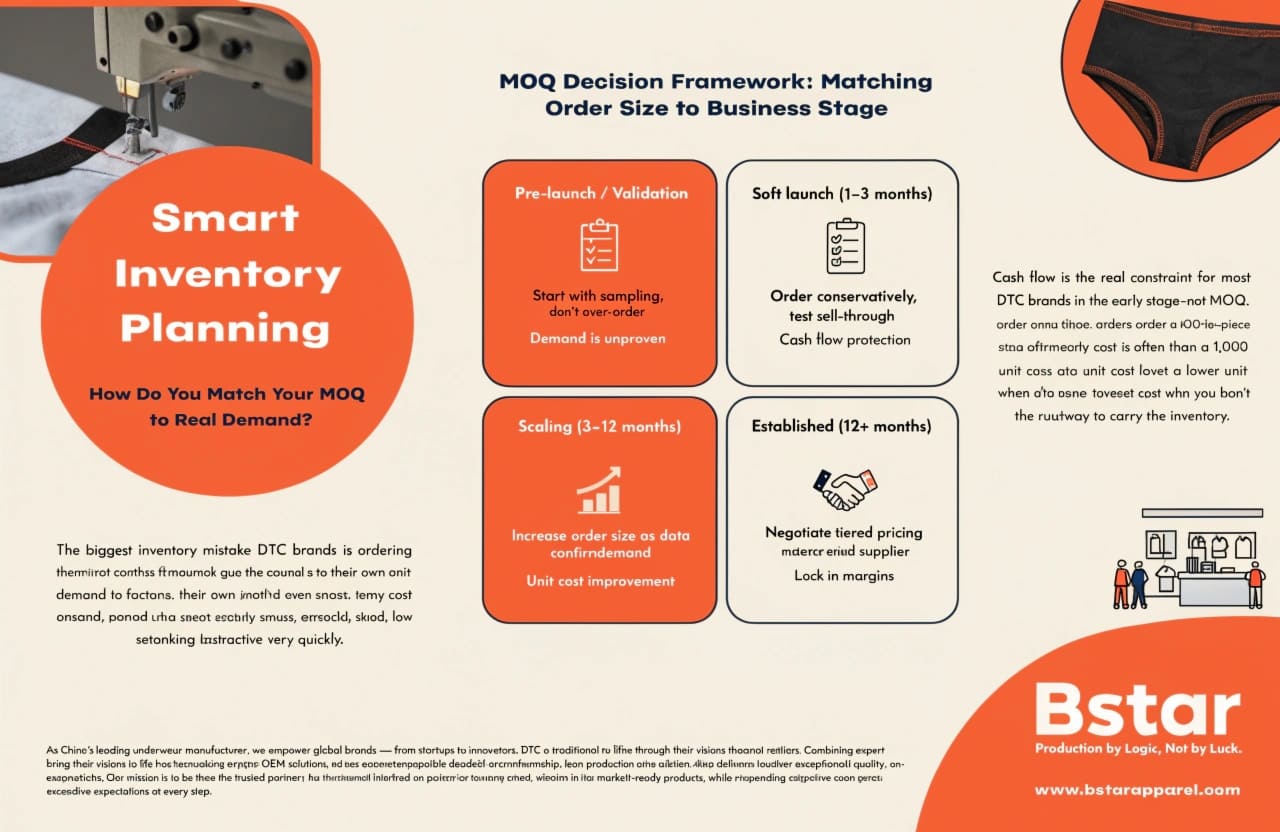
Here’s a practical way to think about it:
MOQ Decision Framework: Matching Order Size to Business Stage
| Business Stage | Recommended Approach | Why |
|---|---|---|
| Pre-launch / Validation | Start with sampling, don’t over-order | Demand is unproven |
| Soft launch (1–3 months) | Order conservatively, test sell-through | Cash flow protection |
| Scaling (3–12 months) | Increase order size as data confirms demand | Unit cost improvement |
| Established (12+ months) | Negotiate tiered pricing with supplier | Lock in margins |
Cash flow is the real constraint for most DTC brands in the early stage8—not MOQ. A 300-piece order at a slightly higher unit cost is often smarter than a 1,000-piece order at a lower unit cost when you don’t have the runway to carry the inventory9.
I’ve seen brands burn cash by chasing the best unit price before they had proof of demand. The cheaper unit cost doesn’t help if the units sit in a warehouse for a year.
The brands that manage this well tend to do a few things differently. They use the first production run as a learning exercise—not just a sales vehicle. They track sell-through rate by SKU before committing to a second order10. And they build supplier relationships early, so when they’re ready to scale, the factory already knows their product and their process.
That last point matters more than most brands realize. When a factory knows your fits, your quality standards, and your timelines, production runs faster and with fewer errors11. That’s worth more than a slightly lower MOQ from a factory that’s never touched your product.
Conclusion
MOQ isn’t the number to chase—it’s the structure to understand. Get your sampling done right, know your margin math, and ask for splits before you negotiate price.
If you’re building a custom underwear line and want to understand how our MOQ structure works for your specific stage—from 1-piece sampling through to scaled production—reach out to the BSTAR team. We’ll ask you the right questions first.
-
"How Sampling Works in Garment Manufacturing – LinkedIn", https://www.linkedin.com/posts/prolobku99_the-sampling-process-in-garments-manufacturing-activity-7340287020772073473-vwXR. Apparel product development literature describes pre-production sampling—including proto samples, fit samples, and pre-production samples—as sequential validation stages in which fit, fabric performance, and construction quality are assessed and approved before production orders are placed; see, e.g., Keiser & Garner, Beyond Design: The Synergy of Apparel Product Development (Fairchild). Evidence role: definition; source type: education. Supports: That pre-production sampling in apparel manufacturing is a formal development stage used to evaluate and approve fit, materials, and construction methods prior to committing to a full production run. ↩
-
"[PDF] Basics of Cost Behavior – NJIT", https://web.njit.edu/~caudill/Lecture%202-Cost%20Behavior%20and%20ABC.pdf. In manufacturing cost accounting, setup costs—including machine configuration and changeover time—are classified as batch-level costs that remain constant per production run regardless of run size, causing unit cost to decline as output volume increases; see, e.g., Horngren et al., Cost Accounting: A Managerial Emphasis (Pearson). Evidence role: mechanism; source type: education. Supports: That setup or changeover costs in manufacturing are fixed per production run and are spread across units produced, driving down unit cost at higher volumes. Scope note: General manufacturing cost accounting principles apply broadly; specific cost proportions in apparel or underwear manufacturing may differ from textbook examples. ↩
-
"Publication: The Promise and Peril of Post-MFA Apparel Production", https://openknowledge.worldbank.org/entities/publication/8e2d091a-605f-5a91-9ca7-0acfb83547c6. Empirical studies on batch-size economics in apparel manufacturing document significant unit-cost premiums for small-run orders relative to standard production volumes, though reported magnitudes vary by product category, factory type, and overhead allocation method. Evidence role: statistic; source type: research. Supports: That unit costs in apparel or cut-and-sew manufacturing can increase substantially—on the order of tens of percent—when order quantities are reduced from several hundred to a few hundred units. Scope note: A direct source confirming the specific 30–50% range for underwear manufacturing was not identified; the figure should be treated as an illustrative estimate rather than a verified industry benchmark. ↩
-
"[PDF] International trade and industrial upgrading in the apparel …", https://www.uky.edu/~tmute2/GEI-Web/password-protect/GEI-readings/gereffi.pdf. Industry analyses of global apparel supply chains, including reports from organizations such as the ILO and McKinsey Global Institute, describe large commodity garment factories as optimized for high-volume, low-variety production, which structurally raises their minimum viable order quantities. Evidence role: general_support; source type: institution. Supports: That large-scale commodity apparel manufacturers are structured around high-volume production runs, resulting in elevated minimum order requirements compared to smaller flexible manufacturers. Scope note: The specific 10,000-piece figure is illustrative; actual thresholds vary by factory, product category, and market segment and are not uniformly documented in public sources. ↩
-
"MOQ Strategies for Small Apparel Brands – Sourcing – Hi-Style", https://www.hi-style.com/moq-strategies-for-small-apparel-brands-smart-sourcing-production-tips/. Apparel sourcing guides and trade publications, including resources from organizations such as the American Apparel & Footwear Association, describe order consolidation strategies—including combining colorways or styles—as a common approach for buyers seeking to meet factory minimums while diversifying their product offering. Evidence role: general_support; source type: institution. Supports: That consolidating orders across multiple colorways or styles to meet a combined minimum order quantity is a recognized practice in apparel sourcing that can provide buyers with greater product variety while satisfying factory production minimums. Scope note: Publicly available sources describing this practice in detail are primarily trade-oriented rather than peer-reviewed; the prevalence and terms of such arrangements vary significantly by factory and product category. ↩
-
"Governance and Relationship Flexibility Under Conditions of Supply …", https://nsuworks.nova.edu/hcbe_facarticles/601/. Research on relational contracting and supply chain governance finds that suppliers allocate preferential capacity, pricing, and flexibility to buyers perceived as long-term partners, as the anticipated future value of the relationship offsets short-term concessions; see, e.g., Macneil (1980), The New Social Contract, or Williamson’s transaction cost economics literature on relational governance. Evidence role: expert_consensus; source type: paper. Supports: That manufacturers extend greater commercial flexibility, including on order minimums and pricing, to buyers with whom they have established long-term relationships, reflecting relational contracting dynamics. Scope note: Academic literature addresses relational contracting broadly across industries; empirical studies documenting MOQ flexibility specifically as a function of buyer-supplier relationship length in apparel manufacturing are limited. ↩
-
"Why DTC Brands Need MEIO: Integrated Demand Forecasting That …", https://deposco.com/blog/meio-solutions-for-dtc/. Operations management and supply chain research identifies demand forecast misalignment as a primary cause of inventory imbalance in consumer goods businesses, with small brands particularly vulnerable due to limited historical sales data and pressure to meet supplier minimums; see literature on the newsvendor problem and small-firm inventory management. Evidence role: general_support; source type: research. Supports: That misalignment between order quantities and actual demand forecasts is a significant driver of inventory overstock and cash flow problems for small and early-stage consumer product brands. Scope note: Research specific to DTC apparel brands ordering to supplier MOQs rather than demand forecasts is limited; the claim extrapolates from broader inventory management literature. ↩
-
"Cash flow management and its effect on firm performance – PMC – NIH", https://pmc.ncbi.nlm.nih.gov/articles/PMC10281586/. Research on small business and e-commerce startup finance consistently identifies working capital and inventory financing as primary operational constraints; see, e.g., U.S. Small Business Administration reports on small business financing challenges or academic literature on DTC brand scaling. Evidence role: expert_consensus; source type: research. Supports: That cash flow and working capital constraints are among the most significant operational challenges facing early-stage direct-to-consumer product brands. Scope note: Available sources address small business cash flow broadly; peer-reviewed research specific to early-stage DTC apparel brands and their inventory financing constraints is limited. ↩
-
"Inventory Management", https://www.uky.edu/~dsianita/300/inventory. Inventory management theory, including the Economic Order Quantity model and its extensions for capital-constrained buyers, demonstrates that optimal order size must account for holding and financing costs alongside unit price; for capital-constrained firms, smaller orders at higher unit prices can yield lower total inventory cost than larger orders at discounted prices; see Silver, Pyke & Thomas, Inventory and Production Management in Supply Chains (CRC Press). Evidence role: mechanism; source type: education. Supports: That the total cost of inventory includes not only unit purchase price but also carrying costs—such as storage, capital tied up, and obsolescence risk—and that for capital-constrained firms, minimizing order size may reduce total cost even when unit purchase price is higher. ↩
-
"Sell-Through Rate | Formula + Calculator – Wall Street Prep", https://www.wallstreetprep.com/knowledge/sell-through-rate/. Retail and supply chain management literature defines sell-through rate as a key performance indicator for inventory efficiency, calculated as units sold divided by units received, and recommends its use at the SKU level to guide reorder and assortment decisions; see, e.g., Chopra & Meindl, Supply Chain Management (Pearson). Evidence role: definition; source type: education. Supports: That sell-through rate—the proportion of inventory sold within a given period—is a standard retail and inventory management metric used to evaluate SKU performance and inform replenishment decisions. ↩
-
"Technology Training, Buyer-Supplier Relationship, and Quality …", https://direct.mit.edu/rest/article/107/3/711/116190/Technology-Training-Buyer-Supplier-Relationship. Supply chain management research documents that repeated buyer-supplier interactions generate tacit, relationship-specific knowledge—including familiarity with product specifications, quality standards, and scheduling preferences—that reduces defect rates and lead times compared to transactions with new suppliers; see, e.g., Dyer & Singh (1998), ‘The Relational View: Cooperative Strategy and Sources of Interorganizational Competitive Advantage,’ Academy of Management Review, 23(4). Evidence role: mechanism; source type: paper. Supports: That long-term buyer-supplier relationships in manufacturing generate relationship-specific knowledge and learning effects that reduce production errors and improve efficiency over time. Scope note: The cited research addresses inter-organizational learning broadly; empirical studies specific to apparel or underwear manufacturing contexts are less common in the peer-reviewed literature. ↩

Discussion & questions 0 comments