
Starting a underwear brand sounds exciting. But the moment you contact a factory, the first number they give you stops everything. The MOQ.
Yes, small-batch underwear manufacturing is possible for startups. But the real goal is not just finding a low MOQ. It is designing a first production run that tests your fit, your sizing, your cost, and your market before you take on serious inventory risk.
Most founders I talk to come in with one question: "What is your minimum order?" That is understandable. Cash is tight. Storage space is limited. But after years of working with startup brands on their first production runs, I can tell you that MOQ is rarely the most important question. The preparation behind that order is what makes or breaks a launch.
Overcoming High MOQs: Is There a Smarter Way to Think About It?
Every startup I speak with is afraid of the same thing. They do not want to be stuck with 5,000 pairs of underwear that do not fit right or do not sell.
High MOQs exist because factories need to cover setup costs, fabric minimums, and machine changeover time.1 But "low MOQ" is not a prize. It is a risk-management tool. A small order can still go wrong if sampling, fabric conditions, rework policies, and replenishment terms are unclear from the start.
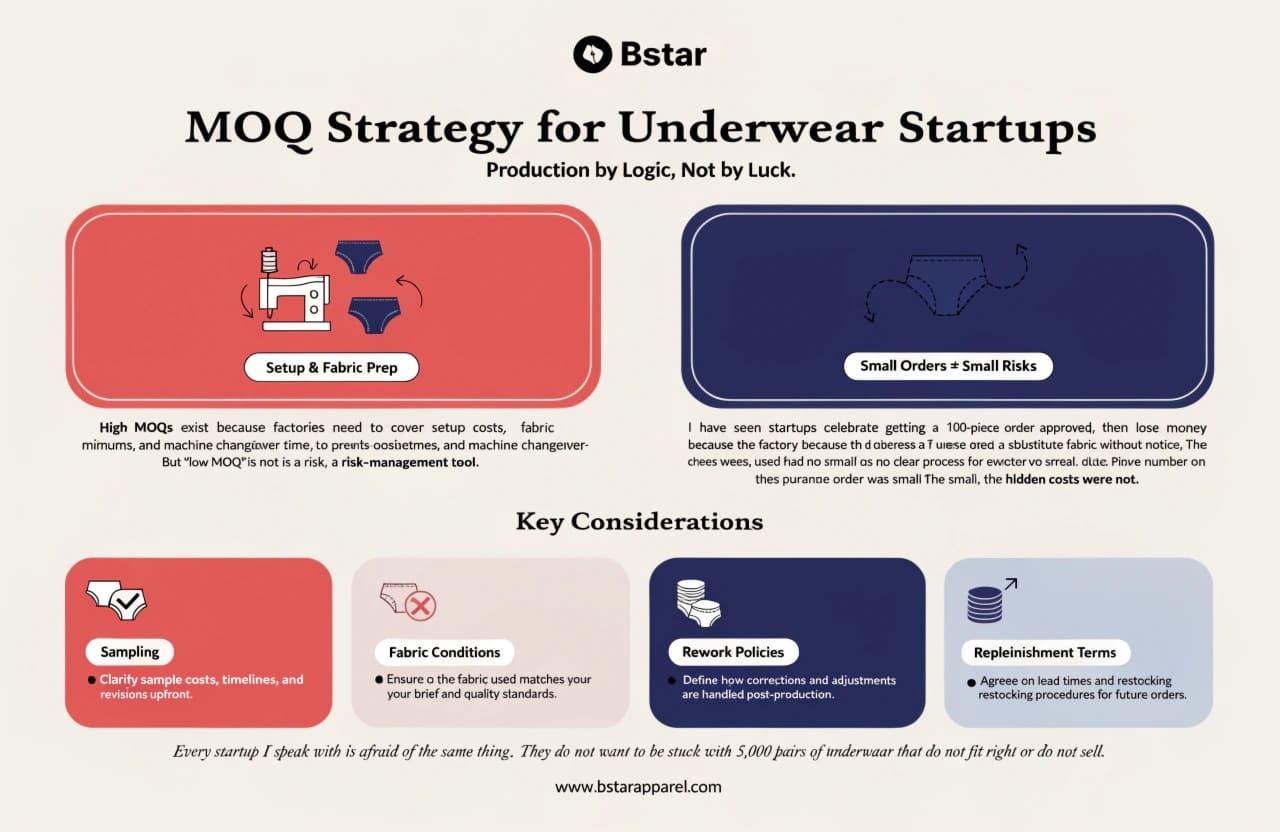
I have seen startups celebrate getting a 100-piece order approved, then lose money because the factory charged high sample fees, used a substitute fabric without notice, or had no clear process for reorders. The number on the purchase order was small. The hidden costs were not.
What Actually Drives MOQ in Underwear Manufacturing?
When you understand what drives MOQ, you can negotiate more intelligently and plan more realistically.
| Cost Driver | Why It Affects MOQ | What Startups Can Do |
|---|---|---|
| Fabric minimums | Knit fabrics often have minimum dye lot or roll requirements2 | Group colorways or use stock fabrics for first orders |
| Elastic and trims | Waistband elastics, labels, and lace have their own minimums3 | Simplify trim choices early, add variety later |
| Machine setup | Cutting and sewing setup time is fixed regardless of quantity | Fewer SKUs per order reduce setup cost per unit |
| Sample amortization | Some factories charge sample fees against bulk orders | Clarify if sample cost is deducted from first order |
| Quality checkpoints | Smaller runs still require full inspection at multiple stages | Build inspection cost into your unit price calculation |
The point is not to fight the factory on MOQ. The point is to understand which cost drivers apply to your specific design, then work with a manufacturing partner who can explain the trade-offs honestly.
Cost vs. Agility: How Do You Balance Unit Price With Inventory Risk?
Here is the conflict every startup faces. A larger order gives you a lower unit cost. But a larger order also means more capital tied up, more storage needed, and more risk if the market response is weak.
There is no perfect formula. But the right balance depends on your sales channel, your launch timeline, and how confident you are in your fit. A first batch should be small enough to test the market, but large enough to generate real feedback across your size range.4
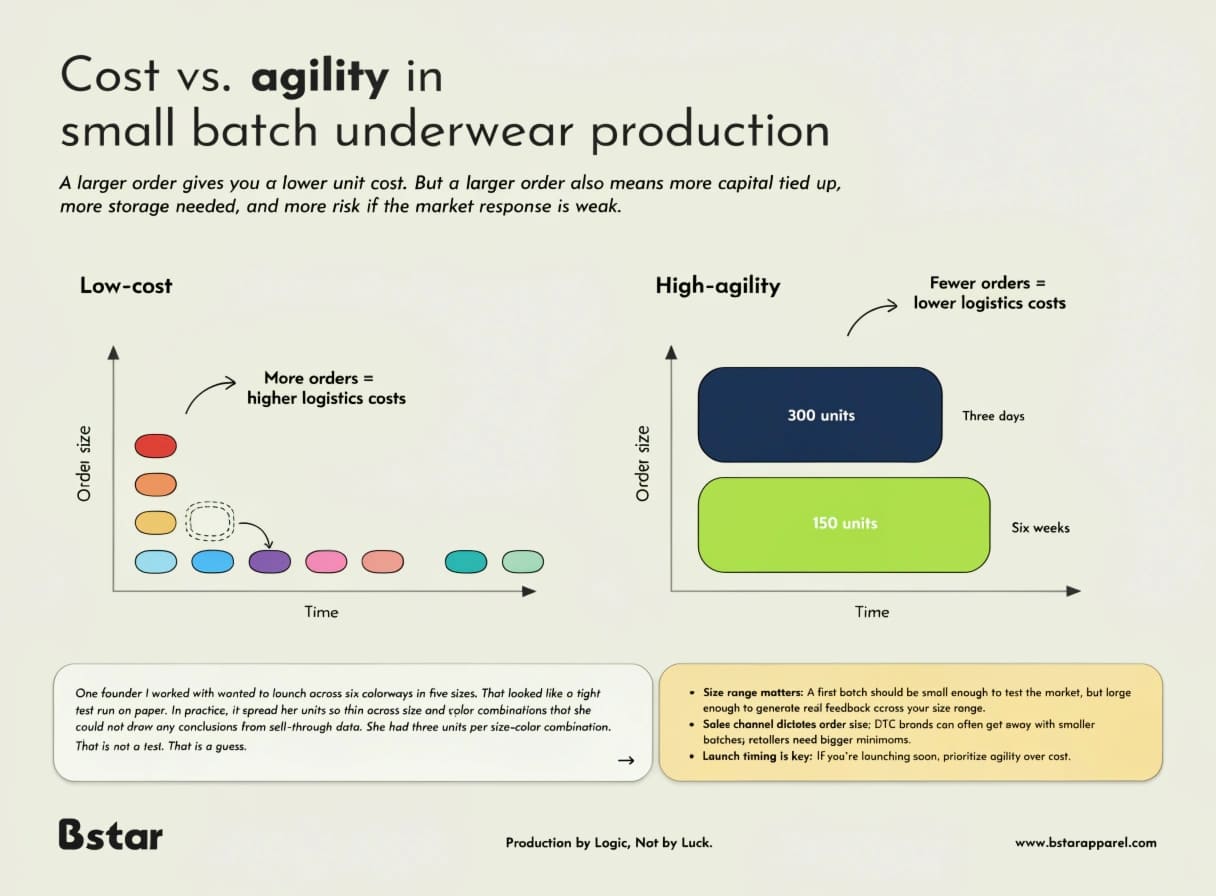
One founder I worked with wanted to launch across six colorways in five sizes. That looked like a tight test run on paper. In practice, it spread her units so thin across size and color combinations that she could not draw any conclusions from sell-through data. She had three units per size-color combination. That is not a test. That is a guess.5
How to Build a Test Order That Actually Teaches You Something
The goal of a first production run is not to maximize revenue. It is to gather information you can use to grow with lower risk.
Think about these four things before you decide on quantity:
Fit validation. Does your size range fit your target customer? You need enough units per size to get real feedback, not just one or two returns.
Fabric performance. Does the fabric hold up after washing? Does the elastic recover? Does the color hold?6 You need real-world wear data.
Size performance. Which sizes sell fastest? This tells you how to weight your next order by size ratio.
Replenishment speed. How fast can your factory turn around a reorder once you have proven a design works? This affects how small your safety stock needs to be.
| Test Goal | Minimum Units Needed | Why |
|---|---|---|
| Fit feedback per size | 10–20 units per size7 | Enough for real customer wear data |
| Size sell-through ratio | At least 3 sizes, 15+ per size | To see which sizes move fastest |
| Fabric durability check | 5–10 units for wash/wear test | Pre-production, not bulk order |
| Reorder readiness | Confirm lead time and fabric hold | Ask factory before placing first order |
Essential Pre-Production Steps: What Do You Need Before You Contact a Factory?
This is where most startups waste time and money. They contact a factory with a rough idea or a photo from Pinterest, then wonder why sampling takes forever and costs more than expected.
Before you approach any underwear manufacturer, you need to prepare a clear tech pack, a reference sample or detailed specifications, your target fabric type, your size range, your fit expectations, and your trial quantity. Without these, the factory cannot give you accurate pricing, realistic lead times, or useful sampling guidance.
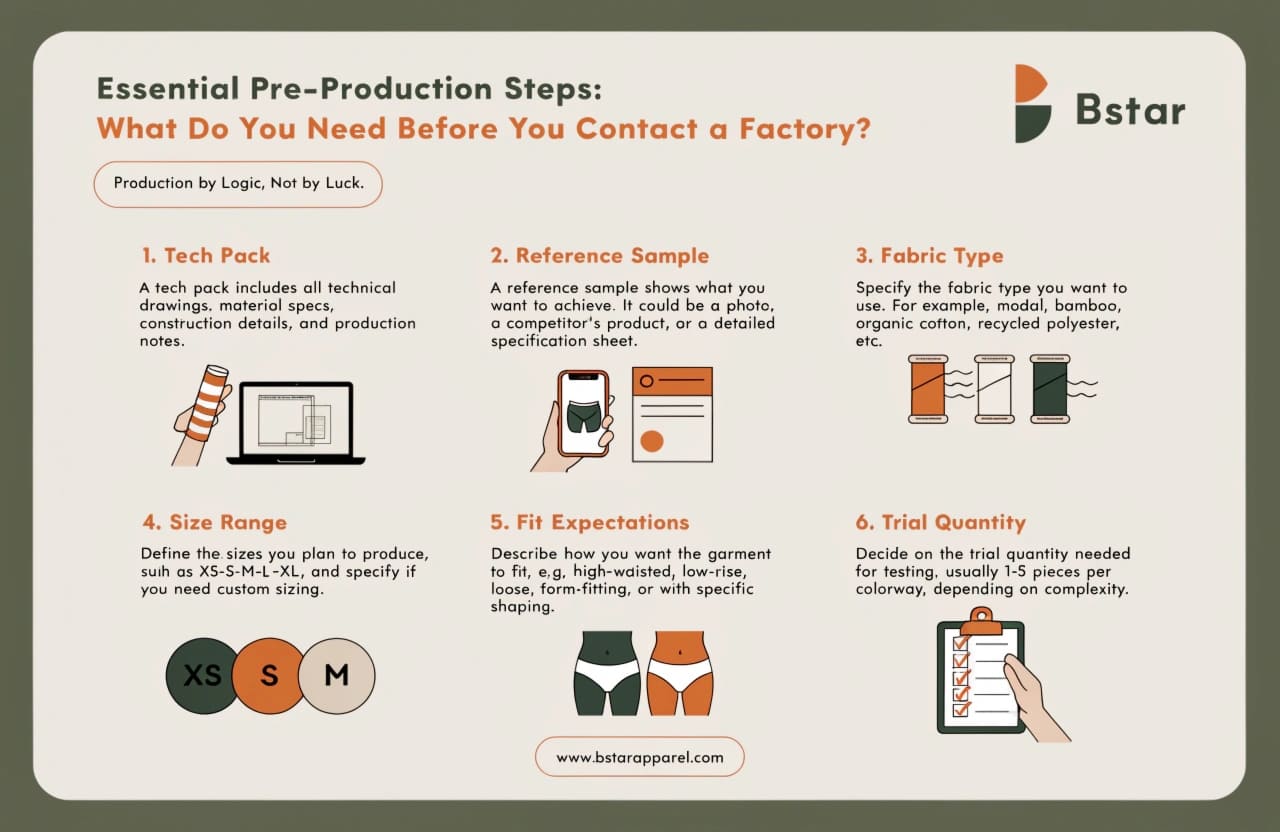
I see this pattern often. A startup sends a design sketch and asks for a quote. The factory gives a rough number. The startup approves sampling. The sample comes back wrong because the stretch ratio was not specified, or the waistband width was never confirmed, or the fabric was a substitute because no real spec was given. Then rework begins. Time and money disappear.
What Goes Into a Proper Pre-Production Preparation?
Tech pack basics. Your tech pack should include flat sketches with measurements, seam placements, elastic specifications, label placement, and size grading notes. It does not need to be a design school project. It needs to be clear enough that a factory technician can cut and sew without guessing.
Fabric and material choices. Underwear fabrics behave differently from woven garments. Stretch percentage, fabric recovery, moisture management, and softness all affect both comfort and production method. If you do not know what fabric you want, ask your factory to show options with test data. Do not pick fabric from a swatch card alone.
Seam and construction decisions. Flatlock seams, narrow seams, and bonded edges all feel different on the body. They also cost differently and require different machines.8 Make this decision before sampling, not after.
Size range and grading. Decide your size range before sampling. Grading underwear across sizes is not simply scaling up a pattern. Stretch, fit, and coverage change as size increases.9 Ask your factory how they handle size grading and whether each size gets a fit review.
| Pre-Production Item | Why It Matters | Common Startup Mistake |
|---|---|---|
| Tech pack | Sets production standard | Sending sketches without measurements |
| Fabric spec | Controls comfort and cost | Accepting substitute without testing |
| Size grading notes | Ensures fit across range | Assuming grading is automatic |
| Packaging brief | Affects cost and timeline | Adding packaging requirements after bulk approval |
| Launch timeline | Helps factory plan capacity | Giving unrealistic deadlines |
Building Long-Term Partnerships: How Do You Grow Your Production as Your Brand Grows?
Your first factory conversation should not only be about your first order. It should also tell you whether this is a partner you can grow with.
A good manufacturing partner can scale with you. That means they can handle small batches at the start, offer faster reorder turnaround as you grow, give you priority capacity when you have proven demand, and help you improve quality and cost as your volume increases.
The startups that scale well are not the ones who found the cheapest factory. They are the ones who built a working relationship early, communicated clearly, and treated the factory as a partner rather than a vendor.10 That relationship pays back when you need a rush reorder, when you want to add a new fabric, or when you need help solving a fit issue quickly.
Signs That a Factory Is Ready to Grow With You
When you are evaluating a manufacturing partner for small-batch underwear, look beyond MOQ and unit price.
Sampling process. Does the factory have an internal fit and sampling process, or are they sending your first sample to an outside workshop? In-house sampling usually means faster revision cycles and more accountability.11
Communication quality. Does the factory ask clarifying questions about your fit expectations, your target customer, and your end use? A factory that asks good questions understands that underwear fit is personal and detail-dependent.
Transparency on lead times. Can they give you realistic production windows? Can they hold fabric or trims between orders to reduce your reorder lead time?
Willingness to discuss scaling. A long-term partner will talk with you about what your production plan looks like at three months, six months, and one year. They want to understand your growth trajectory, not just close one order.
At BSTAR, we work with DTC brands and startups from Europe and North America on exactly this kind of development—from first sample through small-batch production and into scaled reorders. We are not the right fit for every brand, but if you are building a knit underwear line and need a factory that can work through fit development with you from the beginning, it is worth a conversation.
Conclusion
Small-batch underwear manufacturing works best when you treat the first order as a test, not just a purchase. Prepare well, pick the right partner, and let the data guide your next step.
-
"Minimum Order Quantities Explained: Why They Matter in Custom …", https://oss-apparel.com/minimum-order-quantities-for-custom-apparel/. Research on supply chain economics in apparel manufacturing identifies fixed setup costs, raw material minimum order requirements from fabric mills, and machine changeover time as primary structural determinants of minimum order quantities imposed by cut-and-sew factories. Evidence role: mechanism; source type: paper. Supports: That MOQs in apparel and textile manufacturing are structurally tied to fixed setup costs, material minimums, and production changeover inefficiencies.. Scope note: Most academic literature addresses MOQ in broader supply chain contexts; direct empirical studies focused specifically on underwear or intimate apparel manufacturing are limited. ↩
-
"[PDF] dye machine scheduling and roll – selection – UNC Charlotte Pages", https://belkcollegeofbusiness.charlotte.edu/wdcooper/wp-content/uploads/sites/865/2018/05/Dye-Machine-Scheduleing-and-Roll-Selection.pdf. Textile industry documentation indicates that yarn-dyed and piece-dyed knit fabrics are subject to minimum lot requirements at the mill level, driven by dye bath consistency, machine capacity, and color repeatability standards across production runs. Evidence role: mechanism; source type: institution. Supports: That knit fabric suppliers impose minimum dye lot or roll quantities due to the economics and consistency requirements of the dyeing process.. Scope note: Specific minimums vary widely by mill, fiber type, and dyeing method; the claim reflects a general industry norm rather than a universally fixed threshold. ↩
-
"[PDF] A Guide to United States Apparel and Household Textiles …", https://www.cpsc.gov/s3fs-public/Guide-to-US-Apparel-and-Household-Textiles.pdf. Apparel industry supply chain documentation indicates that trim components—including narrow elastic, woven and printed labels, and lace—are typically procured from specialized suppliers who set independent minimum order quantities based on their own production economics, creating a layered MOQ structure that constrains small-batch garment production. Evidence role: mechanism; source type: institution. Supports: That apparel trim components including elastics, woven labels, and lace are sourced from separate suppliers who impose their own minimum order quantities independent of the garment factory’s MOQ.. Scope note: Minimum quantities vary substantially by supplier, material type, and geographic sourcing region; the claim reflects a general industry pattern rather than a uniform standard. ↩
-
"What Is an MVP? Eric Ries Explains – Lean Startup Co.", https://leanstartup.co/resources/articles/what-is-an-mvp/. New product development and lean startup literature describes the minimum viable product concept as a mechanism for generating validated learning with the least possible resource commitment, a principle applied in apparel contexts through small initial production runs designed to test demand signals, fit acceptance, and size distribution before committing to scaled inventory. Evidence role: general_support; source type: paper. Supports: That initial production quantities for new consumer products should be calibrated to enable genuine market learning while managing inventory risk.. Scope note: Lean startup methodology originates in software product development; its application to physical goods with fixed production minimums involves contextual adaptation not always addressed directly in the source literature. ↩
-
"Sample size, power and effect size revisited: simplified and practical …", https://pmc.ncbi.nlm.nih.gov/articles/PMC7745163/. Operations management and retail analytics literature on demand signal detection indicates that per-SKU quantities of fewer than ten units in a test assortment are generally insufficient to produce statistically reliable sell-through ratios, as random variation in consumer purchasing dominates the observed outcome at such small sample sizes. Evidence role: mechanism; source type: paper. Supports: That very small per-SKU quantities in a product test run are insufficient to distinguish signal from noise in sell-through data.. Scope note: The specific threshold of three units is used illustratively in the article; formal minimum sample size recommendations vary by statistical method and acceptable error tolerance. ↩
-
"Complete Textile Testing Standards Guide for QA Professionals", https://blog.textilepages.com/textile-testing-standards. International textile testing standards, including ISO 6330 (domestic washing procedures for textile testing), ISO 105-C (color fastness to washing), and ASTM D4964 (tension and elongation of elastic fabrics), establish standardized methods for evaluating the laundering durability, elastic recovery, and color retention properties cited as quality indicators for underwear fabrics. Evidence role: definition; source type: institution. Supports: That dimensional stability after washing, elastic recovery, and color fastness to laundering are standard measurable performance criteria for knit underwear fabrics.. Scope note: The article does not specify which standards apply; the cited standards are illustrative of the testing framework rather than a direct endorsement of specific pass/fail thresholds. ↩
-
"Understanding Prototypes and Fit Samples: What Base Size Really …", https://www.techpacks.co/blog/understanding-prototypes-and-fit-samples-what-base-size-means?srsltid=AfmBOooi0NVx6leDpA14sHfGkidaRNA-S5w3BgivEcSyh28DlpQ9IOkH. Human factors and consumer product testing literature suggests that meaningful qualitative and quantitative feedback on fit and comfort requires a sufficient number of participants per size category to capture variation in body morphology and use conditions, with recommendations typically ranging from 10 to 30 subjects per group depending on the variability of the outcome measure. Evidence role: general_support; source type: research. Supports: That obtaining reliable fit feedback from consumers requires a minimum number of test units per size category.. Scope note: The 10–20 unit figure in the article conflates units produced with users tested; the cited range from testing literature refers to participants, not inventory units, making the correspondence indirect. ↩
-
"The Building Blocks of Comfort: Types of Seams in Lucky & Me …", https://luckyandme.com/blogs/posts/types-of-seams-in-lucky-me-underwear?srsltid=AfmBOooc6nolu1Kank63XGiYX7xxKeMSaFt1tTm2OdMj_OgzF78YfFFD. Apparel engineering and textile science literature documents that seam construction methods—including flatlock (flatseam), narrow overedge, and adhesive-bonded seams—differ in their pressure and friction profiles against skin, their stitch formation requirements, and the specialized machinery (e.g., flatseam machines, ultrasonic bonding equipment) needed for production. Evidence role: mechanism; source type: paper. Supports: That seam construction type in knit underwear affects wearer comfort, unit production cost, and the specific industrial machinery required.. Scope note: Comparative cost data between seam types is highly variable by region, factory, and order volume and is not consistently reported in academic sources. ↩
-
"PM: Patternmaking | Fashion Institute of Technology Catalog", https://catalog.fitnyc.edu/undergraduate/courses/pm/. Patternmaking and apparel engineering literature establishes that grading stretch knit garments involves non-proportional adjustments to account for changes in fabric tension, body curvature, and coverage requirements across sizes, distinguishing it from standard woven garment grading procedures. Evidence role: mechanism; source type: education. Supports: That grading stretch knit garments such as underwear requires adjustments beyond proportional scaling because elastic recovery, coverage, and fit geometry change across the size range.. Scope note: Published grading standards for intimate apparel specifically are less common in academic literature than for outerwear; much industry knowledge is proprietary or trade-based. ↩
-
"[PDF] buyers’ sourcing strategies and suppliers’ markups", https://cowles.yale.edu/sites/default/files/2024-02/p1859.pdf. Supply chain management research on buyer-supplier relationships in the apparel and textile sector finds that relational governance—characterized by communication quality, trust, and joint problem-solving—is positively associated with supplier responsiveness, quality consistency, and flexibility, outcomes that are particularly valuable for brands scaling from small-batch to higher-volume production. Evidence role: expert_consensus; source type: paper. Supports: That long-term, collaborative buyer-supplier relationships in apparel manufacturing are associated with better scaling outcomes than purely price-driven sourcing strategies.. Scope note: Most studies examine established brands rather than early-stage startups specifically; the generalizability of findings to the startup context involves some extrapolation. ↩
-
"In-House VS. Outsourced Production: Which One Is Right?", https://argusapparel.com/blog/in-house-vs-outsourced-production/. Operations management literature on vertical integration and make-or-buy decisions in manufacturing indicates that internalizing upstream development processes such as prototyping and sampling reduces coordination costs, shortens feedback loops, and concentrates quality accountability within a single organizational unit. Evidence role: mechanism; source type: paper. Supports: That vertical integration of sampling within a manufacturing facility reduces revision lead times and improves accountability compared to outsourced sampling arrangements.. Scope note: Direct empirical studies comparing in-house versus outsourced sampling specifically in garment or intimate apparel factories are scarce; the support is drawn from broader operations management theory. ↩
Discussion & questions 0 comments