
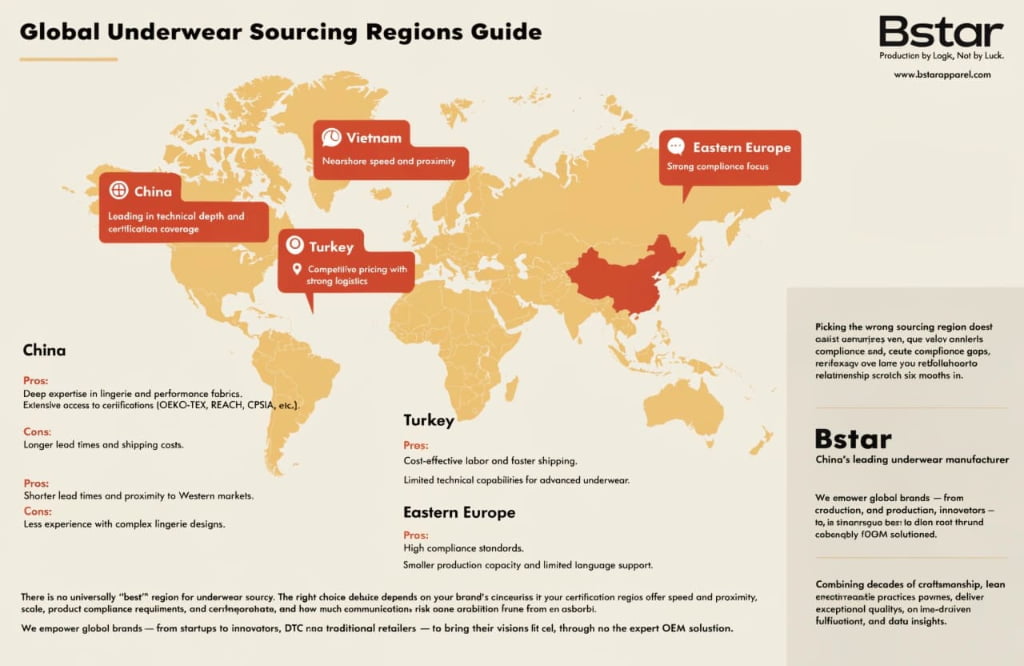
Picking the wrong sourcing region doesn’t just cost money. It can delay your launch, create compliance gaps, and leave you rebuilding supplier relationships from scratch six months in.
The short answer: there is no universally "best" region for underwear sourcing. The right choice depends on your brand’s scale, product complexity, compliance requirements, and how much communication risk you can absorb. China still leads on technical depth and certification coverage. Nearshore regions offer speed proximity. The decision is a brand-fit call, not a cost comparison.
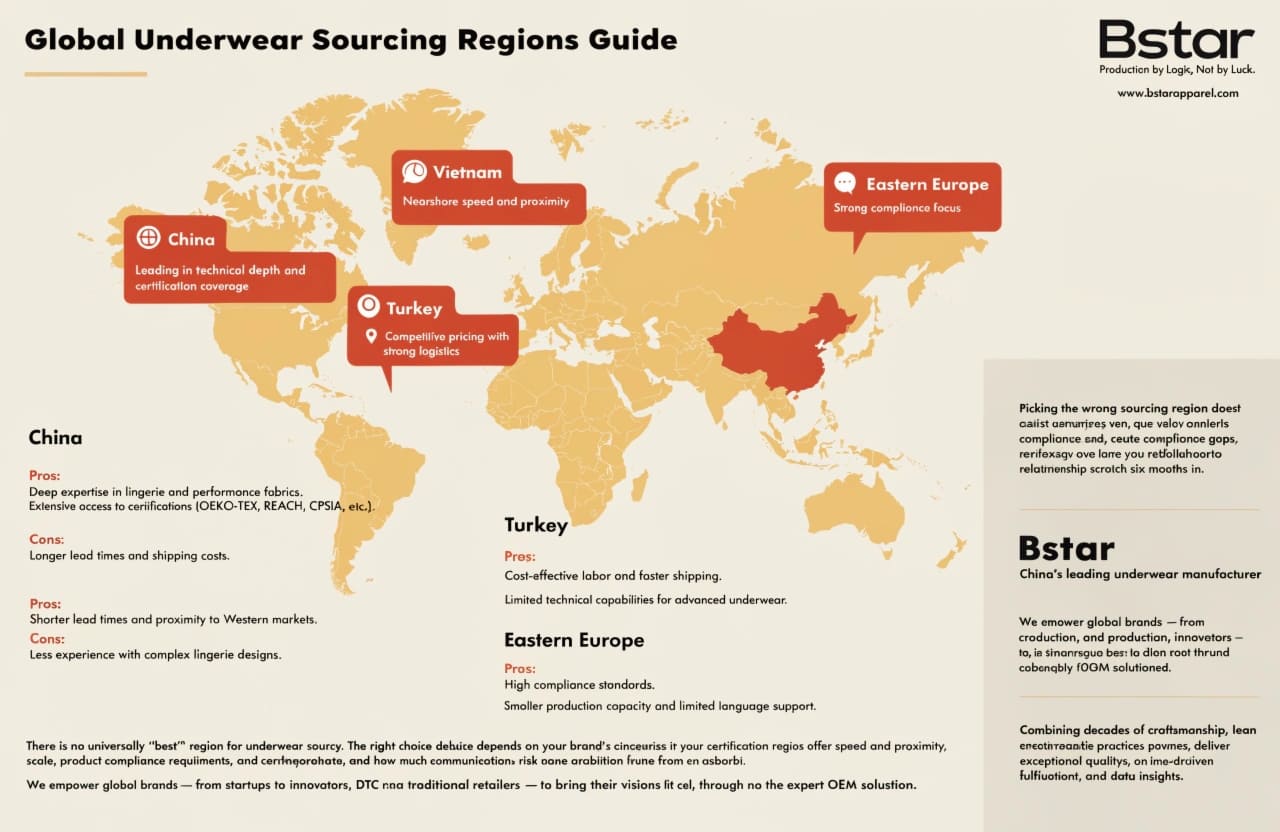
I’ve been part of hundreds of sourcing conversations with DTC and retail buyers from Europe and North America. The ones who make the best decisions aren’t the ones who picked the cheapest option. They’re the ones who matched the region to their actual constraints — not the constraints they assumed they had.
The Asia-Pacific Powerhouse: Is China Still Worth It, or Should You Go With Vietnam?
This is the most common question I hear from buyers who are either sourcing for the first time or reconsidering their current setup.
China remains the dominant choice for technical underwear manufacturing. The depth of the supply chain — elastic engineering, seamless production1, rapid colorway switching — is not replicated at scale elsewhere in Asia-Pacific. Vietnam and Bangladesh have grown fast, but they haven’t closed the gap on product complexity or certification coverage2.
Here’s what buyers often get wrong about this comparison.
They see Vietnam’s labor cost advantage and assume quality has caught up. For basic cotton T-shirts and simple wovens, that’s partly true. For underwear — where elastic tension, fabric recovery, and dye consistency under stretch actually matter3 — the manufacturing depth required is different. A factory that does great work on simple cut-and-sew is not automatically equipped for seamless briefs or four-way stretch intimates4.
The certification picture is also different across regions. At BSTAR, we hold BSCI, OEKO-TEX®, GOTS, and GRS certifications. I want to be clear about what that means for EU and US buyers: these are not marketing badges. They are market entry requirements. If you’re selling into EU retail or working with US platforms that require chemical safety compliance, the absence of OEKO-TEX® certification at your factory creates real buyer liability5 — not just a gap in your marketing copy.
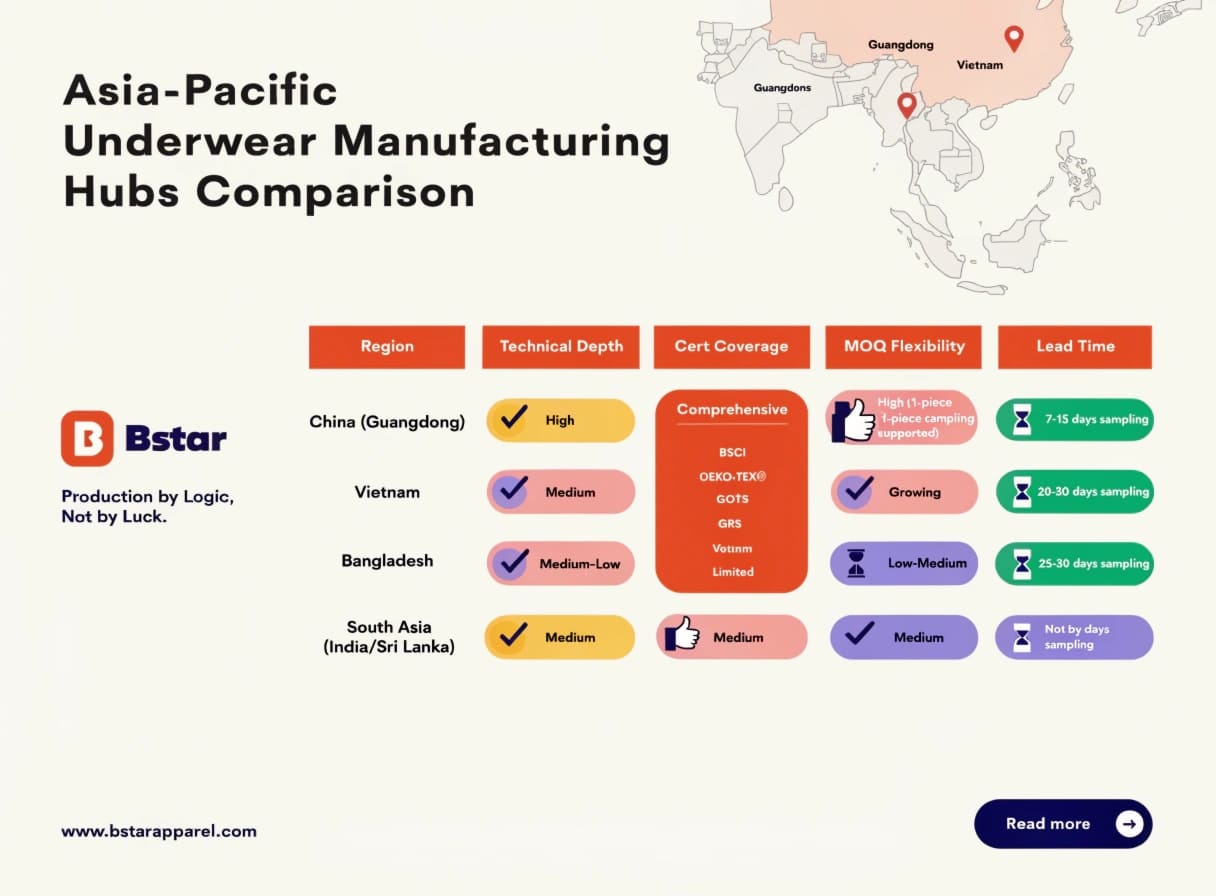
| Region | Technical Depth | Cert Coverage | MOQ Flexibility | Lead Time |
|---|---|---|---|---|
| China (Guangdong) | High | Comprehensive | High (1-piece sampling supported) | 7–15 days sampling |
| Vietnam | Medium | Growing | Medium | 20–30 days sampling |
| Bangladesh | Medium-Low | Limited | Low-Medium | 25–35 days sampling |
| South Asia (India/Sri Lanka) | Medium | Selective | Medium | 20–30 days sampling |
Bangladesh and South Asia work well for buyers with high-volume, lower-complexity briefs or basics where price compression is the primary objective. If your product is technically simple and your volume is large, that region deserves evaluation. But if you’re at an early stage with new SKUs and need compliance documentation from day one, the tradeoffs stack up quickly.
Nearshoring and Specialized Production: When Does Turkey or Eastern Europe Actually Make Sense?
I respect nearshoring as a strategy. I also think it gets oversold for underwear specifically.
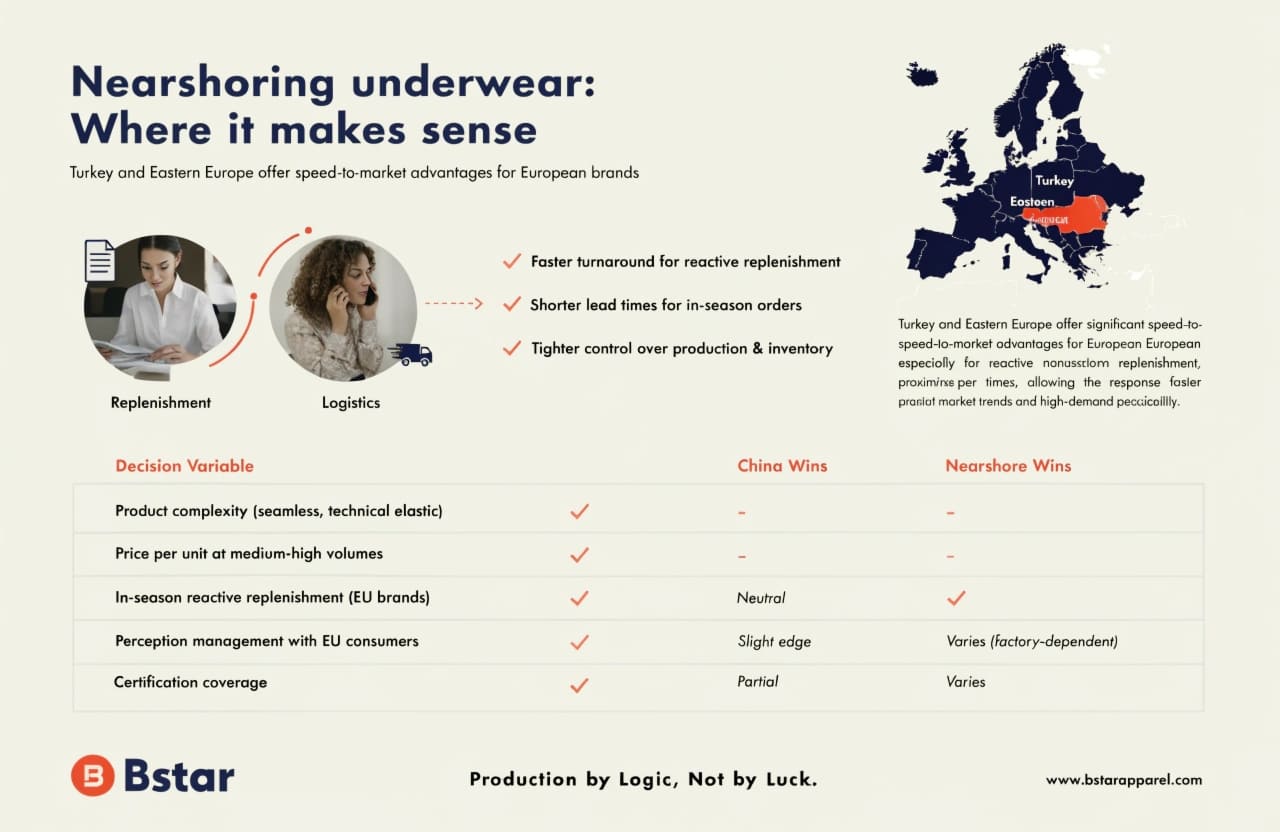
Turkey and Eastern Europe — particularly Portugal, Romania, and North Macedonia — offer real advantages in speed-to-market6 for European brands and tighter control over in-season replenishment. They make the most sense when geographic proximity solves a genuine operational problem, not just a perceived risk about far-east sourcing.
Here’s how I break it down for buyers considering this option.
The genuine use case for nearshoring in underwear is reactive replenishment. If your brand operates on short in-season buying cycles — meaning you need to reorder a top-selling style within 3–4 weeks based on early sales signals — geographic proximity to Turkey or Romania gives you a logistics window that China-based production can’t match on standard shipping timelines.
That’s a real advantage. I don’t dismiss it.
What I do question is whether that use case applies to most DTC and mid-size retail buyers evaluating their first or second overseas supplier. Most of the brands I talk to are planning production in advance, not chasing weekly replenishment signals. For them, the nearshore speed advantage doesn’t offset the cost premium or the narrower technical capability range.
| Decision Variable | China Wins | Nearshore Wins |
|---|---|---|
| Product complexity (seamless, technical elastic) | ✓ | — |
| Price per unit at medium-high volumes | ✓ | — |
| In-season reactive replenishment (EU brands) | — | ✓ |
| Perception management with EU consumers | Neutral | Slight edge |
| Certification coverage | ✓ | Partial |
| English communication reliability | Varies (factory-dependent) | Varies |
The honest answer is: nearshore works for specific operational models. It is not a quality upgrade. And for underwear brands that need strong certification documentation and technical production reliability, the comparison still tilts toward established China manufacturers with the right compliance infrastructure.
Balancing Cost, Quality, and Speed: What Does "Good Sourcing" Actually Look Like at Your Stage?
This is where most sourcing comparisons fall apart. They treat all buyers as if they have the same priorities.
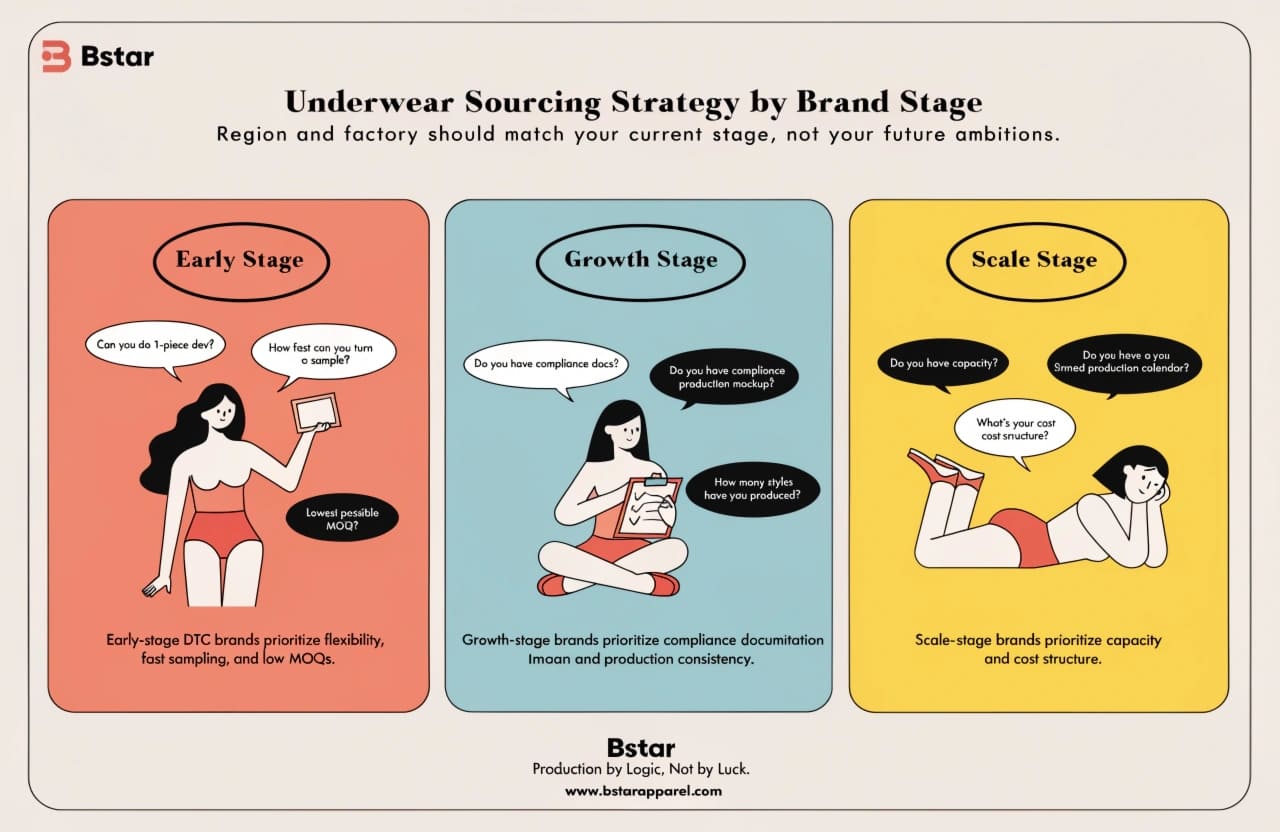
"Good sourcing" means different things at different brand stages. Early-stage brands need flexibility and fast sampling. Growth-stage brands need compliance documentation and production consistency. Scale-stage brands need capacity and cost structure. The region — and the factory — should match your current stage, not your eventual ambitions.
I’ll be specific about what this looks like in practice.
If you’re an early-stage DTC brand running 500–2,000 units per style, the most dangerous mistake you can make is choosing a factory because of their client list or their facility photos. What you actually need is a factory that can turn a sample in 7–15 days, accepts low MOQs without penalizing quality, and has an English-speaking team that responds within 24 hours. A factory that can do 1-piece development samples is not a compromise — it’s a supply chain enabler. It lets you test fit, colorways, and fabric before committing to a production run.
If you’re at a growth stage — say 5,000–20,000 units per style — compliance documentation becomes critical. Your retail partners will start asking for test reports, certification copies, and audit records. If your factory can’t produce these, you’re creating a compliance gap that is expensive to fix retroactively.
At scale — 50,000+ units — capacity and cost structure dominate. You need a factory with a confirmed production calendar, predictable lead times, and a pricing structure that reflects volume efficiency.
What I see most often is buyers making sourcing decisions as if they’re already at the scale stage. They optimize for cost before they’ve stabilized their product. That creates fragility. Get flexibility and compliance right first. Cost structure follows.
Future-Proofing Your Supply Chain: How Do You Handle Tariffs, Sustainability, and Geopolitical Risk?
These concerns are real. I hear them in almost every initial conversation with EU and US buyers right now.
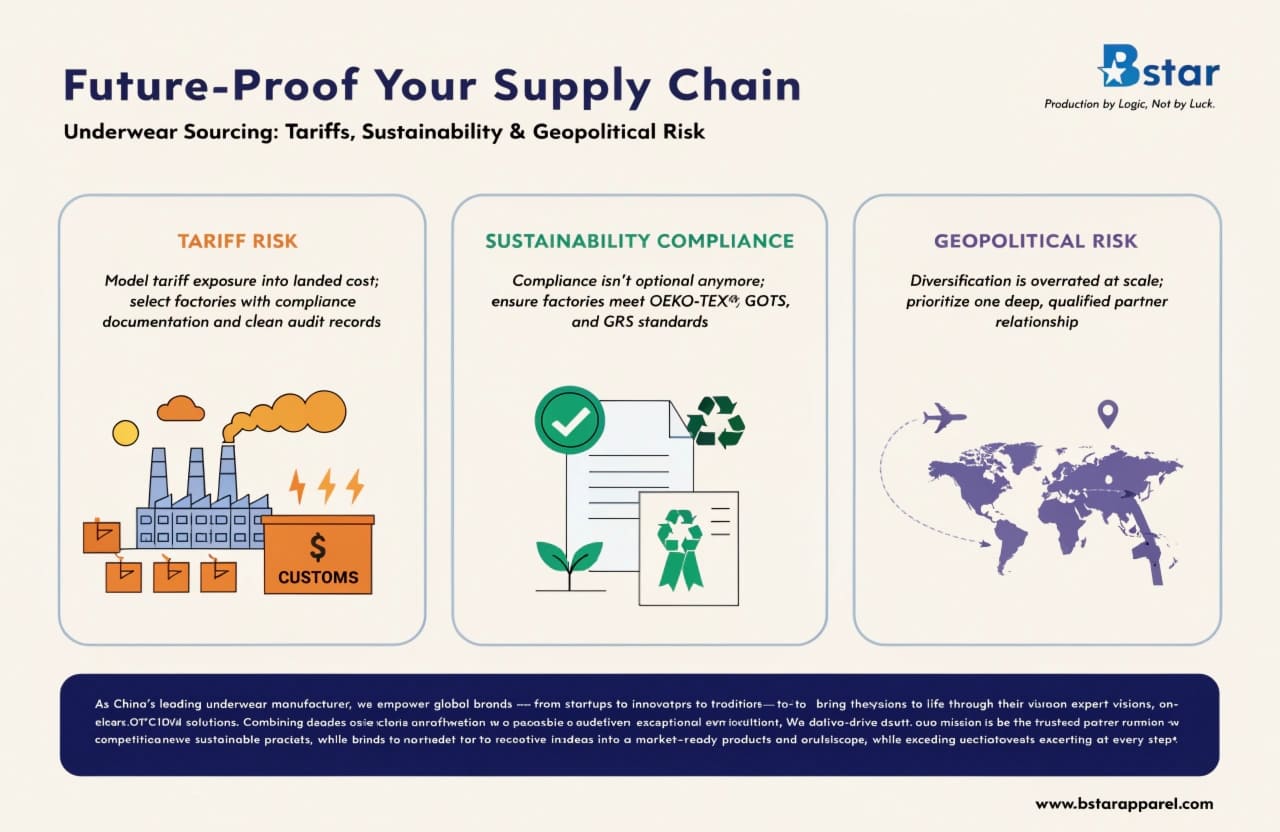
Tariff exposure, sustainability compliance, and geopolitical disruption are legitimate supply chain risks. The practical response is not to avoid China — it’s to build sourcing relationships with factories that have documented compliance infrastructure, transparent production processes, and the financial stability to absorb disruption without passing it entirely to the buyer.
Let’s take each risk separately.
Tariffs: US tariff exposure on China-origin goods is real and buyers should model it into their landed cost. What I’d push back on is the assumption that moving production to Vietnam or another region eliminates this risk. Tariff policy shifts. What’s exempt today may not be in two years. A factory with strong compliance documentation and a clean audit record — like BSCI certification — gives you a cleaner paper trail when customs scrutiny increases7, regardless of origin country.
Sustainability compliance: The EU’s incoming regulations on textile sustainability are not optional for brands selling into European retail8. OEKO-TEX® Standard 100 is increasingly a retail floor requirement. GOTS and GRS certifications matter for organic and recycled product lines9. If your factory doesn’t hold these credentials, you are either locked out of certain retail channels or you are carrying an audit liability you haven’t priced in. At BSTAR, all raw materials go through FSC, OEKO-TEX®, GOTS, and GRS certification before they enter our production line. That’s not a selling point — it’s a baseline.
Geopolitical risk: Diversification sounds like the right answer, but for most brands at the 500–20,000 unit stage, managing two production regions simultaneously creates more operational complexity than it eliminates risk10. A better near-term move is building depth in one well-qualified partner relationship — with documented handoff processes, milestone tracking, and communication SLAs — so that you’re not starting from zero if you ever do need to shift.
Conclusion
The right sourcing region for your underwear brand is the one that fits your stage, your product complexity, and your compliance requirements — not the one that looks cheapest on a spreadsheet.
If you’re evaluating suppliers for a 500–5,000 unit launch and need OEKO-TEX® compliance and low-MOQ flexibility from day one, we should talk. Send us your brief and we’ll respond within 24 hours.
-
"Top Seamless Bra Manufacturer Expands Production Capacity to …", https://www.jsonline.com/press-release/story/139199/top-seamless-bra-manufacturer-expands-production-capacity-to-meet-growing-global-demand/. Seamless knitting technology, commercialized largely through machinery manufacturers such as Santoni, became heavily concentrated in Chinese production clusters during the 2000s as domestic investment in circular knitting equipment accelerated; trade data from the International Textile Manufacturers Federation reflects China’s dominant share of seamless hosiery and intimate apparel output. Evidence role: historical_context; source type: encyclopedia. Supports: China’s concentration of seamless knitting machinery and associated technical expertise in underwear manufacturing. Scope note: Publicly available machinery distribution data is not always disaggregated by end-product category, making precise comparisons of seamless underwear capacity across countries difficult to verify from open sources. ↩
-
"Why Vietnam is the Ideal Hub for Clothing Manufacturing – VinMake", https://www.vinmake.com/insights/why-vietnam-is-the-ideal-hub-for-clothing-manufacturing. Industry assessments by bodies such as the International Labour Organization or the World Bank’s Doing Business reports document sectoral capability differences across Asian garment-producing nations, though direct comparisons of technical underwear production depth are not always disaggregated at the product-category level. Evidence role: general_support; source type: institution. Supports: Comparative manufacturing capability and certification penetration across Asian apparel-producing countries. Scope note: Available institutional data typically covers the broader apparel sector rather than the specific sub-category of technical underwear or seamless intimate apparel. ↩
-
"[PDF] A Comparison of Qualities of Colorfastness for Non-Stretch versus …", https://ir.library.illinoisstate.edu/cgi/viewcontent.cgi?article=1000&context=urs2021fcs. ASTM International and the International Organization for Standardization (ISO) publish test methods relevant to these parameters, including ASTM D2594 (stretch properties of knitted fabrics), ISO 20932 (elasticity of fabrics), and ISO 105 series (color fastness), which are used by manufacturers and buyers to specify and verify performance in stretch intimate apparel. Evidence role: definition; source type: institution. Supports: The existence of standardized test methods for elastic recovery, fabric recovery after stretch, and color fastness under tension in textile and apparel products. ↩
-
"[PDF] Two-way Stretch Fabrics – University of Idaho", https://objects.lib.uidaho.edu/uiext/uiext29767.pdf. Textile engineering literature documents that four-way stretch fabrics, typically constructed from elastane-blended circular or warp knits, require specialized overlock and coverstitch machinery calibrated for high-elongation materials, as well as operator expertise in tension management to maintain consistent recovery properties across a production run. Evidence role: mechanism; source type: paper. Supports: The technical production requirements — including machinery, thread tension management, and seaming techniques — associated with manufacturing four-way stretch intimate apparel. Scope note: Peer-reviewed sources on this topic tend to address fabric properties rather than factory-level capability distribution across countries, making direct citation of geographic concentration difficult. ↩
-
"OEKO-TEX® STANDARD 100", https://www.oeko-tex.com/en/our-standards/oeko-tex-standard-100/. The EU’s REACH Regulation (EC No 1907/2006) and the U.S. Consumer Product Safety Improvement Act establish chemical safety obligations for textile importers; OEKO-TEX® Standard 100 certification is widely used as a conformance tool, though it is a voluntary third-party standard rather than a statutory requirement in most jurisdictions. Evidence role: mechanism; source type: institution. Supports: The regulatory basis under which chemical safety non-compliance in textiles creates liability for importers and buyers in EU and US markets. Scope note: OEKO-TEX® Standard 100 is not itself a legal mandate; liability arises from underlying chemical safety regulations, and the certification serves as evidence of compliance rather than being independently enforceable. ↩
-
"Back-shoring vs near-shoring: a comparative exploratory study in …", https://pmc.ncbi.nlm.nih.gov/articles/PMC7787603/. Academic and industry research on nearshoring in the European fashion supply chain, including work published by the European Apparel and Textile Confederation (Euratex), documents shorter replenishment cycles as a primary driver of sourcing shifts toward Turkey and Eastern Europe, particularly for fast-fashion and in-season reorder models. Evidence role: general_support; source type: research. Supports: Geographic proximity of Turkish and Eastern European garment manufacturers reduces replenishment lead times for European fashion brands relative to Far East sourcing. Scope note: Published lead-time figures vary by product category and factory, and the specific advantage for technical underwear versus general apparel has not been separately quantified in most available studies. ↩
-
"BSCI Code of Conduct: Approach, Implementation and Audit – Greenly", https://greenly.earth/en-us/blog/company-guide/bsci-code-of-conduct-approach-implementation-and-audit. The amfori Business Social Compliance Initiative (BSCI) is a supply chain management system that audits factories against social performance criteria including labor rights, health and safety, and management systems; it does not directly address customs classification, tariff origin, or chemical safety compliance, though audit records may contribute to broader supply chain due diligence documentation. Evidence role: definition; source type: institution. Supports: The scope of BSCI (now amfori BSCI) as a social compliance audit standard and its relationship to supply chain documentation. Scope note: BSCI certification is a social audit standard and does not constitute customs compliance documentation; its relevance to customs scrutiny is indirect, relating to supply chain transparency rather than tariff or origin verification. ↩
-
"[PDF] Ecodesign for Sustainable Products Regulation Textiles", https://susproc.jrc.ec.europa.eu/product-bureau/sites/default/files/2024-03/DG%20ENV%20Introductory%20slides%20CLEAN.pdf. The European Commission’s Ecodesign for Sustainable Products Regulation (ESPR, Regulation (EU) 2024/1781) and the EU Strategy for Sustainable and Circular Textiles (COM/2022/141) establish a framework of mandatory product durability, recyclability, and chemical safety requirements for textiles placed on the EU market, with implementing measures being phased in from 2025 onward. Evidence role: definition; source type: government. Supports: The EU’s regulatory framework imposing sustainability obligations on textile products sold in the European market. Scope note: Specific implementing regulations under ESPR for textile categories were still being developed as of early 2025; the precise compliance timeline and scope for underwear as a sub-category had not been fully finalized. ↩
-
"Certification – GOTS – Global Organic Textile Standard", https://global-standard.org/certification-and-labelling/certification. The Global Organic Textile Standard (GOTS), administered by Global Standard gGmbH, certifies that textile products contain a minimum percentage of certified organic fibers and meet environmental and social criteria throughout processing; the Global Recycled Standard (GRS), administered by Textile Exchange, certifies recycled input content and chain-of-custody claims in textile and apparel products. Evidence role: definition; source type: institution. Supports: The scope of GOTS as a certification for organic fiber content and processing, and GRS as a certification for recycled input materials in textile products. ↩
-
"Prioritising risk mitigation strategies for environmentally sustainable …", https://pmc.ncbi.nlm.nih.gov/articles/PMC8536944/. Supply chain management research, including work published in journals such as the Journal of Supply Chain Management and the International Journal of Production Economics, documents that dual or multi-sourcing strategies reduce disruption risk but introduce coordination costs, quality consistency challenges, and minimum order fragmentation that can be disproportionately burdensome for smaller buyers operating below scale thresholds. Evidence role: expert_consensus; source type: paper. Supports: That supply chain diversification across multiple regions imposes coordination and transaction costs that may outweigh risk-reduction benefits for smaller buyers. Scope note: Most published research on this tradeoff focuses on manufacturing or electronics supply chains; direct empirical evidence specific to apparel or underwear sourcing at the 500–20,000 unit scale is limited. ↩
Discussion & questions 0 comments