
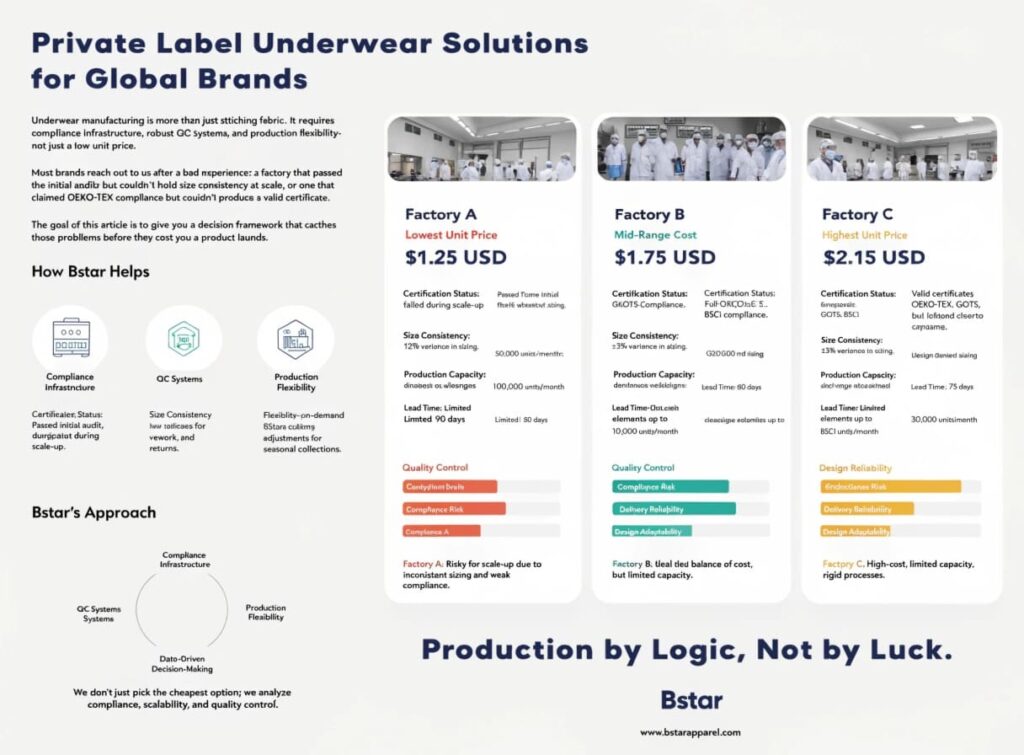
You’ve shortlisted three factories. They all look fine on paper. So why does this decision still feel like a gamble?
Private label underwear manufacturing works best when you evaluate factories on compliance infrastructure, QC systems, and production flexibility — not unit price. The right factory protects your brand from certification failures, sizing inconsistencies, and launch delays.
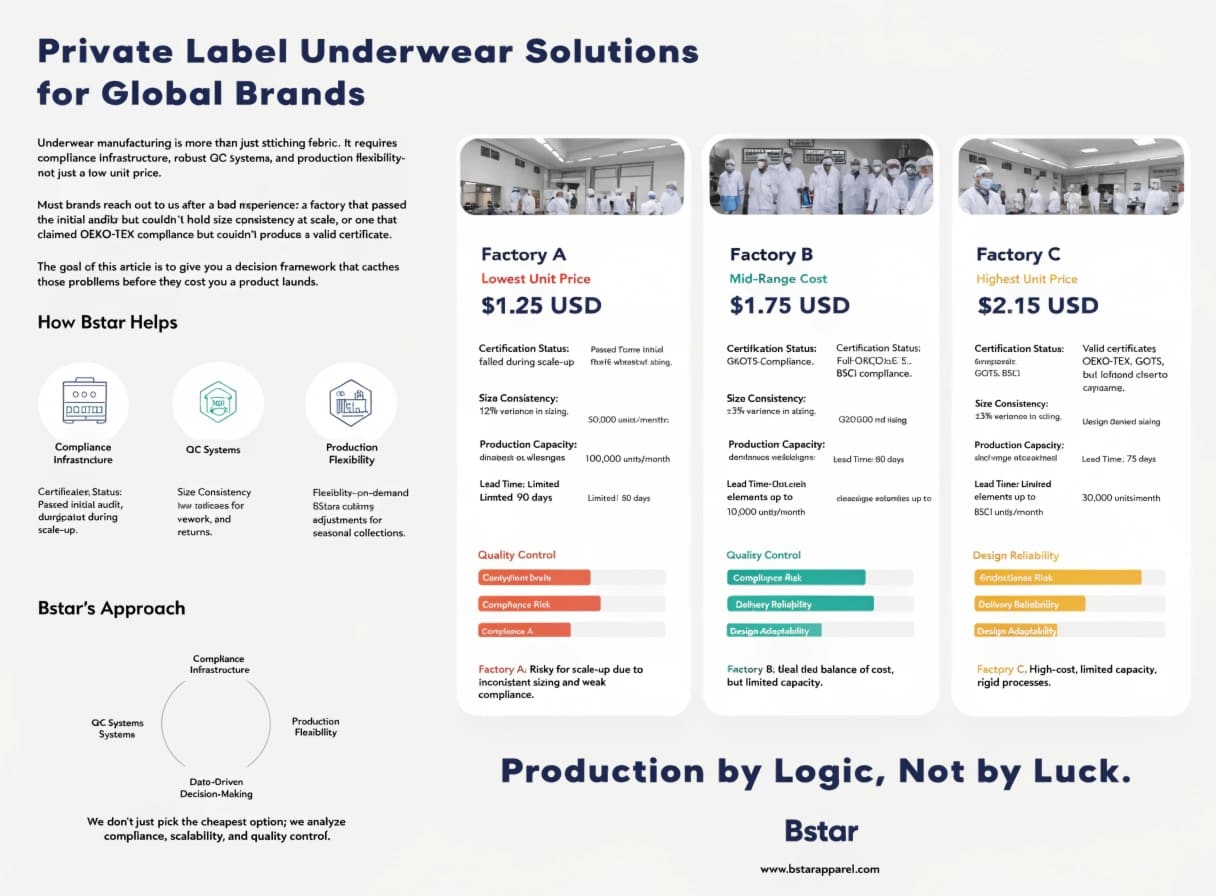
Most brands reach out to us after a bad experience — a factory that passed the initial audit but couldn’t hold size consistency at scale, or one that claimed OEKO-TEX compliance but couldn’t produce a valid certificate. The goal of this article is to give you a decision framework that catches those problems before they cost you a product launch.
Understanding Private Label: OEM vs. ODM Models — Which One Actually Fits Your Brand?
You know you want your name on the product. But do you know whether you need OEM or ODM? Getting this wrong early wastes months.
OEM means you own the design and the factory produces it to your spec. ODM means the factory develops the design and you white-label it. For most DTC underwear brands, OEM gives you stronger brand differentiation, while ODM is faster and cheaper for market testing1.
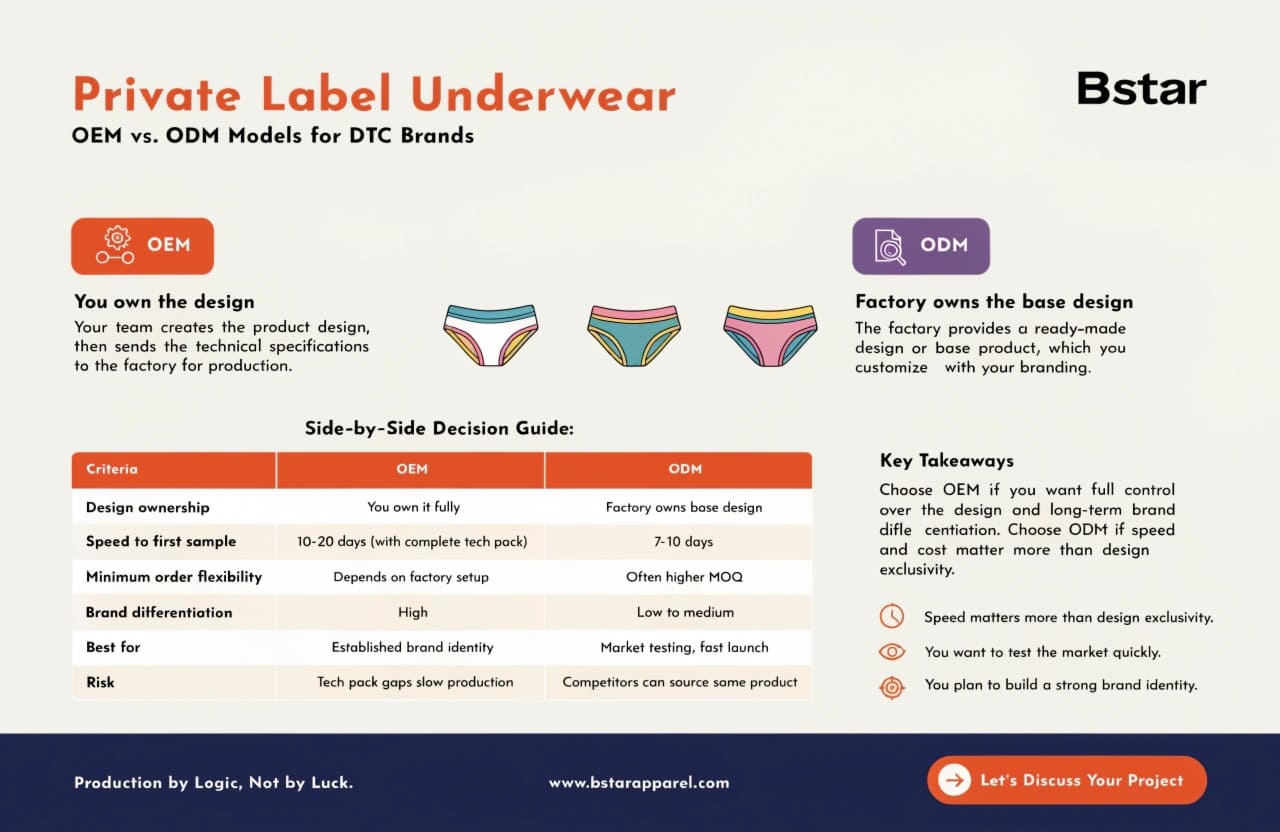
In early consultations with DTC founders, the most common confusion I see is around design ownership. Brands assume ODM is "good enough" because it’s faster. Sometimes it is. But if two competing brands source the same ODM base product from the same factory, the only differentiation is price — and that’s a race you don’t want to run2.
Here’s how to think about it clearly:
OEM vs. ODM: A Side-by-Side Decision Guide
| Criteria | OEM | ODM |
|---|---|---|
| Design ownership | You own it fully | Factory owns base design |
| Speed to first sample | 10–20 days (with complete tech pack) | 7–10 days |
| Minimum order flexibility | Depends on factory setup | Often higher MOQ |
| Brand differentiation | High | Low to medium |
| Best for | Established brand identity | Market testing, fast launch |
| Risk | Tech pack gaps slow production | Competitors can source same product |
One more thing brands overlook: regardless of OEM or ODM, you need to confirm who owns the approved sample. In our experience, this becomes a dispute when brands switch factories mid-development. Get it in writing before sampling starts.
The Manufacturing Journey: What Actually Happens Between Your Design Brief and Final Packaging?
Most sourcing managers have a vague idea of "production stages." But when a launch is delayed, it’s almost always because one specific stage was skipped or rushed.
A standard private label underwear production journey runs through tech pack review, fabric sourcing, proto sampling, fit approval, bulk production, inline QC, and final inspection before packaging. Each stage has a hard dependency on the one before it.
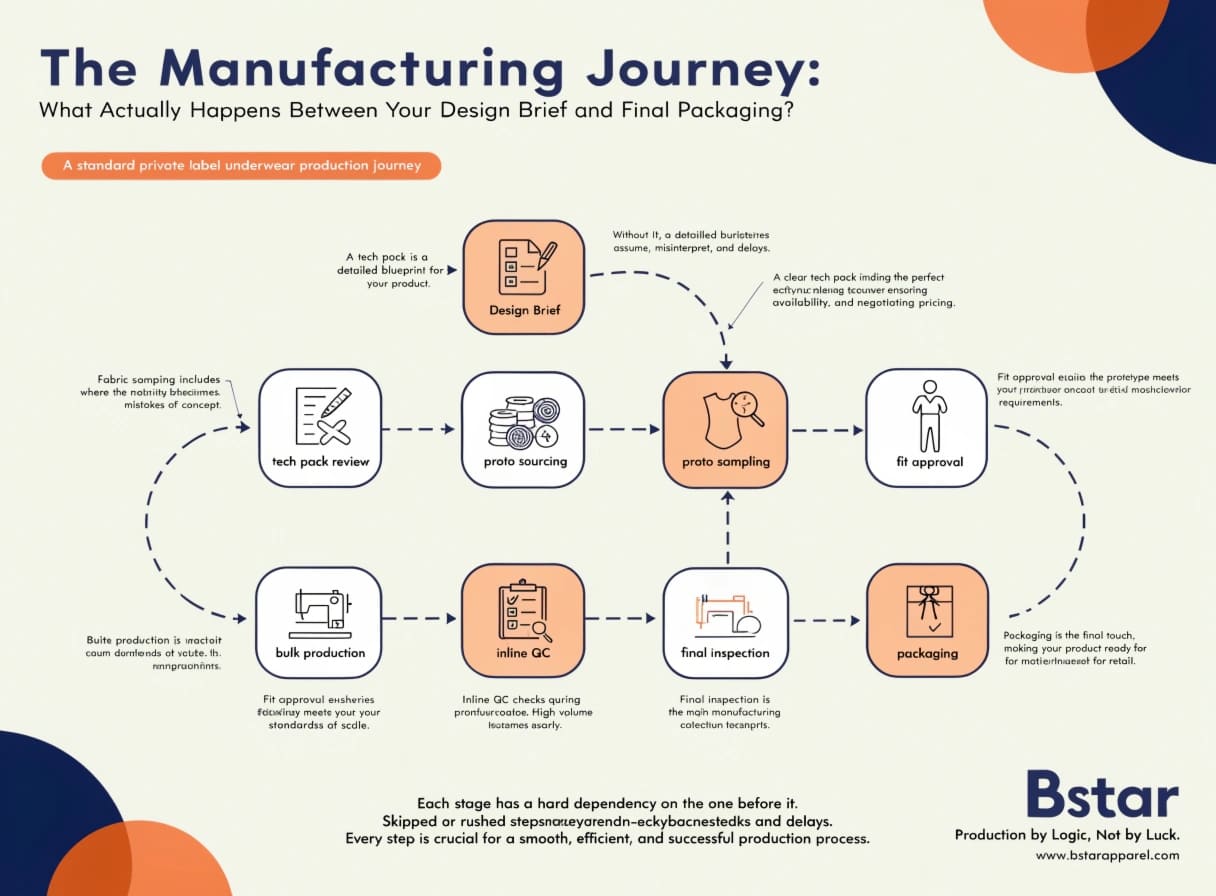
The stage where projects stall most often — in my experience across multiple client types — is proto sampling rejection caused by an incomplete tech pack3. Brands send a reference image and a fabric preference. The factory fills in the gaps with assumptions. The sample comes back wrong. Everyone loses two weeks.
Here’s what a production-ready tech pack for underwear actually needs:
Tech Pack Checklist: What Your Factory Needs Before Sampling
| Component | Why It Matters |
|---|---|
| Flat sketch (front, back, detail) | Eliminates ambiguity in construction |
| Fabric composition + weight (GSM) | Affects hand-feel, stretch, and recovery |
| Size grading table | Prevents inconsistent fit across SKUs |
| Trim and label specs | Necessary for compliance in EU/US markets |
| Stitch type and SPI (stitches per inch) | Controls durability and finish quality |
| Colorway references (Pantone or physical swatch) | Reduces color approval cycles |
When you submit a complete tech pack, a factory that runs proper proto development can return a sample in 7–15 days. When the brief is incomplete, add two to four weeks — minimum. That timeline pressure is what causes brands to approve samples they’re not fully satisfied with. Don’t do it. Hold the standard.
After proto approval, the bulk run should have QC checkpoints built in — not just a final inspection. Ask any factory you’re evaluating how many QC stages they run and at which production points. A factory with a 6-checkpoint system (raw material intake → pre-production → inline → mid-production → pre-shipment → final packaging) manages quality actively4. A factory that only inspects at the end is just sorting problems, not preventing them.
Sourcing Strategies: How Do You Actually Vet a Factory for Quality and Ethical Compliance?
A product page on Alibaba tells you almost nothing useful. So what does good due diligence actually look like?
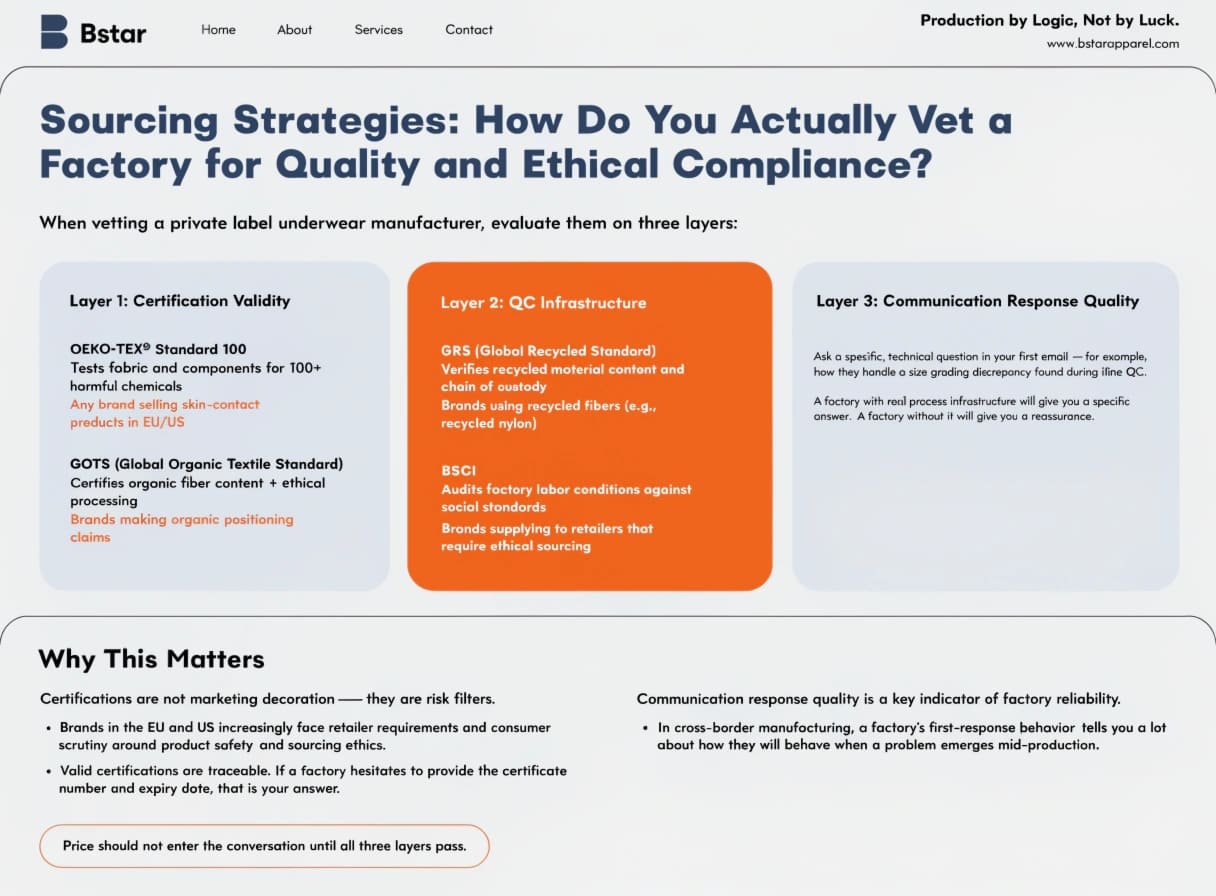
When vetting a private label underwear manufacturer, evaluate them on three layers: certification validity, QC infrastructure, and communication response quality. Price should not enter the conversation until all three pass.
Let’s go through each layer because each one blocks a different category of risk.
Certifications: What They Actually Protect Against
Brands in the EU and US increasingly face retailer requirements and consumer scrutiny around product safety and sourcing ethics5. Certifications are not marketing decoration — they are risk filters.
| Certification | What It Covers | Who Needs It |
|---|---|---|
| [OEKO-TEX® Standard 100 | Tests fabric and components for 100+ harmful chemicals](https://www.oeko-tex.com/en/our-standards/oeko-tex-standard-100/)[^6] | Any brand selling skin-contact products in EU/US |
| [GOTS (Global Organic Textile Standard) | Certifies organic fiber content + ethical processing](https://global-standard.org/certification-and-labelling/certification)[^7] | Brands making organic positioning claims |
| [GRS (Global Recycled Standard) | Verifies recycled material content and chain of custody](https://textileexchange.org/recycled-claim-global-recycled-standard/)[^8] | Brands using recycled fibers (e.g., recycled nylon) |
| [BSCI | Audits factory labor conditions against social standards](https://greenly.earth/en-us/blog/company-guide/bsci-code-of-conduct-approach-implementation-and-audit)[^9] | Brands supplying to retailers that require ethical sourcing |
One common mistake: brands accept a factory’s claim of certification without requesting the certificate number and expiry date. Valid certifications are traceable. If a factory hesitates to provide documentation, that is your answer.
Communication as a Quality Signal
This one sounds soft, but it is not. In cross-border manufacturing, a factory’s first-response behavior tells you a lot about how they will behave when a problem emerges mid-production.
Ask a specific, technical question in your first email — for example, how they handle a size grading discrepancy found during inline QC. A factory with real process infrastructure will give you a specific answer. A factory without it will give you a reassurance.
Scaling Your Brand: How Do You Manage Inventory and Distribution Without Losing Control?
Getting your first order right is one challenge. Building a supply chain that holds up at scale is a different one.
Scaling a private label underwear brand requires aligning your factory’s production lead times with your inventory model — whether that’s pre-order, seasonal batch, or continuous replenishment. Misalignment here is one of the most common causes of stockouts and overstock6.
Early-stage DTC brands often underestimate how much their factory’s minimum order flexibility affects their cash flow. A factory that supports small-batch orders — even down to single-unit sampling — signals that its production setup is built for iterative development, not just bulk fulfillment. That matters when you’re testing a new colorway or a new fit category before committing to a full run.
Here’s how production flexibility maps to common DTC growth stages:
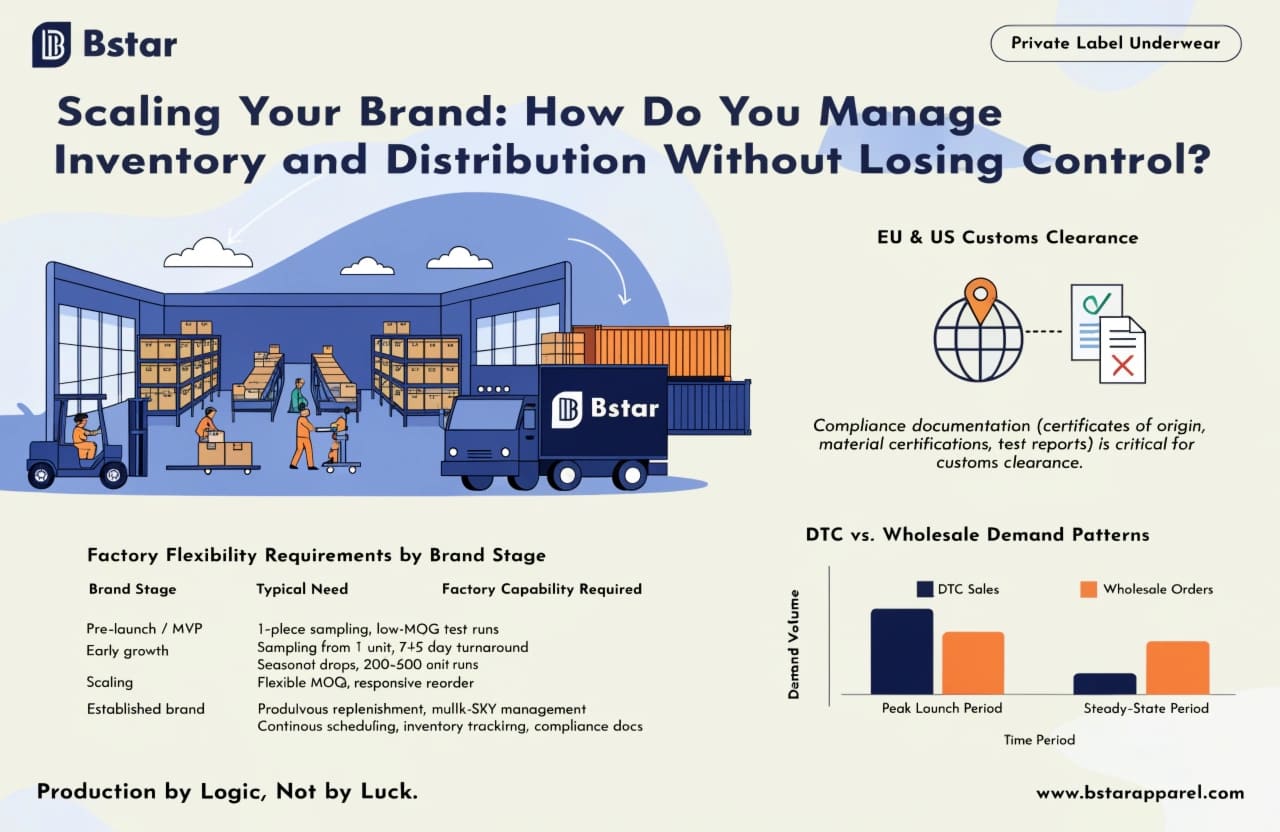
Factory Flexibility Requirements by Brand Stage
| Brand Stage | Typical Need | Factory Capability Required |
|---|---|---|
| Pre-launch / MVP | 1-piece sampling, low-MOQ test runs | Sampling from 1 unit, 7–15 day turnaround |
| Early growth | Seasonal drops, 200–500 unit runs | Flexible MOQ, responsive reorder |
| Scaling | 5,000+ unit runs with consistent quality | AQL-standard QC7, size consistency across batches |
| Established brand | Continuous replenishment, multi-SKU management | Production scheduling, inventory tracking, compliance docs |
For global distribution, the compliance documentation your factory produces — certificates of origin, material certifications, test reports — directly affects customs clearance in the EU and US8. Brands that treat this as an afterthought discover the problem at the port, not at the factory.
One practical step: before committing to bulk, ask your factory for the full documentation set they provide per shipment. Review it against your target market’s import requirements. This takes one day upfront and prevents weeks of delay later.
Conclusion
The right private label underwear manufacturer is one that passes your compliance filter, runs embedded QC, and matches your production scale — not the one with the lowest unit price.
-
"OEM vs ODM vs Private Label Cosmetics: Key Differences Explained", https://arisecosmetic.com/oem-vs-odm-vs-private-label-cosmetics/. Research on private label strategy distinguishes between design-owning and design-licensing arrangements, noting that brand-controlled specifications reduce the risk of product commoditization common in white-label sourcing (see literature on private label brand equity and manufacturer relationships). Evidence role: general_support; source type: paper. Supports: That OEM arrangements, where the brand owns the design, confer greater product differentiation compared to ODM white-label sourcing. Scope note: Direct empirical studies comparing OEM and ODM differentiation outcomes specifically in the DTC apparel sector are limited; general private label research provides contextual rather than direct support. ↩
-
"Price-Directed Search, Product Differentiation and Competition – PMC", https://pmc.ncbi.nlm.nih.gov/articles/PMC10541849/. Porter’s framework of competitive strategy identifies product differentiation as a primary mechanism for avoiding price-based rivalry; firms offering functionally identical products are predicted to compete predominantly on price, compressing margins over time (Porter, M.E., Competitive Strategy, 1980). Evidence role: mechanism; source type: education. Supports: That undifferentiated products competing in the same market converge toward price-based competition, eroding margins. Scope note: Porter’s framework is general and not specific to private label apparel or ODM sourcing arrangements. ↩
-
"Slow Fit Samples: Understanding the Development Process – LinkedIn", https://www.linkedin.com/posts/noelia-gonda-7417738a_why-does-the-development-fit-sample-take-activity-7424930611733381120-5cdx. Literature on apparel product development identifies specification ambiguity and incomplete technical documentation as significant contributors to iterative sampling cycles and extended time-to-market, with each revision round adding weeks to the development schedule (see research on fashion supply chain lead time and product development process efficiency). Evidence role: general_support; source type: paper. Supports: That incomplete or ambiguous technical specifications in apparel development are a leading cause of sample rejection and extended development timelines. Scope note: Peer-reviewed studies quantifying the specific impact of tech pack completeness on sampling rejection rates in underwear manufacturing are not widely published; this support is drawn from broader apparel product development literature. ↩
-
"[PDF] REPORT ON THE USE OF IN-LINE INSPECTION TOOLS … – PHMSA", https://www.phmsa.dot.gov/sites/phmsa.dot.gov/files/docs/technical-resources/pipeline/hazardous-liquid-integrity-management/64411/genphysicsreportonilidtrs56-96-c-0002-008.pdf. Quality management literature, including foundational work in Total Quality Management (TQM) and Statistical Process Control (SPC), establishes that defect detection at the point of origin in a production process is significantly less costly and more effective than end-of-line inspection, which can only sort defective output rather than prevent its creation (Juran, J.M., Quality Control Handbook; Deming, W.E., Out of the Crisis). Evidence role: expert_consensus; source type: paper. Supports: That multi-stage inline quality control systems reduce defect rates more effectively than single-point final inspection by enabling earlier detection and correction. Scope note: The specific six-checkpoint structure described in the article is the author’s operational framework; the cited literature supports the general principle of inline versus final inspection superiority rather than validating this specific checkpoint configuration. ↩
-
"OpenText Survey Shows Increase in Demand for Ethically Sourced …", https://scm.ncsu.edu/ethical-apparel/news/article/opentext-survey-shows-increase-in-demand-for-ethically-sourced-goods/. The EU Corporate Sustainability Due Diligence Directive (CS3D) and the existing EU Textile Labelling Regulation, alongside U.S. import restrictions under the Uyghur Forced Labor Prevention Act (UFLPA, 2021), reflect a legislative trend toward mandatory supply chain transparency and ethical sourcing compliance for apparel brands operating in these markets. Evidence role: historical_context; source type: government. Supports: That regulatory and retailer-driven requirements for ethical sourcing and product safety compliance in apparel have increased in EU and US markets. Scope note: The article’s reference to ‘consumer scrutiny’ is a broader cultural claim; the cited regulatory instruments support the compliance pressure dimension but do not directly quantify consumer sentiment trends. ↩
-
"Cost of Stockouts vs Overstock: Impact on Profitability – ToolsGroup", https://www.toolsgroup.com/blog/cost-of-stockouts-vs-overstock/. Supply chain management literature identifies lead time variability and demand-supply misalignment as primary drivers of inventory imbalance, with stockouts and excess inventory representing the two principal failure modes of inadequate lead time integration into replenishment planning (see Chopra & Meindl, Supply Chain Management: Strategy, Planning, and Operation; and academic literature on bullwhip effect and inventory buffering). Evidence role: mechanism; source type: paper. Supports: That misalignment between supplier lead times and demand-driven inventory planning is a significant contributor to both stockout and overstock outcomes. Scope note: Empirical studies quantifying this effect specifically for DTC apparel brands are limited; the support is drawn from general supply chain management theory. ↩
-
"[PDF] ISO 2859-1 – UNT Chemistry Department", https://chemistry.unt.edu/~tgolden/courses/iso2859-1.pdf. Acceptable Quality Limit (AQL) sampling is defined under ISO 2859-1 (Sampling procedures for inspection by attributes), which specifies the maximum number of defective units in a sample beyond which a production lot is rejected; it is widely adopted in apparel and textile manufacturing as the basis for pre-shipment inspection protocols. Evidence role: definition; source type: institution. Supports: That AQL refers to a standardized statistical sampling methodology used to determine acceptable defect rates in manufactured goods inspections. ↩
-
"Special Documents – International Trade Administration", https://www.trade.gov/special-documents. Both U.S. Customs and Border Protection (CBP) and the European Union’s Union Customs Code require importers of textile and apparel goods to provide certificates of origin and, where applicable, material composition documentation to determine tariff classification, rules-of-origin compliance, and admissibility under applicable trade agreements (CBP, Importing into the United States; European Commission, Union Customs Code). Evidence role: mechanism; source type: government. Supports: That textile and apparel imports into the EU and US require specific documentation including certificates of origin and material certifications for customs clearance. Scope note: Specific documentation requirements vary by product category, country of origin, and applicable trade agreement; the article’s general characterization is accurate but individual importers should verify requirements for their specific circumstances. ↩
Discussion & questions 0 comments