
Are Antibacterial and Antimicrobial Fabrics Worth the Investment for Your Underwear Line?
Brands add "antimicrobial" to their underwear claims every day. But most don’t ask the one question that actually matters before they commit to a fabric.
Antimicrobial underwear fabrics use active agents — such as silver ions, copper, or plant-based treatments — to reduce odor-causing bacteria on the skin. The key performance factor is not which agent you choose, but how well it holds up after repeated washing. Without wash-cycle durability data, any antimicrobial claim is a guess.
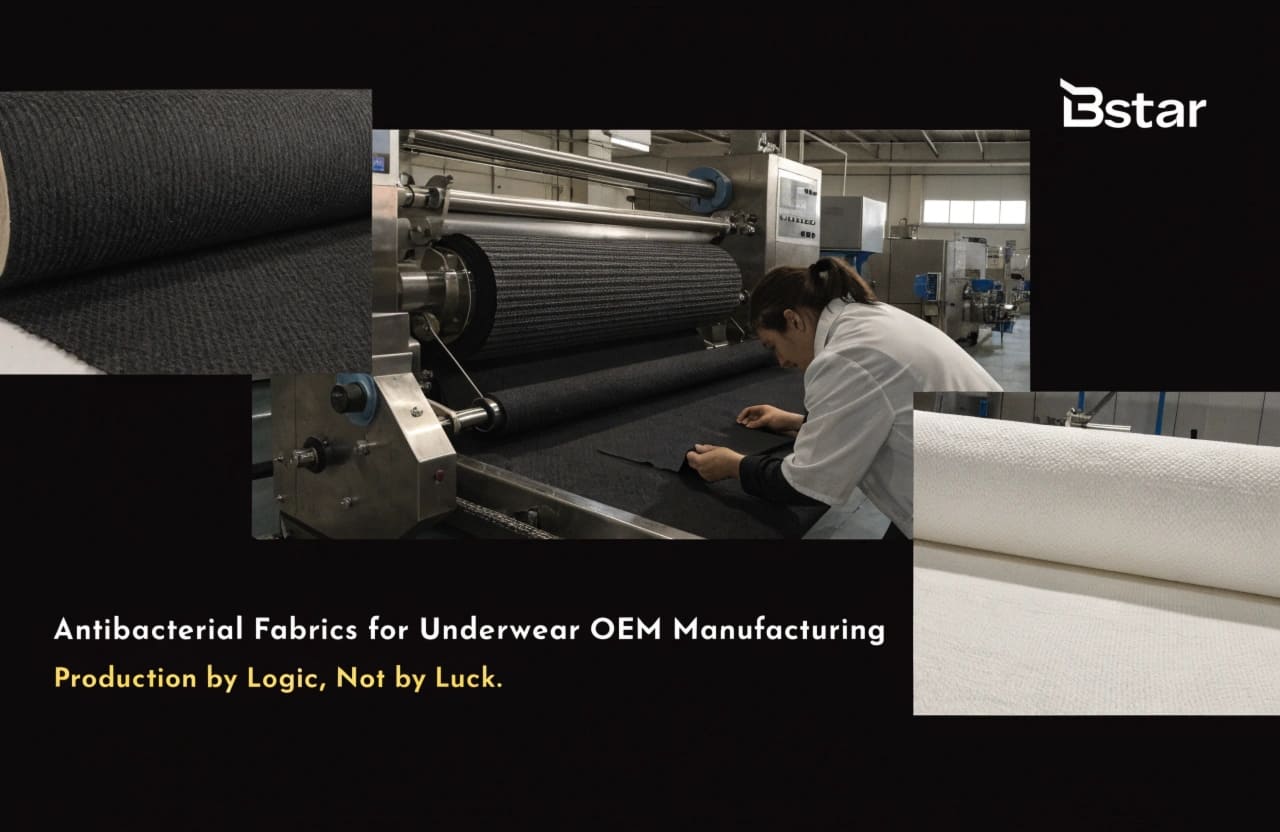
We work with DTC underwear brands from Europe and North America every week. The most common mistake we see is treating antimicrobial fabric as a single category. A brand will come to us and say, "We want antimicrobial." That’s where the conversation needs to start — not end. The active agent type, the application method, the wash durability, and the end-use context all point to completely different answers. This article breaks down each of those variables so you can ask the right questions before you commit.
What’s Actually in Your Fabric — And Does the Difference Matter?
Most sourcing conversations skip the mechanism entirely. Buyers ask for "antimicrobial fabric" the same way they’d ask for a color or a GSM. But in our experience, this is exactly where brands set themselves up for problems later.
Silver ions, copper fibers, bamboo charcoal, and synthetic chemical finishes all target bacteria differently. They vary in how broad their activity is, how safe they are for intimate skin contact, how well they survive washing, and what certifications they can and cannot pass. Choosing one without knowing these differences is the most common early mistake we see in production consultations.
Let me walk through what we actually see in sampling discussions.
Breaking Down the Main Agent Types
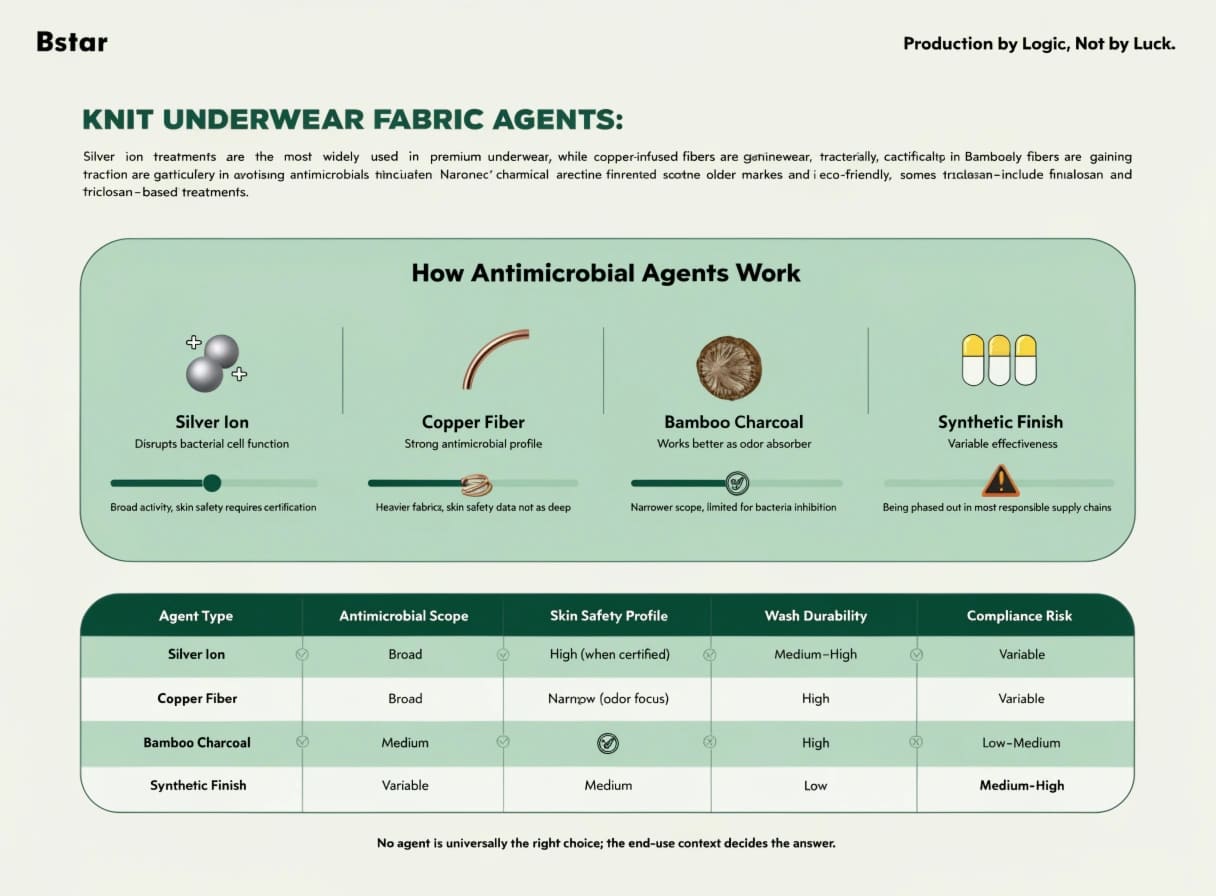
Silver ion treatments are the most widely used in premium underwear. They work by disrupting bacterial cell function. They have a broad activity range and they perform reasonably well on sensitive skin when properly embedded. The trade-off is cost and compliance: silver ion fabrics need to pass a higher bar for skin safety documentation, especially in the EU market.
Copper-infused fibers are gaining traction, particularly in activewear. Copper has a strong antimicrobial profile and some brands position it as more "natural." But copper fabrics can be heavier, and the skin safety data for long-duration intimate contact is not as deep as it is for silver.
Bamboo charcoal and bio-based fibers are often marketed as eco-friendly antimicrobials. In practice, their antimicrobial activity is more limited in scope. They work better as odor absorbers than bacterial inhibitors. This isn’t a dealbreaker, but if your brand claim is specifically about bacteria reduction, you need to verify what the fabric can actually prove.
Synthetic chemical finishes — including some older triclosan-based treatments — are being phased out in most responsible supply chains. Regulatory exposure in the EU and North America is significant. If a supplier is offering you a "cost-effective antimicrobial finish" without naming the agent, this is worth investigating before you proceed.
| Agent Type | Antimicrobial Scope | Skin Safety Profile | Wash Durability | Compliance Risk |
|---|---|---|---|---|
| Silver Ion | Broad | High (when certified) | Medium–High | Low–Medium |
| Copper Fiber | Broad | Medium | High | Low |
| Bamboo Charcoal | Narrow (odor focus) | High | Medium | Low |
| Synthetic Finish | Variable | Variable | Low–Medium | Medium–High |
No agent is universally the right choice. Your end-use context decides the answer.
How Many Washes Before the Claim Falls Apart?
This is the question most brands don’t ask. And it’s the one that matters most.
A fabric can test as highly antimicrobial before its first wash and lose most of that function by wash 20 or 30. The active agent type and how it was applied — surface coating versus embedded into the fiber — directly determine how long the function lasts. If your supplier can’t show you wash-cycle durability data, that’s a red flag.
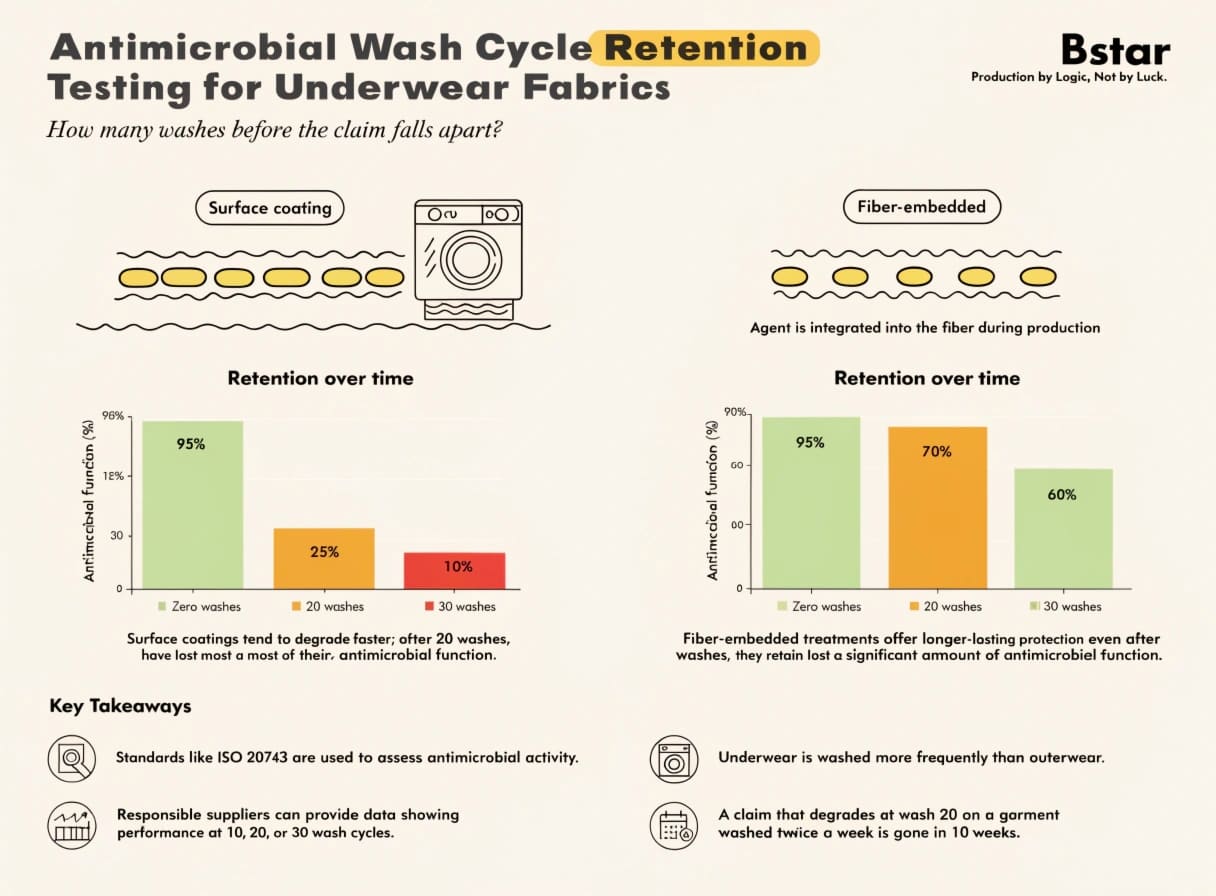
In our sampling process, we always ask for durability test results — specifically results measured after laundering, not just at zero washes. Standards like ISO 20743 are used to assess antimicrobial activity, and responsible suppliers can provide data showing performance at 10, 20, or 30 wash cycles. If a supplier only gives you the initial test result, you’re looking at best-case data, not real-use data.
Surface Coating vs. Fiber-Embedded Agents
The application method is the key variable here.
Surface-coated treatments apply the active agent to the outside of the fabric after knitting or weaving. They’re cheaper and faster to produce. They also wash out faster. In our experience, surface coatings start to degrade noticeably after 15–20 wash cycles, though this varies by agent and coating method.
Fiber-embedded or yarn-level treatments integrate the active agent into the fiber during production. This increases durability significantly. The agent isn’t sitting on the surface waiting to be washed off — it’s part of the fiber structure. The trade-off is cost. Yarn-level antimicrobial treatment costs more per kilogram, and not every mill offers it for every fiber type.
For underwear specifically, fiber-embedded is almost always the better choice. Underwear is washed more frequently than outerwear. A claim that degrades at wash 20 on a garment washed twice a week is gone in 10 weeks. That’s a customer complaint waiting to happen.
What to Ask Your Supplier
- Can you provide ISO 20743 or equivalent results after 20+ wash cycles?
- Is the treatment surface-applied or fiber-embedded?
- What is the recommended wash temperature range to preserve function?
- Has this fabric passed any third-party durability testing?
If a supplier hesitates on these questions, take that seriously.
Is Your Antimicrobial Fabric Safe for Everyday Underwear — Not Just Activewear?
Sportswear and everyday underwear are not the same regulatory or skin-contact context. What works for a gym legging doesn’t automatically qualify for daily intimate wear.
Underwear sits against sensitive skin areas for 8–16 hours a day. This means the bar for biocompatibility and skin safety is higher than it is for performance activewear. A fabric that carries an antimicrobial claim without specific intimate-apparel safety documentation may not meet retailer or regulatory requirements in your target market.
We see this come up often when a brand is moving from activewear into underwear. They’ve used an antimicrobial finish on their leggings and want to carry it over. The finish may be fine. But the documentation path is different, and the skin contact duration is different.
What Certifications Actually Tell You
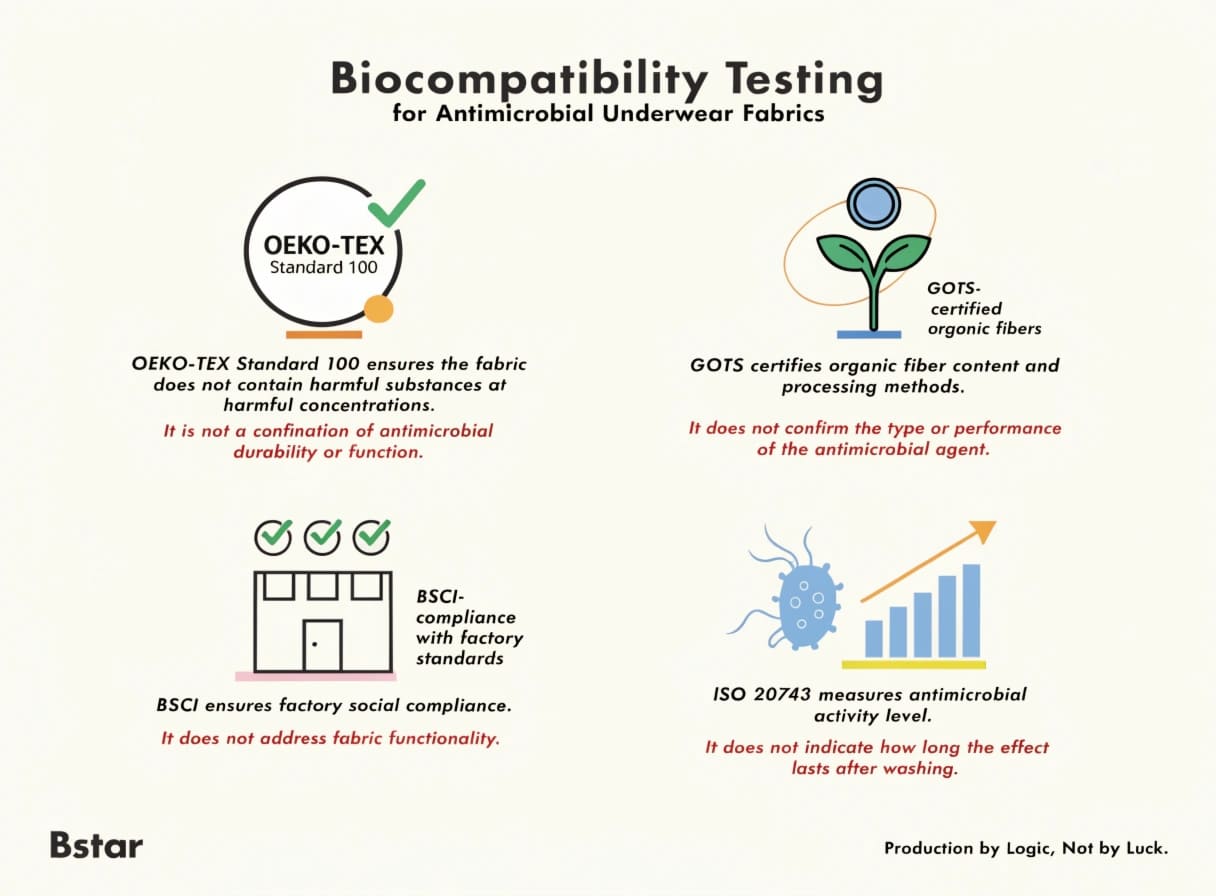
OEKO-TEX Standard 100 is the baseline. It confirms the fabric doesn’t contain harmful substances at harmful concentrations. It’s a safety floor, not a performance claim. A fabric with OEKO-TEX certification is confirmed to be non-harmful. It is not confirmed to have durable antimicrobial function.
This is a distinction that matters. Many buyers treat OEKO-TEX as a full endorsement of the antimicrobial claim. It isn’t. The certification answers a different question.
For brands targeting EU or North American retailers, here’s what the certification stack typically looks like for responsible antimicrobial underwear:
| Certification | What It Confirms | What It Does Not Confirm |
|---|---|---|
| OEKO-TEX Standard 100 | No harmful substances | Antimicrobial durability or function |
| GOTS | Organic fiber content and processing | Antimicrobial agent type or performance |
| BSCI | Factory social compliance | Fabric functionality |
| ISO 20743 Test Result | Antimicrobial activity level | How long it lasts after washing |
Certifications filter out bad actors. They don’t replace the sourcing questions you need to ask about the specific function you’re claiming.
Can Antimicrobial Fabric Also Be Your Sustainability Story?
Eco-friendly and antimicrobial are not opposites. In fact, in the current DTC market, pairing them is a strong brand position — but only if both claims hold up.
Bio-based antimicrobial agents and recycled fiber platforms with embedded treatments allow brands to combine odor-control performance with sustainability credentials. This combination addresses two growing consumer priorities at once and can justify a premium price point, provided the functional claims are backed by verifiable data.
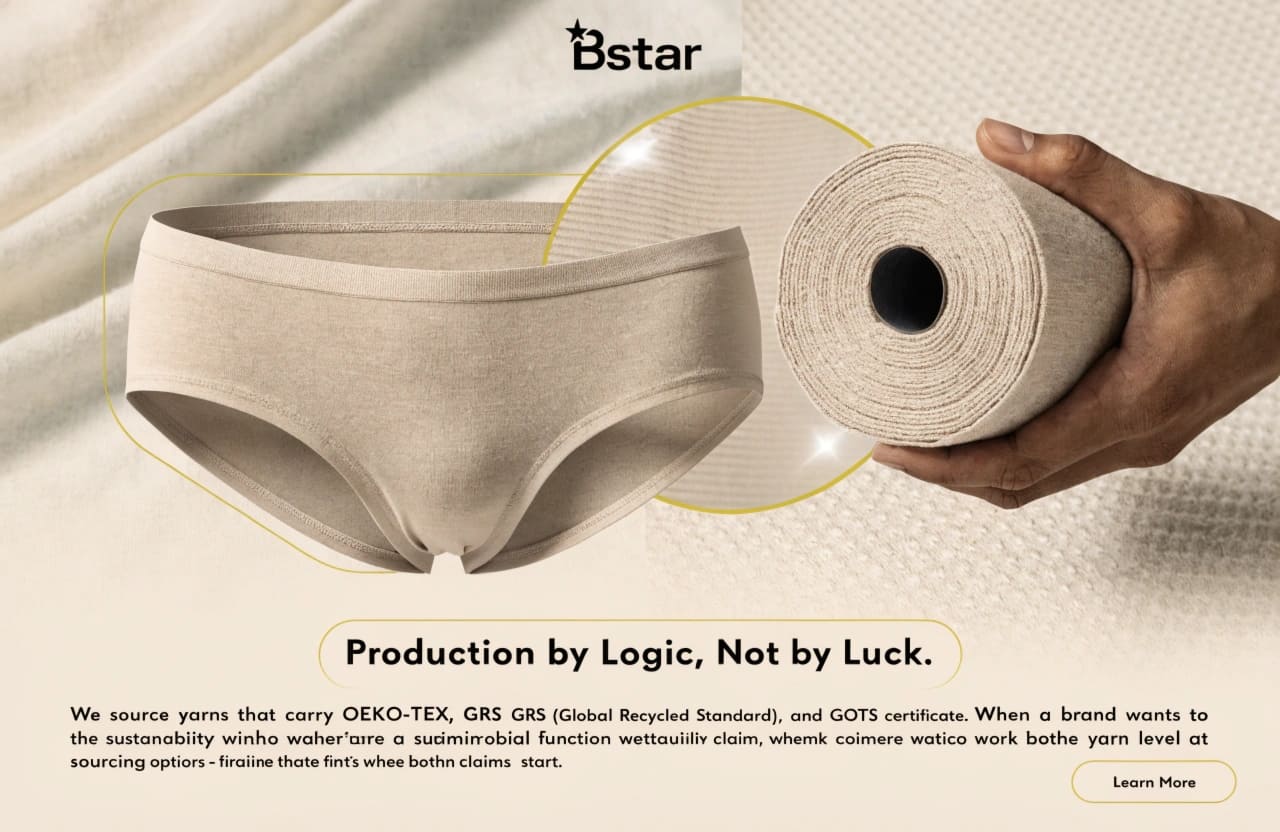
At BSTAR, we source yarns that carry OEKO-TEX, GRS (Global Recycled Standard), and GOTS certification. When a brand wants to combine an antimicrobial function with a sustainability claim, we work through the sourcing options at the yarn level first — because that’s where both claims start. A recycled polyester yarn with a surface antimicrobial coating is a different product, with different durability and a different certification story, than an organic cotton yarn with a fiber-embedded bio-based treatment.
Where the Market is Moving
The DTC brands we work with in Europe and North America are increasingly treating antimicrobial function as a baseline expectation rather than a premium differentiator. The brands that stand out are the ones pairing it with a clear, verifiable sustainability claim — and backing both with documentation their customers can actually read.
If your antimicrobial claim is going to show up on a product page, a retailer spec sheet, or a sustainability report, it needs to be supported by wash-cycle data, an appropriate certification, and a clearly named active agent. "Antimicrobial fabric" without those three things is marketing copy, not a product claim.
Conclusion
Antimicrobial underwear fabric is a real functional category — but only if you choose the right agent, verify wash durability, and match your documentation to your end-use context. Ask the specific questions before you sample.