Custom Packaging Solutions for Underwear Brands: Boxes, Bags, and Tags?
Packaging feels like the last thing to figure out. Then your first shipment arrives, and the unboxing looks nothing like your brand. That moment is expensive.
For DTC underwear brands, packaging is not decoration. It is the first physical signal your customer receives. The right combination of boxes, bags, and tags reinforces your positioning. The wrong combination signals cheap before they even touch the product.
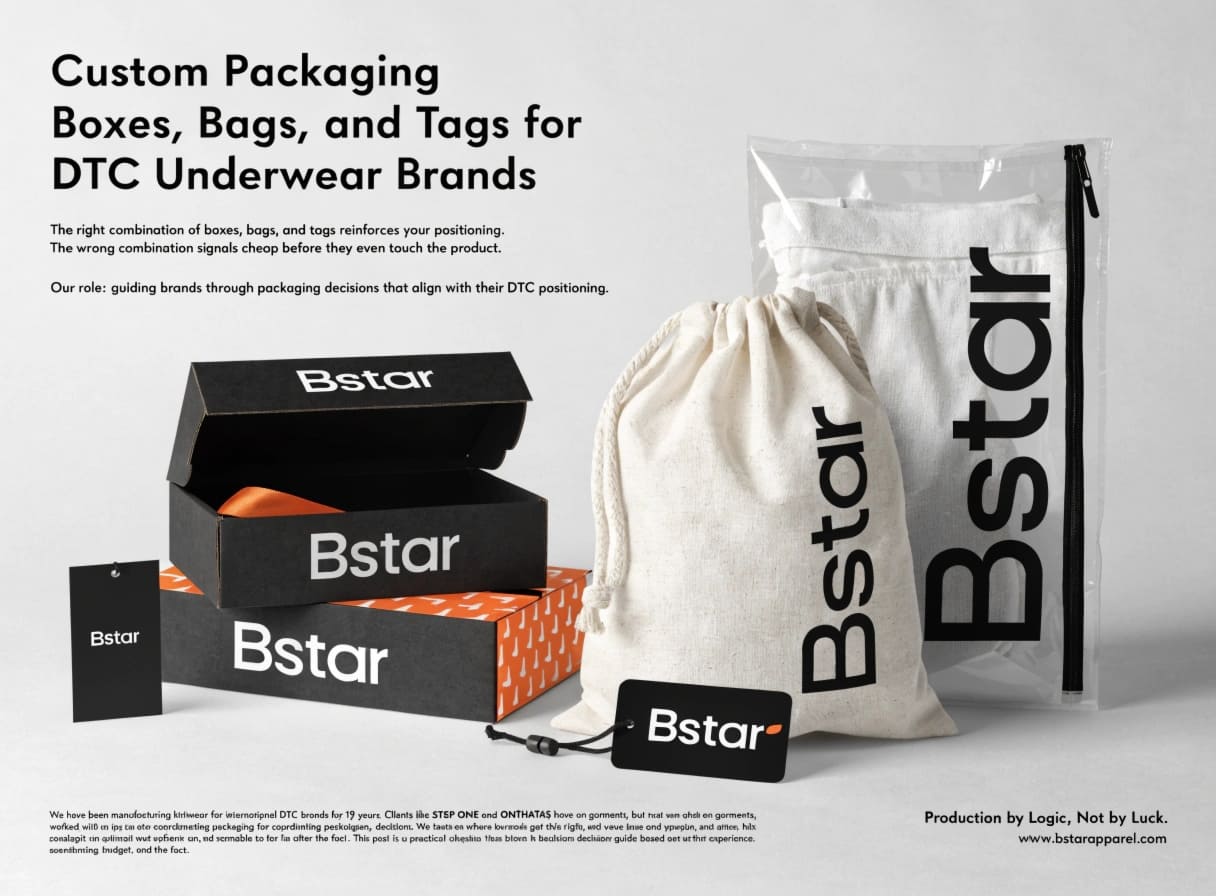
We have been manufacturing knitwear for international DTC brands for 19 years. Clients like STEP ONE and ONTHATASS have worked with us not just on garments, but on coordinating packaging decisions alongside production. We have seen where brands get this right, and we have seen where they waste sampling budget, miss their positioning, and scramble to fix it after the fact. This post is a practical decision guide based on that experience.
The Unboxing Experience: Does Premium Packaging Actually Move the Needle?
You spent money acquiring that customer. They open the package. And the first thing they see is a generic poly bag inside a plain box. Is that the brand you built?
Premium boxes and structured gift sets signal value before the product is seen. For mid-to-premium DTC underwear brands, the unboxing moment is the first retention touchpoint1. Brands that under-invest here often see the gap show up in repeat purchase behavior and in whether customers share the experience online2.
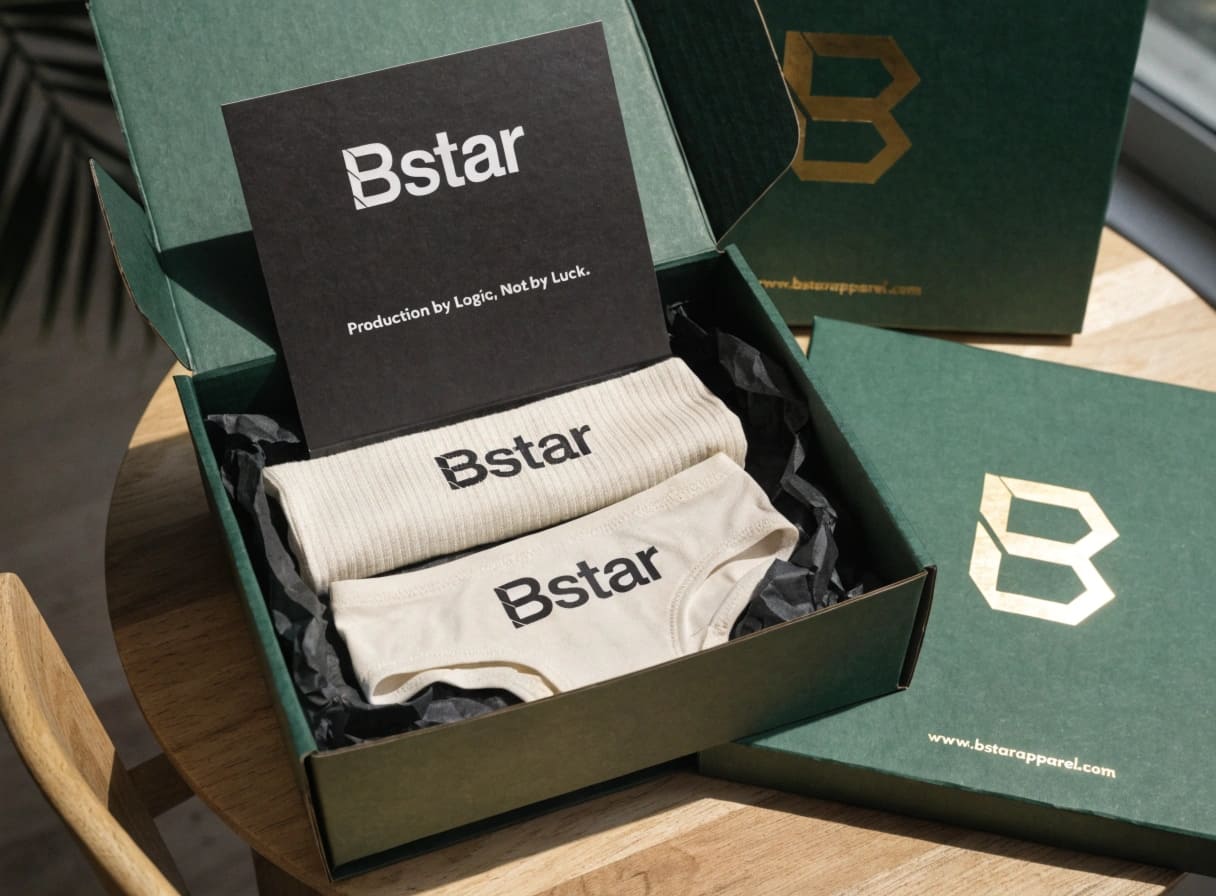
We are not a packaging design studio. But we coordinate packaging alongside garment production for our clients, and we have watched the same pattern repeat. A brand builds a strong product and a strong brand identity online, then ships it in packaging that reads as a discount item. The customer’s expectation meets a different reality. That gap is not abstract. It shows up in how customers talk about the brand, and in whether they come back.
What actually drives the decision to use a box?
The question is not whether a box looks good. The question is whether your channel, price point, and customer behavior justify it.
| Scenario | Box Makes Sense | Box May Be Overkill |
|---|---|---|
| Gift-focused SKUs (e.g., holiday sets) | Yes | — |
| Mid-to-premium DTC, $30+ per unit | Yes | — |
| Wholesale or retail shelf display | Yes | — |
| Budget DTC, high-volume fulfillment | — | Yes |
| Subscription boxes (brand controls outer) | — | Possibly |
A rigid gift box with tissue paper and a branded insert card works for a premium two-piece set. It does not make sense for a basic five-pack sold at a mid-tier price point. The format should follow the channel and the price signal you want to send, not just what looks impressive in a mockup.
One thing we flag to clients early: boxes require their own lead time, their own MOQ, and their own artwork approval cycle. If you treat the box as a last-minute add-on after garments are already in production, you will either delay shipment or end up with off-spec packaging. Plan it as a parallel workstream from the start.
Functional & Eco-Friendly Bags: Are Poly Bags Still the Right Choice?
Poly bags are the default. Most brands use them without asking whether they should. But your customer notices, and so does the platform you sell on.
Poly bags, pouches, and totes each serve a different function. The right choice depends on your fulfillment model, your sustainability commitments, and what the bag signals to your customer when they receive it. A recycled matte poly bag reads differently than a standard clear one, even at the same cost tier.
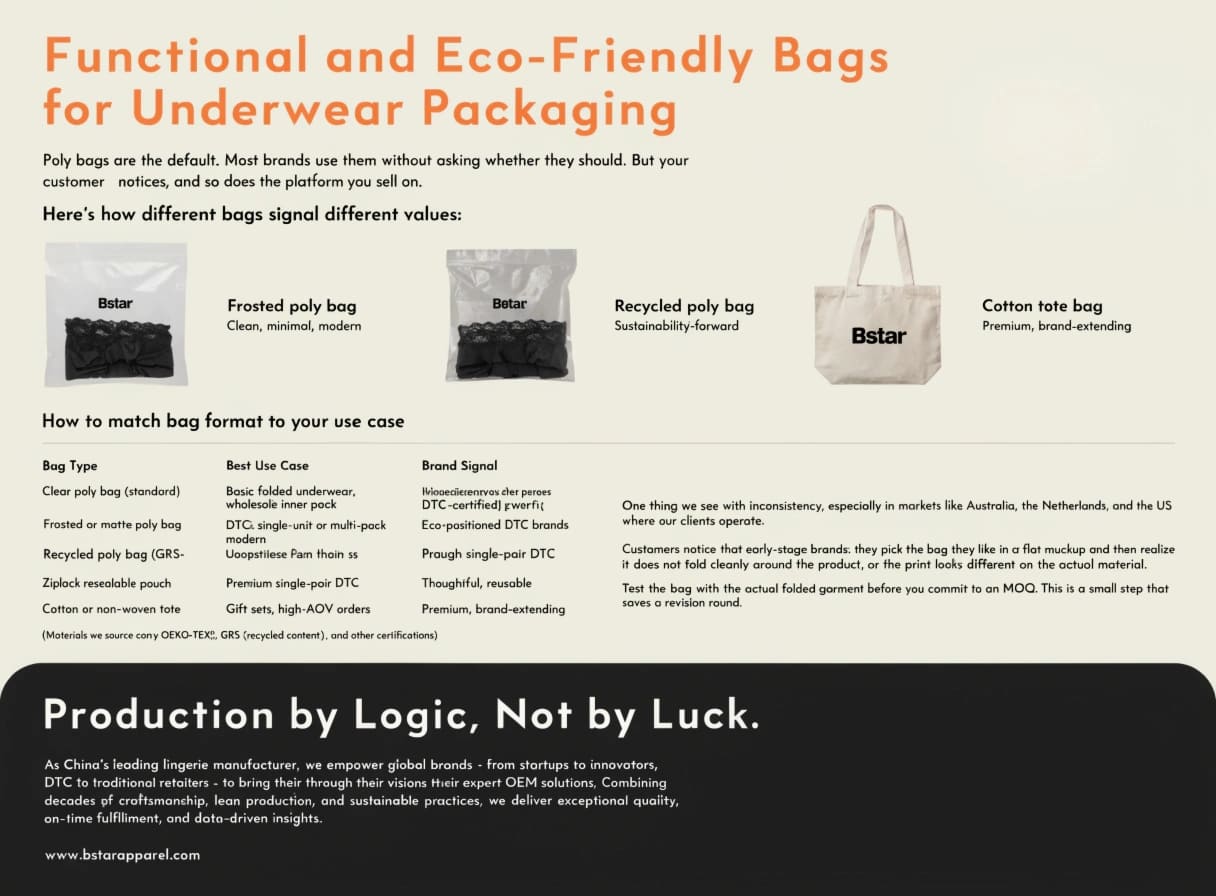
We source materials for our clients that carry OEKO-TEX®3, GRS (recycled content), and other certifications. The same logic applies to packaging. If your garment is made from sustainable materials and your packaging is a standard virgin plastic bag, there is a credibility gap. Customers notice that inconsistency, especially in markets like Australia, the Netherlands, and the US4 where our clients operate.
How to match bag format to your use case
The functional question is simple: what does this bag need to do?
| Bag Type | Best Use Case | Brand Signal |
|---|---|---|
| Clear poly bag (standard) | Basic folded underwear, wholesale inner pack | Functional, no brand impression |
| Frosted or matte poly bag | DTC single-unit or multi-pack | Clean, minimal, modern |
| Recycled poly bag (GRS-certified) | Eco-positioned DTC brands | Sustainability-forward |
| Ziplock resealable pouch | Premium single-pair DTC | Thoughtful, reusable |
| Cotton or non-woven tote | Gift sets, high-AOV orders | Premium, brand-extending |
One thing we see with early-stage brands: they pick the bag they like in a flat mockup and then realize it does not fold cleanly around the product, or the print looks different on the actual material. Test the bag with the actual folded garment before you commit to an MOQ. This is a small step that saves a revision round.
The Power of Tags: Are Your Hang Tags and Labels Doing Enough Work?
A hang tag is often the only physical brand touchpoint in a wholesale or retail environment. Most brands treat it like a price sticker. That is a missed opportunity.
Custom hang tags and care labels carry brand story, compliance information, and positioning signals all at once. For DTC brands moving into wholesale or retail, the tag is frequently the first thing a buyer or a customer reads. What it says, and how it looks, shapes perception before the product is even tried on.
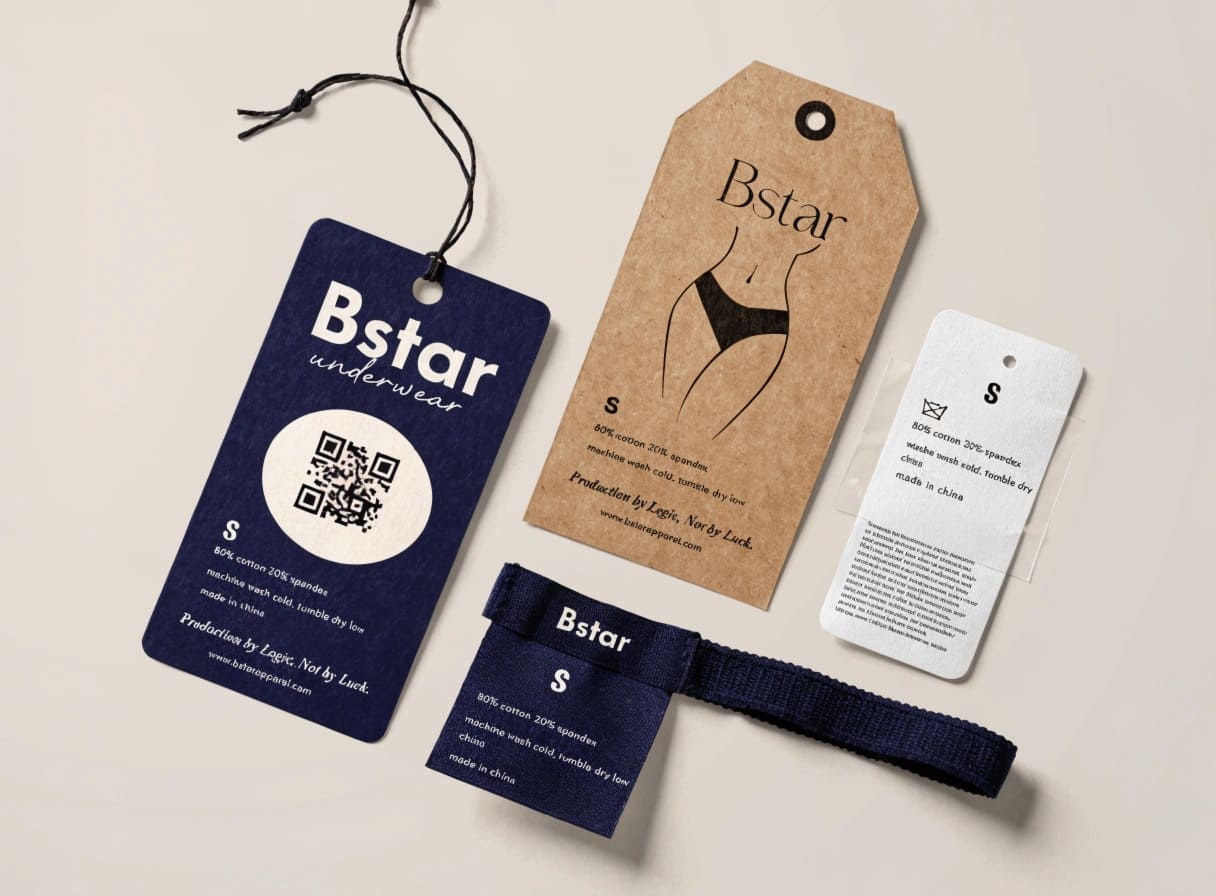
We produce garments with custom woven labels, printed care labels, and coordinated hang tags for our clients. We have seen brands invest heavily in fabric and construction, then use a template-printed hang tag that reads as generic. The disconnect is visible. It signals that the brand has not thought through the full product experience.
What your tags need to cover, and what they can do beyond compliance
Care labels are required. They carry fiber content, washing instructions, and country of origin.5 That is the floor. But hang tags have more room to work.
| Tag Element | Required | Optional But Valuable |
|---|---|---|
| Fiber content and composition | Yes | — |
| Country of origin | Yes | — |
| Care instructions | Yes | — |
| Brand name and logo | No | Yes — always do this |
| QR code (size guide, brand story, reorder)6 | No | High ROI for DTC |
| Sustainability messaging (cert logos) | No | Yes, if certified |
| Founder note or brand story | No | Strong for early-stage DTC |
The material of the tag sends a signal too. A kraft paper hang tag with soy-based ink reads differently than a glossy coated card7. Match the tag material to the overall brand language. If you are going for a clean, premium look, do not undercut it with an inconsistent tag.
Sustainable Packaging Trends: Is Your Packaging Aligned with Where the Market Is Going?
Sustainability is no longer a differentiator for premium brands. It is an expectation. Brands that have not addressed it yet are already behind in certain markets.
Eco-conscious packaging materials — recycled poly, FSC-certified paper, biodegradable mailers — are now baseline requirements for mid-to-premium DTC brands selling in Europe, Australia, and North America. Failing to align creates friction with buyers, retail partners, and environmentally aware consumers.
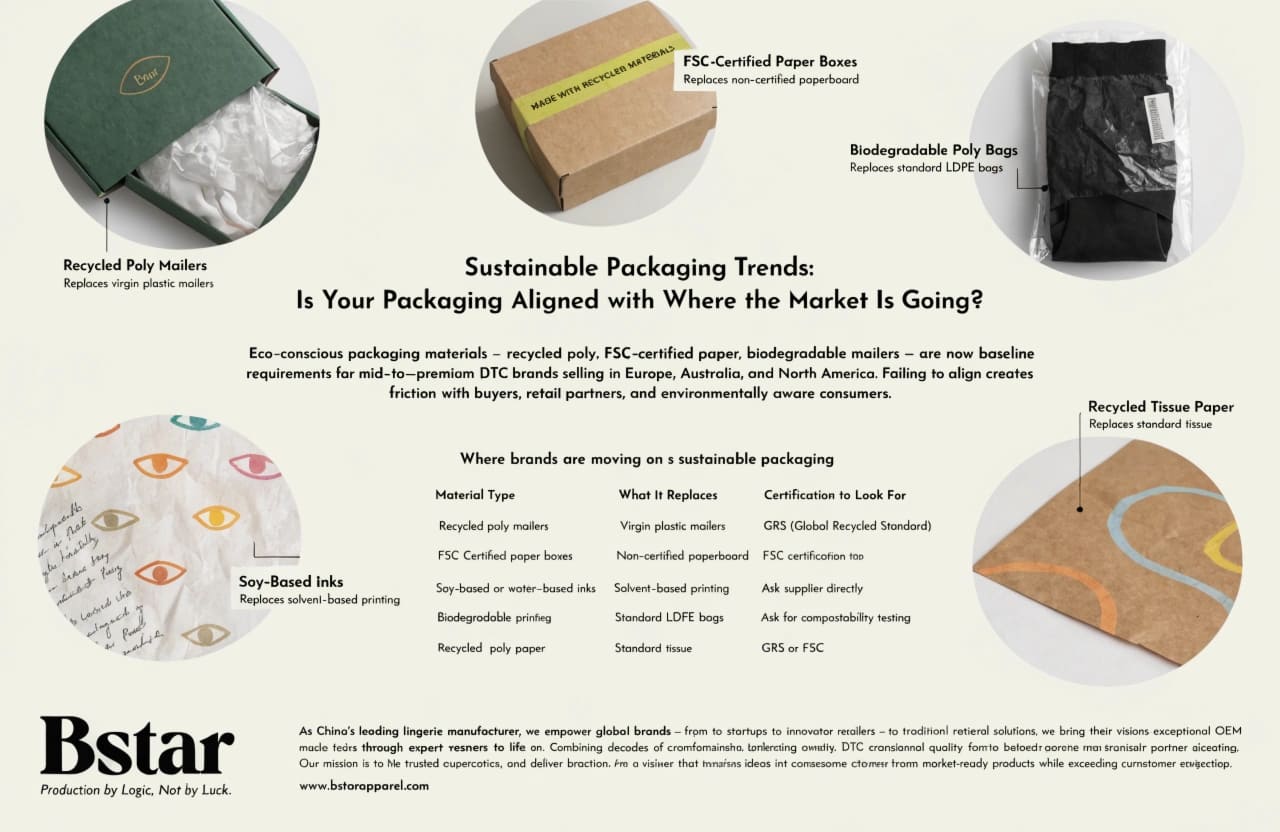
We hold BSCI certification, and our material suppliers carry FSC, OEKO-TEX®, GOTS, and GRS certifications. We bring the same expectation to packaging coordination. When a client’s garment is certified sustainable and their packaging is not, we flag that as a brand risk, not just an environmental one.
Where brands are moving on sustainable packaging
| Material Type | What It Replaces | Certification to Look For |
|---|---|---|
| Recycled poly mailers | Virgin plastic mailers | GRS (Global Recycled Standard)8 |
| FSC-certified paper boxes9 | Non-certified paperboard | FSC certification |
| Soy-based or water-based inks | Solvent-based printing | Ask supplier directly |
| Biodegradable poly bags10 | Standard LDPE bags | Ask for compostability testing |
| Recycled tissue paper | Standard tissue | GRS or FSC |
The practical challenge for early-stage brands is MOQ. Sustainable materials often carry higher minimum order quantities and longer lead times11. This is why packaging planning needs to happen early in your production timeline, not at the end. We work with clients to build packaging lead times into the overall production schedule so these decisions do not create delays.
One thing we tell brands consistently: do not claim sustainability on packaging you have not verified. Greenwashing complaints are real, and buyers in the EU and Australia are increasingly asking for documentation12. If you say your packaging is recycled, have the cert to back it up.
Conclusion
Packaging is a brand decision, not a last-minute logistics task. Match your format to your channel, plan the lead times in parallel with production, and make sure every element reads as one consistent brand.
-
"Optimizing brand loyalty through user-centric product package design", https://pmc.ncbi.nlm.nih.gov/articles/PMC10862676/. Research on post-purchase customer experience in e-commerce has identified packaging and unboxing as a component of the ‘last mile’ brand interaction that shapes satisfaction and repurchase intent, though effect sizes vary by product category and price tier. Evidence role: mechanism; source type: paper. Supports: That the physical unboxing experience influences post-purchase satisfaction and downstream retention metrics for direct-to-consumer brands.. Scope note: Most published studies examine general e-commerce packaging rather than apparel or underwear specifically; direct causal links to repeat purchase rates require category-specific data. ↩
-
"Research on the impact of User-Generated Content (UGC) in … – PMC", https://pmc.ncbi.nlm.nih.gov/articles/PMC12637987/. Studies of unboxing content on platforms such as YouTube have documented that packaging presentation — including structural design, materials, and branded inserts — is a primary driver of consumer decisions to record and share the opening experience. Evidence role: statistic; source type: research. Supports: That packaging aesthetics and perceived premium quality are motivators for consumers to create and share unboxing content on social platforms.. Scope note: Available data tends to aggregate across product categories; apparel-specific sharing rates attributable solely to packaging are not consistently isolated in the literature. ↩
-
"OEKO-TEX® STANDARD 100", https://www.oeko-tex.com/en/our-standards/oeko-tex-standard-100/. OEKO-TEX® is a certification system administered by the International OEKO-TEX Association; its STANDARD 100 label certifies that every component of a textile article has been tested for harmful substances and found harmless, while the STeP by OEKO-TEX certification addresses sustainable and socially responsible manufacturing processes at the facility level. Evidence role: definition; source type: institution. Supports: That OEKO-TEX® is an internationally recognized certification system for textiles and related materials, with specific standards addressing harmful substance limits and sustainable production practices.. Scope note: OEKO-TEX® STANDARD 100 applies primarily to textile components rather than packaging materials such as poly bags or paper boxes; applicability to packaging substrates depends on which standard within the OEKO-TEX® family is referenced. ↩
-
"Sustainable Paper-Based Packaging: A Consumer’s Perspective", https://pmc.ncbi.nlm.nih.gov/articles/PMC8151435/. Cross-market consumer surveys conducted by organizations such as Nielsen and the European Environment Agency have found elevated consumer concern for sustainable packaging in Northern European, Australian, and North American markets, with respondents in these regions more likely to report purchasing decisions influenced by packaging environmental claims. Evidence role: statistic; source type: institution. Supports: That consumers in Western European, Australian, and North American markets demonstrate above-average sensitivity to sustainability credentials in packaging relative to global averages.. Scope note: Survey-based findings reflect stated preferences, which may overstate actual purchasing behavior; country-level variation within these broad regions is significant. ↩
-
"Threading Your Way Through the Labeling Requirements Under the …", https://www.ftc.gov/business-guidance/resources/threading-your-way-through-labeling-requirements-under-textile-wool-acts. In the United States, the Textile Fiber Products Identification Act (administered by the FTC) and the Care Labeling Rule require garments to disclose fiber content and care instructions; country of origin disclosure is required under US Customs regulations. The EU’s Textile Regulation (EU) No 1007/2011 similarly mandates fiber composition labeling, with country of origin requirements governed by separate customs and import rules. Evidence role: expert_consensus; source type: government. Supports: That apparel sold in major markets such as the United States and European Union is subject to mandatory labeling requirements covering fiber content, care instructions, and country of origin.. Scope note: Specific requirements differ across jurisdictions; brands selling in multiple markets must comply with each destination country’s labeling law, which may impose additional or different obligations. ↩
-
"QR Codes for Fashion (2026) – Supercode", https://www.supercode.com/use-case/qr-codes-for-fashion. Research on connected packaging has found that QR code scan rates on physical product materials vary substantially by category, placement, and consumer awareness; studies indicate that clear value propositions (e.g., discount, size guide, warranty registration) significantly increase scan likelihood compared to generic brand links. Evidence role: general_support; source type: research. Supports: That QR codes embedded in physical product packaging or tags can drive measurable consumer engagement including reorder and brand content interaction.. Scope note: Published scan-rate and ROI data for hang tags specifically in the apparel category is limited; most available evidence comes from food, beverage, and consumer electronics packaging contexts. ↩
-
"Hand-Feel Touch Cues and Their Influences on Consumer … – PMC", https://pmc.ncbi.nlm.nih.gov/articles/PMC6678767/. Research in sensory marketing has demonstrated that haptic and visual properties of packaging materials, including surface texture and finish, activate cognitive associations that shape brand perception; matte and uncoated natural substrates have been found to cue associations with authenticity and environmental responsibility, while high-gloss finishes tend to cue luxury or mass-market positioning depending on category context. Evidence role: mechanism; source type: paper. Supports: That the physical properties of packaging materials — including texture, finish, and substrate type — influence consumer inferences about brand positioning, quality, and values.. Scope note: Specific studies on hang tag materials in the apparel category are limited; most sensory packaging research focuses on primary packaging in food and cosmetics, and findings may not transfer directly to apparel hang tags. ↩
-
"Recycled Claim Standard (RCS) + Global Recycled Standard (GRS)", https://textileexchange.org/recycled-claim-global-recycled-standard/. The Global Recycled Standard, administered by Textile Exchange, provides chain-of-custody certification for products containing recycled material; it verifies the percentage of recycled input and requires social and environmental processing criteria to be met at each production stage. Evidence role: definition; source type: institution. Supports: That the Global Recycled Standard (GRS) is a third-party certification system that verifies the recycled content of materials and products, including packaging substrates such as polyethylene.. Scope note: GRS certifies recycled content percentage and chain of custody but does not independently assess end-of-life recyclability or biodegradability of the finished packaging item. ↩
-
"Paper & Packaging | Forest Stewardship Council", https://fsc.org/en/businesses/paper-packaging. The Forest Stewardship Council (FSC) is an international non-profit that sets standards for responsible forest management; FSC chain-of-custody certification tracks certified material through processing and manufacturing, allowing finished paper products including packaging to carry the FSC label as evidence of verified sourcing. Evidence role: definition; source type: institution. Supports: That FSC (Forest Stewardship Council) certification provides third-party verification that paper and paperboard packaging materials originate from forests managed to environmental and social standards.. ↩
-
"Oxo-degradable Plastics Risk Environmental Pollution", https://smallfruits.wsu.edu/2025/12/17/oxo-degradable-plastics-risk-environmental-pollution/. Scientific reviews of biodegradable and oxo-degradable plastics have found that many products marketed as biodegradable do not degrade effectively in landfill or marine environments and may require industrial composting conditions to break down as claimed; the EU banned oxo-degradable plastics under the Single-Use Plastics Directive (2019/904) on these grounds. Evidence role: mechanism; source type: paper. Supports: That the environmental benefit of biodegradable or compostable poly bags depends critically on end-of-life disposal conditions, and that degradation claims require verification against recognized standards.. Scope note: Certified compostable bags meeting EN 13432 or ASTM D6400 standards perform differently from uncertified ‘biodegradable’ products; the article’s recommendation to ‘ask for compostability testing’ is appropriate but does not fully convey this distinction. ↩
-
"Sustainable Paper-Based Packaging: A Consumer’s Perspective", https://pmc.ncbi.nlm.nih.gov/articles/PMC8151435/. Industry analyses of sustainable packaging supply chains have identified MOQ constraints and longer procurement cycles as barriers to adoption for small and medium-sized consumer goods brands, attributable to lower production volumes of certified materials and more limited supplier networks compared to conventional packaging substrates. Evidence role: general_support; source type: research. Supports: That sourcing certified sustainable packaging materials presents procurement challenges for smaller brands, including higher minimum order quantities and extended lead times relative to conventional materials.. Scope note: Market conditions for sustainable packaging materials are evolving rapidly; MOQ and lead time differentials reported in earlier studies may not reflect current supplier capabilities as demand has scaled. ↩
-
"Green claims – Environment – European Commission", https://environment.ec.europa.eu/topics/circular-economy-topics/green-claims_en. The European Commission’s proposed Green Claims Directive (2023) would require businesses to substantiate environmental claims with verifiable evidence before use in marketing; Australia’s ACCC has similarly issued guidance warning that unsubstantiated sustainability claims on packaging may constitute misleading conduct under the Australian Consumer Law. Evidence role: historical_context; source type: government. Supports: That the European Union and Australian regulatory bodies have introduced or are advancing requirements for substantiated, documented environmental claims on consumer products and packaging.. Scope note: The EU directive was still progressing through legislative stages as of 2024 and had not yet entered into force; enforcement timelines and scope may differ from the article’s framing. ↩