Microfiber Underwear Manufacturing: Pros, Cons, and Best Uses?
You’re building a new underwear line. You’ve heard microfiber is soft, stretchy, and cheap to produce. But is it actually the right call for your brand?
Microfiber underwear works extremely well in specific use cases—seamless construction, activewear-adjacent basics, and softness-led everyday underwear. But it is a poor fit for brands that lead with natural or sustainable messaging, or for customers with documented skin sensitivity, unless proper certifications like OEKO-TEX® or GRS are in place.
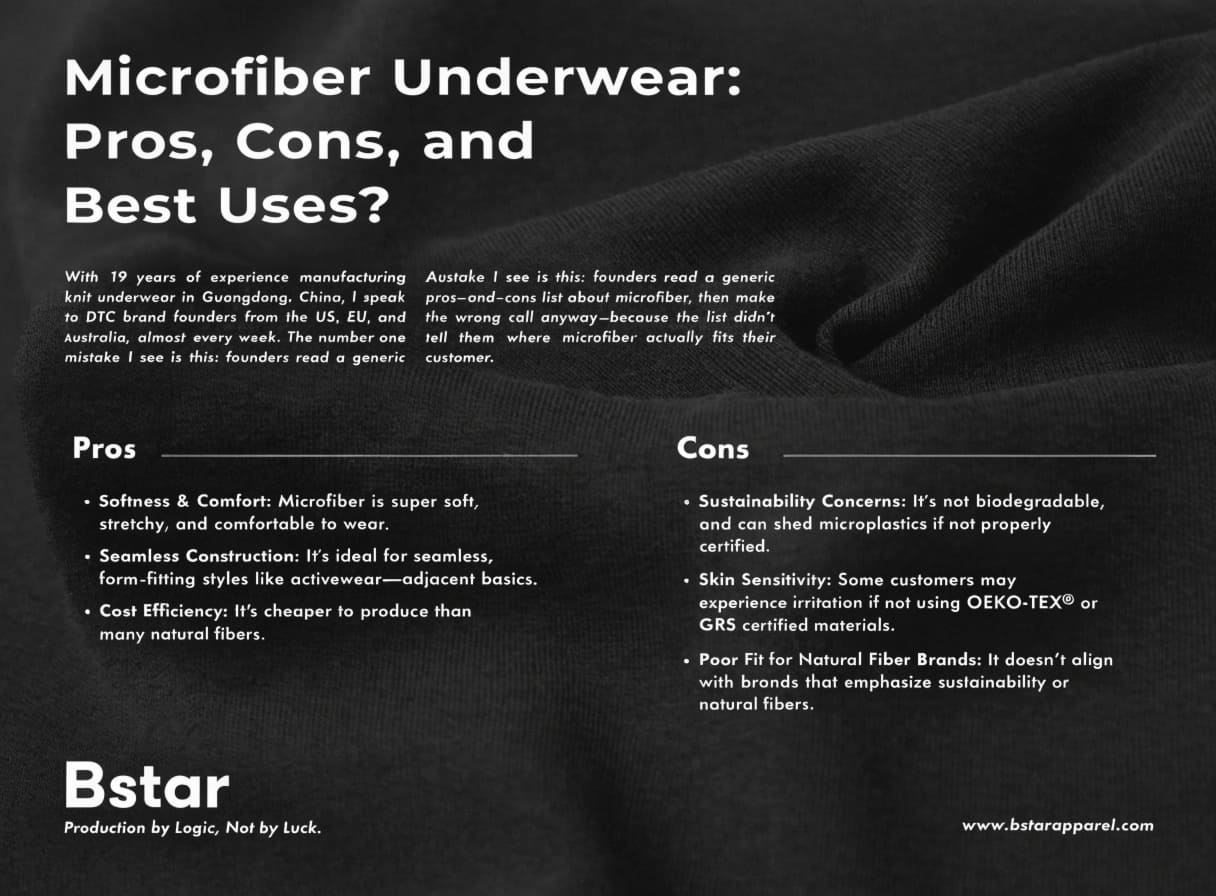
I’ve spent 19 years manufacturing knit underwear in Guangdong, China. I talk to DTC brand founders from the US, EU, and Australia almost every week. And the number one mistake I see is this: founders read a generic pros-and-cons list about microfiber, then make the wrong call anyway—because the list didn’t tell them where microfiber actually fits their customer.
That’s what this article is for. Not a material science lecture. A sourcing judgment guide.
What Is Microfiber, Really—And Why Does the Construction Matter?
Most founders come to me knowing microfiber is "synthetic and soft." But when I ask what denier count or knit structure they’re targeting, I get silence. That silence is where sourcing mistakes begin.
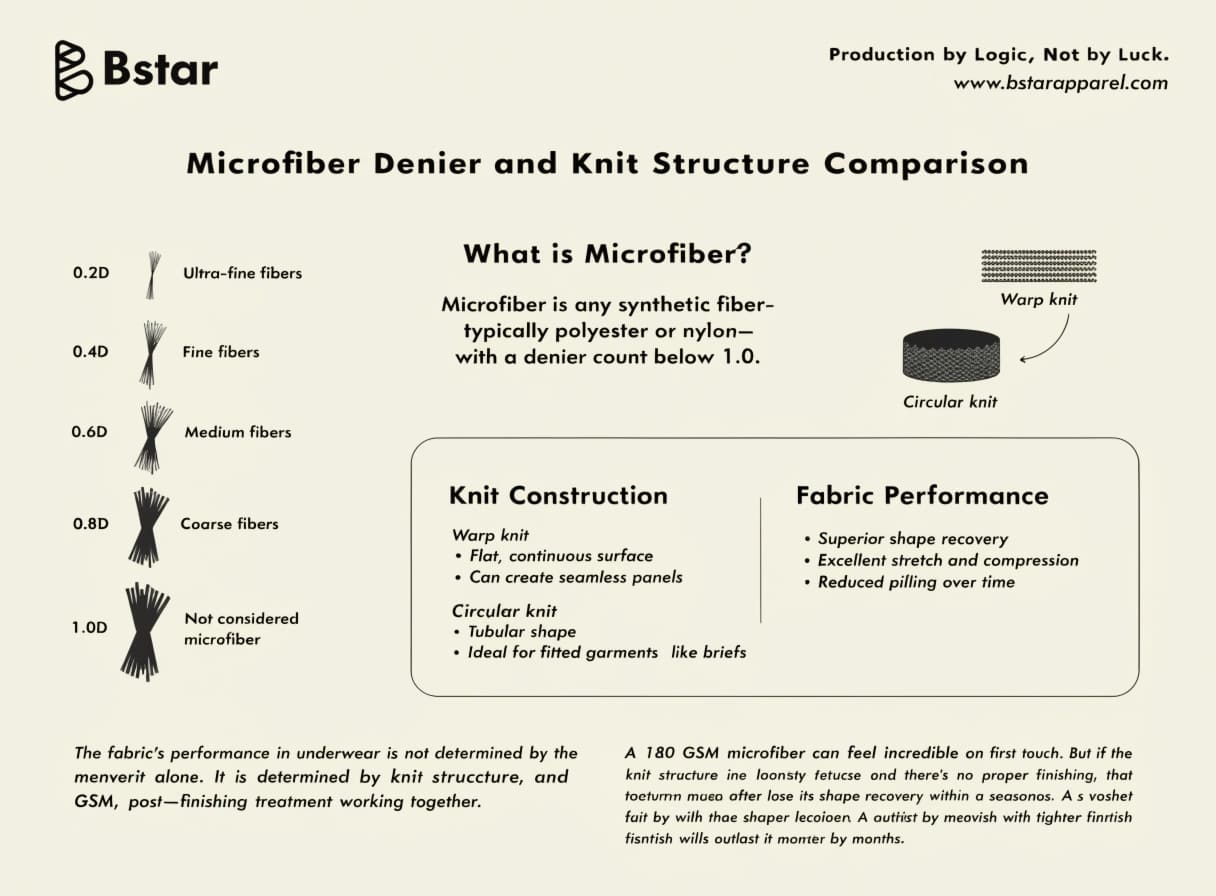
Microfiber is any synthetic fiber—typically polyester or nylon—with a denier count below 1.01. The fabric’s performance in underwear is not determined by the fiber alone. It is determined by knit structure, GSM, and post-finishing treatment working together.
Here’s where it gets practical. I see founders compare fabrics by touching samples and checking GSM. That tells you almost nothing useful on its own.
A 180 GSM microfiber can feel incredible on first touch. Smooth, premium, almost silky. But if the knit structure is loose and there’s no proper finishing treatment, that fabric will pill after 15–20 washes2 and lose its shape recovery within a season. A 160 GSM fabric with tighter loop construction and a proper heat-set finish will outlast it by months.
The variables that actually determine durability are:
| Variable | What It Affects | What to Ask Your Supplier |
|---|---|---|
| Denier count | Hand-feel, snag resistance | Is it below 0.5D or 0.5–1.0D? |
| Knit structure | Shape recovery, pill resistance | Warp knit vs. circular knit3? |
| GSM | Weight, coverage, drape | What’s the tolerance range in production? |
| Post-finishing | Surface feel, dimensional stability | Heat-set? Anti-pilling treatment? |
I’m not a lab. I can’t give you test data on every fabric combination. What I can tell you is that when a founder sends me a fabric complaint six months after delivery, it almost always traces back to one of these four variables being under-specified at the sampling stage.
What Microfiber Does Well—And Where Those Benefits Actually Show Up?
Microfiber has real advantages. The problem is that most articles present them as universal. They’re not. Each benefit maps to a specific use scenario.
Microfiber’s core performance strengths are moisture management, stretch recovery, smooth hand-feel, and compatibility with seamless knitting. These benefits are most valuable in activewear-adjacent basics and seamless bodywear—not across all underwear categories equally.
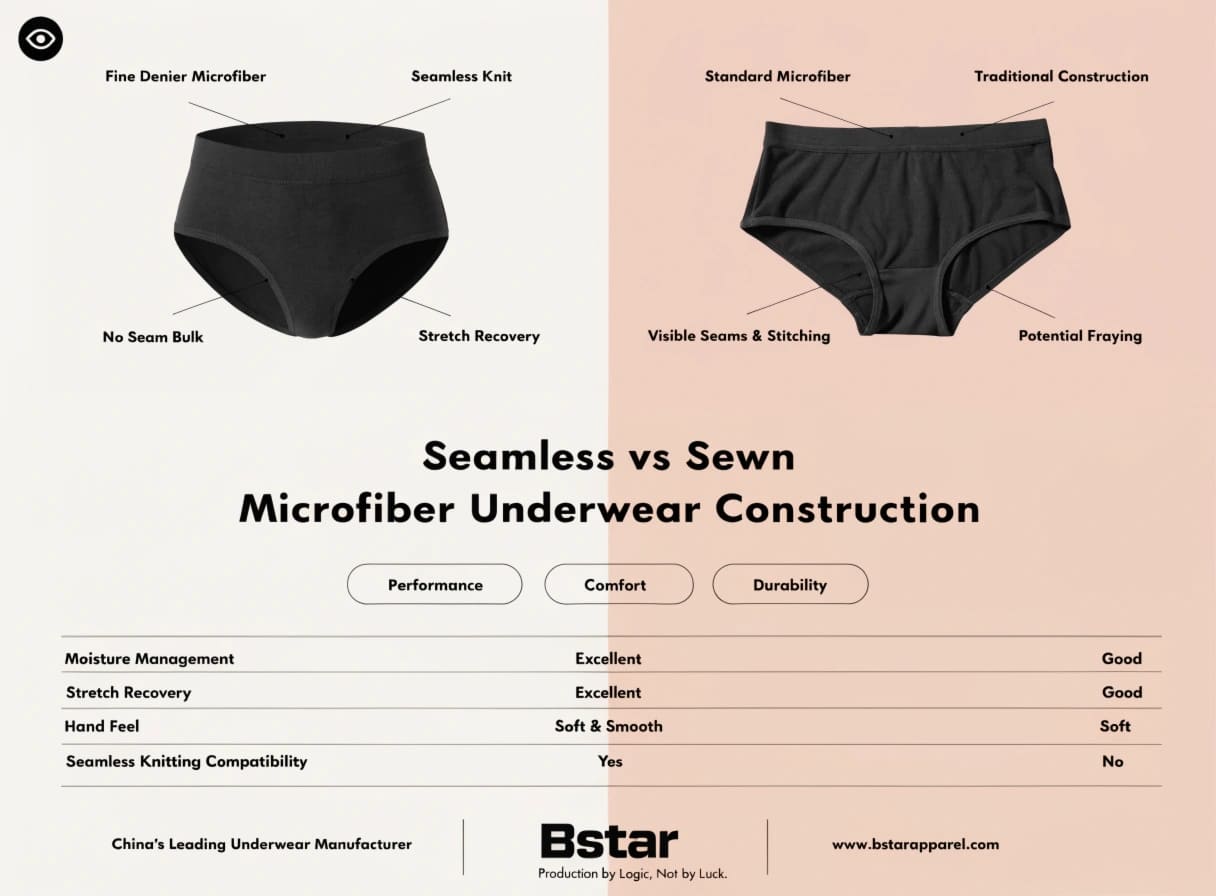
Let me break this down by use case, because that’s the only framing that’s actually useful.
Seamless underwear is where microfiber performs best, full stop. The fiber’s fine denier allows seamless knitting machines to produce smooth, uninterrupted fabric with no seam bulk.4 If your brand is building bodywear, shapewear, or any product that’s worn under fitted clothing, microfiber seamless construction is hard to beat on pure performance.
Activewear-adjacent basics—think everyday underwear marketed to active women or men—is the second strong use case. Microfiber pulls moisture away from skin faster than cotton under manufacturer test conditions. It also dries faster.5 For a customer who runs errands, goes to the gym, and doesn’t want to change underwear in between, this matters.
Softness-led everyday underwear is the third valid use case. If your brand differentiates on premium feel at an accessible price point, microfiber delivers a softness profile that many natural fibers can’t match at the same cost.
Where does it not deliver? I’ll get to that next.
The Risks Founders Don’t Price In—And Where the Real Costs Hide?
Here’s what doesn’t show up in any fabric cost comparison: the downstream cost of getting the material wrong. This is the part of the microfiber conversation that most articles skip, and it’s the most important part for anyone placing a $20K+ first run.
The biggest hidden cost risks in microfiber underwear6 are post-wash performance failures, breathability complaints in sedentary use, and environmental or certification gaps that create messaging problems—or worse, customer returns and inventory write-offs.
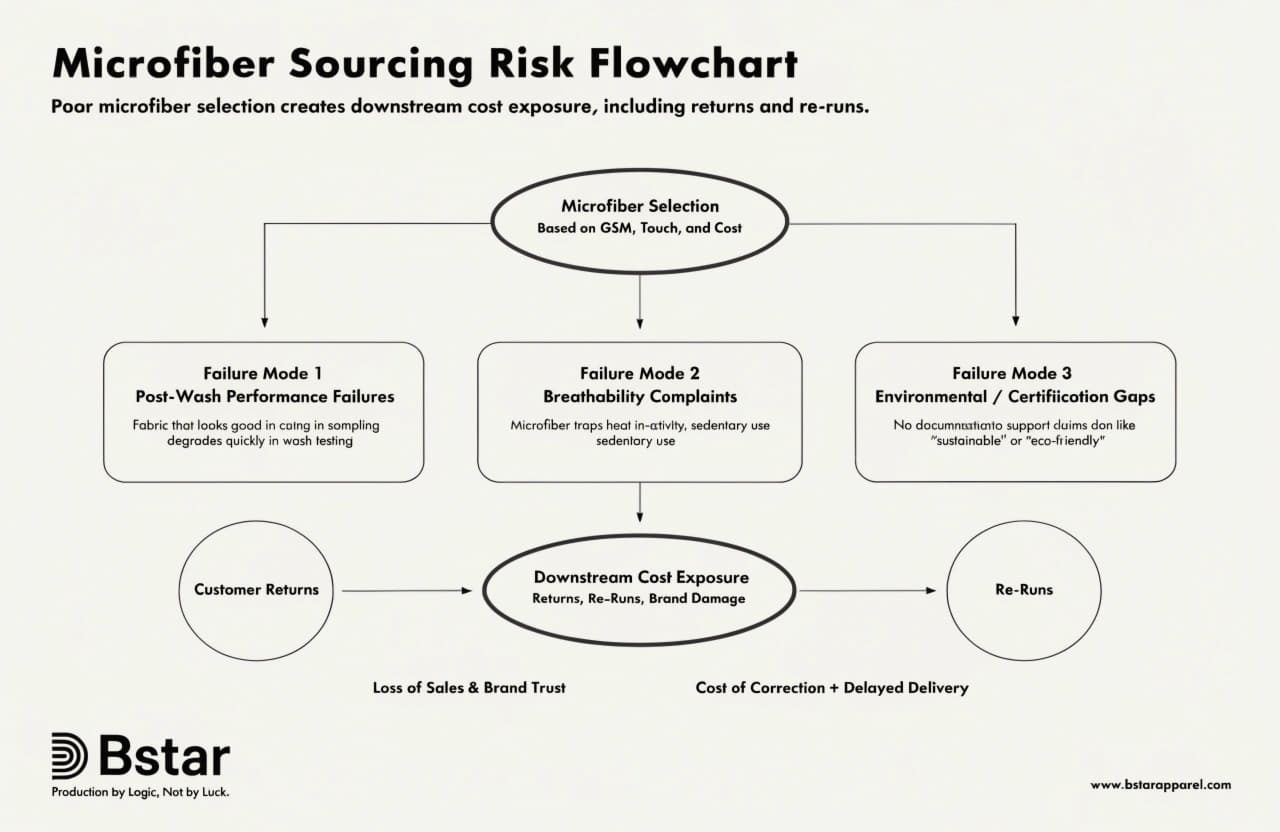
I want to walk through the three failure modes I see most often.
Failure Mode 1: Fabric that looks good in sampling but fails in wash testing.
This is the GSM-and-touch trap I mentioned earlier. A fabric that’s under-specified on knit structure and finishing will degrade fast. Your customers wash underwear constantly. If shape recovery or surface quality drops after 20 washes, you get returns, bad reviews, and a re-run—at full cost.
Failure Mode 2: Breathability complaints from the wrong customer segment.
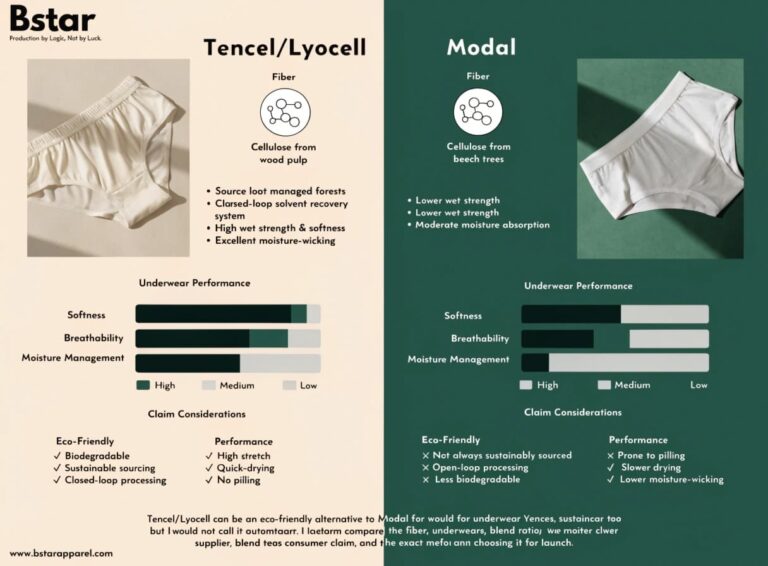
Microfiber is a synthetic. In low-activity, sedentary use, it traps more heat than cotton or modal.7 If your target customer is someone who sits at a desk all day in a warm climate and prioritizes comfort over everything else, microfiber may generate consistent breathability complaints. No amount of marketing language fixes a material fit problem.
Failure Mode 3: Certification gaps that block your brand story.
This one is increasingly relevant for EU and AU market brands. If you want to say "sustainable," "eco-friendly," or "safe for sensitive skin," you need documentation. At our factory, we require that all microfiber raw materials carry OEKO-TEX® certification at minimum. GRS certification covers recycled polyester if that’s part of your sourcing story.8 Without these, your brand claim has no backing—and in some markets, that’s a legal compliance issue, not just a marketing problem9.
The question isn’t "is microfiber cheap or expensive?" The question is: which of these failure modes am I exposed to, and what does fixing them cost after the fact?
Where Microfiber Actually Belongs in Your Product Line?
So when should you build in microfiber? Based on what I hear from brand founders in consultation, the answer is clearer than most people think once you map performance to use case.
Microfiber is the right choice when your product requires seamless construction, moisture management in active or transitional use, or a smooth premium hand-feel—and when your brand can support it with appropriate certifications. It is the wrong choice when your brand leads with "natural" or when your core customer is sedentary and heat-sensitive.
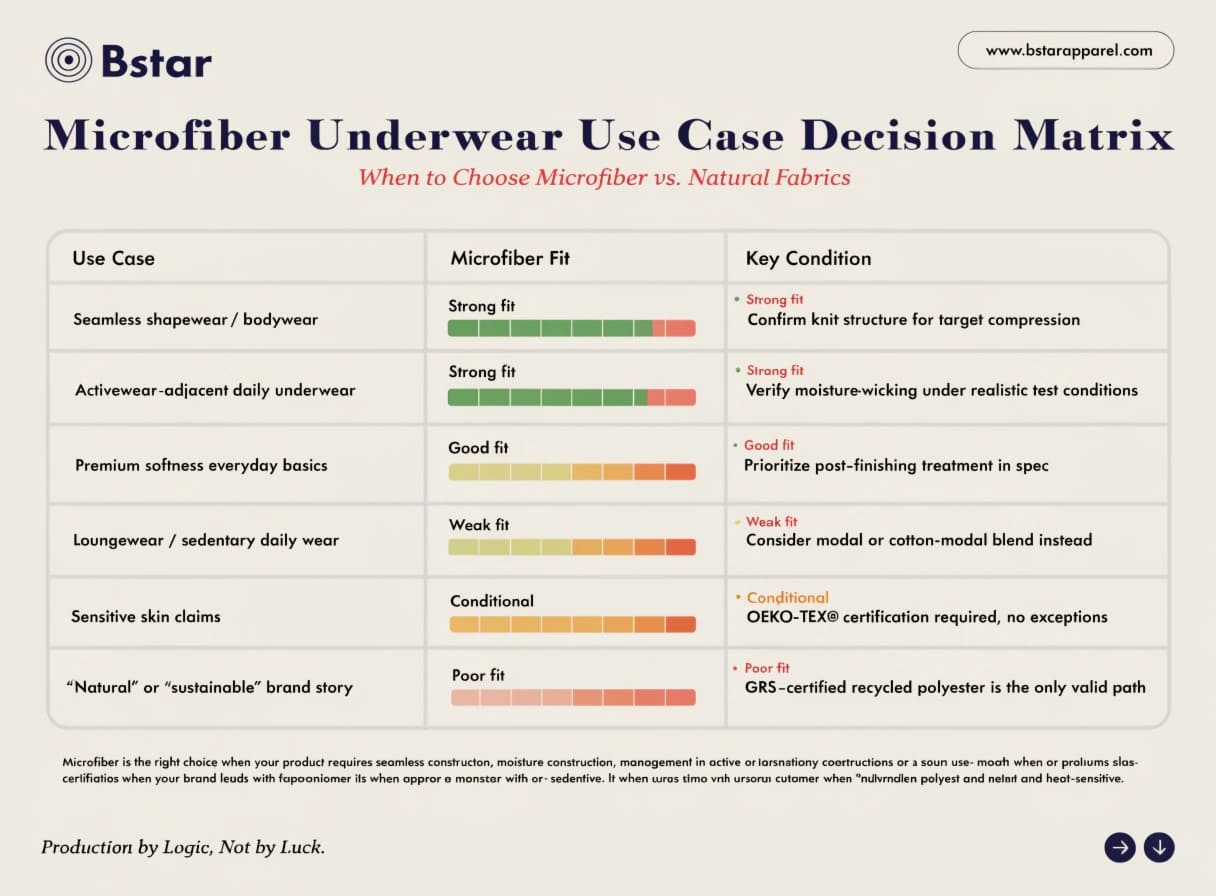
Here’s the framework I walk founders through before they commit to a fabric:
| Use Case | Microfiber Fit | Key Condition |
|---|---|---|
| Seamless shapewear / bodywear | Strong fit | Confirm knit structure for target compression |
| Activewear-adjacent daily underwear | Strong fit | Verify moisture-wicking under realistic test conditions |
| Premium softness everyday basics | Good fit | Prioritize post-finishing treatment in spec |
| Loungewear / sedentary daily wear | Weak fit | Consider modal or cotton-modal blend instead10 |
| Sensitive skin claims | Conditional | OEKO-TEX® certification required, no exceptions |
| "Natural" or "sustainable" brand story | Poor fit unless recycled | GRS-certified recycled polyester is the only valid path11 |
One more thing I tell founders: microfiber is not a shortcut to a lower price point. A well-specified microfiber fabric with proper finishing and certification costs more than a cheap cotton jersey.12 The margin case for microfiber is in performance differentiation, not raw material savings. If you’re building a brand around performance and feel, microfiber earns its place. If you’re trying to cut costs, it will create more problems than it solves.
Conclusion
Microfiber works when you match it to the right use case, specify it correctly, and back it with the right certifications. Get any of those three wrong, and the downstream costs will outweigh the benefits.
-
"Fiber – Wikipedia", https://en.wikipedia.org/wiki/Fiber. Microfiber is conventionally defined in textile science as a synthetic fiber with a linear mass density below 1 denier (or 1 dtex), though some standards place the threshold at 0.9 or 0.7 denier depending on the classifying body. Evidence role: definition; source type: encyclopedia. Supports: The standard technical definition of microfiber as a synthetic fiber with a denier count at or below a specified threshold. Scope note: Definitions vary slightly across standards organizations; the article’s stated threshold of 1.0 denier may not align with all authoritative sources. ↩
-
"Microfiber Pollution: A Systematic Literature Review to Overcome …", https://pmc.ncbi.nlm.nih.gov/articles/PMC10919082/. Standardized pilling resistance tests, such as ISO 12945-2 or ASTM D3512, assess fabric surface degradation under simulated wear and laundering conditions; research using these methods has shown that knit construction density and heat-set finishing are significant determinants of pilling onset in synthetic fabrics. Evidence role: mechanism; source type: institution. Supports: That knit structure and finishing treatment significantly influence pilling onset and wash durability in synthetic knit fabrics. Scope note: The specific figure of 15–20 washes is the author’s experiential estimate, not a value derived from a cited controlled study. ↩
-
"Fiber types and fabric structures influence on weft knitted fabrics – PMC", https://pmc.ncbi.nlm.nih.gov/articles/PMC9204663/. In textile engineering, warp knitting interlocks yarns in a vertical (warp) direction producing dimensionally stable, run-resistant fabrics commonly used in lingerie and bodywear, while circular knitting interlocks yarns horizontally (weft) producing more extensible fabrics; these structural differences result in distinct stretch recovery, pill resistance, and shape retention profiles. Evidence role: definition; source type: encyclopedia. Supports: That warp knitting and circular (weft) knitting produce structurally distinct fabrics with different performance characteristics relevant to stretch recovery and durability. Scope note: Performance outcomes also depend heavily on yarn type, stitch density, and finishing; knit structure alone does not determine durability. ↩
-
"(PDF) Three Dimensional Seamless Garment Knitting on V-Bed Flat …", https://www.academia.edu/63856881/Three_Dimensional_Seamless_Garment_Knitting_on_V_Bed_Flat_Knitting_Machines. Textile engineering literature on seamless knitting technology notes that finer denier yarns allow higher needle gauge machines to produce denser, smoother fabric structures with reduced surface irregularity, which is a key requirement for bodywear and underwear applications. Evidence role: mechanism; source type: research. Supports: That lower denier fibers are better suited to seamless circular knitting machines due to their fineness enabling tighter, smoother loop formation. Scope note: The specific claim is well-supported as a general principle; direct citations linking sub-1.0 denier microfiber to seamless machine output quality in underwear are more commonly found in trade literature than peer-reviewed journals. ↩
-
"Liquid Moisture Transport in Cotton Woven Fabrics with Different …", https://pmc.ncbi.nlm.nih.gov/articles/PMC9504572/. Studies employing AATCC 195 (Liquid Moisture Management Properties) and related protocols have documented that polyester microfiber constructions generally achieve higher moisture transport rates and shorter drying times than equivalent-weight cotton fabrics, attributable to capillary action along fine fiber surfaces rather than fiber absorbency. Evidence role: mechanism; source type: paper. Supports: That synthetic microfiber fabrics exhibit faster moisture transport and drying rates compared to cotton under controlled test conditions. Scope note: Performance outcomes vary substantially by knit structure, GSM, and finishing treatment; manufacturer test conditions may not replicate real-world sedentary or high-activity wear scenarios. ↩
-
"Underwear Market Size, Share & 2031 Growth Trends Report", https://www.mordorintelligence.com/industry-reports/underwear-market. Industry reports from organizations such as Textile Exchange and market research bodies document the growth of synthetic microfiber as a significant material category in intimate apparel and underwear, driven by demand for lightweight, moisture-managing, and seamless-compatible fabrics in both performance and everyday segments. Evidence role: historical_context; source type: institution. Supports: That microfiber has become an established and commercially significant fabric category in the underwear and intimate apparel industry. Scope note: Specific market share figures vary by report and year; this citation provides contextual grounding rather than precise quantitative support for any single claim in the article. ↩
-
"The Role of Sports Clothing in Thermoregulation, Comfort, and …", https://pmc.ncbi.nlm.nih.gov/articles/PMC9051004/. Research on fabric thermal comfort, including studies measuring thermal resistance (Rct) and water vapor resistance (Ret) per ISO 11092, has generally found that tightly constructed synthetic fabrics retain more heat and resist moisture vapor transmission more than cellulosic fibers such as cotton and modal under sedentary conditions. Evidence role: mechanism; source type: paper. Supports: That synthetic polyester fabrics exhibit lower breathability and higher thermal retention compared to cotton and modal in low-activity conditions. Scope note: Thermal performance is highly dependent on fabric construction and GSM; the claim as stated is a generalization that may not hold for all microfiber constructions. ↩
-
"OEKO-TEX® STANDARD 100", https://www.oeko-tex.com/en/our-standards/oeko-tex-standard-100/. OEKO-TEX Standard 100 is an independent testing and certification system for textile raw materials and finished products, verifying the absence of harmful substances above defined thresholds; the Global Recycled Standard (GRS), administered by Textile Exchange, certifies the recycled content of materials and chain-of-custody practices for inputs including recycled polyester. Evidence role: definition; source type: institution. Supports: That OEKO-TEX Standard 100 certifies textiles tested for harmful substances and that GRS certifies recycled content in materials including recycled polyester. Scope note: Neither certification addresses all sustainability dimensions; OEKO-TEX does not certify environmental production impact, and GRS does not address chemical safety of the finished product. ↩
-
"Green Guides | Federal Trade Commission", https://www.ftc.gov/news-events/topics/truth-advertising/green-guides. The European Commission’s proposed Green Claims Directive (2023) and existing Unfair Commercial Practices Directive require that environmental claims made about products, including textiles, be substantiated by recognized evidence; similar provisions exist under Australian Consumer Law (ACL) administered by the ACCC, which prohibits misleading representations about product characteristics including environmental attributes. Evidence role: general_support; source type: government. Supports: That regulatory frameworks in the EU and comparable markets impose legal obligations on brands making environmental or safety claims about textile products. Scope note: The Green Claims Directive was still in legislative process as of 2024; enforcement timelines and specific textile sector guidance vary by jurisdiction. ↩
-
"Effect of different garments on thermophysiological and … – PMC", https://pmc.ncbi.nlm.nih.gov/articles/PMC10492855/. Modal, a cellulosic fiber derived from beech wood pulp, exhibits higher moisture absorption capacity (approximately 50% greater than cotton by some measures) and lower thermal resistance than polyester microfiber, properties that contribute to improved perceived comfort in sedentary, low-perspiration conditions. Evidence role: general_support; source type: paper. Supports: That modal and cotton-modal blends offer superior breathability and thermal comfort compared to synthetic microfiber in low-activity wear scenarios. Scope note: Comparative comfort studies often rely on subjective wearer assessments, and results vary by fabric construction; the recommendation is contextually supported rather than proven by a single definitive study. ↩
-
"Global Recycled Standard (GRS) Certification – SCS Global Services", https://www.scsglobalservices.com/services/global-recycled-standard. The Global Recycled Standard (GRS), administered by Textile Exchange, is one of the most widely recognized third-party certification frameworks for recycled content in textiles including recycled polyester; the Recycled Claim Standard (RCS), also from Textile Exchange, provides an alternative for brands seeking to verify recycled content without the full chain-of-custody requirements of GRS. Evidence role: general_support; source type: institution. Supports: That GRS is a recognized standard for certifying recycled content in polyester textiles used to substantiate sustainability claims. Scope note: The article’s claim that GRS is ‘the only valid path’ overstates exclusivity; RCS and other regional standards may satisfy sustainability claim requirements in certain markets. ↩
-
"How much do you typically expect to pay for fabric per yard/metre …", https://www.reddit.com/r/craftsnark/comments/kymogm/how_much_do_you_typically_expect_to_pay_for/. Industry textile pricing data and commodity reports from organizations such as Textile Exchange and ITMF indicate that certified recycled or performance-finished synthetic fabrics carry cost premiums over standard cotton jersey, reflecting additional processing steps, certification fees, and quality control requirements; however, absolute price comparisons are highly dependent on order volume, supplier region, and market conditions. Evidence role: general_support; source type: institution. Supports: That certified, finished microfiber fabrics carry a cost premium over commodity cotton jersey due to processing, finishing, and certification requirements. Scope note: Fabric pricing is volatile and market-specific; the claim is directionally supported but cannot be verified with a single static source. ↩