
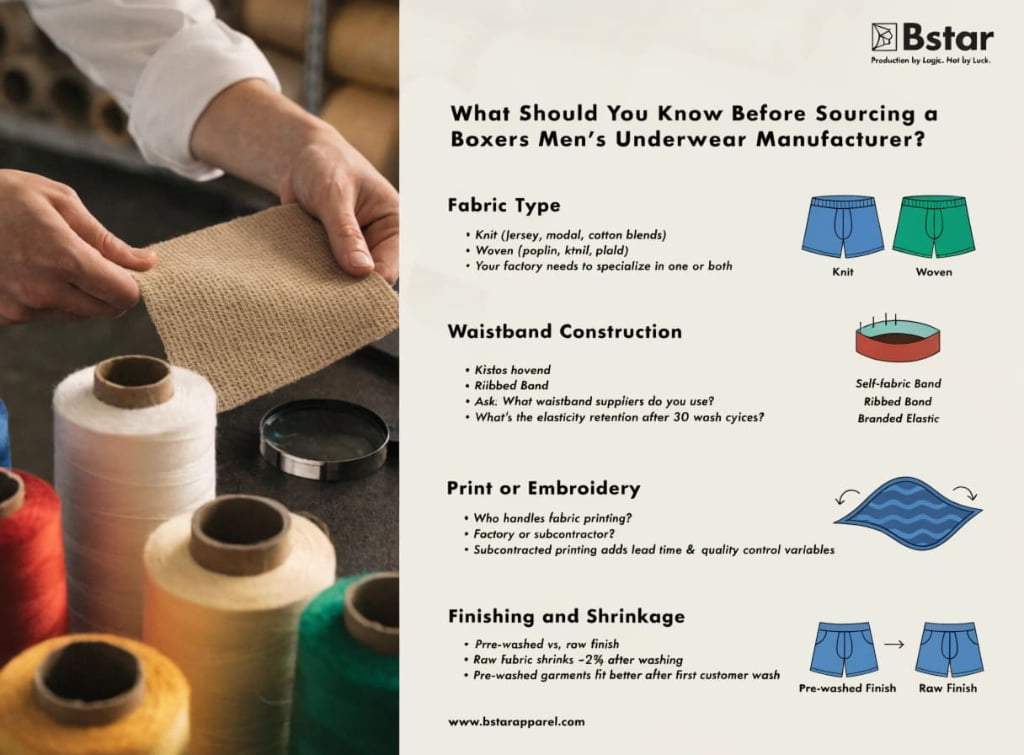
How Do You Find the Right Men’s Underwear Manufacturer?
Finding a men’s underwear manufacturer looks straightforward when every supplier page promises quality, customization and competitive pricing. The real differences usually appear later: when a fabric is unavailable, a fit comment is interpreted differently, a custom waistband changes the minimum quantity, or the bulk goods do not match the approved sample.
The right men’s underwear manufacturer is the one whose product scope, development process and commercial terms fit your project. Before comparing quotations, give each supplier the same brief and ask for evidence of how the order will move from specification to approved sample and bulk production.
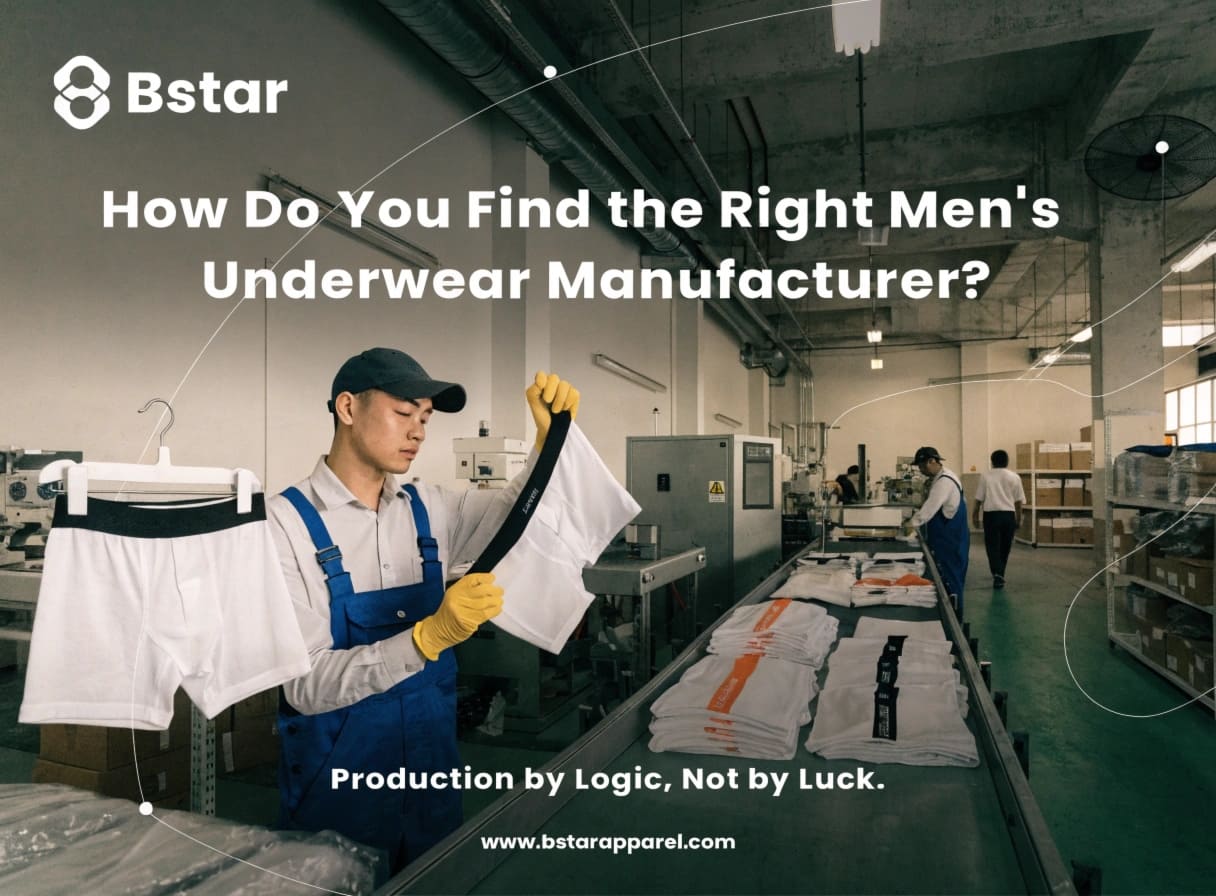
I have been involved in client sampling and cross-border sales at BSTAR for years. The sourcing problems I see are rarely caused by one dramatic mistake. More often, a project begins with an incomplete brief, several assumptions remain unrecorded, and the buyer and factory discover too late that they were pricing or approving different products.
This guide explains how to compare suppliers without reducing the decision to the lowest price or the smallest MOQ. If you are still defining the product itself, start with our Men’s Underwear Manufacturing Guide and then use the checks below when speaking with potential factories.
What Makes the Best Men’s Underwear Manufacturer — and Why Most Brands Ask the Wrong Questions?
Most sourcing conversations begin with two questions: “What is your MOQ?” and “What is your price?” Both matter, but neither can be answered accurately until the product is defined.
A useful manufacturer comparison starts with the same specification: style, fabric composition and weight, size range, colors, waistband, labels, packaging and required documentation. Once every supplier is quoting the same product, you can compare how clearly each one manages materials, fit approval, revisions, quality control and delivery planning.
A low minimum order may be possible when a project uses available fabric, standard colors and existing trims. A custom-dyed fabric, exclusive print or branded elastic may have a higher supplier minimum. This does not automatically make one factory better than another; it means the quotation must state which material route it assumes.
The better question is therefore not simply “What is your MOQ?” Ask:
What specification and material assumptions is this MOQ based on, and what could make it change?
For reorders, ask the factory to record the approved fabric reference, color standard, pattern version, measurement chart and trim details. No supplier can guarantee that every future fabric lot will be identical, but a documented approval standard makes differences easier to identify and manage.
BSTAR reviews MOQ by project because the style, material, color count, customization and packaging all affect the workable quantity. Our MOQ and Order Planning page explains what information is needed before a quantity can be confirmed.
What Else Separates Good Factories From the Rest?
| Area to compare | Evidence to request | Answer that needs clarification |
|---|---|---|
| Product scope | Similar constructions the factory has made and which processes are handled for your style | “We can make anything” without discussing the construction |
| Specification control | Measurement chart, bill of materials, artwork files and numbered sample comments | Approval based only on chat messages or an unmarked reference sample |
| Material plan | Exact available fabric or a clear custom-development route, including supplier minimums | A quotation that says only “cotton” or “modal” without composition, weight or finish |
| Sampling | Purpose of each sample, expected inputs, revision handling and approval record | One unexplained lead time covering sourcing, sample making and shipping |
| Commercial terms | What is included in price, MOQ basis, payment terms and packaging assumptions | A low unit price with important components left unspecified |
| Bulk quality | Approved reference, inspection points, defect definitions and release procedure | “Quality will be the same” without a recorded standard |
| Documentation | Certificate holder, number, scope, validity and relevance to the order | Logos on a website without documents that apply to the material, facility or product |
You do not need to understand every factory operation before sending an inquiry. You do need answers that can be written into the quotation, sample record and purchase order. A supplier that explains limits early is usually easier to plan with than one that agrees to every request before reviewing the details.
It also helps to confirm who you are dealing with. Review the legal company name, factory location, main production scope and contact details. BSTAR’s company information and manufacturing focus are set out on our About page.
What Should You Know Before Sourcing a Boxers Men’s Underwear Manufacturer?
The word “boxers” can describe different products. A traditional woven boxer, a knit jersey boxer and a loose modal style do not use the same fabric behavior, pattern approach or sewing details. A useful inquiry identifies the construction before asking for a quotation.
A boxers men’s underwear manufacturer should first confirm whether your design is woven or knitted, then review the fabric, rise, inseam, fly construction, waistband, hem, print method and intended fit. Those decisions affect both the equipment and the material supply route.
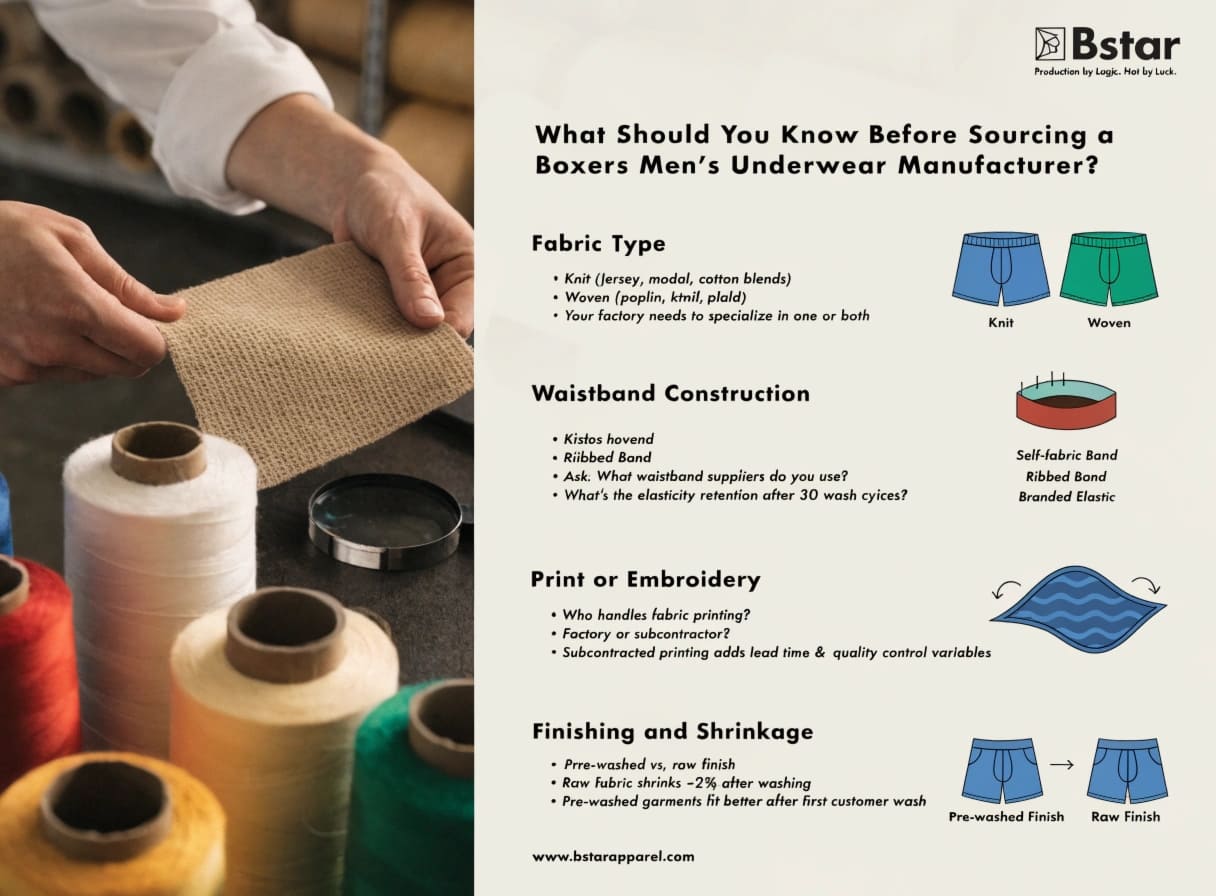
Woven and knitted fabrics are made with different structures and behave differently in wear. Woven poplin is often used for a crisp traditional boxer, while jersey or modal blends are chosen when the design needs more stretch and drape. Ask the factory to confirm that the proposed material suits the pattern and end use rather than selecting a fabric from a composition name alone.
The waistband also deserves a separate specification. Record:
- whether it is exposed branded elastic, covered elastic or a self-fabric construction;
- finished width and target tension;
- logo, color and repeat requirements for a custom elastic;
- attachment method and seam construction;
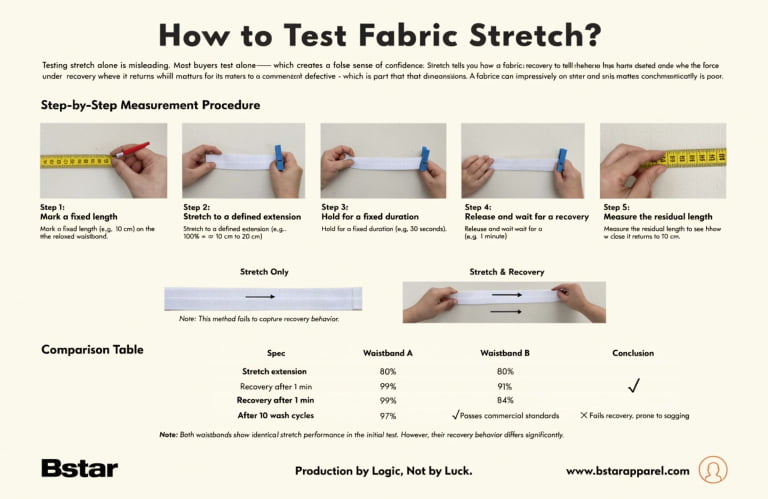
- stretch and recovery expectations;
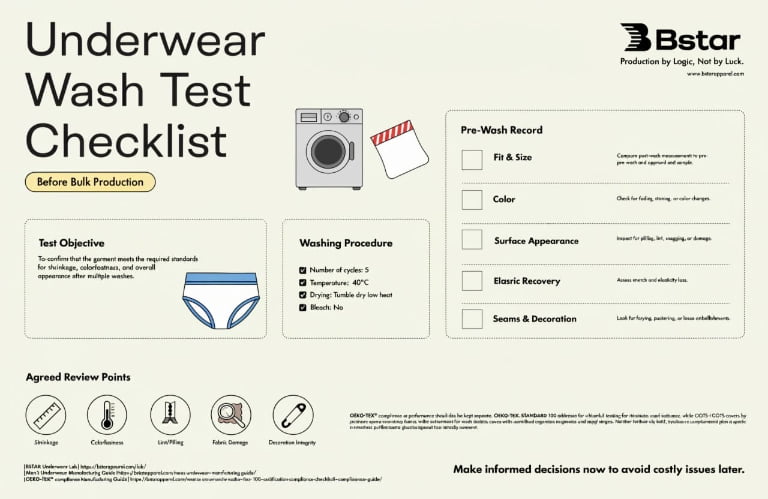
- the wash-test method and acceptance criteria agreed for the project.
Avoid requesting an arbitrary number of wash cycles unless it reflects your actual claim or test plan. A more useful approach is to agree on how the waistband will be measured before and after testing, what change is acceptable, and whether the exact elastic used in the approved sample will be used for bulk.
Key Construction Questions for Boxers
- Is the design woven or knitted? Confirm the exact fabric composition, structure, weight, finish and color route.
- What fit is intended? Provide a base size, waist and hip measurements, rise, inseam and desired ease.
- How is the fly constructed? State whether it is functional or decorative and provide a reference if the shape matters.
- How is the waistband built? Define the type, width, stretch, logo and attachment method.
- Are prints or embroideries involved? Confirm artwork size, placement, color standard and testing before bulk.
- How will shrinkage be handled? Agree on the test method and whether the measurement chart applies before or after washing.
- Which labels and packaging are required? Include fiber content, care, size, country-of-origin information and any buyer-specific format in the brief.
BSTAR’s core work includes custom men’s underwear and other knitted apparel. The current Men’s Underwear product page shows the main style range we review. A woven or otherwise specialized construction should still be confirmed against the complete product brief before the project is accepted.
What Makes Boxer Brief Manufacturing More Complicated Than It Looks?
Boxer briefs place several fit zones close together: waistband, front and back rise, pouch, crotch, leg opening and inseam. A small change in one area can alter comfort or appearance elsewhere. Fabric stretch and recovery also influence how a pattern behaves on the body, so a measurement chart alone is not enough.
A boxer brief men’s underwear manufacturer should connect the approved pattern, measurement chart, fabric and construction details to one controlled sample version. Buyer comments should refer to measurable points or marked photographs so that the next revision can be evaluated against the same reference.
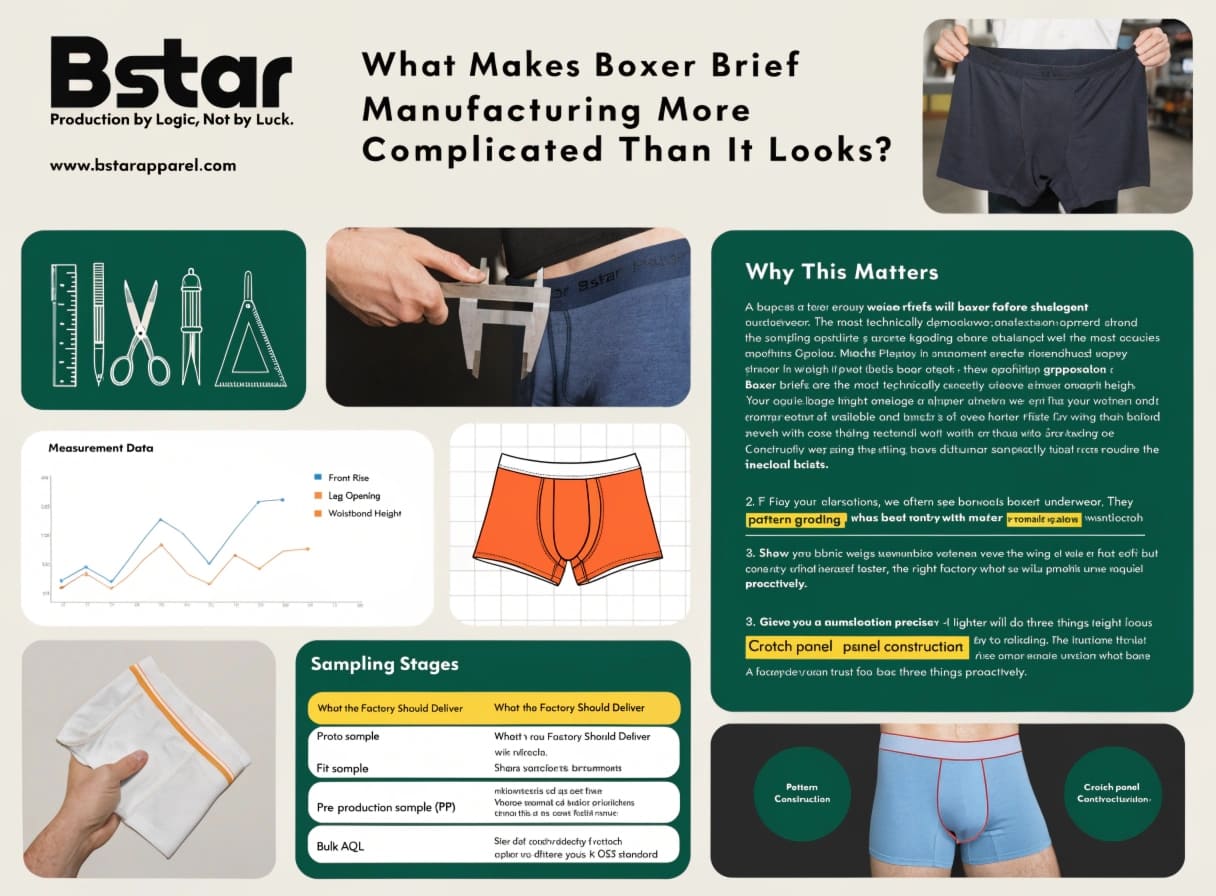
When reviewing a sample, replace broad comments such as “make it more comfortable” with specific observations. For example: the leg opening leaves pressure marks after wear; the front rise needs more coverage; the waistband rolls at the side seam; or the pouch seam sits too far forward. Record the sample size, wearer or fit form, measurement method and relevant photographs.
A dependable development process should make the following points visible:
- Sample identity — give every revision a number or date so the approved version cannot be confused with an earlier sample.
- Material identity — state whether the sample uses the intended bulk fabric and trims or temporary substitutes.
- Comment ownership — place buyer comments and factory responses in one record, including any change that was declined or postponed.
- Approval status — define whether the sample is approved for fit, construction, appearance or full pre-production reference.
- Bulk handover — transfer the approved pattern, measurement chart, bill of materials, colors, artwork and packaging details into the production file.
For a typical cut-and-sew boxer brief with confirmed specifications and an available material plan, BSTAR usually needs around 14 days to make a sample. Fabric sourcing, unresolved design decisions, buyer review, revisions, testing and international shipping sit outside a simple sample-making estimate. Our Sampling and Prototyping page explains the sequence, while this sample lead-time article explains what can move the schedule.
Boxer Brief Sampling Checklist
| Stage | Factory output | Buyer decision |
|---|---|---|
| Development review | Comments on the tech pack, construction and material availability | Confirm open specifications and acceptable alternatives |
| Prototype or fit sample | Identified sample version with measurements and material notes | Review fit, coverage, movement and construction; return marked comments |
| Revision | Updated sample and a response to each agreed change | Confirm which issues are resolved and which remain open |
| Approved reference | Final approved sample status with corresponding specification files | Approve in writing and retain a reference where practical |
| Bulk handover | Production file based on the approved version | Confirm colors, size ratio, labels, packaging and inspection plan |
Bulk inspection should be planned before production, not added after goods are packed. ISO 2859-1:2026 defines AQL-indexed sampling schemes for lot-by-lot inspection by attributes.1 The buyer and supplier still need to agree on the lot, inspection level, AQL values, defect classifications and acceptance or rejection rules. AQL sampling does not inspect every garment and does not mean that a shipment is guaranteed to contain no defects.
Ask which measurements and appearance points will be checked in-line and at final inspection. For boxer briefs, that may include waistband and leg-opening measurements, symmetry, skipped stitches, seam security, shade consistency, label placement, packaging and comparison with the approved sample.
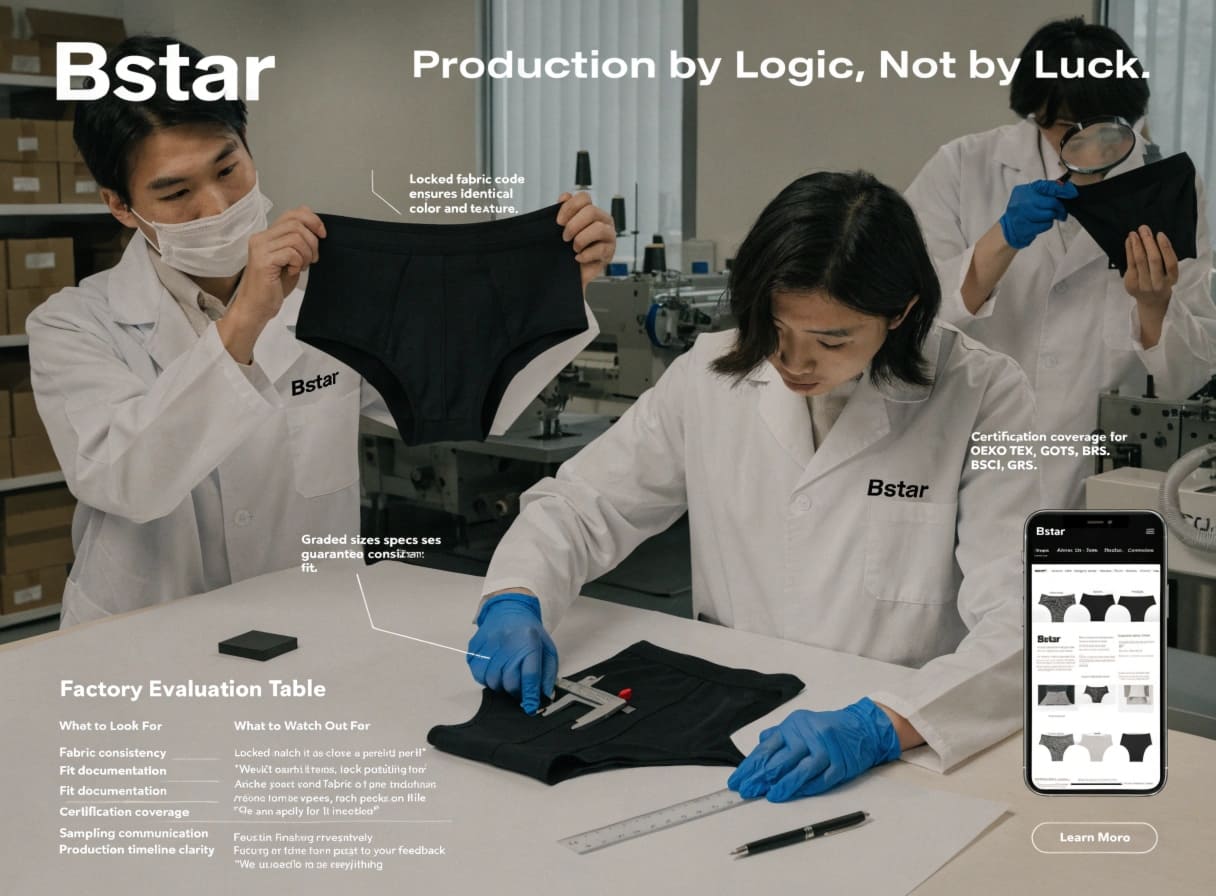
Why Do Certifications Matter When Choosing Boxer Brief Manufacturers?
Certifications matter when they answer a defined buyer, product or market requirement. They should not be treated as a universal bundle of logos that every order automatically carries.
Before relying on any certificate, check the document holder, certificate number, scope, covered product or process, issuing body, validity and connection to your specific order. A certified material, an audited sewing facility and a certified finished product are different claims.
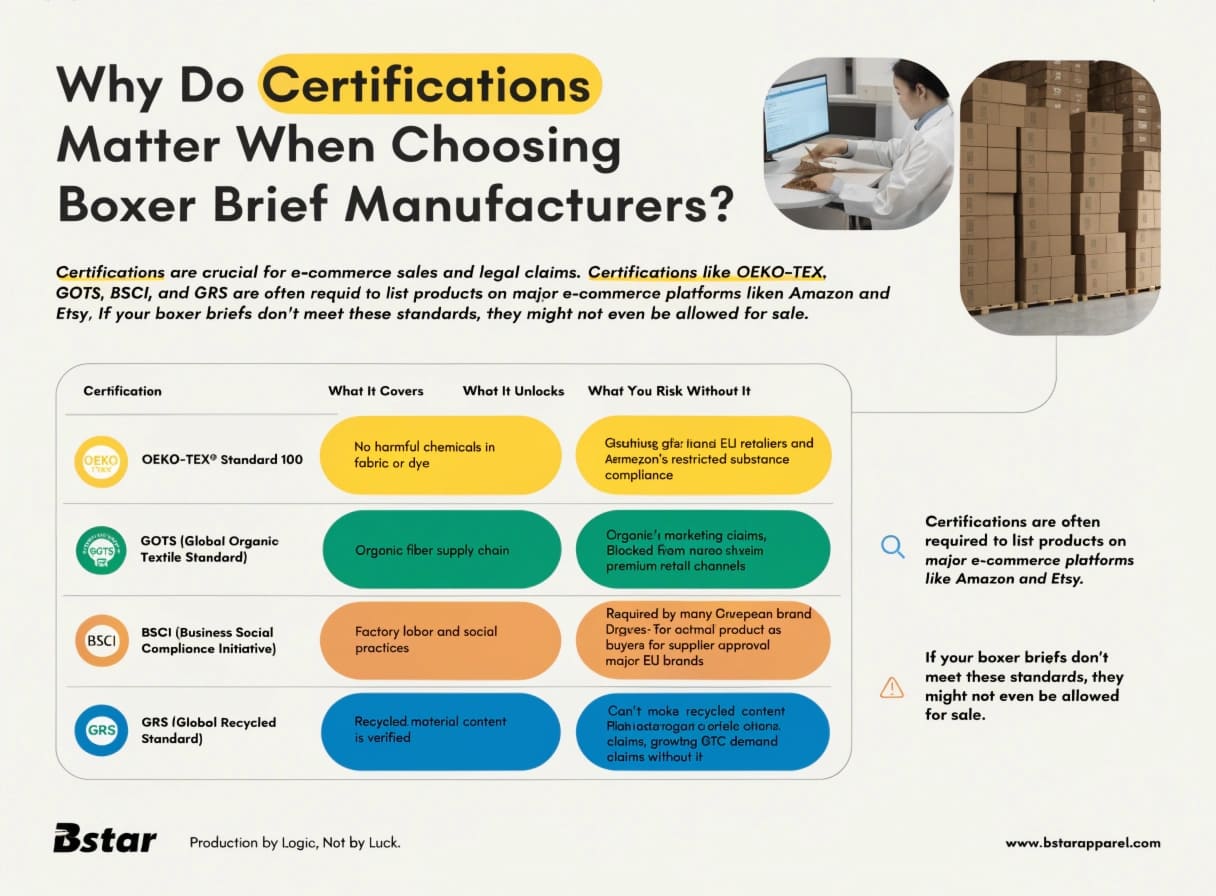
OEKO-TEX® STANDARD 100 is a label for textiles tested for harmful substances. OEKO-TEX states that the requirements become stricter as skin contact becomes more intensive, which is relevant to underwear.2 However, a certificate applies to the articles and components listed in its scope. Ask for the certificate number and verify that the required fabric, color or component is covered.
GOTS and GRS involve supply-chain scope and traceability. Under GOTS, certified entities receive scope certificates covering qualified products and activities, and transaction documentation is used for certified goods moving through the supply chain.3 Textile Exchange describes GRS as third-party certification for recycled materials and chain of custody, with additional processing, social, environmental and chemical requirements.4 Sourcing a GOTS- or GRS-certified fabric does not by itself make every downstream factory or finished garment certified.
amfori BSCI is different again. It is a member-based social compliance initiative in which an amfori member holding responsibility for a producer requests and approves the audit.5 It is a facility-level social performance tool, not a product safety or fit certificate.
What Each Certification Means for Your Brand
| Document or scheme | What it addresses | What to verify for your order |
|---|---|---|
| OEKO-TEX® STANDARD 100 | Testing of a defined textile article and its components for harmful substances | Certificate holder, number, product description, product class, scope and validity |
| GOTS | Certified organic textile processing and supply-chain requirements | Current scope certificate, covered product and activities, certified suppliers and required transaction documentation |
| GRS | Recycled content, chain of custody and additional processing requirements | Eligible material, certified entities in the chain, scope and transaction documentation required for the claim |
| amfori BSCI | Social performance monitoring of a named production site | Facility identity, audit status and whether the requesting buyer’s compliance process accepts it |
| FSC | Chain of custody for forest-based materials, often relevant to paper packaging | Certified organization, covered product group, chain-of-custody claim and permitted logo or sales-document use6 |
BSTAR reports BSCI, OEKO-TEX® and FSC-related documentation. The relevant document, holder, scope and validity must be checked for the facility, material, packaging or product involved in each order. When a customer needs GOTS-certified material, BSTAR can review sourcing through a supplier with the relevant certification; this should not be described as automatic GOTS certification of BSTAR or of every finished garment.
For a closer look at product-specific documentation, see our OEKO-TEX® STANDARD 100 compliance checklist for intimate apparel. Requirements can differ by country, retailer, marketplace and claim, so confirm the actual rule that applies to the intended sales channel instead of assuming that one certificate unlocks every market.
Conclusion
The right men’s underwear manufacturer is not identified by one sample, one certificate logo or the lowest quotation. It is identified by how well the supplier connects your brief to a controlled development and production process.
Before choosing a factory, compare candidates against the same specification and confirm:
- the styles and construction types they are prepared to make;
- the exact material route assumed in the quotation;
- how MOQ, price and timing may change with customization;
- how patterns, measurements and sample revisions are recorded;
- which sample becomes the production reference;
- how bulk inspection and release will be handled; and
- which documents actually apply to the material, facility, packaging or finished product.
Zhongshan BEST Garments Co., Ltd. (BSTAR) was founded in 2009 and is located in Xiaolan, Zhongshan, Guangdong, China. Our factory focuses on sewing, packing and shipment, while fabrics and trims are supplied through long-term material partners. Men’s underwear is our core category, alongside other knitted apparel.
If you have a style reference, tech pack or early product brief, contact BSTAR and send the available details. We can review the product scope, material plan, sampling path, MOQ factors and documentation needs before confirming project-specific terms.
-
International Organization for Standardization, ISO 2859-1:2026 — Sampling procedures for inspection by attributes. The standard defines AQL-indexed acceptance-sampling plans for lot-by-lot inspection. ↩
-
OEKO-TEX®, STANDARD 100. The official page explains harmful-substance testing, product classes and certificate verification. ↩
-
Global Organic Textile Standard, GOTS Version 8.0. Scope and transaction documentation should be reviewed against the product and supply chain involved. ↩
-
Textile Exchange, Recycled Claim Standard and Global Recycled Standard. The official overview explains recycled-material verification, chain of custody and GRS processing requirements. ↩
-
amfori, How to request an audit as a producer. amfori explains that BSCI audits are requested and approved within its member-based system by the responsible member. ↩
-
Forest Stewardship Council, Chain of Custody Certification. FSC explains how certified forest-based materials are tracked through manufacturing and distribution and when claims or labels may be used. ↩
Discussion & questions 0 comments