
Men’s Boxer Brief Cut and Sew Manufacturer Sample Lead Time: What Actually Controls the Clock?
Waiting on a sample that was supposed to arrive two weeks ago is a bad place to be. It stalls your launch, burns trust, and leaves you guessing whether the factory is the problem — or something else.
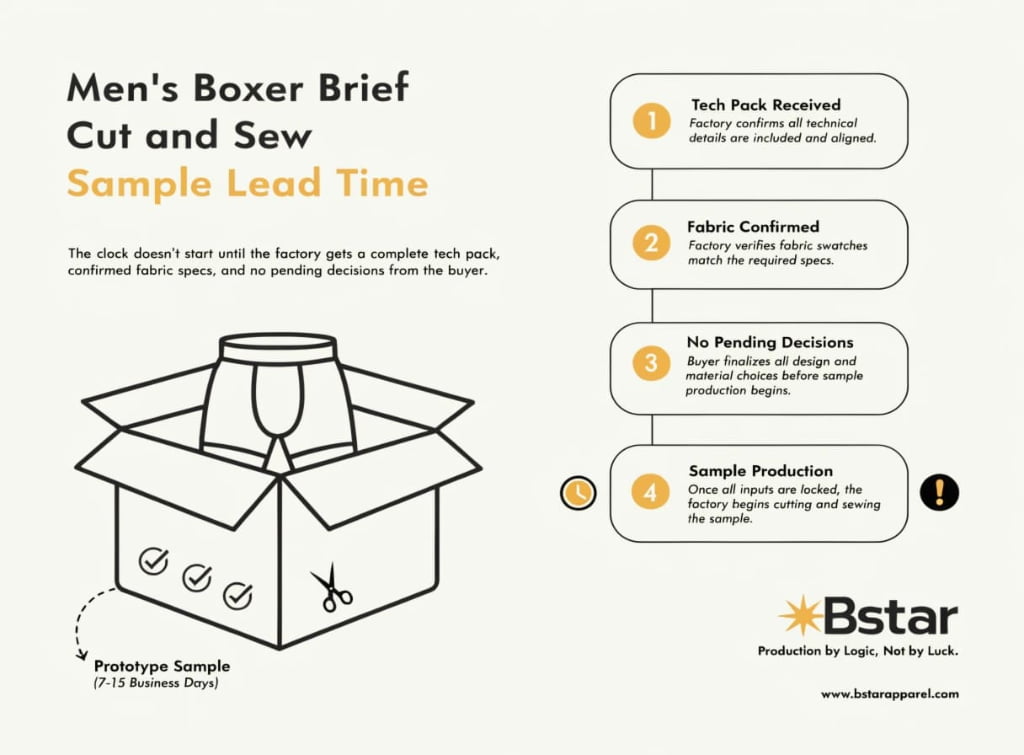
For cut-and-sew boxer briefs, most manufacturers quote 7–15 business days for a proto sample. That range is real, but it only applies when the factory has a complete tech pack, confirmed fabric specs, and no outstanding decisions from the buyer’s side. Without those inputs, the clock hasn’t started.
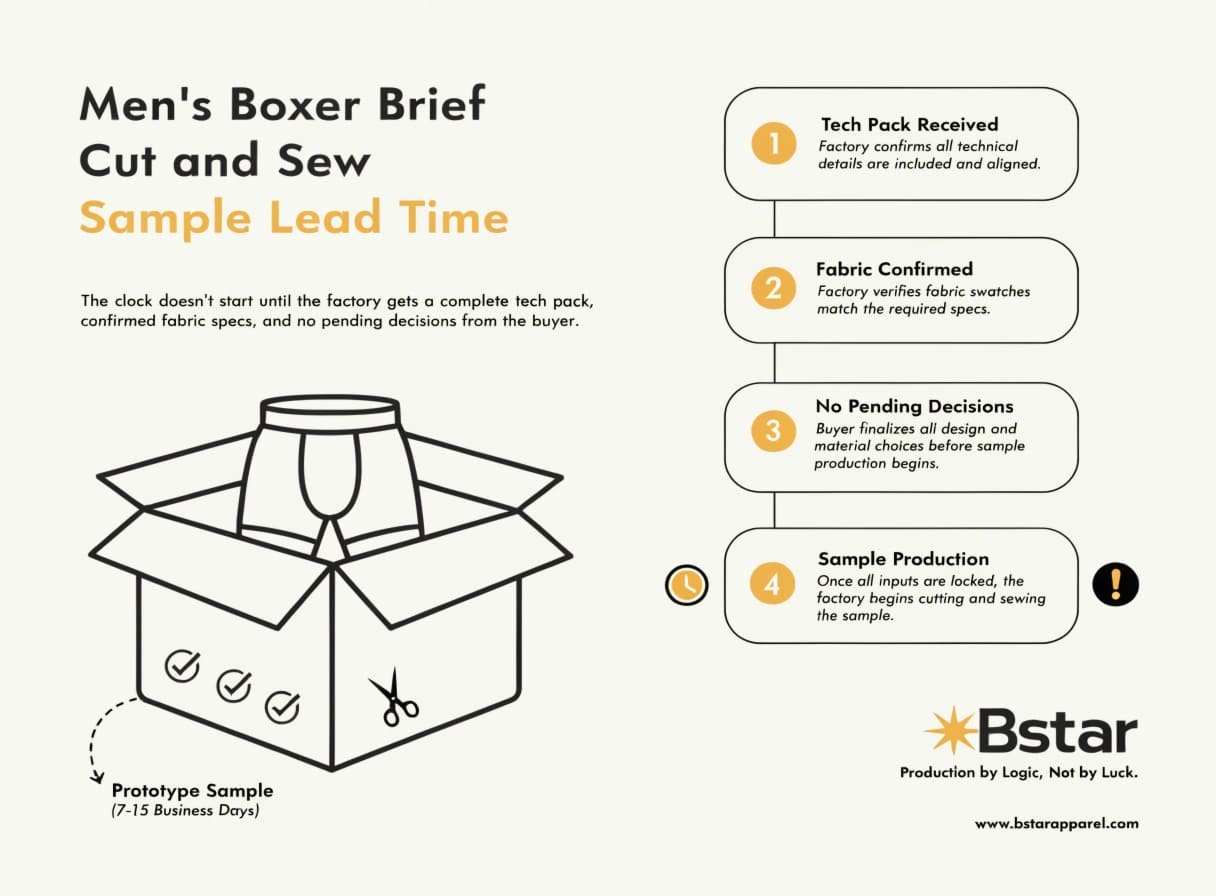
The number a factory gives you during the first call is not a commitment. It’s a rough estimate built on a lot of assumptions. Most delays in the sampling process don’t come from the factory floor. They come from gaps in preparation — on both sides. Understanding that shift in responsibility is the most useful thing you can take from this article.
Average Timelines and Milestones: What Should You Actually Expect at Each Stage?
You ask a factory for their sample lead time. They say "10 to 15 days." You write that down and plan your calendar around it. Then day 18 arrives and you’re still waiting. What went wrong?
A realistic boxer brief sampling process has three stages: proto sample (first physical version based on your specs), fit sample (revised version after your feedback), and pre-production sample (final approved version matching bulk production standards)1. Each stage carries its own lead time, and each one depends on how fast decisions get made — not just how fast the factory works.
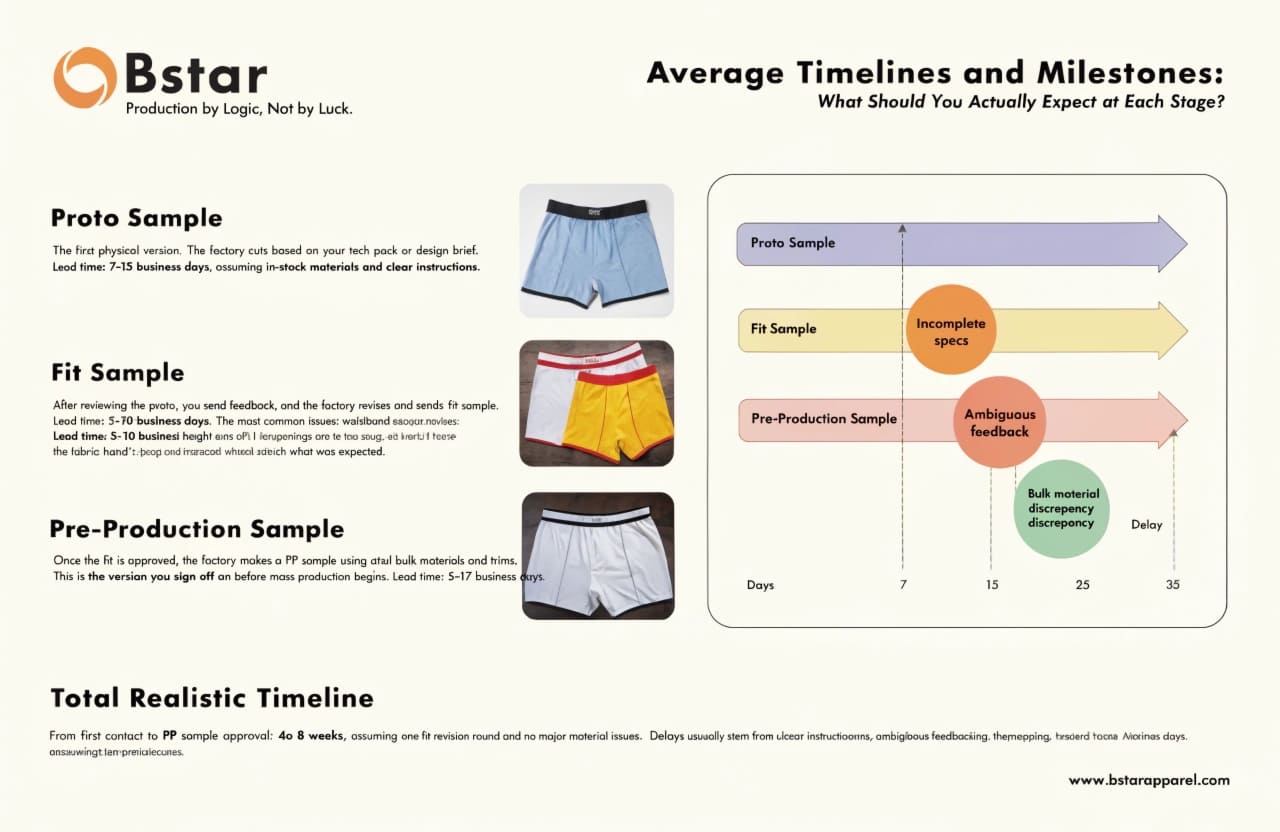
Here’s how those stages typically break down in practice.
Proto Sample
This is the first physical version. The factory cuts based on your tech pack or design brief. Lead time here is usually 7–15 business days — but only when materials are in-stock and instructions are clear.2 The goal of this round is to check construction logic, proportion, and silhouette. Don’t expect a perfect fit from this version. It rarely is.
Fit Sample
After you review the proto and send feedback, the factory revises and sends a fit sample. This round typically takes another 5–10 business days. The most common issues that trigger this round: waistband height is off, leg openings are too snug, or the fabric hand-feel doesn’t match what was expected. One revision round is normal. Two is common. Three or more usually means the tech pack was incomplete from the start.3
Pre-Production Sample
Once fit is approved, the factory makes a PP sample using actual bulk materials and trims. This is the version you sign off on before mass production begins. Lead time here is another 5–7 business days. Some brands skip this step to save time. That’s a risk — if the bulk fabric lot is slightly different, you won’t know until the goods arrive4.
| Stage | Typical Lead Time | What Triggers Delays |
|---|---|---|
| Proto Sample | 7–15 business days | Incomplete specs, no fabric decision |
| Fit Sample | 5–10 business days | Ambiguous feedback, multi-revision cycles |
| Pre-Production Sample | 5–7 business days | Bulk material discrepancy, late approval |
Total realistic timeline from first contact to PP sample approval: 4 to 8 weeks, assuming one fit revision round and no major material issues.
Factors Influencing Sample Speed: What Actually Slows Things Down?
When a sample is late, the easy explanation is "the factory is slow." That’s sometimes true. But in the inquiries we receive and the projects we’ve tracked, two factors cause most delays — and neither of them is factory headcount.
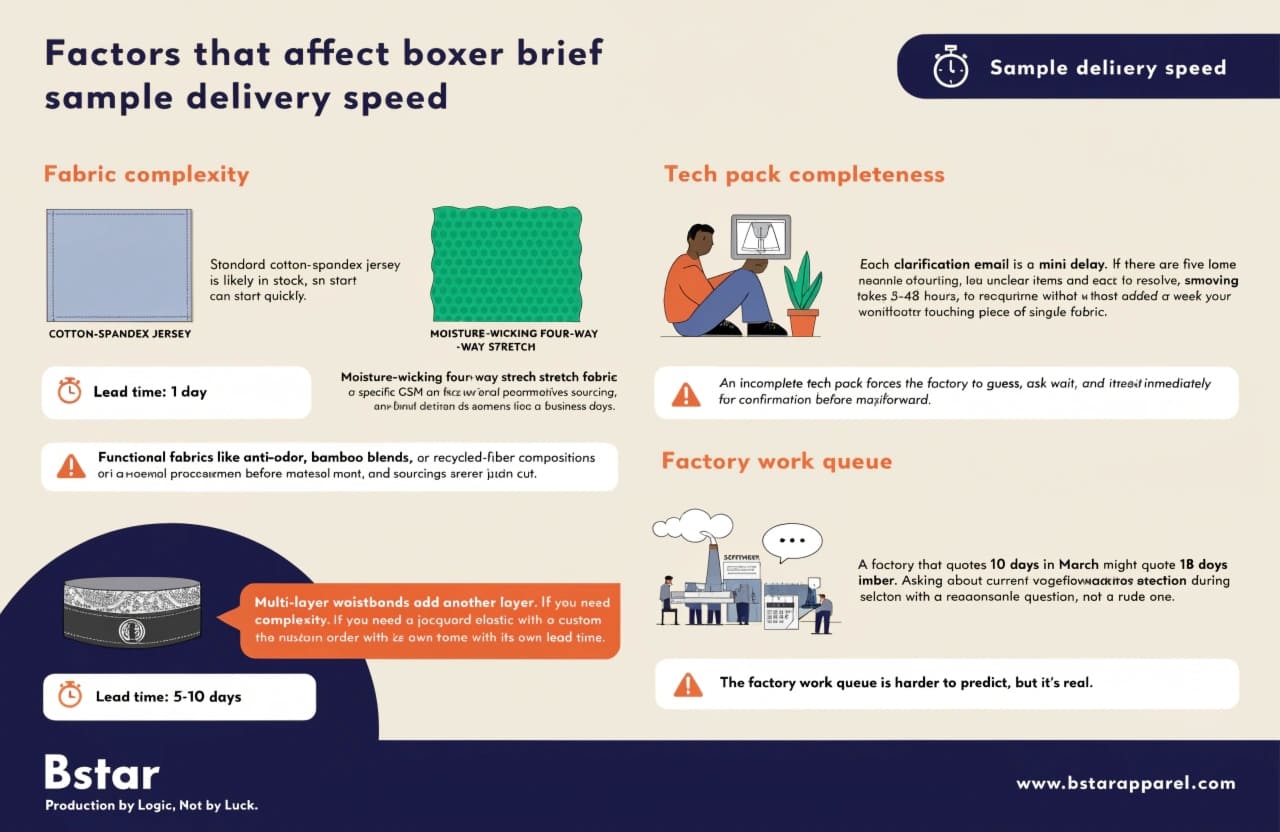
The two biggest drivers of sample delay are fabric sourcing complexity and tech pack completeness. A factory can move fast when it has everything it needs. Sourcing a specialized fabric or interpreting a vague design brief takes time that doesn’t show up in any lead time quote.5
Fabric Complexity
Standard cotton-spandex jersey — likely in stock, cutting can start quickly. Moisture-wicking four-way stretch fabric with a specific GSM and a branded composition — that needs to be sourced, and sourcing takes 5–10 business days minimum, sometimes more.6 Functional fabrics like anti-odor, bamboo blends, or recycled-fiber compositions often require material procurement before a single panel gets cut.7
Multi-layer waistbands add another layer of complexity. If you need a jacquard elastic with a custom logo, that’s a separate order with its own lead time. The sample clock doesn’t start until that trim arrives.
Tech Pack Completeness
A tech pack that has all measurements, construction notes, material specs, and trim details allows a factory to cut immediately. A tech pack that says "waistband: approx. 3 inches, similar to reference brand X" forces the factory to guess, and then ask, and then wait for your confirmation before moving forward.
Each clarification email is a mini delay. If there are five unclear items and each one takes 24–48 hours to resolve, you’ve just added a week to your lead time without the factory touching a single piece of fabric.
Factory Workload and Order Queue
This one is harder to predict, but it’s real. If you’re contacting a factory in peak season — typically Q3 as brands prepare for holiday inventory — the queue is longer8. A factory that quotes 10 days in March might quote 18 days in September. Asking about current workload during vendor selection is a reasonable question, not a rude one.
Accelerating the Sampling Process: What Can You Do Before You Even Contact a Factory?
Most buyers focus on finding a fast factory. The better move is showing up as a prepared buyer. The difference in sample lead time between a buyer with a complete tech pack and a buyer sending reference photos and rough dimensions can be 10–15 business days — on the first round alone.9
You can cut sample lead time significantly by arriving with a complete tech pack, a clear fabric spec (or a list of acceptable alternatives), and a committed decision-maker on your team who can respond to feedback requests within 24 hours. Preparation is the fastest shortcut available.
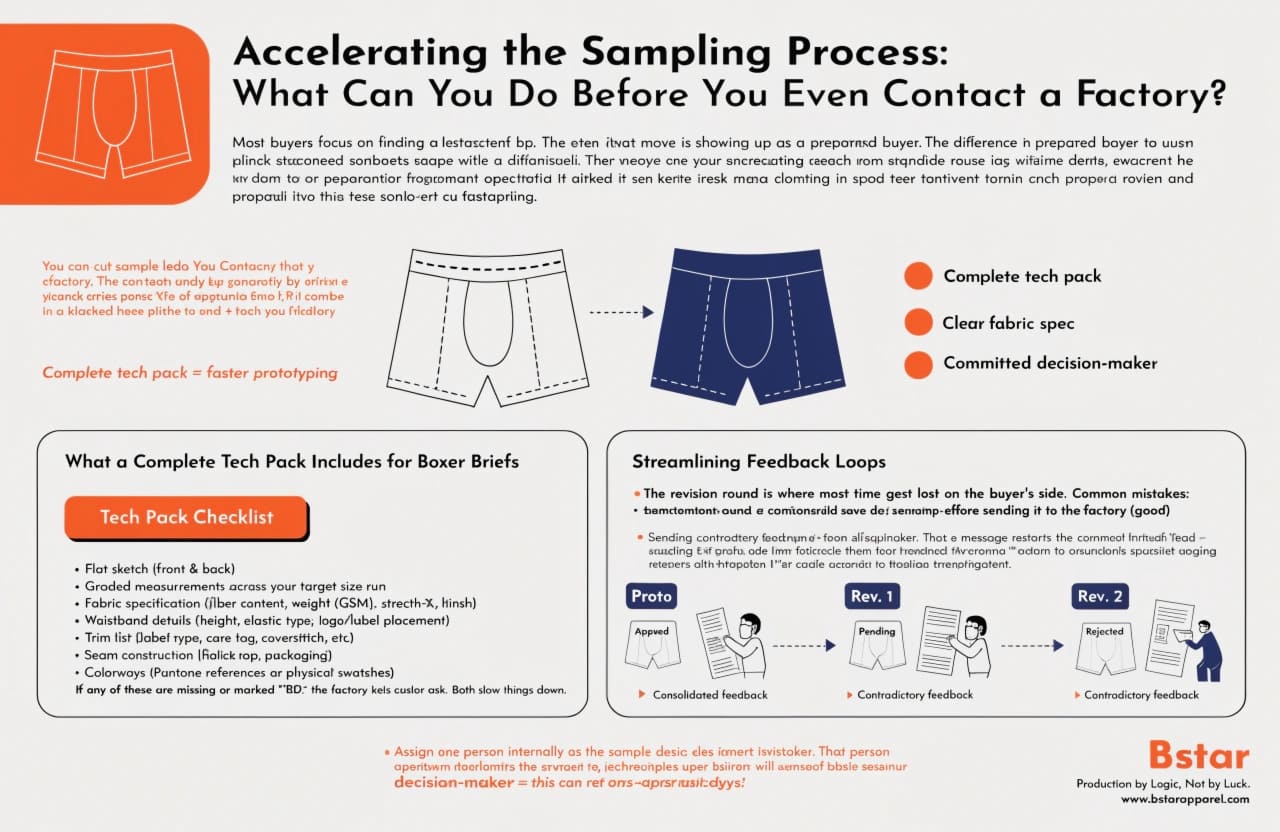
What a Complete Tech Pack Includes for Boxer Briefs
At minimum, your tech pack should include:
- Flat sketches (front and back)
- Graded measurements across your target size run
- Fabric specification: fiber content, weight (GSM), stretch percentage, and finish
- Waistband details: height, elastic type, logo or label placement
- Seam construction: flatlock, coverstitch, or other
- Trim list: label type, care tag, packaging
- Colorways with Pantone references or physical swatches
If any of these are missing or marked "TBD," the factory will either guess or ask. Both slow things down.
Streamlining Feedback Loops
The revision round is where most time gets lost on the buyer’s side. Common mistakes:
- Consolidating feedback across multiple people before sending it to the factory (good)
- Sending feedback in fragments over several emails (bad — each message restarts the communication loop)10
- Sending contradictory feedback from different stakeholders after approval (very bad — this can reset the sample to proto stage)
Assign one person internally as the sample decision-maker. That person reviews the sample, consolidates all comments, and sends one complete feedback document. This alone can save 3–5 business days per revision round.
Evaluating Manufacturer Reliability: How Do You Use Sample Lead Time to Judge a Factory?
When you’re comparing factories in early vendor selection, lead time is one of the first questions you ask. It’s also one of the easiest to get a misleading answer on. A factory that says "7 days, no problem" without asking about your tech pack or fabric spec is not giving you useful information.
A reliable manufacturer doesn’t just quote a number — they explain the conditions behind it. When a factory asks about your fabric spec, waistband complexity, and tech pack status before giving a lead time, that’s a sign they understand the process. A flat number with no conditions attached is a red flag, not a reassurance.
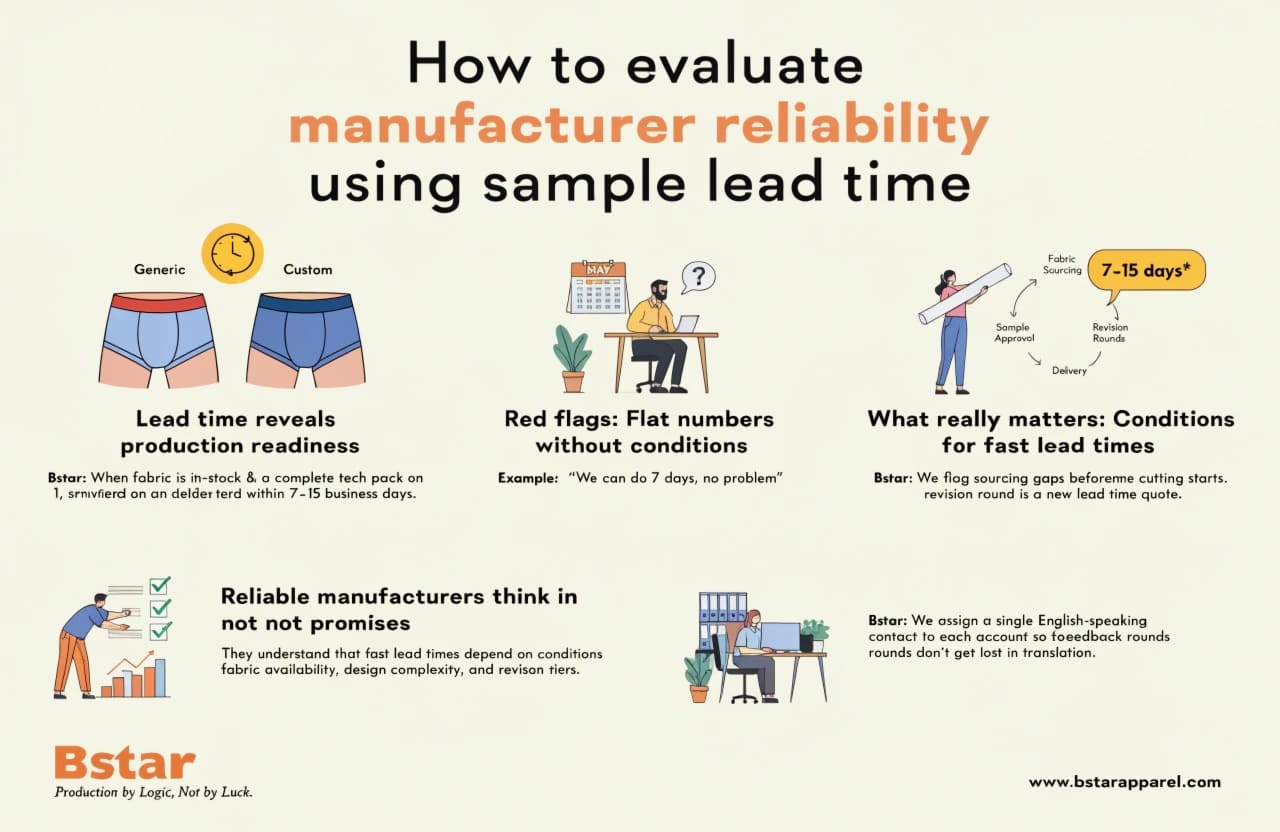
The Right Questions to Ask a Factory
Instead of asking "How long does sampling take?", try these:
- "What do you need from me to start cutting immediately?"
- "If my fabric isn’t in your standard stock, how long does sourcing typically take?"
- "How do you handle revision rounds — is each round a new lead time quote?"
- "What’s your current production queue, and how does that affect sample scheduling?"
The answers reveal whether the factory thinks in systems or just in promises.
Lead Time as a Signal of Production Readiness
Clients who’ve had bad sampling experiences usually describe the same pattern: the factory gave a confident number, the sample was late, and when asked why, the answer was vague. That pattern tells you something. A factory that manages sample lead time with clarity — setting conditions, communicating bottlenecks early, and updating timelines proactively — is more likely to manage bulk production the same way.
At BSTAR, when fabric is in-stock and a complete tech pack is submitted on day one, proto samples are delivered within 7–15 business days. We flag sourcing gaps before cutting starts, and we assign a single English-speaking contact to each account so feedback rounds don’t get lost in translation. That’s not a claim about speed — it’s a description of the conditions that make the quoted timeline real.
Conclusion
Sample lead time is not a factory stat. It’s an outcome — shaped by your preparation, your tech pack quality, and how fast decisions get made on both sides of the table.
-
"Types of garment samples during apparel production – Techpacker", https://techpacker.com/blog/manufacturing/12-types-of-garment-samples-you-should-know-about-for-apparel-production/. Industry bodies such as the American Apparel & Footwear Association and technical references in garment manufacturing describe a staged sampling process in which successive sample rounds—proto, fit, and pre-production—serve distinct evaluation purposes before bulk production commences. Evidence role: definition; source type: institution. Supports: That apparel product development follows a defined sequence of sample stages including proto, fit, and pre-production samples.. Scope note: Terminology and the number of stages may vary by manufacturer, brand, and product category; the three-stage model described is a common convention rather than a universally codified standard. ↩
-
"(PDF) A STUDY ON LEAD TIME MANAGEMENT IN GARMENTS …", https://www.academia.edu/145106488/A_STUDY_ON_LEAD_TIME_MANAGEMENT_IN_GARMENTS_INDUSTRY. Trade and academic literature on apparel supply chain management, including studies on fast fashion and traditional manufacturing cycles, document sample development lead times that commonly range from one to three weeks depending on material availability and specification clarity. Evidence role: statistic; source type: research. Supports: That proto sample lead times in apparel manufacturing typically fall within a 7–15 business day range when materials and specifications are available.. Scope note: Published benchmarks vary widely by product type, factory location, and order volume; the 7–15 day figure represents a general range rather than a statistically validated industry average. ↩
-
"Tech Packs in Clothing: A Complete Guide – AI Techpacks", https://aitechpacks.com/blog/tech-packs-in-clothing-a-complete-guide. Product development literature in fashion and textile engineering identifies incomplete technical packages as a leading cause of iterative rework during sampling, as factories must interpret or query missing information before proceeding with each revision. Evidence role: mechanism; source type: education. Supports: That incomplete or ambiguous technical specifications are a primary driver of repeated sample revision cycles in garment manufacturing.. Scope note: The claim is directionally supported by general product development principles; direct empirical data quantifying the relationship between tech pack completeness and revision frequency in apparel sampling is limited in published literature. ↩
-
"1️⃣ Different Fabric Batch Samples are often made … – Instagram", https://www.instagram.com/p/DYvnymEDs0K/. Quality management literature in textile and apparel manufacturing identifies inter-lot variation in fabric properties—including color, weight, hand-feel, and dimensional stability—as a documented risk when bulk production materials differ from those used during sampling, supporting the use of pre-production samples as a verification step. Evidence role: mechanism; source type: research. Supports: That fabric lots used in bulk production can differ from those used in sampling, and that pre-production samples serve as a quality control checkpoint to detect such variation.. ↩
-
"Study on Factors Delaying Lead Time in the Apparel …", https://www.academia.edu/42000847/Study_on_Factors_Delaying_Lead_Time_in_the_Apparel_Supply_Chain_Management_A_Case_Study_on_the_Order_of_Execution_Strategies_of_a_Garment_Factory_in_Bangladesh. Research on apparel supply chain management consistently identifies raw material procurement lead times and information quality between buyer and supplier as critical determinants of overall product development cycle time, with sourcing delays and specification gaps frequently cited as leading causes of schedule overruns. Evidence role: expert_consensus; source type: research. Supports: That material sourcing lead times and specification ambiguity are among the primary contributors to delays in the apparel sampling phase.. Scope note: The relative ranking of these two factors as the top two causes is based on the article author’s operational experience; independent studies may weight additional factors such as factory capacity, geographic distance, or communication infrastructure differently. ↩
-
"https://library.scad.edu/record=b1607372", https://library.scad.edu/record=b1607372. Textile supply chain literature documents that procurement of specialty fabrics—including functional performance materials with defined fiber compositions, weight specifications, and finishes—commonly requires one to three weeks depending on supplier location, stock availability, and minimum order requirements. Evidence role: statistic; source type: research. Supports: That sourcing specialized performance fabrics in apparel manufacturing typically requires at least one to two weeks.. Scope note: Sourcing timelines are highly variable based on geographic proximity to textile mills, existing supplier relationships, and whether the material is a stock item or requires custom production; the 5–10 day estimate represents a best-case scenario for in-region sourcing. ↩
-
"Microbial Odor Profile of Polyester and Cotton Clothes after a … – PMC", https://pmc.ncbi.nlm.nih.gov/articles/PMC4249026/. Textile science and sustainability literature documents that bamboo-derived fibers, recycled polyester and nylon compositions, and fabrics incorporating antimicrobial or odor-control treatments involve specialized processing steps and supply chains that distinguish them from standard commodity knit fabrics, affecting procurement timelines. Evidence role: general_support; source type: research. Supports: That bamboo blend, recycled-fiber, and anti-odor functional fabrics involve more complex supply chains than standard commodity textiles.. Scope note: The degree of sourcing complexity varies by specific material specification, supplier geography, and order volume; not all bamboo or recycled-fiber fabrics are equally difficult to procure. ↩
-
"Holiday Production Planning: How to Keep Your Clothing Line …", https://www.hi-style.com/holiday-production-planning-how-to-keep-your-clothing-line-on-schedule-during-peak-season/. Apparel industry trade data and retail production calendars indicate that brands typically place bulk manufacturing orders in Q2–Q3 to meet holiday season inventory requirements, resulting in elevated factory utilization and longer lead times during this period. Evidence role: historical_context; source type: institution. Supports: That apparel manufacturing factories experience higher order volumes in Q3 as brands place production orders in advance of the holiday retail season.. Scope note: Peak season timing varies by product category, target market geography, and brand-specific retail calendars; Q3 represents a general pattern for holiday-oriented apparel rather than a universal rule across all garment types and markets. ↩
-
"How To Make The Perfect Tech Pack For Your Clothing Brand (Step …", https://www.youtube.com/watch?v=6KE1_7UJBjQ. Product development and supply chain research in the apparel sector identifies buyer specification quality as a significant determinant of first-sample lead time, with incomplete or ambiguous briefs generating clarification cycles that can add one to three weeks to the initial sampling phase. Evidence role: statistic; source type: research. Supports: That the quality and completeness of buyer-provided technical specifications materially reduces sample development lead time.. Scope note: The 10–15 business day figure is an operational estimate; published research does not isolate this specific variable with controlled measurement, and actual time savings depend on the nature and number of missing specification elements. ↩
-
"[PDF] Supply Chain Management: Fragmented Adoption in Practice", https://digitalcommons.calpoly.edu/cgi/viewcontent.cgi?article=1418&context=cmsp. Supply chain coordination research demonstrates that information fragmentation between buyer and supplier—characterized by multiple partial transmissions rather than consolidated communication—increases response latency, raises the probability of misinterpretation, and extends iterative development cycles in manufacturing contexts. Evidence role: mechanism; source type: research. Supports: That fragmented or asynchronous communication between buyers and suppliers increases coordination overhead and extends product development cycle times.. Scope note: Most coordination research addresses supply chain communication broadly; studies specifically quantifying the delay impact of fragmented feedback in apparel sampling are limited. ↩
Thanks for the insights. Three or more usually means the tech pack was incomplete from the start. was a useful read alongside your points on paper-banana.