
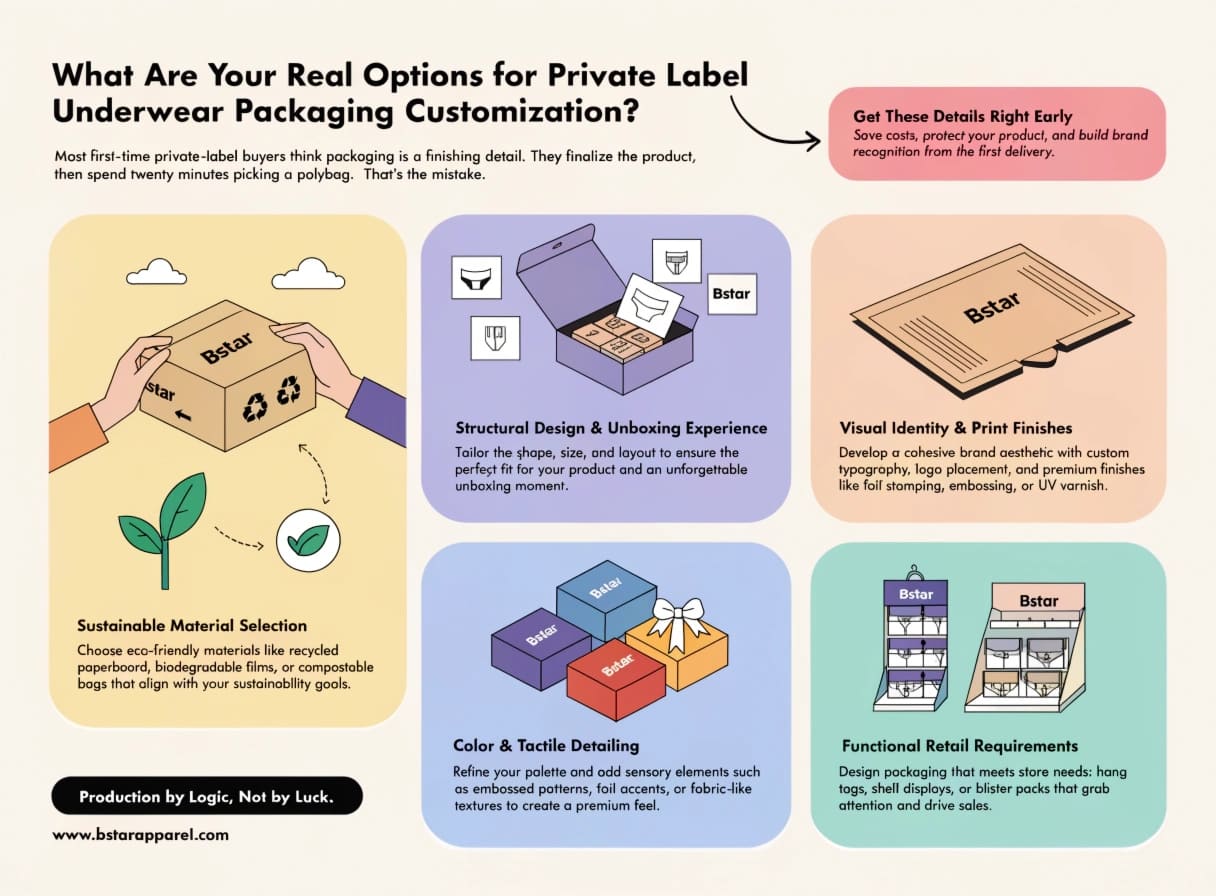
What Are Your Real Options for Private Label Underwear Packaging Customization?
Most first-time private-label buyers think packaging is a finishing detail. They finalize the product, then spend twenty minutes picking a polybag. That’s the mistake.
Private label underwear packaging customization covers five main areas: sustainable material selection, structural design and unboxing experience, visual identity and print finishes, color and tactile detailing, and functional retail requirements. Getting these right early saves cost, protects the product, and builds real brand recognition from the first delivery.
Packaging is the first physical thing your customer touches. Before they try the product on, before they read a review, they open a box or pull something out of a bag. That moment is working for your brand or against it. The buyers I talk to at the earliest stage of their first run often don’t realize how many real decisions sit inside that moment—or how accessible the options actually are.
Are You Choosing the Right Packaging Material for Your Brand Stage?
A lot of buyers come to us having already decided on a material without knowing what else was available. They picked it because it looked familiar, not because it fit their product or their customer.
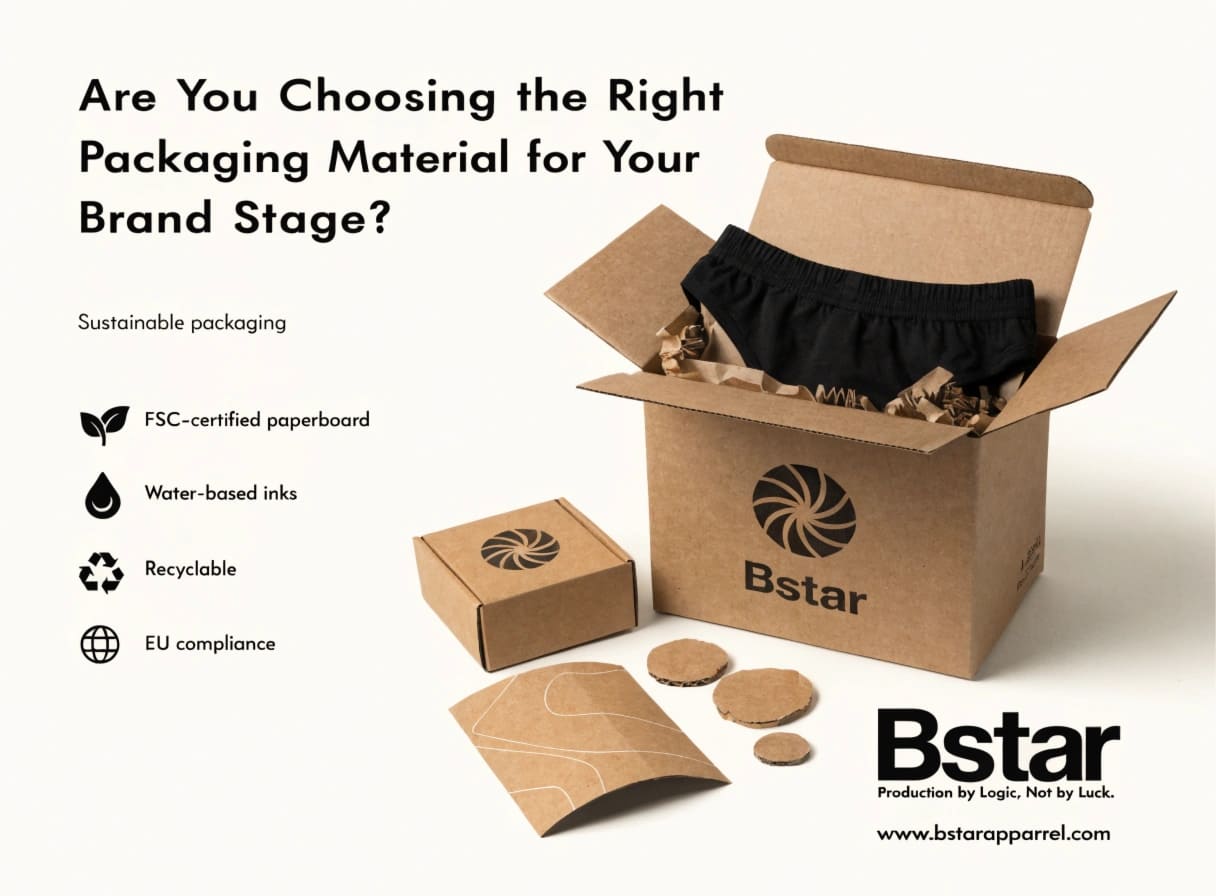
Sustainable substrates like FSC-certified paperboard and water-based ink printing are now practical at lower order quantities than most buyers expect1. These materials reduce your environmental footprint, meet EU retail compliance requirements2, and signal brand seriousness to conscious consumers—without automatically pushing your per-unit cost out of range.
The question I hear often in early conversations is: "Do I need to go sustainable, or is that just a premium option?" The honest answer is that it depends on your channel and your customer, but ignoring it is increasingly a risk.
What Sustainable Packaging Actually Means in Practice
"Sustainable packaging" is not one thing. It’s a set of decisions across material, process, and certification.
| Decision Area | Standard Option | Sustainable Option | Practical Impact |
|---|---|---|---|
| Paperboard source | Uncertified stock | FSC-certified | Required by some EU retailers |
| Ink type | Solvent-based | Water-based or soy-based | Lower VOC output, better recyclability3 |
| Coating | Plastic laminate | Matte aqueous coating | Still premium feel, more recyclable |
| Insert cards | Virgin paper | Recycled or seed paper | Strong DTC brand story potential |
If you’re selling into European boutiques or building a DTC brand with sustainability as part of the positioning, these choices are not optional extras. They are table stakes. If you’re selling through a marketplace and your buyer never sees the outer packaging, the calculus is different. The material decision should follow the channel decision, not precede it.
At BSTAR, the materials we source for packaging—like the yarns and fabrics we use in production—carry recognized certifications including FSC and OEKO-TEX. That matters because it means the chain of custody is documented, which buyers increasingly need to prove to their own retail partners4.
Does Your Packaging Structure Actually Create a Brand Moment?
Here’s a question I get from DTC founders more than any other: "Will anyone really notice the box?" My answer is always the same. Your customer won’t consciously analyze it. But they’ll feel it. And that feeling becomes their first association with your brand5.
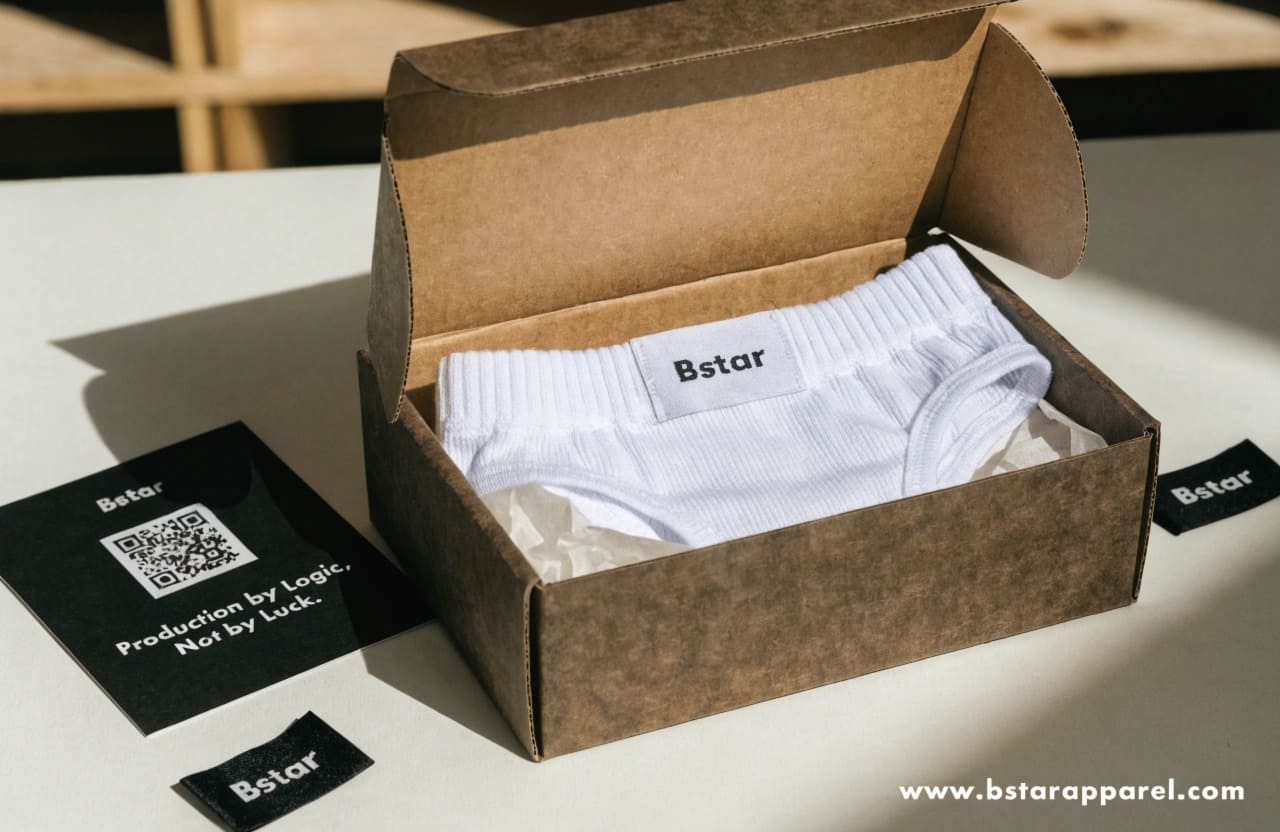
The unboxing experience is determined by structural choices: box type, closure method, interior arrangement, and finishing treatments6 like soft-touch lamination, spot UV, or foil stamping. These elements together create the physical signal that tells a customer whether they bought something ordinary or something worth remembering.
The mistake I see most often is buyers choosing a structure that’s either too cheap for their price point or too elaborate for their volume stage. Both create problems.
Matching Structure to Brand Stage
A startup selling 300 units on Shopify does not need a rigid gift box with magnetic closure and a ribbon pull. That’s a cash flow and storage problem before it’s a brand asset. But that same founder does need something better than a plain polybag with a printed sticker. The middle ground is where most brands actually live.
| Brand Stage | Recommended Structure | Why It Works |
|---|---|---|
| Early DTC, under 500 units | OPP self-seal bag + printed insert card | Low MOQ, flexible, easy to ship |
| Growing DTC, 500–2000 units | Kraft or coated paper box with hang tag | Professional retail look, storable |
| Wholesale or boutique launch | Rigid or semi-rigid box, soft-touch finish | Shelf presence, buyer impression |
| Gift or premium tier | Full rigid box, foil detail, tissue paper | Justifies higher price point |
Structural finishing techniques—embossing, debossing, spot UV coating, soft-touch laminate—don’t require enormous minimums. They do require planning lead time. That’s the practical constraint most buyers don’t account for. The earlier you lock the structure, the more finish options stay on the table.
How Do You Get the Visual Identity Right Without Overspending on Print?
Color is where brand identity becomes tangible. And it’s also where buyers most often get disappointed—because what they approved on screen doesn’t match what arrived in the box.
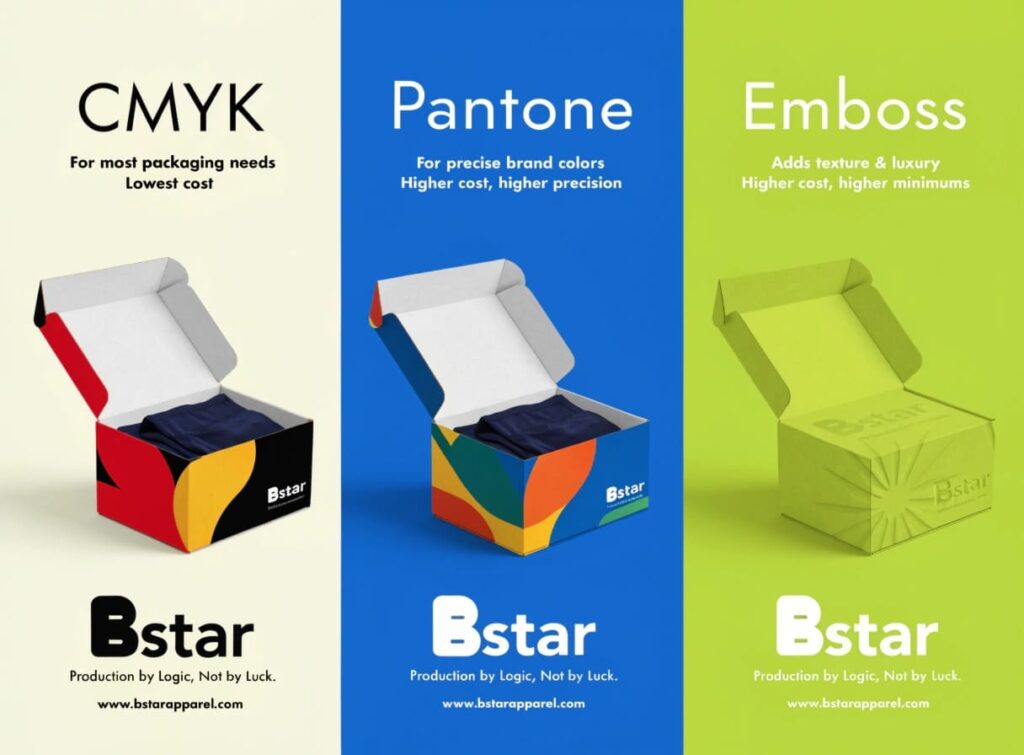
CMYK printing covers most standard packaging needs at the lowest cost. Pantone color matching is used when brand colors must be exact and consistent across materials7. Tactile finishes like embossing and foil stamping add dimension that printing alone cannot achieve. Each option has a different cost tier and minimum quantity implication.
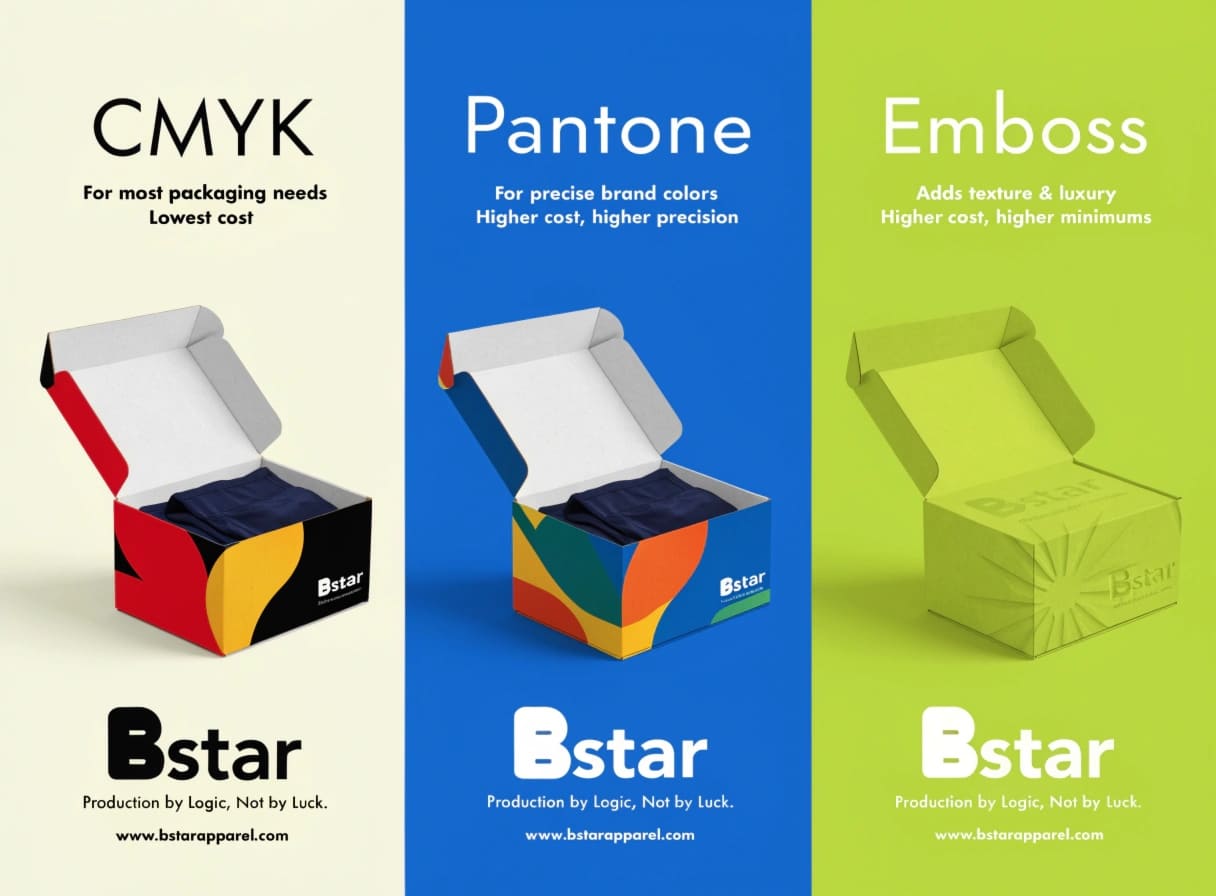
The most common situation I see: a buyer has a carefully designed brand identity with a specific shade of navy or coral, and they approved a CMYK proof without requesting Pantone matching. The final packaging comes back close but not right. That gap feels small in isolation and enormous on a retail shelf next to your competitor.
Understanding Your Print Options
CMYK vs. Pantone: When Each One Makes Sense
CMYK (four-color process printing) is the default for most packaging. It handles photography, gradients, and multi-color designs well. It’s cost-effective and widely available. Use it when your design has many colors or photographic elements, and when slight color variation across print runs is acceptable.
Pantone matching is worth the additional cost when your brand has one or two signature colors that must be exact. If your brand color is the thing that differentiates your packaging on a shelf—or if you’re printing across multiple materials like hang tags, boxes, and bags and need them to match—Pantone is the right call.
Tactile Finishes: What They Do and When They’re Worth It
Embossing raises your logo or design element physically off the surface. Debossing presses it in. Foil stamping adds a metallic or holographic layer. Spot UV creates a glossy contrast on a matte surface8.
None of these are "luxury only." They are increasingly expected in the mid-tier DTC market. A soft-touch matte box with a debossed logo costs more per unit than a plain printed box. But it communicates something that a printed logo on gloss stock cannot9. If your product sits in the $25–$60 price range and you’re asking customers to buy direct, the packaging needs to carry the weight of what a physical retail environment would otherwise provide10.
What Does Functional Packaging Actually Need to Do at Retail?
Aesthetics matter. But packaging also has to work. That means protecting the product in transit, displaying it clearly at point of sale, and making fulfillment practical at your volume.
Functional underwear packaging needs to protect against moisture and handling damage during shipping, allow product visibility where retail requires it, and stack or hang efficiently in a warehouse or store environment. Mesh window panels, hang holes, and self-seal enclosures each address a specific functional need—and the right combination depends on your sales channel.
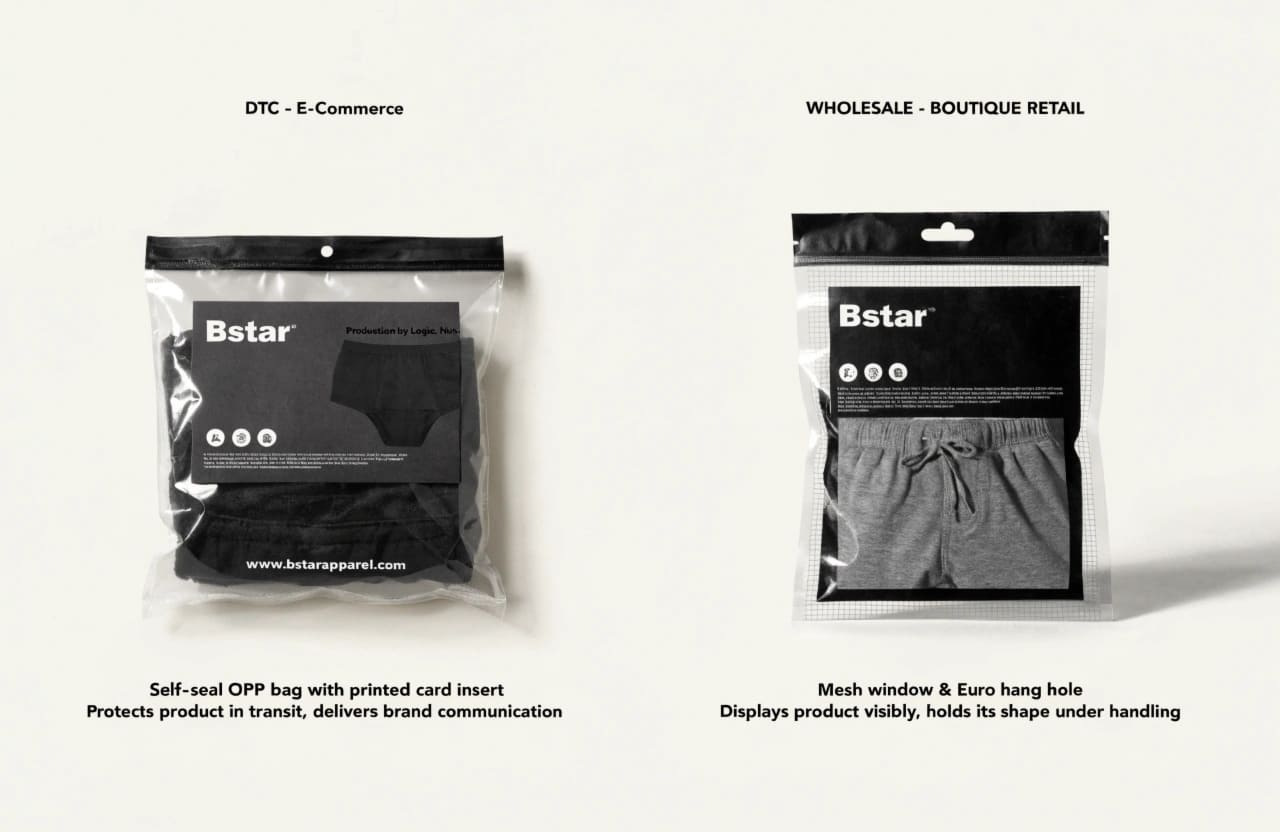
A question that comes up often at this stage: "Can I use one packaging format for both DTC shipping and wholesale?" Sometimes yes, but not always without modification. What ships well in a mailer doesn’t always display well on a hook or shelf11.
Functional Requirements by Channel
For DTC / E-commerce
Your packaging travels in a mailer or poly bag. The main risks are moisture, crushing, and transit handling. A self-seal OPP bag with a printed card insert protects the product and delivers brand communication. You don’t need retail hang holes. You do need clear product identification in case of a return.
For Wholesale / Boutique Retail
Your packaging sits on a shelf or hangs on a rack. Visibility matters. A mesh or PVC window lets the buyer see color and texture without opening the package12. A Euro hang hole at the top lets it display on standard retail hardware. The packaging needs to hold its shape after being handled repeatedly.
For Both Channels (Hybrid)
Some brands run one SKU across both channels. In that case, design for the more demanding environment—retail display—and simplify from there. A hang-hole box with a window panel works in both contexts. A plain polybag does not.
The practical constraint is always MOQ and lead time. Functional packaging components like window panels and custom inserts add steps to the production process. Building this into your timeline from the start—not as an afterthought—keeps the options open.
Conclusion
Underwear packaging is a brand decision, not a detail. Know your channel, match your format to your stage, and lock the spec before production starts.
-
"Need for Sustainable Packaging: An Overview – PMC – NIH", https://pmc.ncbi.nlm.nih.gov/articles/PMC9609329/. The Forest Stewardship Council maintains a public database of certified suppliers across packaging material categories, indicating broad market availability of certified stock across supplier tiers; however, specific MOQ thresholds vary by supplier and are not standardized by FSC certification requirements. Evidence role: general_support; source type: institution. Supports: That FSC-certified materials are available through certified supply chains at varying volume levels. Scope note: FSC certification governs chain-of-custody documentation, not commercial order minimums; MOQ accessibility is a market condition claim that requires supplier-level data rather than certification body documentation. ↩
-
"Packaging waste – Environment – European Commission", https://environment.ec.europa.eu/topics/waste-and-recycling/packaging-waste_en. The European Union’s revised Packaging and Packaging Waste Regulation (PPWR), proposed by the European Commission in 2022 and advancing through legislative process, establishes recyclability and recycled-content requirements for packaging placed on the EU market, providing a regulatory basis for material selection decisions by brands entering European retail. Evidence role: historical_context; source type: government. Supports: That EU regulatory frameworks impose sustainability-related requirements on packaging materials sold into European retail channels. Scope note: The PPWR was still in legislative process as of 2024; specific compliance timelines and thresholds differ by packaging category and member state implementation, so the claim that these materials ‘meet’ requirements should be verified against the final enacted text. ↩
-
"Control Of Voc Emissions From Ink and Paint Manufacturing …", https://nepis.epa.gov/Exe/ZyPURL.cgi?Dockey=2000MU8Z.TXT. Research on printing ink chemistry documents that solvent-based inks release volatile organic compounds during drying through solvent evaporation, while water-based formulations use water as the primary carrier, substantially reducing VOC emissions; soy-based inks have similarly been studied for their compatibility with paper deinking processes used in recycling. Evidence role: mechanism; source type: paper. Supports: That water-based and soy-based inks emit fewer volatile organic compounds than solvent-based inks and present fewer barriers to paper recycling. Scope note: VOC reduction magnitude varies by specific formulation and application method; recyclability improvement depends on the deinking process used at the receiving recycling facility, which is not uniform across markets. ↩
-
"[PDF] FSC Standards for Chain of Custody – Indiana State Government", https://www.in.gov/dnr/forestry/files/FSC-COC_Certification_of_Multiple_Sites.pdf. The Forest Stewardship Council’s chain-of-custody certification standard is designed to allow certified businesses to demonstrate to customers and trading partners that FSC-certified materials have been tracked through the supply chain; the FSC notes that retailers and brand owners use this documentation to substantiate sustainability claims in procurement and marketing contexts. Evidence role: expert_consensus; source type: institution. Supports: That FSC chain-of-custody certification is used by brands to demonstrate material provenance to retail buyers. Scope note: The FSC’s own documentation describes the purpose of chain-of-custody certification but does not constitute independent evidence of how frequently or strictly retail buyers enforce such requirements in practice. ↩
-
"Hand-Feel Touch Cues and Their Influences on Consumer … – PMC", https://pmc.ncbi.nlm.nih.gov/articles/PMC6678767/. Consumer behavior research has documented that packaging attributes including material texture, weight, and structural quality influence product quality perception and brand evaluation, with studies indicating that haptic cues can affect willingness to pay and brand attitude independent of explicit product assessment. Evidence role: mechanism; source type: paper. Supports: That physical and sensory properties of packaging influence consumer brand perception and emotional response. Scope note: Research findings on packaging sensory effects vary by product category, consumer segment, and cultural context; the specific claim about ‘first association’ formation is a simplification of a more complex and context-dependent psychological process. ↩
-
"Packaging Design: Unboxing with Memorable Experience", https://www.ijsrtjournal.com/article/Packaging-Design:-Unboxing-with-Memorable-Experience. Academic and industry research on direct-to-consumer retail has identified the unboxing moment as a distinct touchpoint in the customer experience, with studies noting its role in social sharing behavior, repeat purchase intent, and perceived brand quality, particularly in categories where physical retail interaction is absent. Evidence role: general_support; source type: paper. Supports: That the unboxing experience influences consumer brand perception and has become a recognized element of DTC brand strategy. Scope note: Much published research on unboxing draws from marketing practitioner literature or platform-specific data rather than controlled experimental studies; effect sizes and generalizability across product categories remain incompletely established. ↩
-
"Pantone – Wikipedia", https://en.wikipedia.org/wiki/Pantone. The Pantone Matching System (PMS) is a proprietary color space used in a variety of industries, primarily printing, in which colors are identified by a standardized numerical code, allowing printers using different equipment and substrates to reproduce a specified color with greater consistency than is achievable through process color mixing alone. Evidence role: definition; source type: encyclopedia. Supports: That the Pantone Matching System provides standardized color references used to achieve consistency across different printing substrates and processes. Scope note: Pantone color accuracy on physical substrates still varies by material type, surface finish, and ink absorption; the system reduces but does not eliminate cross-material color variation. ↩
-
"What is Spot UV Printing? | Pakfactory Blog", https://pakfactory.com/blog/learn/what-is-spot-uv/?srsltid=AfmBOoqvnProQq1WcOf6YDtXew9uSiV8ML-fGC5msJbmrTrDXIGfltGy. Spot UV coating is a print finishing technique in which ultraviolet-cured varnish is applied selectively to designated areas of a printed substrate, creating a high-gloss effect that contrasts with surrounding matte or uncoated surfaces; the process is used in packaging and commercial printing to add visual and tactile differentiation to specific design elements. Evidence role: definition; source type: encyclopedia. Supports: That spot UV is a printing finishing process that applies ultraviolet-cured varnish to selected areas of a printed surface to create localized gloss contrast. ↩
-
"The Impact of Visual Elements of Packaging Design on Purchase …", https://pmc.ncbi.nlm.nih.gov/articles/PMC11851823/. Research in consumer psychology and packaging science has found that material quality cues, including surface texture and finish, function as extrinsic quality signals that influence product value perception and purchase intent, with effects documented across apparel, cosmetics, and consumer goods categories. Evidence role: expert_consensus; source type: paper. Supports: That packaging material quality and tactile finish influence consumer perception of product value and brand positioning. Scope note: Studies on packaging quality perception are often conducted in controlled settings or specific product categories; the claim that premium finishes are ‘increasingly expected’ at a specific price tier reflects a market trend assertion that would require longitudinal consumer survey data to substantiate directly. ↩
-
"What signal are you sending? How website quality influences …", https://experts.arizona.edu/en/publications/what-signal-are-you-sending-how-website-quality-influences-percep/. Research on direct-to-consumer retail and online purchase behavior has identified packaging as a critical post-purchase touchpoint that shapes product quality perception and brand evaluation in the absence of pre-purchase physical inspection, with scholars noting that packaging quality signals function as proxies for the store environment and sales interaction that brick-and-mortar retail provides. Evidence role: mechanism; source type: paper. Supports: That in direct-to-consumer channels, packaging serves as a primary physical brand touchpoint that compensates for the absence of in-store environmental cues. Scope note: The specific price range cited ($25–$60) as a threshold for premium packaging investment is a practitioner heuristic rather than a finding from consumer research; the underlying mechanism of packaging as a retail environment substitute has research support, but the price-point framing does not. ↩
-
"E-commerce Packaging vs. Retail Packaging (What’s the Difference?)", https://atlaspackaginginc.com/e-commerce-packaging-vs-retail-packaging/?. The International Safe Transit Association (ISTA) and packaging industry standards bodies document distinct performance requirements for packages intended for parcel shipping versus retail shelf display, including differences in compression resistance, moisture barrier needs, and structural integrity under repeated handling, supporting the principle that channel-specific packaging design is a recognized engineering consideration. Evidence role: general_support; source type: institution. Supports: That e-commerce and retail display environments impose different structural and functional requirements on packaging design. Scope note: Formal packaging standards address structural performance thresholds rather than brand communication outcomes; the article’s broader claim about display effectiveness combines engineering and marketing considerations that are not jointly addressed in a single standards document. ↩
-
"Eye-Tracking Evidence on How Product Visual Strategy … – PMC", https://pmc.ncbi.nlm.nih.gov/articles/PMC13010595/. Consumer research on retail packaging has found that product visibility through transparent or windowed packaging reduces purchase uncertainty by allowing consumers to evaluate product attributes such as color, texture, and quality prior to purchase, with studies in apparel and consumer goods categories documenting positive effects on purchase intent. Evidence role: mechanism; source type: paper. Supports: That packaging transparency and product visibility at point of sale influence consumer purchase decisions in retail environments. Scope note: Effect sizes vary by product category and retail context; the specific claim about mesh versus PVC window materials is a practical design consideration not directly addressed in consumer behavior literature. ↩
Discussion & questions 0 comments