
What Materials Actually Work for Thermal Underwear in Winter Sports?
Winter sports buyers lose money not because they picked a bad fabric—but because they matched the wrong fabric to the wrong activity.
Thermal underwear for winter sports needs to balance heat retention, moisture movement, and body-temperature regulation. The right material depends entirely on the sport: high-output skiing demands fast moisture evacuation, while cold-weather hiking needs retained warmth with minimal bulk. There is no single best fabric.
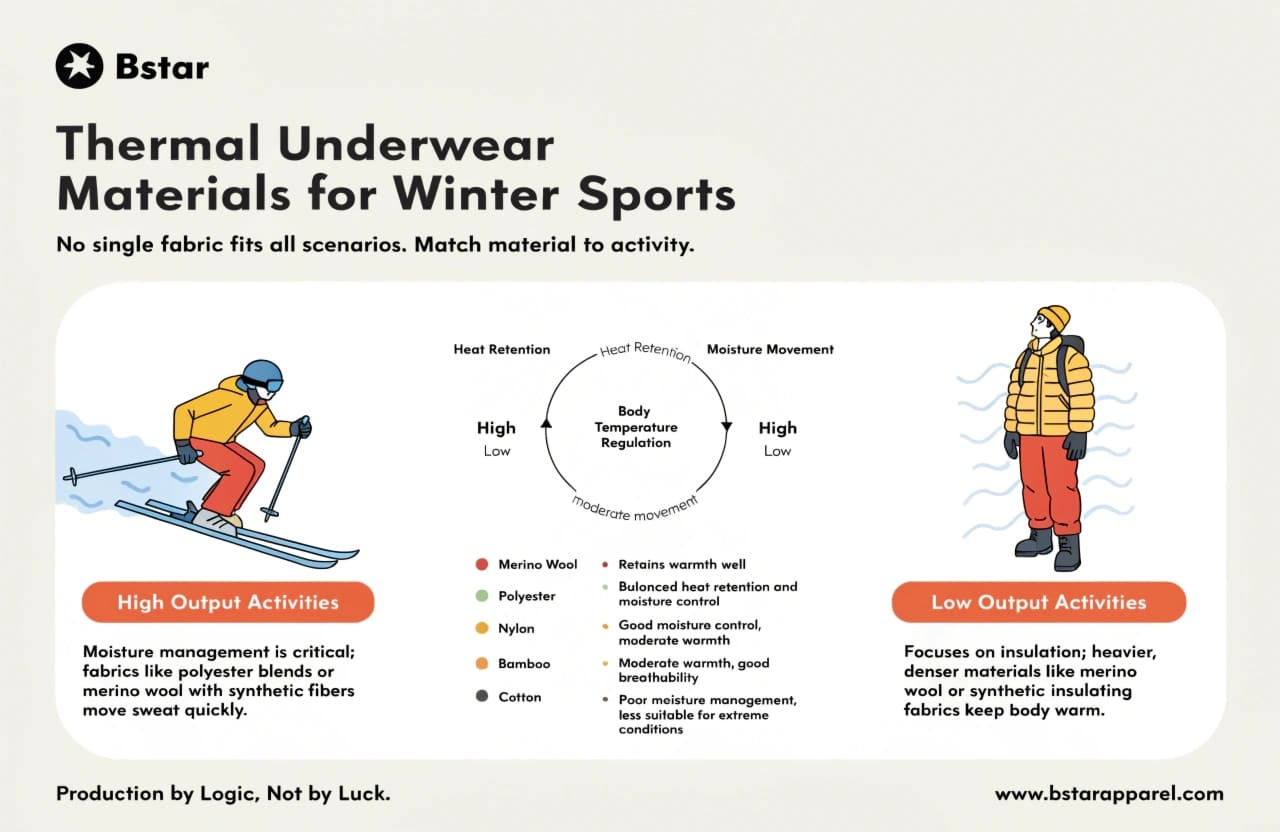
Most buyers I talk to come in with a GSM range and a fiber preference. That’s a starting point—but it’s not a brief. At BSTAR, we’ve spent 19 years adjusting knit structures and fiber blends for exactly the kind of scenario gaps that don’t show up on a spec sheet. What I want to walk you through here is the actual decision logic—material category by material category—so you can write a brief that matches your end customer’s real conditions.
Performance Fiber Blends: Does Merino Wool Always Win?
Every season, a buyer comes to us convinced that merino is the only answer for premium winter sports base layers. It’s not wrong—but it’s not always right either.
Merino wool regulates temperature naturally and resists odor, making it a strong choice for low-to-mid intensity activity in dry cold. But hollow polyester and synthetic blends move moisture faster, recover shape better after repeated wash cycles, and cost significantly less per unit at production scale.
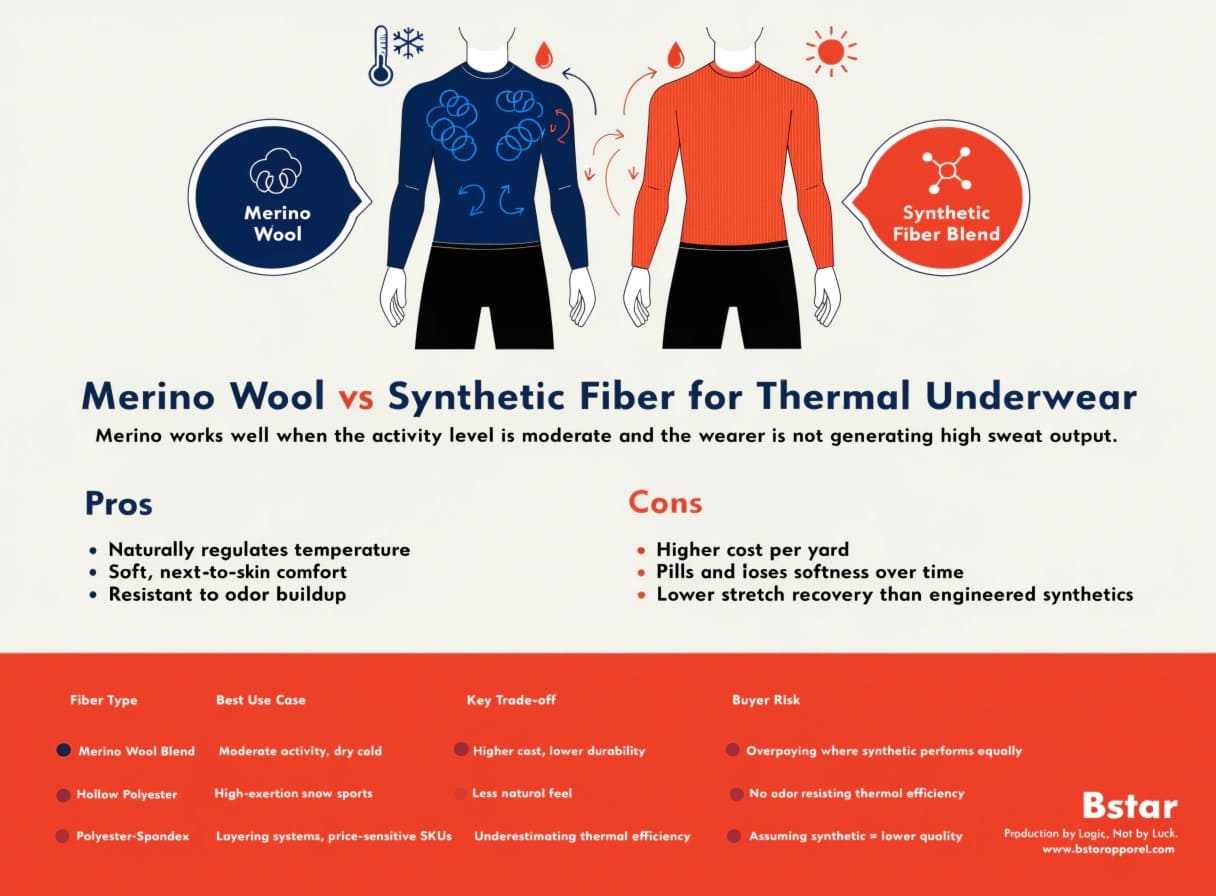
Here’s how I think about the fiber decision in practice:
Merino Wool
Merino works well when the activity level is moderate and the wearer is not generating high sweat output. It handles temperature swings reasonably well, and it has a next-to-skin softness that synthetic fibers haven’t fully matched. But merino pills faster, costs more, and has weaker stretch recovery than engineered synthetic knits. For a DTC brand targeting recreational skiers or casual winter hikers, merino blends—typically 70% merino / 30% nylon—offer a balance of performance and price.
Hollow Polyester
Hollow-core polyester traps air within each fiber strand. That air layer adds thermal insulation without adding weight. Based on our production experience, hollow polyester constructions consistently outperform heavier GSM fleece in high-exertion skiing conditions because they move sweat away from the skin faster. Buyers who anchor on GSM as a proxy for warmth end up overspecifying weight and underspecifying structure.
Synthetic Blends for Performance
Polyester-spandex and nylon-spandex constructions are not low-end fabrics. When engineered for four-way stretch, moisture transfer, and layering compatibility, they deliver performance that merino cannot match at scale or at price point. For a brand building a mid-tier ski base layer at a competitive retail price, a 90% polyester / 10% spandex jersey with a dual-layer wicking knit structure will serve the end customer better than a heavier merino blend at twice the cost.
| Fiber Type | Best Use Case | Key Trade-off | Buyer Risk |
|---|---|---|---|
| Merino Wool Blend | Moderate activity, dry cold | Higher cost, lower durability | Overpaying where synthetic performs equally |
| Hollow Polyester | High-exertion snow sports | Less natural feel | Underestimating thermal efficiency |
| Polyester-Spandex | Layering systems, price-sensitive SKUs | No odor resistance | Assuming synthetic = lower quality |
Advanced Moisture Management: How Does Fabric Actually Move Sweat?
A skier generates a lot of heat. That heat becomes a problem the moment they stop moving—if sweat is sitting against their skin, body temperature drops fast.
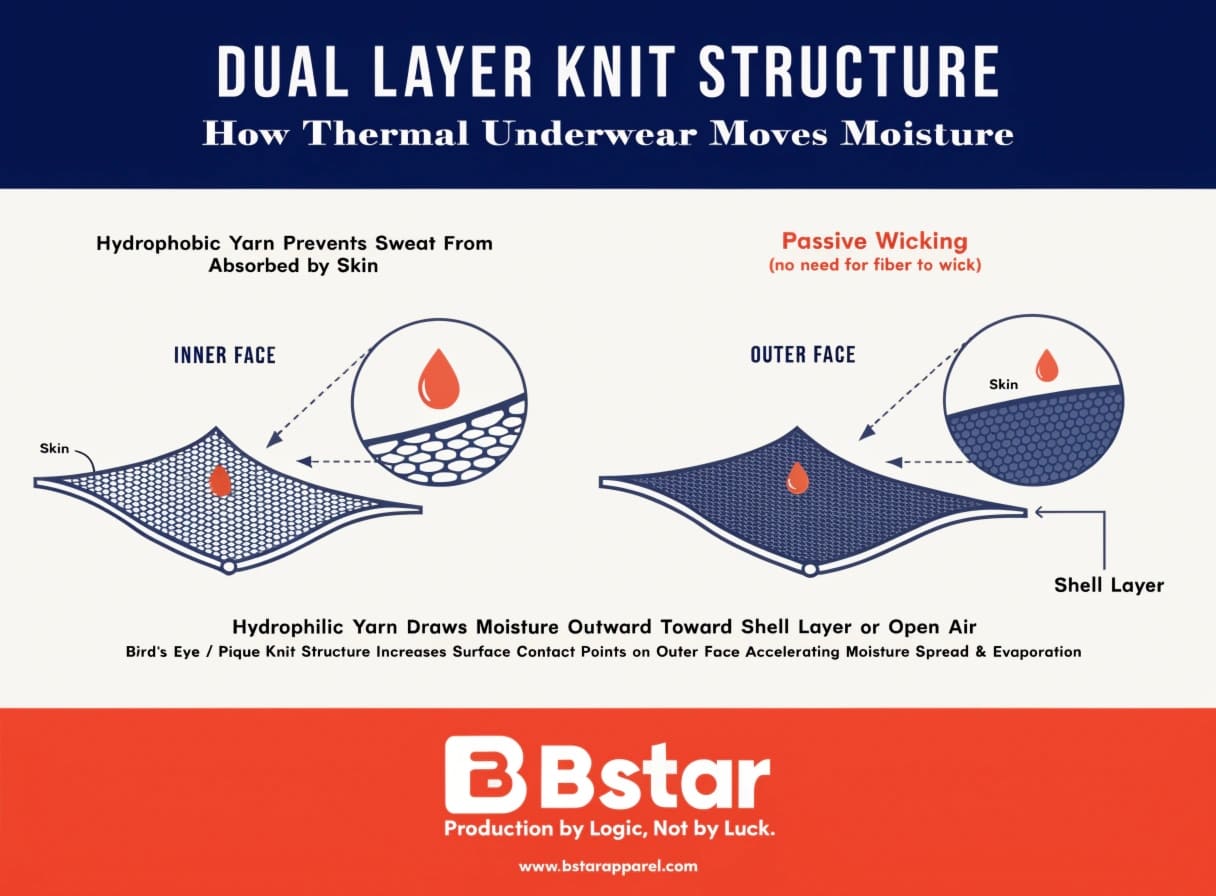
Moisture management in thermal underwear depends on fabric construction, not fiber content alone. Dual-layer knit structures—with a hydrophobic inner face and a hydrophilic outer face—move moisture away from skin passively, without relying on the fiber to wick.
When a client came to us with a ski base layer brief and asked for a "fast-dry merino," we had to push back. Merino absorbs moisture before it releases it—that’s part of how it regulates temperature. But in a high-intensity ski scenario, absorption isn’t the goal. Evacuation is.
What Dual-Layer Construction Actually Does
The inner face of the fabric—what touches skin—is made from a hydrophobic yarn that resists absorbing moisture. Sweat has nowhere to go except outward. The outer face is made from a hydrophilic yarn that draws the moisture further out toward the shell layer or the open air. The result is a drier skin surface even during peak exertion.
Knit Structure Matters as Much as Fiber
A flat single-jersey construction in 100% polyester will wick passively, but not efficiently. A bird’s-eye or pique knit structure increases surface contact points on the outer face, which accelerates moisture spread and evaporation. We adjusted the knit structure—not the fiber blend—for a client’s ski base layer when they reported that the fabric felt wet too quickly after short runs. The fiber content stayed the same. The construction changed.
Quick-Dry vs. Moisture-Wicking: These Are Different Things
Moisture-wicking moves sweat away from skin. Quick-dry refers to how fast the fabric surface releases that moisture into the air. Both matter, but they respond to different construction decisions. Wicking speed is primarily a function of knit structure and fiber surface treatment. Dry time is primarily a function of fabric weight and weave density. Buyers who treat these as the same spec often end up with a fabric that wicks fast but stays damp for a long time.
Active Heating Technologies: Are PCM and Electric Heating Worth the Investment?
Phase change materials and electric heating elements show up in premium winter sports briefs more often than they used to. The question isn’t whether they work—it’s whether they match the brand’s supply chain and end customer’s use case.
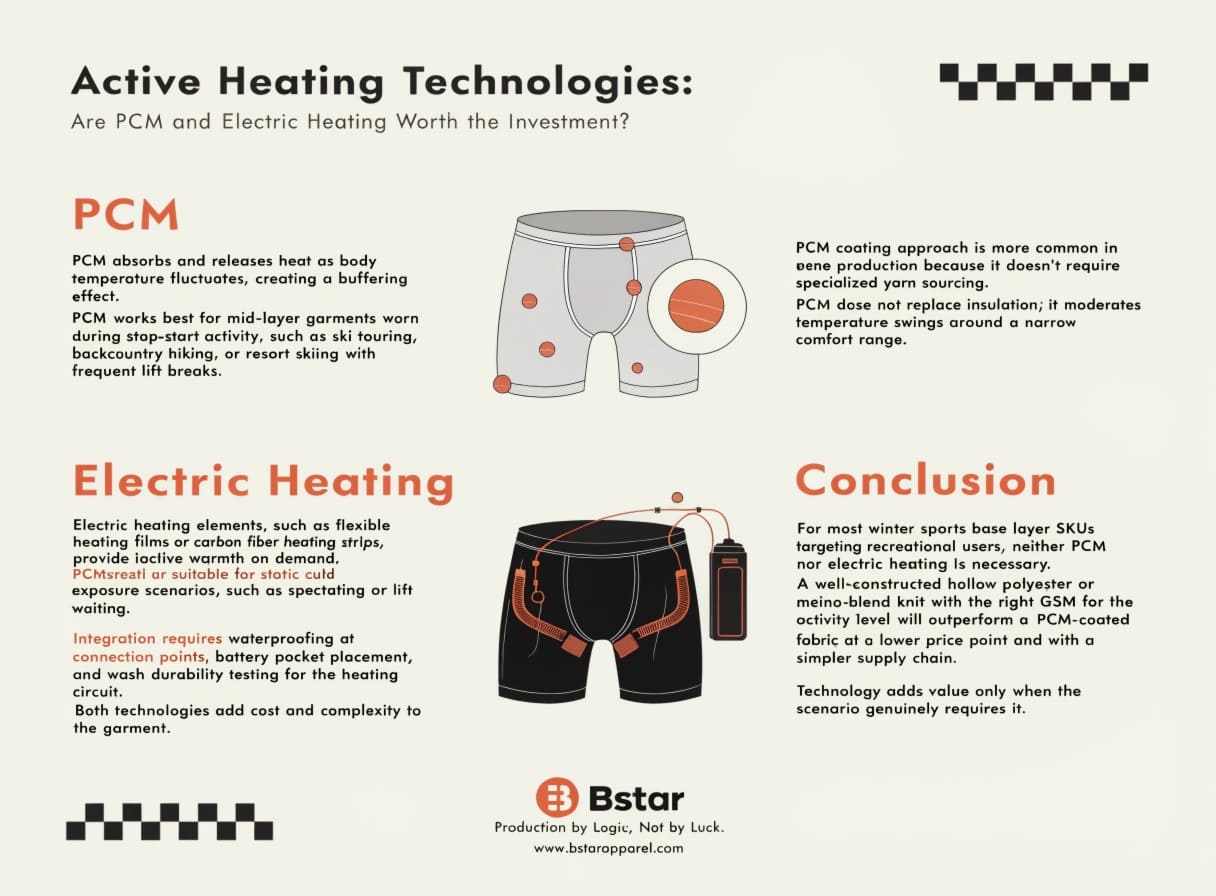
Phase change materials (PCM) absorb and release heat as the body temperature fluctuates, creating a buffering effect. Electric heating elements add active warmth on demand. Both add cost and complexity. PCM suits intermittent-activity sports; electric heating suits static cold exposure like spectating or lift waiting.
Phase Change Materials in Knitwear
PCM can be applied as a microencapsulated coating on the fabric surface or integrated into the fiber during yarn production. The coating approach is more common in OEM production because it doesn’t require specialized yarn sourcing. Based on our production experience, PCM coatings work best for mid-layer garments worn during stop-start activity—ski touring, backcountry hiking, or resort skiing with frequent lift breaks. They don’t replace insulation; they moderate temperature swings around a narrow comfort range.
Electric Heating Elements
Integrating flexible heating films or carbon fiber heating strips into a knit base layer is a more complex production process. It requires waterproofing at connection points, battery pocket placement, and wash durability testing for the heating circuit. We’ve handled briefs that include heating elements, but we always ask the buyer one question first: is your end customer wearing this as a standalone layer, or under a shell? The answer changes where the power source sits and how the garment is constructed.
When to Skip Both
For most winter sports base layer SKUs targeting recreational users, neither PCM nor electric heating is necessary. A well-constructed hollow polyester or merino-blend knit with the right GSM for the activity level will outperform a PCM-coated fabric at a lower price point and with a simpler supply chain. Technology adds value only when the scenario genuinely requires it.
Thermal Regulation & Comfort: What Changes at Sub-Zero Temperatures?
Most thermal underwear specs are written for temperatures between -5°C and +5°C. When a brief is for expedition-level cold—sub -20°C—the fabric logic changes in ways that aren’t obvious from standard spec sheets.
At extreme cold, the base layer functions as part of a system, not a standalone garment. Seam construction, stretch recovery, next-to-skin texture, and layering compatibility become critical selection criteria alongside thermal retention. The fiber blend decision is secondary to the construction decision.
Flatlock Seams and Skin Contact
In sub -20°C conditions, even a small amount of air movement between layers accelerates heat loss. Flatlock-stitched seams reduce bulk at overlap points, which keeps the mid layer sitting flush against the base layer. We switched a client’s expedition base layer from a standard overlock seam to a flatlock construction after they reported pressure points from seam bulk under a tight softshell mid layer.
Stretch Recovery Under Compression
At extreme cold, the base layer is worn under multiple layers. Stretch recovery—the fabric’s ability to return to its original shape after being compressed—determines whether the garment still functions as designed after a full day of layered wear. A low-recovery knit will bag out, creating dead air pockets that reduce thermal efficiency. Polyester-spandex blends with a spandex content of at least 10% maintain recovery better than merino-only constructions under compression.
Windproofing vs. Breathability Trade-off
Some buyers ask for a windproof base layer for polar or expedition use. In our experience, this is usually a brief-writing mistake. A windproof membrane on a base layer kills breathability, which causes sweat buildup, which drops body temperature faster than the wind would. Windproofing belongs at the shell layer. The base layer should be as breathable as the activity output requires.
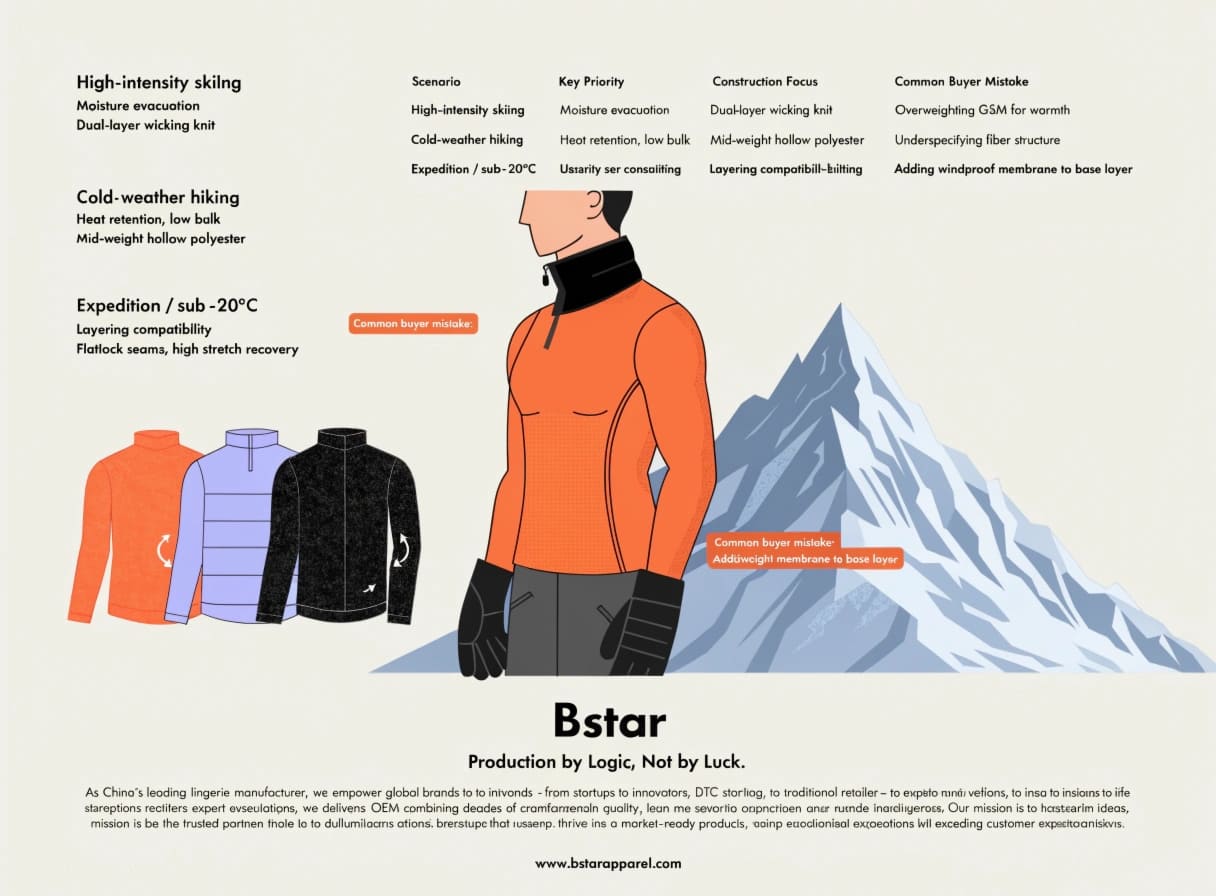
| Scenario | Key Priority | Construction Focus | Common Buyer Mistake |
|---|---|---|---|
| High-intensity skiing | Moisture evacuation | Dual-layer wicking knit | Overweighting GSM for warmth |
| Cold-weather hiking | Heat retention, low bulk | Mid-weight hollow polyester | Underspecifying fiber structure |
| Expedition / sub -20°C | Layering compatibility | Flatlock seams, high stretch recovery | Adding windproof membrane to base layer |
Conclusion
Match the fabric to the activity, not the spec sheet. GSM, fiber content, and technology features only matter when they’re tied to a specific sport scenario and wear condition.