
Luxury Underwear Brands: What Defines High-End Manufacturing?
Most brands chasing the "luxury" label focus on storytelling. But when a buyer places a large order and the first returns start arriving, the story stops mattering.
Luxury underwear manufacturing comes down to what you can verify, not what a supplier claims. That means traceable fiber certifications, documented quality checkpoints at multiple stages of production, and process flexibility that reveals real manufacturing depth — not just volume capacity.
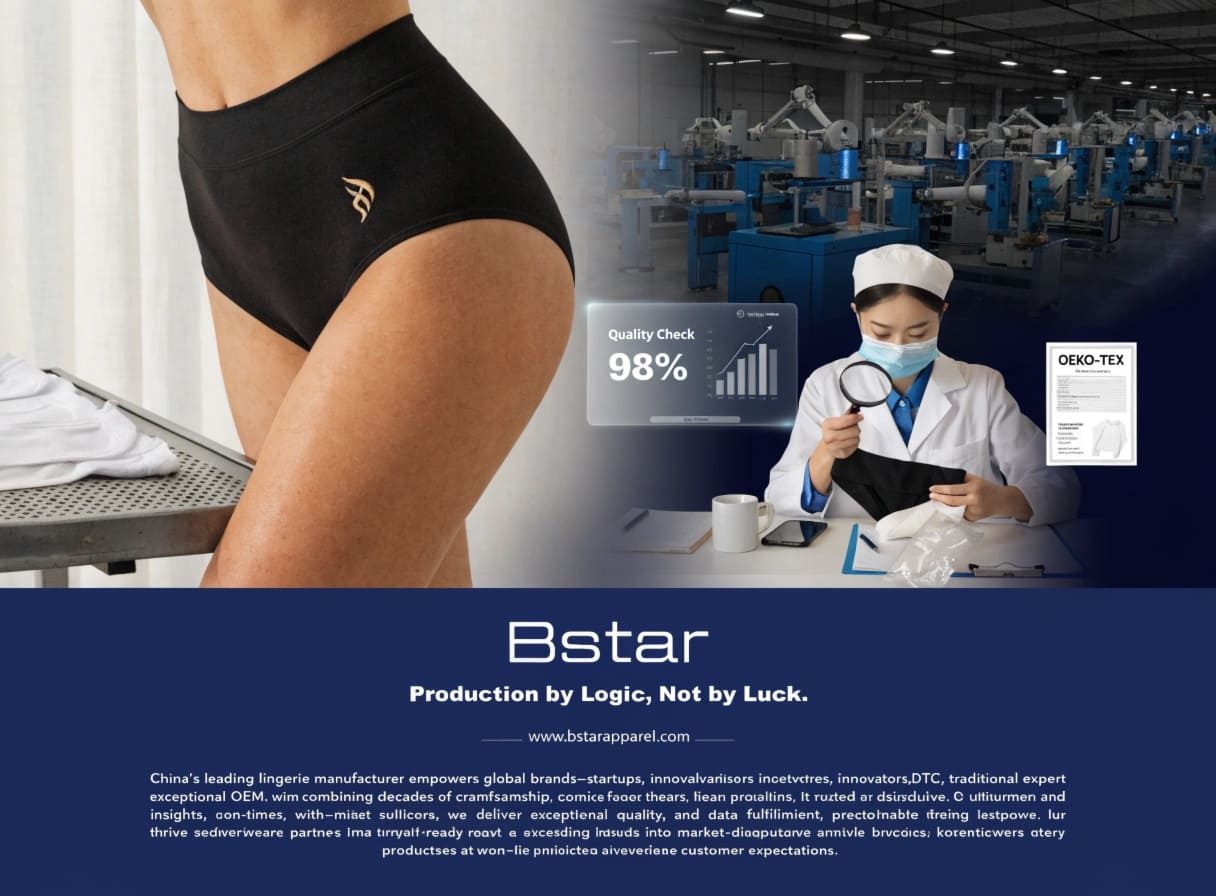
In our experience working with DTC brands across Europe, Australia, and North America, the buyers who get burned are almost always the ones who evaluated suppliers on pitch decks instead of production systems. This article is about what to look for instead.
Premium Material Selection: Does Your Supplier Actually Know What’s in the Fabric?
Words like "buttery soft" and "premium feel" appear in almost every factory’s introduction deck. They mean nothing on their own.
The real question is whether your supplier can name the yarn count, fiber composition, and knitting gauge — and show you documentation proving it. Certifications like OEKO-TEX®, GOTS, and GRS confirm that the raw materials meet defined standards1. Without them, "premium fabric" is just a claim.
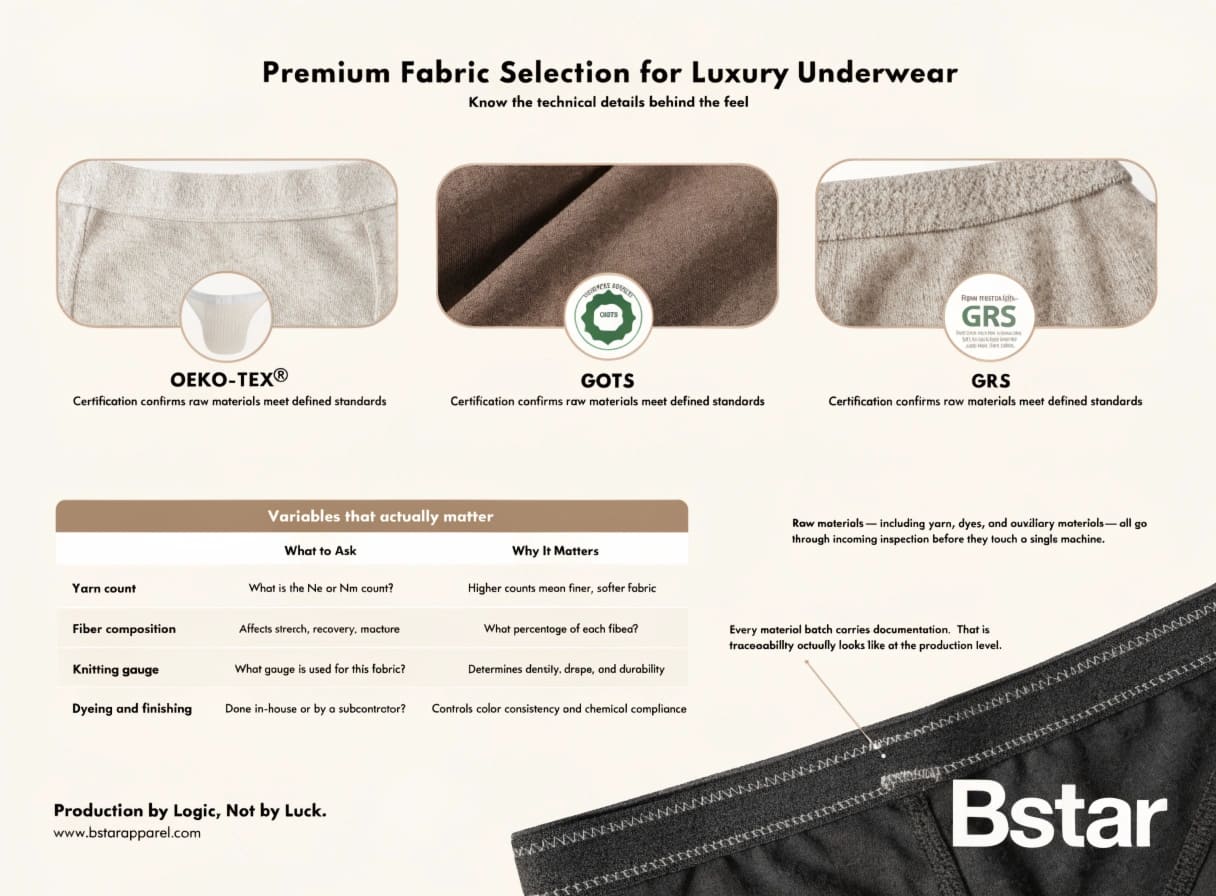
Here is what actually drives hand-feel and performance in knitted underwear: it is not the price tier or the brand name on the label. It is the yarn spec and the finishing process.
The Variables That Actually Matter
| Variable | What to Ask | Why It Matters |
|---|---|---|
| Yarn count | What is the Ne or Nm count? | Higher counts mean finer, softer fabric2 |
| Fiber composition | What percentage of each fiber? | Affects stretch, recovery, and durability |
| Knitting gauge | What gauge is used for this fabric? | Determines density, drape, and structure |
| Dyeing and finishing | Done in-house or by a subcontractor? | Controls color consistency and chemical compliance |
That last row is one buyers often skip. A factory can own the knitting process but outsource dyeing to a facility that uses non-compliant dyes3. If the finishing step is not in-house and not under the factory’s direct quality control, you have a gap in the traceability chain.
In our factory, raw materials — including yarn, dyes, and auxiliary materials — all go through incoming inspection before they touch a single machine. Every material batch carries documentation. That is what traceability actually looks like at the production level. Buyers we have worked with, including DTC brands in the Netherlands and Australia, often tell us this is the step that gets skipped most in cheaper sourcing relationships.
Artisanal Craftsmanship: What Does "Hand-Finished" Actually Mean in a Factory?
"Artisanal" is one of the most overused words in the underwear category. It sounds impressive. It is also almost impossible to verify from a product photo or a supplier website.
In practical manufacturing terms, craftsmanship means defined operator skill standards, controlled stitch tension, and documented inspection steps — not just that a human being touched the garment. A well-run production line with trained operators and mid-process checkpoints will consistently outperform a "hand-finished" claim with no audit trail.
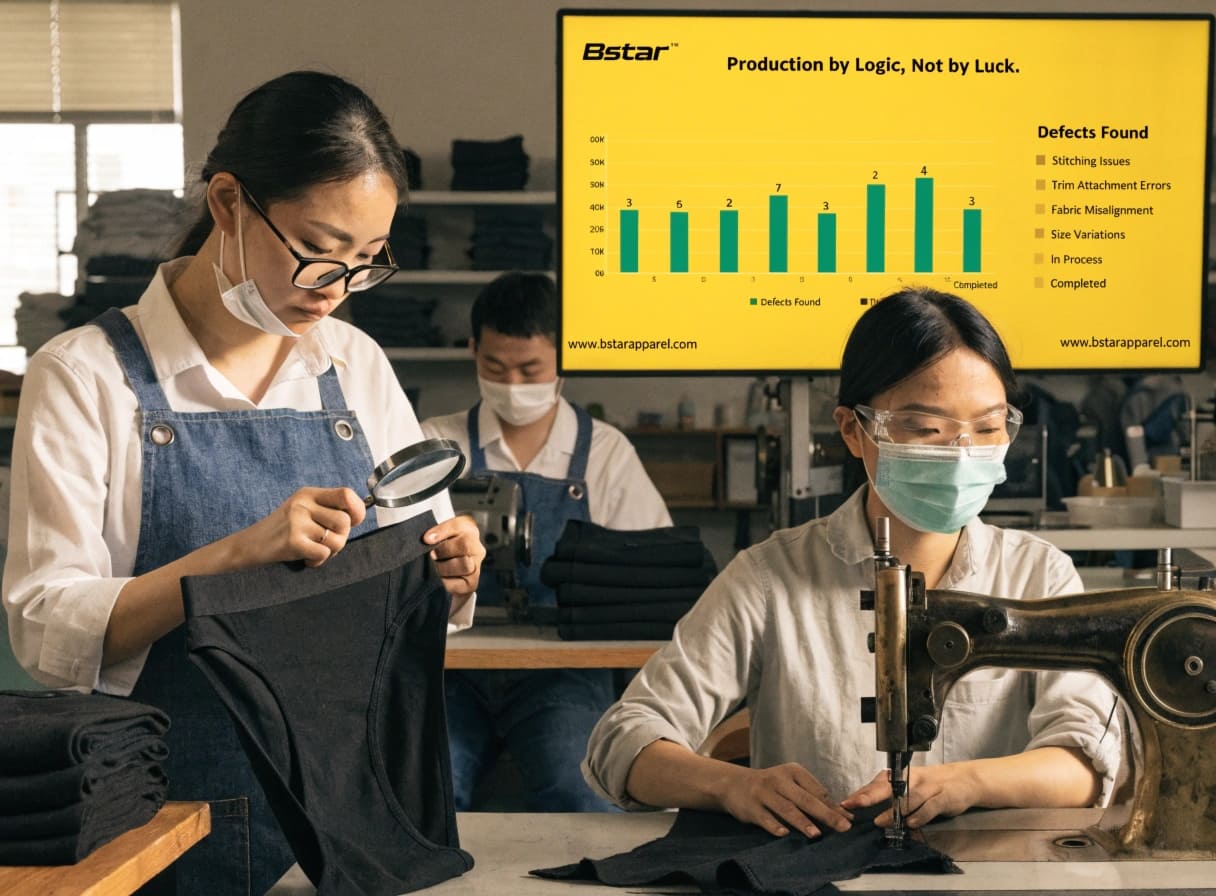
Here is a useful reframe. When a supplier says "artisanal craftsmanship," ask them this: at what points in the production flow does a quality check happen, and what happens when a defect is found?
Breaking Down What "Craftsmanship" Should Mean to a Buyer
A factory serious about craft does not just inspect at the end. By the time a garment reaches final inspection, any defect in stitching, tension, or trim attachment has already traveled through the whole line. That is expensive to catch late and almost impossible to fix in volume.
| Checkpoint | What It Covers | Red Flag If Missing |
|---|---|---|
| Pre-production | Fabric, trims, and first samples confirmed | No sample sign-off process |
| Cut panel inspection | Accuracy of cutting before sewing begins | Defects built into every unit from the start |
| Mid-production audit | Random sampling of in-progress units | Problems only caught at the end |
| Semi-finished check | Seams, hems, and attachments before finishing | Trim and detail issues missed |
| Final inspection | AQL standard sampling across finished units4 | No statistical basis for acceptance |
| Packing check | Label, hang tag, size, and packing accuracy | Shipping errors reach the customer |
We run six quality checkpoints across every production run. The mid-production audit is the one buyers most often do not think to ask about — and it is the one that catches the most fixable problems5 before they become costly ones.
Advanced Manufacturing Techniques: Are Seamless and Bonding Technologies Actually Being Used — Or Just Listed?
Seamless knitting, bonded construction, and molded foam technologies6 appear in many supplier capability lists. Whether a factory actually runs them well is a different question.
Seamless knitting reduces friction points and creates a cleaner silhouette7 — real advantages for luxury underwear. But the technology only delivers results when it is combined with the right yarn spec, knitting program, and post-knitting finishing. Listing the equipment is not the same as mastering the process.
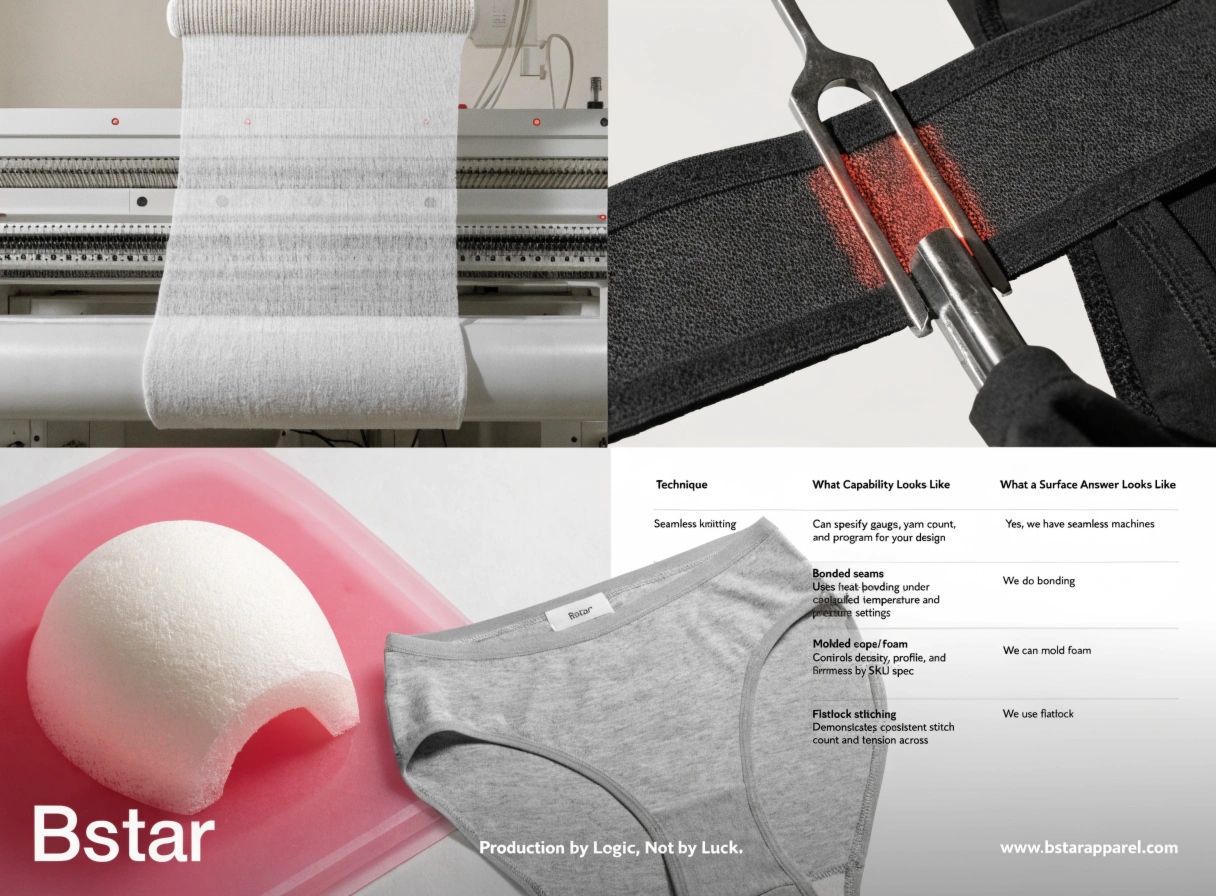
One pattern we have seen in sourcing conversations: buyers come in asking whether a factory has seamless machines, and the answer is yes. Then the first samples arrive and the fabric weight is wrong, the leg openings have inconsistent tension, or the waistband rolls. The machine existed. The process capability did not.
What to Ask About Advanced Techniques
| Technique | What Capability Looks Like | What a Surface Answer Looks Like |
|---|---|---|
| Seamless knitting | Can specify gauge, yarn count, and program for your design | "Yes, we have seamless machines" |
| Bonded seams | Uses heat-bonding under controlled temperature and pressure settings | "We do bonding" |
| Molded cups/foam | Controls density, profile, and firmness by SKU spec | "We can mold foam" |
| Flatlock stitching | Demonstrates consistent stitch count and tension across production | "We use flatlock" |
The follow-up question that separates a capable factory from a capable-sounding factory is this: can you show me the spec sheet and the process parameters used for a previous production run in this technique? If the answer is vague, the capability is probably surface-level.
We support sampling from one piece. That matters here because it means a buyer can test a seamless or bonded construction before committing to volume — and the factory’s willingness to do that reveals something about their confidence in their own process.
Rigorous Quality Assurance: A Certificate Is a Past Audit, Not a Guarantee
BSCI, ISO, and similar certifications are frequently listed as proof of quality. They are not. They are proof that a factory passed an audit at a specific point in time.
What matters more than holding a certification is how quality is managed between audits — specifically, how many checkpoints exist in the live production flow, whether defects are caught mid-process or only at the end, and whether the factory can show you their AQL sampling standard in writing.
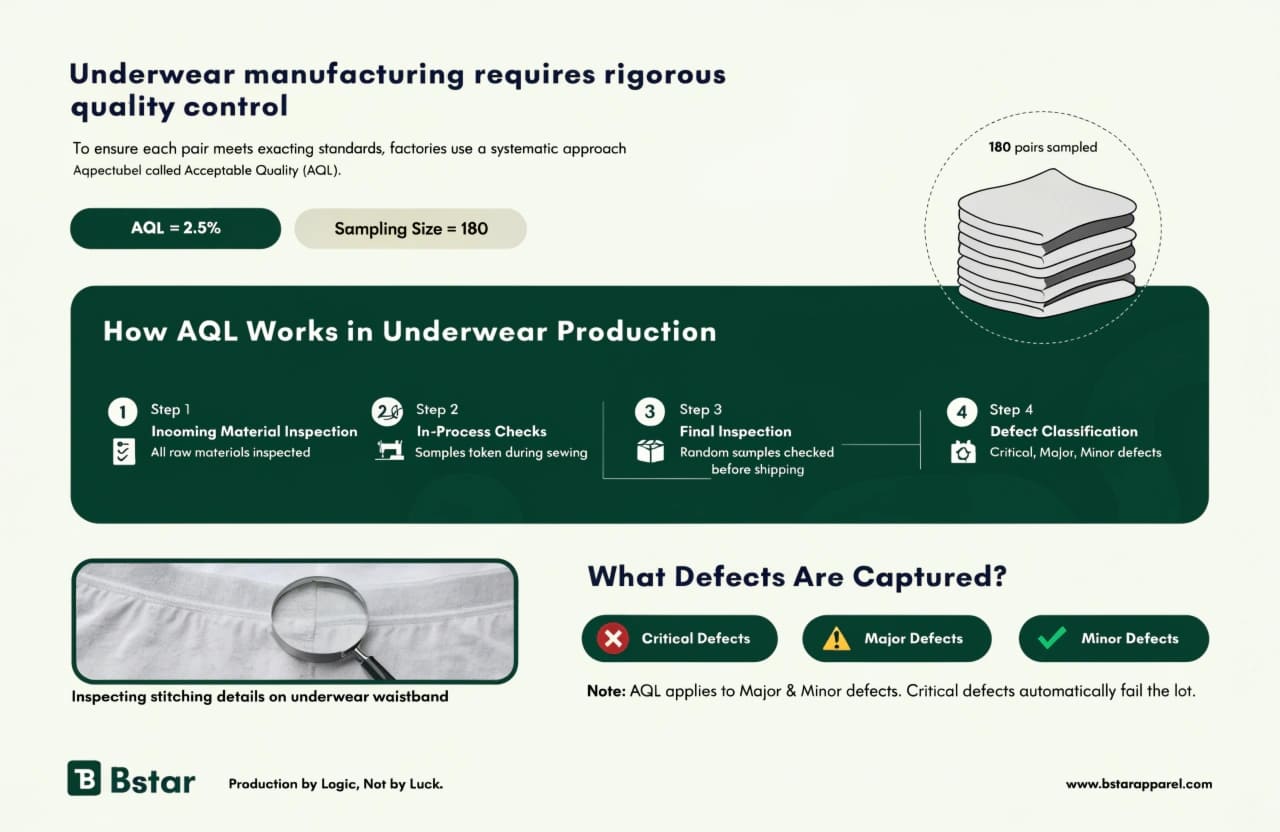
We hold BSCI certification. We also think it is important to be honest about what that means: it covers social compliance — labor conditions, worker rights, facility standards. It does not certify that every unit leaving the line meets your brand’s quality spec. That is a separate system, and it has to be built into production, not bolted on at the end.
The QA Questions That Actually Reveal Manufacturing Capability
| Question | What a Strong Answer Includes |
|---|---|
| What QC checkpoints do you run? | Named stages with specific defect categories per stage |
| What AQL level do you apply? | A specific number (e.g., AQL 2.5) with sampling size logic |
| What happens when a defect is found mid-production? | A defined rework or rejection protocol |
| How do you handle first-article confirmation? | A documented sign-off process before full production starts |
| Can I review past inspection reports? | Yes, with actual data — not just a template |
Buyers who ask these questions in early supplier conversations almost always get a clearer picture of whether a factory is actually equipped to protect a premium brand position — or whether they are hoping the final inspection holds everything together.
Our QA system runs six checkpoints per production order, from incoming material inspection through packing verification. Every checkpoint is documented. That documentation exists not because an auditor asked for it, but because it is how you actually control output across 150,000+ units per month without losing consistency.
Conclusion
Luxury manufacturing is a system you can audit, not a story you should believe. Ask about certifications, checkpoints, yarn specs, and process ownership — and evaluate suppliers on what they can show you, not what they claim.
-
"Textile Certifications Explained: Why GOTS, OEKO-TEX, RCS and …", https://world-collective.com/blogs/news/textile-certifications-explained-why-gots-oeko-tex-rcs-and-grs-matter-for-fashion-brands-now?srsltid=AfmBOoqXFVb2rAvkdR_Y4bukPTbOnRkGZjg7YVfe6Rz5nelY2qxZhnKr. OEKO-TEX® STANDARD 100 tests for harmful substances in finished textiles; the Global Organic Textile Standard (GOTS) certifies organic fiber processing and social criteria throughout the supply chain; the Global Recycled Standard (GRS), administered by Textile Exchange, verifies recycled content and chain of custody — each certification addresses a different dimension of material compliance. Evidence role: definition; source type: institution. Supports: The distinct scope of OEKO-TEX, GOTS, and GRS certifications as applied to textile raw materials. Scope note: Certification requirements are periodically updated; the specific version year should be confirmed against the issuing body’s current documentation. ↩
-
"Units of textile measurement – Wikipedia", https://en.wikipedia.org/wiki/Units_of_textile_measurement. In textile engineering, yarn count systems such as the English cotton count (Ne) and metric count (Nm) express the fineness of a yarn; higher values in indirect count systems indicate finer yarns, which generally produce fabrics with a smoother hand-feel and closer surface texture when knitted at appropriate gauges. Evidence role: mechanism; source type: education. Supports: The relationship between yarn count (Ne/Nm) and fabric fineness or softness in knitted textiles. Scope note: Sources may address woven fabrics primarily; the relationship in knitted constructions involves additional variables such as gauge and loop length. ↩
-
"Environmental Impact of Textile Materials: Challenges in Fiber–Dye …", https://pmc.ncbi.nlm.nih.gov/articles/PMC11991193/. Dyeing and finishing are identified as high-risk stages in textile chemical compliance frameworks; the OEKO-TEX® STANDARD 100 and the EU REACH Regulation both restrict specific dye classes and auxiliary chemicals — including certain azo dyes, formaldehyde, and heavy metals — that may be introduced when wet processing is performed by subcontractors outside the primary manufacturer’s quality system. Evidence role: mechanism; source type: institution. Supports: That dyeing and finishing processes are a recognized source of restricted substance risk in textile supply chains. Scope note: Specific restricted substance lists differ between regulatory regimes (e.g., EU REACH vs. CPSC) and certification standards; compliance in one jurisdiction does not guarantee compliance in another. ↩
-
"[PDF] ISO 2859-1 – UNT Chemistry", https://chemistry.unt.edu/~tgolden/courses/iso2859-1.pdf. Acceptable Quality Level (AQL) sampling is defined under ISO 2859-1 (Sampling procedures for inspection by attributes), which specifies the maximum number of defective units statistically tolerable in a sample before a lot is rejected; AQL 2.5 is a commonly applied level in apparel inspection. Evidence role: definition; source type: institution. Supports: AQL as a statistically defined acceptance sampling standard used in manufacturing inspection. Scope note: The standard governs sampling methodology, not the specific defect categories relevant to any individual product category such as underwear. ↩
-
"[PDF] Reducing the Costs of Poor Quality: A Manufacturing Case Study", https://scholarworks.waldenu.edu/cgi/viewcontent.cgi?article=6608&context=dissertations. Quality management literature, including work derived from Juran’s cost-of-quality model and lean manufacturing principles, consistently documents that the cost of correcting a defect increases substantially the later it is detected in the production sequence; in-process inspection is therefore associated with lower total quality costs than reliance on final inspection alone. Evidence role: expert_consensus; source type: research. Supports: That defects detected earlier in the production process are less costly to correct than those found at final inspection. Scope note: Quantitative cost ratios vary widely by product type, defect category, and production volume; the general principle is well-supported but specific figures cited in some sources may not apply directly to apparel manufacturing. ↩
-
"Garment Bonding Technology The Basics Heat + … – Instagram", https://www.instagram.com/reel/DQoKna1kWjK/. Heat-bonded seam technology in intimate apparel uses thermoplastic adhesive films or tapes activated under controlled temperature and pressure to join fabric panels without needle and thread, eliminating seam bulk; molded foam cup construction involves compression molding of polyurethane foam to a defined profile, with density and firmness determined by material specification and mold geometry. Evidence role: mechanism; source type: research. Supports: The technical basis of heat-bonded seam construction and molded foam components in intimate apparel manufacturing. Scope note: Process parameters vary by equipment manufacturer and material supplier; the cited mechanisms describe general industry practice rather than any single factory’s implementation. ↩
-
"Thermoregulatory Performance and Thermal Comfort Analysis of …", https://pmc.ncbi.nlm.nih.gov/articles/PMC12693357/. Seamless weft-knitting technology produces garments in a single continuous knitting process, eliminating sewn seams at high-contact areas; research on close-fitting sportswear and underwear has associated seam elimination with reduced skin pressure and chafing, contributing to improved wear comfort. Evidence role: mechanism; source type: research. Supports: That seamless knitting eliminates sewn seams and thereby reduces pressure and friction points in close-fitting garments. Scope note: Performance benefits are context-dependent and vary with yarn composition, garment fit, and end-use activity; direct clinical evidence specific to underwear is limited. ↩