
The Rise of Period Panties: Manufacturing and Absorbency Layers
A brand once sent us a brief that read: "We need period panties, 3 layers, maximum absorbency." That one line told us everything about what they didn’t know yet.
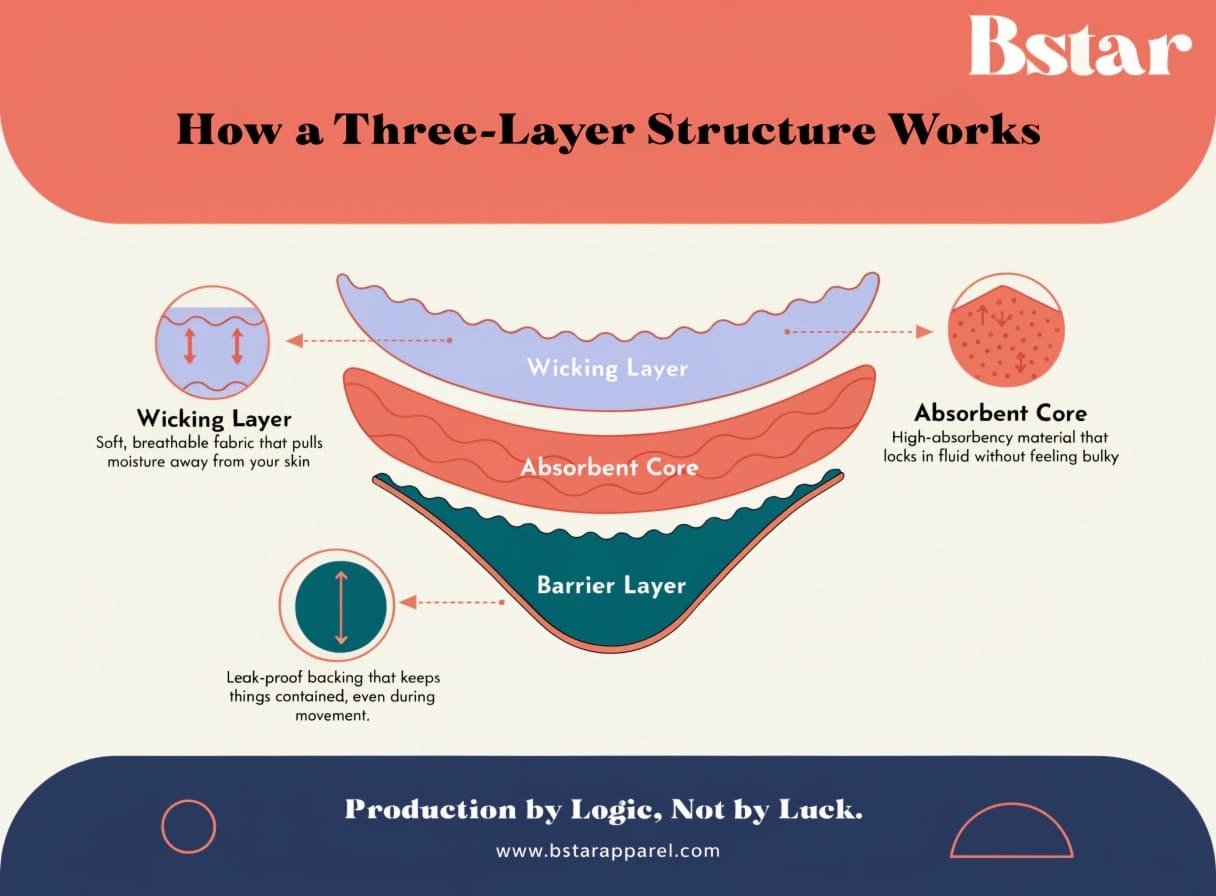
Period panties work when each layer does a specific job. The structure is not about stacking more layers for better protection. It is about matching the right fabric to the right function for a specific use case—light daily discharge or medium-flow period wear require completely different builds.
That brief we mentioned? We see it every few months. A founder has done their market research, they know the product category is growing, and they come to us with a layer count instead of a use scenario. Our job starts by reframing the question. This article is that reframe—written from the bench, not from a lab.
The Multi-Layer Architecture: What Are Absorbent Cores, Wicking Fabrics, and Leak-Proof Barriers Actually Doing?
Most people assume more layers means better performance. We have seen that assumption cost brands money on returns.
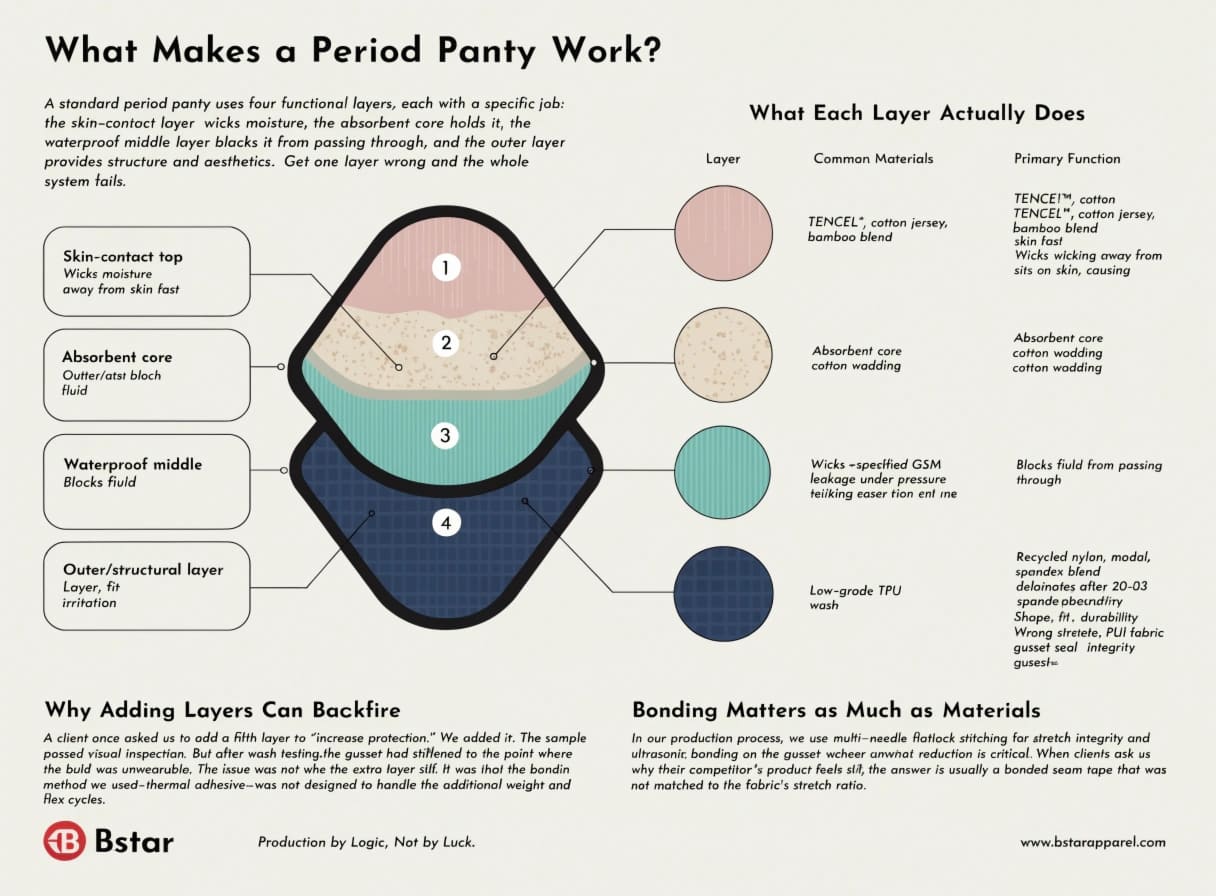
A standard period panty uses four functional layers. Each one has one job. The skin-contact layer moves moisture away from the body. The absorbent core holds it. The waterproof middle layer stops it from passing through. The outer layer provides structure and aesthetics. Get one layer wrong and the whole system fails.
Here is what we see happen when brands skip the function conversation and go straight to specs.
A client once asked us to add a fifth layer to "increase protection." We added it. The sample passed visual inspection. But after wash testing, the gusset had stiffened to the point where the brief was unwearable. The issue was not the extra layer itself. It was that the bonding method we used—thermal adhesive—was not designed to handle the additional weight and flex cycles. The layer count went up. Comfort went down. Protection did not change.
What Each Layer Actually Does
| Layer | Common Materials | Primary Function | What Goes Wrong |
|---|---|---|---|
| Skin-contact top | TENCEL™, cotton jersey, bamboo blend | Wicks moisture away from skin fast | Slow wicking = moisture sits on skin, causing irritation |
| Absorbent core | Microfiber nonwoven, cotton wadding | Holds absorbed fluid | Under-specified GSM = leakage under pressure |
| Waterproof middle | TPU laminate, PUL fabric | Blocks fluid from passing through | Low-grade TPU delaminates after 20–30 washes |
| Outer/structural layer | Recycled nylon, modal, spandex blend | Shape, fit, durability | Wrong stretch % affects gusset seal integrity |
The bonding method between layers matters as much as the materials themselves. In our production process, we use multi-needle flatlock stitching for stretch integrity and ultrasonic bonding on the gusset panel where bulk reduction is critical. When clients ask us why their competitor’s product feels stiff, the answer is usually a bonded seam tape that was not matched to the fabric’s stretch ratio.
The question a brand should ask their factory is not "how many layers?" It is "how are the layers joined, and what is your wash durability benchmark?"
Engineering Absorbency: How Do You Match Flow Level to Construction?
We get this question a lot: "Can you make it absorb as much as possible?" Our answer is always the same—absorb as much as possible for what situation?
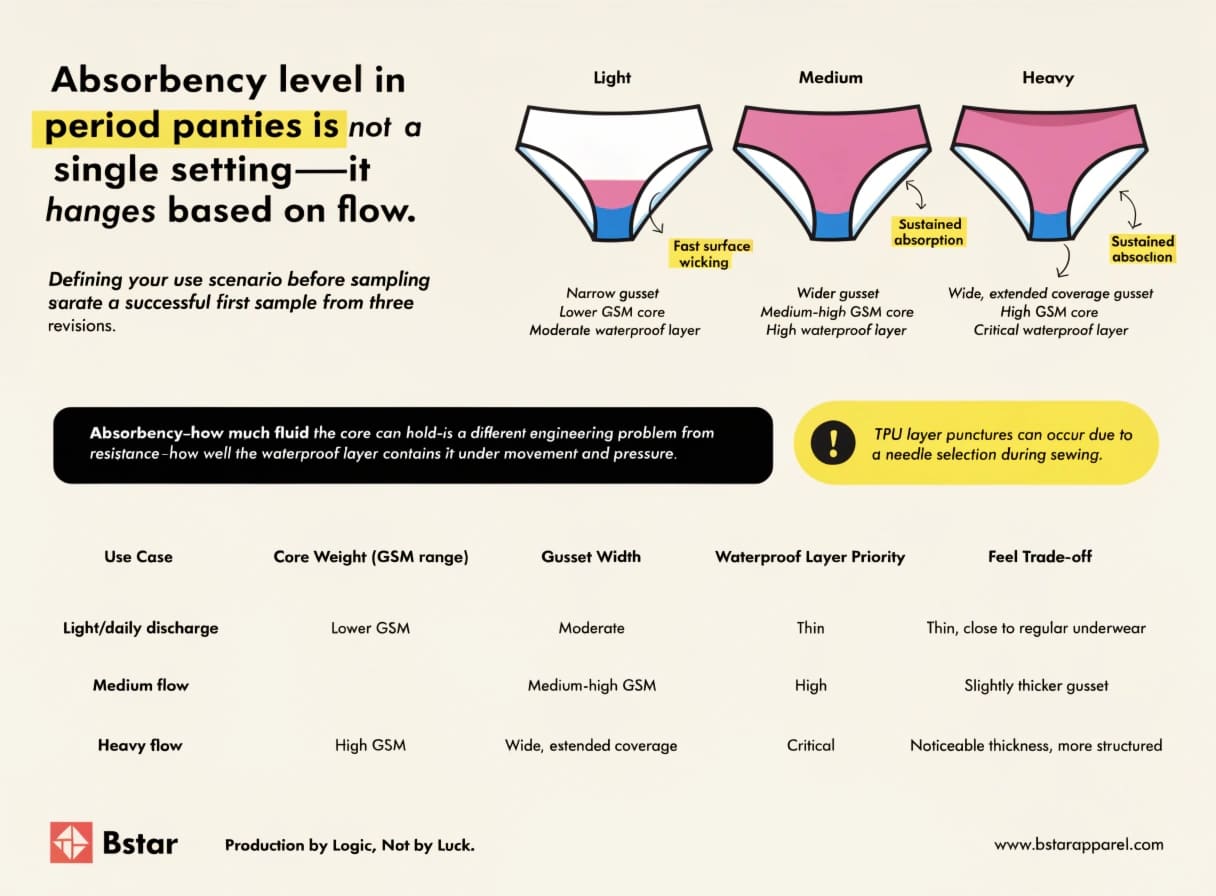
Absorbency level in period panties is not a single setting. Light-flow and medium-flow products require different core weights, different gusset dimensions, and different construction priorities. Defining the use scenario before sampling is what separates a successful first sample from three rounds of revisions.
Here is the practical distinction we use in our sampling consultations.
A brief built for light daily discharge—spotting, end-of-period days, or discharge management—needs a thinner absorbent core with fast surface wicking. The priority is comfort and discretion. The gusset can be narrower. The core GSM can be lower. The product should feel close to a regular underwear silhouette.
A brief built for medium-flow period use needs a higher-GSM absorbent core, a wider gusset panel, and a waterproof layer that is tested to hold under sustained pressure—not just a single pour test. The product will be slightly thicker. That is a functional necessity, not a design flaw.
Flow Level vs. Construction Priorities
| Use Case | Core Weight (GSM range) | Gusset Width | Waterproof Layer Priority | Feel Trade-off |
|---|---|---|---|---|
| Light/daily discharge | Lower GSM | Narrow | Moderate | Thin, close to regular underwear |
| Medium flow | Medium-high GSM | Wider | High | Slightly thicker gusset |
| Heavy flow | High GSM | Wide, extended coverage | Critical | Noticeable thickness, more structured |
We also want to be clear about something we see brands confuse regularly. Absorbency—how much fluid the core can hold—is a different engineering problem from leak resistance—how well the waterproof layer contains it under movement and pressure. A core can be highly absorbent and still leak if the TPU layer has micro-punctures from poor needle selection during sewing. These are two separate checkpoints in our quality process, and they require two separate tests.
We do not publish specific ml absorption figures for our constructions here because those numbers are only valid for a specific SKU with a specific layer spec and a specific construction method. Brands that ask us for a number up front get a realistic answer: we will give you that data after your first validated sample, not before.
Material Innovation: How Do You Balance Breathability, Moisture Management, and Skin Safety?
This is where the sourcing decision gets complicated fast. Every material supplier will tell you their fabric is breathable, moisture-wicking, and skin-safe. Not all of them are right.
The best-performing period panty materials balance three things at once: fast moisture transfer away from the skin, enough breathability to prevent heat buildup, and certified safety for prolonged skin contact. No single fabric does all three equally well—construction choices fill the gaps.
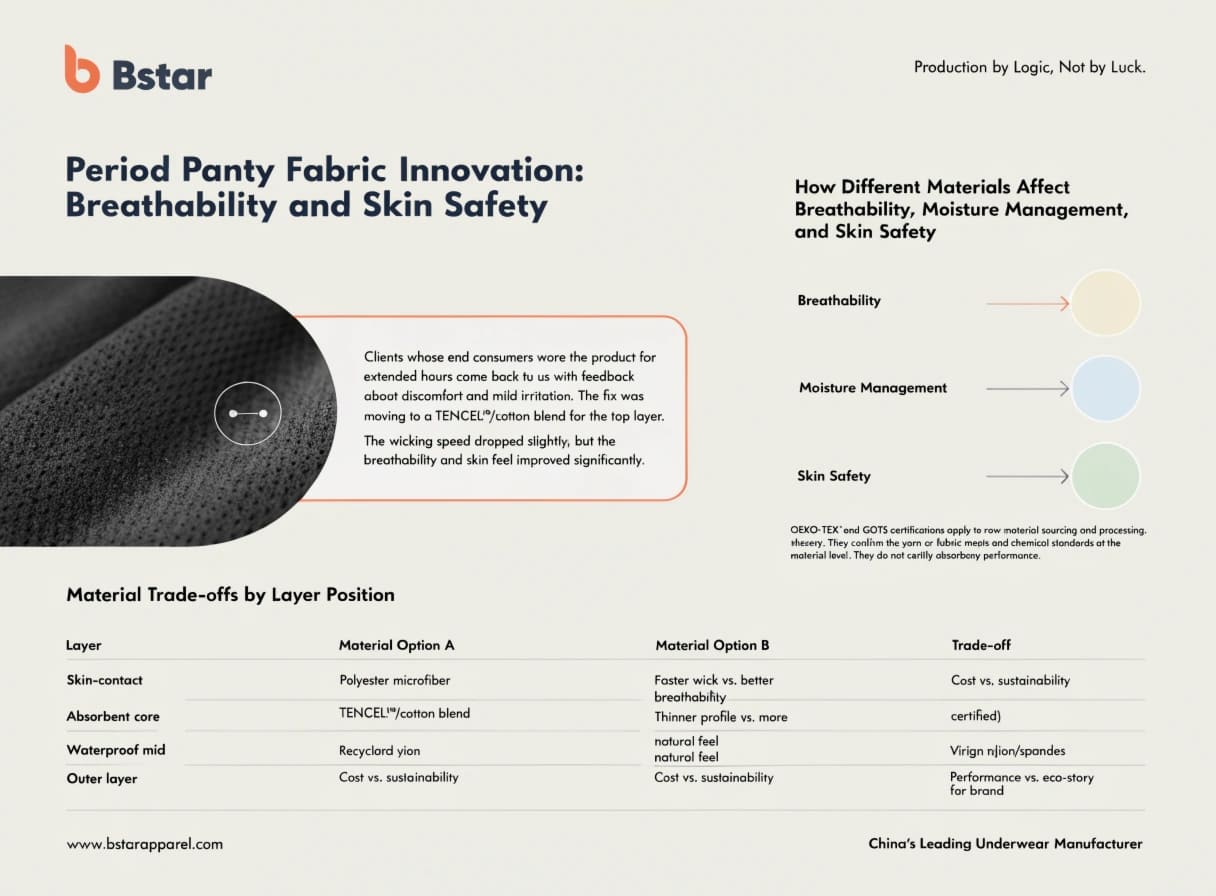
In our sampling work, the skin-contact layer is where we see the most complaints traced back to material selection. Synthetic-only top layers—plain polyester mesh, for example—wick fast but trap heat. Clients whose end consumers wore the product for extended hours came back to us with feedback about discomfort and mild irritation. The fix was moving to a TENCEL™/cotton blend for the top layer. The wicking speed dropped slightly, but the breathability and skin feel improved significantly.
Material Trade-offs by Layer Position
| Layer | Material Option A | Material Option B | Trade-off |
|---|---|---|---|
| Skin-contact | Polyester microfiber | TENCEL™/cotton blend | Faster wick vs. better breathability |
| Absorbent core | Microfiber nonwoven | Cotton wadding | Thinner profile vs. more natural feel |
| Waterproof mid | Standard TPU laminate | Recycled TPU (GRS-certified) | Cost vs. sustainability positioning |
| Outer layer | Virgin nylon/spandex | Recycled nylon blend | Performance vs. eco-story for brand |
On certifications: OEKO-TEX® and GOTS certifications apply to raw material sourcing and processing. They confirm that the yarn or fabric meets safety and chemical standards at the material level. They do not certify absorbency performance. We source certified materials for our period panty production—but we always make sure clients understand that certification and functional testing are separate conversations.
Sustainable Manufacturing: Is the Shift to Reusable Period Panties Actually Better for the Planet?
The short answer from where we sit: yes, but only when the product is built to last.
Reusable period panties reduce disposable hygiene waste, but their environmental benefit only holds if the product survives repeated washing. A period panty that delaminates after 30 washes and ends up in landfill negates most of its sustainability advantage. Durability is the sustainability metric that matters most in manufacturing.
We have seen brands launch with a strong eco-positioning—recycled materials, compostable packaging, carbon-neutral shipping—and then receive a wave of returns at the 6-month mark because the gusset had delaminated. The product story was right. The construction was not built to support it.
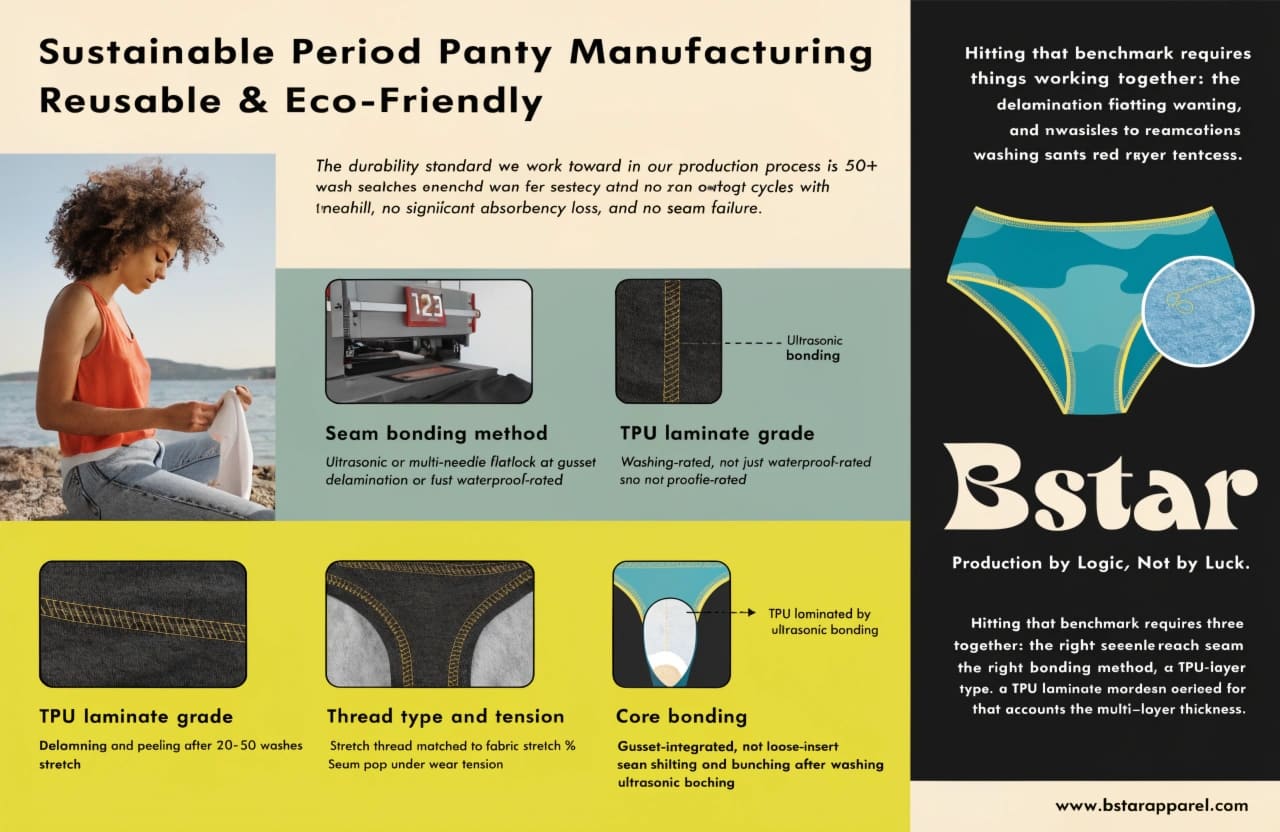
The durability standard we work toward in our production process is 50+ wash cycles with no delamination, no significant absorbency loss, and no seam failure. Hitting that benchmark requires three things working together: the right bonding method for each seam type, a TPU laminate grade rated for repeated machine washing, and a thread tension spec that accounts for the multi-layer gusset thickness.
What "Built to Last" Means in Production Terms
| Durability Factor | What to Specify | What Fails Without It |
|---|---|---|
| Seam bonding method | Ultrasonic or multi-needle flatlock at gusset | Delamination under wash heat and mechanical stress |
| TPU laminate grade | Washing-rated, not just waterproof-rated | Cracking and peeling after 20–30 washes |
| Thread type and tension | Stretch thread matched to fabric stretch % | Seam pop under wear tension |
| Core bonding | Gusset-integrated, not loose-insert | Core shifting and bunching after washing |
Brands that come to us with a sustainability brief get the same message: the eco-story lives or dies on how long the product lasts in a real consumer’s hands. Pick the right materials, yes—but build the thing to survive.
Conclusion
Period panty construction is a scenario-matching problem, not a spec-stacking exercise. Define the use case first, then build the layers to fit it.