
Shapewear Manufacturing: How Do Compression Levels and Design Actually Work Together?
Getting shapewear wrong is expensive. You approve a sample, run bulk production, and then the reviews come in: "too tight to breathe," "rolls down," "looks great but I can’t sit in it." That’s not a fabric problem. That’s a product definition problem.
Compression level in shapewear is not a quality setting you turn up. It is a design outcome. The right compression for your product depends on who is wearing it, when, and what the garment structure can actually support. Getting this right before sampling saves you from the most common — and most costly — mistakes in shapewear development.
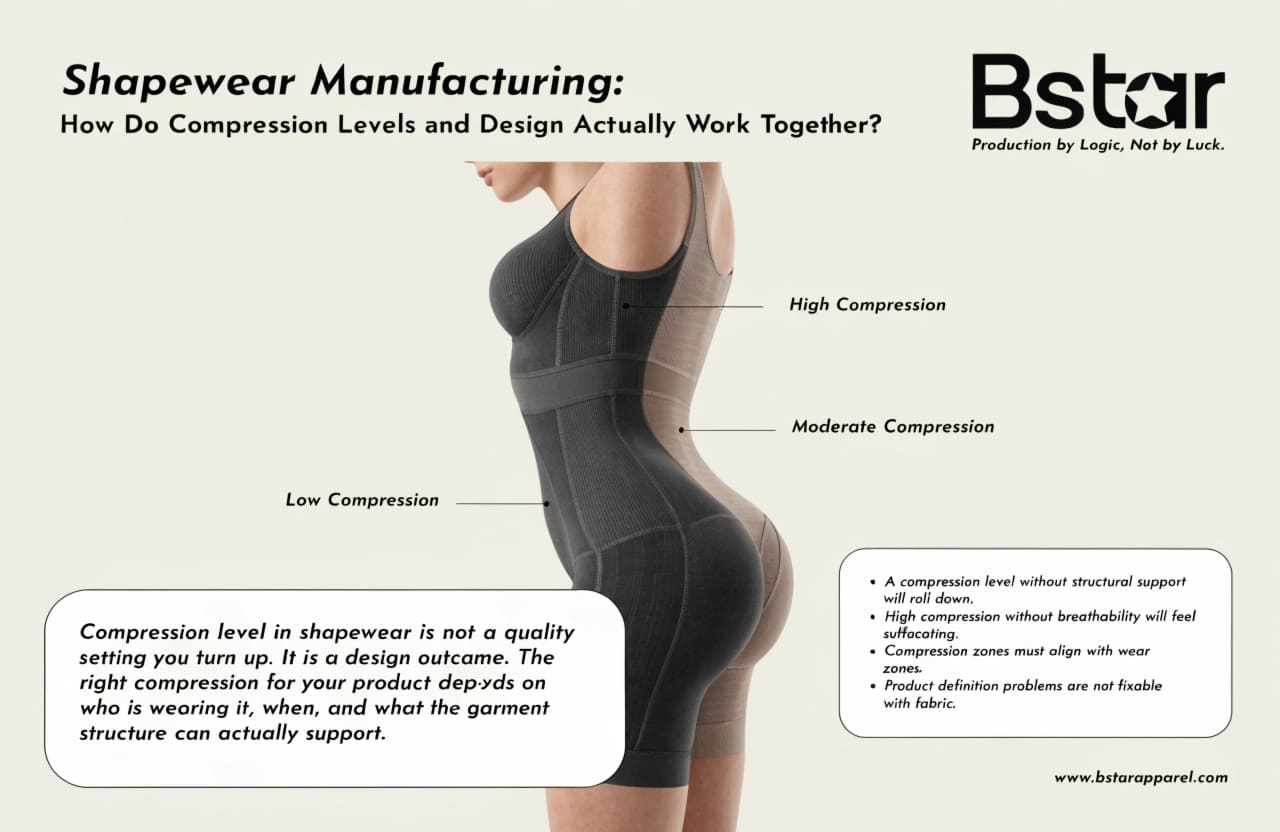
I’ve worked through enough shapewear sampling projects at our factory to know that most product misalignments happen before a single pattern is cut. Brands arrive with mood boards and a vague compression target. The factory makes assumptions. The sample feels "close enough." Bulk production runs. And somewhere between the sample and the customer’s body, the product fails. This article is about how to avoid that.
Understanding Compression Levels: Are You Choosing the Right Category for the Right Reason?
The most dangerous belief a first-time shapewear founder can have is that higher compression means a better product. It doesn’t. It means a more demanding product — one that requires more precise construction, more careful fabric selection, and a much clearer picture of who is actually going to wear it.
Light, medium, and firm compression are not a quality ladder. They are use-case categories. Light shaping works for daily wear and all-day comfort. Medium compression suits active use and moderate body contouring. Firm compression is for targeted sculpting in specific, shorter-wear occasions. The right choice depends on your end-user scenario first, not your brand positioning.
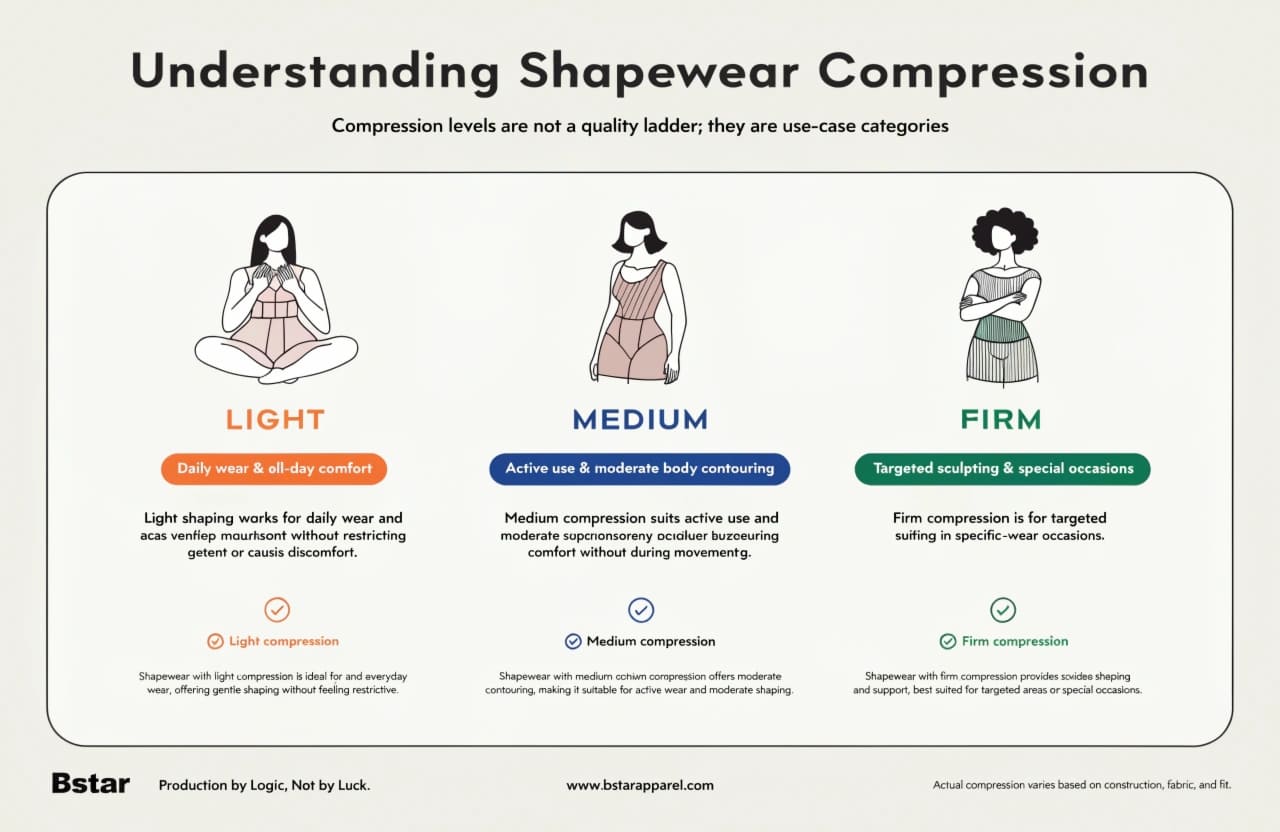
When a client comes to us asking for "high-compression everyday shapewear," the first question we ask is: what does your customer do while wearing this? If the answer is "sit at a desk for eight hours," we have a problem. Firm compression across the abdomen in a sedentary posture creates discomfort fast1. That discomfort becomes a return. That return becomes a one-star review.
The decision framework we use with clients looks like this:
| Use Occasion | Recommended Starting Point | Key Design Trade-Off |
|---|---|---|
| Daily wear (8+ hours) | Light to medium | Comfort vs. visible smoothing |
| Special occasion (2–4 hours) | Medium to firm | Sculpting vs. mobility |
| Post-workout recovery2 | Medium | Support vs. breathability |
| Postpartum support3 | Medium to firm | Targeted compression vs. full-body restriction |
This table is a starting point for conversation, not a spec sheet. The actual compression outcome is shaped by construction — which brings us to the real engineering work.
Engineering the Fit: Does Fabric Compression or Pattern Construction Do More of the Work?
Here is the insight most DTC founders miss: compression level is primarily a pattern engineering problem, not a fabric sourcing problem4. I’ve seen the same fabric deliver completely different compression results depending on how the panels were cut and assembled.
Panel placement, seam positioning, and structural zones control compression far more than fabric elastane percentage5. A brand that specifies "80% nylon, 20% spandex" without addressing cut direction, panel tension, or gradient zones will get inconsistent results across body types — even from the same fabric roll.
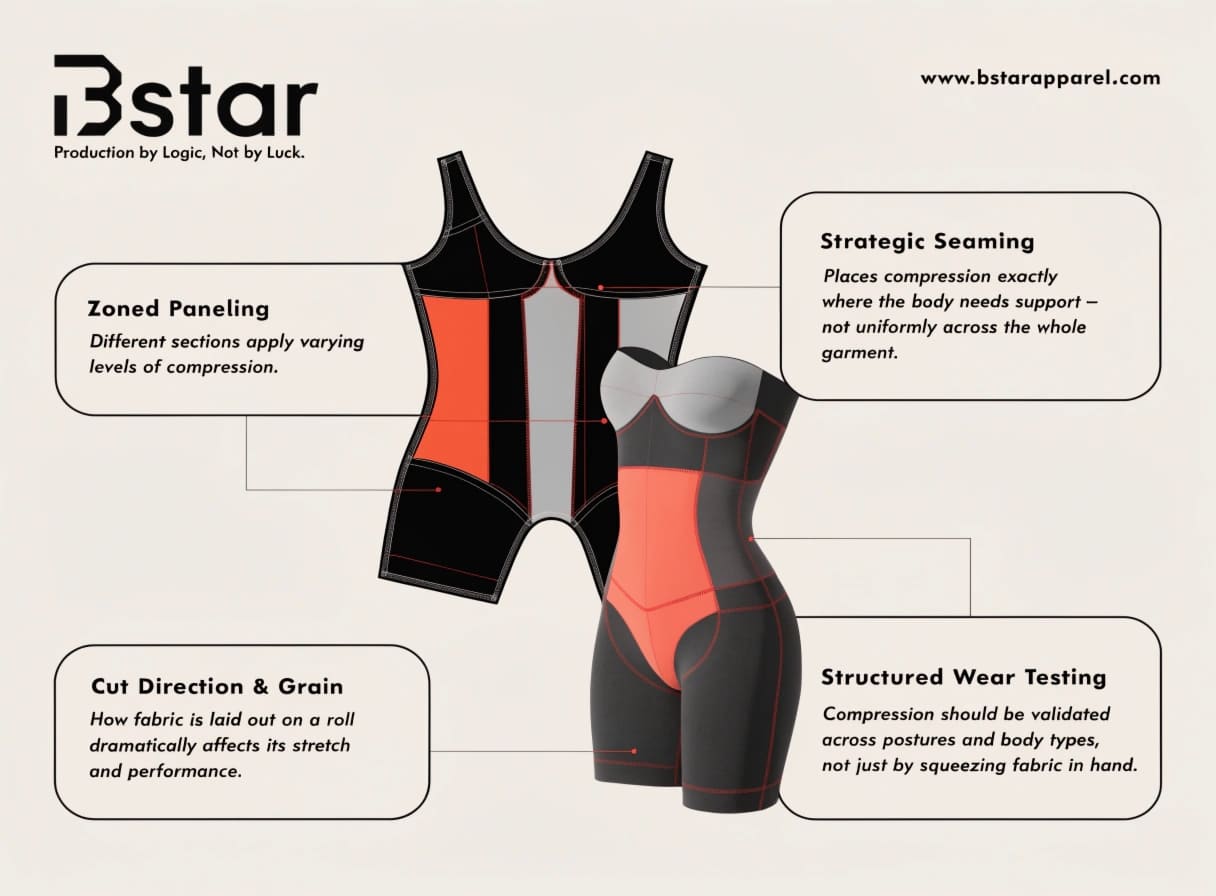
Zoned paneling means different sections of the garment apply different levels of compression to different areas of the body. A well-designed waist cincher, for example, might use a firmer panel across the lower abdomen, a medium-tension panel at the sides, and a more flexible panel at the hip. Each panel is cut from fabric on a specific grain to control stretch direction and tension.
Strategic seaming does two things. First, it places compression exactly where the body needs support — not uniformly across the whole garment. Second, it creates structure that guides the body’s silhouette without fighting natural movement.
What I consistently see in client sampling is that founders approve a sample based on how it feels in hand. They squeeze the fabric, they feel the tension, they say "yes, this feels firm enough." Then the sample goes on a body, the person sits down, bends forward, or has a different body type than the fit model — and the compression reads completely differently. Structured wear-testing across postures and body types is not optional in shapewear. It is the only honest way to validate compression intent.
Advanced Design Features: When Do You Actually Need Boning, Closures, or Targeted Support?
Boning, hook-and-eye closures, power mesh inserts, crotch gussets, silicone grip strips — these are not premium features you add to justify a higher price point. They are structural solutions to specific construction problems. Adding them without a clear purpose adds cost and complexity without adding performance.
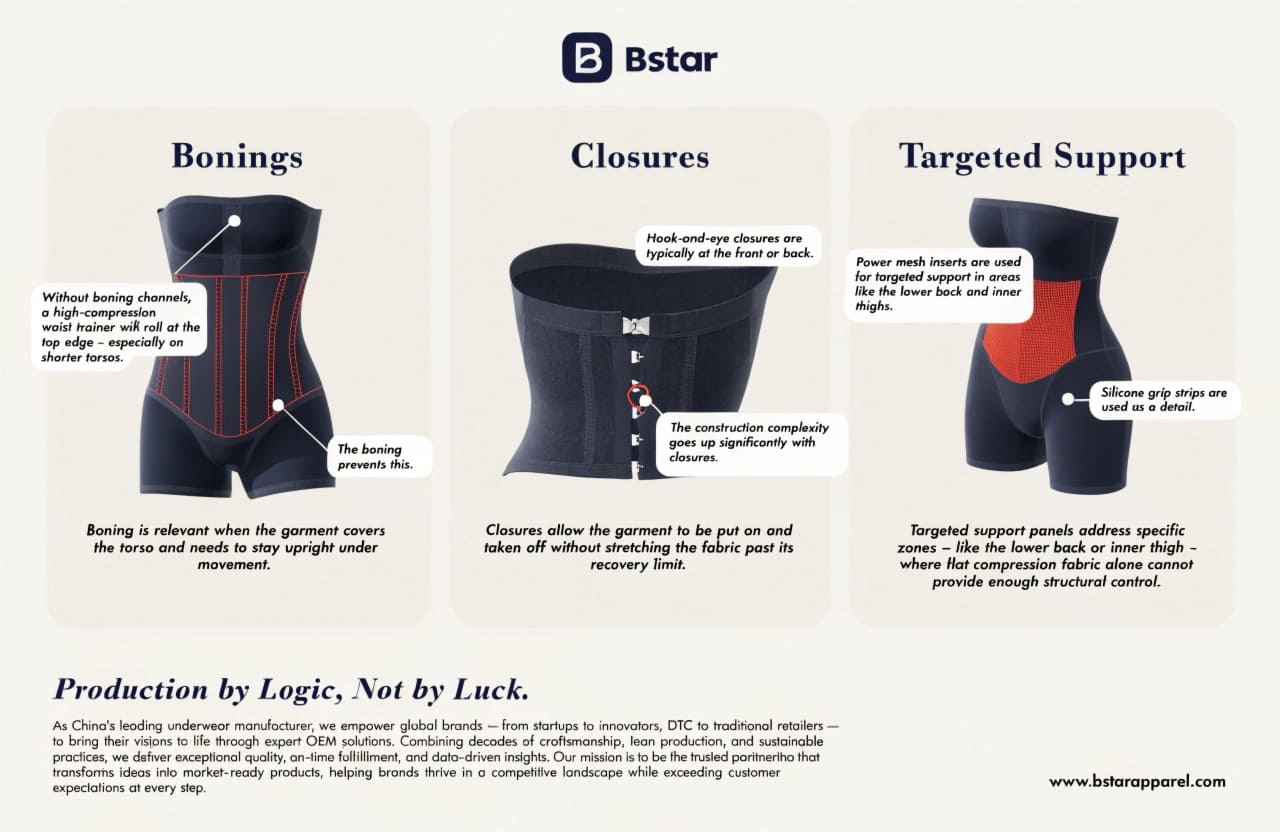
Boning prevents garment rolling and maintains vertical structure under compression6. Closures allow compression to be adjusted for different body shapes and wearing occasions. Targeted support panels address specific zones — like the lower back or inner thigh — where flat compression fabric alone cannot provide enough structural control.
Let me walk through the scenarios where these features actually earn their place.
Boning is relevant when the garment covers the torso and needs to stay upright under movement. Without boning channels, a high-compression waist trainer will roll at the top edge — especially on shorter torsos. The boning prevents that. But boning also adds stiffness. In a garment designed for active wear, that stiffness creates friction and restricts bend. So the question is: does your customer need roll-prevention more than they need mobility?
Closures — typically hook-and-eye or hook-and-bar at the front or back — allow the garment to be put on and taken off without stretching the fabric past its recovery limit. They also allow the brand to offer a size range that fits a wider body variation. The construction complexity goes up significantly with closures. Quality closures require reinforced panels and precise alignment across multiple hooks. A miscalibrated closure row creates pulling and misalignment at the seam line7.
Targeted support inserts, like power mesh overlays at the lower abdomen, are one of the most underused tools in shapewear construction. A single-layer fabric can only apply uniform compression across a panel. An overlay creates a secondary tension layer over a specific zone, effectively doubling down on support in that area8 without increasing compression across the whole garment. This is how you build a product that feels firm where the customer wants it and comfortable everywhere else.
Fabric & Functionality: Can You Have High Performance and All-Day Comfort at the Same Time?
Yes — but only if the fabric decision comes after the design decision, not before. I see brands go fabric shopping first. They find a high-elastane, high-recovery fabric they like the feel of, then try to build a compression garment around it. That sequence works fine for basic activewear. For shapewear, it often fails.
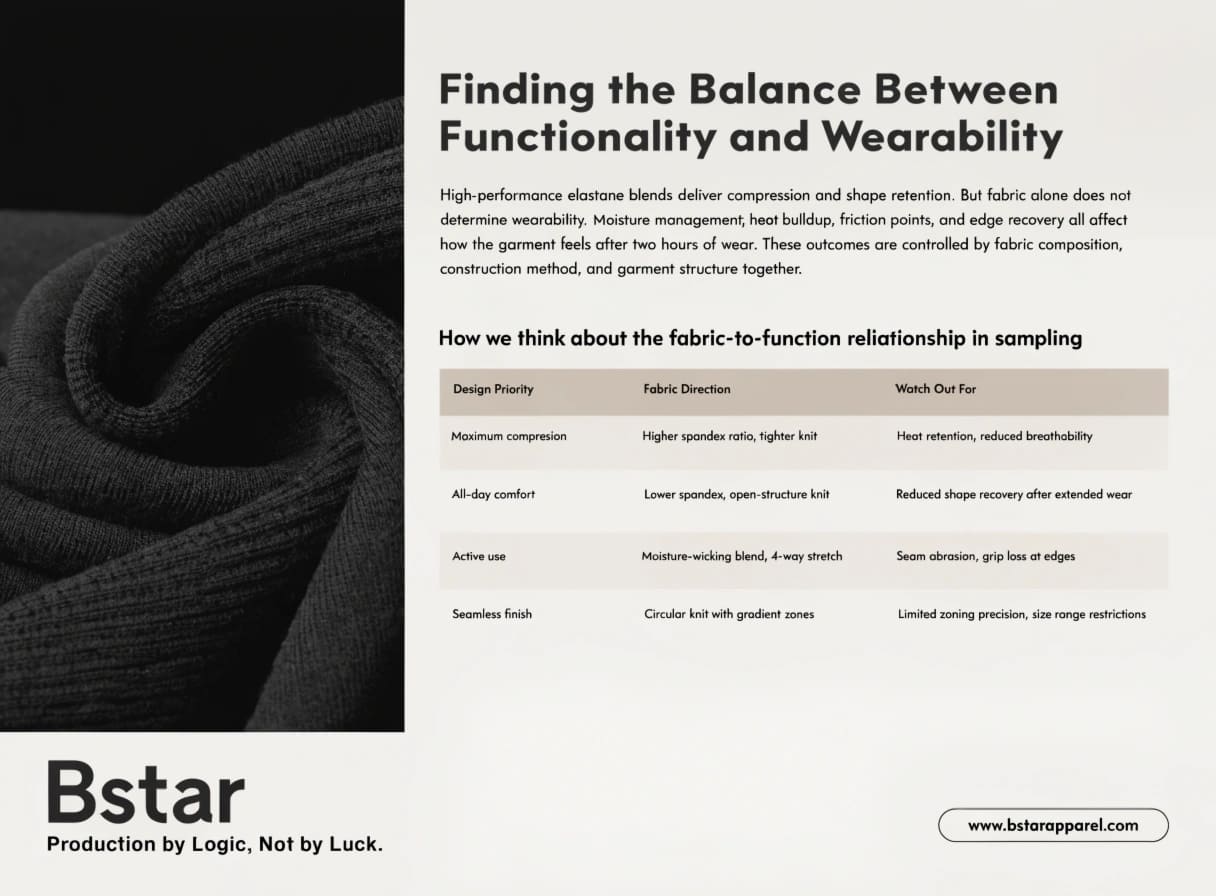
High-performance elastane blends deliver compression and shape retention. But fabric alone does not determine wearability. Moisture management, heat buildup, friction points, and edge recovery all affect how the garment feels after two hours of wear9. These outcomes are controlled by fabric composition, construction method, and garment structure together.
The common elastane blend range for shapewear sits between 15% and 30% spandex10, depending on the compression target and garment category. But the percentage alone tells you very little without knowing the yarn type, the knit structure, and how the fabric is finished.
Here is how we think about the fabric-to-function relationship in sampling:
| Design Priority | Fabric Direction | Watch Out For |
|---|---|---|
| Maximum compression | Higher spandex ratio, tighter knit | Heat retention, reduced breathability |
| All-day comfort | Lower spandex, open-structure knit | Reduced shape recovery after extended wear |
| Active use | Moisture-wicking blend, 4-way stretch | Seam abrasion, grip loss at edges |
| Seamless finish | Circular knit with gradient zones11 | Limited zoning precision, size range restrictions |
One thing I always tell clients: the fabric sample you approve in a cold room with dry hands will feel different after two hours of body heat and movement. We build sweat simulation and extended wear testing into our sampling review process for exactly this reason. A fabric that feels perfect at the fitting table can feel suffocating by lunchtime.
The trade-off between compression and comfort is real. But it is manageable — if you define the acceptable trade-off before sampling starts. That definition belongs in your brief, not in the factory’s judgment call.
Conclusion
Compression is a design outcome, not a dial. Define your use case, brief your factory clearly, and test across real bodies before committing to bulk.
-
"Current Landscape of Compression Products for Treatment of … – PMC", https://pmc.ncbi.nlm.nih.gov/articles/PMC11642223/. Research on intra-abdominal pressure and compressive garments indicates that sustained external abdominal compression during seated postures can restrict diaphragmatic movement and elevate discomfort, particularly over extended wear periods. Evidence role: mechanism; source type: paper. Supports: That sustained abdominal compression during sedentary postures elevates intra-abdominal pressure and contributes to discomfort. Scope note: Most clinical literature on compression garments focuses on medical-grade products; direct evidence for consumer shapewear in sedentary office settings is limited. ↩
-
"Effects of Compression Garments on Muscle Strength and Power …", https://pmc.ncbi.nlm.nih.gov/articles/PMC11944185/. Systematic reviews of compression garment use in athletic recovery report that moderate compression levels are associated with reductions in delayed-onset muscle soreness and perceived fatigue, though optimal pressure ranges vary across studies and body regions. Evidence role: general_support; source type: paper. Supports: That compression garments in a moderate pressure range are associated with post-exercise recovery benefits including reduced muscle soreness and improved venous return. Scope note: Research findings on compression and recovery are heterogeneous; effect sizes are often modest and the specific pressure ranges studied do not always correspond directly to consumer shapewear compression categories. ↩
-
"A Systematic Review – PMC", https://pmc.ncbi.nlm.nih.gov/articles/PMC6651323/. Clinical literature on postpartum abdominal support describes the use of compression binders and garments to provide mechanical support to the abdominal wall and lumbar region following delivery, with compression levels typically calibrated to avoid restriction of respiration or circulation. Evidence role: expert_consensus; source type: paper. Supports: That graduated or targeted compression in the medium-to-firm range is used in postpartum recovery garments to support abdominal wall recovery and pelvic stability. Scope note: Evidence for specific compression level recommendations in postpartum shapewear is limited; most clinical guidance addresses medical abdominal binders rather than consumer fashion shapewear products. ↩
-
"Compression Garments for Medical Therapy and Sports – PMC", https://pmc.ncbi.nlm.nih.gov/articles/PMC6404358/. Studies in compression garment engineering have demonstrated that panel geometry, grain orientation, and seam placement are primary determinants of interface pressure, with fabric elastane percentage serving as a secondary variable when construction parameters are held constant. Evidence role: mechanism; source type: paper. Supports: That garment construction variables such as panel geometry and cut direction significantly influence the pressure delivered by a compression garment, independent of fabric composition alone. Scope note: Much of the primary research in this area concerns medical compression hosiery and bandaging rather than fashion shapewear, so direct transferability of findings should be interpreted cautiously. ↩
-
"Compression Garments for Medical Therapy and Sports – PMC", https://pmc.ncbi.nlm.nih.gov/articles/PMC6404358/. Garment engineering literature on compression products consistently identifies construction parameters—including panel tension, seam orientation, and structural zoning—as primary drivers of interface pressure, with fiber blend ratios functioning as a boundary condition rather than the principal determinant. Evidence role: expert_consensus; source type: paper. Supports: That structural design parameters in compression garments have a greater effect on delivered pressure than fiber composition ratios alone. Scope note: Comparative quantification of construction versus material contributions varies across studies and garment categories; the claim as stated is directionally supported but not universally proven across all shapewear types. ↩
-
"Bone (corsetry) – Wikipedia", https://en.wikipedia.org/wiki/Bone_(corsetry). Historical and technical accounts of foundation garment construction describe boning as a structural element inserted into channels to resist vertical deformation and maintain garment silhouette under the lateral forces generated by compression fabrics. Evidence role: definition; source type: encyclopedia. Supports: That boning in foundation garments and shapewear functions to maintain vertical structure and prevent fabric rolling or collapse under compression forces. Scope note: Most detailed documentation of boning function appears in historical corsetry literature; direct empirical testing of boning’s anti-roll performance in modern shapewear is not widely published. ↩
-
"Highway Standards and District Specific Details", https://idot.illinois.gov/doing-business/industry-marketplace/construction-services/highway-standards-and-district-specific-details.html. Apparel construction standards for foundation garments specify that hook-and-eye closure rows must be anchored to reinforced panels capable of withstanding the lateral forces generated by compression fabrics, with misalignment tolerances typically held to within millimeters to prevent seam torque and garment distortion. Evidence role: general_support; source type: institution. Supports: That hook-and-eye closures in compression and foundation garments require reinforced attachment panels and precise row alignment to prevent seam distortion and maintain structural integrity under tension. Scope note: Publicly available construction standards specific to shapewear closures are not widely published; this claim is well-supported by general apparel engineering practice but lacks a single citable primary standard. ↩
-
"Hybrid Finite Element Model for Predicting the Interface Pressure of …", https://pmc.ncbi.nlm.nih.gov/articles/PMC12920784/. Pressure mapping studies of multi-layer compression garment constructions confirm that localized overlay panels produce measurably higher interface pressures in the covered zone compared to adjacent single-layer regions, consistent with the additive tension model described in garment engineering literature. Evidence role: mechanism; source type: paper. Supports: That applying a secondary fabric layer over a defined zone of a compression garment increases interface pressure in that zone relative to adjacent single-layer areas. Scope note: Published pressure mapping data for fashion shapewear overlays specifically is limited; most available evidence derives from medical compression garment research where overlay techniques are used for scar management and lymphedema treatment. ↩
-
"The Role of Sports Clothing in Thermoregulation, Comfort …", https://pmc.ncbi.nlm.nih.gov/articles/PMC9051004/. Wear comfort research on compression and close-fitting garments identifies thermophysiological factors—including heat flux, moisture vapor transmission, and surface friction—as significant predictors of subjective comfort ratings during extended wear, with discomfort typically increasing after 90–120 minutes of continuous use. Evidence role: mechanism; source type: paper. Supports: That thermal regulation, moisture transport, friction at contact points, and fabric edge behavior are measurable contributors to wearer comfort in compression garments over extended wear periods. Scope note: Most published wear comfort studies use athletic or medical compression garments as test articles; findings may not translate directly to the specific construction characteristics of fashion shapewear. ↩
-
"Compression Garments for Medical Therapy and Sports – PMC", https://pmc.ncbi.nlm.nih.gov/articles/PMC6404358/. Textile industry specifications and fabric supplier documentation for compression and foundation garments generally place elastane content for shapewear applications in the 15–30% range, with variation driven by target compression level and knit structure. Evidence role: statistic; source type: institution. Supports: That consumer shapewear products commonly fall within a 15–30% elastane content range depending on compression category. Scope note: Publicly available standardized data on elastane ranges specifically for shapewear is sparse; this range is widely cited in trade contexts but is not codified in a single authoritative published standard. ↩
-
"(PDF) 30 Seamless Knitting – Academia.edu", https://www.academia.edu/12875076/30_Seamless_Knitting. Textile engineering literature on seamless garment production describes the use of programmable circular knitting systems to modulate loop length and yarn feed rates across defined body-mapped zones, enabling the production of graduated compression profiles without the use of cut-and-sew panel construction. Evidence role: mechanism; source type: paper. Supports: That circular knitting machines can be programmed to vary stitch density and yarn tension across garment sections, producing graduated compression zones in seamless garments. Scope note: The precision of gradient zoning achievable via circular knitting is constrained by machine gauge and yarn properties; the article’s note that circular knit construction limits zoning precision is consistent with published technical assessments of seamless knitting capabilities. ↩