Men’s Trunks vs. Boxer Briefs: Which Style Should Your Brand Lead With?
Most new underwear brands get this wrong. They see two popular styles, they try to launch both, and then they wonder why inventory is a mess six months in.
The choice between trunks and boxer briefs is not about personal comfort. It is a brand-positioning decision. The right answer depends on your target customer, your price tier, and your channel. Pick the wrong one to lead with, and the first year gets expensive fast.
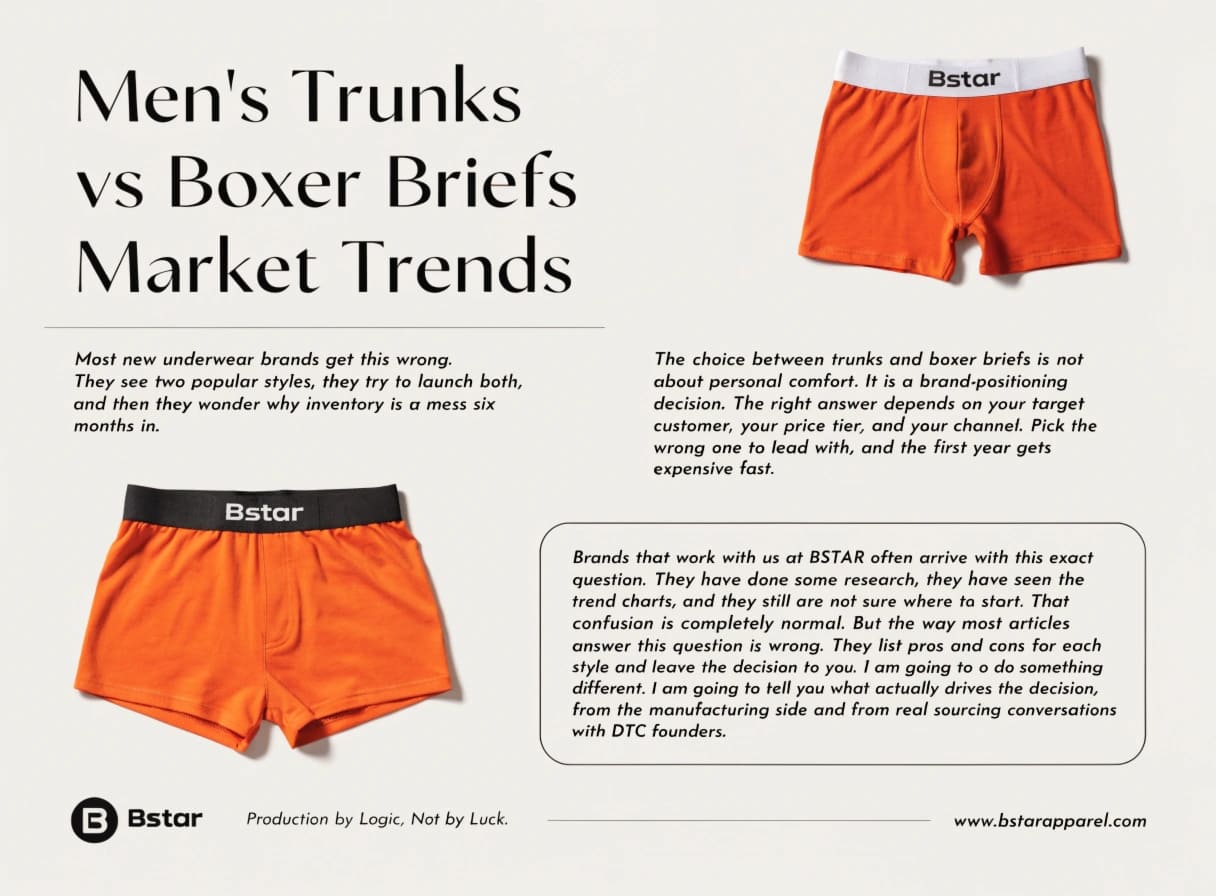
Brands that work with us at BSTAR often arrive with this exact question. They have done some research, they have seen the trend charts, and they still are not sure where to start. That confusion is completely normal. But the way most articles answer this question is wrong. They list pros and cons for each style and leave the decision to you. I am going to do something different. I am going to tell you what actually drives the decision, from the manufacturing side and from real sourcing conversations with DTC founders.
Decoding the Silhouette: What Actually Separates Trunks from Boxer Briefs?
Most people describe this as a leg-length difference. That is true, but it misses the bigger picture.
Trunks have a shorter inseam, typically 2–4 inches, a boxier cut through the seat, and a lower-rise profile. Boxer briefs run longer, usually 5–8 inches in the inseam, with a closer fit through the thigh and a higher-rise waistband. These differences affect how each style is cut, sewn, and worn.
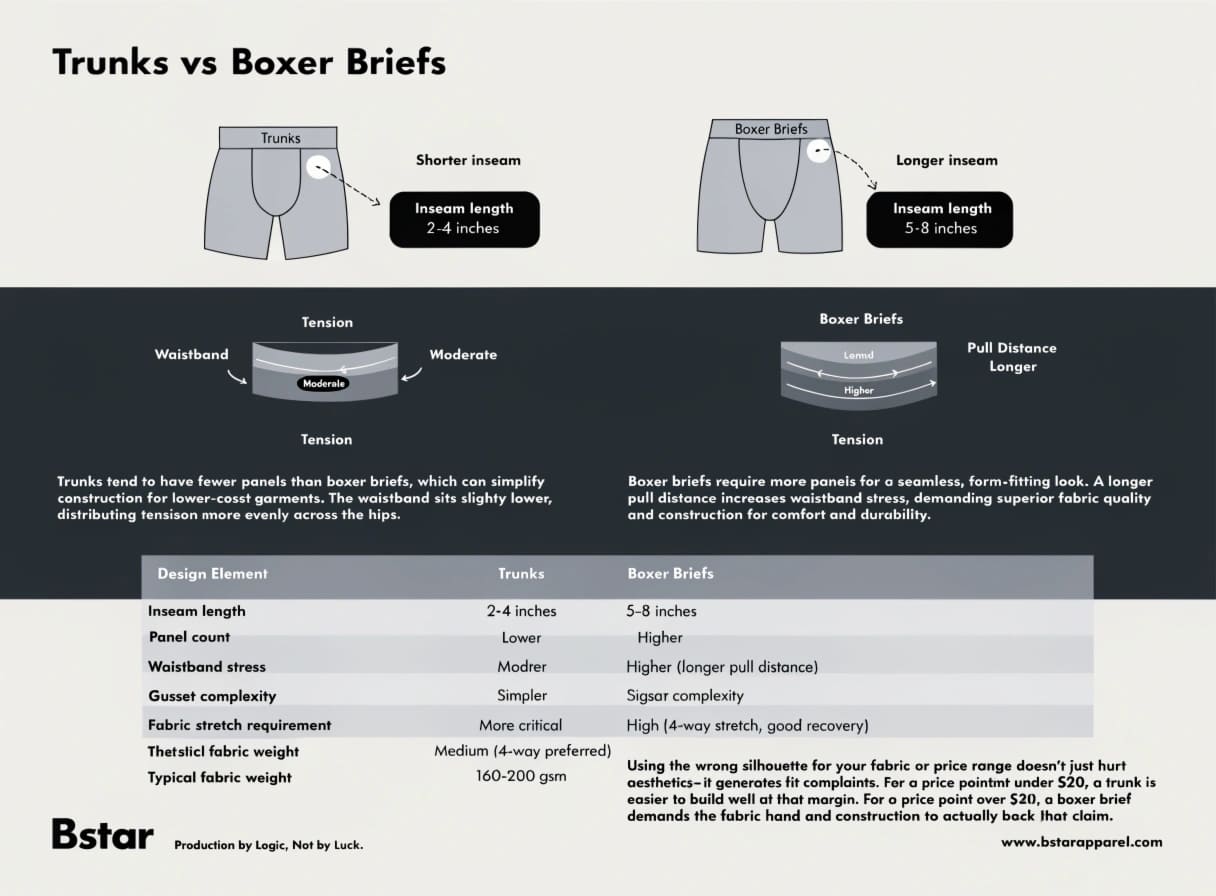
From a production standpoint, these two styles are not just "the same garment with a different hem." They use different panel counts. The waistband tension sits differently on each silhouette. The inseam on a boxer brief adds a seam junction that does not exist in a trunk, which means more stress at the crotch gusset and stricter fabric stretch-recovery requirements1.
Here is what this means for your brand in practice:
| Design Element | Trunks | Boxer Briefs |
|---|---|---|
| Inseam length | 2–4 inches | 5–8 inches |
| Panel count | Lower | Higher |
| Waistband stress | Moderate | Higher (longer pull distance) |
| Gusset complexity | Simpler | More critical |
| Fabric stretch requirement | Medium (4-way preferred) | High (4-way stretch2, good recovery) |
| Typical fabric weight | 160–200 gsm | 170–220 gsm |
If your target price point is below $20 retail, a trunk is easier to build well at that margin. If you are positioning above $30 and marketing on "no-ride-up" or "all-day comfort," a boxer brief demands the fabric hand and construction to actually back that claim. Using the wrong silhouette for your fabric or price range does not just hurt aesthetics. It generates fit complaints, and fit complaints kill repeat purchase.
Global Market Trends: What the Numbers Tell You—and What They Don’t
Boxer briefs have grown in global market share over the past decade3. That is a real trend. But using that data alone to decide what your brand should launch first is a shortcut that skips the real question.
Globally, boxer briefs hold the largest share of the men’s underwear market4, driven by comfort positioning and performance fabric adoption. Trunks have grown fastest in younger demographics and fashion-forward DTC channels, particularly in markets like Europe, Australia, and the US5 where aesthetics-led branding has gained ground.
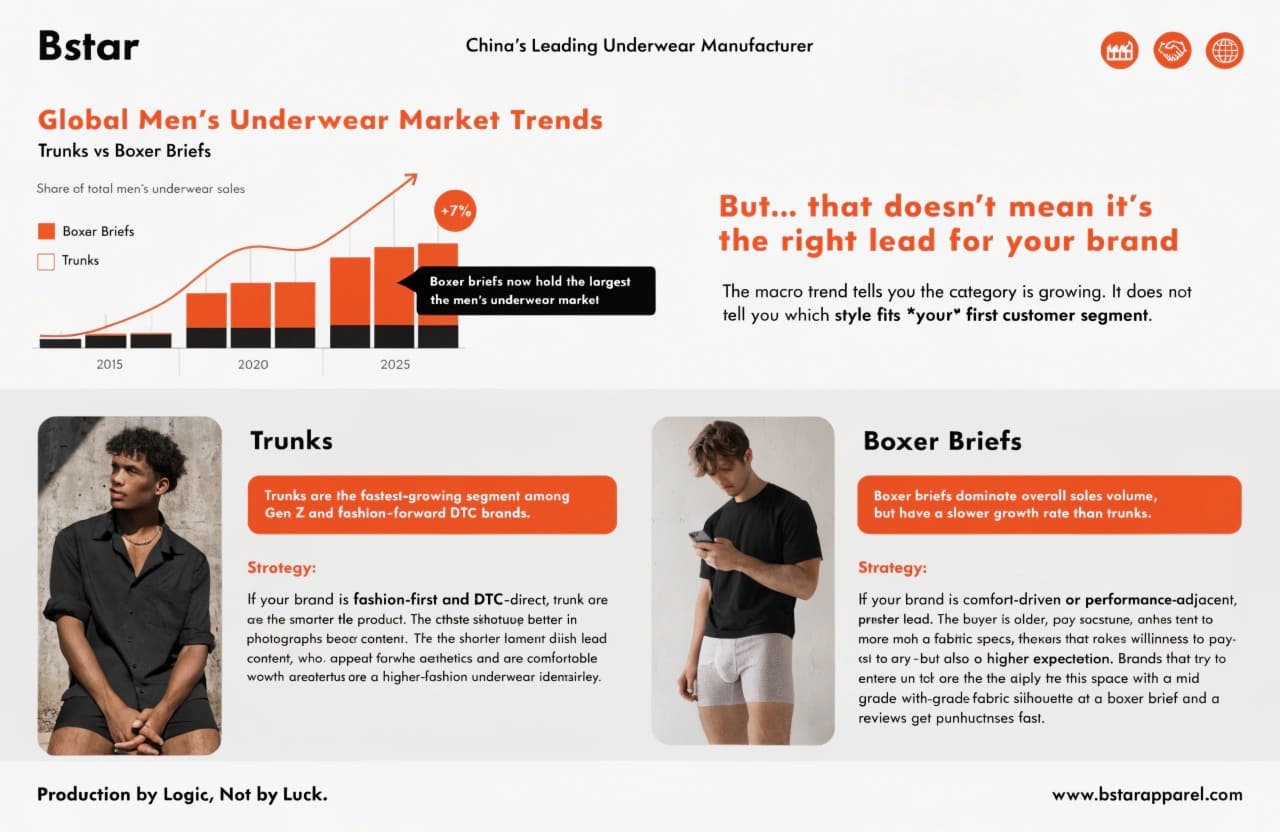
The macro trend tells you the category is growing. It does not tell you which style fits your first customer segment.
Here is how I would read the trend data through a positioning lens:
If your brand is fashion-first and DTC-direct, trunks are the smarter lead product. The shorter silhouette photographs better in lifestyle content. It appeals to younger buyers who prioritize aesthetics and are comfortable with a higher-fashion underwear identity. Several brands we work with in the Australian and US DTC space have built their first 10,000 units of demand entirely on a trunk-led lineup before ever touching boxer briefs.
If your brand is comfort-driven or performance-adjacent, boxer briefs are the right lead. The buyer is older, pays more attention to fabric specs, and has a higher willingness to pay—but also a higher expectation. Brands that try to enter this space with a mid-grade fabric and a boxer brief silhouette get punished in reviews fast.
If your brand is value-tier or marketplace-first (Amazon, etc.), trunks win on unit economics. Fewer panels, simpler construction, lower cost per unit at the same fabric quality. For a first-time brand validating demand on Amazon before investing in brand infrastructure, this matters.
The trend data is background context. Your segment is the decision variable.
Consumer Preferences: Chafing, Support, and Freedom of Movement
Brands often frame this as a comfort question. In sourcing conversations, we see it show up as a fit complaint question after launch.
Consumer preference research consistently shows that chafing prevention and support are the top functional priorities for men’s underwear buyers6. Boxer briefs perform better for chafing prevention due to longer inseam coverage7. Trunks score higher on freedom of movement and breathability perception, particularly in warmer climates.
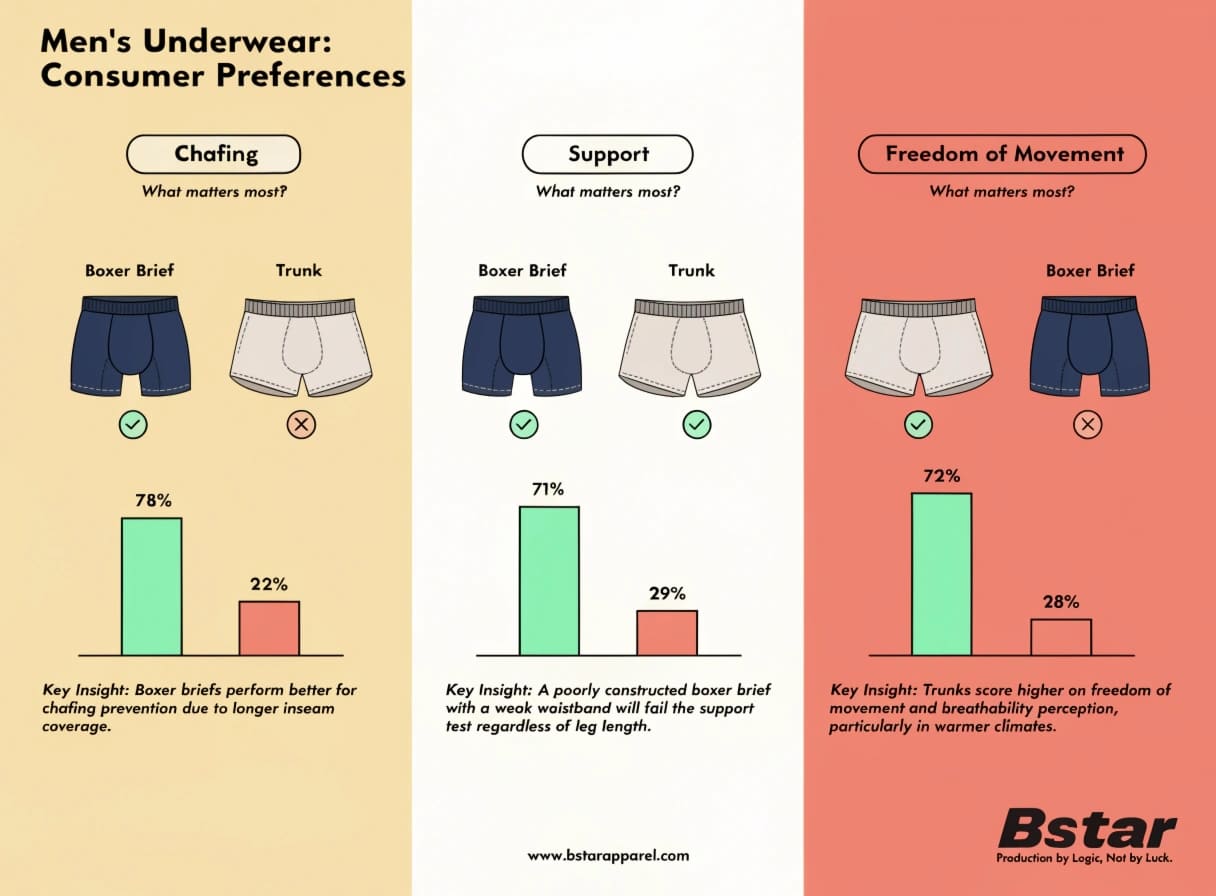
From the production side, "support" is not just about silhouette. It is about the waistband construction, the pouch design, and the fabric recovery after stretch. A poorly constructed boxer brief with a weak waistband will fail the support test regardless of leg length. A trunk with a well-engineered pouch will out-support a lazy boxer brief design.
What this means for your brand:
| Consumer Priority | Better Silhouette | Manufacturing Variable That Delivers It |
|---|---|---|
| Chafing prevention | Boxer brief | Inseam length + flat-lock seam finish8 |
| Support | Boxer brief (if well constructed) | Pouch depth + waistband elastic recovery |
| Freedom of movement | Trunks | Fabric 4-way stretch + shorter inseam |
| Breathability | Trunks | Fabric GSM + fiber blend |
| All-day wearability | Boxer brief | Fabric weight + inseam gusset design |
If your customer segment is active men or desk-to-gym buyers, the boxer brief’s anti-chafe advantage is a real product story. If your customer is a younger buyer who wears slim-cut pants and cares about visible lines and bulk, trunks solve a real problem for them. The brand that tries to claim both audiences simultaneously with one product usually ends up owning neither conversation clearly.
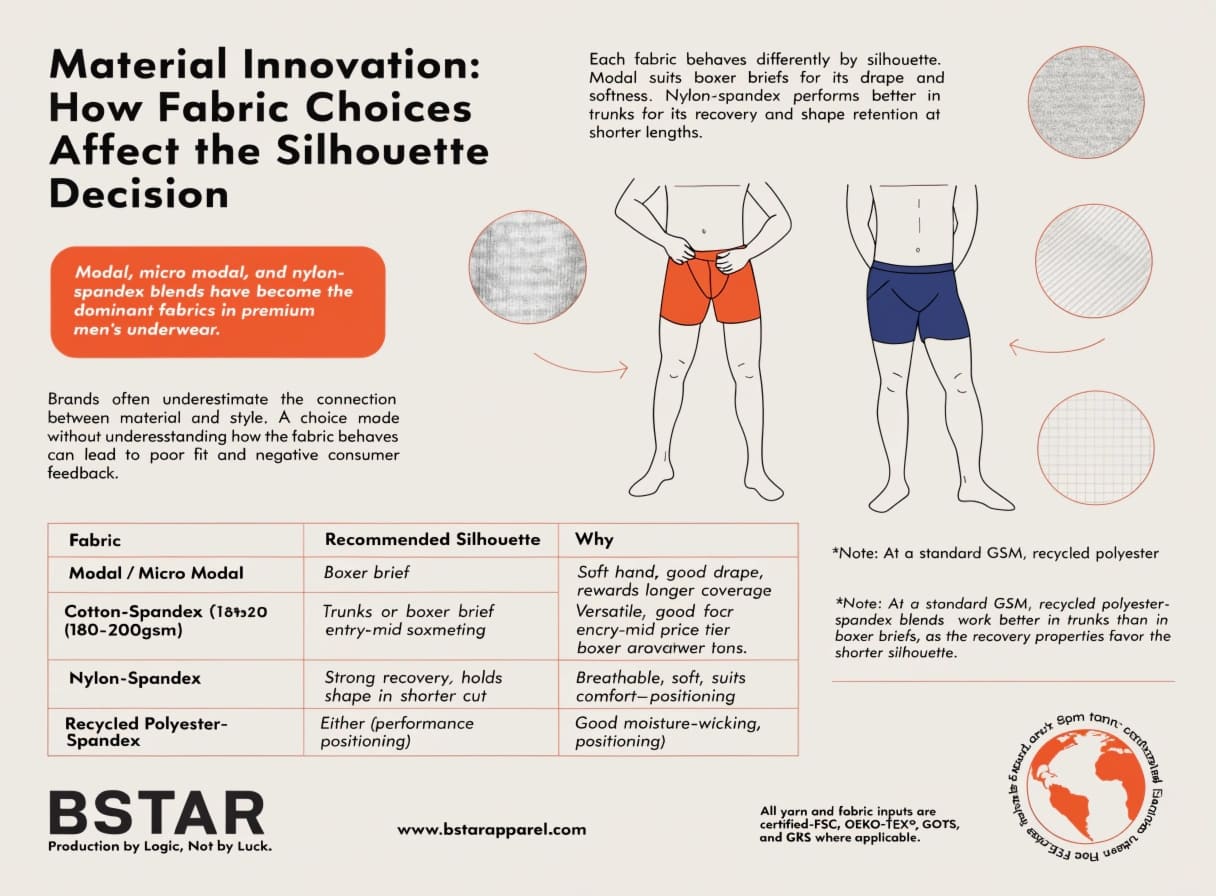
Material Innovation: How Fabric Choices Affect the Silhouette Decision
This is where brands underestimate the connection between material and style.
Modal, micro modal, and nylon-spandex blends have become the dominant fabrics in premium men’s underwear9. Each fabric behaves differently by silhouette. Modal suits boxer briefs for its drape and softness10. Nylon-spandex performs better in trunks for its recovery and shape retention at shorter lengths11.
At BSTAR, all our yarn and fabric inputs are certified—FSC, OEKO-TEX®, GOTS, and GRS where applicable. But certification aside, the functional behavior of the fabric is what matters for the final product.
Here is how fabric choice maps to silhouette:
| Fabric | Recommended Silhouette | Why |
|---|---|---|
| Modal / Micro Modal | Boxer brief | Soft hand, good drape, rewards longer coverage |
| Cotton-Spandex (180–200gsm) | Trunks or boxer brief | Versatile, good for entry-mid price tier |
| Nylon-Spandex | Trunks | Strong recovery, holds shape in shorter cut |
| Bamboo-Spandex | Boxer brief | Breathable, soft, suits comfort-positioning |
| Recycled Polyester-Spandex | Either (performance positioning) | Good moisture-wicking, GRS-certifiable |
A brand that wants to launch on a "sustainable" platform with GRS-certified recycled materials should know that recycled polyester-spandex blends work better in trunks than in boxer briefs at a standard GSM, because the recovery properties favor the shorter silhouette12. Choosing the right fabric-silhouette combination is not a styling call. It is a technical one, and getting it wrong produces fit complaints that no amount of marketing fixes.
Conclusion
Lead with one style, match it to your customer segment and price tier, and make sure your fabric supports the silhouette. That single focus is what separates a clean product launch from an expensive inventory lesson.
-
"Effect of Sewing Thread Linear Density on Apparel Seam …", https://www.academia.edu/20594587/Effect_of_Sewing_Thread_Linear_Density_on_Apparel_Seam_Strength_A_research_on_Lapped_and_Superimposed_seam. Apparel engineering literature on seam mechanics identifies multi-seam junctions as stress concentration points in fitted garments; the convergence of inseam and gusset seams in close-fitting lower-body garments is recognized as a high-stress zone requiring elevated fabric elongation and recovery specifications to prevent seam failure. Evidence role: mechanism; source type: research. Supports: That additional seam junctions in fitted garments concentrate mechanical stress at intersection points, increasing fabric and seam performance requirements. Scope note: Published studies on seam stress in underwear specifically are limited; the principle is extrapolated from broader garment engineering and seam performance research. ↩
-
"Stretch fabric – Wikipedia", https://en.wikipedia.org/wiki/Stretch_fabric. In textile and apparel engineering, four-way stretch refers to a fabric’s capacity to elongate in both the warp and weft directions, typically achieved through the incorporation of elastomeric fibers such as spandex; this bidirectional extensibility is considered essential for fitted garments that must accommodate multidirectional body movement. Evidence role: definition; source type: education. Supports: That four-way stretch fabric—stretching both along the grain and cross-grain—is the relevant technical standard for fitted underwear construction. ↩
-
"Underwear – Wikipedia", https://en.wikipedia.org/wiki/Underwear. Market research analyses of the men’s innerwear segment have documented a sustained shift toward fitted styles, including boxer briefs, attributed to comfort-driven consumer preferences and the expansion of performance fabric offerings; specific share figures vary by region and methodology across reports. Evidence role: statistic; source type: institution. Supports: That boxer briefs have increased their share of the global men’s underwear market over the past decade. Scope note: Aggregate market share figures differ across research providers and may not reflect regional variation or DTC-channel-specific trends. ↩
-
"Men’s Underwear Market Size & Trends Analysis Report, 2030", https://www.grandviewresearch.com/industry-analysis/mens-underwear-market. Industry analyses of the men’s underwear category have identified fitted brief-style garments, including boxer briefs, as the dominant segment by volume in several major markets, driven by comfort positioning and athleisure-adjacent marketing. Evidence role: statistic; source type: institution. Supports: That boxer briefs represent the largest style segment within the global men’s underwear market. Scope note: Market segmentation definitions vary by analyst; some reports combine trunks and boxer briefs into a single ‘fitted’ category, which may overstate boxer brief dominance specifically. ↩
-
"Choice of underwear and male fecundity in a preconception cohort …", https://pmc.ncbi.nlm.nih.gov/articles/PMC6214186/. Consumer preference surveys in men’s apparel have noted a correlation between younger age cohorts and preference for shorter, fashion-oriented underwear silhouettes, consistent with broader trends toward fitted, aesthetics-led innerwear in DTC retail environments. Evidence role: statistic; source type: research. Supports: That trunk-style underwear has seen faster adoption among younger male consumers and in direct-to-consumer fashion channels in Western markets. Scope note: Publicly available demographic breakdowns specific to trunk underwear adoption by region are limited; this claim may rest primarily on proprietary retail or survey data. ↩
-
"exploring the decision-making process of men’s branded underwear …", https://www.academia.edu/14550603/EXPLORING_THE_DECISION_MAKING_PROCESS_OF_MEN_S_BRANDED_UNDERWEAR_CONSUMERS. Consumer surveys examining men’s apparel purchase motivations have identified comfort-related attributes—including friction reduction and physical support—as primary functional drivers, alongside fit and fabric feel, in underwear category decisions. Evidence role: expert_consensus; source type: research. Supports: That chafing prevention and support rank among the highest functional priorities in men’s underwear purchase decisions. Scope note: Priority rankings vary across survey methodologies and demographic samples; no single universally cited study establishes a definitive ranking of these attributes. ↩
-
"7 Tips to Help Prevent Chafing – GoodRx", https://www.goodrx.com/health-topic/dermatology/how-to-prevent-chafing?srsltid=AfmBOorZdEuSKIFt_ckwL5wihuRPhYLKq1DgIMQWPnAuMxta8aQIwbsJ. Dermatological literature on intertrigo and exercise-related skin friction identifies direct skin-to-skin contact in the inner thigh region as a primary chafing mechanism; fabric barriers that extend coverage of this area are recognized as a mitigation strategy. Evidence role: mechanism; source type: paper. Supports: That longer fabric coverage of the inner thigh reduces skin-on-skin or skin-on-fabric friction and thereby lowers chafing incidence. Scope note: Published studies focus primarily on clinical skin conditions rather than underwear design specifically; the direct link between inseam length and chafing reduction in underwear is inferred from friction-reduction principles rather than controlled garment trials. ↩
-
"Flatlock seam used in activewear and outdoor clothing to reduce …", https://www.reddit.com/r/toolgifs/comments/1pnkppx/flatlock_seam_used_in_activewear_and_outdoor/. Apparel construction literature distinguishes flat-lock seaming—in which seam allowances lie flat and parallel to the fabric surface—from raised-edge alternatives such as overlocked seams; the flat profile reduces the pressure differential and friction coefficient at the seam-skin interface, a recognized factor in chafing prevention for close-fitting garments. Evidence role: mechanism; source type: research. Supports: That flat-lock seam construction reduces skin irritation and chafing by eliminating raised seam edges that create friction against the skin. Scope note: Quantitative comparative studies measuring chafing incidence by seam type in underwear specifically are not widely published; the mechanism is supported by general tribological and skin-friction principles applied to textile contact. ↩
-
"The Science Behind Micromodal: Why Its a Game-Changer in …", https://www.andcircus.com/blogs/industry-news/the-science-behind-micromodal-why-its-a-game-changer-in-underwear?srsltid=AfmBOoof3pNc614aD1faoZwHDQFgh0WcLn_PD0X3cPQAFgLejr8ql0Gw. Textile industry analyses of the innerwear segment have documented the displacement of conventional cotton constructions by engineered fiber blends—including modal derivatives and nylon-elastane composites—in premium-positioned men’s underwear, driven by performance and hand-feel requirements. Evidence role: general_support; source type: institution. Supports: That modal, micro modal, and nylon-spandex blends have achieved widespread adoption in the premium men’s underwear segment. Scope note: Precise market share data for specific fiber types in the underwear segment is not consistently published in open-access sources; dominance claims may reflect trade reporting rather than independently verified volume data. ↩
-
"A Study on Modal Fibre Based on the Absorption Characteristics", https://symbiosisonlinepublishing.com/materialsscience-engineering/materialsscience-engineering23.php. Modal is a cellulosic regenerated fiber produced from beech wood pulp; textile characterization studies document its high moisture absorption, low stiffness modulus, and superior drape compared to conventional cotton, properties that favor applications requiring soft, conforming coverage. Evidence role: mechanism; source type: research. Supports: That modal fiber exhibits high drape and softness characteristics that make it well-suited to garments requiring fluid coverage over longer body areas. Scope note: The specific inference that modal’s drape advantage is more pronounced in boxer briefs than trunks is a design application judgment not directly tested in published textile science literature. ↩
-
"Impact of the Elastane Percentage on the Elastic Properties of … – PMC", https://pmc.ncbi.nlm.nih.gov/articles/PMC9570736/. Textile engineering studies on elastomeric fiber blends document that nylon-spandex composites achieve high elastic recovery percentages after cyclic deformation, a property particularly relevant in garments subject to repeated stretch-and-release cycles across short panel lengths. Evidence role: mechanism; source type: research. Supports: That nylon-spandex blends exhibit high elastic recovery rates that help shorter garment cuts retain their intended shape under repeated stretch. Scope note: The comparative advantage of nylon-spandex over modal specifically in short-inseam silhouettes is a practical application inference; controlled comparative garment trials are not widely published in open literature. ↩
-
"Changes in Mechanical Properties of Fabrics Made of … – PMC", https://pmc.ncbi.nlm.nih.gov/articles/PMC10708220/. Studies comparing recycled and virgin polyester fiber blends in stretch fabrics indicate that mechanical recovery properties are influenced by fiber crimp and molecular weight distribution; recycled polyester-spandex composites may exhibit marginally lower recovery consistency than virgin equivalents, a factor relevant to garment fit retention in longer panel constructions. Evidence role: mechanism; source type: research. Supports: That recycled polyester-spandex blends have recovery characteristics that are better suited to shorter garment constructions. Scope note: Direct comparative testing of recycled polyester-spandex performance specifically in trunk versus boxer brief silhouettes is not documented in publicly available research; the claim extrapolates from general fiber recovery data. ↩
“Every single point you made is dead on. Nothing to add, just nodding along the whole time”
Thank you for your visit