Plus Size Underwear Manufacturing: Inclusive Sizing Standards
If you’ve ever launched a plus size underwear line and watched the returns pile up, you already know something went wrong. The question is where.
Plus size underwear manufacturing is not a grading exercise. It is a separate pattern engineering problem. Brands that brief manufacturers to "scale up" from standard blocks almost always burn 2–4 sampling rounds before discovering the fit fails on the body. The right move is to understand which structural variables need to be rebuilt before you brief anyone.
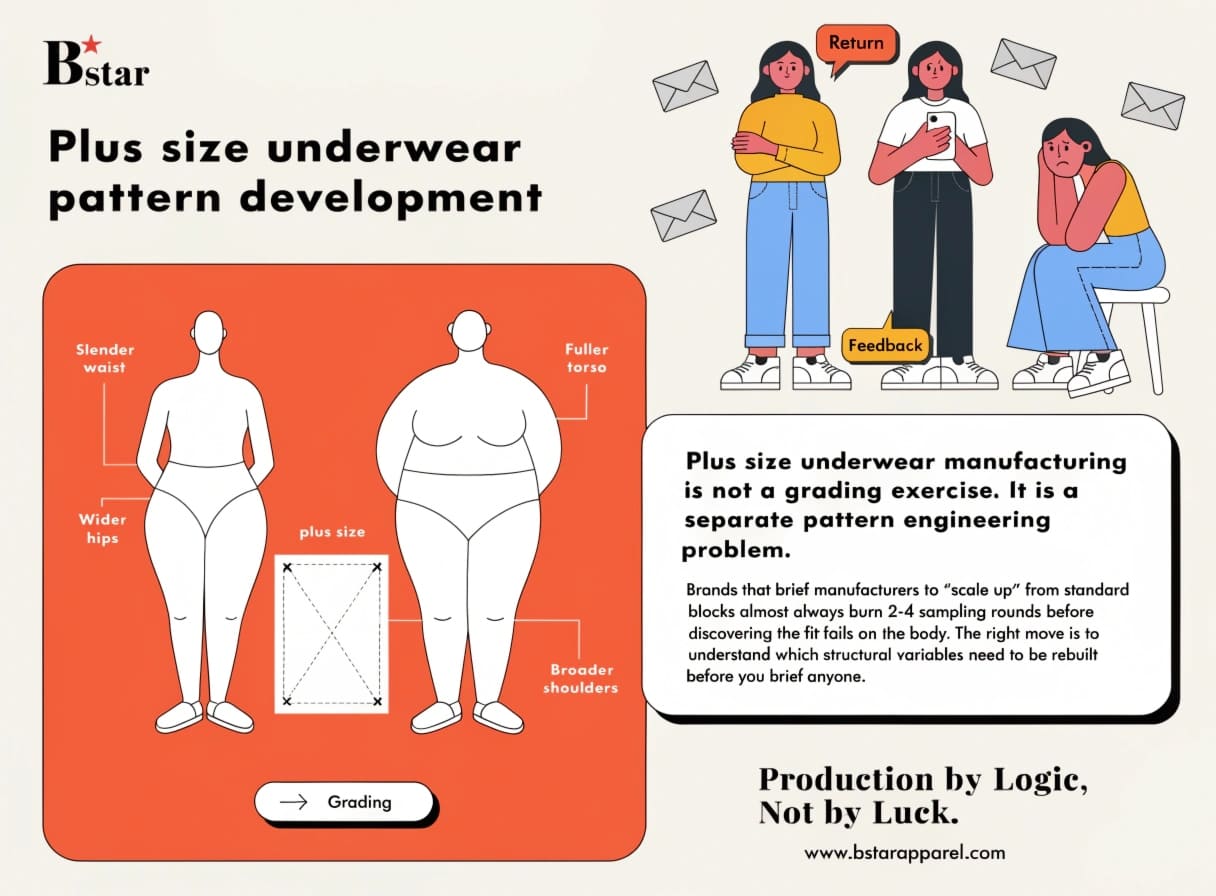
Most brands find this out the hard way. They brief a manufacturer, approve a size chart, run samples, and then get fit feedback that feels unsolvable. The samples look fine on a dress form. They fail on real bodies. This article breaks down exactly why that happens and what you need to fix before your next sampling round.
Beyond Scaling Up: Do You Actually Understand Plus Size Body Proportions?
Most brands assume plus size patterns are just bigger versions of standard patterns. That assumption is the root cause of most fit failures I see come through our sampling process.
Plus size bodies do not scale proportionally. The waist-to-hip ratio, abdominal curve depth, and torso length all shift non-linearly as size increases.1 A pattern graded up from a standard block will not sit correctly on the body, no matter how accurate the measurements on paper look.
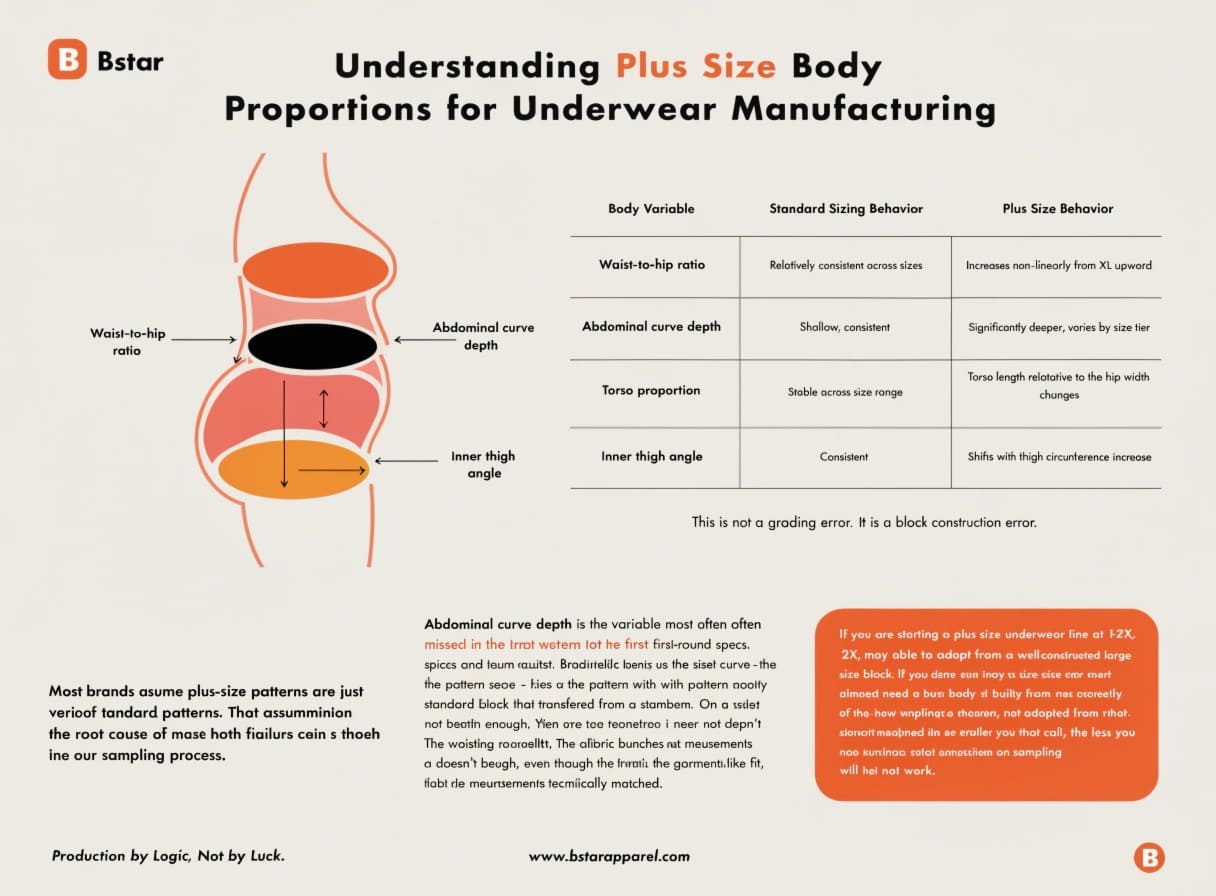
In our sampling rounds for plus size briefs, abdominal curve depth is the variable most often missed in first-round specs. Brands will send us a size chart with waist and hip measurements, and those numbers are fine. But the front rise curve — the depth of the pattern piece that accommodates the abdomen — gets transferred from a standard block. On a plus size body, that curve is not deep enough. The waistband pulls down at the front. The fabric bunches. The garment looks like it doesn’t fit, even though the measurements technically matched.
This is not a grading error. It is a block construction error.
| Body Variable | Standard Sizing Behavior | Plus Size Behavior |
|---|---|---|
| Waist-to-hip ratio | Relatively consistent across sizes | Increases non-linearly from XL upward |
| Abdominal curve depth | Shallow, consistent | Significantly deeper, varies by size tier |
| Torso proportion | Stable across size range | Torso length relative to hip width changes |
| Inner thigh angle | Consistent | Shifts with thigh circumference increase |
The practical implication is straightforward. If you are starting a plus size underwear line at 1X–2X, you may be able to adapt from a well-constructed large block. If you are going to 3X–4X or beyond, you almost certainly need a new block built from plus size body data, not adapted from anything smaller. The earlier you make that call, the less you spend on sampling that will not work.
Data-Driven Grading: Are Your Size Charts Actually Built for the Bodies You’re Selling To?
A lot of brands come to us with size charts that look comprehensive. Lots of measurements, multiple size tiers. But when we ask where the data came from, the answer is usually "we based it on industry standard charts" or "we extended from our existing size range."
Accurate plus size grading starts with body measurement data from actual plus size consumers. If your size chart is extrapolated from standard sizing rather than measured from the target population, your grading intervals will be wrong2 at the sizes that matter most to your customer.
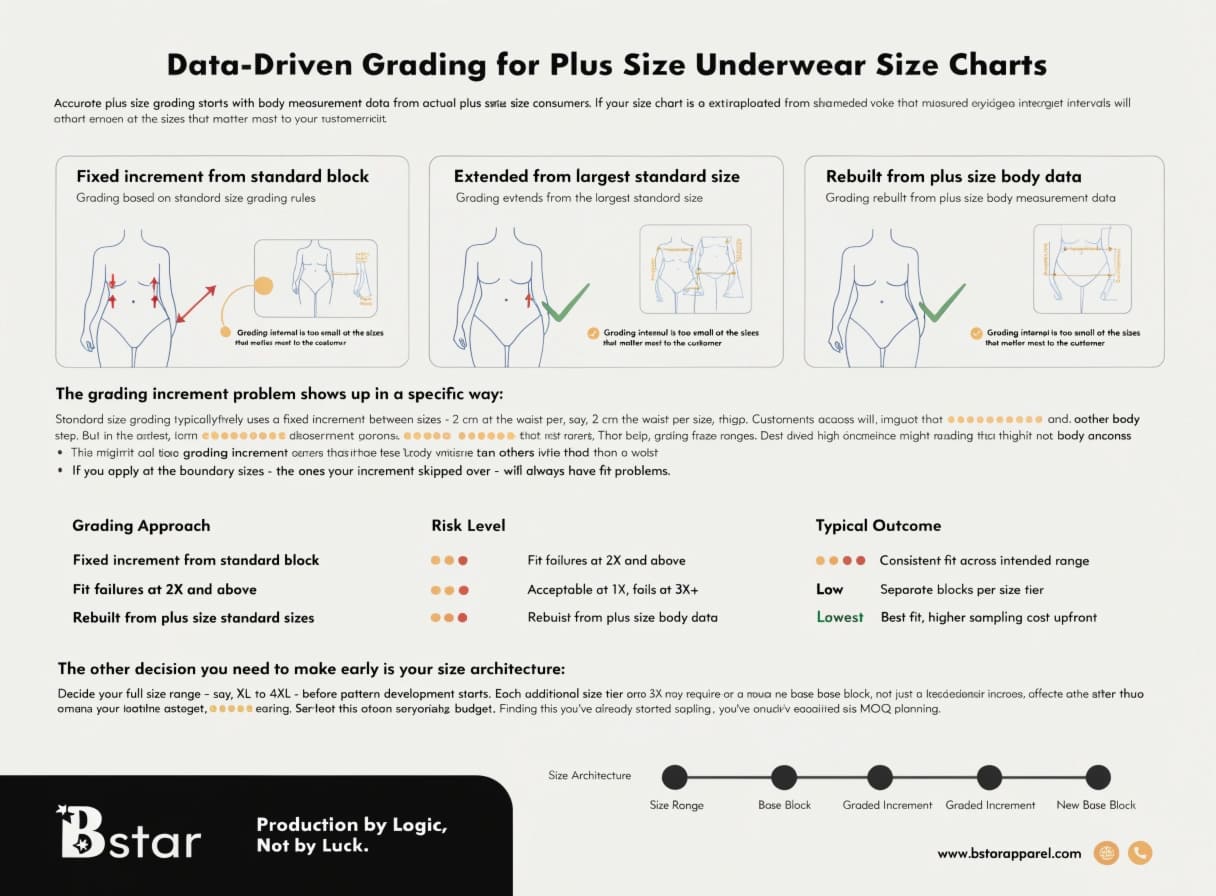
The grading increment problem shows up in a specific way. Standard size grading typically uses a fixed increment between sizes — say, 2 cm at the waist per size step. In plus size ranges, the actual body measurement difference between sizes is often larger, and it is not the same across all body zones.3 The hip might increase faster than the waist. The thigh circumference might increase faster than either.
If you apply a fixed grading increment across your plus size range, some sizes will fit well and others will not. Customers at the boundary sizes — the ones your increment skipped over — will always have fit problems.
| Grading Approach | Risk Level | Typical Outcome |
|---|---|---|
| Fixed increment from standard block | High | Fit failures at 2X and above |
| Extended from largest standard size | Medium-High | Acceptable at 1X, fails at 3X+ |
| Rebuilt from plus size body data | Low | Consistent fit across intended range |
| Separate blocks per size tier | Lowest | Best fit, higher sampling cost upfront |
The other decision you need to make early is your size architecture. Decide your full size range — say, XL to 4XL — before pattern development starts. Each additional size tier above 2X or 3X may require a new base block, not just a graded increment. That affects your sampling budget, your timeline, and your MOQ planning. Finding this out after you’ve already started sampling is expensive.
Engineering for Comfort: Are Your Fabrics and Support Structures Matched to Plus Size Mechanical Demand?
This is the part that most brands treat as a sourcing decision. It is actually a technical specification decision, and getting it wrong at the sampling stage locks in a comfort failure that no grading fix can correct.
Plus size underwear places higher mechanical demand on fabric. Stretch rate, recovery force, and fatigue resistance all need to be matched to the actual body load at larger sizes. A fabric that performs well in standard sizes will degrade, lose recovery, and create pressure points when worn at plus size body loads.4
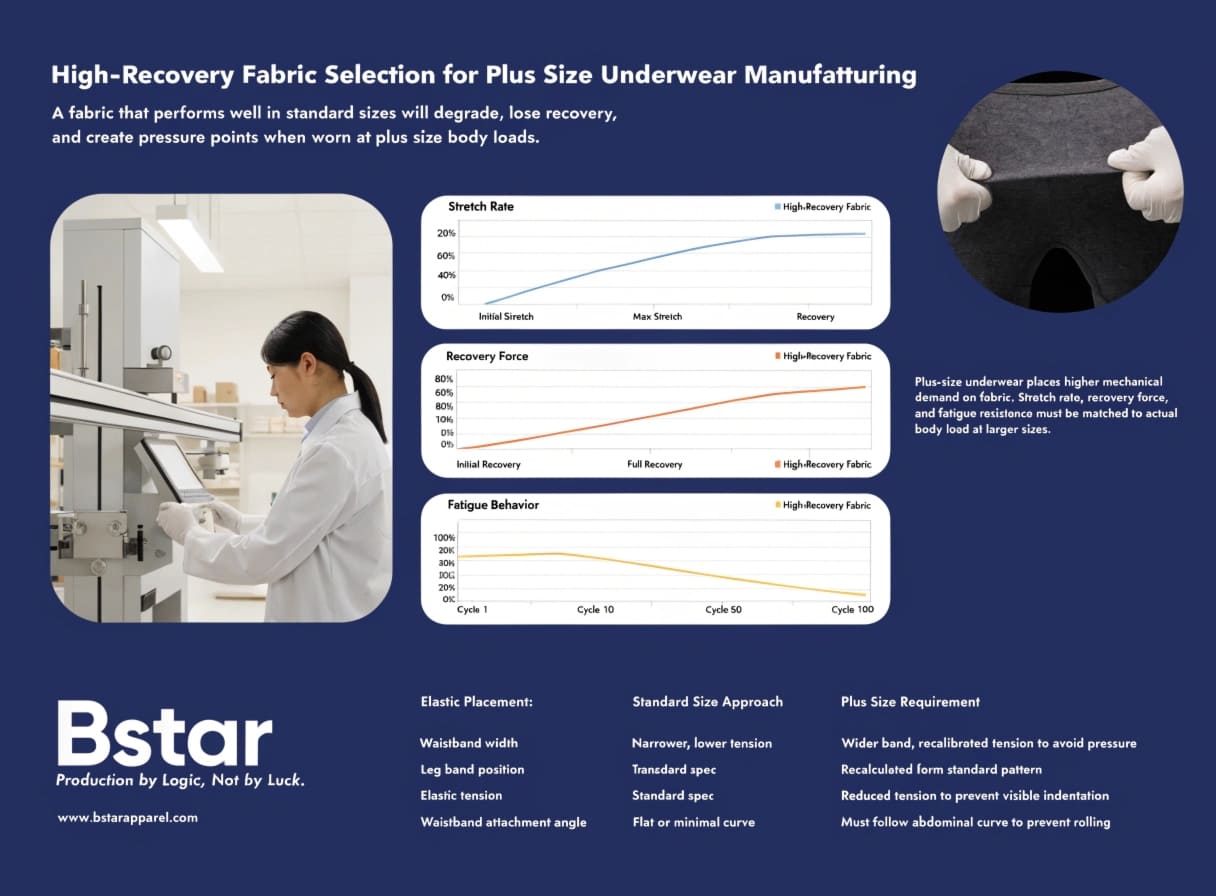
The recovery force issue is the one I see cause the most problems. A fabric with adequate stretch for standard sizes may not have enough recovery force to maintain its position on a plus size body during movement. It stretches, but it does not spring back. The waistband drops. The leg bands roll up. The fabric sags at the seat. These are not fit problems. They are fabric specification problems wearing the costume of fit problems.
When we run fabric testing for plus size underwear development, we look at stretch rate and recovery force together — not just elongation percentage. We also test fatigue behavior: how does the fabric perform after repeated stretch-recovery cycles? A fabric that tests fine in static conditions but degrades quickly under wear is a return risk, not a sampling success.
Elastic placement is the other structural variable that brands consistently underestimate.
| Elastic Variable | Standard Size Approach | Plus Size Requirement |
|---|---|---|
| Waistband width | Narrower, lower tension | Wider band, recalibrated tension to avoid pressure |
| Leg band position | Transferred from standard pattern | Recalculated for thigh circumference and angle |
| Elastic tension | Standard spec | Reduced tension to prevent visible indentation |
| Waistband attachment angle | Flat or minimal curve | Must follow abdominal curve to prevent rolling |
The waistband and leg band tension in a plus size garment cannot be transferred from a standard pattern.5 The tension that creates a clean finish on a standard size body creates a pressure point and visible indentation on a plus size body.6 This is why plus size customers frequently report "the elastic digs in" — it is not a fit complaint, it is a construction spec complaint. The elastic was not recalculated for the body it is sitting on.
We use fabrics that carry OEKO-TEX® certification across our plus size underwear production, which matters for this category because fabrics with chemical residues in finishing treatments can amplify skin sensitivity at high-contact zones7 — exactly where elastic sits on a plus size body.
Market Opportunities: Is the Demand for Plus Size Underwear Actually Worth Engineering Properly?
Some brands treat plus size as a line extension — something to add when the core range is established. That framing understates what the market data says and what the commercial risk of poor execution looks like.
The plus size underwear segment is growing faster than the standard size segment in most western DTC markets.8 Consumers in this segment are highly vocal about fit failures and share reviews publicly.9 A poorly engineered plus size line generates returns, negative reviews, and customer acquisition costs that a well-engineered launch avoids entirely.
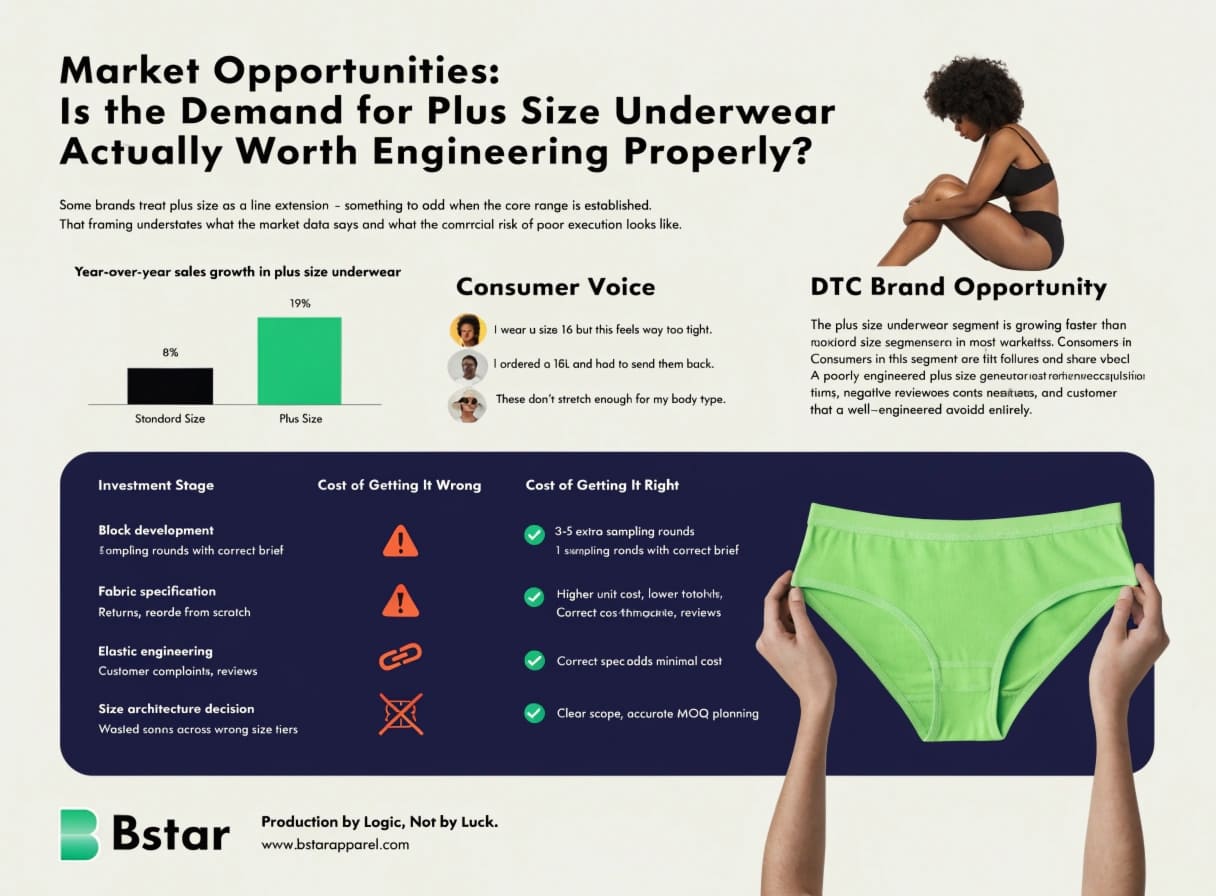
The commercial reality is that plus size underwear customers have been underserved for a long time. When a brand gets the fit right, loyalty is high and word-of-mouth is strong. When a brand gets the fit wrong, the negative feedback is fast and public. The return rate difference between a properly engineered plus size brief and a graded-up standard brief is significant — in my experience across multiple client sampling projects, poor fit in plus size underwear generates return rates that are noticeably higher than the brand’s standard size return baseline.
The brands that do well in this segment treat the engineering investment as upfront cost reduction, not as added expense. Spending more time and budget on correct block development, fabric specification, and elastic engineering in the sampling phase saves a multiple of that cost in resampling rounds, production defects, and returns.10
| Investment Stage | Cost of Getting It Wrong | Cost of Getting It Right |
|---|---|---|
| Block development | 3–5 extra sampling rounds | 1–2 sampling rounds with correct brief |
| Fabric specification | Returns, reorder from scratch | Higher unit cost, lower total cost |
| Elastic engineering | Customer complaints, reviews | Correct spec adds minimal cost |
| Size architecture decision | Wasted sampling across wrong size tiers | Clear scope, accurate MOQ planning |
The brands I’ve seen enter the plus size market successfully are the ones who brief their manufacturer with a clear size architecture, a fabric spec that accounts for plus size mechanical demand, and pattern briefs that flag abdominal curve depth, elastic placement, and recovery requirements explicitly. They treat the manufacturer as a technical partner on a specific engineering problem, not as a factory that will figure it out.
Conclusion
Plus size underwear requires separate block engineering, matched fabric specs, and deliberate size architecture decisions made before sampling begins. Brands that approach it this way spend less and launch better.
-
"Prediction the changes of anthropometric indices following a weight …", https://pmc.ncbi.nlm.nih.gov/articles/PMC11196268/. Anthropometric studies of body shape variation across size categories have documented non-linear relationships between waist, hip, and abdominal measurements as body mass increases, supporting the principle that proportional grading from standard blocks does not accurately represent larger body geometries. Evidence role: mechanism; source type: paper. Supports: That anthropometric measurements do not scale linearly across size categories, particularly in the waist-to-hip and abdominal regions.. Scope note: Most published anthropometric datasets focus on general population distributions rather than apparel-specific grading intervals; direct evidence for underwear pattern construction specifically may require inference from broader body measurement literature. ↩
-
"Evaluating machine learning models for clothing size prediction …", https://pmc.ncbi.nlm.nih.gov/articles/PMC12630603/. Standards bodies such as ASTM International have developed separate sizing specifications for plus size women’s apparel (e.g., ASTM D5585) based on body measurement data, reflecting the principle that plus size ranges require independently measured references rather than extrapolation from misses sizing. Evidence role: expert_consensus; source type: institution. Supports: That accurate size charts for plus size garments should be derived from measured body data of the target population rather than extrapolated from smaller size standards.. Scope note: ASTM standards describe measurement-based sizing frameworks but do not directly quantify the fit failure rate attributable to extrapolated versus measured size charts. ↩
-
"Manipulating measurement scales in medical statistical analysis and …", https://pmc.ncbi.nlm.nih.gov/articles/PMC3963323/. Research in apparel pattern grading has demonstrated that body measurement increments between size steps vary by anatomical location and do not remain proportionally consistent across extended size ranges, a finding with direct implications for plus size grading accuracy. Evidence role: mechanism; source type: paper. Supports: That grading increments between sizes are not uniform across body zones and that standard fixed-increment grading does not accurately represent plus size body measurement distributions.. Scope note: Published grading research often focuses on misses or women’s standard ranges; direct empirical data on increment variation specifically within plus size tiers is less extensively documented in peer-reviewed literature. ↩
-
"Fatigue Testing of Wearable Sensing Technologies – PMC – NIH", https://pmc.ncbi.nlm.nih.gov/articles/PMC8347841/. Textile engineering research on elastomeric fabric behavior has documented that recovery force and elastic fatigue resistance are load-dependent properties, with repeated high-load stretch cycles accelerating loss of recovery relative to lower-load conditions. Evidence role: mechanism; source type: paper. Supports: That elastomeric fabrics exhibit measurable degradation in recovery force under higher mechanical loads and repeated stretch-recovery cycles, relevant to plus size garment performance.. Scope note: Published textile fatigue studies typically use standardized laboratory conditions rather than simulated body-load scenarios specific to plus size wear; extrapolation to real-world garment performance requires contextual inference. ↩
-
"Waistbands Made Easy – BE BOLD. Shape the Future.", https://pubs.nmsu.edu/_c/C234/index.html. Garment engineering principles establish that elastic tension interacts with body circumference and tissue compliance to determine contact pressure; as circumference increases, a fixed elastic tension specification produces proportionally higher contact force, necessitating recalibration of tension values rather than direct transfer across size ranges. Evidence role: mechanism; source type: paper. Supports: That elastic tension in garments must be recalculated for different body circumferences rather than transferred directly from smaller size specifications.. Scope note: Formal published guidelines specifically addressing elastic tension recalculation protocols for plus size underwear are limited in peer-reviewed literature; the mechanical principle is well-established but apparel-specific empirical thresholds are not widely standard ↩
-
"Hole Matrix Mapping Model for Partitioned Sitting Surface Based on …", https://pmc.ncbi.nlm.nih.gov/articles/PMC10048545/. Research in garment pressure and ergonomics has established that contact pressure from elastic components varies with body curvature, tissue compliance, and circumference, indicating that a fixed elastic tension specification will produce different pressure outcomes across body sizes. Evidence role: mechanism; source type: paper. Supports: That elastic tension in garments produces different pressure distributions on bodies of varying size and composition, with fixed tension specifications creating higher contact pressure on larger bodies.. Scope note: Most garment pressure research focuses on compression garments or medical hosiery rather than everyday underwear elastic specifically; findings are directionally applicable but not directly derived from the underwear context described. ↩
-
"Early-Life Exposure to Formaldehyde through Clothing – PMC", https://pmc.ncbi.nlm.nih.gov/articles/PMC9318620/. The OEKO-TEX Standard 100 certification framework limits concentrations of harmful substances in textiles based on skin contact classification, reflecting established evidence that finishing chemical residues — including formaldehyde, azo dyes, and softener residues — can cause or exacerbate contact dermatitis in skin-contact applications. Evidence role: mechanism; source type: institution. Supports: That chemical residues from textile finishing processes are associated with skin sensitivity reactions, particularly in high-contact garment areas.. Scope note: The claim that residues specifically ‘amplify’ sensitivity at elastic contact zones in plus size bodies is a contextual inference; published dermatology literature documents textile contact dermatitis generally rather than by garment zone or body size. ↩
-
"[PDF] LINGERIE COMPANY MARKET OPPORTUNITY ASSESSMENT", https://dukespace.lib.duke.edu/bitstreams/d8bb9d45-4eab-494f-9251-7a8937cdf5aa/download. Market research reports from firms such as Grand View Research, Statista, and the NPD Group have tracked growth in the plus size apparel and lingerie categories, with several indicating above-average category expansion relative to standard sizing segments. Evidence role: statistic; source type: institution. Supports: That the plus size underwear or lingerie segment is experiencing above-average growth relative to the standard size segment.. Scope note: Specific growth rate figures vary by report, methodology, and geographic scope; the claim as stated applies broadly to ‘most western DTC markets,’ which may not be uniformly supported across all available data sources. ↩
-
"[PDF] understanding plus-size women’s decision-making process", https://scholarworks.calstate.edu/downloads/gm80j194s. Consumer behavior research on apparel fit satisfaction has identified fit as a primary driver of both returns and negative online reviews, with studies noting that underserved size segments exhibit heightened sensitivity to fit failures given historically limited options. Evidence role: general_support; source type: paper. Supports: That plus size consumers actively share fit-related feedback publicly and that fit dissatisfaction is a documented driver of negative reviews in this segment.. Scope note: Direct comparative data on review volume or sentiment between plus size and standard size consumers specifically for underwear is not widely available in published academic literature; the claim relies on inference from broader apparel consumer behavior research. ↩
-
"[PDF] The Economic Impacts of Inadequate Infrastructure for Software …", https://www.nist.gov/document/report02-3pdf. Product development and quality management research has documented that the cost of correcting design or specification errors increases significantly at each successive stage of the development-to-production pipeline, with errors identified post-production typically costing an order of magnitude more to resolve than those caught during design or sampling phases. Evidence role: general_support; source type: paper. Supports: That identifying and correcting technical errors during early development phases is substantially less costly than addressing the same errors during or after production.. Scope note: Published cost-of-quality multipliers are derived primarily from manufacturing and software engineering contexts; apparel-specific empirical data on sampling versus production correction cost ratios is less systematically documented in academic literature. ↩