
Building a Brand Story for Your Underwear Line: Where Does It Actually Start?
Most founders build their product first and plan to figure out the story later. By the time they get to "later," they have a warehouse full of product and nothing to say about it that a competitor cannot also say.
A strong underwear brand story is not written after manufacturing — it is built into the manufacturing decisions themselves. The materials you source, the factory you choose, and the certifications behind your supply chain are the raw proof points your story depends on. Without them, the narrative has no legs.
Most of what gets written about brand storytelling treats it as a marketing problem. Choose your tone of voice, write a compelling About page, post consistently. That advice is not wrong — but for a physical product like underwear, it skips the step that actually determines whether your story is credible or not. Let me break down what that actually looks like in practice.
Defining Your Core Mission: What Does Your Brand Actually Stand For?
A lot of founders start here with good intentions and end up stuck. They know why they started the brand, but they cannot quite connect that to something a buyer in a checkout moment actually cares about.
Your core mission works when it is connected to a consumer-facing problem — fit, comfort, skin sensitivity, sustainability, body confidence1. The moment your mission statement answers a question your customer is already asking, it becomes useful. Until then, it is just founder autobiography.
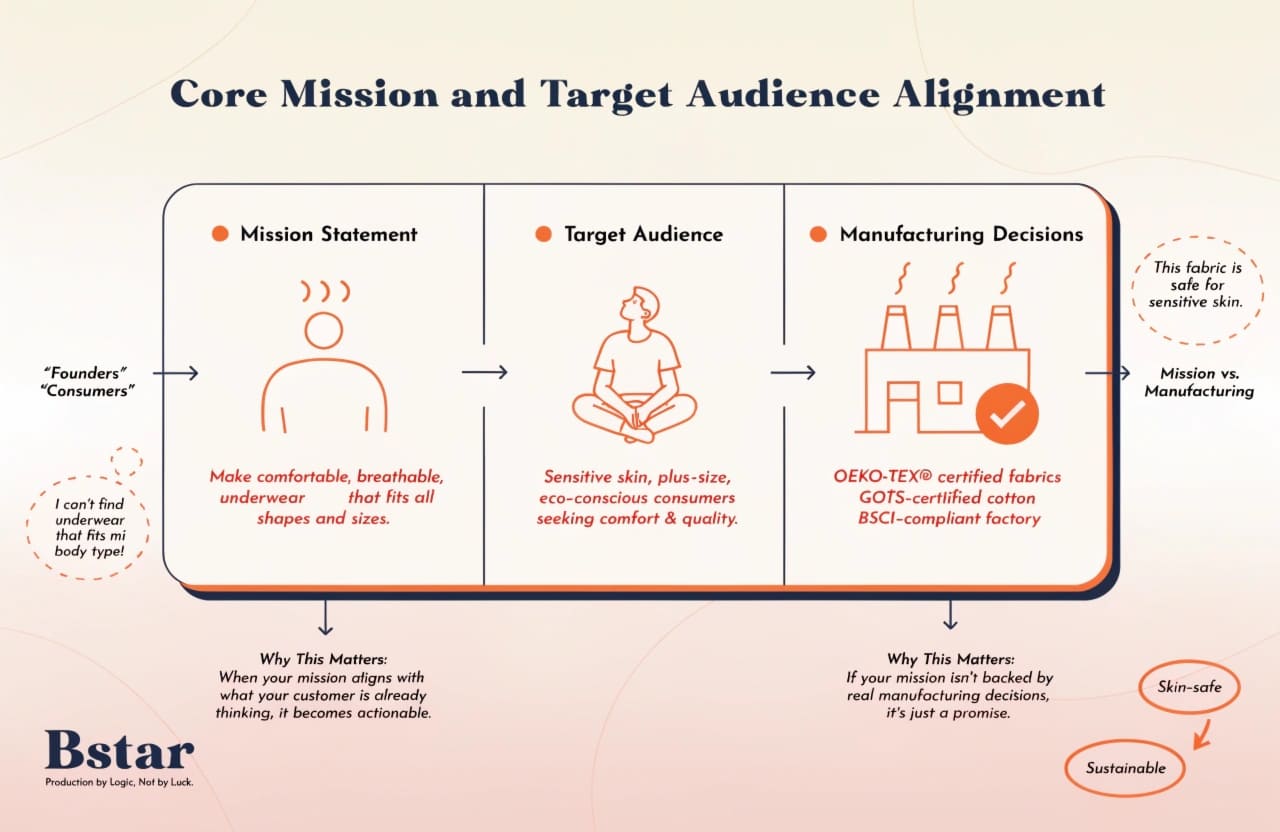
Here is what we see repeatedly when working with early-stage underwear founders. The founder has a genuine personal story — maybe they could never find underwear that fit well, or they wanted to stop buying cheap synthetics that irritated their skin. That story has energy. But the mistake is treating it as the whole story rather than the entry point to the real story.
The real story is what your customer experiences when they put on the product. Your mission has to point toward that experience — not toward the moment you had the idea.
Connecting Mission to Manufacturing Decisions
This is where things get practical. If your mission is built around skin-safe materials, you need a manufacturer whose raw materials are tested and certified for skin contact. If your mission is sustainability, you need documented evidence of sustainable sourcing — not just a claim on your website.
| Brand Position | What the Customer Needs to Believe | What You Need Behind It |
|---|---|---|
| Skin-safe / sensitive skin | Materials tested for skin contact | OEKO-TEX® certified fabrics |
| Sustainably made | Traceable, ethical sourcing | GOTS, GRS certified supply chain |
| Ethically manufactured | Fair labor conditions | BSCI audit documentation |
| Premium quality | Consistent construction standards | AQL-tested production process2 |
Your mission is not separate from these decisions. They are the same decision, made at the same time.
Highlighting Material Innovation: How Do You Talk About What Your Product Is Made Of?
"Made from premium materials" means nothing. Every brand says this. The question is whether you can say something specific — and whether you can back it up.
Material claims only build trust when they are verifiable. Certifications like OEKO-TEX®, GOTS, and GRS are not compliance paperwork — they are the proof that turns a vague product claim into a specific, trustworthy statement a buyer can act on3.
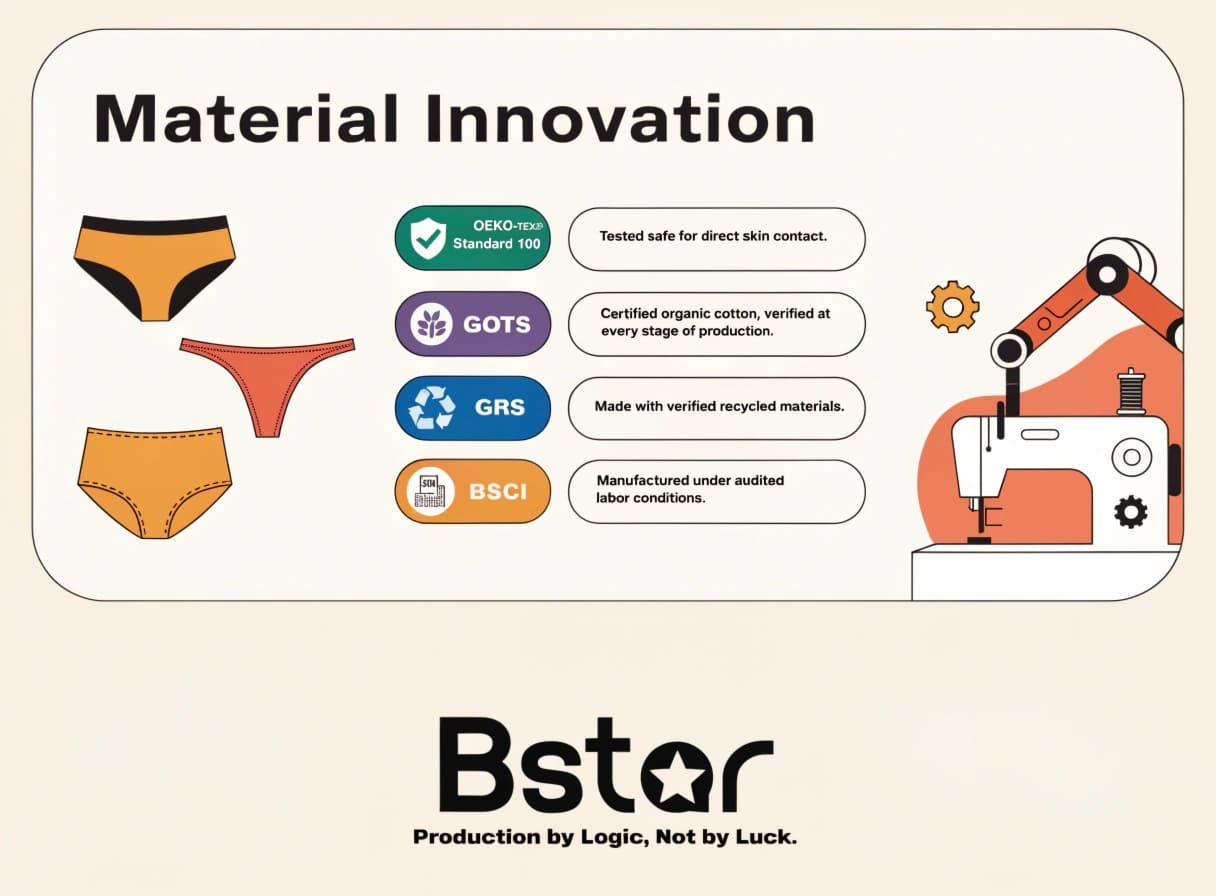
Here is what each certification actually makes claimable in your product copy and marketing:
What Certifications Actually Let You Say
OEKO-TEX® Standard 100 means every component of the fabric — dye, yarn, elastic, thread — has been tested against a list of harmful substances. What this lets you say: "Tested safe for direct skin contact." That is a specific claim. It is relevant to buyers with sensitive skin, parents shopping for children, and anyone who has ever had a reaction to cheap fabric. A competitor without this certification cannot make the same claim legitimately.
GOTS (Global Organic Textile Standard) covers the full chain of organic fibers from harvest through manufacturing. What it lets you say: "Certified organic cotton, verified at every stage of production." This is meaningful for the sustainability-positioned brand that wants to go beyond vague "eco-friendly" language.
GRS (Global Recycled Standard) applies to recycled content — recycled polyester, nylon, and similar materials. What it lets you say: "Made with verified recycled materials." This is the certification that separates brands genuinely using recycled content from brands using "recycled" as a marketing word.
BSCI is a labor audit standard. What it lets you say: "Manufactured under audited labor conditions." This matters to the growing segment of buyers who care about who made the product, not just what it is made of4.
The key point here is simple: the claims you can make about your product are determined by what your manufacturer can document. Choosing a manufacturer with this certification infrastructure is not a compliance decision — it is a content and marketing decision.
Crafting Authentic Emotional Connections: What Makes Buyers Actually Trust You?
The word "authentic" gets used so much in brand writing that it has almost lost meaning. So let me say it differently. Buyers of underwear — especially direct-to-consumer buyers paying a premium — are making a trust decision5. They are going to wear this product against their skin every day. They want to feel confident in that choice.
Trust in an underwear brand is built through three specific sources: visible proof of material safety, evidence of consistent product quality, and recognition that the brand understands the buyer’s life and body. Founder stories can open a door, but one of these three needs to be waiting on the other side.
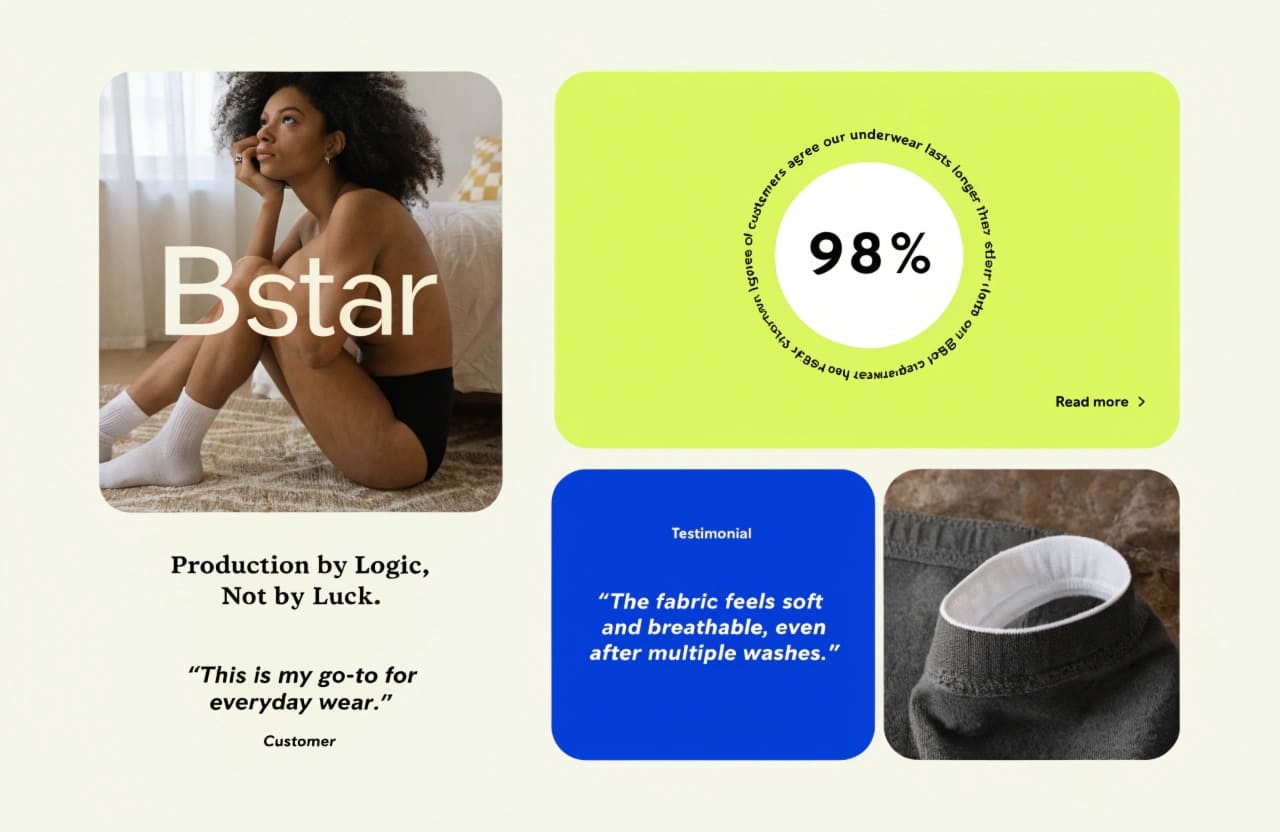
Founder stories work best when they are specific and when they point directly to a consumer problem6. "I was frustrated with waistbands that rolled down" is a better story than "I wanted to build a better underwear brand" — because the first one makes the buyer think yes, that happens to me too.
From Founder Story to Customer Evidence
The founder story gets a buyer’s attention. Customer evidence keeps them. This is where testimonials, reviews, and repeat purchase behavior become narrative assets — not just social proof widgets on a product page.
We have seen this work well with brands that do the following:
- Lead with a specific material or fit claim tied to a real certification
- Back it with early customer language that mirrors that same claim
- Use both together across product pages, email, and packaging
The brands that struggle are the ones that lead with inspiration ("we believe everyone deserves to feel confident") without ever connecting that to something the buyer can verify. Inspiration without evidence is just noise.
Maintaining Consistent Brand Voice: How Do You Keep the Story from Falling Apart Across Channels?
A lot of underwear brands launch with a clear story on their website and then drift. The packaging sounds different from the emails. The social content feels like it belongs to a different brand7. The product inserts have nothing to do with the About page.
Consistency is not about using the same words everywhere. It is about making sure every customer touchpoint reflects the same core claim — whether that claim is about comfort, sustainability, ethics, or fit. When the touchpoints contradict each other, buyers notice, even if they cannot articulate why.
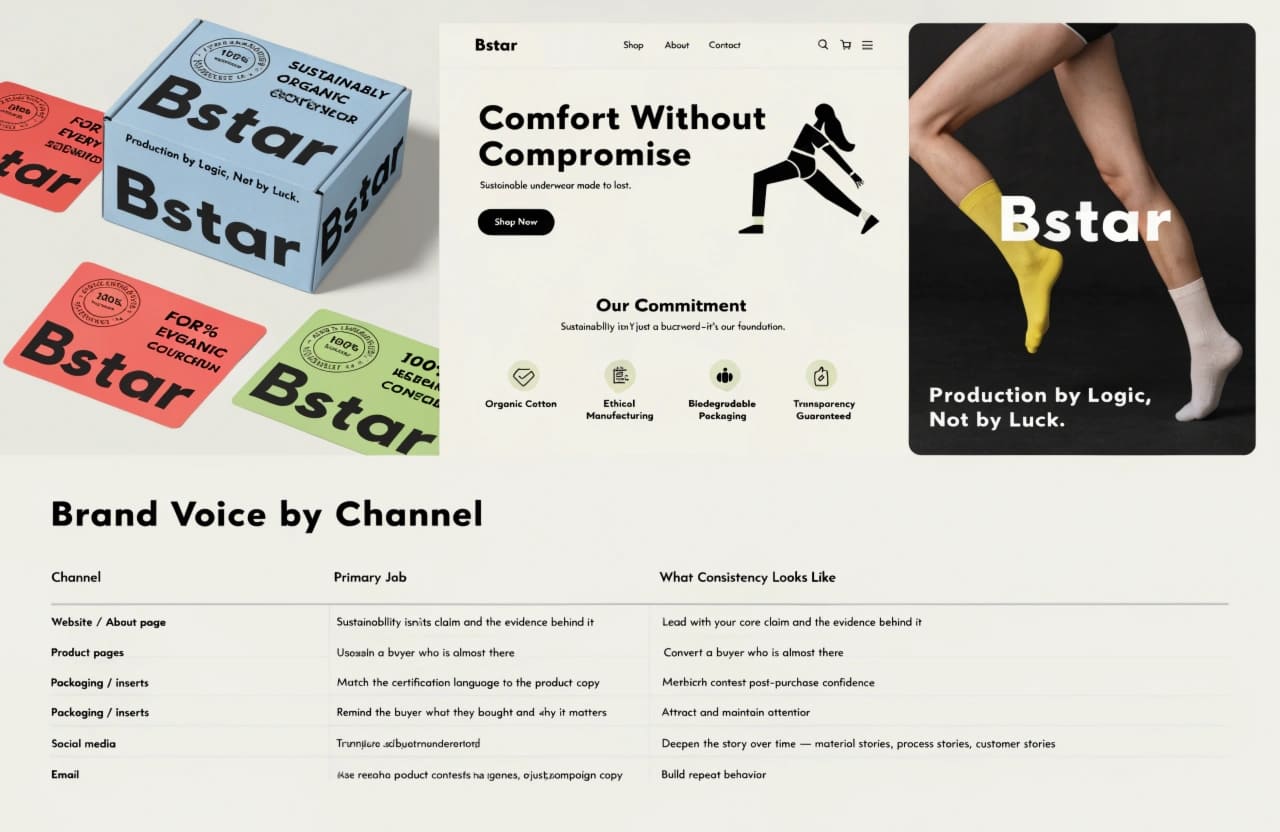
Here is a practical way to think about this. Every major channel has a job:
Brand Voice by Channel
| Channel | Primary Job | What Consistency Looks Like |
|---|---|---|
| Website / About page | Establish credibility and mission | Lead with your core claim and the evidence behind it |
| Product pages | Convert a buyer who is almost there | Match the certification language to the product copy |
| Packaging / inserts | Reinforce post-purchase confidence | Remind the buyer what they bought and why it matters |
| Social media | Attract and maintain attention | Use real product context and customer language, not just campaign copy |
| Build repeat behavior | Deepen the story over time — material stories, process stories, customer stories |
The drift usually happens because different people are writing for different channels without a shared reference document. The fix is not complicated — it is having a one-page brand brief that states: here is our core claim, here is the evidence behind it, here is how we talk about it8. Every writer, every designer, every channel owner works from the same document.
The brands we have worked with that execute this well — including those who have gone through multiple seasons of production with us — are the ones who built this brief before they briefed the factory. They knew what they needed to claim before they placed their first order.
Conclusion
Your underwear brand story starts with your sourcing decisions, not your marketing copy. Get the manufacturing foundation right first, and the narrative follows from real evidence.
-
"How perceived sustainability influences consumers’ clothing … – PMC", https://pmc.ncbi.nlm.nih.gov/articles/PMC11576948/. Market research in the intimate apparel sector, including reports from Euromonitor International and the Sustainable Apparel Coalition, identifies comfort and skin compatibility as primary purchase drivers, with sustainability and inclusive sizing emerging as increasingly significant factors among younger consumer segments. Evidence role: statistic; source type: research. Supports: That skin comfort, sustainability, and body image are documented consumer motivations in the intimate apparel purchasing category. Scope note: The relative weighting of these factors varies by consumer demographic, price tier, and geography; the article’s framing implies universal applicability, which market data does not fully support. ↩
-
"[PDF] ISO 2859-1 – UNT Chemistry", https://chemistry.unt.edu/~tgolden/courses/iso2859-1.pdf. Acceptable Quality Limit (AQL) inspection is a statistical sampling method standardized under ISO 2859-1, widely used in garment and textile manufacturing to determine whether a production batch meets a pre-agreed defect tolerance threshold without inspecting every unit. Evidence role: definition; source type: institution. Supports: That AQL is a statistically based sampling inspection methodology used in manufacturing to define the maximum acceptable number of defective units in a production lot. Scope note: AQL inspection identifies defect rates within sampled lots but does not guarantee zero defects in uninspected units; its effectiveness depends on the agreed AQL level and the rigor of the inspection protocol applied. ↩
-
"[PDF] Green Trust Perceptions of Eco-labels – My ASP.NET Application", https://purls.library.ucf.edu/go/DP0023084. Research on eco-label effectiveness, including meta-analyses published in the Journal of Consumer Psychology and studies by the European Environment Agency, finds that third-party certified labels generally increase consumer confidence in environmental and safety claims compared to self-declared brand statements, though the effect size varies with consumer familiarity with the specific label. Evidence role: mechanism; source type: paper. Supports: That third-party eco-labels and certifications increase consumer trust in product claims and positively influence purchase intention. Scope note: Consumer recognition of specific textile certifications such as OEKO-TEX® and GOTS varies considerably by market and demographic; the trust benefit described in the article may be limited in markets where these labels are not widely recognized. ↩
-
"[PDF] Ethical Fashion and Its Effects on Consumer Buying Behavior", https://docs.lib.purdue.edu/cgi/viewcontent.cgi?article=1016&context=hhstheses. Multiple consumer surveys, including those conducted by McKinsey & Company and the Fashion Revolution Transparency Index, have documented increasing consumer interest in supply chain ethics, though the proportion willing to pay a premium for ethically made goods varies significantly by demographic and market. Evidence role: statistic; source type: research. Supports: That a measurable and growing share of apparel consumers consider ethical manufacturing or labor conditions when making purchase decisions. Scope note: Stated consumer preferences in surveys frequently overestimate actual purchasing behavior; the gap between expressed values and purchase decisions is well-documented in behavioral economics literature. ↩
-
"the impact of consumer trust, perceived risk … – Academia.edu", https://www.academia.edu/35957812/THE_IMPACT_OF_CONSUMER_TRUST_PERCEIVED_RISK_PERCEIVED_BENEFIT_ON_PURCHASE_INTENTION_AND_PURCHASE_DECISION. Research in consumer behavior consistently identifies perceived trust — encompassing product safety, brand credibility, and value alignment — as a significant antecedent of purchase intention, with the effect amplified for products involving physical intimacy or health considerations. Evidence role: mechanism; source type: paper. Supports: That consumer trust is a primary driver of purchase intention, particularly for products with high skin contact or personal relevance. Scope note: This citation provides general support for the trust-purchase relationship; direct empirical research specifically on intimate apparel purchase decisions is limited and the article’s claim is an extrapolation from broader consumer psychology findings. ↩
-
"The role of storytelling in the creation of brand love: the PANDORA …", https://pmc.ncbi.nlm.nih.gov/articles/PMC8494506/. Research in narrative persuasion, including work by Green and Brock on transportation theory, suggests that concrete, relatable narratives produce stronger identification and attitude change than abstract messaging, supporting the claim that problem-specific founder stories are more persuasive than general vision statements. Evidence role: mechanism; source type: paper. Supports: That narrative specificity and problem-relevance increase consumer engagement and persuasive impact compared to abstract or aspirational brand messaging. Scope note: The cited research addresses narrative persuasion broadly; direct experimental evidence comparing founder story formats in e-commerce contexts is limited, making this a theoretical extrapolation rather than direct proof. ↩
-
"How can perceived consistency in marketing communications …", https://www.sciencedirect.com/science/article/abs/pii/S0263237319301057. Marketing research on brand consistency, including studies published in the Journal of Marketing and reports from the Lucidpress Brand Consistency Report, indicates that inconsistent brand presentation across channels reduces consumer trust and brand recognition, with consistent brands reported to see significantly higher revenue growth. Evidence role: general_support; source type: research. Supports: That inconsistency in brand communication across channels negatively affects consumer perception and brand equity. Scope note: Industry reports on brand consistency are often produced by vendors with a commercial interest in the finding; the specific revenue figures cited in such reports should be treated as indicative rather than rigorously validated. ↩
-
"Building Brand Consistency Across Channels", https://marketingcommunications.wvu.edu/professional-development/marketing-communications-today/marketing-communications-today-blog/2025/02/12/building-brand-consistency-across-channels. Organizational communication research and brand management literature, including frameworks developed by the American Marketing Association, support the use of centralized brand documentation as a mechanism for reducing cross-channel inconsistency, particularly in organizations where multiple contributors produce customer-facing content. Evidence role: general_support; source type: research. Supports: That documented brand guidelines or briefs improve consistency of brand communication across teams and channels. Scope note: The specific format of a ‘one-page brief’ is the author’s practical recommendation rather than a finding from controlled research; the evidence supports the principle of documented brand standards rather than any particular document format. ↩
Discussion & questions 0 comments