
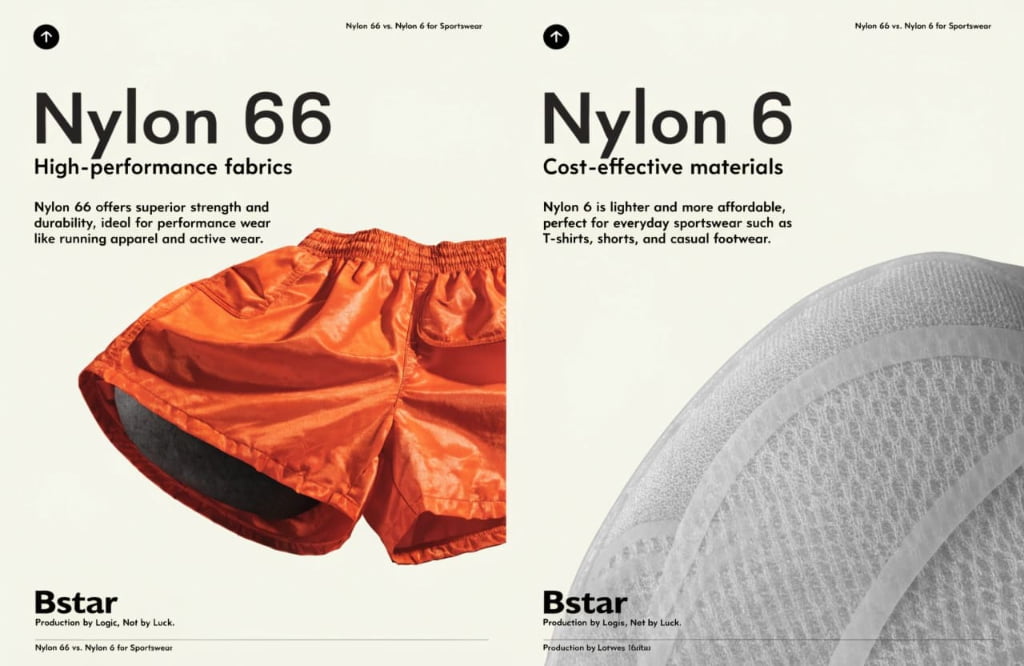
Nylon 66 vs. Nylon 6 for Sportswear: Which One Actually Fits Your Product?
If you’ve spent time sourcing activewear fabrics, you’ve probably run into this exact moment of confusion—Nylon 66 or Nylon 6? One number apart, wildly different price quotes, and somehow everyone online seems to have a different answer.
Nylon 66 and Nylon 6 are both strong, stretch-friendly, and widely used in sportswear—but they serve different product categories. Nylon 66 performs better under high mechanical stress, while Nylon 6 delivers softer hand-feel and richer color at a lower cost. The right choice depends on your garment type, not the number’s perceived prestige.
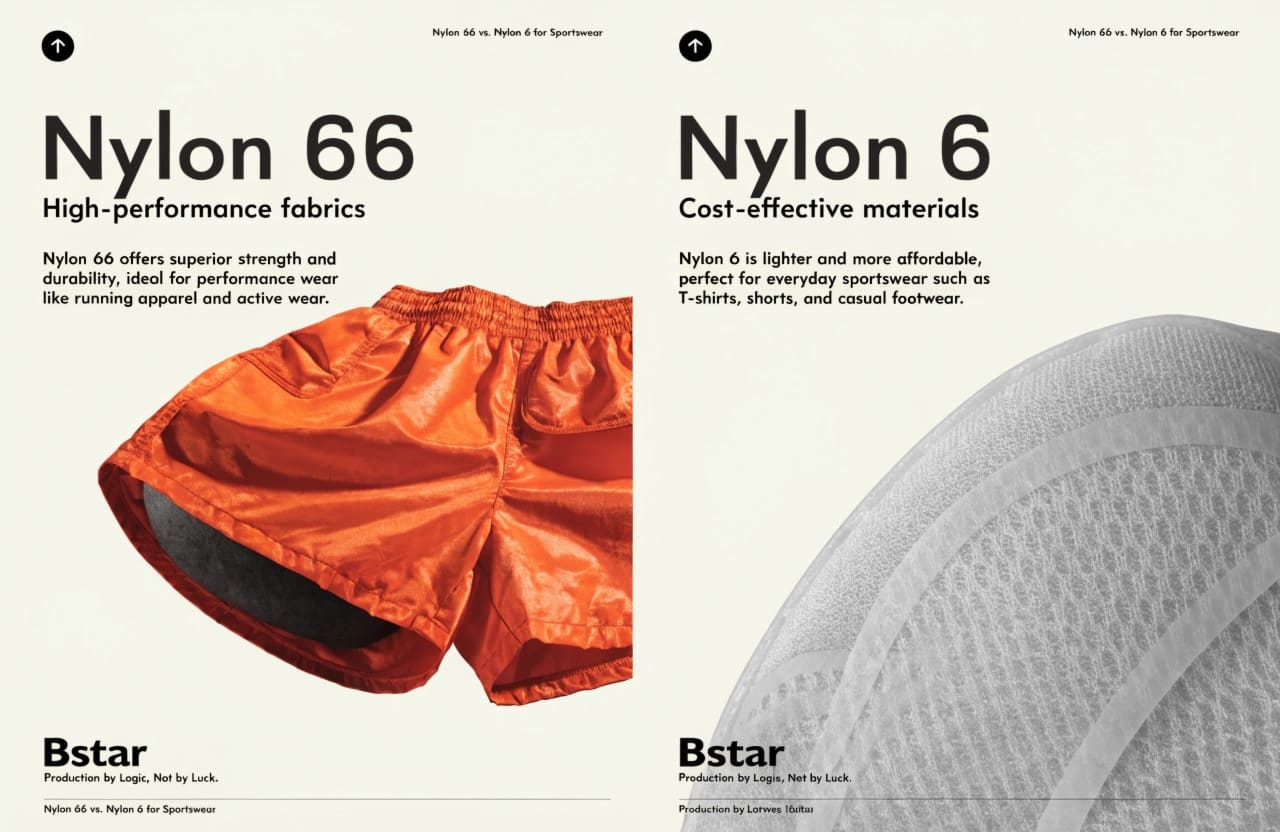
We’ve had this conversation with dozens of DTC brand founders and sourcing managers over the years. The same pattern shows up repeatedly: a buyer requests Nylon 66 because it sounds more technical, gets a higher quote, and then wonders why the final product doesn’t feel meaningfully different from what they had before. This article is here to break that cycle. Let’s go section by section.
Does the Molecular Structure of Nylon 66 Actually Give You Better Performance in a Garment?
Most sourcing guides lead with a table of polymer properties. Melting points, crystallinity percentages, tensile modulus figures. But here’s the honest truth—none of that data tells you whether your customer will return the legging or keep wearing it for two years.
Nylon 66 has a higher melting point, slightly greater stiffness, and marginally better abrasion resistance than Nylon 6. These differences exist at the molecular level and they do translate into real garment performance—but only in specific, high-stress applications where those properties are actually being tested.
Here’s how I think about this when a client brings me a spec sheet.
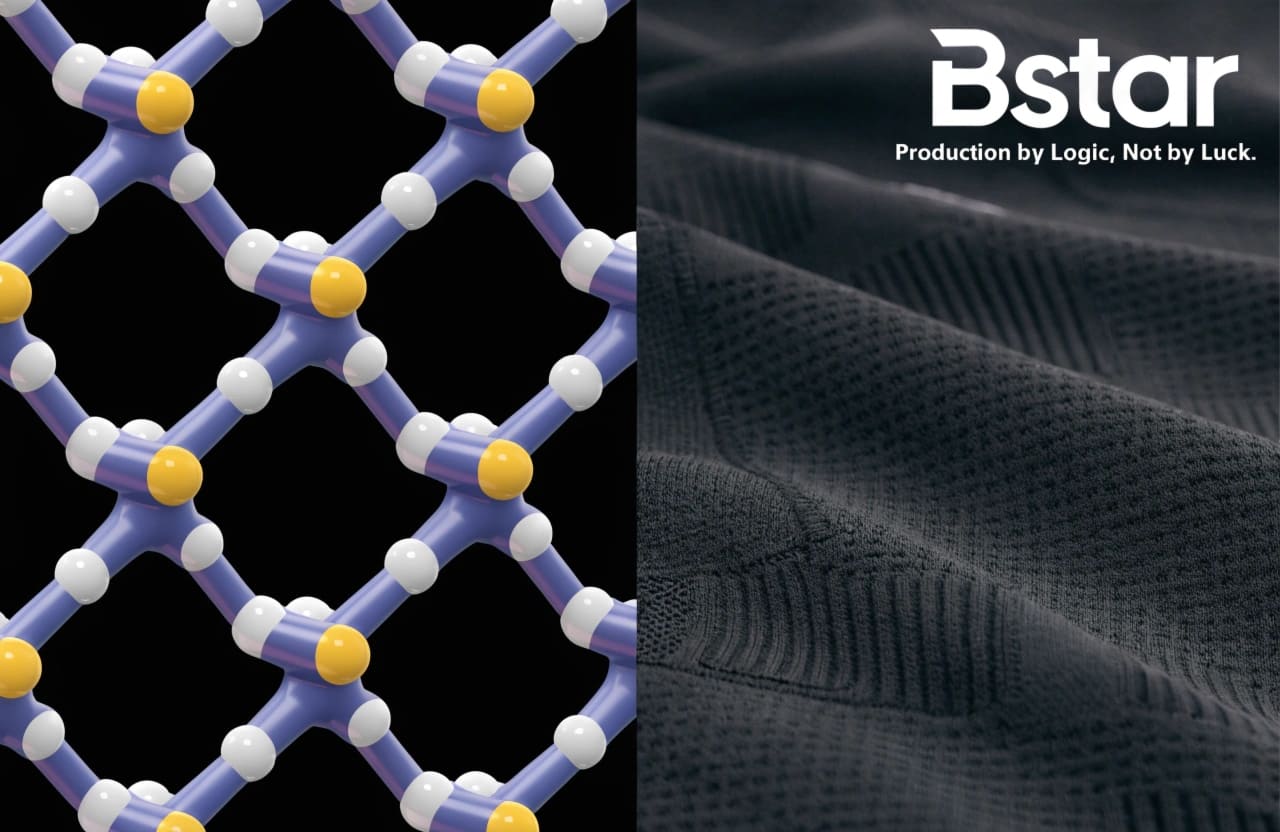
The structural difference between Nylon 66 and Nylon 6 comes down to how their polymer chains are arranged. Nylon 66 has a more symmetrical, tightly packed chain structure, which gives it higher crystallinity. That higher crystallinity is what drives its better abrasion resistance and dimensional stability under heat and stress.
In practical garment terms, this matters most in three scenarios:
| Application | Why Nylon 66 Helps | Why It Might Not Matter |
|---|---|---|
| Performance compression tights | High friction against skin during long runs | Not relevant for low-impact yoga wear |
| Swim bottoms | Chlorine and UV exposure, repeated stress | Overkill for casual beach cover-ups |
| Cycling shorts | Pad interface, constant mechanical friction | Less critical for leisure cycling wear |
| Athleisure tops | Rarely under enough stress to show difference | Nylon 6 is often the better call here |
When clients come to us asking for Nylon 66, the first thing we ask is: where on the body does this garment sit, and how hard is your customer working in it? If the answer is "high-impact, high-friction, worn repeatedly by athletes," then yes, the structural benefits of Nylon 66 are worth the cost. If the answer is "yoga studio two times a week," then you’re paying a premium for a property your customer will never stress-test.
Does Nylon 6 Actually Feel Better on Skin—And Does That Matter for Your Brand?
This is the section that surprises most buyers when we first bring it up. The softer material is not the premium one. Or at least, that’s the assumption worth questioning.
Nylon 6 produces a noticeably softer, silkier hand-feel compared to Nylon 66. It also absorbs dye more readily, which means richer, more saturated colors and better consistency across dye lots. For fashion-forward activewear and athleisure brands, these two properties alone can make Nylon 6 the stronger commercial choice.
In our experience working with DTC brands that sit in the athleisure and lifestyle sportswear space, the end customer’s first interaction with the product is tactile. They open the package, touch the fabric, and make a judgment call in the first few seconds. Nylon 6’s softer surface texture scores well in that moment.
The dye uptake point is equally important for product strategy. Nylon 6’s less crystalline structure allows dye molecules to penetrate more deeply and evenly. The result is more vibrant colors, cleaner color matching across production runs, and fewer color inconsistency complaints—which is a real issue for brands running seasonal collections.
Here’s how this breaks down by brand type:
| Brand Type | Recommended Material | Primary Reason |
|---|---|---|
| Fashion-forward athleisure | Nylon 6 | Softer feel, better color pop |
| Yoga and low-impact activewear | Nylon 6 | Comfort and flexibility priority |
| High-performance run/cycle gear | Nylon 66 | Durability under mechanical stress |
| Budget-tier fashion sportswear | Nylon 6 | Cost efficiency without quality loss |
| Premium compression wear | Nylon 66 | Structural support and longevity |
The takeaway here is simple. If your brand identity is built around how the product feels—and how good it looks in product photography and on the body—Nylon 6 is not a downgrade. It is the right tool for that job.
How Do These Two Materials Handle Sweat and Heat During an Actual Workout?
Moisture management is where most sportswear buyers start their material conversation. And it’s a fair starting point—nobody wants a garment that traps sweat or overheats during exercise.
Nylon 66’s higher thermal conductivity gives it a slight edge in dissipating body heat during intense activity. Nylon 6, while slightly less conductive, still performs well in moisture-wicking applications when knitted into the right fabric construction. For most activewear use cases, the construction of the knit matters more than the base polymer.
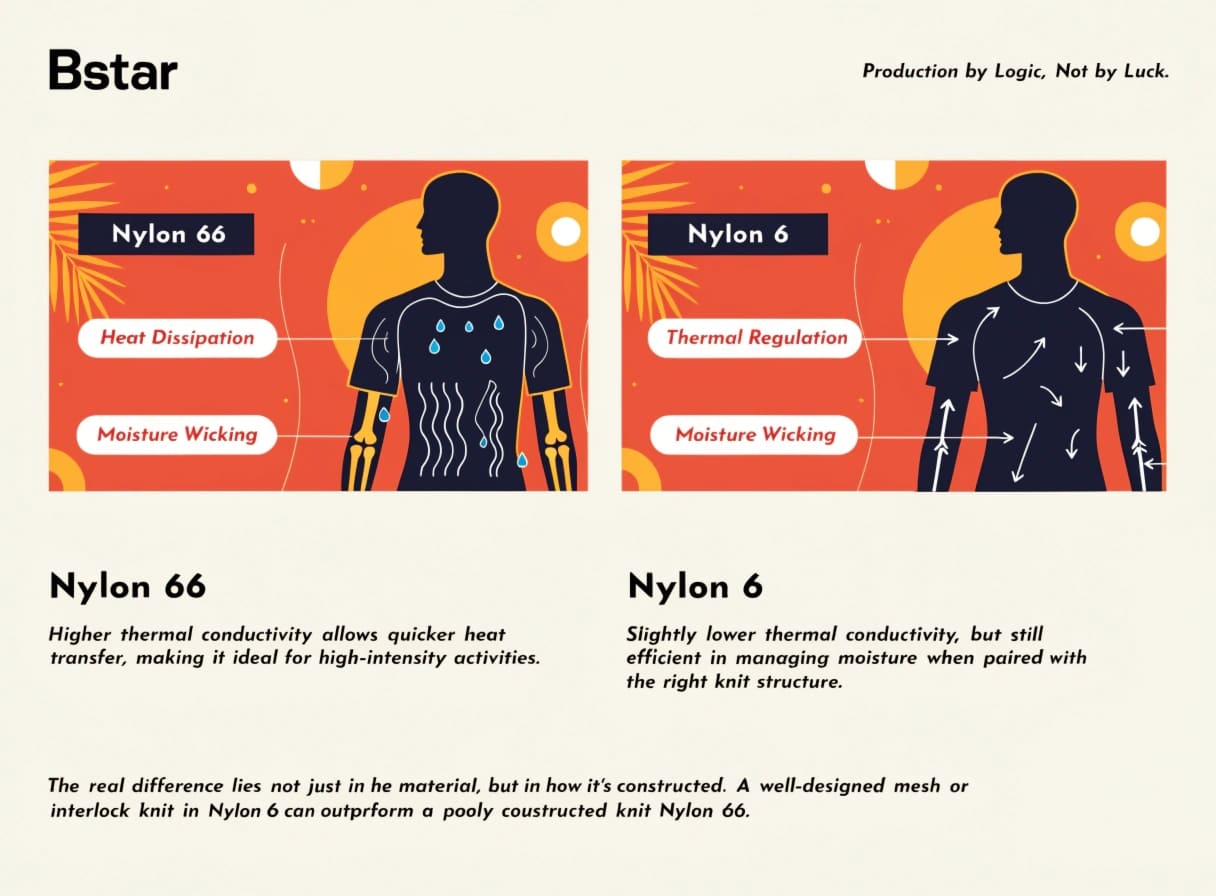
This is where I want to push back on a common sourcing instinct. Buyers sometimes try to solve moisture management purely through material selection—choosing Nylon 66 because it sounds more technical. But in our factory, the bigger lever is always the knit structure.
A well-designed mesh or interlock construction in Nylon 6 will outperform a poor knit construction in Nylon 66 every single time. Here’s why this matters for your brief:
What Actually Controls Moisture Management in a Knit Sportswear Garment
Fiber choice sets the baseline properties. Nylon 66 has a slight thermal advantage. Both nylons benefit significantly from spandex blending (typically 15–25%) for stretch and recovery.
Knit structure determines airflow and sweat channeling. Open-knit and mesh panels move moisture away from skin faster than dense jersey constructions—regardless of which nylon variant is used.
Finishing treatments such as moisture-wicking finishes or anti-odor treatments can be applied to either nylon variant and often close whatever performance gap exists between the two base materials.
So if a supplier is pitching you Nylon 66 as the automatic answer to your thermoregulation requirements, ask them to show you the knit structure alongside the material spec. That conversation will tell you much more.
Does Nylon 66 Cost More—And Is That Cost Justified for Your Margin?
This is the most direct question, and it deserves a direct answer.
Nylon 66 costs more than Nylon 6, typically by a meaningful margin at the yarn level. This cost difference flows through to fabric and finished goods pricing. For brands where Nylon 66’s specific performance properties are not being utilized, this premium represents margin waste without end-product benefit.
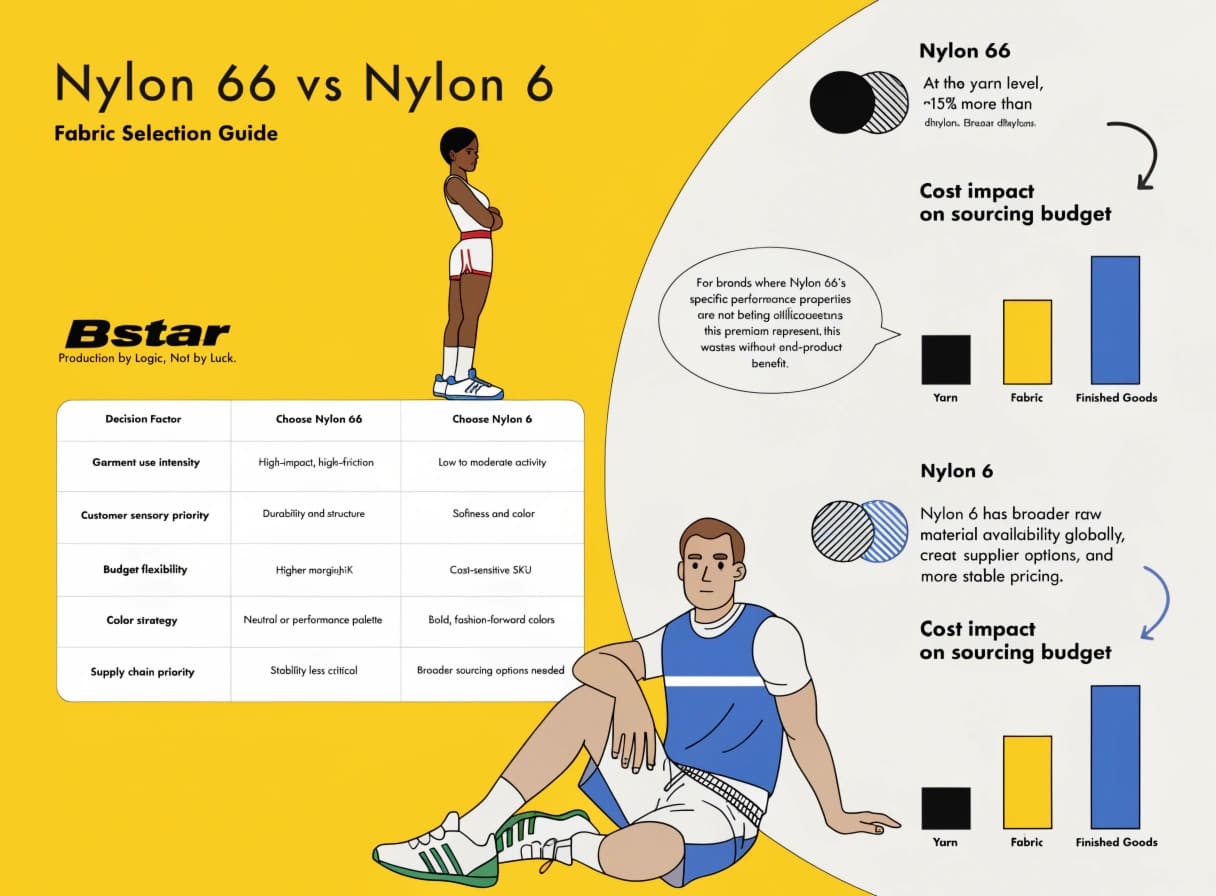
The supply chain reality is also worth understanding. Nylon 6 has broader raw material availability globally, more supplier options, and more stable pricing. Nylon 66 production is more concentrated, which can create lead time variability and tighter supply in certain seasons.
Here’s a simple decision framework we walk buyers through before finalizing a fabric spec:
Three Questions to Decide Between Nylon 66 and Nylon 6
1. What is the mechanical stress profile of this garment?
High friction, high compression, high-impact sport? Start with Nylon 66. Low-impact, lifestyle, fashion-forward? Start with Nylon 6.
2. What does your customer value most at first touch?
Softness, color richness, and feel? Nylon 6 wins. Technical performance credentials and durability? Nylon 66 earns its cost.
3. What is your target cost per unit, and where is your margin?
If your price point doesn’t support the Nylon 66 premium, the material spec will either erode your margin or force you to cut costs elsewhere. Neither outcome serves the product.
| Decision Factor | Choose Nylon 66 | Choose Nylon 6 |
|---|---|---|
| Garment use intensity | High-impact, high-friction | Low to moderate activity |
| Customer sensory priority | Durability and structure | Softness and color |
| Budget flexibility | Higher margin product | Cost-sensitive SKU |
| Color strategy | Neutral or performance palette | Bold, fashion-forward colors |
| Supply chain priority | Stability less critical | Broader sourcing options needed |
When a client comes to us with a brief that says "Nylon 66, premium quality"—with no further context—that’s usually a sign we need to have a longer conversation before anything goes into production.
Conclusion
Nylon 66 is not better than Nylon 6. Nylon 6 is not a budget shortcut. They are different tools. Match the tool to your product category, your customer’s priorities, and your margin structure—and you’ll brief your manufacturer with confidence.
Discussion & questions 0 comments